
My Last Duchess Robert Browning 1845 What is
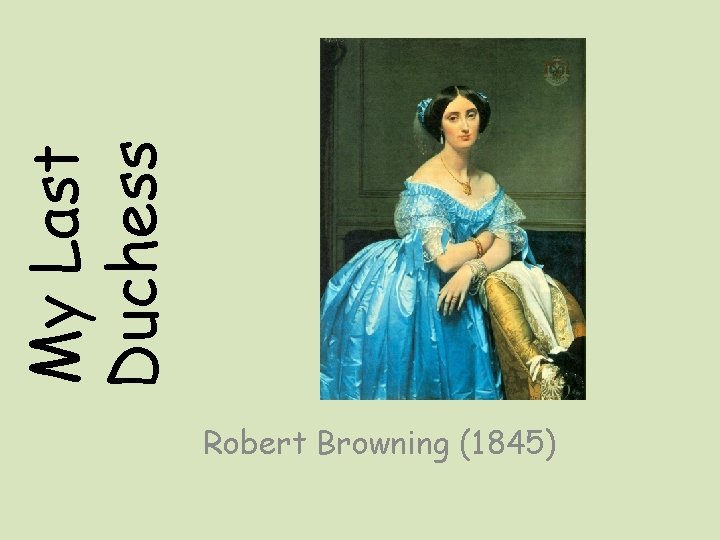
My Last Duchess Robert Browning (1845)
What is it about? Based on the life of Alfonso II, Duke of Ferreira, Italy The Duke’s first wife died in 1561 after 3 years of marriage We learn about the Duke by what he says about her and how he says it. We also learn about their relationship; what was expected; how she responded.
What is the poem about? The poem is a dramatic monologue. This means the poem is written in the voice of a character, a male narrator - an imaginary Italian Duke. When? Browning wrote the poem in 1842. However, it seems likely that his idea for the poem was based on Alfonso II, Duke of Ferrara, whose first wife died after three years of marriage in 1561. The subject matter of the poem – the ‘marriage market’ - would have ensured that the poem was topical in 1850 s Britain. What? The Duke now wants to marry the Count’s daughter. He is discussing this with the Count’s representative. As he does so, he shows his guest around his palace. During the conversation and tour, he reveals a portrait of his previous wife – his ‘last duchess’.
The Duchess • There a number of word sets and / or phrases within the poem. Work in small groups to collate evidence linked to the following areas: The Duchess’ beauty: There is considerable evidence within the poem to suggest that the Duchess was beautiful, and that the Duke loved and admired her for this. The Duchess - alive or dead: The poem is extremely ambiguous about the Duchess’ fate. Is she alive or dead? Consider the tense of verbs at certain points in the poem. The Duchess as art: Calder and Goodman have stated: “ … the Duchess’s translation into valuable ‘art’ confirms her status as a possessed ‘object’. ” This will also link to: Looking: There are many references to, or words associated with, looking. Uncertainty: The Duke reveals uncertainty - with regard to himself and his wife - on a number of occasions within the monologue.

Fra Pandolf The artist who painted the fresco of the Duchess was called Fra Pandolf. The Duke seems particularly jealous and angered by the possible relationship that developed between the artist and the Duchess. What is the Duke’s attitude to Fra Pandolf? Look at: lines 3 – 4; lines 5 – 7; lines 15 – 21. “ … This grew; I gave commands; / Then all smiles stopped together. ”
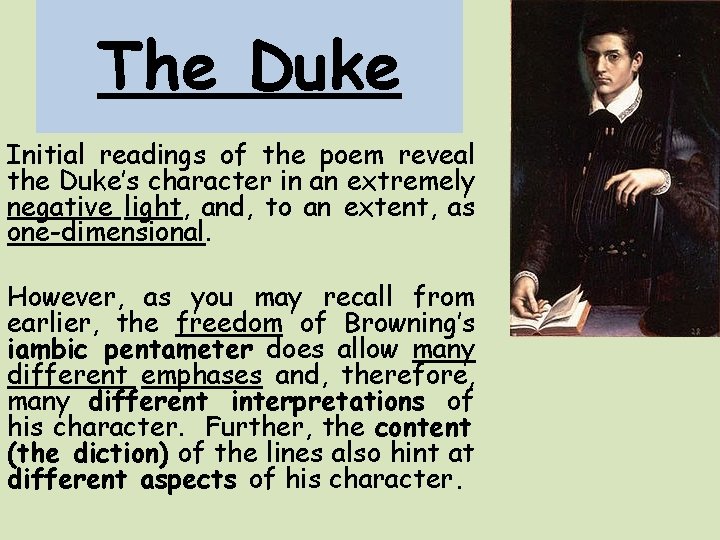
The Duke Initial readings of the poem reveal the Duke’s character in an extremely negative light, and, to an extent, as one-dimensional. However, as you may recall from earlier, the freedom of Browning’s iambic pentameter does allow many different emphases and, therefore, many different interpretations of his character. Further, the content (the diction) of the lines also hint at different aspects of his character.
It’s all about me, me! “ …(since none puts by The curtain I have drawn for you, but I)” The above lines (9 – 10) rhyme perfectly. However, if the lines were grammatically perfect then line ten should end in ‘me’ rather than ‘I’. Why might Browning have chosen to do this? Look at the lines just before and after this section – as well as the rest of the poem.
So what’s the point? Read the statements below, decide which one you agree with most and find some evidence to support it! The Duke was jealous and angry about his wife’s relationship with the artist, Fra Pandolf, and therefore, he had her murdered. The Duke was jealous and angry about his wife’s relationship with the artist, Fra Pandolf, and therefore, he had them both murdered. The Duke loved his wife dearly. The Duke loathed his wife and resents even the memory of her. The Duke misses his wife. The Duke views his wife as an object, a piece of art, something he owns. The Duchess died and the Duke is still in mourning. The Duke is furious because the Duchess left him and ran away with the artist, Fra Pandolf. The Duke loves his wife but loathes the artist, Fra Pandolf.
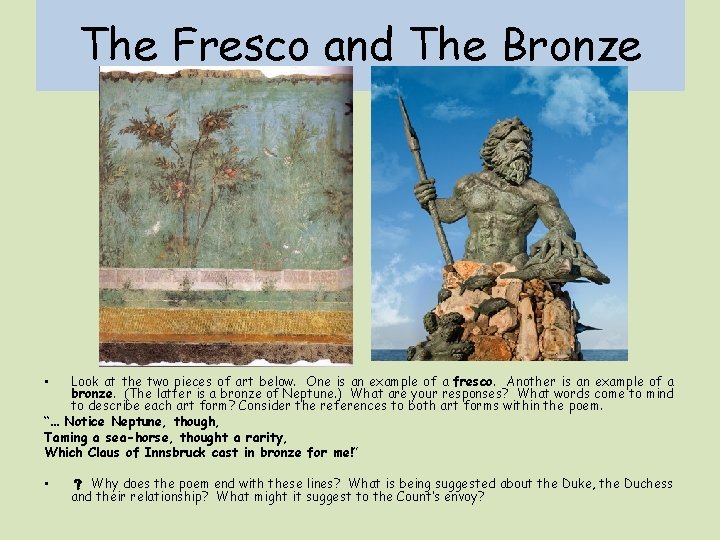
The Fresco and The Bronze Look at the two pieces of art below. One is an example of a fresco. Another is an example of a bronze. (The latter is a bronze of Neptune. ) What are your responses? What words come to mind to describe each art form? Consider the references to both art forms within the poem. “… Notice Neptune, though, Taming a sea-horse, thought a rarity, Which Claus of Innsbruck cast in bronze for me!” • • Why does the poem end with these lines? What is being suggested about the Duke, the Duchess and their relationship? What might it suggest to the Count’s envoy?
- Slides: 9