
MY FAVORITE FUNCTIONS OR Continuous from what to


![THEOREM. There is a continuous function from C onto [0, 1]. The points of](https://slidetodoc.com/presentation_image_h2/8d2914789e749fbd1a1115f2dc417be9/image-14.jpg "THEOREM. There is a continuous function from C onto [0, 1]. The points of")
![Theorem. There is a continuous function from [0, 1] onto the square. We’ll cheat](https://slidetodoc.com/presentation_image_h2/8d2914789e749fbd1a1115f2dc417be9/image-18.jpg "Theorem. There is a continuous function from [0, 1] onto the square. We’ll cheat")

- Slides: 30
MY FAVORITE FUNCTIONS OR Continuous from what to WHAT? !?
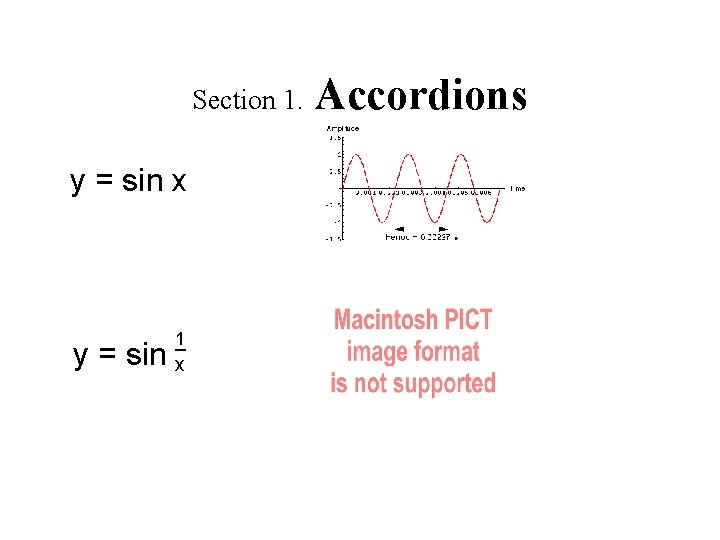
Section 1. y = sin x 1 _ y = sin x Accordions
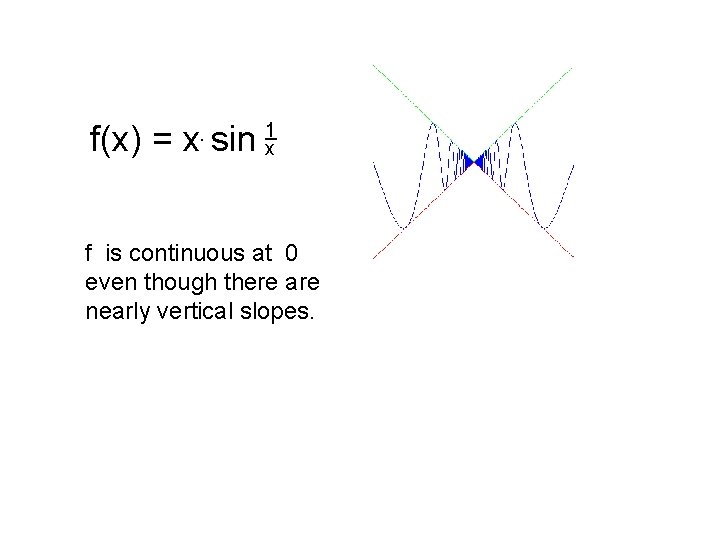
f(x) = x. sin 1 x f is continuous at 0 even though there are nearly vertical slopes.
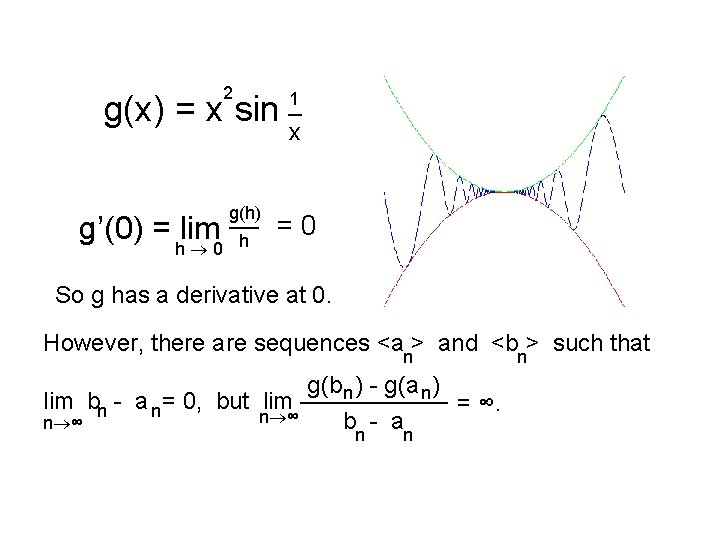
2 g(x) = x sin g(h) ___ h 0 h g’(0) = lim 1 _ x =0 So g has a derivative at 0. However, there are sequences <a > and <b > such that n g(b n ) - g(a n ) ______ lim bn - a n= 0, but lim = ∞. n ∞ b - a n ∞ n n n
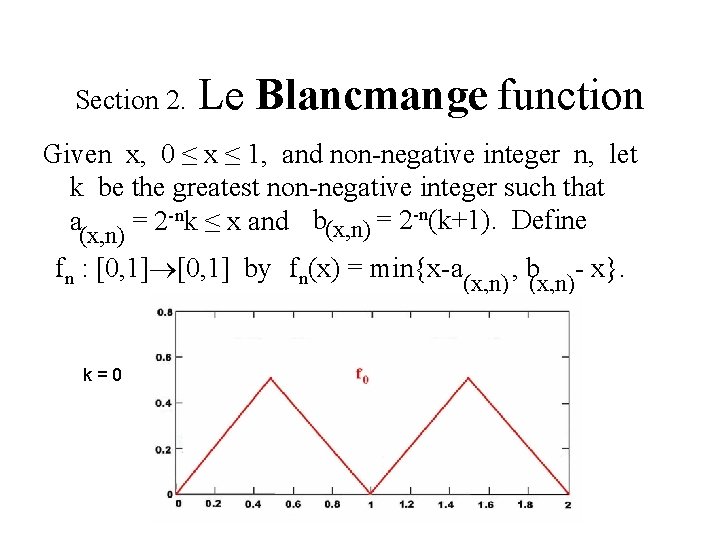
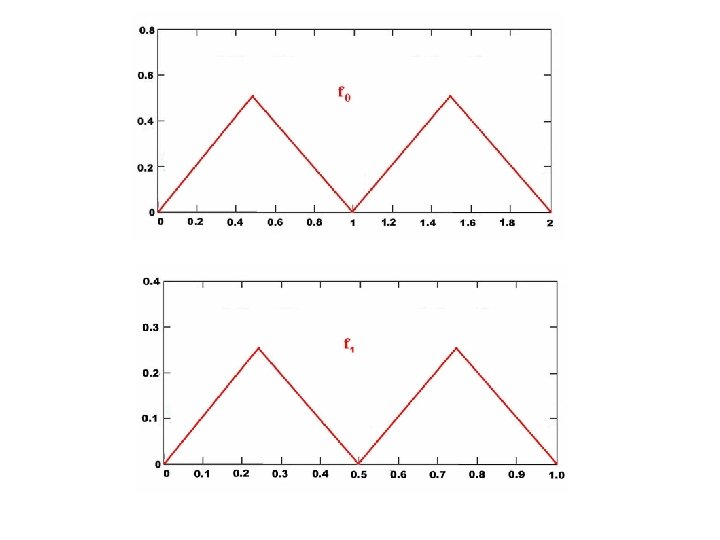
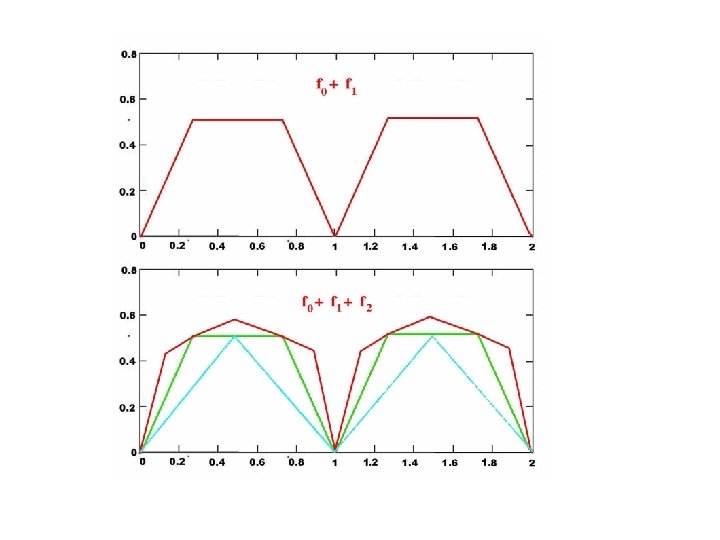
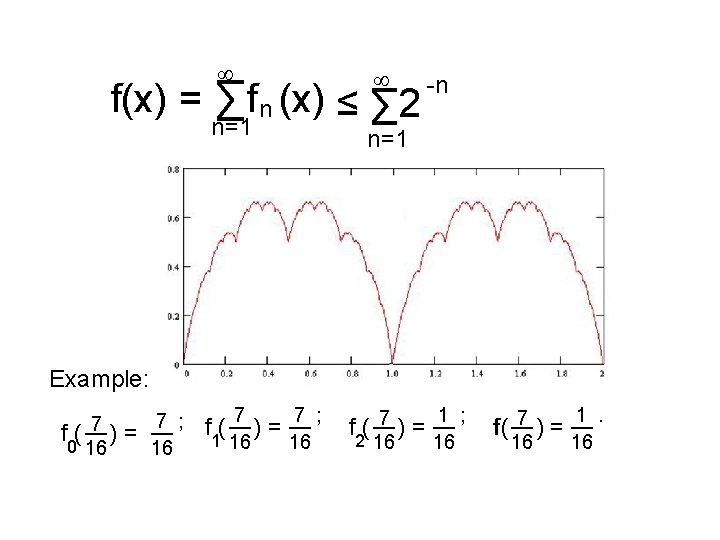
Section 2. Le Blancmange function Given x, 0 ≤ x ≤ 1, and non-negative integer n, let k be the greatest non-negative integer such that a = 2 -nk ≤ x and b(x, n) = 2 -n(k+1). Define (x, n) fn : [0, 1] by fn(x) = min{x-a k=0 , b - x}. (x, n)
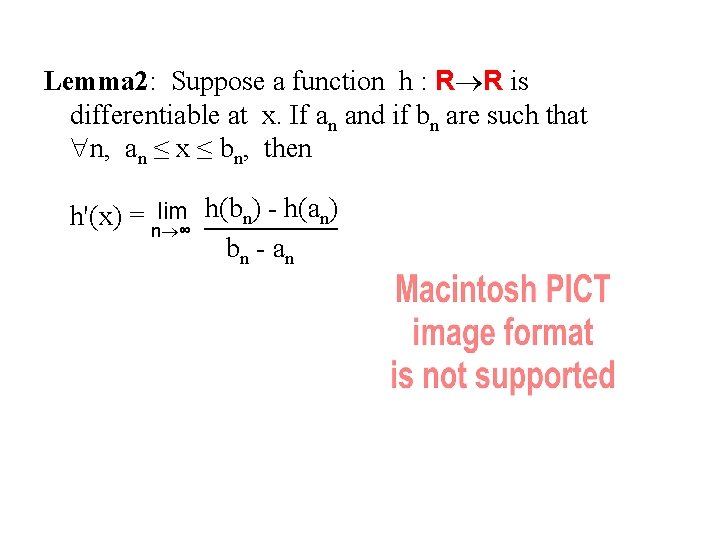
Lemma 2: Suppose a function h : R R is differentiable at x. If an and if bn are such that n, an ≤ x ≤ bn, then lim h(b n) - h(an) h'(x) = n ∞ _____ bn - an
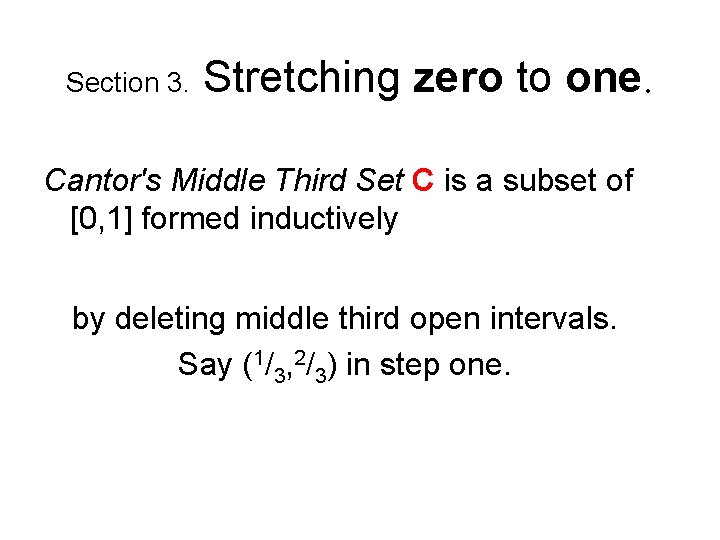
Section 3. Stretching zero to one. Cantor's Middle Third Set C is a subset of [0, 1] formed inductively by deleting middle third open intervals. Say (1/3, 2/3) in step one.
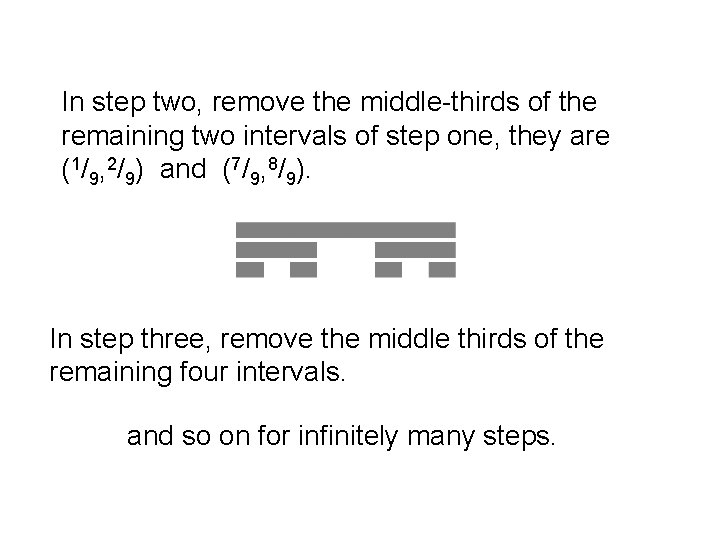
In step two, remove the middle-thirds of the remaining two intervals of step one, they are (1/9, 2/9) and (7/9, 8/9). In step three, remove the middle thirds of the remaining four intervals. and so on for infinitely many steps.
What we get is C, Cantor’s Middle Thirds Set. C is very “thin” and a “spread out” set whose measure is 0 (since the sum of the lengths of intervals remived from [0, 1] is 1. As [0, 1] is thick, the following is surprising:
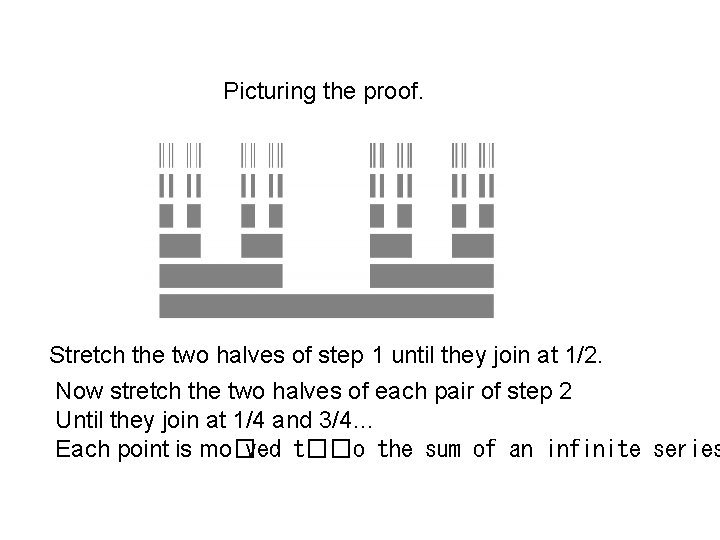
THEOREM. There is a continuous function from C onto [0, 1]. The points of C are the points equal to the sums of infinite series of form ¥ -n ∑ 2 s(n)3 n=1 where s(n) {0, 1}.
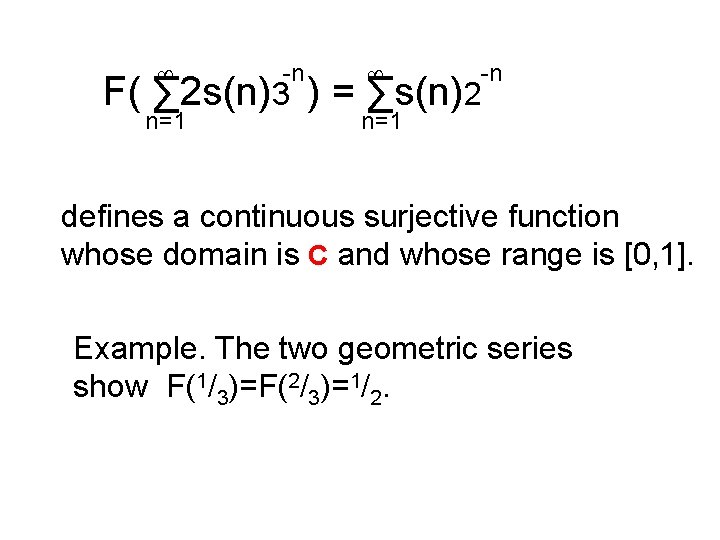
¥ -n F( ∑ 2 s(n)3 ) = ∑s(n)2 n=1 defines a continuous surjective function whose domain is C and whose range is [0, 1]. Example. The two geometric series show F(1/3)=F(2/3)=1/2.
Picturing the proof. Stretch the two halves of step 1 until they join at 1/2. Now stretch the two halves of each pair of step 2 Until they join at 1/4 and 3/4… Each point is mo�ved t��o the sum of an infinite series
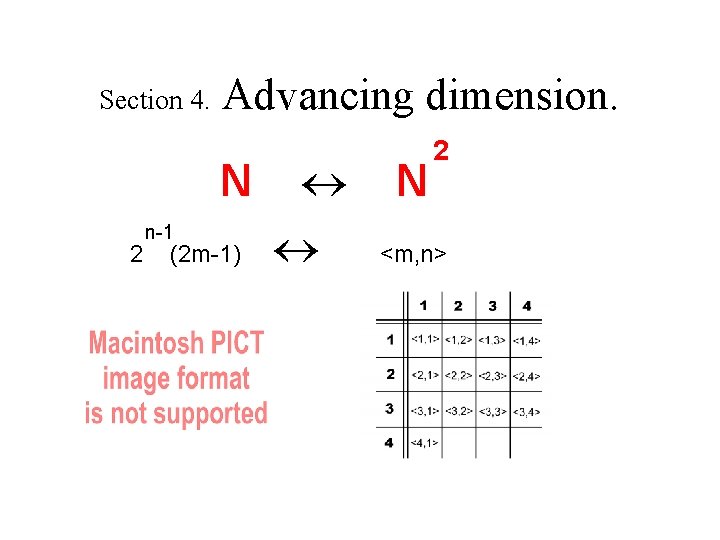
Section 4. Advancing dimension. N 2 n-1 (2 m-1) N 2 <m, n>
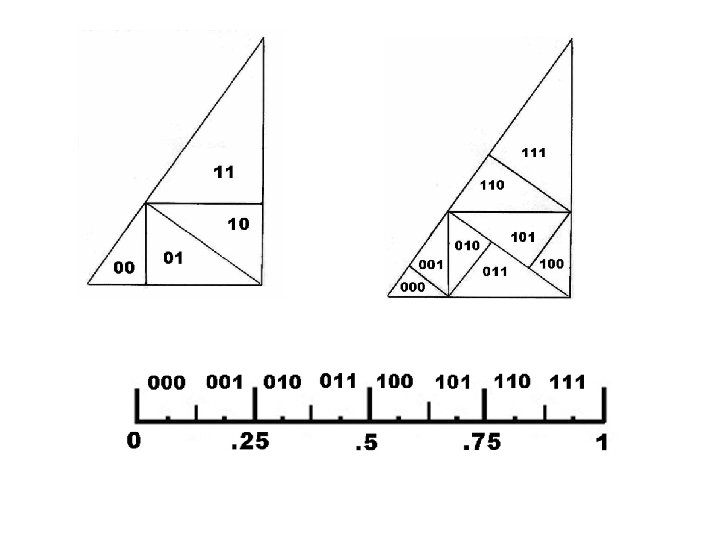
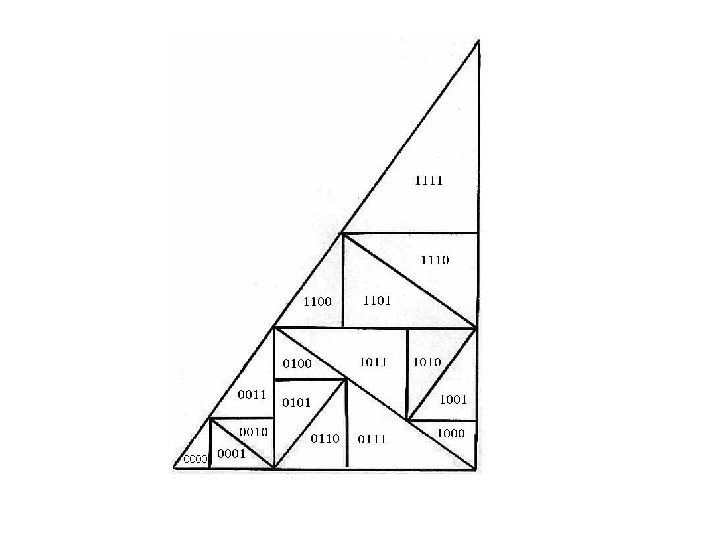
Theorem. There is a continuous function from [0, 1] onto the square. We’ll cheat and do it with the triangle.
Section 5. An addition for the irrationals By an addition for those objects X [0, ∞) we mean a continuous function s : X´X X (write x+y instead of s(<x, y>)) such that for x+y the following three rules hold: (1). x+y = y+x (the commutative law) and (2). (x+y)+z = x+(y+z) (the associative law). With sets like Q, the set of positive rationals, the addition inherited from the reals R works, but with the set P of positive irratonals it does not work: (3+√ 2 )+(3 -√ 2) = 6.
THEOREM 5. The set P of positive irrationals has an addition. Our aim is to consider another object which has an addition And also “looks like” P. Continued fraction
Given an irrational x, the sequence <an> is computed as follows: Let G(x) denote the greatest integer ≤ x. Let a 0 = G(x). If a 0, , , an have been found as below, let an+1 = G(1/r).
Continuing in this fashion we get a sequence which converges to x. Often the result is denoted by However, here we denote it by CF(x) = < a 0, a 1, a 2, a 3, …>.
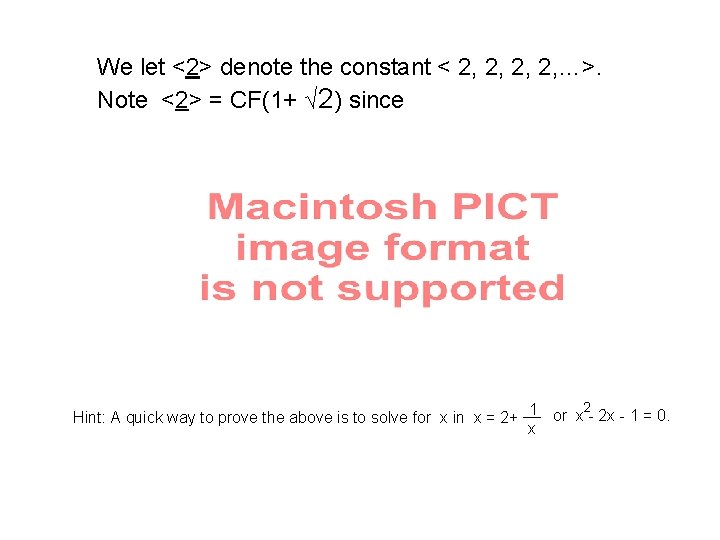
We let <2> denote the constant < 2, 2, …>. Note <2> = CF(1+ √ 2) since 1 or x 2 - 2 x - 1 = 0. Hint: A quick way to prove the above is to solve for x in x = 2+ __ x
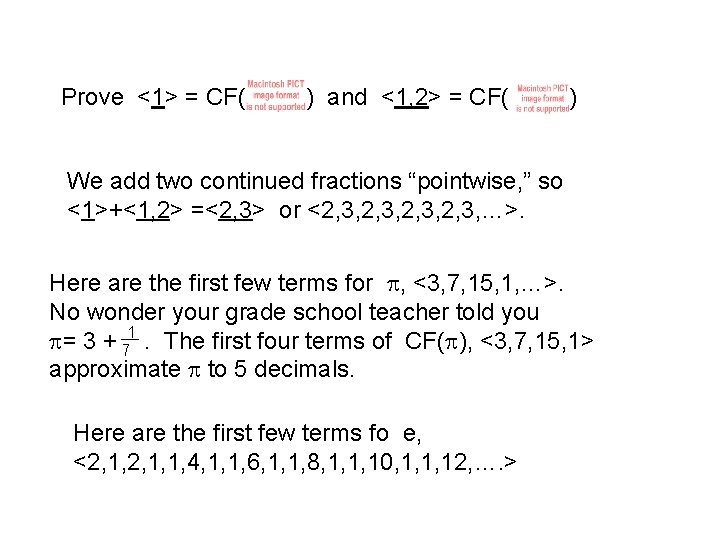
Prove <1> = CF( ) and <1, 2> = CF( ) We add two continued fractions “pointwise, ” so <1>+<1, 2> =<2, 3> or <2, 3, …>. Here are the first few terms for , <3, 7, 15, 1, …>. No wonder your grade school teacher told you 1 = 3 + __ 7. The first four terms of CF( ), <3, 7, 15, 1> approximate to 5 decimals. Here are the first few terms fo e, <2, 1, 1, 4, 1, 1, 6, 1, 1, 8, 1, 1, 10, 1, 1, 12, …. >
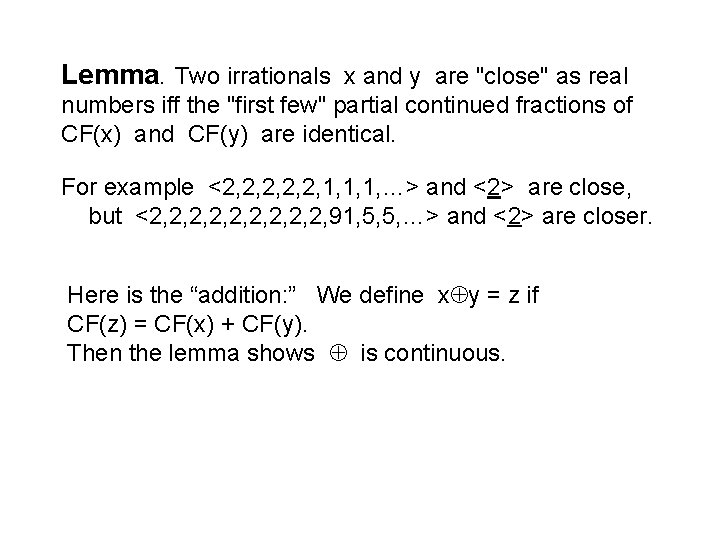
Lemma. Two irrationals x and y are "close" as real numbers iff the "first few" partial continued fractions of CF(x) and CF(y) are identical. For example <2, 2, 2, 1, 1, 1, …> and <2> are close, but <2, 2, 2, 91, 5, 5, …> and <2> are closer. Here is the “addition: ” We define x y = z if CF(z) = CF(x) + CF(y). Then the lemma shows is continuous.
However, strange things happen:
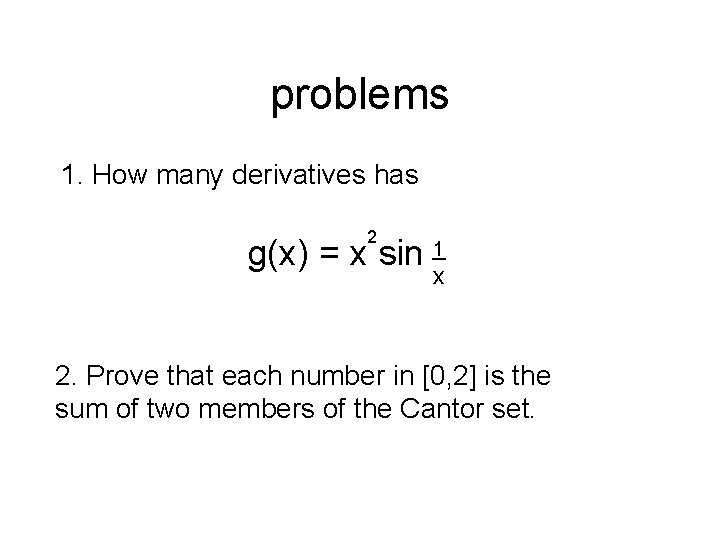
problems 1. How many derivatives has 2 g(x) = x sin 1_ x 2. Prove that each number in [0, 2] is the sum of two members of the Cantor set.
Problems 3. Prove there is no distance non-increasing function whose domain is a closed interval in N and whose range is the unit square [0, 1] ´ [0, 1]. 4. Determine