
MY ENGLISH BY JULIA ALVAREZ NOTES ON STYLE
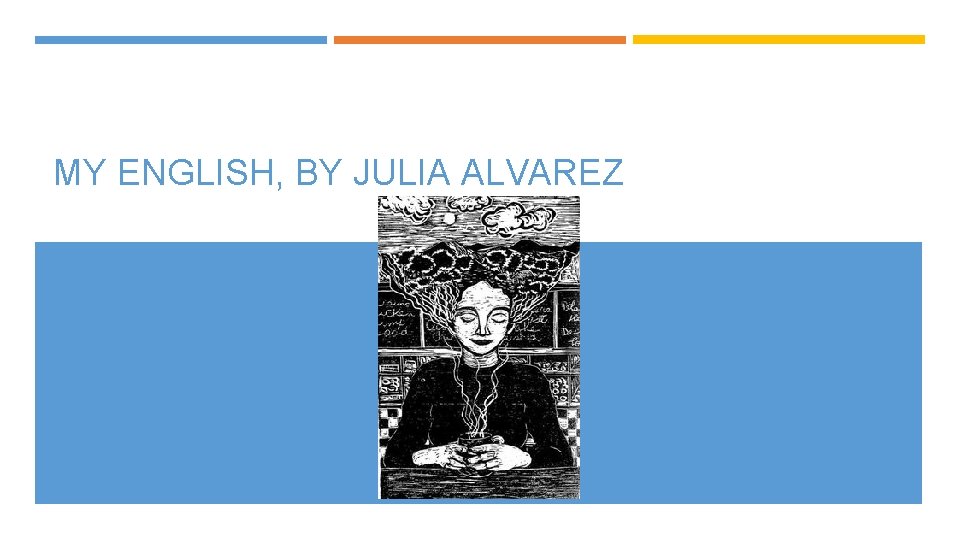
MY ENGLISH, BY JULIA ALVAREZ
NOTES ON STYLE Voice is the way a writer sounds on the page. For example, the writer’s voice in a work can be smooth and sophisticated, choppy and blunt, or breathless and full of wonder. Voice is a result of the following elements: Word choice: the kinds of words the author uses Attitude: the way the writer feels about his or her subject Sentence structure: the arrangement of words in sentences In autobiographical writing, the author tells all or part of his or her life story. The details the author includes show what he or she notices, thinks, and feels about events. One feature of autobiographical writing that is that the voice of the author usually reflects his or her personality and way of speaking. For readers, voice can also affect the tone and credibility of the text.
NOTES ON STYLE An author’s purpose is his or her main reason for writing. An author can write for a general purpose, such as to inform, to entertain, or to persuade. He or she may also write for a specific purpose, such as to expose a particular problem in society. To get the most out of what you read. Look for textual evidence that will enable you to make inferences about the author’s purpose. Notice information or ideas conveyed in the title Look for any organization features, such as subheads Identify the subject of photos, illustrations, or diagrams
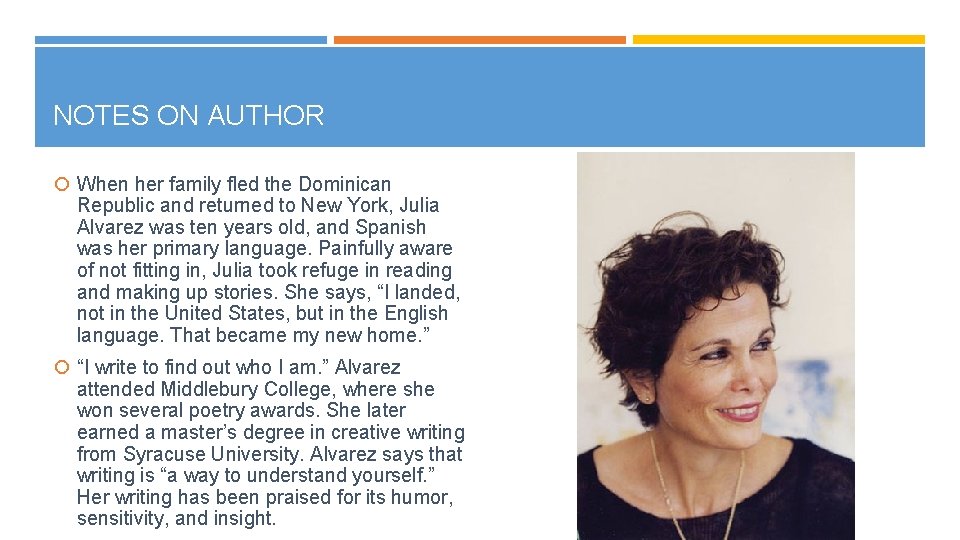
NOTES ON AUTHOR When her family fled the Dominican Republic and returned to New York, Julia Alvarez was ten years old, and Spanish was her primary language. Painfully aware of not fitting in, Julia took refuge in reading and making up stories. She says, “I landed, not in the United States, but in the English language. That became my new home. ” “I write to find out who I am. ” Alvarez attended Middlebury College, where she won several poetry awards. She later earned a master’s degree in creative writing from Syracuse University. Alvarez says that writing is “a way to understand yourself. ” Her writing has been praised for its humor, sensitivity, and insight.
![VOCABULARY DEFINITIONS Word List A Word List B Acquired [uh KWYRD] adj. gained through](http://slidetodoc.com/presentation_image_h2/6e34a3763d1c1b3388740de62ce29311/image-5.jpg "VOCABULARY DEFINITIONS Word List A Word List B Acquired [uh KWYRD] adj. gained through")
VOCABULARY DEFINITIONS Word List A Word List B Acquired [uh KWYRD] adj. gained through experience Animated [AN i may tid] adj. lively; energetic Anxiety [ang ZY uh tee] n. uneasiness Bland [BLAND] adj. dull; without flavor Childhood [CHYLD hood] n. time of being a child Enlisted [en LIS tid] v. got help or support from Necessarily [nes uh SER uh lee] adv. unavoidably; definitely Particularly [pahr TIK yuh ler lee] adv. especially, specifically Referring [ri FER ing] v. directing attention to Superior [soo PEER ee er] adj. in a higher position Demonstration [dem uhn STRAY shun] n. explanation by example Drastically [DRAS tik lee] adv. extremely; harshly Expressive [ek SPRES iv] adj. full of meaning or feeling Fluent [FLOO uhnt] adj. speaking smoothly and easily Tradition [truh DISH uhn] n. custom; established practice
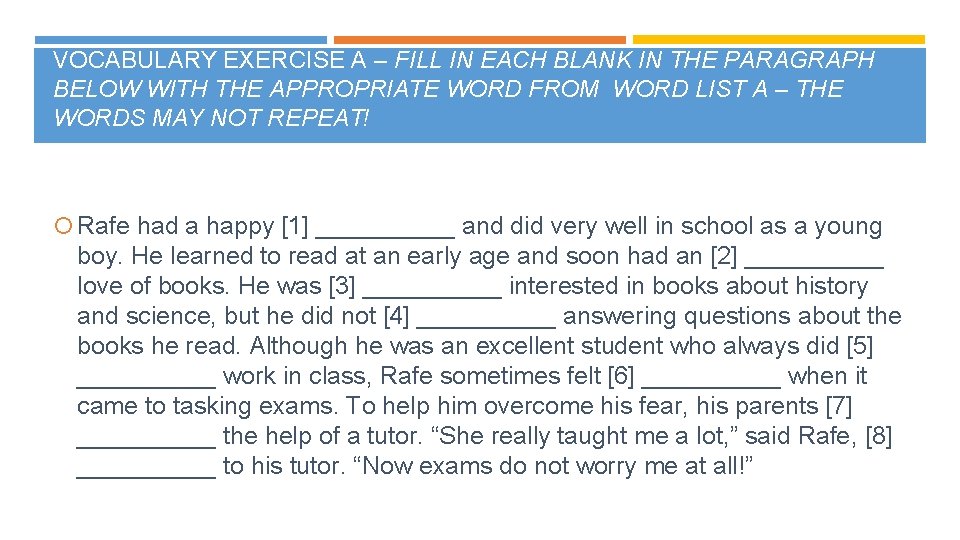
VOCABULARY EXERCISE A – FILL IN EACH BLANK IN THE PARAGRAPH BELOW WITH THE APPROPRIATE WORD FROM WORD LIST A – THE WORDS MAY NOT REPEAT! Rafe had a happy [1] _____ and did very well in school as a young boy. He learned to read at an early age and soon had an [2] _____ love of books. He was [3] _____ interested in books about history and science, but he did not [4] _____ answering questions about the books he read. Although he was an excellent student who always did [5] _____ work in class, Rafe sometimes felt [6] _____ when it came to tasking exams. To help him overcome his fear, his parents [7] _____ the help of a tutor. “She really taught me a lot, ” said Rafe, [8] _____ to his tutor. “Now exams do not worry me at all!”
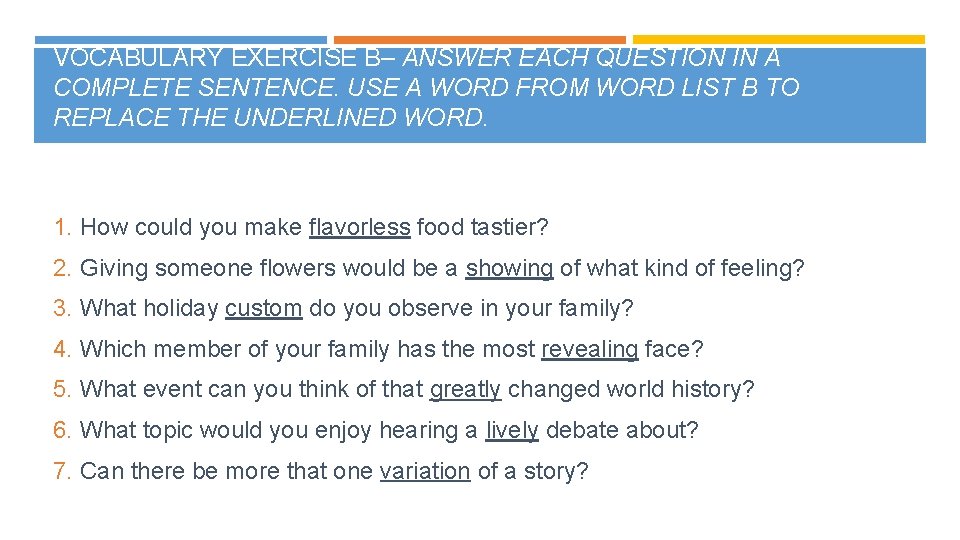
VOCABULARY EXERCISE B– ANSWER EACH QUESTION IN A COMPLETE SENTENCE. USE A WORD FROM WORD LIST B TO REPLACE THE UNDERLINED WORD. 1. How could you make flavorless food tastier? 2. Giving someone flowers would be a showing of what kind of feeling? 3. What holiday custom do you observe in your family? 4. Which member of your family has the most revealing face? 5. What event can you think of that greatly changed world history? 6. What topic would you enjoy hearing a lively debate about? 7. Can there be more that one variation of a story?

READ “MY ENGLISH” – P. 114 -120
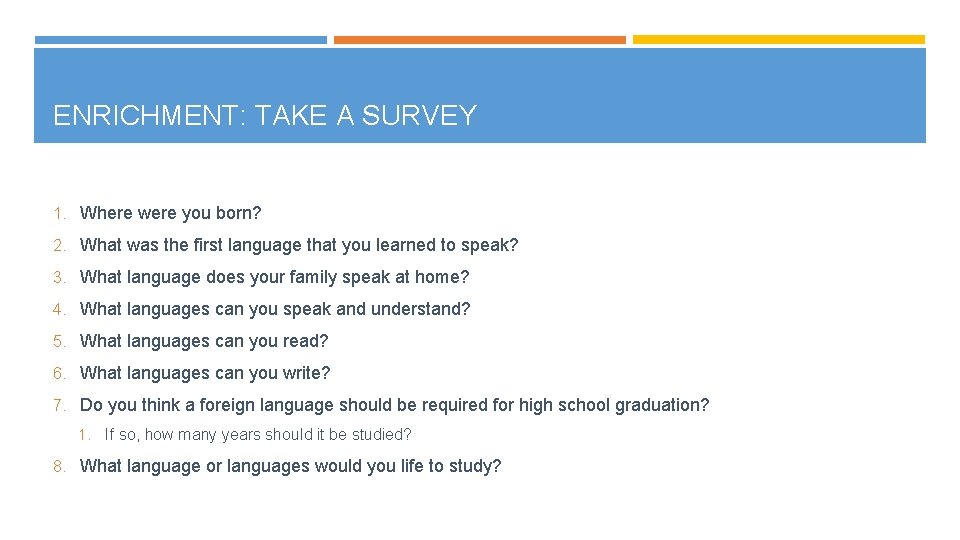
ENRICHMENT: TAKE A SURVEY 1. Where were you born? 2. What was the first language that you learned to speak? 3. What language does your family speak at home? 4. What languages can you speak and understand? 5. What languages can you read? 6. What languages can you write? 7. Do you think a foreign language should be required for high school graduation? 1. If so, how many years should it be studied? 8. What language or languages would you life to study?
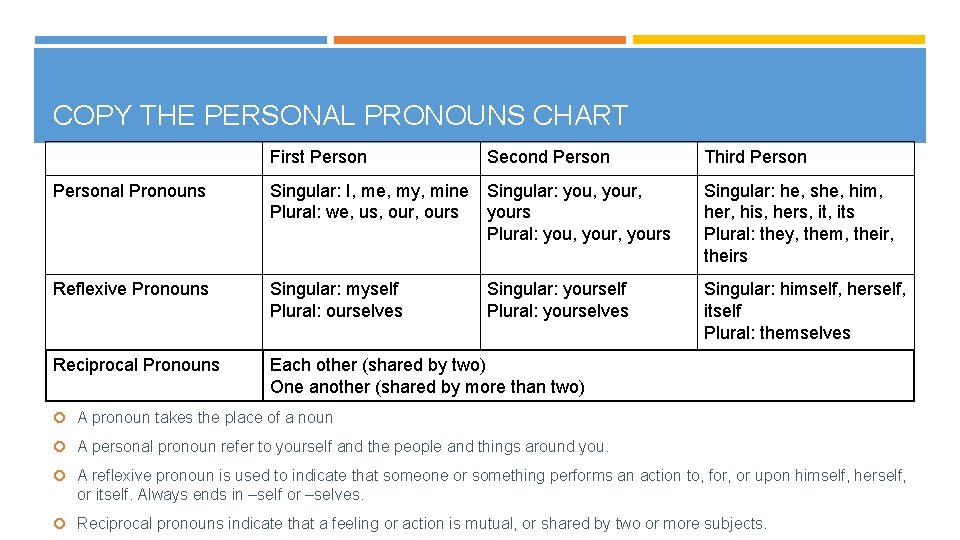
COPY THE PERSONAL PRONOUNS CHART First Person Second Person Third Personal Pronouns Singular: I, me, my, mine Plural: we, us, ours Singular: you, yours Plural: you, yours Singular: he, she, him, her, his, hers, its Plural: they, them, theirs Reflexive Pronouns Singular: myself Plural: ourselves Singular: yourself Plural: yourselves Singular: himself, herself, itself Plural: themselves Reciprocal Pronouns Each other (shared by two) One another (shared by more than two) A pronoun takes the place of a noun A personal pronoun refer to yourself and the people and things around you. A reflexive pronoun is used to indicate that someone or something performs an action to, for, or upon himself, herself, or itself. Always ends in –self or –selves. Reciprocal pronouns indicate that a feeling or action is mutual, or shared by two or more subjects.
IDIOMS - EXPLAIN THE MEANING OF THE FOLLOWING IDIOMS THEN WRITE ONE SENTENCE USING THE IDIOM CORRECTLY. An idiom is a phrase or expression whose meaning cannot be understood from the ordinary meaning of the words in that phrase or expression. For example: “Hold one’s tongue” is an English idiom meaning “keep still”. Example: The idiom “It cost me an arm and a leg” means it cost a fortune. Buying that new car cost an arm and a leg! Blessing in disguise means = A chip on your shoulder means = A dime a dozen means = A fool and his money are easily parted means = A piece of cake means = A slap on the wrist means = A taste of your own medicine means = Actions speak louder than words means = All bark and no bite means = Spilled the beans means =
ESSAY Julia Alvarez, in her narrative “My English, ” tells of her relationship with the English language. As an English learner, Alvarez’ experience with English is similar to the experience of many people on this campus. In a two to three page essay, describe how Alvarez’ relationship with English develops and how her experience is similar to and different from your own experience. Follow the outline on the following slide.
ESSAY Paragraph 1: Introduction Give the author’s name, title, and a brief summary of the text. Explain your connection to this text. Explain a theme (a lesson about life) from this text. Paragraph 2: Julia Alvarez’ story Give a more detailed summary of Julia Alvarez’ narrative as her relationship with English grows. Describe her thoughts about English when she was young, as she grew up, and as an adult. You need to show her understanding of English grew as she grew older and learned more. Paragraph 3: Your story Give a summary of your own journey with English. As an English language learner, how has your relationship with English changed? Explain how your experience is similar to and different from Julia’s experience. In this paragraph you also need to give your reason for wanting to learn English. End by answering this question: Are you done learning English? Why/why not?
TODAY’S GRADE CHECKLIST – COPY THIS ONTO A SHEET OF PAPER AND STAPLE EVERYTHING TOGETHER! I. Author/Style notes ___/10 pts. Vocabulary Definitions ___/10 pts. Vocabulary Exercise A ___/10 pts. Vocabulary Exercise B ___10 pts. Oral Reading ___/10 pts. Enrichment ___/10 pts Nouns Chart ___/10 pts. Idioms ___/10 pts. Essay ___/20 pts. Total: 100 pts. II. “My English” online test ___/100 pts. Total: 100 pts.
- Slides: 14