
My Desk Chapter 1 1 1 3 What
- Slides: 18
My Desk
Chapter 1 -1 & 1 -3 What is Science? Studying Life
A. What Science Is and Is Not l The goal of science is to investigate and understand the natural world, to explain events in the natural world, and to use those explanations to make useful predictions.
B. Thinking Like a Scientist – – Scientists make observations of the natural world, the information gathered is called data. Scientists may use data to make inferences, which are logical interpretation based on prior knowledge. Example: -Testing water in a reservoir -Cannot test all the water -Take samples -All samples clean -Infer that all the water in the reservoir is clean enough to drink.
C. Explaining and Interpreting Evidence l l l Scientists try to explain events in the natural world by interpreting evidence logically and analytically. After initial observations, a hypothesis must be proposed—an educated guess as an explanation to a problem. A hypothesis must be able to be tested.
D. Science as a way of knowing l l Science is constantly changing. Science can be thought of as an ongoing process, and through asking questions, making observations, making inferences and testing hypotheses new information about the natural world can be learned.
E. Science and Human Values l l Biology is not just found in the scientific world, it extends into our lives. Contributes information to health, disease and the relationship between human beings and the living and nonliving environment. Examples: l l l Drugs and alcohols effect on the body AIDS virus Lung cancer How much of your genetic make-up should be allowed to be kept private? How do we keep antibiotics effective?
Characteristics of Life l Made Up of Cells—everything living is made from cells a. Unicellular—only being one cell ex: bacteria b. Multicellular—made of many cells ex: humans
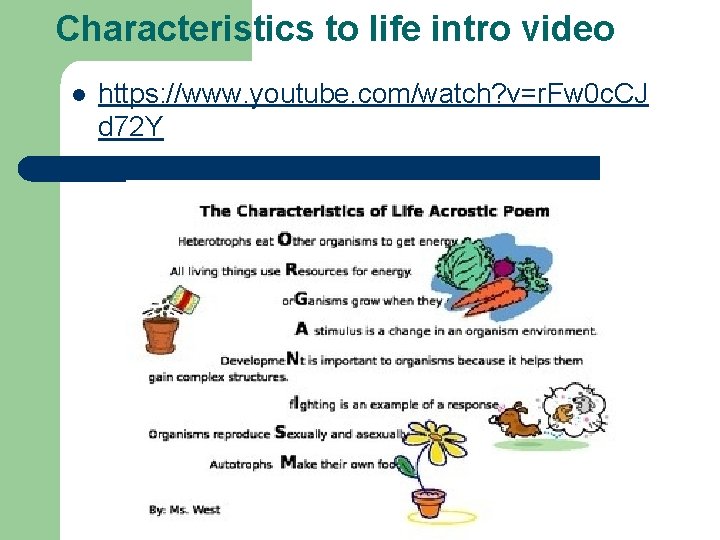
Characteristics to life intro video l https: //www. youtube. com/watch? v=r. Fw 0 c. CJ d 72 Y
Characteristics of Life Reproduction—in order for a population or species to survive it must reproduce. a. asexual reproduction—only one parent ex: budding, binary fission b. sexual reproduction—two parents needed REPRODUCTION IS NOT NECESSARY FOR THE SURVIVAL OF AN INDIVIDUAL, ONLY FOR THE SURVIVAL OF THE SPECIES! l
Characteristics of Life l Based on a Genetic Code—makes all organisms species specific. Ex: dogs produces dogs, humans produce humans
Characteristics of Life l Growth and Development—all living things grow, develop, and then die. a. Growth: becoming larger b. Development: physical and mental changes--maturing
Characteristics of Life l Need for Materials and Energy—must have energy to survive a. autotroph—make their own food b. heterotroph—must find food and “eat”
Characteristics of Life l Response to the Environment—all living things react Ex: Animals move Plants grow toward light
Characteristics of Life l Maintaining Internal Balance—in order for internal process to occur a balance must be kept Ex: Temperature of environment changes, internal temperature stays the same. a. Homeostasis—biological balance b. When an organism is no longer in homeostasis, it is said to have a disease.
Characteristics of Life l Evolution—living things must change over time to adapt to changing conditions of the Earth
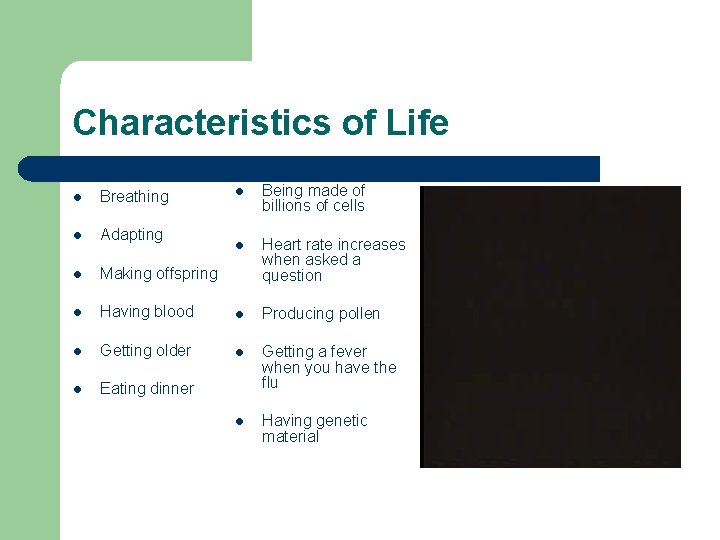
Characteristics of Life l Being made of billions of cells l Heart rate increases when asked a question Having blood l Producing pollen l Getting older l l Eating dinner Getting a fever when you have the flu l Having genetic material l Breathing l Adapting l Making offspring l
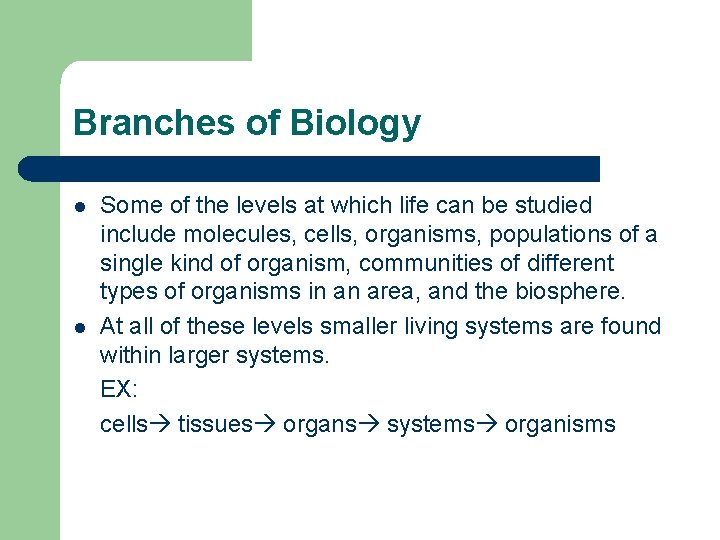
Branches of Biology l l Some of the levels at which life can be studied include molecules, cells, organisms, populations of a single kind of organism, communities of different types of organisms in an area, and the biosphere. At all of these levels smaller living systems are found within larger systems. EX: cells tissues organs systems organisms