
My Book of English MIDDLE SCHOOL YEAR ONE
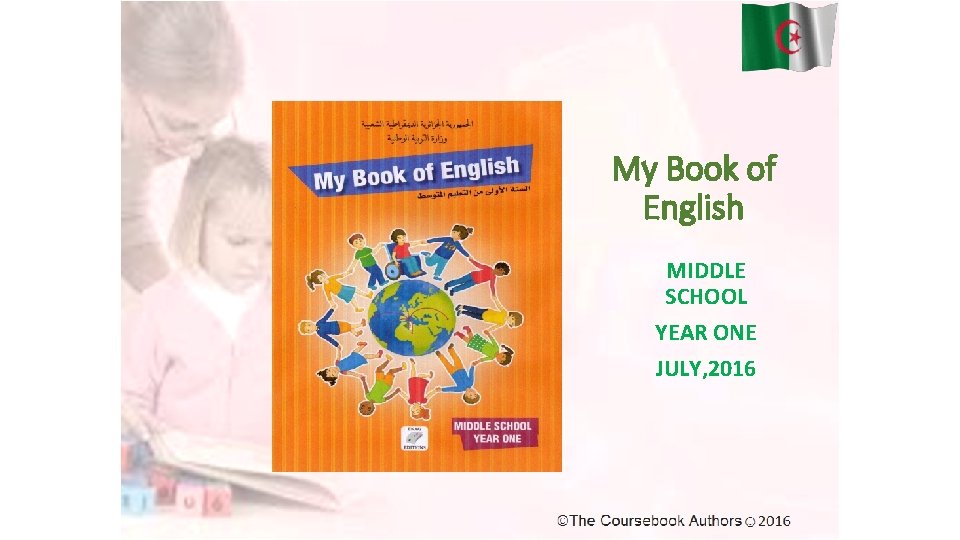
My Book of English MIDDLE SCHOOL YEAR ONE JULY, 2016
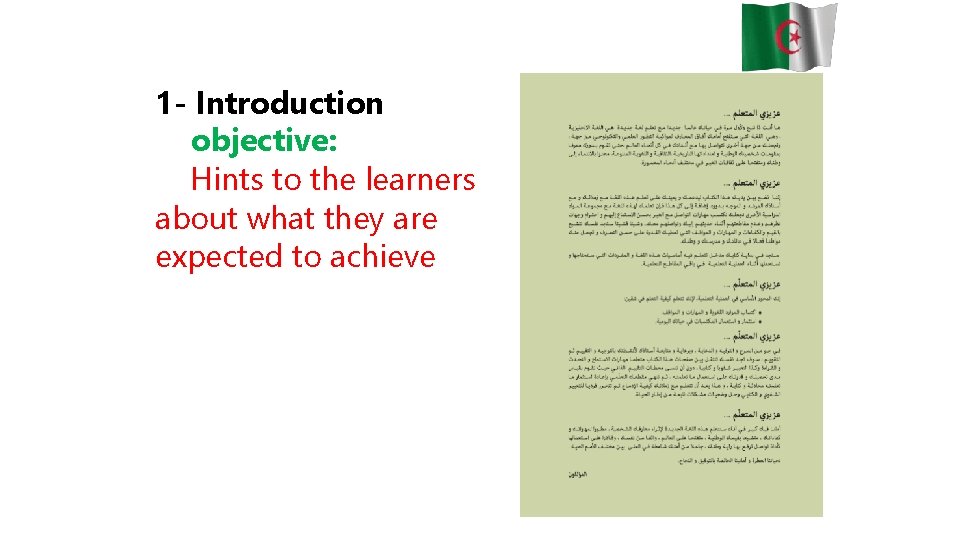
1 - Introduction objective: Hints to the learners about what they are expected to achieve
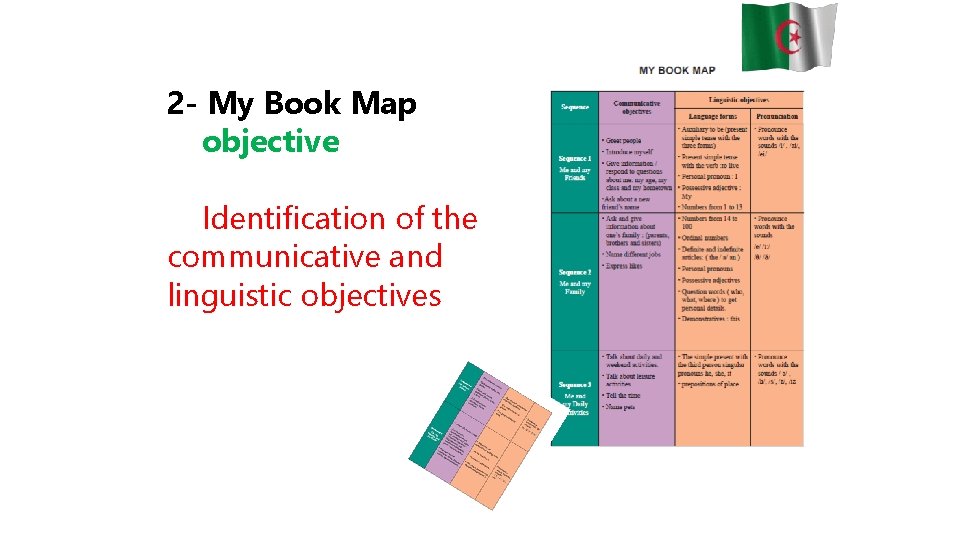
2 - My Book Map objective Identification of the communicative and linguistic objectives
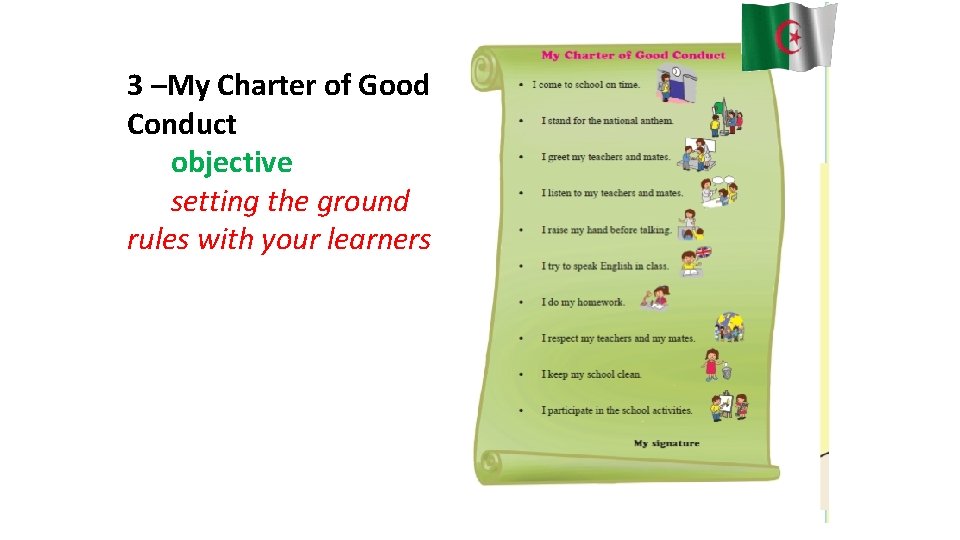
3 –My Charter of Good Conduct objective setting the ground rules with your learners
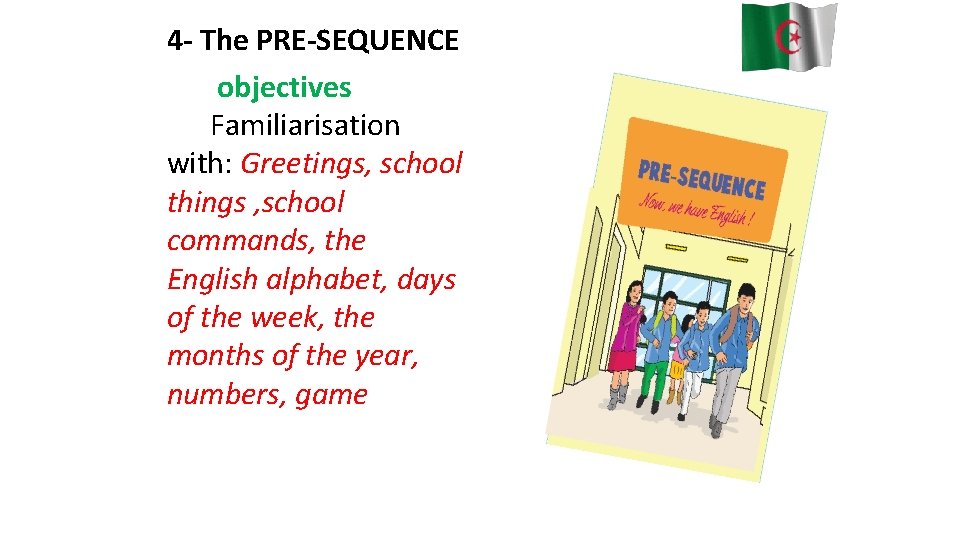
4 - The PRE-SEQUENCE objectives Familiarisation with: Greetings, school things , school commands, the English alphabet, days of the week, the months of the year, numbers, game
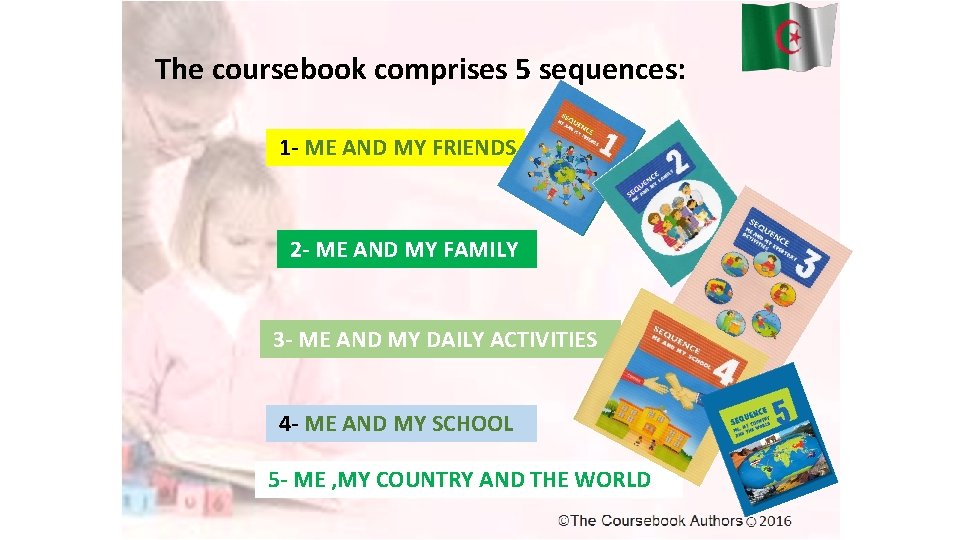
The coursebook comprises 5 sequences: 1 - ME AND MY FRIENDS 2 - ME AND MY FAMILY 3 - ME AND MY DAILY ACTIVITIES 4 - ME AND MY SCHOOL 5 - ME , MY COUNTRY AND THE WORLD
PROJECT ANNOUCEMENT FOR EACH TERM A-THE STARTING OFF B- BUILDING THE PROJECT C - PRESENTATION
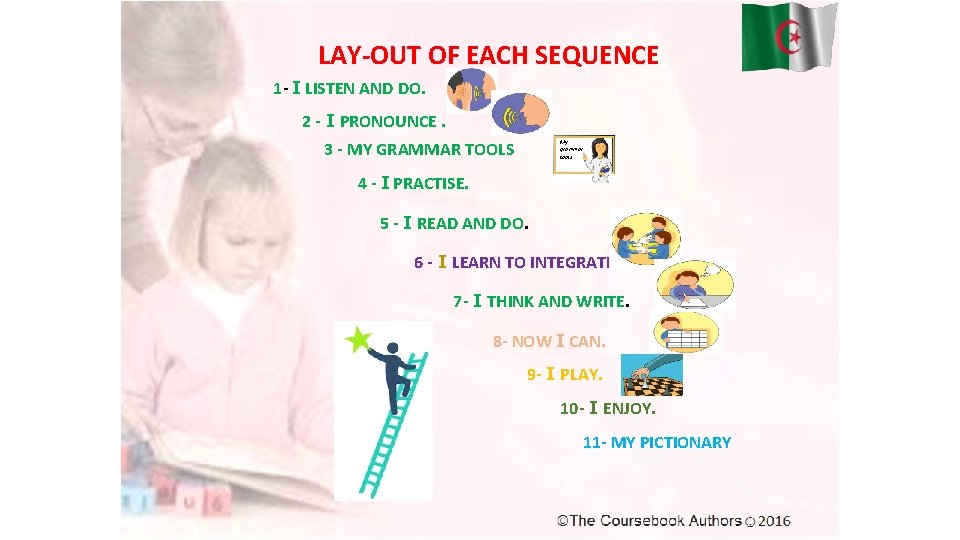
LAY-OUT OF EACH SEQUENCE 1 - I LISTEN AND DO. 2 - I PRONOUNCE. 3 - MY GRAMMAR TOOLS My grammar tools 4 - I PRACTISE. 5 - I READ AND DO. 6 - I LEARN TO INTEGRATE. 7 - I THINK AND WRITE. 8 - NOW I CAN. 9 - I PLAY. 10 - I ENJOY. 11 - MY PICTIONARY
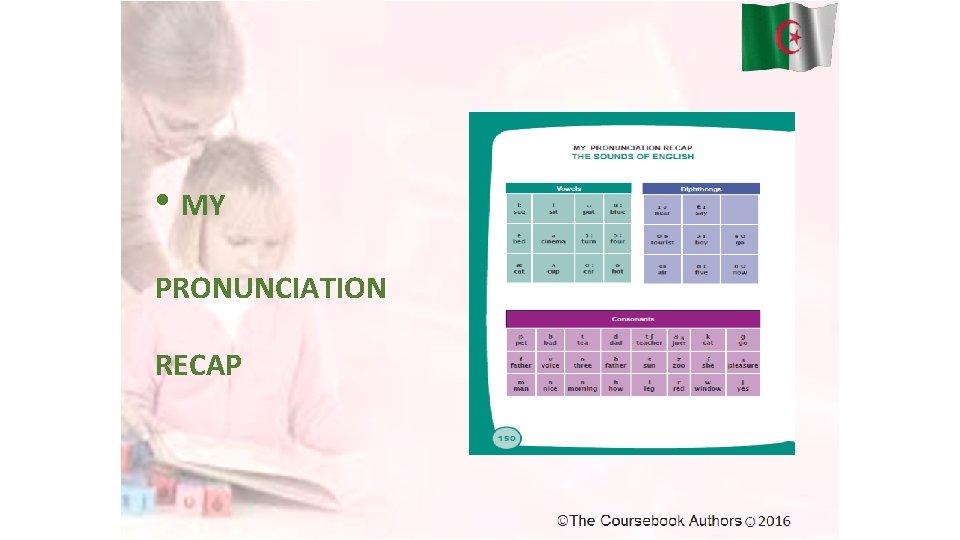
• MY PRONUNCIATION RECAP
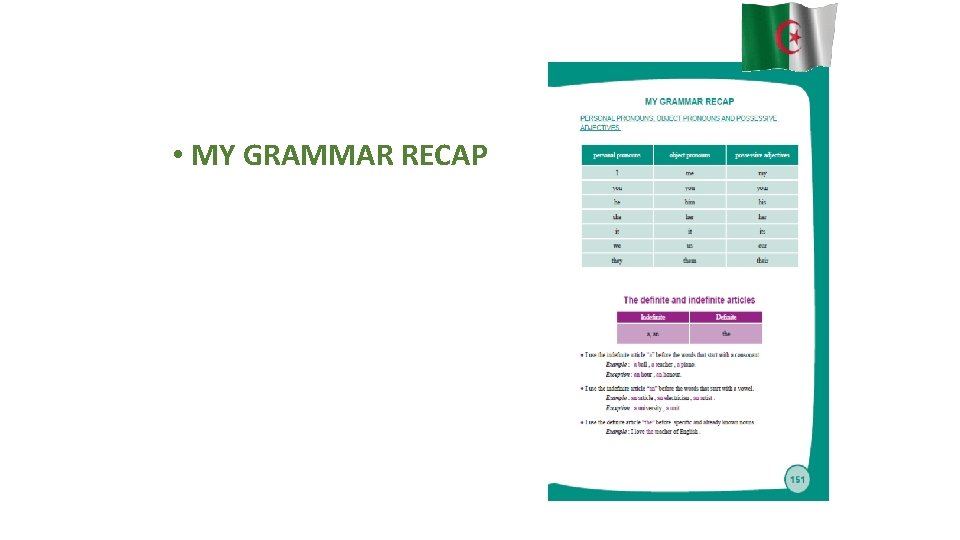
• MY GRAMMAR RECAP
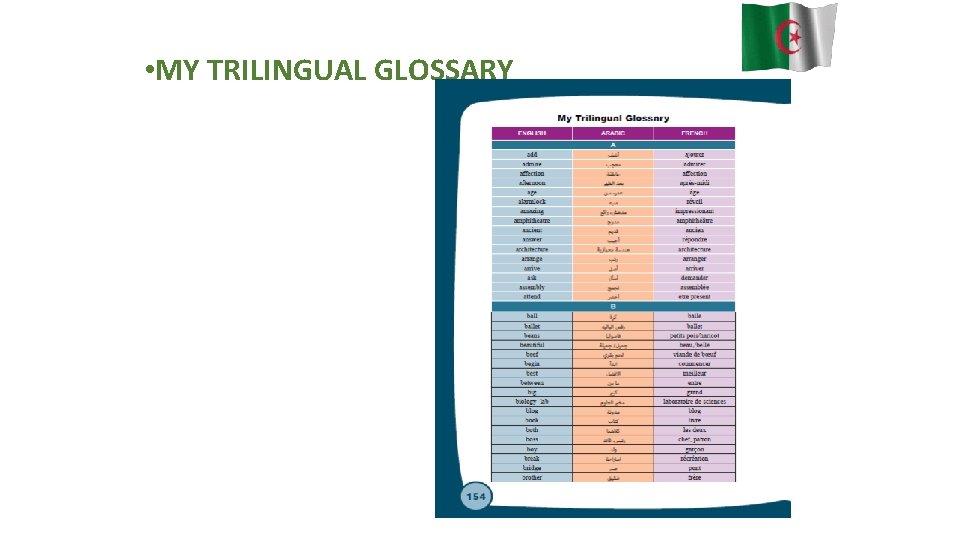
• MY TRILINGUAL GLOSSARY
TASK 1 WITH YOUR PARTNER OR IN GROUPS OF FIVE, SORT OUT THE OBJECTIVE OF EACH SECTION OF A SEQUENCE.
Section. 1 I listen and do. Objectives : *NAMING AND IDENTIFYING MONUMENTS * LOCATING PLACES
SECTION. 2 I Pronounce Objectives : *Identifying and comparing sounds * Classifying
Secti. on. 3 My grammar tools/I practise Objectives: -LWABT manipulate the target language in real life situations
Section. 4 I read and do Objectives: -LWABT interpret written messages
Secti. on. 5 Iearn to integrate Objectives: LWBAT be better able to mobilize the net work of the internal and external ressources to accomplish a task
Section. 7 I think and write Objectives: - LWBAT produce a piece of writing.
Section. 8 Now I can Objectives: -LWBAT self assess using can do statements
Section. 9 I play Objectives: - LWBAT to expand on aspects of culture as relaxing activities

Thank you !
I. Characteristics of the 11 year learner. There should be a special care for the 11 year learner taking into account the followings: -Age -Knowledge ( pre-requisites- ) - attitudes -behaviour ( they like moving )
• -They should be prepared psychologically first. ( new setting) • -There should be involved from the right beginning
Presentation. 1 • Characteristics of the 11 year learner from a classroom picture. Innocent learners. Wide range of mood. can be loud & happy. talented for laughter. interrupts. is impulsive. is highly curious. emotionally immature and unaware about his mates views towards him. . fatigues readily. exhibits best behavior when away from home. . quarrels with siblings. rebels against parents. . resists
Reflections There should be a special care for these learners for their characteristics are so special. Teachers should know their learners and find how to cope with each difference. ( know how to explode their inner capacities –talents –behaviour. . ) be patient and go slowly according to the learners pace of learning. .
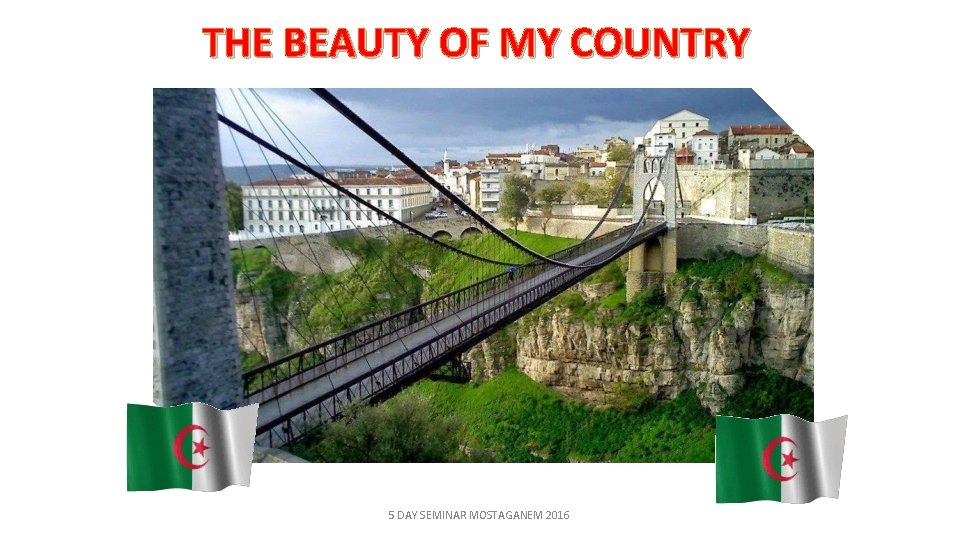
THE BEAUTY OF MY COUNTRY 5 DAY SEMINAR MOSTAGANEM 2016

5 DAY SEMINAR MOSTAGANEM 2016
MS 1 Exit profile By the end of the Key Stage 1, the learner will be able to interact , interpret and produce oral and written messages/ texts of average complexity, of a descriptive type, using verbal or non-verbal supports (written texts, audio and visual aids) and in meaningful situations related to his environment and interests.
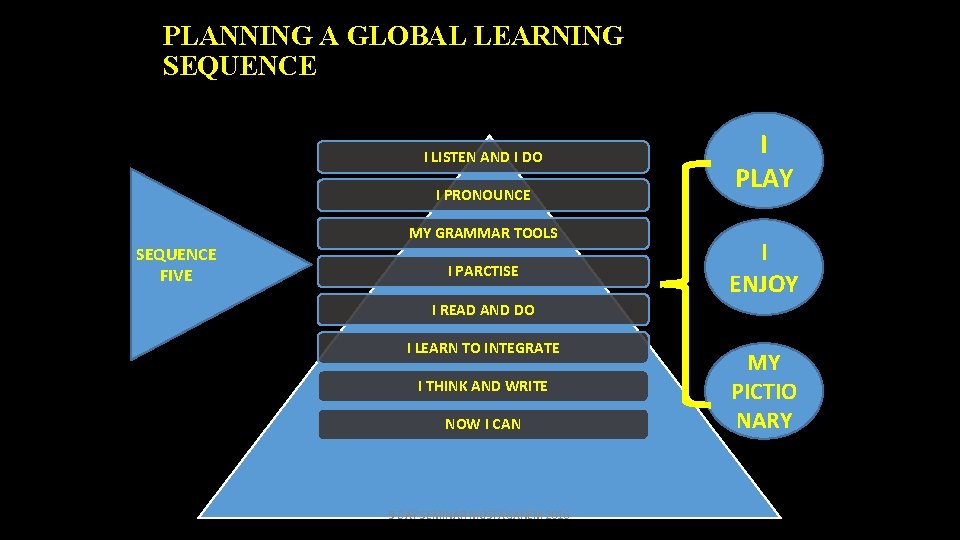
PLANNING A GLOBAL LEARNING SEQUENCE I LISTEN AND I DO I PRONOUNCE MY GRAMMAR TOOLS SEQUENCE FIVE Use definite/indefinite articles in a passage I PARCTISE I PLAY I ENJOY I READ AND DO I LEARN TO INTEGRATE I THINK AND WRITE NOW I CAN 5 DAY SEMINAR MOSTAGANEM 2016 MY PICTIO NARY
LESSON 1 I LISTEN AND DO I PRONOUNCE 5 DAY SEMINAR MOSTAGANEM 2016
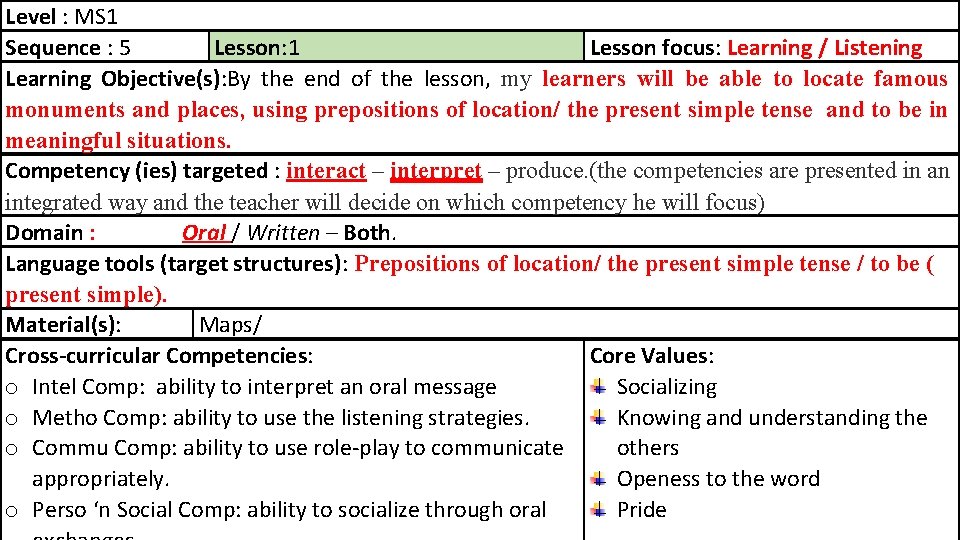
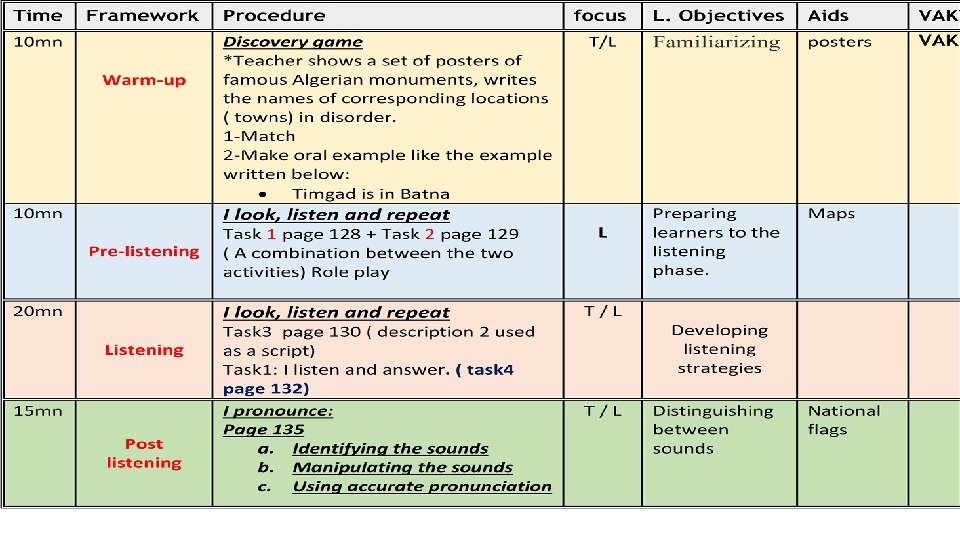
Level : MS 1 Sequence : 5 Lesson: 1 Lesson focus: Learning / Listening Learning Objective(s): By the end of the lesson, my learners will be able to locate famous monuments and places, using prepositions of location/ the present simple tense and to be in meaningful situations. Competency (ies) targeted : interact – interpret – produce. (the competencies are presented in an integrated way and the teacher will decide on which competency he will focus) Domain : Oral / Written – Both. Language tools (target structures): Prepositions of location/ the present simple tense / to be ( present simple). Material(s): Maps/ Cross-curricular Competencies: Core Values: o Intel Comp: ability to interpret an oral message Socializing o Metho Comp: ability to use the listening strategies. Knowing and understanding the o Commu Comp: ability to use role-play to communicate others appropriately. Openess to the word o Perso ‘n Social Comp: ability to socialize through oral Pride
The teacher’s comments: What worked -. . . -. . . What hindered -. . . -. . . Action points -. . . -. . .
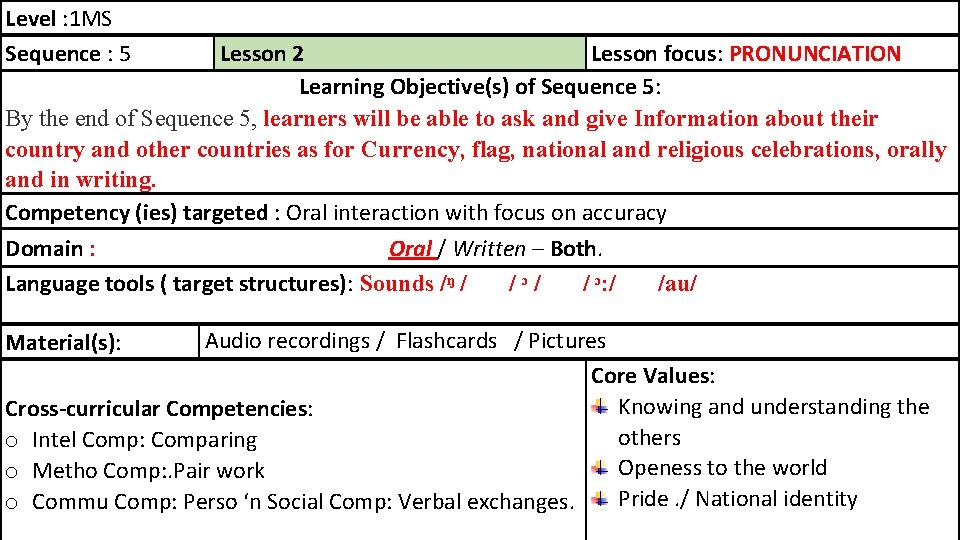
Level : 1 MS Sequence : 5 Lesson 2 Lesson focus: PRONUNCIATION Learning Objective(s) of Sequence 5: By the end of Sequence 5, learners will be able to ask and give Information about their country and other countries as for Currency, flag, national and religious celebrations, orally and in writing. Competency (ies) targeted : Oral interaction with focus on accuracy Domain : Oral / Written – Both. Language tools ( target structures): Sounds /ᵑ / /ᵓ/ / ᵓ: / /au/ Audio recordings / Flashcards / Pictures Core Values: Knowing and understanding the Cross-curricular Competencies: others o Intel Comp: Comparing Openess to the world o Metho Comp: . Pair work Pride. / National identity o Commu Comp: Perso ‘n Social Comp: Verbal exchanges. Material(s):
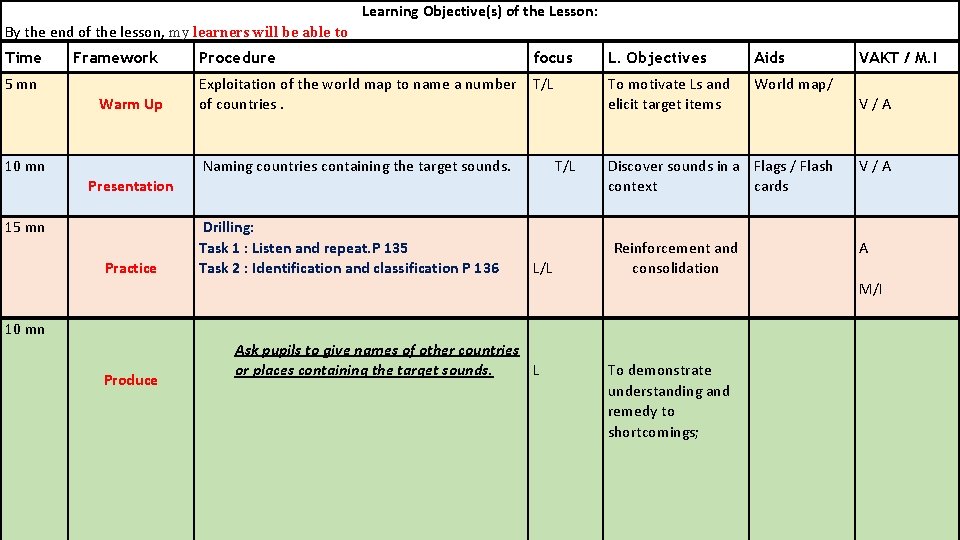
Learning Objective(s) of the Lesson: By the end of the lesson, my learners will be able to Time Framework 5 mn Warm Up 10 mn Procedure focus L. Objectives Aids Exploitation of the world map to name a number of countries. T/L To motivate Ls and elicit target items World map/ Naming countries containing the target sounds. T/L Presentation 15 mn Practice Drilling: Task 1 : Listen and repeat. P 135 Task 2 : Identification and classification P 136 L/L Discover sounds in a Flags / Flash context cards Reinforcement and consolidation VAKT / M. I V/A A M/I 10 mn Produce Ask pupils to give names of other countries or places containing the target sounds. L To demonstrate understanding and remedy to shortcomings;
The teacher’s comments: What worked -. . . -. . . What hindered -. . . -. . . Action points -. . . -. . .
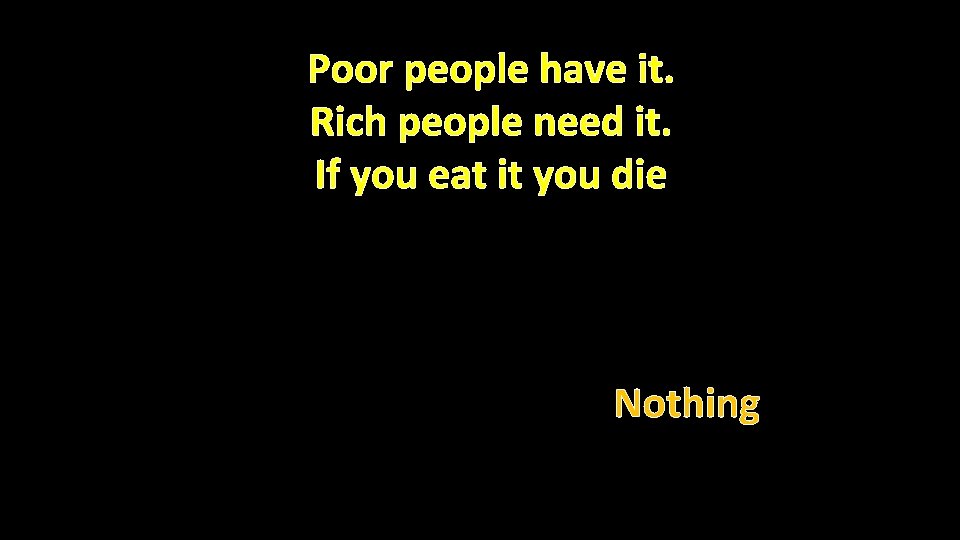
Poor people have it. Rich people need it. If you eat it you die Nothing
LESSON 3 MY GRAMMAR TOOLS I PRACTISE 5 DAY SEMINAR MOSTAGANEM 2016
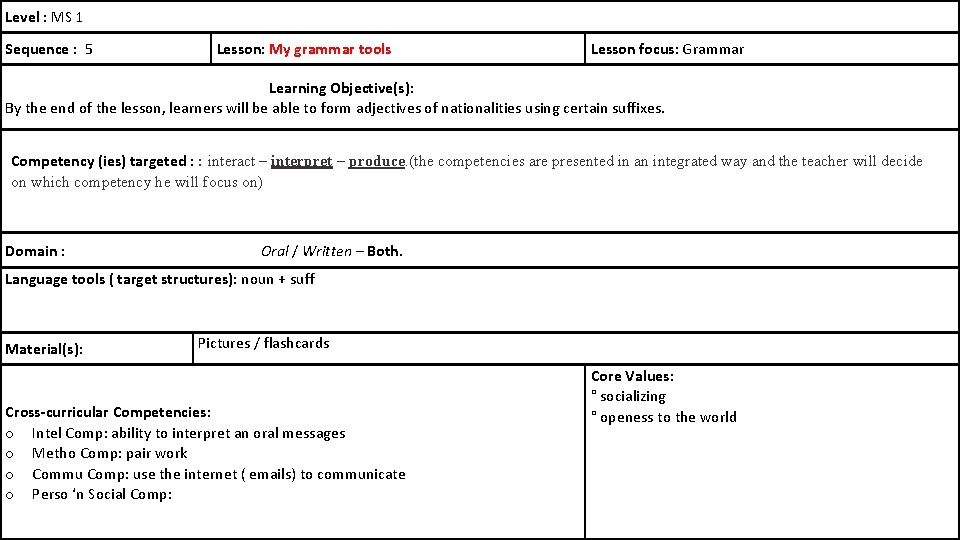
Level : MS 1 Sequence : 5 Lesson: My grammar tools Lesson focus: Grammar Learning Objective(s): By the end of the lesson, learners will be able to form adjectives of nationalities using certain suffixes. Competency (ies) targeted : : interact – interpret – produce. (the competencies are presented in an integrated way and the teacher will decide on which competency he will focus on) Domain : Oral / Written – Both. Language tools ( target structures): noun + suff Material(s): Pictures / flashcards Cross-curricular Competencies: o Intel Comp: ability to interpret an oral messages o Metho Comp: pair work o Commu Comp: use the internet ( emails) to communicate o Perso ‘n Social Comp: Core Values: ° socializing ° openess to the world
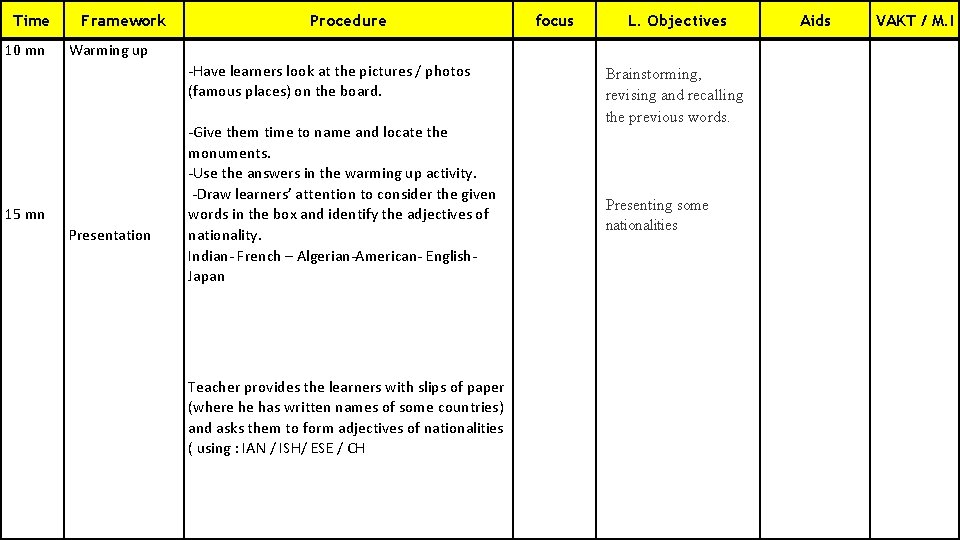
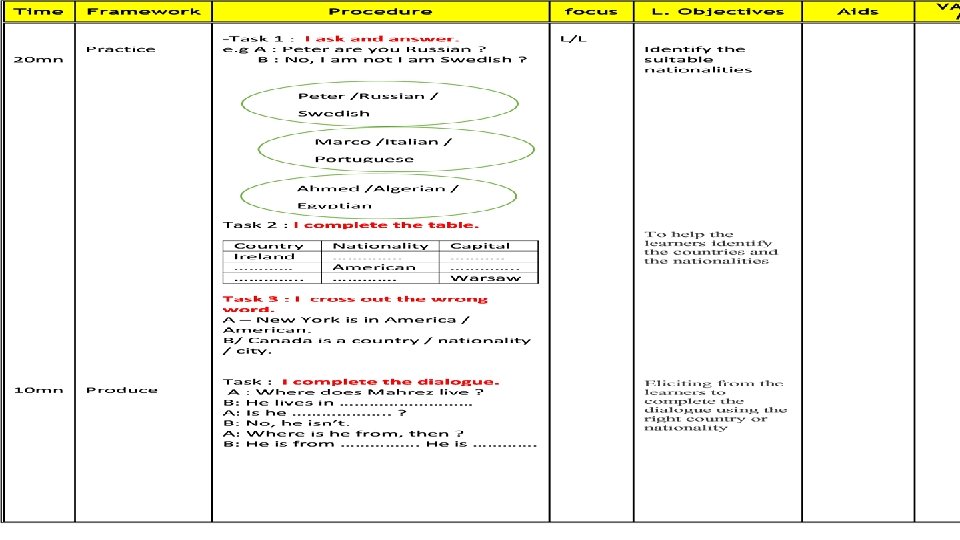
Time 10 mn Framework Procedure focus L. Objectives Warming up -Have learners look at the pictures / photos (famous places) on the board. 15 mn Presentation -Give them time to name and locate the monuments. -Use the answers in the warming up activity. -Draw learners’ attention to consider the given words in the box and identify the adjectives of nationality. Indian- French – Algerian-American- English. Japan Teacher provides the learners with slips of paper (where he has written names of some countries) and asks them to form adjectives of nationalities ( using : IAN / ISH/ ESE / CH Brainstorming, revising and recalling the previous words. Presenting some nationalities Aids VAKT / M. I
The teacher’s comments: What worked -. . . What hindered -. . . Action points -. . .
LESSON 4 I READ AND DO 5 DAY SEMINAR MOSTAGANEM 2016
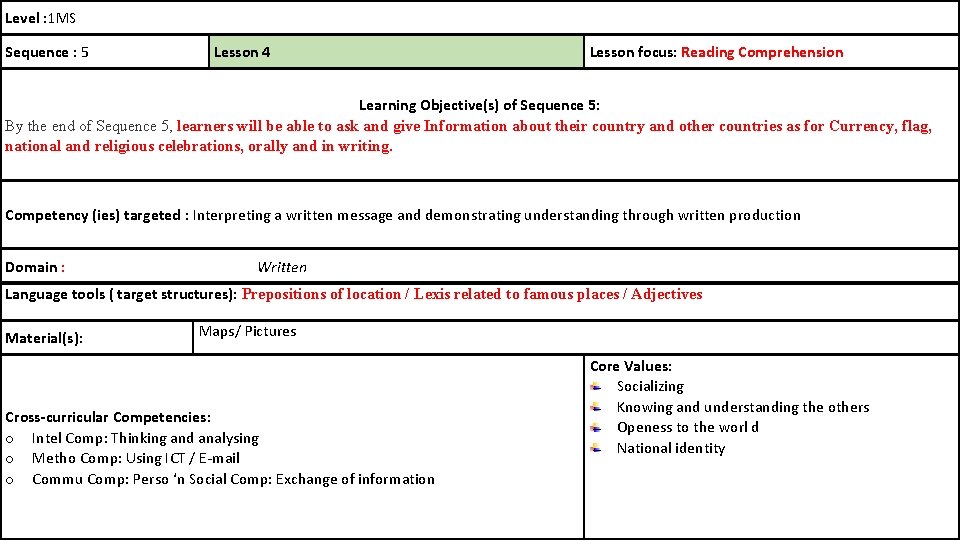
Level : 1 MS Sequence : 5 Lesson 4 Lesson focus: Reading Comprehension Learning Objective(s) of Sequence 5: By the end of Sequence 5, learners will be able to ask and give Information about their country and other countries as for Currency, flag, national and religious celebrations, orally and in writing. Competency (ies) targeted : Interpreting a written message and demonstrating understanding through written production Domain : Written Language tools ( target structures): Prepositions of location / Lexis related to famous places / Adjectives Material(s): Maps/ Pictures Cross-curricular Competencies: o Intel Comp: Thinking and analysing o Metho Comp: Using ICT / E-mail o Commu Comp: Perso ‘n Social Comp: Exchange of information Core Values: Socializing Knowing and understanding the others Openess to the worl d National identity
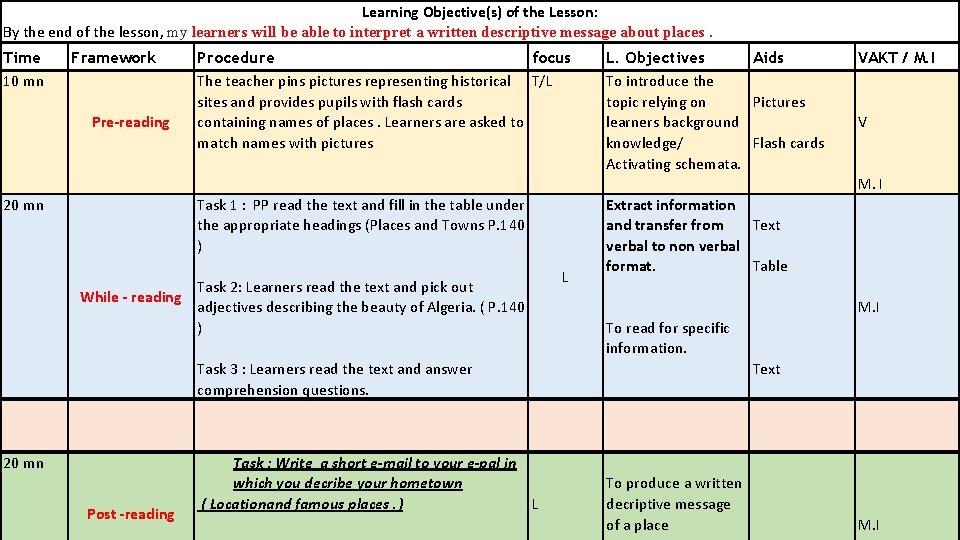
Learning Objective(s) of the Lesson: By the end of the lesson, my learners will be able to interpret a written descriptive message about places. Time 10 mn Framework Pre-reading Procedure focus The teacher pins pictures representing historical T/L sites and provides pupils with flash cards containing names of places. Learners are asked to match names with pictures L. Objectives Aids To introduce the topic relying on Pictures learners background knowledge/ Flash cards Activating schemata. VAKT / M. I V M. I 20 mn Task 1 : PP read the text and fill in the table under the appropriate headings (Places and Towns P. 140 ) Task 2: Learners read the text and pick out While - reading adjectives describing the beauty of Algeria. ( P. 140 ) L Extract information and transfer from Text verbal to non verbal format. Table M. I To read for specific information. Task 3 : Learners read the text and answer comprehension questions. 20 mn Post -reading Task : Write a short e-mail to your e-pal in which you decribe your hometown ( Locationand famous places. ) L Text To produce a written decriptive message of a place M. I
The teacher’s comments: What worked -. . . -. . . What hindered -. . . -. . . Action points -. . . -. . .
LESSON 5 I LEARN TO INTEGRATE 5 DAY SEMINAR MOSTAGANEM 2016
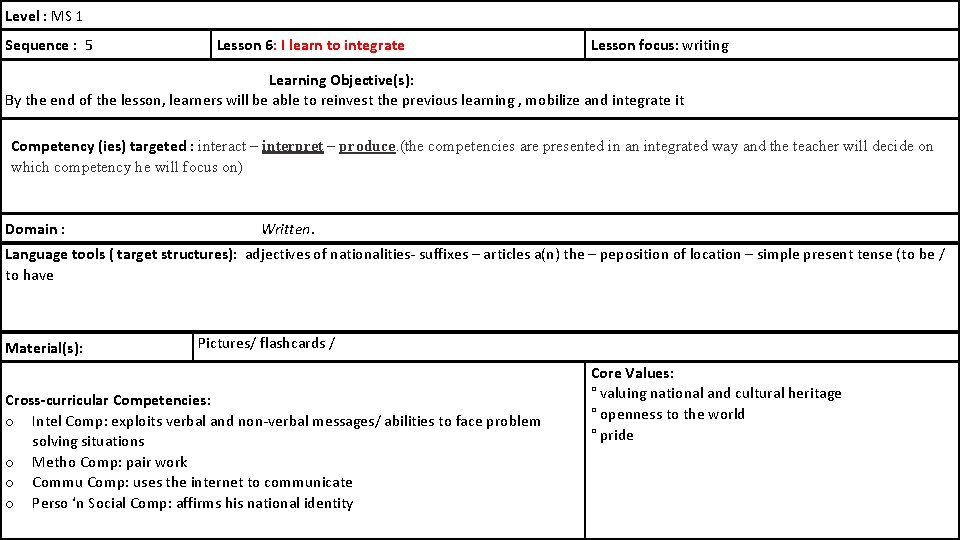
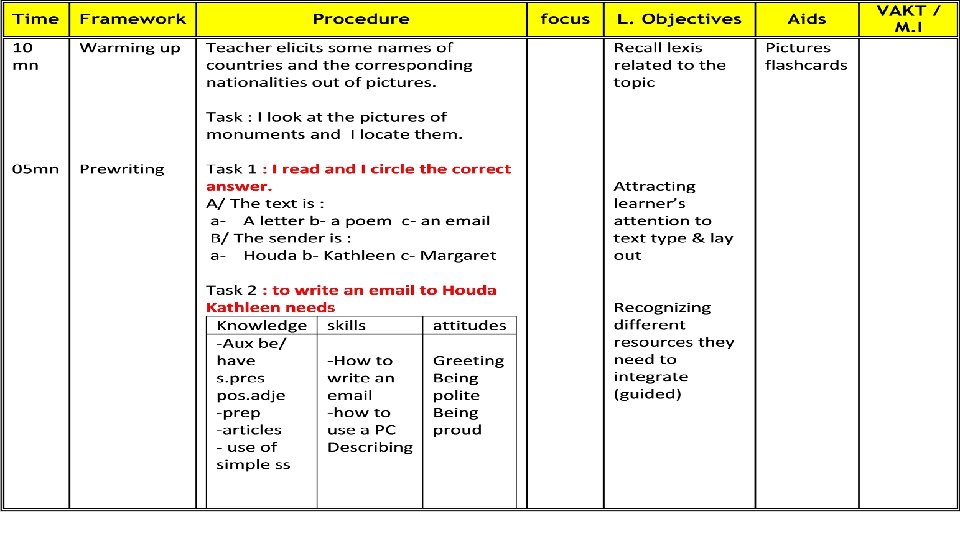
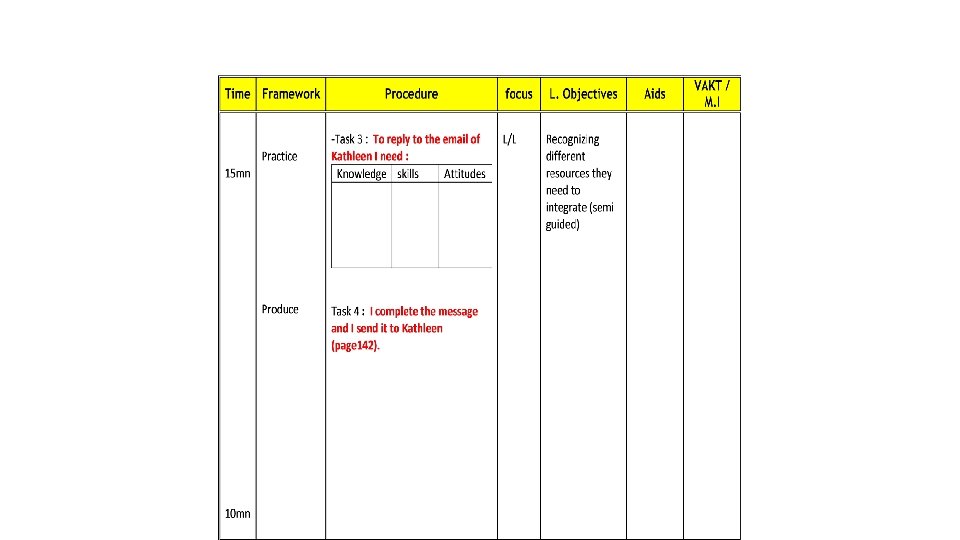
Level : MS 1 Sequence : 5 Lesson 6: I learn to integrate Lesson focus: writing Learning Objective(s): By the end of the lesson, learners will be able to reinvest the previous learning , mobilize and integrate it Competency (ies) targeted : interact – interpret – produce. (the competencies are presented in an integrated way and the teacher will decide on which competency he will focus on) Domain : Written. Language tools ( target structures): adjectives of nationalities- suffixes – articles a(n) the – peposition of location – simple present tense (to be / to have Material(s): Pictures/ flashcards / Cross-curricular Competencies: o Intel Comp: exploits verbal and non-verbal messages/ abilities to face problem solving situations o Metho Comp: pair work o Commu Comp: uses the internet to communicate o Perso ‘n Social Comp: affirms his national identity Core Values: ° valuing national and cultural heritage ° openness to the world ° pride
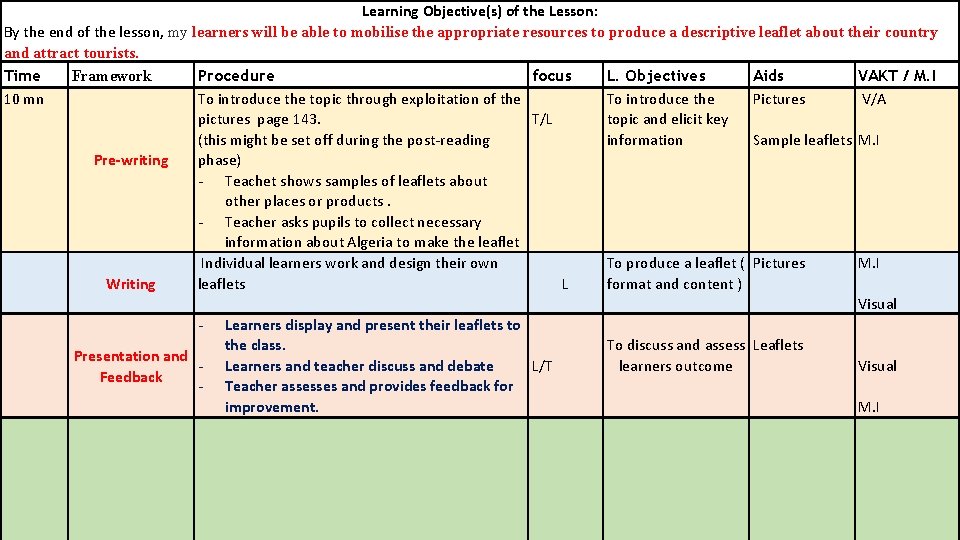
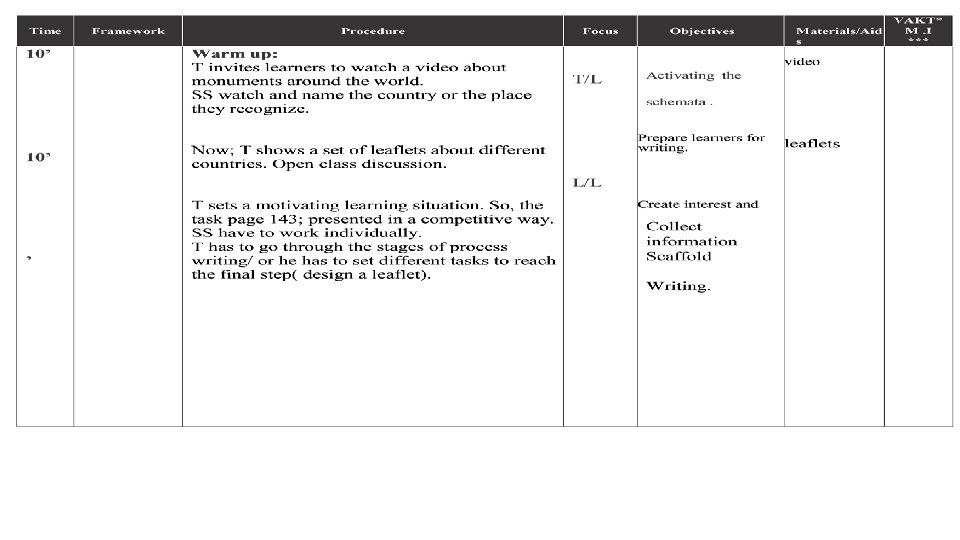
Learning Objective(s) of the Lesson: By the end of the lesson, my learners will be able to mobilise the appropriate resources to produce a descriptive leaflet about their country and attract tourists. Framework Time Procedure focus L. Objectives Aids VAKT / M. I 10 mn To introduce the topic through exploitation of the To introduce the Pictures V/A pictures page 143. T/L topic and elicit key (this might be set off during the post-reading information Sample leaflets M. I phase) Pre-writing - Teachet shows samples of leaflets about other places or products. - Teacher asks pupils to collect necessary information about Algeria to make the leaflet Individual learners work and design their own To produce a leaflet ( Pictures M. I Writing leaflets L format and content ) Visual - Learners display and present their leaflets to the class. To discuss and assess Leaflets Presentation and - Learners and teacher discuss and debate L/T learners outcome Visual Feedback - Teacher assesses and provides feedback for improvement. M. I
The teacher’s comments: What worked -. . . What hindered -. . . Action points -. . .
LESSON 6 I THINK AND WRITE 5 DAY SEMINAR MOSTAGANEM 2016
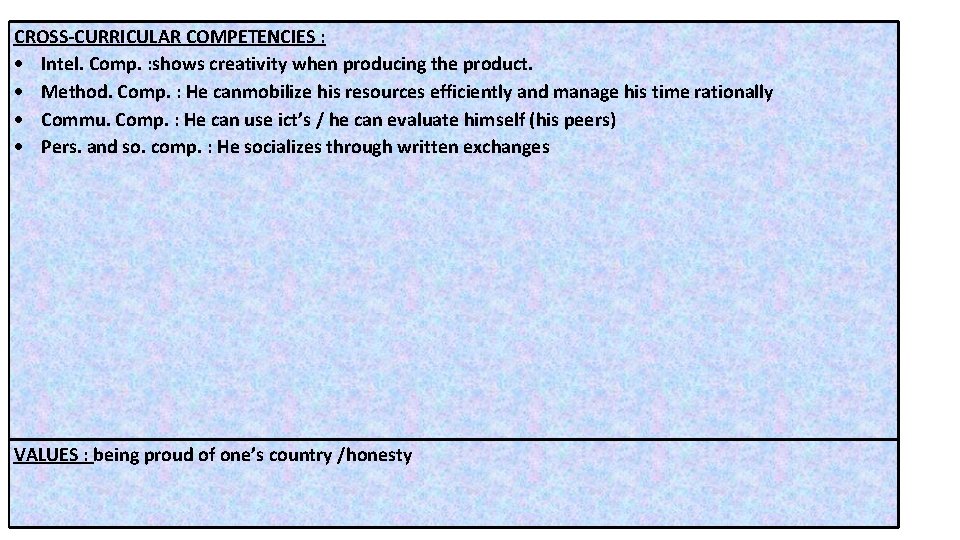
CROSS-CURRICULAR COMPETENCIES : Intel. Comp. : shows creativity when producing the product. Method. Comp. : He canmobilize his resources efficiently and manage his time rationally Commu. Comp. : He can use ict’s / he can evaluate himself (his peers) Pers. and so. comp. : He socializes through written exchanges VALUES : being proud of one’s country /honesty
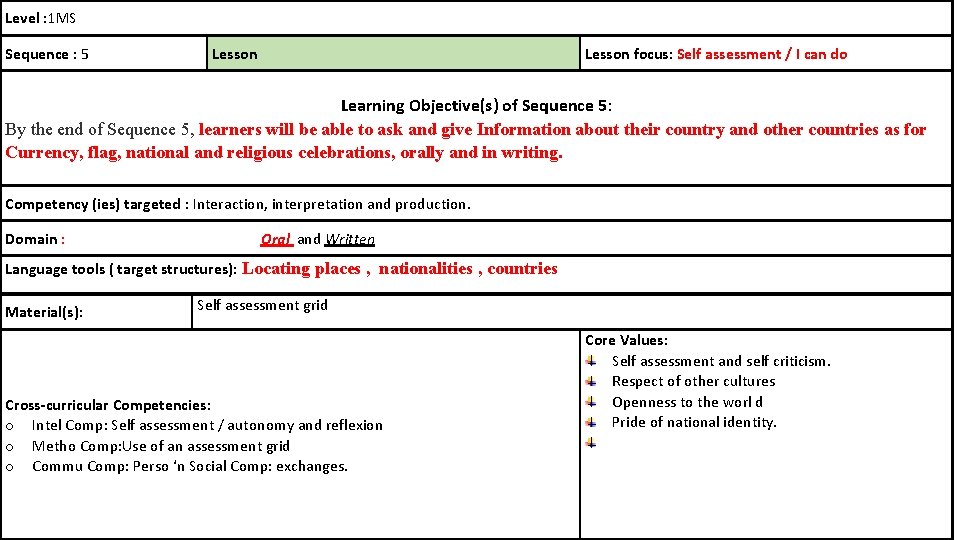
Level : 1 MS Sequence : 5 Lesson focus: Self assessment / I can do Learning Objective(s) of Sequence 5: By the end of Sequence 5, learners will be able to ask and give Information about their country and other countries as for Currency, flag, national and religious celebrations, orally and in writing. Competency (ies) targeted : Interaction, interpretation and production. Domain : Oral and Written Language tools ( target structures): Locating places , nationalities , countries Material(s): Self assessment grid Cross-curricular Competencies: o Intel Comp: Self assessment / autonomy and reflexion o Metho Comp: Use of an assessment grid o Commu Comp: Perso ‘n Social Comp: exchanges. Core Values: Self assessment and self criticism. Respect of other cultures Openness to the worl d Pride of national identity.
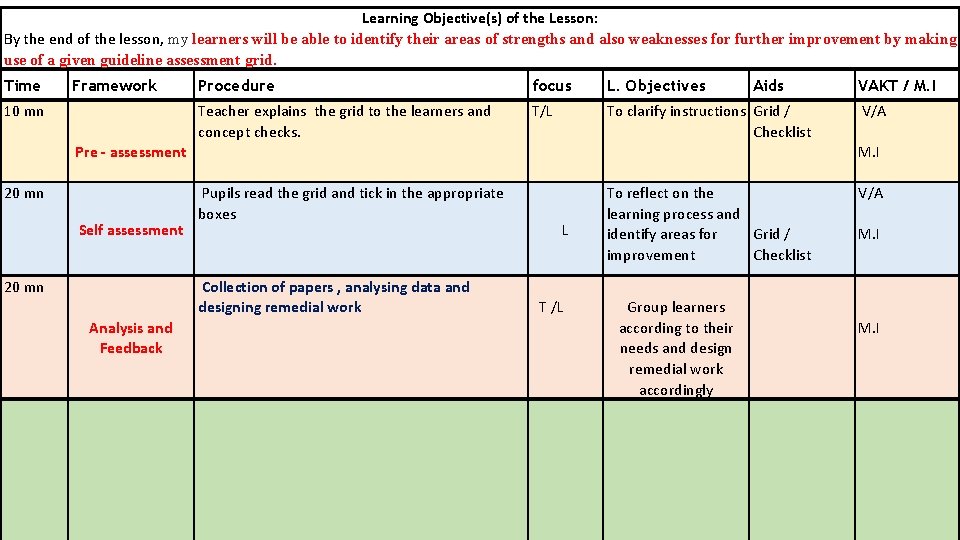
Learning Objective(s) of the Lesson: By the end of the lesson, my learners will be able to identify their areas of strengths and also weaknesses for further improvement by making use of a given guideline assessment grid. Time Framework 10 mn Procedure focus L. Objectives Aids Teacher explains the grid to the learners and concept checks. T/L To clarify instructions Grid / Checklist Pre - assessment 20 mn Self assessment 20 mn V/A M. I Pupils read the grid and tick in the appropriate boxes Collection of papers , analysing data and designing remedial work Analysis and Feedback VAKT / M. I L T /L To reflect on the learning process and identify areas for Grid / improvement Checklist Group learners according to their needs and design remedial work accordingly V/A M. I
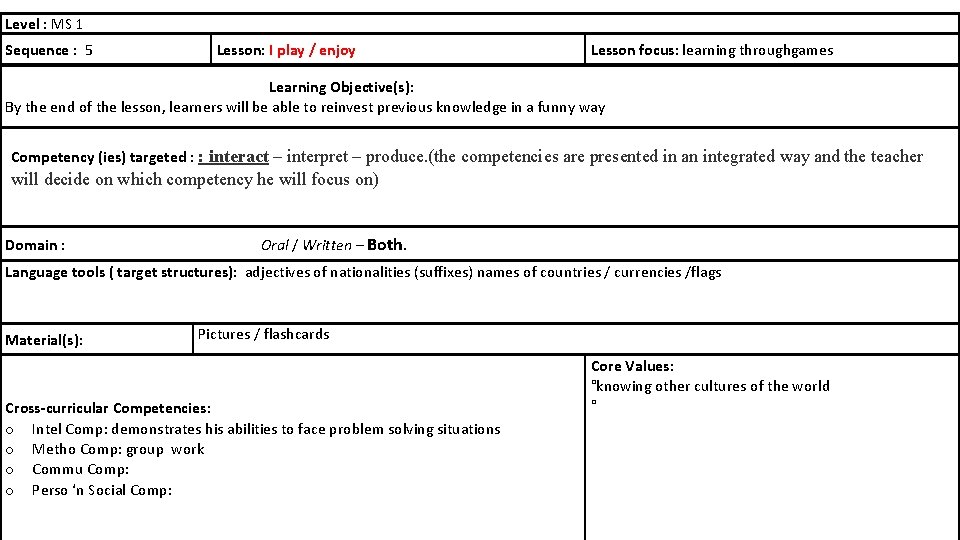
Level : MS 1 Sequence : 5 Lesson: I play / enjoy Lesson focus: learning throughgames Learning Objective(s): By the end of the lesson, learners will be able to reinvest previous knowledge in a funny way Competency (ies) targeted : : interact – interpret – produce. (the competencies are presented in an integrated way and the teacher will decide on which competency he will focus on) Domain : Oral / Written – Both. Language tools ( target structures): adjectives of nationalities (suffixes) names of countries / currencies /flags Material(s): Pictures / flashcards Cross-curricular Competencies: o Intel Comp: demonstrates his abilities to face problem solving situations o Metho Comp: group work o Commu Comp: o Perso ‘n Social Comp: Core Values: °knowing other cultures of the world °
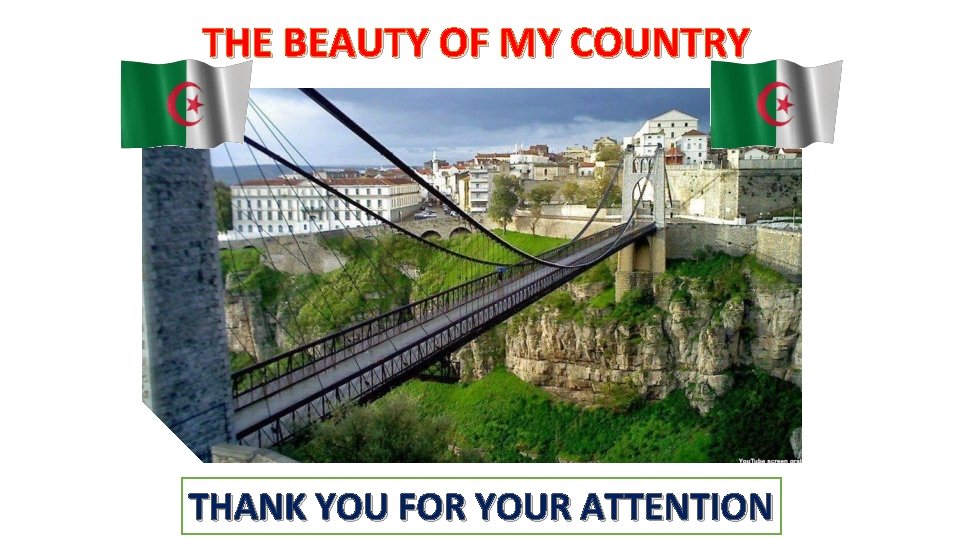
THE BEAUTY OF MY COUNTRY THANK YOU FOR YOUR ATTENTION 5 DAY SEMINAR MOSTAGANEM 2016
Layout of a sequence: suggested lesson plans
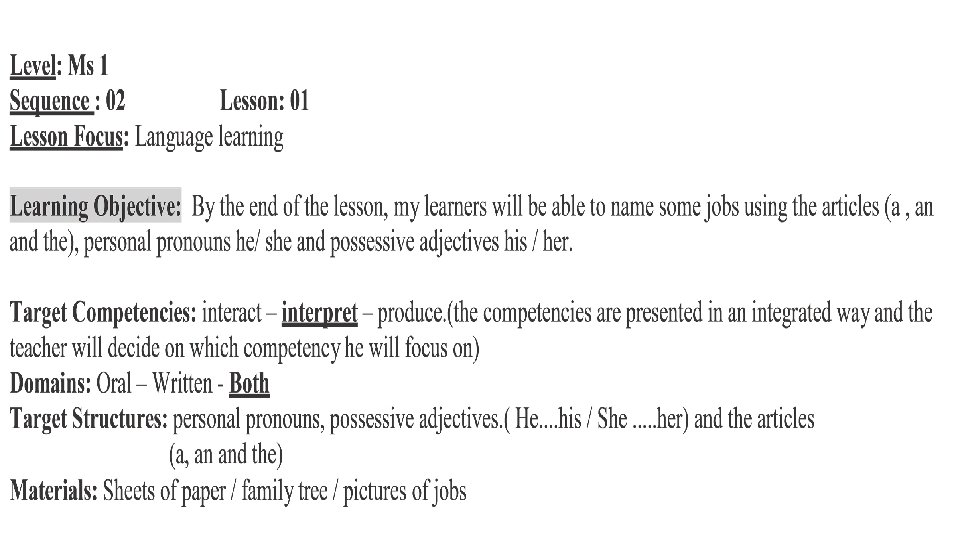
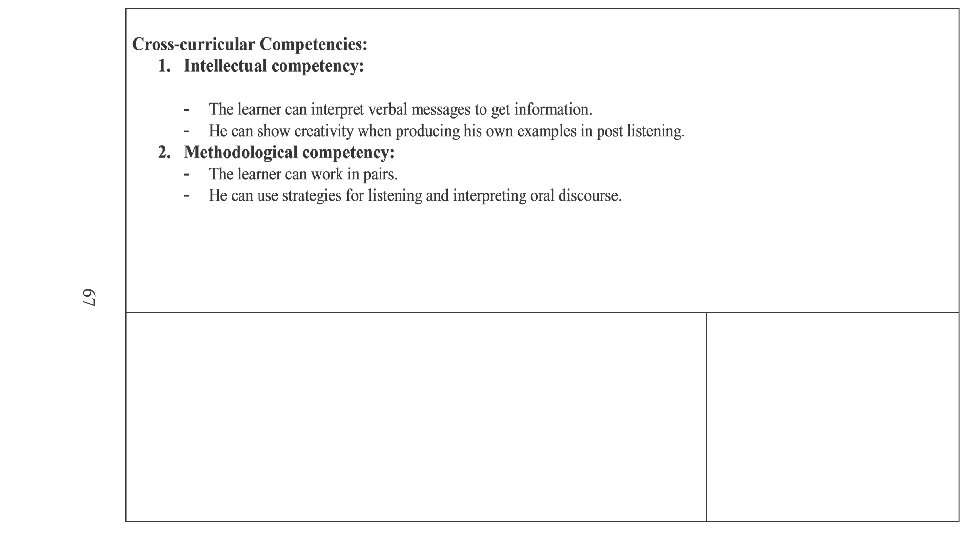
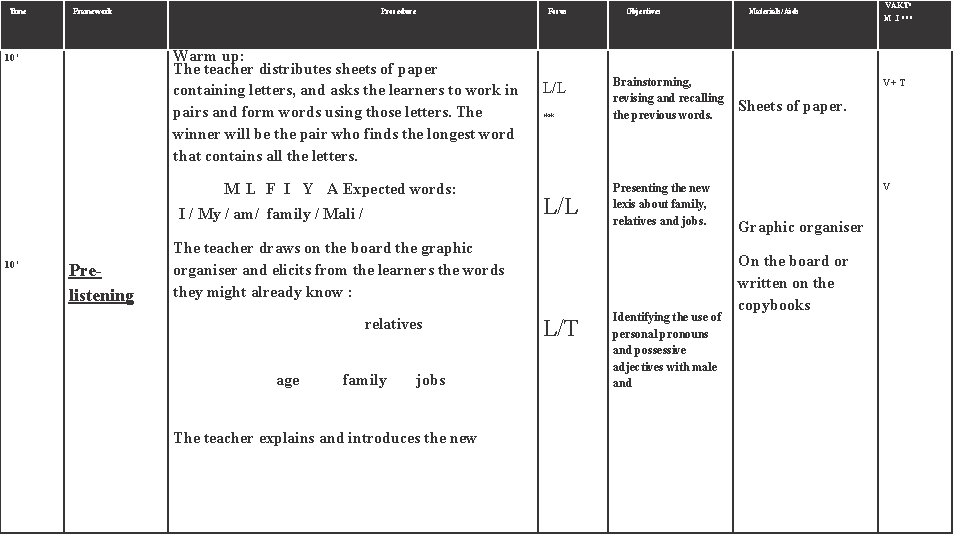
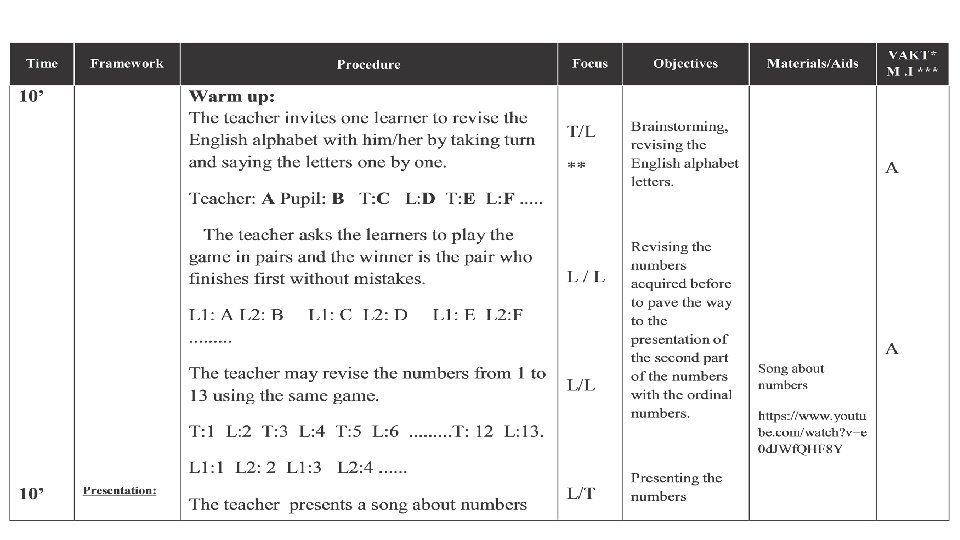
Time Framework Procedure Focus Warm up: The teacher distributes sheets of paper containing letters, and asks the learners to work in pairs and form words using those letters. The winner will be the pair who finds the longest word that contains all the letters. 10’ M L F I Y A Expected words: I / My / am/ family / Mali / 10’ Prelistening L/L ** L/L Objectives Brainstorming, revising and recalling the previous words. Presenting the new lexis about family, relatives and jobs. The teacher draws on the board the graphic organiser and elicits from the learners the words they might already know : relatives age family jobs The teacher explains and introduces the new L/T Identifying the use of personal pronouns and possessive adjectives with male and Materials/Aids VAKT* M. I *** V+ T Sheets of paper. V Graphic organiser On the board or written on the copybooks
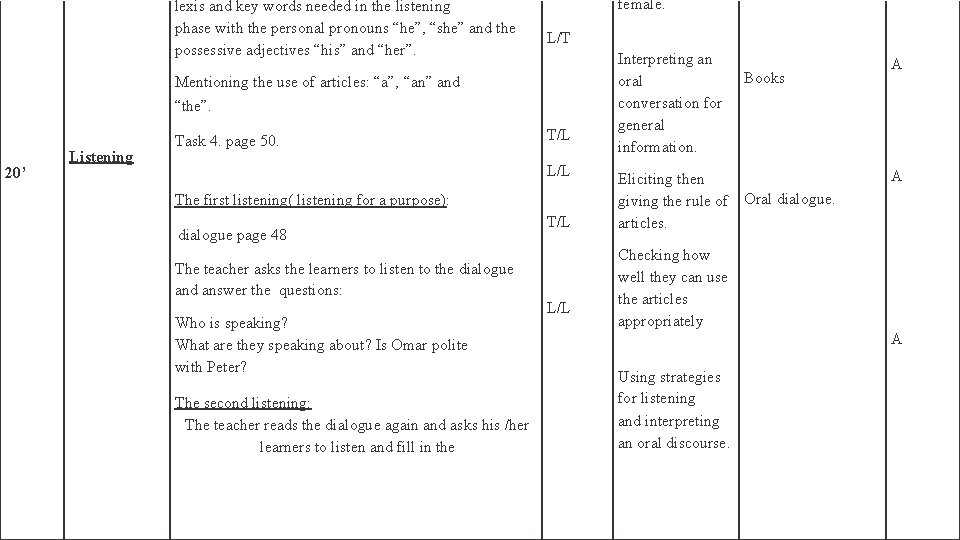
lexis and key words needed in the listening phase with the personal pronouns “he”, “she” and the possessive adjectives “his” and “her”. female. L/T Mentioning the use of articles: “a”, “an” and “the”. 20’ Listening Task 4. page 50. T/L L/L The first listening( listening for a purpose): dialogue page 48 The teacher asks the learners to listen to the dialogue and answer the questions: Who is speaking? What are they speaking about? Is Omar polite with Peter? The second listening: The teacher reads the dialogue again and asks his /her learners to listen and fill in the T/L L/L Interpreting an oral conversation for general information. Books Eliciting then giving the rule of Oral dialogue. articles. A A Checking how well they can use the articles appropriately A Using strategies for listening and interpreting an oral discourse.
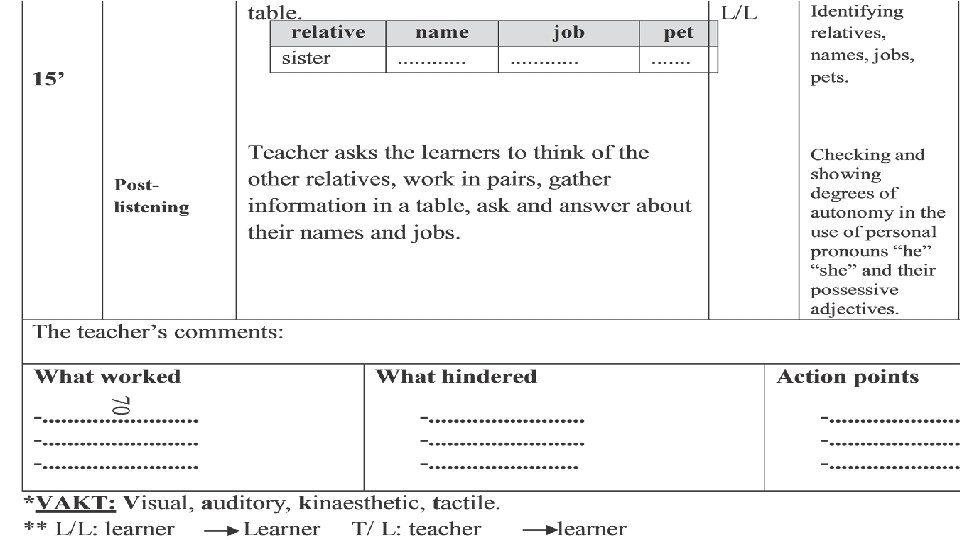
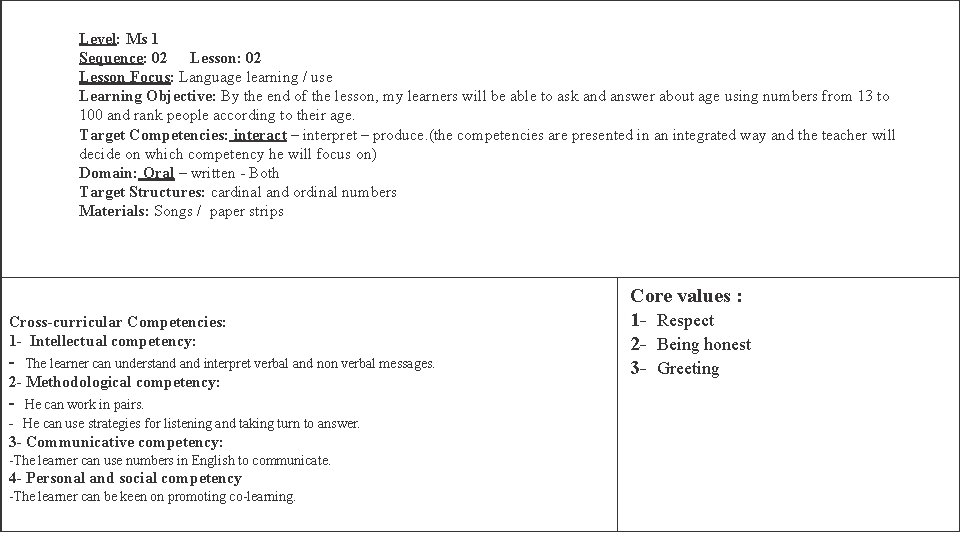
Level: Ms 1 Sequence: 02 Lesson Focus: Language learning / use Learning Objective: By the end of the lesson, my learners will be able to ask and answer about age using numbers from 13 to 100 and rank people according to their age. Target Competencies: interact – interpret – produce. (the competencies are presented in an integrated way and the teacher will decide on which competency he will focus on) Domain: Oral – written - Both Target Structures: cardinal and ordinal numbers Materials: Songs / paper strips Cross-curricular Competencies: 1 - Intellectual competency: - The learner can understand interpret verbal and non verbal messages. 2 - Methodological competency: - He can work in pairs. - He can use strategies for listening and taking turn to answer. 3 - Communicative competency: -The learner can use numbers in English to communicate. 4 - Personal and social competency -The learner can be keen on promoting co-learning. Core values : 1 - Respect 2 - Being honest 3 - Greeting
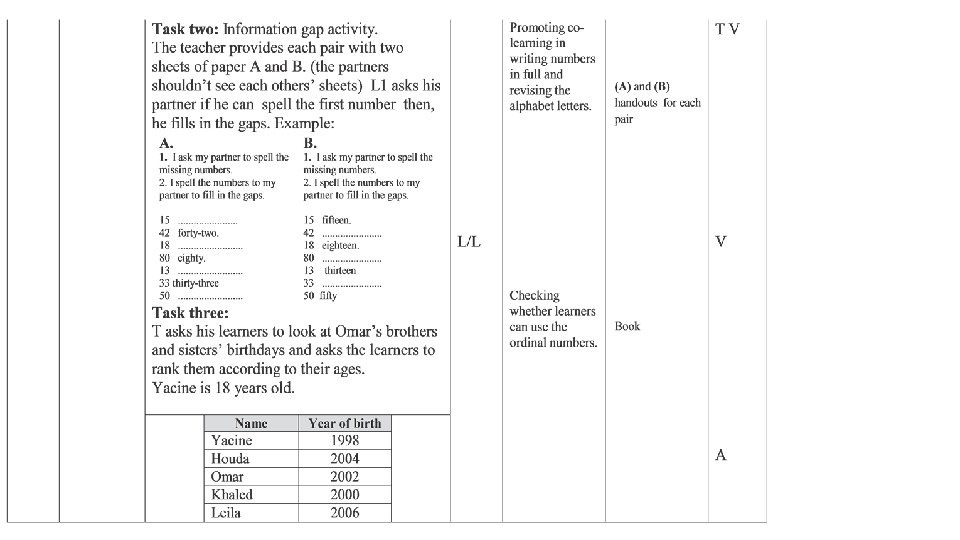
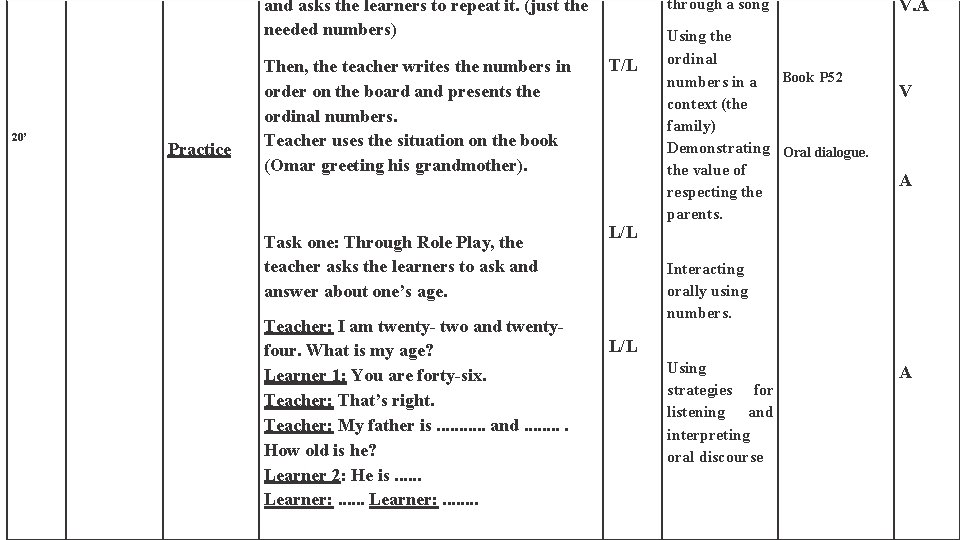
and asks the learners to repeat it. (just the needed numbers) 20’ Practice Then, the teacher writes the numbers in order on the board and presents the ordinal numbers. Teacher uses the situation on the book (Omar greeting his grandmother). Task one: Through Role Play, the teacher asks the learners to ask and answer about one’s age. Teacher: I am twenty- two and twentyfour. What is my age? Learner 1: You are forty-six. Teacher: That’s right. Teacher: My father is. . . and. . How old is he? Learner 2: He is. . . Learner: . . . . through a song T/L L/L Using the ordinal Book P 52 numbers in a context (the family) Demonstrating Oral dialogue. the value of respecting the parents. V. A V A Interacting orally using numbers. L/L Using strategies for listening and interpreting oral discourse A
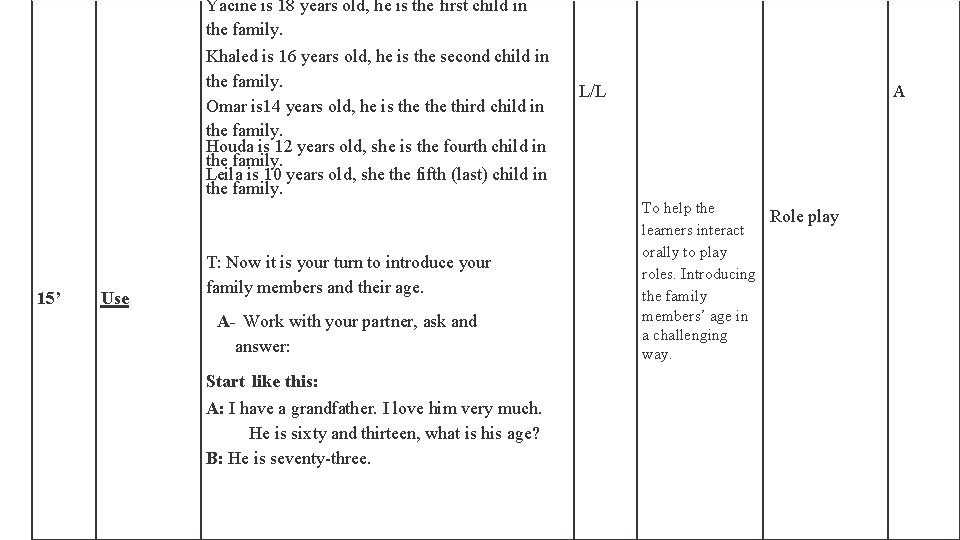
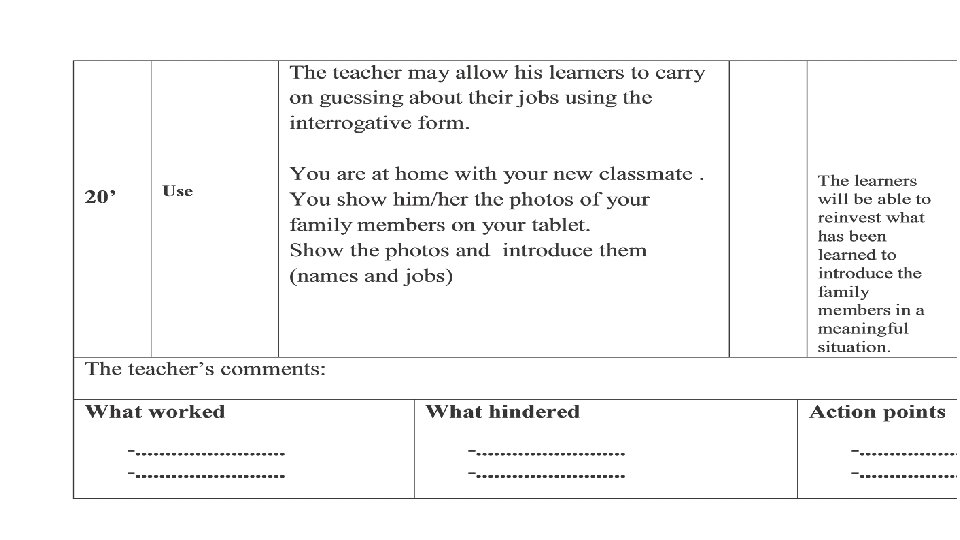
Yacine is 18 years old, he is the first child in the family. Khaled is 16 years old, he is the second child in the family. Omar is 14 years old, he is the third child in the family. Houda is 12 years old, she is the fourth child in the family. Leila is 10 years old, she the fifth (last) child in the family. 15’ Use T: Now it is your turn to introduce your family members and their age. A- Work with your partner, ask and answer: Start like this: A: I have a grandfather. I love him very much. He is sixty and thirteen, what is his age? B: He is seventy-three. L/L A To help the Role play learners interact orally to play roles. Introducing the family members’ age in a challenging way.
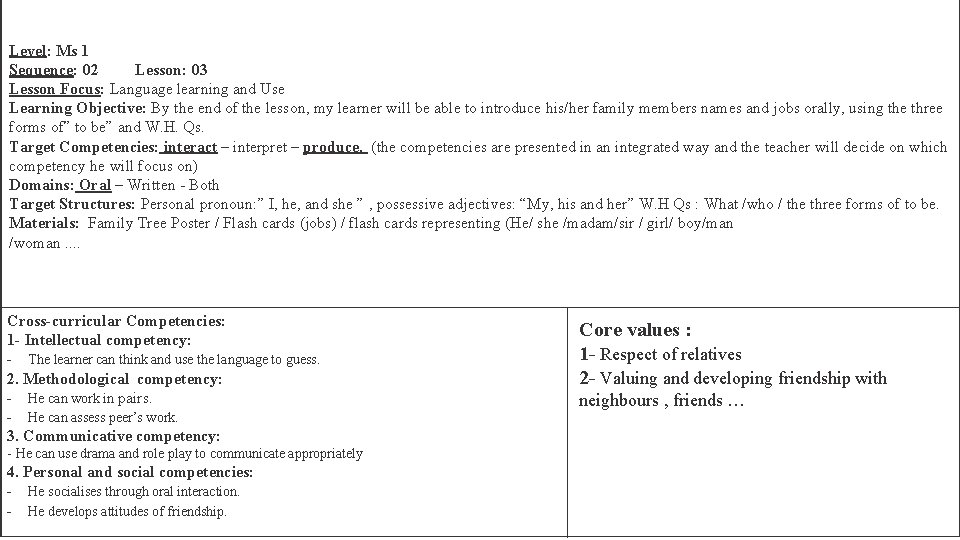
Level: Ms 1 Sequence: 02 Lesson: 03 Lesson Focus: Language learning and Use Learning Objective: By the end of the lesson, my learner will be able to introduce his/her family members names and jobs orally, using the three forms of” to be” and W. H. Qs. Target Competencies: interact – interpret – produce. (the competencies are presented in an integrated way and the teacher will decide on which competency he will focus on) Domains: Oral – Written - Both Target Structures: Personal pronoun: ” I, he, and she ” , possessive adjectives: “My, his and her” W. H Qs : What /who / the three forms of to be. Materials: Family Tree Poster / Flash cards (jobs) / flash cards representing (He/ she /madam/sir / girl/ boy/man /woman. . Cross-curricular Competencies: 1 - Intellectual competency: - The learner can think and use the language to guess. 2. Methodological competency: - He can work in pairs. - He can assess peer’s work. 3. Communicative competency: - He can use drama and role play to communicate appropriately 4. Personal and social competencies: - He socialises through oral interaction. - He develops attitudes of friendship. Core values : 1 - Respect of relatives 2 - Valuing and developing friendship with neighbours , friends …
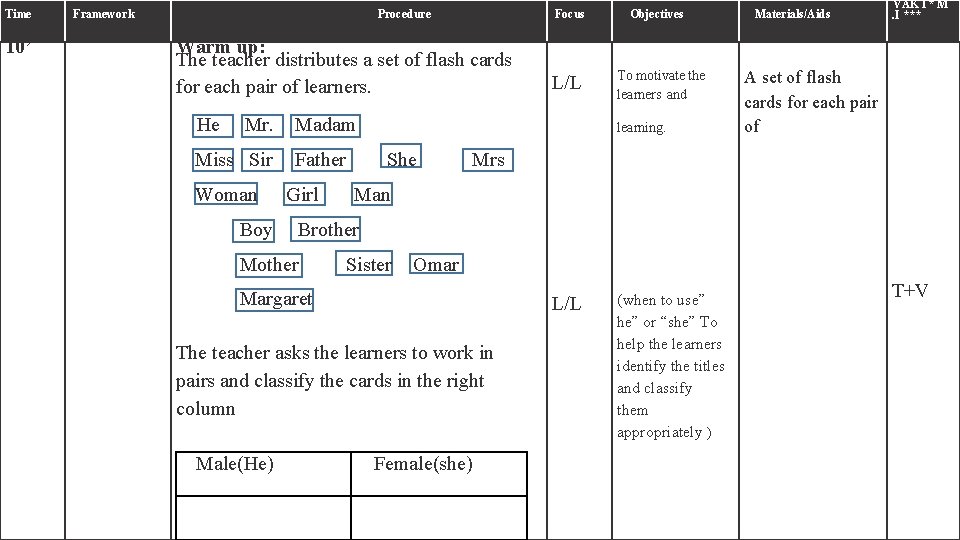
Time 10’ Framework Procedure Focus Warm up: The teacher distributes a set of flash cards for each pair of learners. He Mr. Miss Sir Woman Boy Madam Father Girl To motivate the learners and learning. She Materials/Aids VAKT* M. I *** A set of flash cards for each pair of Mrs Man Brother Mother Sister Omar Margaret L/L The teacher asks the learners to work in pairs and classify the cards in the right column Male(He) L/L Objectives Female(she) (when to use” he” or “she” To help the learners identify the titles and classify them appropriately ) T+V
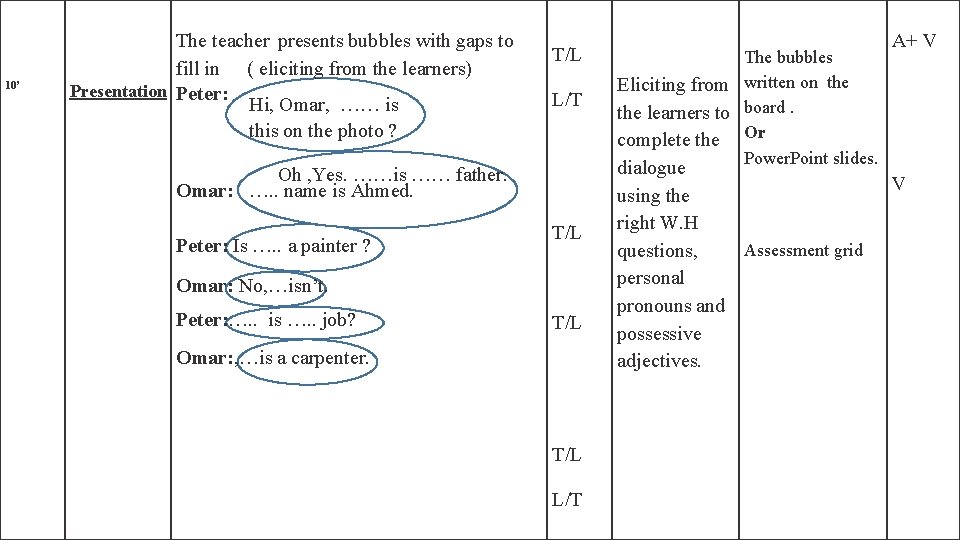
10’ The teacher presents bubbles with gaps to fill in ( eliciting from the learners) Presentation Peter: Hi, Omar, …… is this on the photo ? T/L L/T Oh , Yes. ……is …… father. Omar: …. . name is Ahmed. Peter: Is …. . a painter ? T/L Omar: No, …isn’t. Peter: …. . is …. . job? T/L Omar: , …is a carpenter. T/L L/T The bubbles Eliciting from written on the learners to board. complete the Or Power. Point slides. dialogue using the right W. H Assessment grid questions, personal pronouns and possessive adjectives. A+ V V
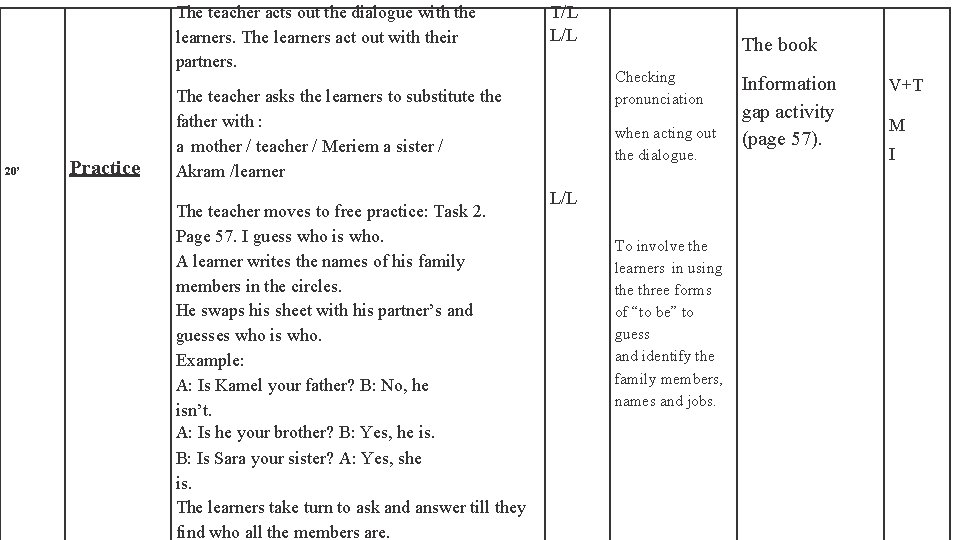
The teacher acts out the dialogue with the learners. The learners act out with their partners. 20’ Practice T/L L/L Checking pronunciation The teacher asks the learners to substitute the father with : a mother / teacher / Meriem a sister / Akram /learner The teacher moves to free practice: Task 2. Page 57. I guess who is who. A learner writes the names of his family members in the circles. He swaps his sheet with his partner’s and guesses who is who. Example: A: Is Kamel your father? B: No, he isn’t. A: Is he your brother? B: Yes, he is. B: Is Sara your sister? A: Yes, she is. The learners take turn to ask and answer till they find who all the members are. The book when acting out the dialogue. L/L To involve the learners in using the three forms of “to be” to guess and identify the family members, names and jobs. Information gap activity (page 57). V+T M I
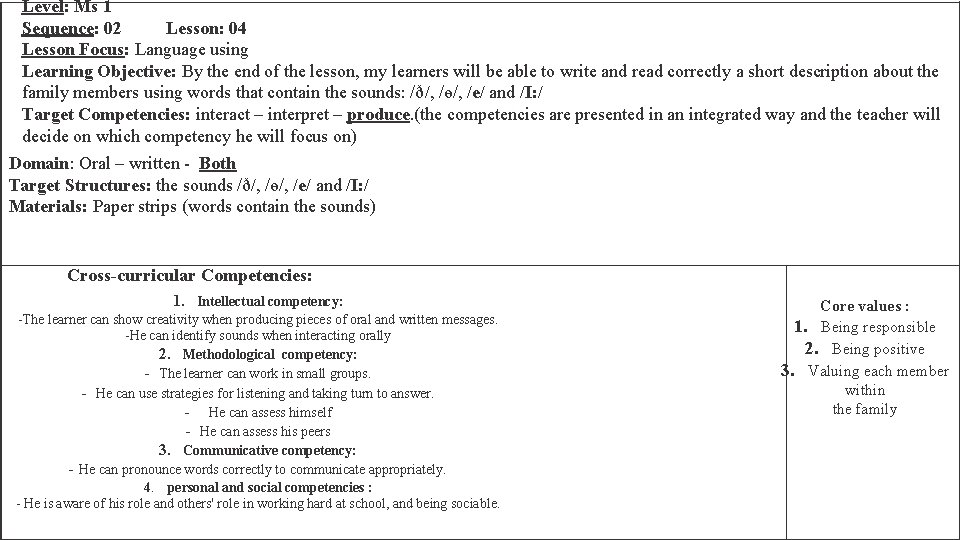
Level: Ms 1 Sequence: 02 Lesson: 04 Lesson Focus: Language using Learning Objective: By the end of the lesson, my learners will be able to write and read correctly a short description about the family members using words that contain the sounds: /ð/, /ө/, /e/ and /I: / Target Competencies: interact – interpret – produce. (the competencies are presented in an integrated way and the teacher will decide on which competency he will focus on) Domain: Oral – written - Both Target Structures: the sounds /ð/, /ө/, /e/ and /I: / Materials: Paper strips (words contain the sounds) Cross-curricular Competencies: 1. Intellectual competency: -The learner can show creativity when producing pieces of oral and written messages. -He can identify sounds when interacting orally 2. Methodological competency: - The learner can work in small groups. - He can use strategies for listening and taking turn to answer. - He can assess himself - He can assess his peers 3. Communicative competency: - He can pronounce words correctly to communicate appropriately. 4. personal and social competencies : - He is aware of his role and others' role in working hard at school, and being sociable. Core values : 1. Being responsible 2. Being positive 3. Valuing each member within the family
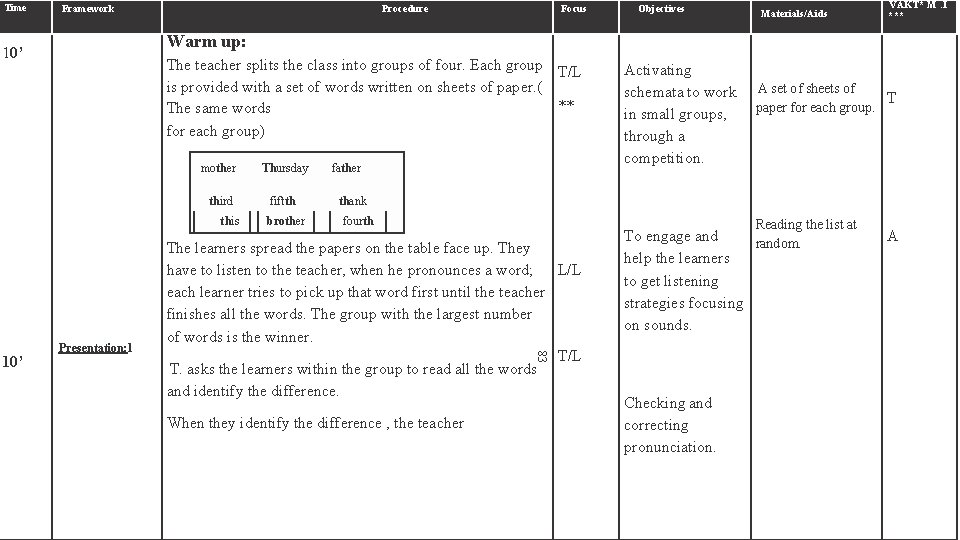
Time Framework Procedure Objectives Materials/Aids VAKT* M. I *** Warm up: 10’ The teacher splits the class into groups of four. Each group T/L is provided with a set of words written on sheets of paper. ( ** The same words for each group) mother Thursday third fiftth this Presentation: 1 brother father Activating schemata to work in small groups, through a competition. A set of sheets of T paper for each group. thank fourth Reading the list at The learners spread the papers on the table face up. They have to listen to the teacher, when he pronounces a word; L/L each learner tries to pick up that word first until the teacher finishes all the words. The group with the largest number of words is the winner. T/L T. asks the learners within the group to read all the words and identify the difference. To engage and random. help the learners to get listening strategies focusing on sounds. 83 10’ Focus When they identify the difference , the teacher Checking and correcting pronunciation. A
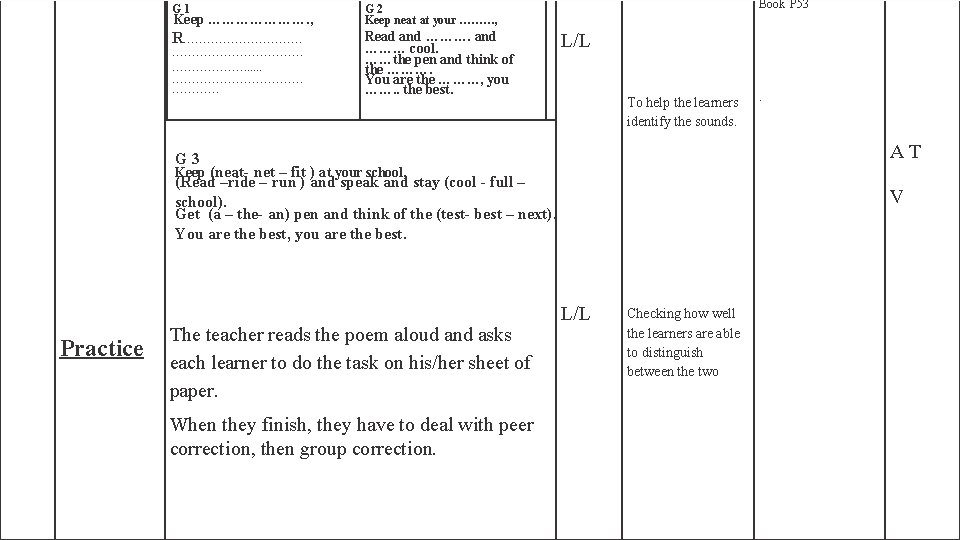
G 1 G 2 Keep neat at your ………, R…………… Read and ……… cool. ……the pen and think of the ………. You are the ………, you ……. . the best. Keep …………………. , ………………. . . ……………… Book P 53 L/L To help the learners identify the sounds. AT G 3 Keep (neat- net – fit ) at your school, (Read –ride – run ) and speak and stay (cool - full – school). Get (a – the- an) pen and think of the (test- best – next). You are the best, you are the best. Practice The teacher reads the poem aloud and asks each learner to do the task on his/her sheet of paper. When they finish, they have to deal with peer correction, then group correction. . V L/L Checking how well the learners are able to distinguish between the two
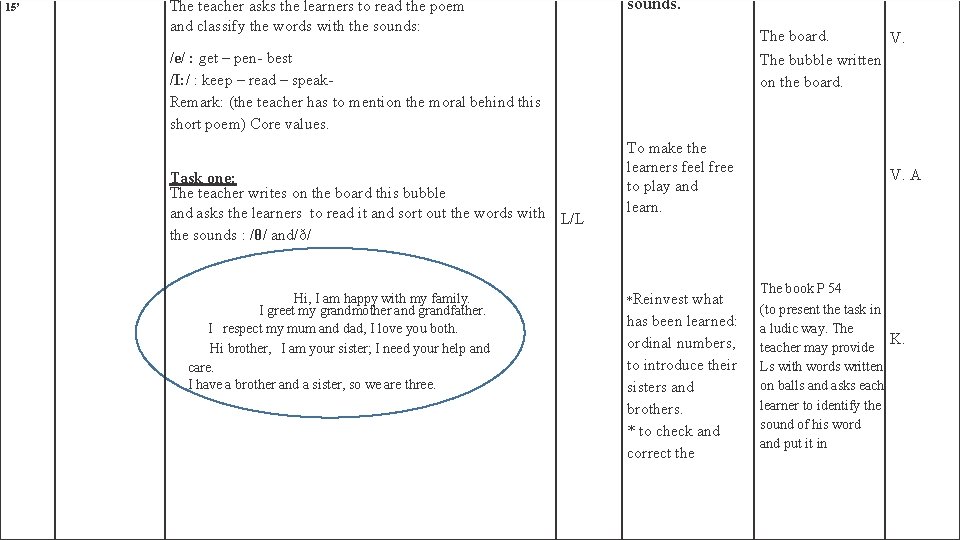
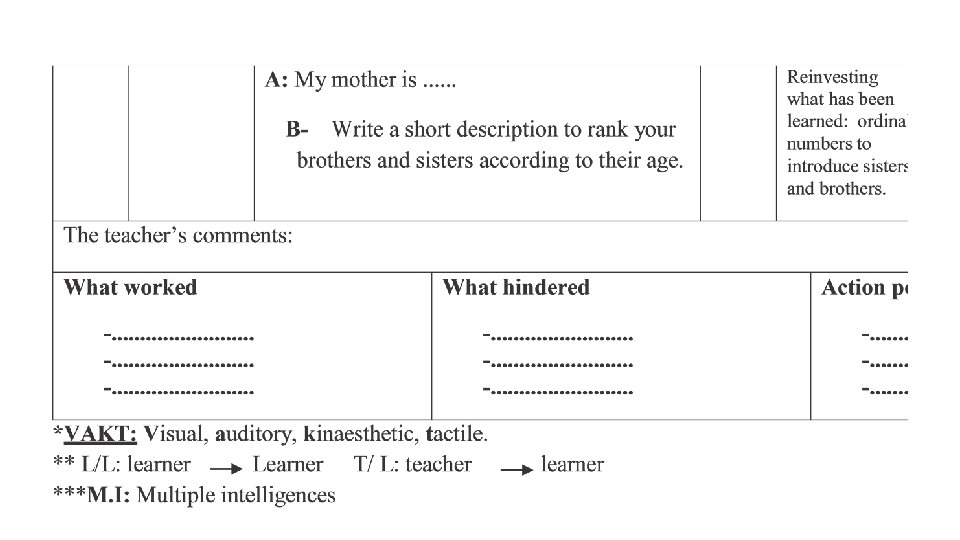
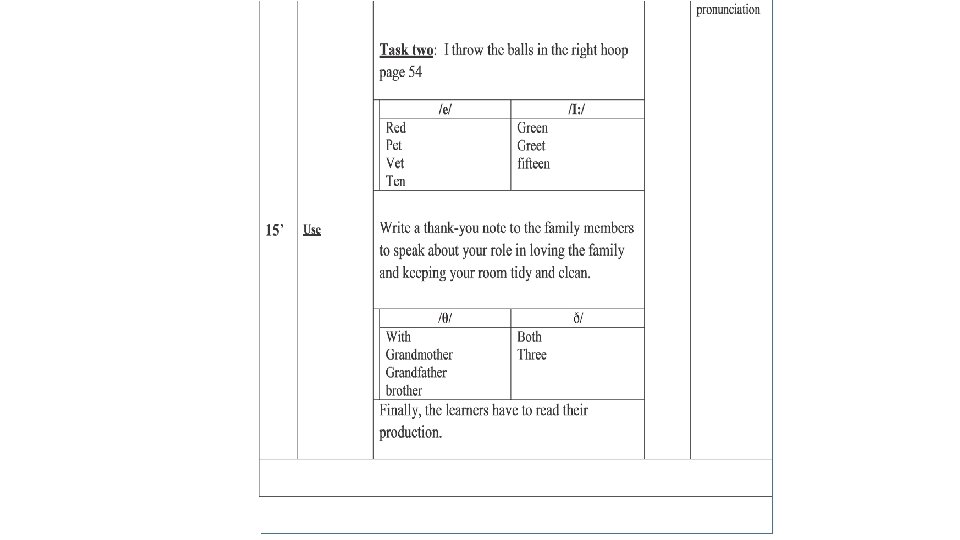
15’ The teacher asks the learners to read the poem and classify the words with the sounds: sounds. The board. V. The bubble written on the board. /e/ : get – pen- best /I: / : keep – read – speak. Remark: (the teacher has to mention the moral behind this short poem) Core values. Task one: The teacher writes on the board this bubble and asks the learners to read it and sort out the words with L/L the sounds : /θ/ and/ð/ Hi, I am happy with my family. I greet my grandmother and grandfather. I respect my mum and dad, I love you both. Hi brother, I am your sister; I need your help and care. I have a brother and a sister, so we are three. To make the learners feel free to play and learn. *Reinvest what has been learned: ordinal numbers, to introduce their sisters and brothers. * to check and correct the V. A The book P 54 (to present the task in a ludic way. The K. teacher may provide Ls with words written on balls and asks each learner to identify the sound of his word and put it in
The teacher’s comments: What worked What hindered -. . . Action points -. . . *VAKT: ** L/L: -. . . Visual, auditory, kinaesthetic, tactile. learner Learner T/ L: teacher learner
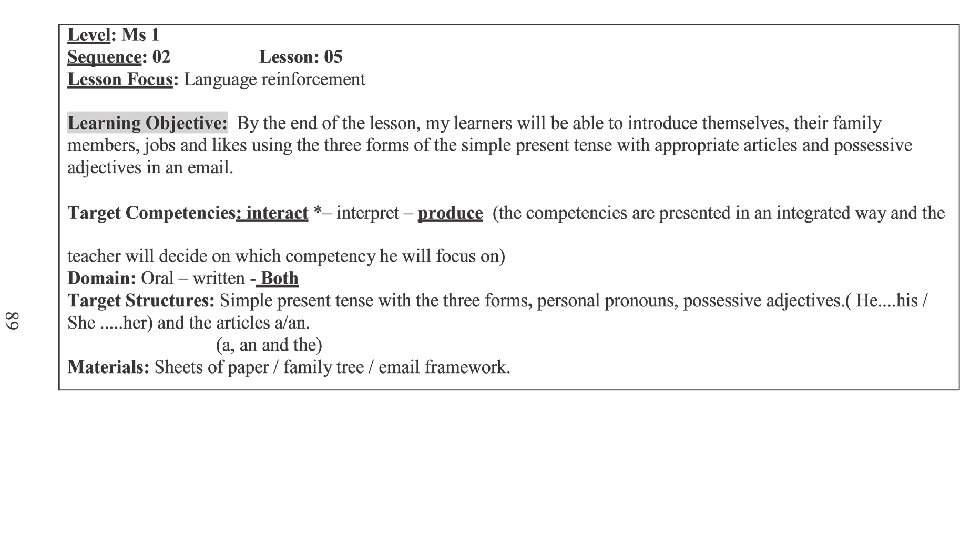
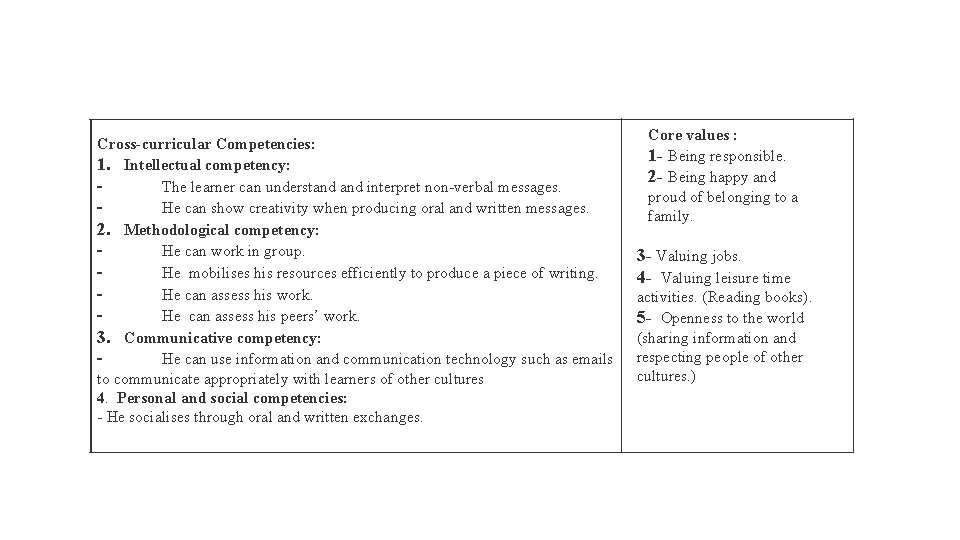
Cross-curricular Competencies: 1. Intellectual competency: The learner can understand interpret non-verbal messages. He can show creativity when producing oral and written messages. 2. Methodological competency: He can work in group. He mobilises his resources efficiently to produce a piece of writing. He can assess his work. He can assess his peers’ work. 3. Communicative competency: He can use information and communication technology such as emails to communicate appropriately with learners of other cultures 4. Personal and social competencies: - He socialises through oral and written exchanges. Core values : 1 - Being responsible. 2 - Being happy and proud of belonging to a family. 3 - Valuing jobs. 4 - Valuing leisure time activities. (Reading books). 5 - Openness to the world (sharing information and respecting people of other cultures. )
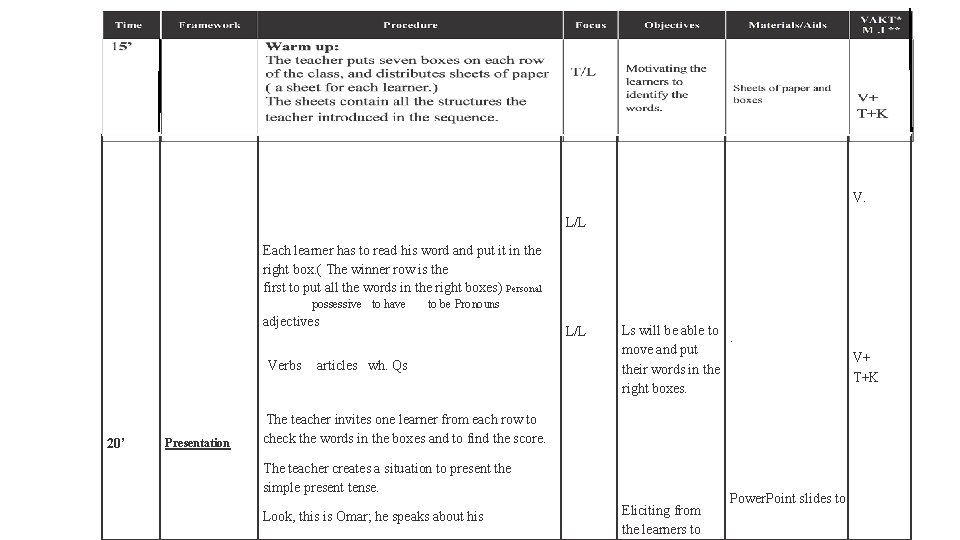
V. L/L Each learner has to read his word and put it in the right box. ( The winner row is the first to put all the words in the right boxes) Personal possessive to have to be Pronouns adjectives Verbs 20’ Presentation articles wh. Qs L/L Ls will be able to move and put their words in the right boxes. . V+ T+K The teacher invites one learner from each row to check the words in the boxes and to find the score. The teacher creates a situation to present the simple present tense. Look, this is Omar; he speaks about his Eliciting from the learners to Power. Point slides to
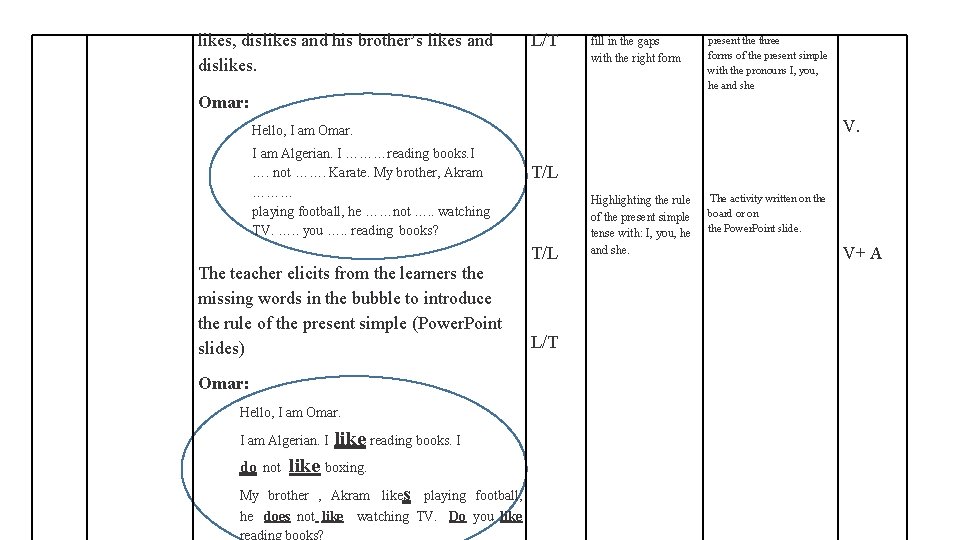
likes, dislikes and his brother’s likes and dislikes. L/T fill in the gaps with the right form present the three forms of the present simple with the pronouns I, you, he and she Omar: V. Hello, I am Omar. I am Algerian. I ………reading books. I …. not ……. Karate. My brother, Akram ……… playing football, he ……not …. . watching TV. …. . you …. . reading books? T/L The teacher elicits from the learners the missing words in the bubble to introduce the rule of the present simple (Power. Point slides) Omar: Hello, I am Omar. I am Algerian. I do not like reading books. I like boxing. My brother , Akram likes playing football, he does not like watching TV. Do you like reading books? L/T Highlighting the rule of the present simple tense with: I, you, he and she. The activity written on the board or on the Power. Point slide. V+ A
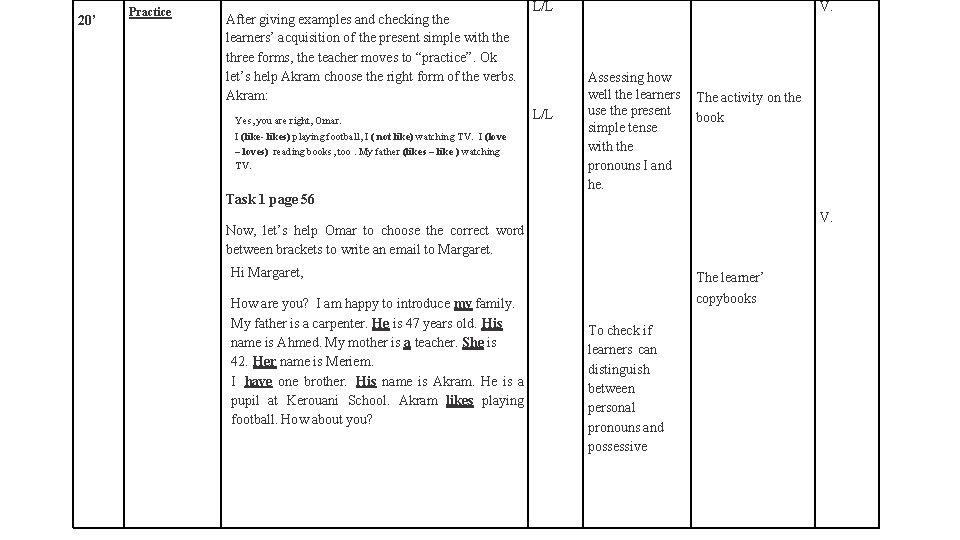
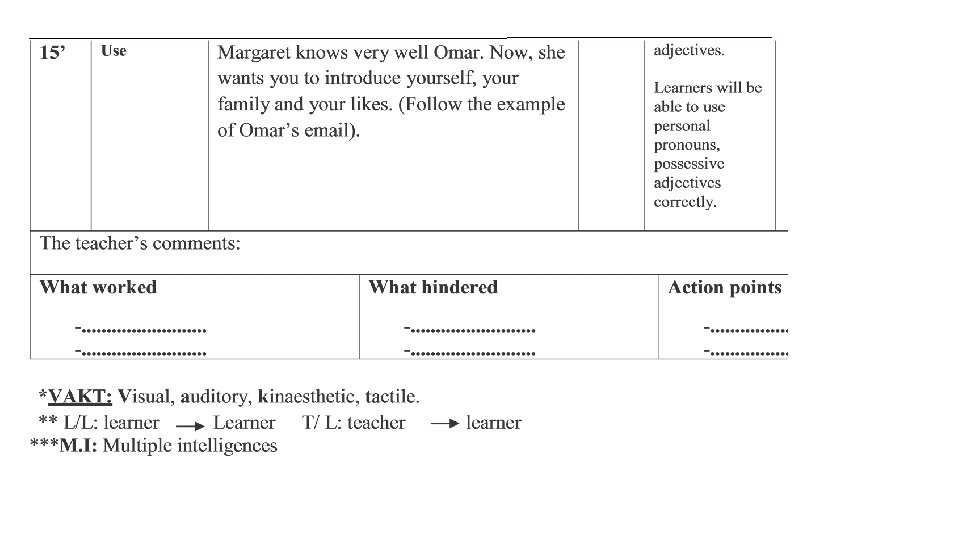
20’ Practice After giving examples and checking the learners’ acquisition of the present simple with the three forms, the teacher moves to “practice”. Ok let’s help Akram choose the right form of the verbs. Akram: Yes, you are right, Omar. I (like- likes) playing football, I ( not like) watching TV. I (love – loves) reading books, too. My father (likes – like ) watching TV. Task 1 page 56 L/L V. Assessing how well the learners use the present simple tense with the pronouns I and he. The activity on the book V. Now, let’s help Omar to choose the correct word between brackets to write an email to Margaret. Hi Margaret, How are you? I am happy to introduce my family. My father is a carpenter. He is 47 years old. His name is Ahmed. My mother is a teacher. She is 42. Her name is Meriem. I have one brother. His name is Akram. He is a pupil at Kerouani School. Akram likes playing football. How about you? The learner’ copybooks To check if learners can distinguish between personal pronouns and possessive
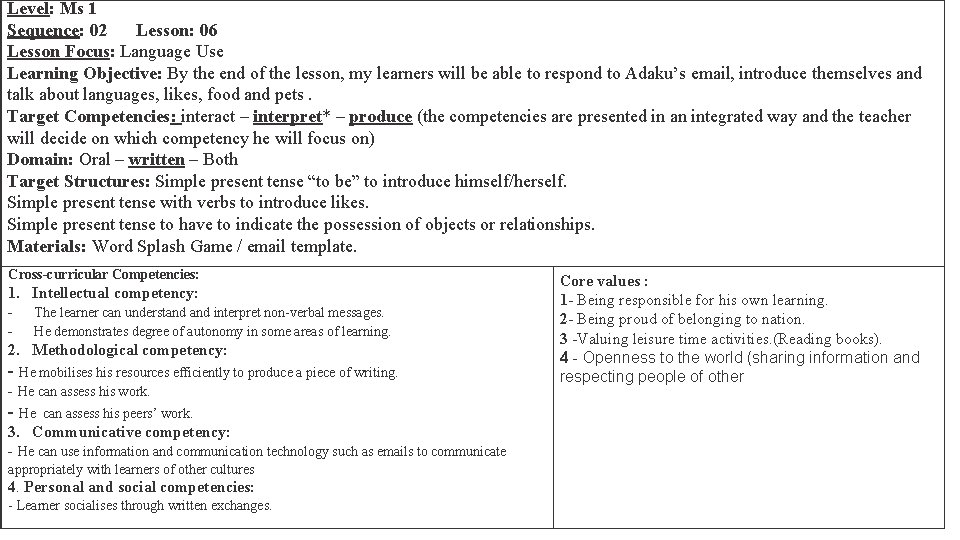
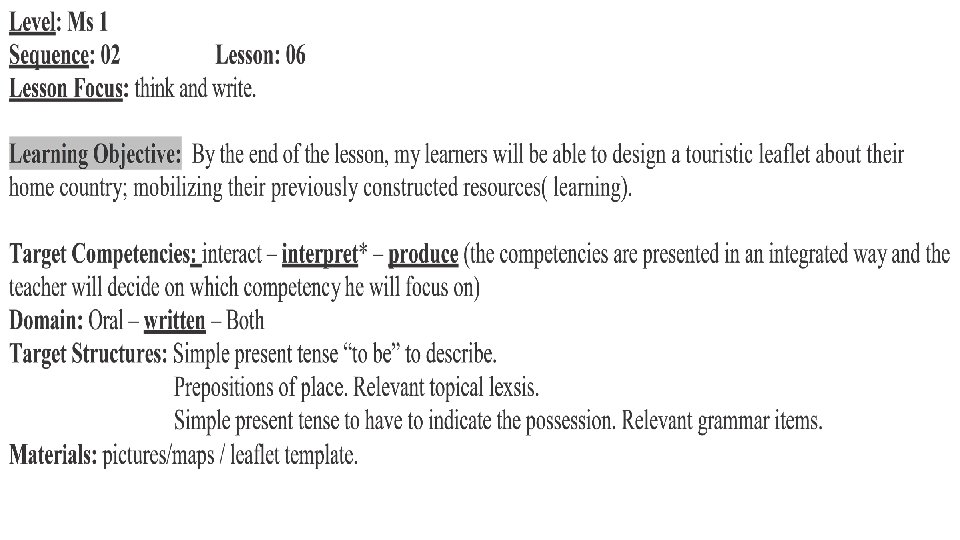
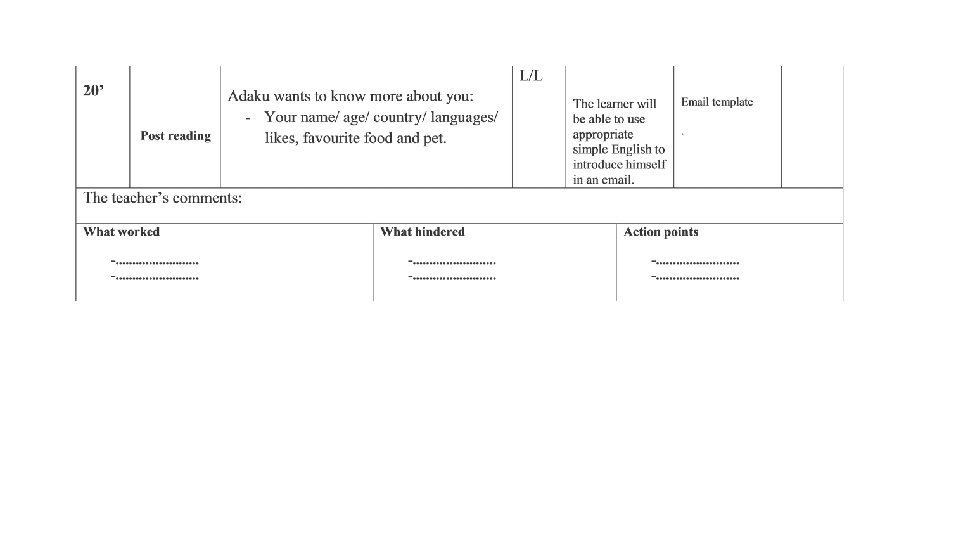
Level: Ms 1 Sequence: 02 Lesson: 06 Lesson Focus: Language Use Learning Objective: By the end of the lesson, my learners will be able to respond to Adaku’s email, introduce themselves and talk about languages, likes, food and pets. Target Competencies: interact – interpret* – produce (the competencies are presented in an integrated way and the teacher will decide on which competency he will focus on) Domain: Oral – written – Both Target Structures: Simple present tense “to be” to introduce himself/herself. Simple present tense with verbs to introduce likes. Simple present tense to have to indicate the possession of objects or relationships. Materials: Word Splash Game / email template. Cross-curricular Competencies: 1. 2. Intellectual competency: The learner can understand interpret non-verbal messages. He demonstrates degree of autonomy in some areas of learning. Methodological competency: - He mobilises his resources efficiently to produce a piece of writing. - He can assess his work. - He can assess his peers’ work. 3. Communicative competency: - He can use information and communication technology such as emails to communicate appropriately with learners of other cultures 4. Personal and social competencies: - Learner socialises through written exchanges. Core values : 1 - Being responsible for his own learning. 2 - Being proud of belonging to nation. 3 -Valuing leisure time activities. (Reading books). 4 - Openness to the world (sharing information and respecting people of other
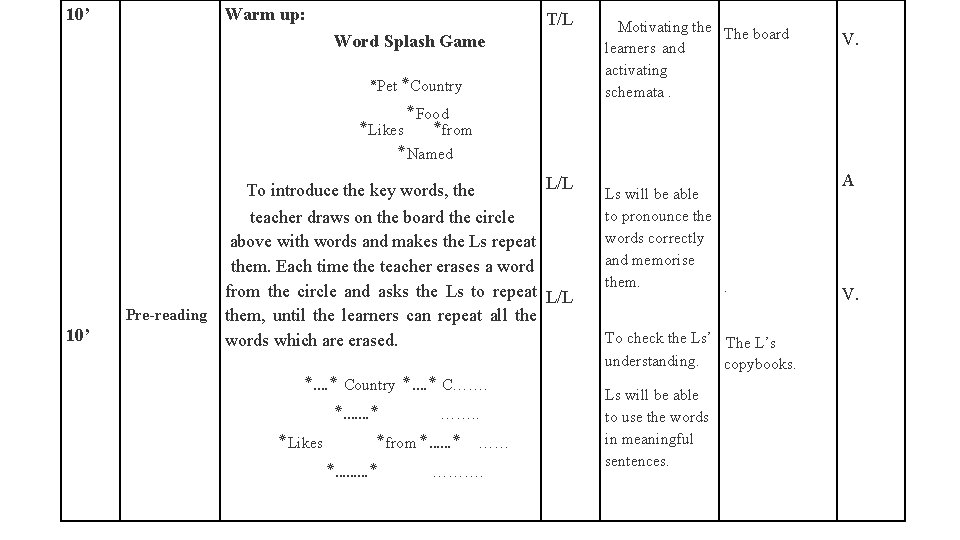
10’ Warm up: T/L Word Splash Game ٭ Pet ٭ Country Motivating the The board learners and activating schemata. V. ٭ Food ٭ Likes ٭ from ٭ Named 10’ L/L To introduce the key words, the teacher draws on the board the circle above with words and makes the Ls repeat them. Each time the teacher erases a word from the circle and asks the Ls to repeat L/L Pre-reading them, until the learners can repeat all the words which are erased. ٭. … ٭ Country ٭. … ٭ C……. ٭. …… ٭ ……. . ٭ Likes ٭ from …… ٭……٭ ٭………٭ ………. Ls will be able to pronounce the words correctly and memorise them. . To check the Ls’ The L’s understanding. copybooks. Ls will be able to use the words in meaningful sentences. A V.
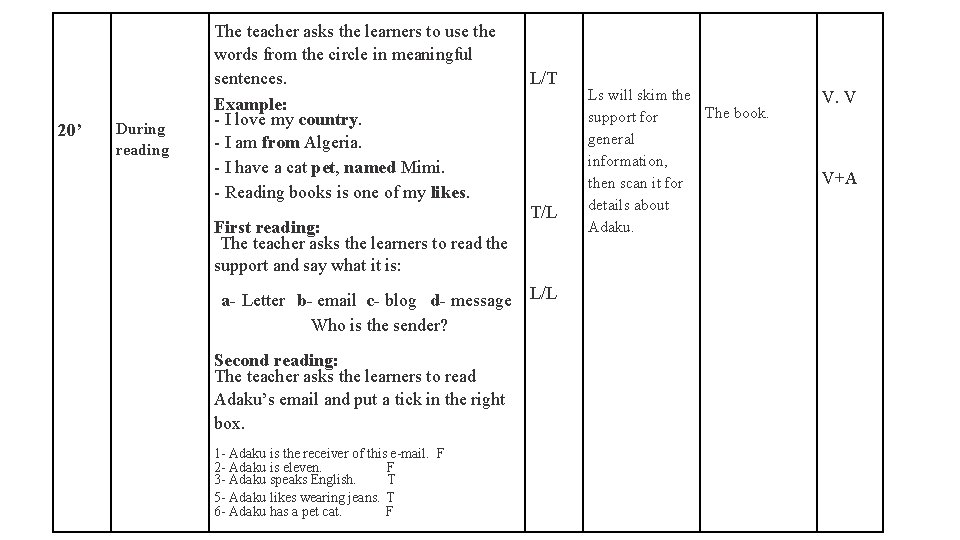
20’ During reading The teacher asks the learners to use the words from the circle in meaningful sentences. Example: - I love my country. - I am from Algeria. - I have a cat pet, named Mimi. - Reading books is one of my likes. First reading: The teacher asks the learners to read the support and say what it is: a- Letter b- email c- blog d- message Who is the sender? Second reading: The teacher asks the learners to read Adaku’s email and put a tick in the right box. 1 - Adaku is the receiver of this e-mail. F 2 - Adaku is eleven. F 3 - Adaku speaks English. T 5 - Adaku likes wearing jeans. T 6 - Adaku has a pet cat. F L/T T/L Ls will skim the The book. support for general information, then scan it for details about Adaku. V. V V+A

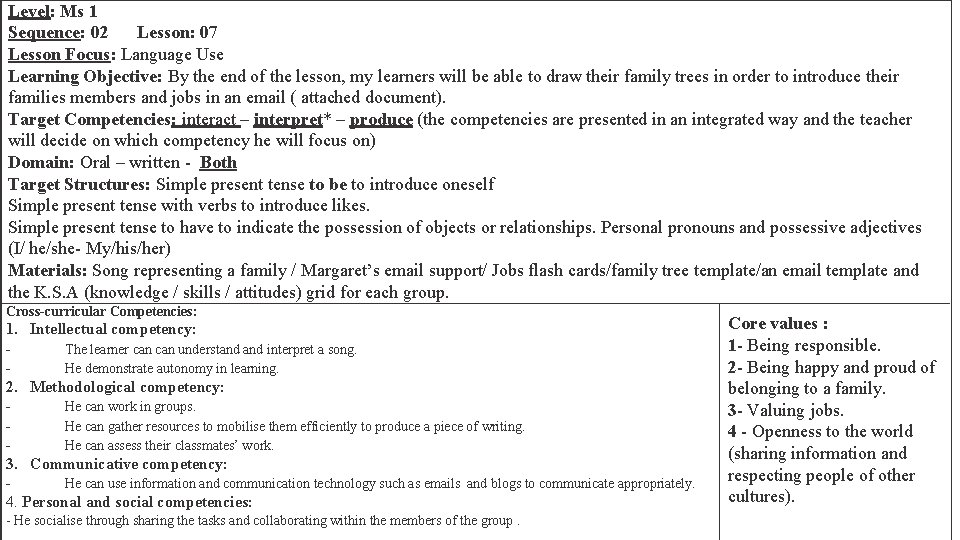
Level: Ms 1 Sequence: 02 Lesson: 07 Lesson Focus: Language Use Learning Objective: By the end of the lesson, my learners will be able to draw their family trees in order to introduce their families members and jobs in an email ( attached document). Target Competencies: interact – interpret* – produce (the competencies are presented in an integrated way and the teacher will decide on which competency he will focus on) Domain: Oral – written - Both Target Structures: Simple present tense to be to introduce oneself Simple present tense with verbs to introduce likes. Simple present tense to have to indicate the possession of objects or relationships. Personal pronouns and possessive adjectives (I/ he/she- My/his/her) Materials: Song representing a family / Margaret’s email support/ Jobs flash cards/family tree template/an email template and the K. S. A (knowledge / skills / attitudes) grid for each group. Cross-curricular Competencies: 1. Intellectual competency: The learner can understand interpret a song. He demonstrate autonomy in learning. 2. Methodological competency: He can work in groups. He can gather resources to mobilise them efficiently to produce a piece of writing. He can assess their classmates’ work. 3. Communicative competency: He can use information and communication technology such as emails and blogs to communicate appropriately. 4. Personal and social competencies: - He socialise through sharing the tasks and collaborating within the members of the group. Core values : 1 - Being responsible. 2 - Being happy and proud of belonging to a family. 3 - Valuing jobs. 4 - Openness to the world (sharing information and respecting people of other cultures).
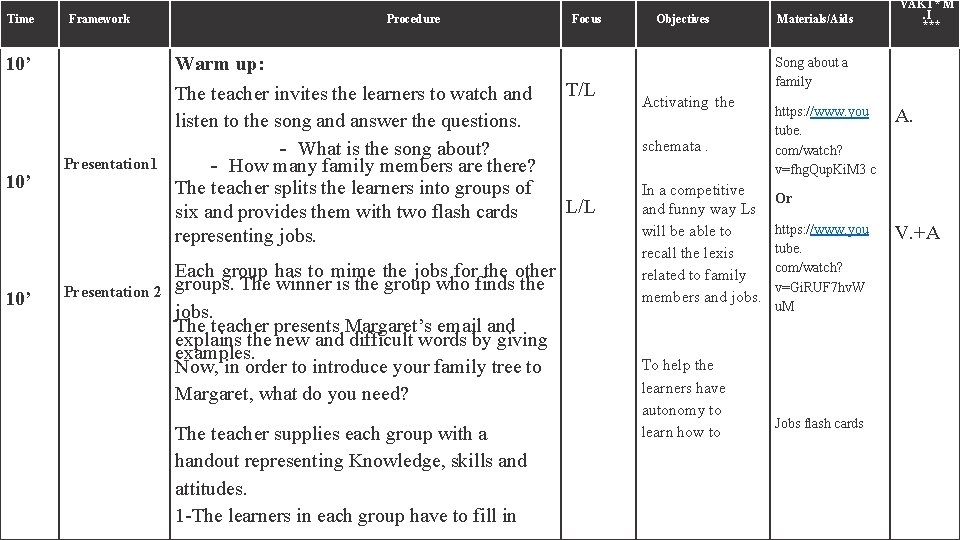
Time Framework 10’ 10’ Presentation 1 Presentation 2 Procedure Warm up: The teacher invites the learners to watch and listen to the song and answer the questions. - What is the song about? - How many family members are there? The teacher splits the learners into groups of six and provides them with two flash cards representing jobs. Each group has to mime the jobs for the other groups. The winner is the group who finds the jobs. The teacher presents Margaret’s email and explains the new and difficult words by giving examples. Now, in order to introduce your family tree to Margaret, what do you need? The teacher supplies each group with a handout representing Knowledge, skills and attitudes. 1 -The learners in each group have to fill in Focus T/L Objectives VAKT* M. I *** Song about a family Activating the schemata. L/L Materials/Aids In a competitive and funny way Ls will be able to recall the lexis related to family members and jobs. To help the learners have autonomy to learn how to https: //www. you tube. com/watch? v=fhg. Qup. Ki. M 3 c A. Or https: //www. you tube. com/watch? v=Gi. RUF 7 hv. W u. M Jobs flash cards V. +A
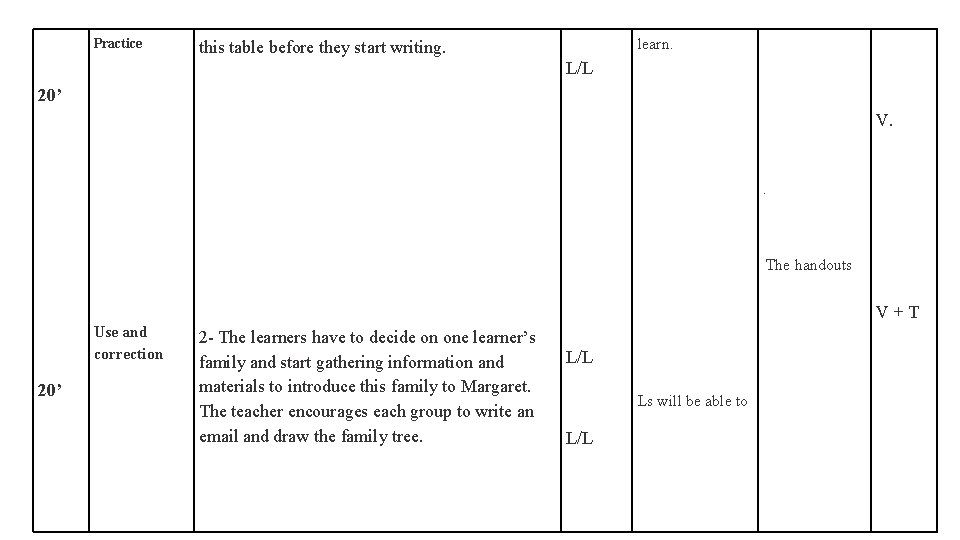
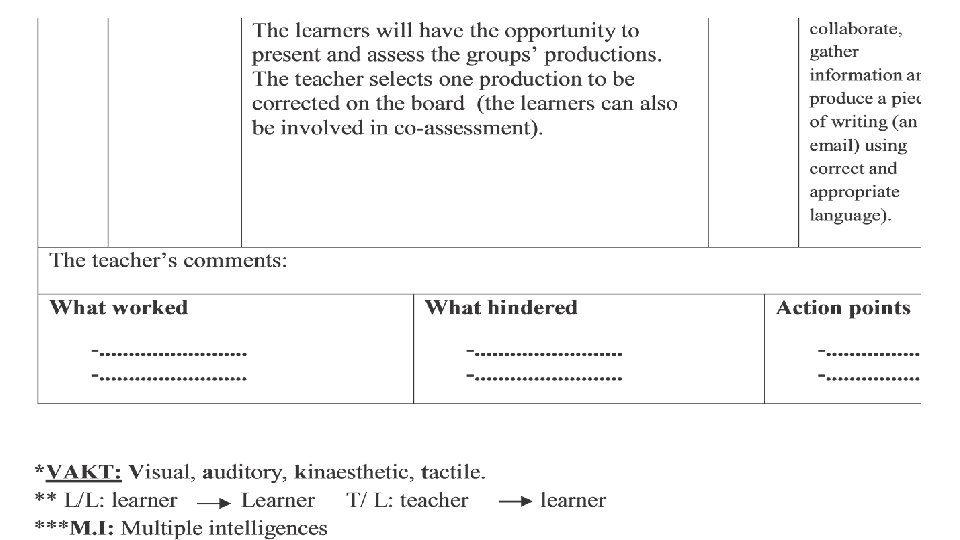
Practice learn. this table before they start writing. L/L 20’ V. . The handouts V+T Use and correction 20’ 2 - The learners have to decide on one learner’s family and start gathering information and materials to introduce this family to Margaret. The teacher encourages each group to write an email and draw the family tree. L/L Ls will be able to L/L
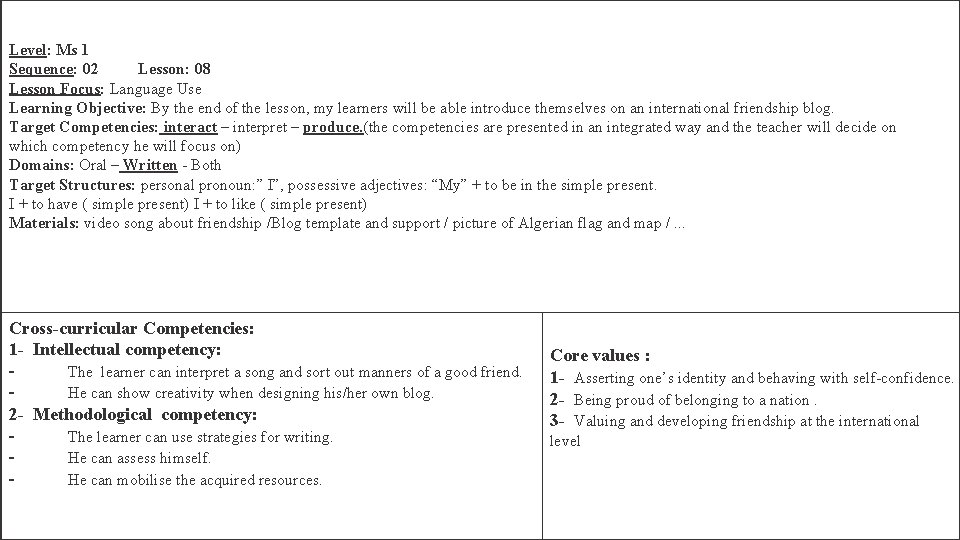
Level: Ms 1 Sequence: 02 Lesson: 08 Lesson Focus: Language Use Learning Objective: By the end of the lesson, my learners will be able introduce themselves on an international friendship blog. Target Competencies: interact – interpret – produce. (the competencies are presented in an integrated way and the teacher will decide on which competency he will focus on) Domains: Oral – Written - Both Target Structures: personal pronoun: ” I”, possessive adjectives: “My” + to be in the simple present. I + to have ( simple present) I + to like ( simple present) Materials: video song about friendship /Blog template and support / picture of Algerian flag and map /. . . Cross-curricular Competencies: 1 - Intellectual competency: The learner can interpret a song and sort out manners of a good friend. He can show creativity when designing his/her own blog. 2 - Methodological competency: The learner can use strategies for writing. He can assess himself. He can mobilise the acquired resources. Core values : 1 - Asserting one’s identity and behaving with self-confidence. 2 - Being proud of belonging to a nation. 3 - Valuing and developing friendship at the international level
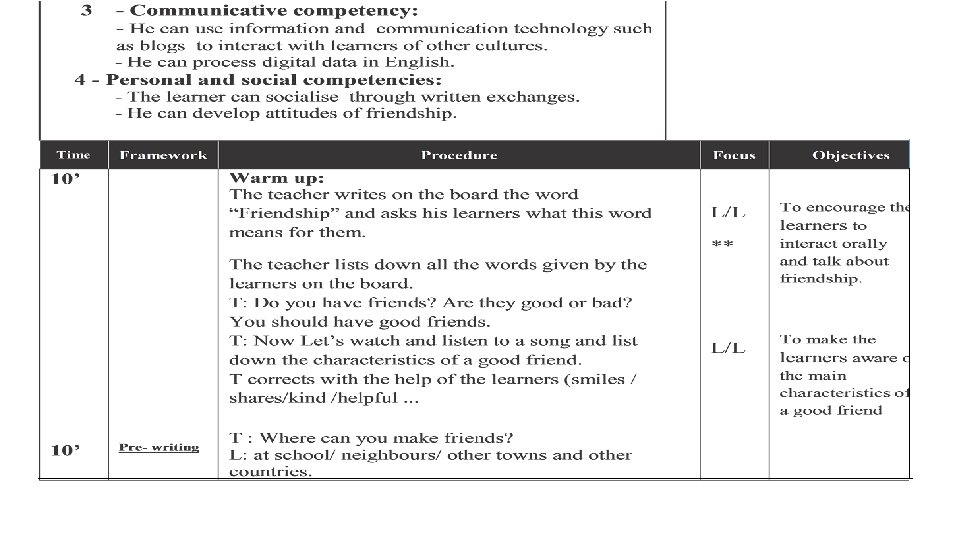
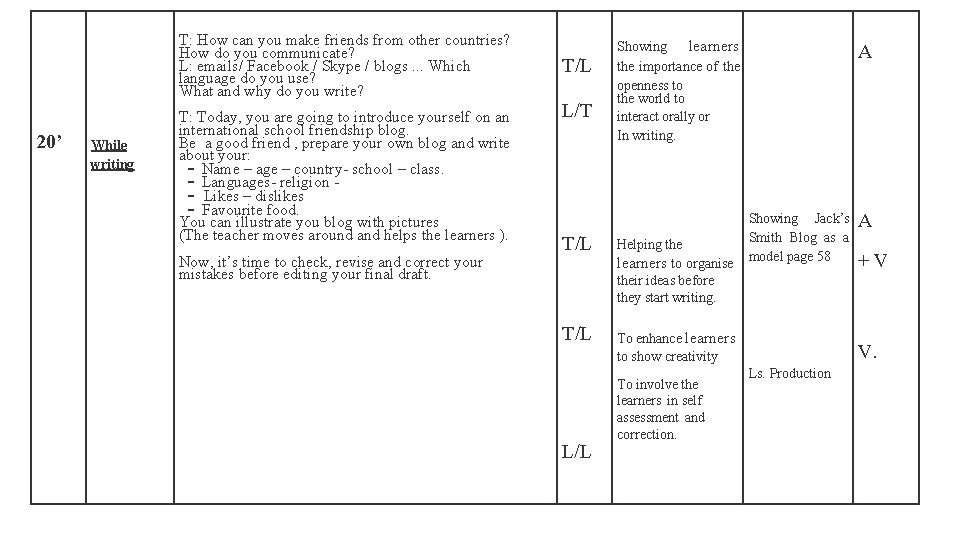
T: How can you make friends from other countries? How do you communicate? L: emails/ Facebook / Skype / blogs. . . Which language do you use? What and why do you write? 20’ While writing T: Today, you are going to introduce yourself on an international school friendship blog. Be a good friend , prepare your own blog and write about your: - Name – age – country- school – class. - Languages- religion - Likes – dislikes - Favourite food. You can illustrate you blog with pictures (The teacher moves around and helps the learners ). Now, it’s time to check, revise and correct your mistakes before editing your final draft. T/L L/T T/L L/L Showing learners the importance of the openness to the world to interact orally or In writing. Helping the learners to organise their ideas before they start writing. A Showing Jack’s Smith Blog as a model page 58 To enhance learners to show creativity To involve the learners in self assessment and correction. A +V V. Ls. Production
- Slides: 103