
MVTS Porta Billing Infrastructure for global communications Integration
MVTS & Porta. Billing Infrastructure for global communications Integration between MVTS (Mera Vo. IP Transit Softswitch) and Porta. Billing 100 Porta Software http: //www. portaone. com Mera Networks http: //www. mera-voip. com Vancouver, BC July 2004
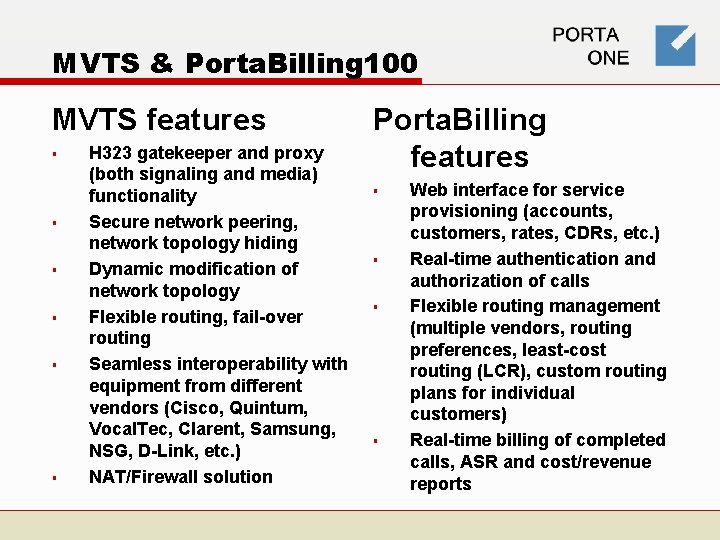
MVTS & Porta. Billing 100 MVTS features § § § H 323 gatekeeper and proxy (both signaling and media) functionality Secure network peering, network topology hiding Dynamic modification of network topology Flexible routing, fail-over routing Seamless interoperability with equipment from different vendors (Cisco, Quintum, Vocal. Tec, Clarent, Samsung, NSG, D-Link, etc. ) NAT/Firewall solution Porta. Billing features § § Web interface for service provisioning (accounts, customers, rates, CDRs, etc. ) Real-time authentication and authorization of calls Flexible routing management (multiple vendors, routing preferences, least-cost routing (LCR), custom routing plans for individual customers) Real-time billing of completed calls, ASR and cost/revenue reports
Integration between MVTS and Porta. Billing 100 Operations performed in tandem by MVTS and Porta. Billing 100: § § Endpoint registration (authentication) Call authorization Call routing Billing completed calls
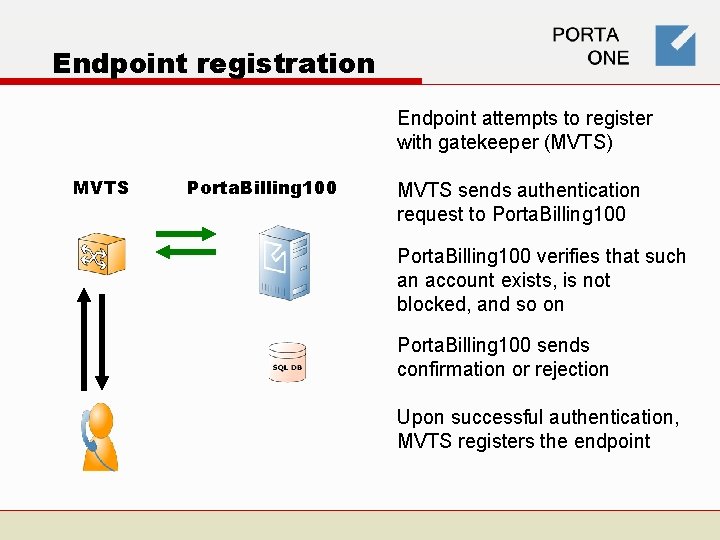
Endpoint registration Endpoint attempts to register with gatekeeper (MVTS) MVTS Porta. Billing 100 MVTS sends authentication request to Porta. Billing 100 verifies that such an account exists, is not blocked, and so on Porta. Billing 100 sends confirmation or rejection Upon successful authentication, MVTS registers the endpoint
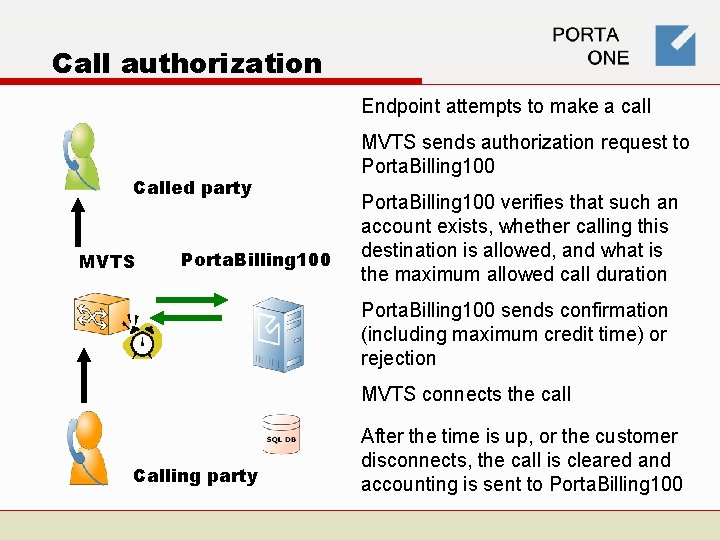
Call authorization Endpoint attempts to make a call Called party MVTS Porta. Billing 100 MVTS sends authorization request to Porta. Billing 100 verifies that such an account exists, whether calling this destination is allowed, and what is the maximum allowed call duration Porta. Billing 100 sends confirmation (including maximum credit time) or rejection MVTS connects the call Calling party After the time is up, or the customer disconnects, the call is cleared and accounting is sent to Porta. Billing 100
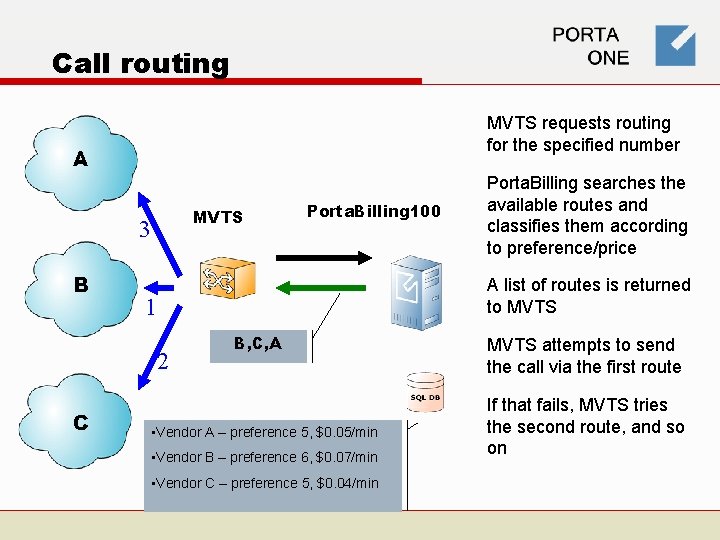
Call routing MVTS requests routing for the specified number A MVTS 3 B A list of routes is returned to MVTS 1 2 C Porta. Billing 100 Porta. Billing searches the available routes and classifies them according to preference/price B, C, A • Vendor A – preference 5, $0. 05/min • Vendor B – preference 6, $0. 07/min • Vendor C – preference 5, $0. 04/min MVTS attempts to send the call via the first route If that fails, MVTS tries the second route, and so on
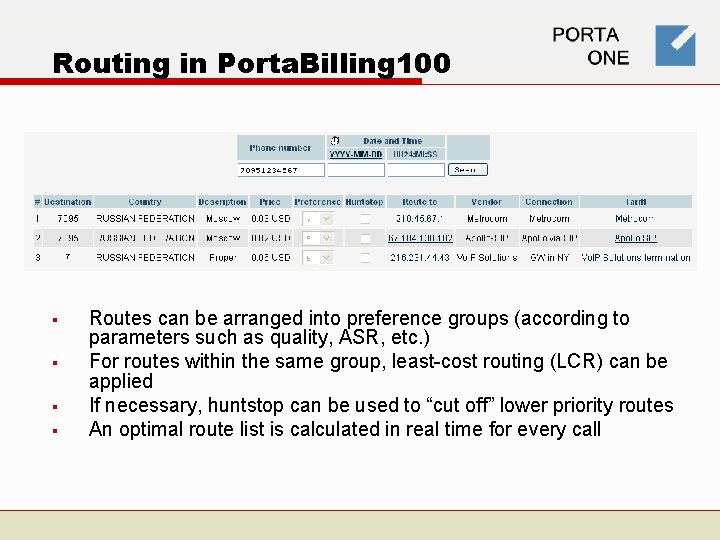
Routing in Porta. Billing 100 § § Routes can be arranged into preference groups (according to parameters such as quality, ASR, etc. ) For routes within the same group, least-cost routing (LCR) can be applied If necessary, huntstop can be used to “cut off” lower priority routes An optimal route list is calculated in real time for every call
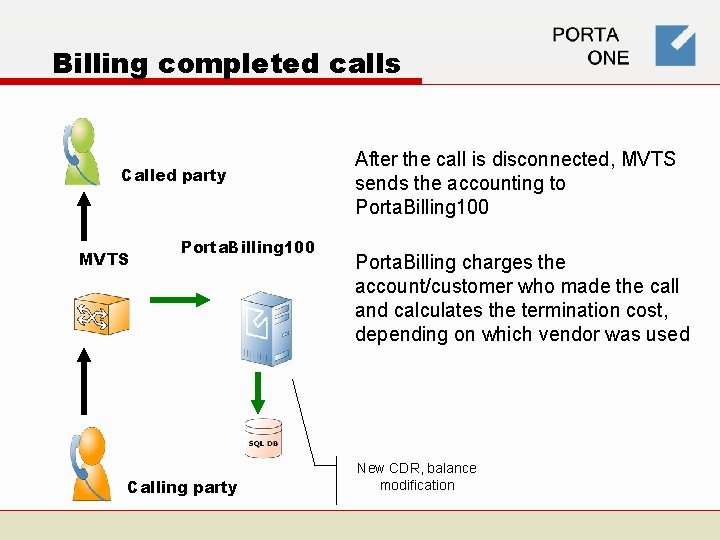
Billing completed calls Called party MVTS Porta. Billing 100 Calling party After the call is disconnected, MVTS sends the accounting to Porta. Billing 100 Porta. Billing charges the account/customer who made the call and calculates the termination cost, depending on which vendor was used New CDR, balance modification
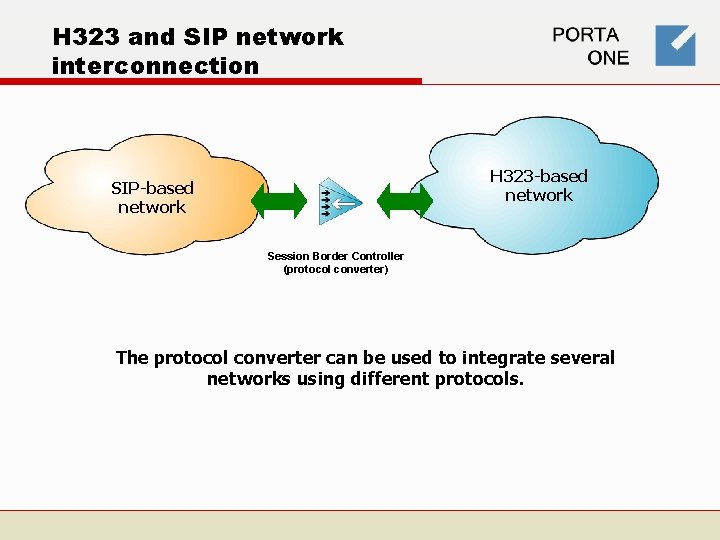
H 323 and SIP network interconnection H 323 -based network SIP-based network Session Border Controller (protocol converter) The protocol converter can be used to integrate several networks using different protocols.
Porta. Switch & SIP-HIT Porta. Switch allows: SIP-HIT allows: § § Easy web-based provisioning and management of SIP accounts Auto-configuration tool for SIP UAs (Cisco ATA, etc. ) Class 5 features (call transfer, abbreviated dialing, customer-based numbering plans, etc. ) Special features (follow-me services, unified messaging integration, etc. ) § § § Terminating calls to legacy H 323 networks or receiving calls from such networks Codec conversion, solving vendor incompatibility issues Optional usage of MVTS for advanced call handling
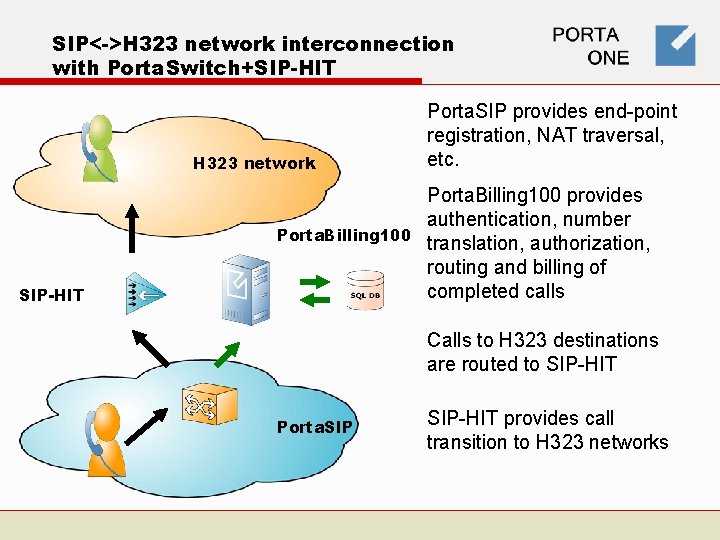
SIP<->H 323 network interconnection with Porta. Switch+SIP-HIT H 323 network Porta. Billing 100 SIP-HIT Porta. SIP provides end-point registration, NAT traversal, etc. Porta. Billing 100 provides authentication, number translation, authorization, routing and billing of completed calls Calls to H 323 destinations are routed to SIP-HIT Porta. SIP-HIT provides call transition to H 323 networks
Conclusion Porta Software's Porta. Billing/Porta. SIP and MERA Networks' MVTS are highly symbiotic products - the "yin and yang" of Vo. IP. Each component's functionality ideally fits the other's to create a complete and perfect Vo. IP solution, with scalable architecture and open protocols for easy integration. [
- Slides: 12