
MV weaning Critical Care Nursing 2 ed Year



- Slides: 19
MV weaning Critical Care Nursing, 2 ed Year Student PREPARED BY: DR. Warda Ramadan Lecturer of critical care & emergency nursing
Definition weaning is the process whereby a patient is transferred from mechanical ventilation support to spontaneous breathing. i. e weaning is the gradual process of removing the patient from mechanical ventilation therapy.
Methods of weaning 1 - T- piece trial. 2 - Continuous Positive Airway pressure (CPAP). 3 -Synchronized intermittent mandatory (SIMV). 4 - pressure support ventilation (PSV)
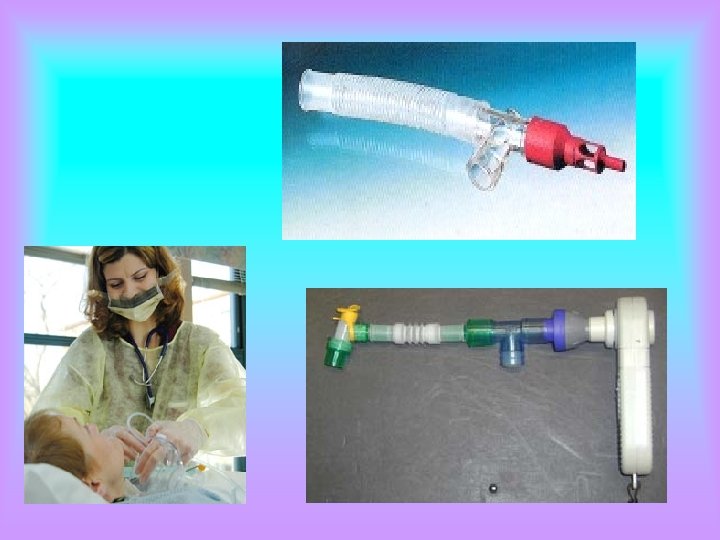
T-Piece trial : *Consists of removing the patient from the ventilator and having him/her breathe spontaneously on a T-tube connected to oxygen source. *After a time , the patient is placed back on the ventilator. *The goal is to progressively increase the time spent off the ventilator
CPAP Continuous positive airway pressure Is similar to T-piece trial. All ventilation is spontaneously initiated by the patient.
Synchronized intermittent mandatory ventilation (SIMV) The ventilator provides the patient with apre-set number of breaths/minute at a specified tidal volume and fio 2. -In between the ventilator delivered breathes , the patient is able to breathe spontaneously. -The ventilator does not assist the spontaneous breath.
SIMV weaning • Is the most common method of weaning. • It consists of gradually decreasing the number of breaths delivered by ventilator to allow the patient to increase the number of spontaneous breaths
Pressure support ventilation PSV -With PSV , the patient breaths spontaneously while the ventilator applies apre determined amount of positive pressure to the airway upon inspiration. -PSV, assisting each spontaneous inspiration. -indicated for patients with small spontaneous tidal volume and difficult to wean patients
PSV • It is a mode used primary for weaning from MV. • During weaning the level of pressure support is gradually decreased.
CPAP & PSV are modes of mechanical ventilation that are completely dependent on the spontaneous effort of the patient for initiation of inspiration These modes are often used for weaning purposes
Weaning criteria / parameters • • A wake and alert. Pao 2 > 60 mm Hg on Fio 2 < 50%. Pa. Co 2 acceptable with PH of 7. 35 -7. 45 F <25/ minute. Vt 5 ml/kg. VC >10 -15 ml/kg VE 5 -10 L/m (f×Vt).
Nursing role in weaning • Before weaning: 1 -Assess readiness for weaning through checking the following: – Indications for the implementation of MV have improved. – Any abnormalities are corrected e. g fluid imbalance , acid base &electrolyte abnormalities.
• Weaning criteria are met. • Patient should be positioned upright to facilitate breathing. • Patient should be suctioned before weaning and provide for rest period on ventilator for 15 -20 m.
During weaning: • Wean only during the day. • Remain with the patient during initiation of weaning. • Instruct the patient to relax and breathe normally. • Frequently monitor the RR, vital signs , ABG, and use of accessory muscles. • Record: • Date & time of starting weaning - Method of weaning used - ABGs & oxygen saturation • - Spontaneous respiratory rate - Use of accessory muscle -Time spent in the weaning process - Patient's response
*Continuously monitoring the patient for signs of weaning intolerance: • Dysrhythmia • ↑ or ↓ in heart rate , >20 b/m or >110 b/m • ↑ or ↓ in blood pressure of >20 mm. Hg • ↑ or ↓ in respiratory rate >30 • Dyspnea • restlessness • Decrease in level of consciousness. • Sa. O 2 < 90% • Pa. O 2 < 60% • ↑ in Pa. Co 2 with ↓ in PH of < 7. 35
Any Questions?