
MV Part 4 MV Plan Review MV Plan



- Slides: 30
M&V Part 4: M&V Plan Review
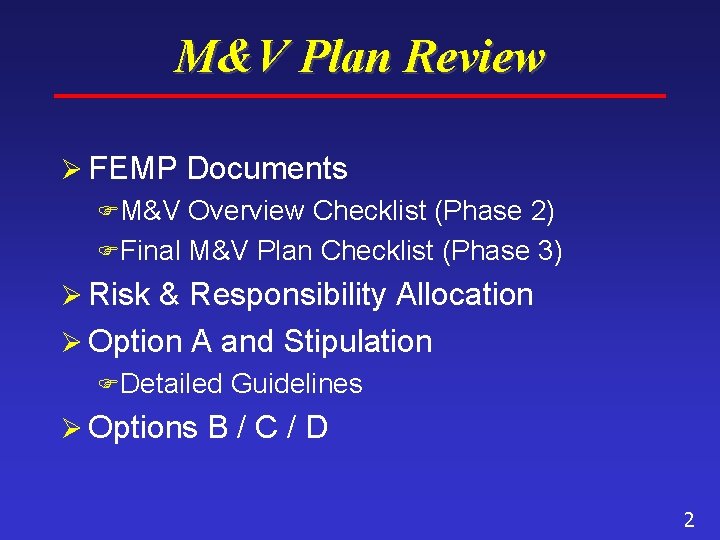
M&V Plan Review Ø FEMP Documents FM&V Overview Checklist (Phase 2) FFinal M&V Plan Checklist (Phase 3) Ø Risk & Responsibility Allocation Ø Option A and Stipulation FDetailed Guidelines Ø Options B / C / D 2
Phase 2: Project Development Phase 1 Phase 2 Phase 3 Phase 4 Contractor Responsibilities Ø Develop M&V approach (M&V Overview). Ø Explain and justify approach. Agency Responsibilities Ø Review M&V approach and provide feedback. 3
M&V Overview Checklist Phase 1 Phase 2 Phase 3 Phase 4 The following items should be described: Ø Project site and measures. Ø What savings will be claimed. Ø M&V approach for each measure. Ø Baseline equipment and conditions. Ø Proposed equipment and conditions. Ø Annual measurement and verification activities. 4
Phase 3: Negotiation and Award Phase 1 Phase 2 Phase 3 Phase 4 Contractor Responsibilities Ø Perform Detailed Energy Survey (DES) and document baseline information. Ø Modify M&V plan to satisfy agency needs and desires. Agency Responsibilities Ø Review and Approve M&V Plan. Ø Witness and observe DES. 5
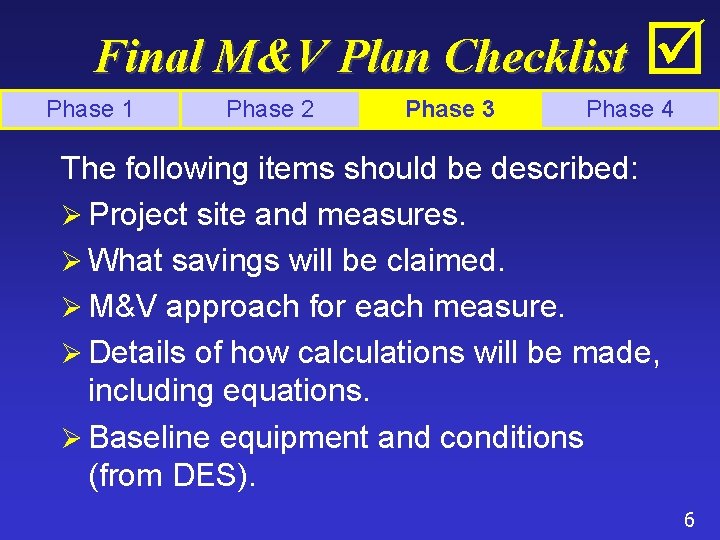
Final M&V Plan Checklist Phase 1 Phase 2 Phase 3 Phase 4 The following items should be described: Ø Project site and measures. Ø What savings will be claimed. Ø M&V approach for each measure. Ø Details of how calculations will be made, including equations. Ø Baseline equipment and conditions (from DES). 6
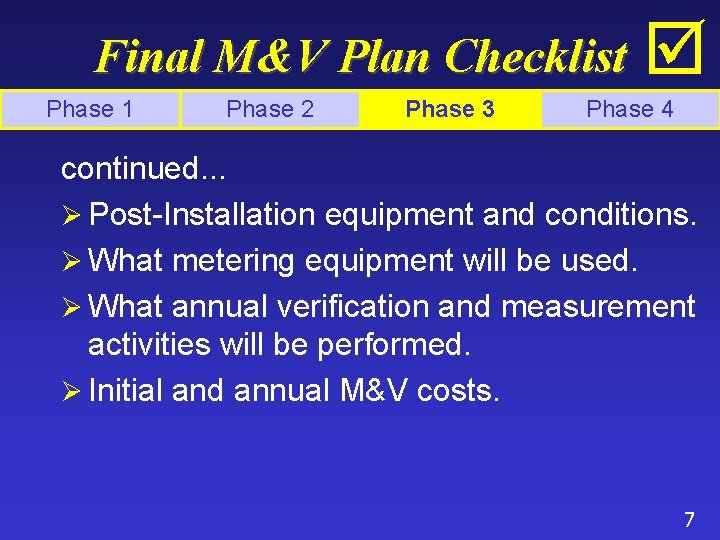
Final M&V Plan Checklist Phase 1 Phase 2 Phase 3 Phase 4 continued. . . Ø Post-Installation equipment and conditions. Ø What metering equipment will be used. Ø What annual verification and measurement activities will be performed. Ø Initial and annual M&V costs. 7
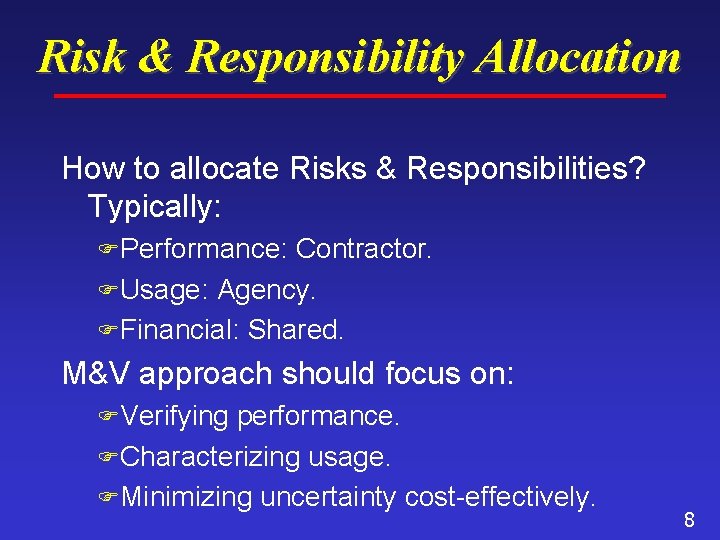
Risk & Responsibility Allocation How to allocate Risks & Responsibilities? Typically: FPerformance: Contractor. FUsage: Agency. FFinancial: Shared. M&V approach should focus on: FVerifying performance. FCharacterizing usage. FMinimizing uncertainty cost-effectively. 8
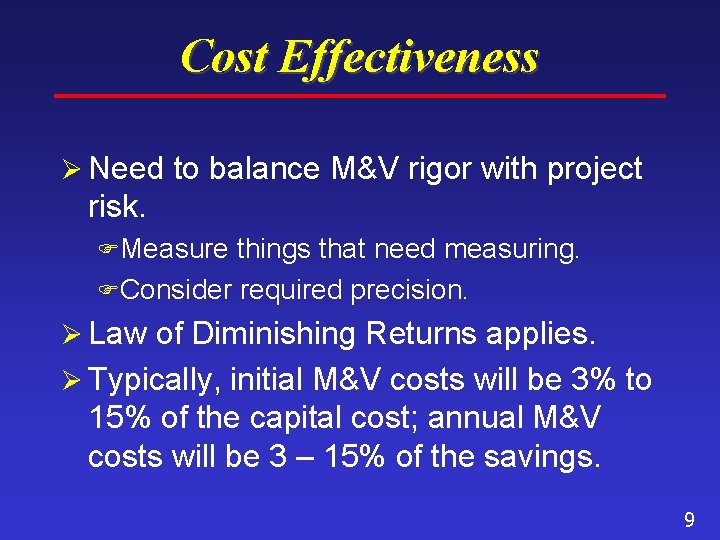
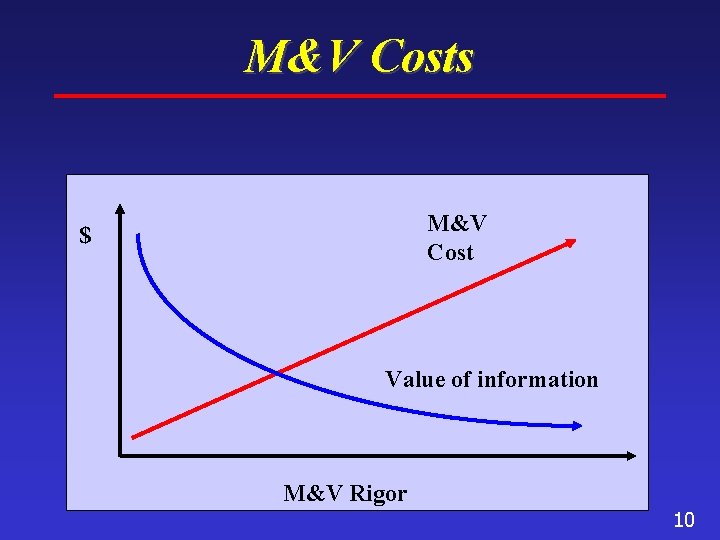
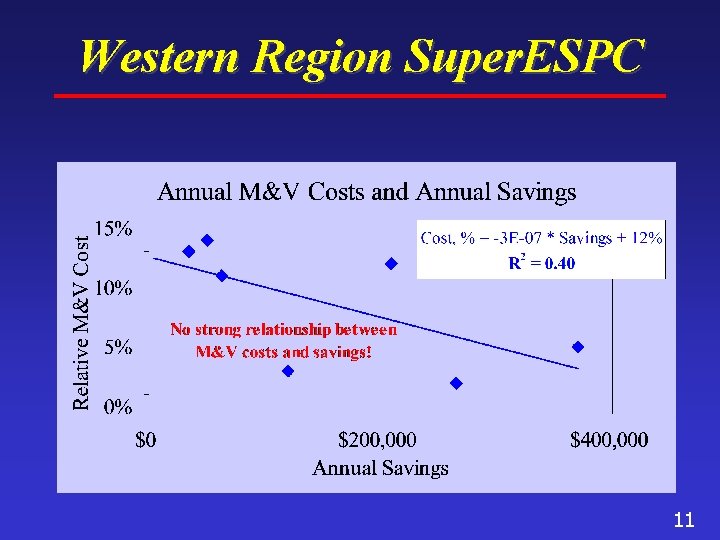
Cost Effectiveness Ø Need to balance M&V rigor with project risk. FMeasure things that need measuring. FConsider required precision. Ø Law of Diminishing Returns applies. Ø Typically, initial M&V costs will be 3% to 15% of the capital cost; annual M&V costs will be 3 – 15% of the savings. 9
M&V Costs M&V Cost $ Value of information M&V Rigor 10
Western Region Super. ESPC 11
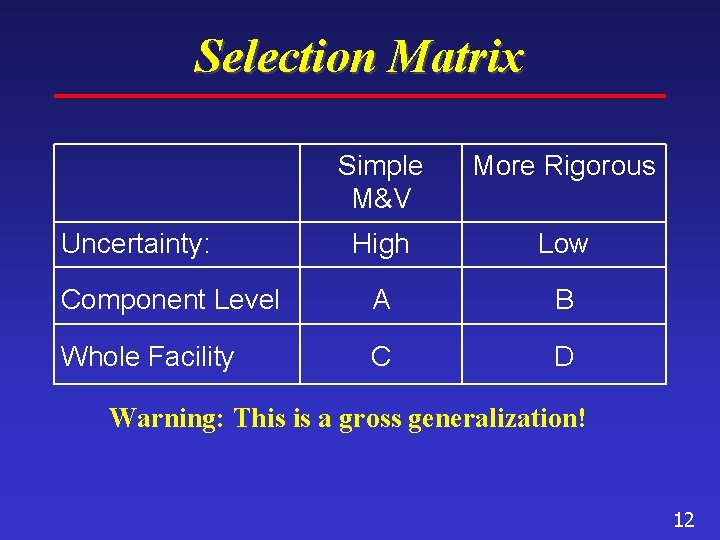
Selection Matrix Simple M&V More Rigorous High Low Component Level A B Whole Facility C D Uncertainty: Warning: This is a gross generalization! 12
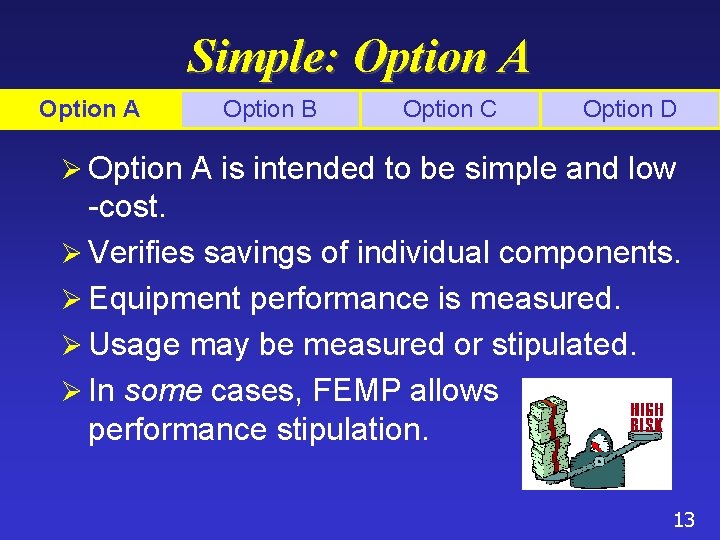
Simple: Option A Option B Option C Option D Ø Option A is intended to be simple and low -cost. Ø Verifies savings of individual components. Ø Equipment performance is measured. Ø Usage may be measured or stipulated. Ø In some cases, FEMP allows performance stipulation. 13
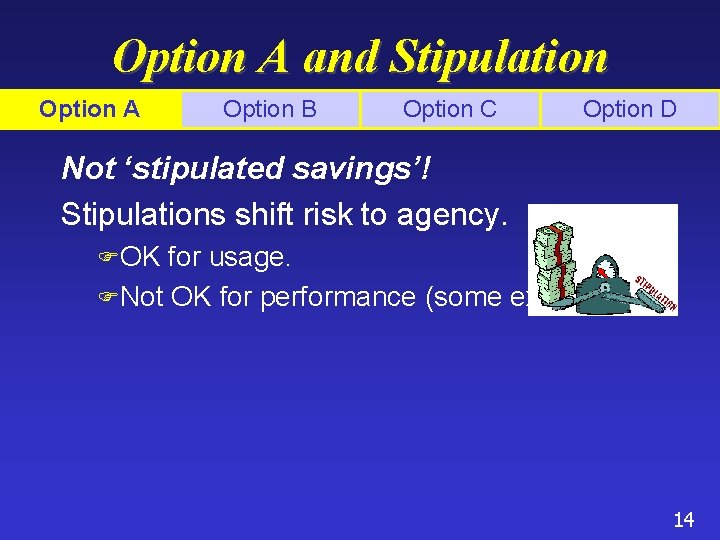
Option A and Stipulation Option A Option B Option C Option D Not ‘stipulated savings’! Stipulations shift risk to agency. FOK for usage. FNot OK for performance (some exceptions). 14
Option A Guidelines Option A Option B Option C Option D Ø Option A most common in Super. ESPC. Ø Potential for misapplication. Ø Discusses how to use Option A. Ø Discusses how to apply stipulations. See Detailed Guidelines For FEMP M&V Option A (2002) 15
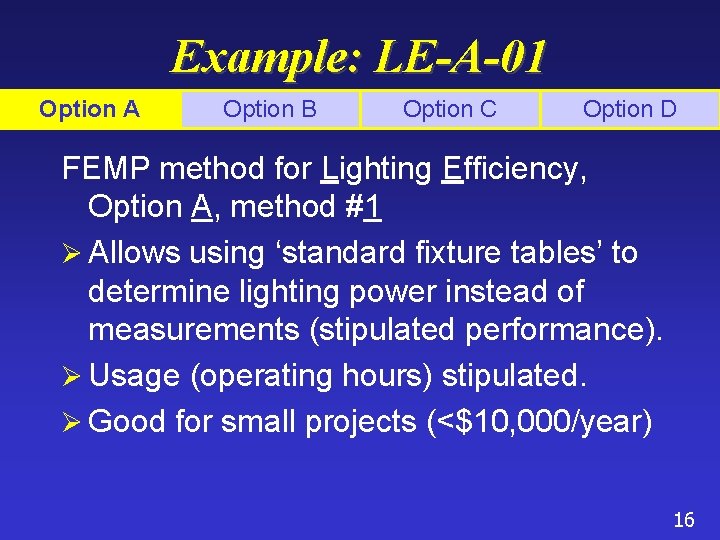
Example: LE-A-01 Option A Option B Option C Option D FEMP method for Lighting Efficiency, Option A, method #1 Ø Allows using ‘standard fixture tables’ to determine lighting power instead of measurements (stipulated performance). Ø Usage (operating hours) stipulated. Ø Good for small projects (<$10, 000/year) 16
Stipulation Risk Option A Option B Option C Option D LE-A-01 allows stipulation of both usage and performance parameters. Ø If the stipulated values are wrong, the savings estimates will be wrong. Ø The agency assumes all risk, contrary to the intent of a performance contract. 17
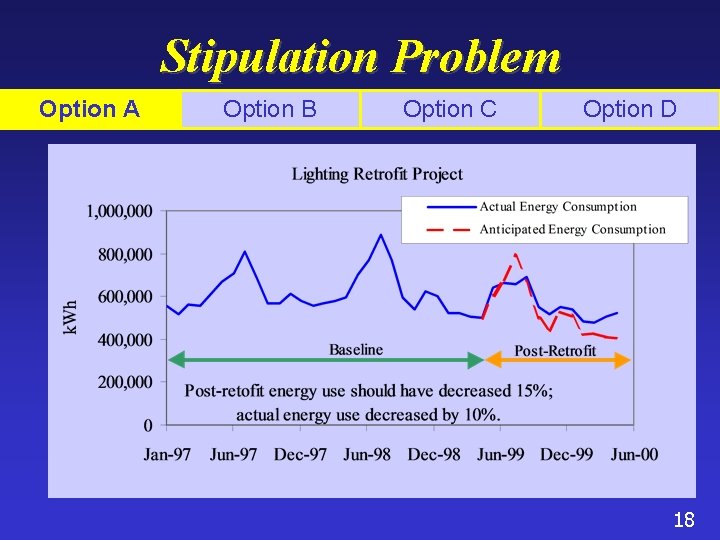
Stipulation Problem Option A Option B Option C Option D 18
Stipulation Lessons Option A Option B Option C Option D Ø Guaranteed savings $50, 000; $24, 000 observed in utility bill. Ø Poorly-defined baseline prevents adequate after-the-fact analysis. Ø Option C methods are not sufficiently accurate to support or reject savings claims. 19
Example: LE-A-02 Option A Option B Option C Option D FEMP method for Lighting Efficiency, Option A, method #2 Ø Common fixture types measured using a statistically-valid number of measurements (3 -6). Ø Operating hours usually stipulated, but can be measured. Ø Good for large projects (>$100, 000/yr) 20
Option A Risk Allocation Option A Option B Option C Option D Ø The contractor should measure performance since they control this. Ø The operating hours may be stipulated. Measuring the operating hours reduces uncertainty and risks to both parties. Ø The agency bears the risk of unrealized savings due to changing schedule or incorrect operating hours. 21
More Rigorous: Option B Option A Option B Option C Option D Ø Verifies at component level. Ø Requires periodic performance measurements- annual to hourly. Ø Usage can be stipulated or measured. 22
Option B Risk Allocation Option A Option B Option C Option D Ø Energy use and claimed savings will vary from year to year. Ø The contractor assumes all project risk (performance & usage) since savings are based on measured energy use. Ø The contractor would be wise to include in the M&V plan: Flimits on their exposure Fmethods of adjusting the baseline or usage 23
Simple: Option C Option A Option B Option C Option D Ø Regression method using existing utility meters. Ø Captures interactions between measures to find total savings. Ø Requires collecting and tracking information that affects energy use: Fweather Foccupancy Fproduction 24
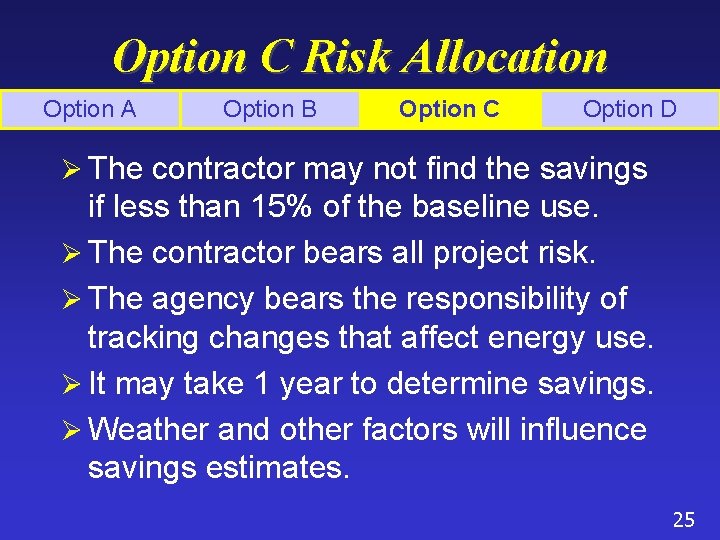
Option C Risk Allocation Option A Option B Option C Option D Ø The contractor may not find the savings if less than 15% of the baseline use. Ø The contractor bears all project risk. Ø The agency bears the responsibility of tracking changes that affect energy use. Ø It may take 1 year to determine savings. Ø Weather and other factors will influence savings estimates. 25
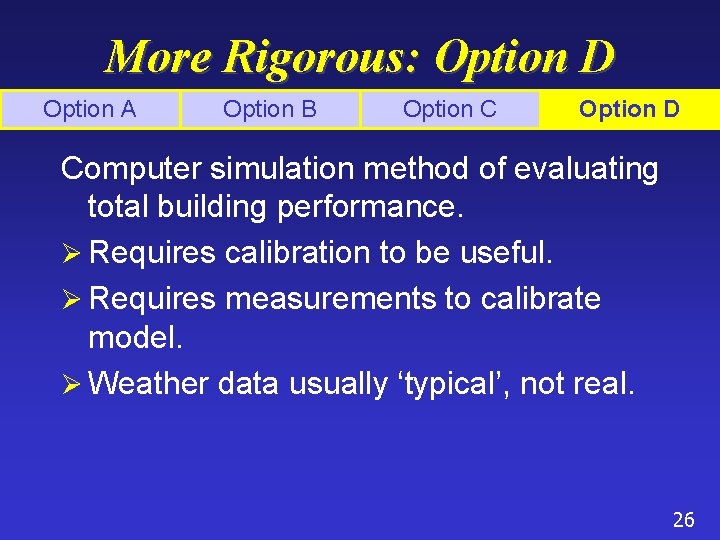
More Rigorous: Option D Option A Option B Option C Option D Computer simulation method of evaluating total building performance. Ø Requires calibration to be useful. Ø Requires measurements to calibrate model. Ø Weather data usually ‘typical’, not real. 26
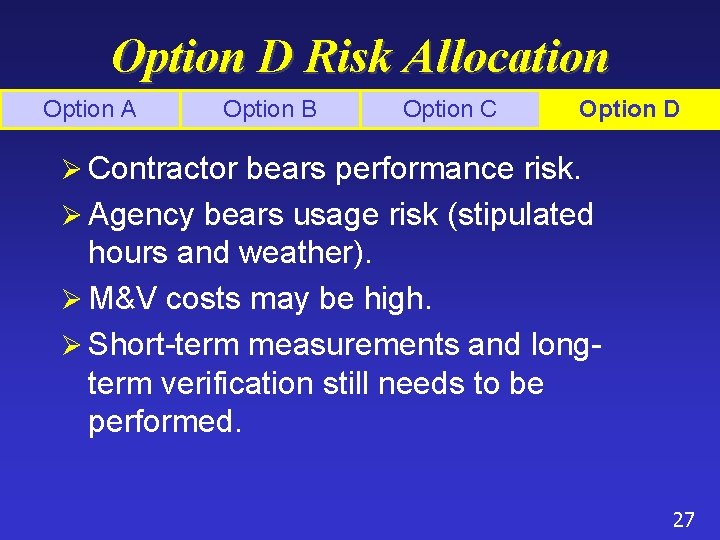
Option D Risk Allocation Option A Option B Option C Option D Ø Contractor bears performance risk. Ø Agency bears usage risk (stipulated hours and weather). Ø M&V costs may be high. Ø Short-term measurements and longterm verification still needs to be performed. 27
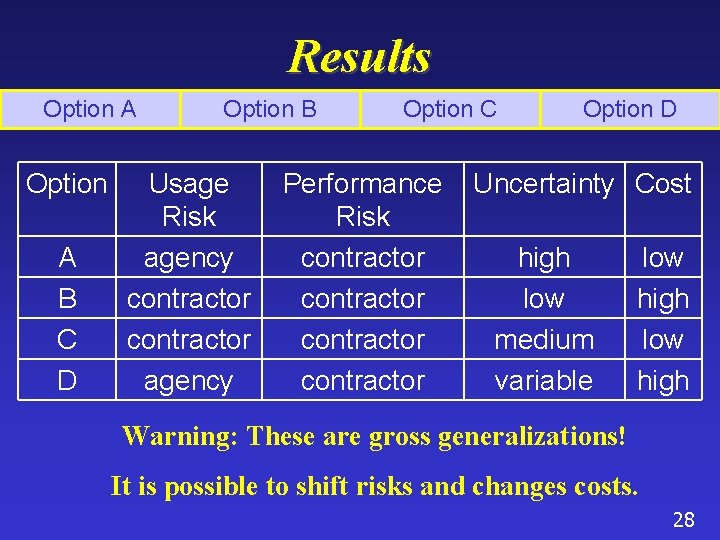
Results Option A B C D Option B Usage Risk agency contractor agency Option C Performance Risk contractor Option D Uncertainty Cost high low medium variable low high Warning: These are gross generalizations! It is possible to shift risks and changes costs. 28
Review & Discussion Ø Performance must be verified if guarantee is to have value. Ø Agency often assumes usage risk. Ø Uncertainty is inherent in M&V. Ø M&V costs need to be balanced against project risks. 29
Review Questions Ø How do we measure savings? Ø When might an agency accept performance risk? 30