
Mutual Funds and Regulation Compensation for Mutual Fund
- Slides: 35
Mutual Funds and Regulation Compensation for Mutual Fund Sales Todd Cipperman, Esq. , Cipperman & Company November 1, 2007
FINRA Disclaimer on content herein: FINRA's classroom learning course information is the sole property of FINRA and the content provided is for informational and educational purposes only. The content of the classroom learning courses does not constitute any FINRA rule or amendment or interpretation to such rules. Compliance with any recommended conduct presented does not mean that a firm or person has complied with the full extent of their obligations under FINRA rules, the rules of any other SRO or securities laws. Use of this classroom learning course does not create a safe harbor from regulatory responsibility. This classroom learning course is provided "as is. " FINRA and its affiliates are not responsible for any human or mechanical errors or omissions. Parties may not reproduce the classroom learning courses in any form, nor reference them in any publication, without the express written consent of FINRA. It is important to emphasize that while the particular materials that individual speakers have provided from their firms have been reviewed by FINRA, these may not reflect the express views of FINRA. The regulations and rules are the final authority. Opinions that may be expressed are the opinions of the speakers and participants and not those of FINRA. Compensation for Mutual Fund Sales Confidential Copyright 2007 FINRA 2
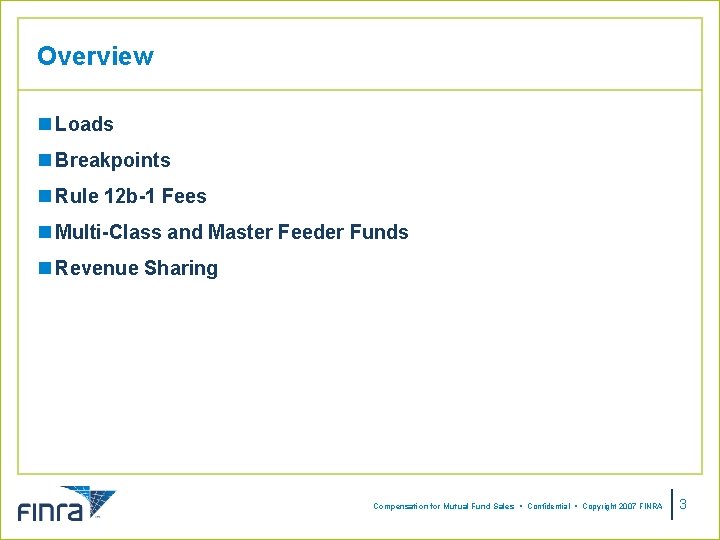
Overview n Loads n Breakpoints n Rule 12 b-1 Fees n Multi-Class and Master Feeder Funds n Revenue Sharing Compensation for Mutual Fund Sales Confidential Copyright 2007 FINRA 3
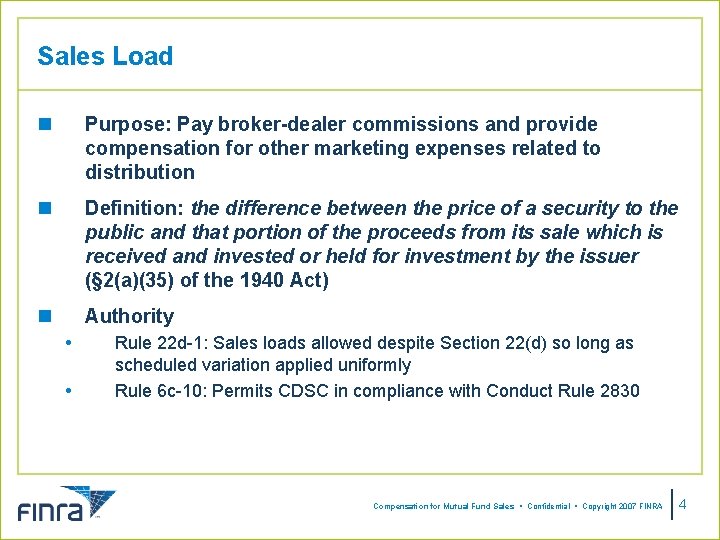
Sales Load n Purpose: Pay broker-dealer commissions and provide compensation for other marketing expenses related to distribution n Definition: the difference between the price of a security to the public and that portion of the proceeds from its sale which is received and invested or held for investment by the issuer (§ 2(a)(35) of the 1940 Act) n Authority Rule 22 d-1: Sales loads allowed despite Section 22(d) so long as scheduled variation applied uniformly Rule 6 c-10: Permits CDSC in compliance with Conduct Rule 2830 Compensation for Mutual Fund Sales Confidential Copyright 2007 FINRA 4
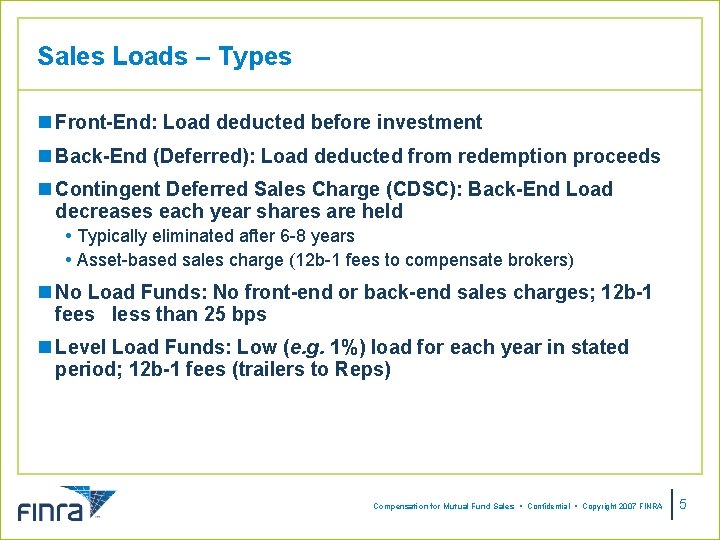
Sales Loads – Types n Front-End: Load deducted before investment n Back-End (Deferred): Load deducted from redemption proceeds n Contingent Deferred Sales Charge (CDSC): Back-End Load decreases each year shares are held Typically eliminated after 6 -8 years Asset-based sales charge (12 b-1 fees to compensate brokers) n No Load Funds: No front-end or back-end sales charges; 12 b-1 fees less than 25 bps n Level Load Funds: Low (e. g. 1%) load for each year in stated period; 12 b-1 fees (trailers to Reps) Compensation for Mutual Fund Sales Confidential Copyright 2007 FINRA 5
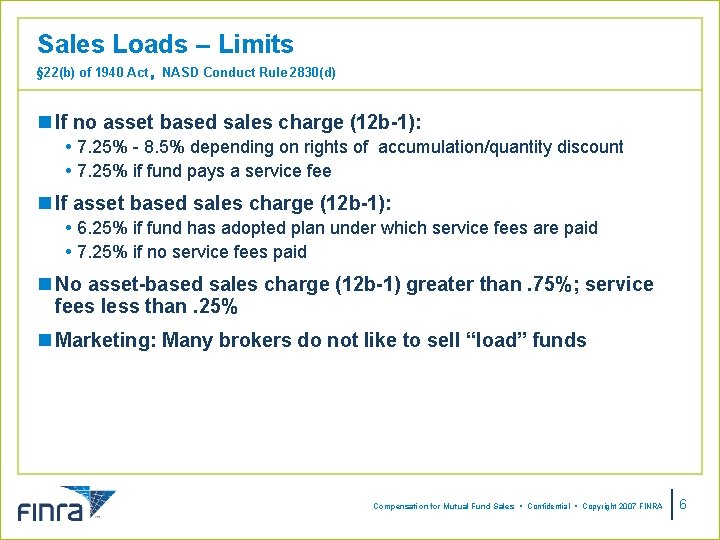
Sales Loads – Limits § 22(b) of 1940 Act, NASD Conduct Rule 2830(d) n If no asset based sales charge (12 b-1): 7. 25% - 8. 5% depending on rights of accumulation/quantity discount 7. 25% if fund pays a service fee n If asset based sales charge (12 b-1): 6. 25% if fund has adopted plan under which service fees are paid 7. 25% if no service fees paid n No asset-based sales charge (12 b-1) greater than. 75%; service fees less than. 25% n Marketing: Many brokers do not like to sell “load” funds Compensation for Mutual Fund Sales Confidential Copyright 2007 FINRA 6
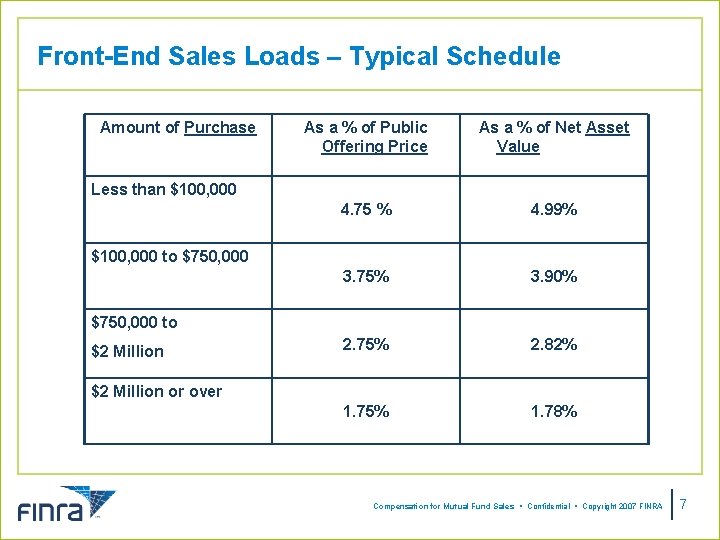
Front-End Sales Loads – Typical Schedule Amount of Purchase As a % of Public Offering Price As a % of Net Asset Value 4. 75 % 4. 99% 3. 75% 3. 90% 2. 75% 2. 82% 1. 75% 1. 78% Less than $100, 000 to $750, 000 to $2 Million or over Compensation for Mutual Fund Sales Confidential Copyright 2007 FINRA 7
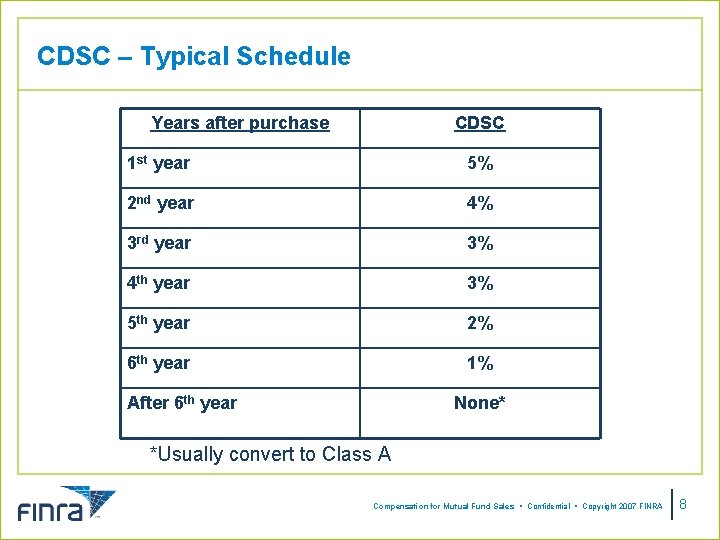
CDSC – Typical Schedule Years after purchase CDSC 1 st year 5% 2 nd year 4% 3 rd year 3% 4 th year 3% 5 th year 2% 6 th year 1% After 6 th year None* *Usually convert to Class A Compensation for Mutual Fund Sales Confidential Copyright 2007 FINRA 8
Breakpoints n The dollar amount at which the Load declines n Right of Accumulation: Combining several transactions to get the benefit of breakpoints n Letter of Intent: Obtain the breakpoint by investing over a period of time n Combining multiple accounts Compensation for Mutual Fund Sales Confidential Copyright 2007 FINRA 9
Breakpoints – A Breakdown n Failure to give investors benefit of breakpoint discounts especially with respect to multiple accounts, rights of accumulation, letter of intent See NASD Notice to Members 02 -85 n Failing to notify investors of the benefit of a breakpoint n Fifteen firms agreed to pay $21. 5 Million in fines as a result of joint examination Joint SEC/NASD/NYSE sweep 1 in 3 eligible transactions did not get breakpoints n See Report of the Joint NASD/Industry Task Force on Breakpoints (July 2003) n Note: Similar issue with NAV transfer programs (See AXA Advisors (February 26, 2004)) Compensation for Mutual Fund Sales Confidential Copyright 2007 FINRA 10
Legal Authority for Breakpoints n 17(a)(2): It is unlawful for any person in the offer or sale of any securities…to obtain money or property by means of an untrue statement of a material fact or any omission to state a material fact necessary in order to make the statements made, in light of the circumstances under which they were made, not misleading… n 10 b-10: It shall be unlawful for any broker or dealer to effect for or with an account of a customer any transaction in, or to induce the purchase or sale by such customer of, any security…unless such broker or dealer, at or before completion of such transaction gives or sends to such customer written notification disclosing… the source and amount of any other remuneration received or to be received by the broker in connection with the transaction. n. NASD IM-2830 -1: It is contrary to just and equitable principles of trade to sell investment company shares just below the point at which the sales charge is reduced on quantity transactions so as to share in the higher sales charges applicable on sales below the breakpoint. Compensation for Mutual Fund Sales Confidential Copyright 2007 FINRA 11
Rule 12 b-1: The Issue n Section 12(b): It shall be unlawful for any registered open-end investment company…to act as distributor of securities of which it is the issuer. n Rule 12 b-1(a)(2): A registered open-end investment company will be deemed to be acting as a distributor of securities of which it is the issuer if it engages directly or indirectly in financing any activity which is primarily intended to result in the sale of shares. n Policy - Existing shareholders should not pay costs of acquiring new shareholders - Indirectly benefiting Advisor in violation of § 36 Compensation for Mutual Fund Sales Confidential Copyright 2007 FINRA 12
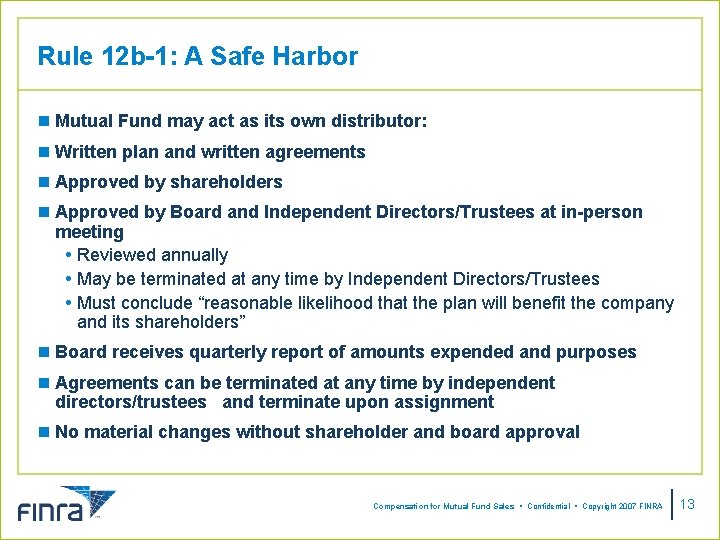
Rule 12 b-1: A Safe Harbor n Mutual Fund may act as its own distributor: n Written plan and written agreements n Approved by shareholders n Approved by Board and Independent Directors/Trustees at in-person meeting Reviewed annually May be terminated at any time by Independent Directors/Trustees Must conclude “reasonable likelihood that the plan will benefit the company and its shareholders” n Board receives quarterly report of amounts expended and purposes n Agreements can be terminated at any time by independent directors/trustees and terminate upon assignment n No material changes without shareholder and board approval Compensation for Mutual Fund Sales Confidential Copyright 2007 FINRA 13
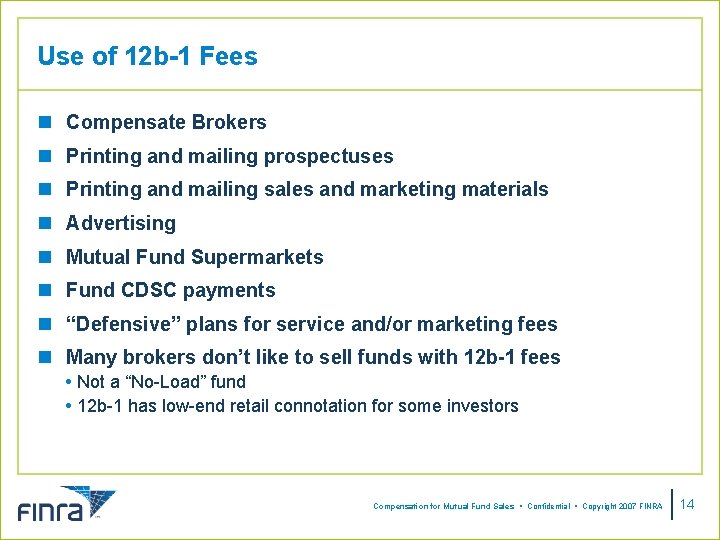
Use of 12 b-1 Fees n Compensate Brokers n Printing and mailing prospectuses n Printing and mailing sales and marketing materials n Advertising n Mutual Fund Supermarkets n Fund CDSC payments n “Defensive” plans for service and/or marketing fees n Many brokers don’t like to sell funds with 12 b-1 fees Not a “No-Load” fund 12 b-1 has low-end retail connotation for some investors Compensation for Mutual Fund Sales Confidential Copyright 2007 FINRA 14
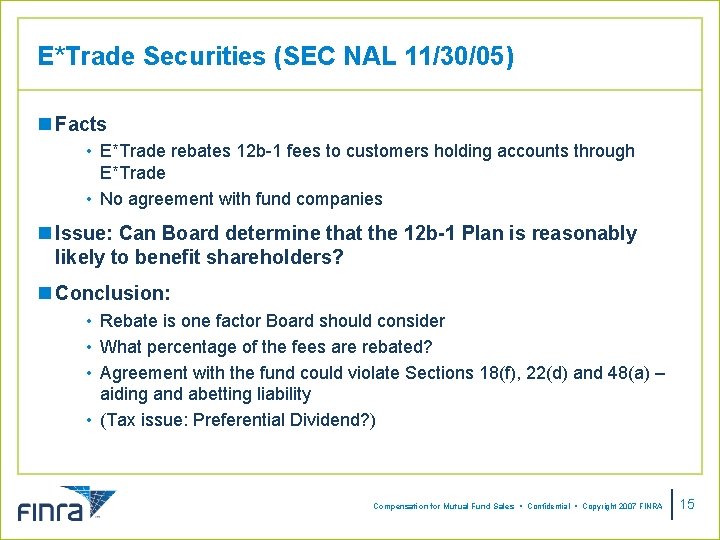
E*Trade Securities (SEC NAL 11/30/05) n Facts • E*Trade rebates 12 b-1 fees to customers holding accounts through E*Trade • No agreement with fund companies n Issue: Can Board determine that the 12 b-1 Plan is reasonably likely to benefit shareholders? n Conclusion: • Rebate is one factor Board should consider • What percentage of the fees are rebated? • Agreement with the fund could violate Sections 18(f), 22(d) and 48(a) – aiding and abetting liability • (Tax issue: Preferential Dividend? ) Compensation for Mutual Fund Sales Confidential Copyright 2007 FINRA 15
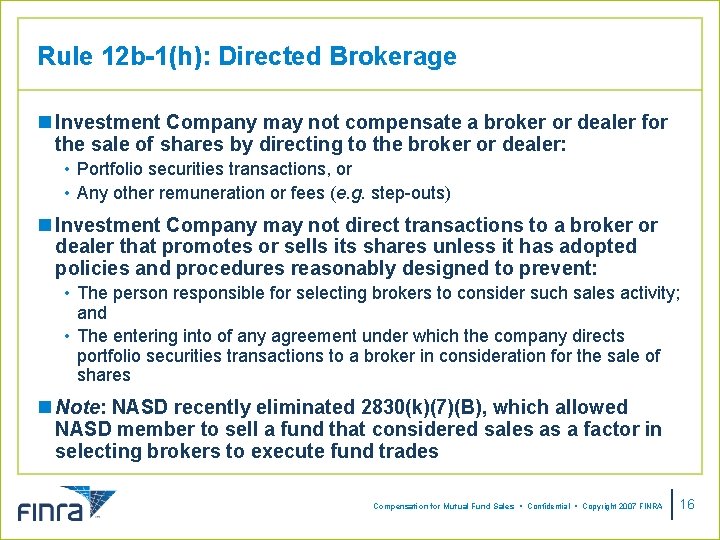
Rule 12 b-1(h): Directed Brokerage n Investment Company may not compensate a broker or dealer for the sale of shares by directing to the broker or dealer: • Portfolio securities transactions, or • Any other remuneration or fees (e. g. step-outs) n Investment Company may not direct transactions to a broker or dealer that promotes or sells its shares unless it has adopted policies and procedures reasonably designed to prevent: • The person responsible for selecting brokers to consider such sales activity; and • The entering into of any agreement under which the company directs portfolio securities transactions to a broker in consideration for the sale of shares n Note: NASD recently eliminated 2830(k)(7)(B), which allowed NASD member to sell a fund that considered sales as a factor in selecting brokers to execute fund trades Compensation for Mutual Fund Sales Confidential Copyright 2007 FINRA 16
NASD Fines 8 Firms $7. 75 Million n Payment of directed brokerage in exchange for preferential treatment for certain funds n Violation of 2830(k) (Anti-Reciprocal Rule) n “We continue to pursue conduct which puts the interests of firms ahead of the interests of customers. ” (Barry Goldsmith) n Preferred Partner/Shelf Space programs n Step-Out trading n Lord Abbett Distributor LLC (mutual fund distributor) n National Planning Corp. : non-cash compensation for credits toward rewards conference Compensation for Mutual Fund Sales Confidential Copyright 2007 FINRA 17
Multi-Class Funds n Without an exemption, multiple classes would violate prohibition on issuing senior securities. § 18(f)(1) of 1940 Act. n Rule 18 f-3: Multiple Classes permissible: – Each class has a different arrangement for shareholder services and/or distribution and may pay different expenses (other than advisory, custodial, management) – Approval by independent trustees Compensation for Mutual Fund Sales Confidential Copyright 2007 FINRA 18
Multi-Class Funds: Suitability n Typical fund family • Class A: Front-End Load • Class B: CDSC • Class C: Level Load n Class B may avoid load but 12 b-1 fees increase expenses for long -term investors • Consider benefit of breakpoints • See In re Michael Flanagan et. al. (January 31, 2000); In re Morgan Stanley DW Inc. (November 17, 2003); In re Citigroup Global Markets, Inc. (March 23, 2005) n Many brokerage firms have stopped selling Class B shares. • See IM 2830 -1 • See NASD Alert “Class B Mutual Fund Shares: Do They Make the Grade? ” (June 25, 2003) Compensation for Mutual Fund Sales Confidential Copyright 2007 FINRA 19
Master-Feeder: Purpose n Asset Allocation n Marketing to multiple distribution channels • • Institutional/Retail Qualified/Non-Qualified Insurance Company separate accounts Onshore/Offshore n Multi-Class fund (Rule 18 f-3) not flexible enough n Registration Costs Compensation for Mutual Fund Sales Confidential Copyright 2007 FINRA 20
Master-Feeder Types n Unaffiliated: limit to 3% of acquired fund n Affiliated i. e. part of same group of investment companies (held out to investors as related for investment and investor services): • • • All securities owned within the same family Master does not charge for distribution or aggregate sales loads not ` excessive under NASD rules Master cannot be a fund-of-funds Compensation for Mutual Fund Sales Confidential Copyright 2007 FINRA 21
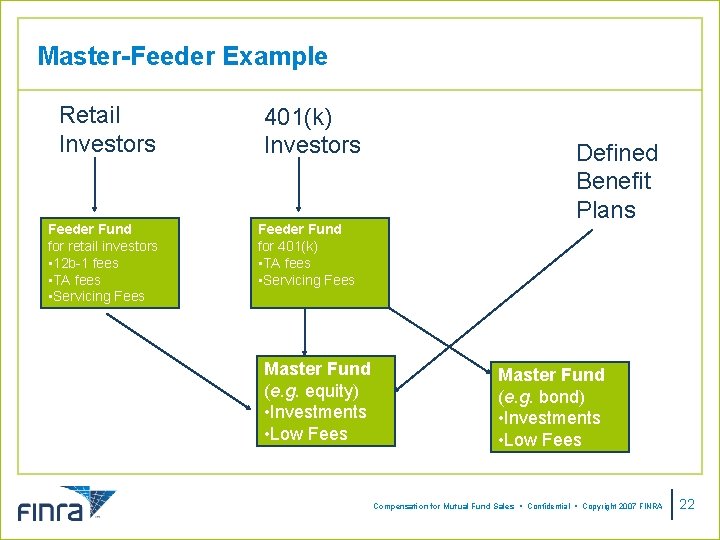
Master-Feeder Example Retail Investors Feeder Fund for retail investors • 12 b-1 fees • TA fees • Servicing Fees 401(k) Investors Feeder Fund for 401(k) • TA fees • Servicing Fees Master Fund (e. g. equity) • Investments • Low Fees Defined Benefit Plans Master Fund (e. g. bond) • Investments • Low Fees Compensation for Mutual Fund Sales Confidential Copyright 2007 FINRA 22
Revenue Sharing: The Challenge n Pressure to distribute n Brokers could/would not sell front-end load funds n Regulatory scrutiny of Back-End Load shares n 12 b-1 fees inadequate • not “No Load” • NASD Limits n Multi-Class Funds too restrictive n Master-Feeder too complicated Compensation for Mutual Fund Sales Confidential Copyright 2007 FINRA 23
Revenue Sharing: Direct Payments n Direct payments for production n Client Administration/Sub-TA arrangements n Sponsorship of conferences and seminars n Payment of marketing expenses n Directed brokerage and step-outs Compensation for Mutual Fund Sales Confidential Copyright 2007 FINRA 24
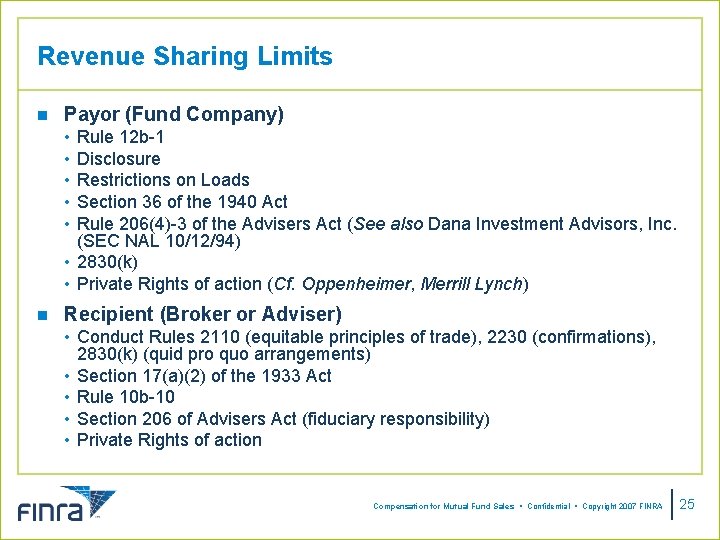
Revenue Sharing Limits n Payor (Fund Company) • • • Rule 12 b-1 Disclosure Restrictions on Loads Section 36 of the 1940 Act Rule 206(4)-3 of the Advisers Act (See also Dana Investment Advisors, Inc. (SEC NAL 10/12/94) • 2830(k) • Private Rights of action (Cf. Oppenheimer, Merrill Lynch) n Recipient (Broker or Adviser) • Conduct Rules 2110 (equitable principles of trade), 2230 (confirmations), 2830(k) (quid pro quo arrangements) • Section 17(a)(2) of the 1933 Act • Rule 10 b-10 • Section 206 of Advisers Act (fiduciary responsibility) • Private Rights of action Compensation for Mutual Fund Sales Confidential Copyright 2007 FINRA 25
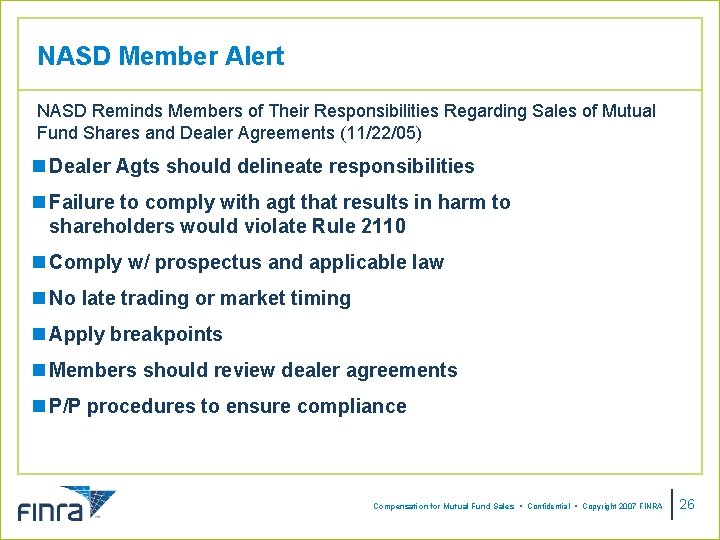
NASD Member Alert NASD Reminds Members of Their Responsibilities Regarding Sales of Mutual Fund Shares and Dealer Agreements (11/22/05) n Dealer Agts should delineate responsibilities n Failure to comply with agt that results in harm to shareholders would violate Rule 2110 n Comply w/ prospectus and applicable law n No late trading or market timing n Apply breakpoints n Members should review dealer agreements n P/P procedures to ensure compliance Compensation for Mutual Fund Sales Confidential Copyright 2007 FINRA 26
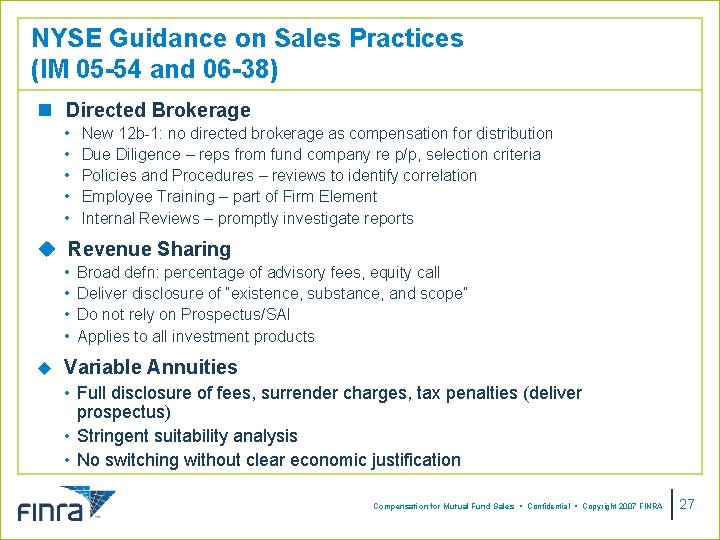
NYSE Guidance on Sales Practices (IM 05 -54 and 06 -38) n Directed Brokerage • • • New 12 b-1: no directed brokerage as compensation for distribution Due Diligence – reps from fund company re p/p, selection criteria Policies and Procedures – reviews to identify correlation Employee Training – part of Firm Element Internal Reviews – promptly investigate reports u Revenue Sharing • • u Broad defn: percentage of advisory fees, equity call Deliver disclosure of “existence, substance, and scope” Do not rely on Prospectus/SAI Applies to all investment products Variable Annuities • Full disclosure of fees, surrender charges, tax penalties (deliver prospectus) • Stringent suitability analysis • No switching without clear economic justification Compensation for Mutual Fund Sales Confidential Copyright 2007 FINRA 27
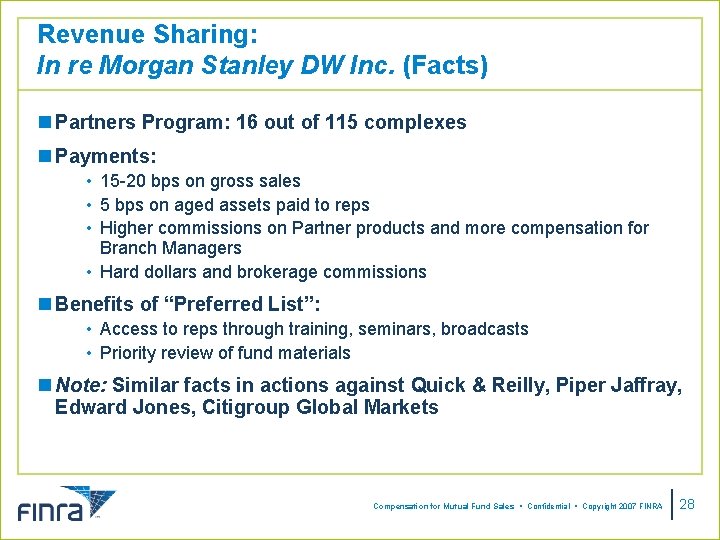
Revenue Sharing: In re Morgan Stanley DW Inc. (Facts) n Partners Program: 16 out of 115 complexes n Payments: • 15 -20 bps on gross sales • 5 bps on aged assets paid to reps • Higher commissions on Partner products and more compensation for Branch Managers • Hard dollars and brokerage commissions n Benefits of “Preferred List”: • Access to reps through training, seminars, broadcasts • Priority review of fund materials n Note: Similar facts in actions against Quick & Reilly, Piper Jaffray, Edward Jones, Citigroup Global Markets Compensation for Mutual Fund Sales Confidential Copyright 2007 FINRA 28
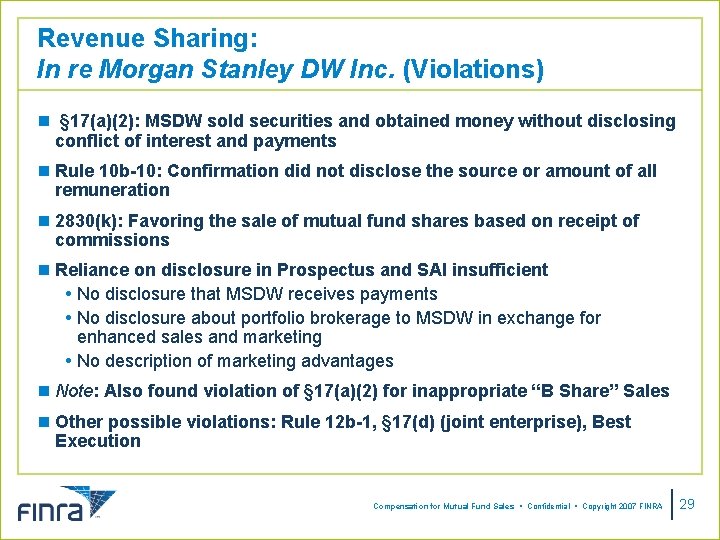
Revenue Sharing: In re Morgan Stanley DW Inc. (Violations) n § 17(a)(2): MSDW sold securities and obtained money without disclosing conflict of interest and payments n Rule 10 b-10: Confirmation did not disclose the source or amount of all remuneration n 2830(k): Favoring the sale of mutual fund shares based on receipt of commissions n Reliance on disclosure in Prospectus and SAI insufficient No disclosure that MSDW receives payments No disclosure about portfolio brokerage to MSDW in exchange for enhanced sales and marketing No description of marketing advantages n Note: Also found violation of § 17(a)(2) for inappropriate “B Share” Sales n Other possible violations: Rule 12 b-1, § 17(d) (joint enterprise), Best Execution Compensation for Mutual Fund Sales Confidential Copyright 2007 FINRA 29
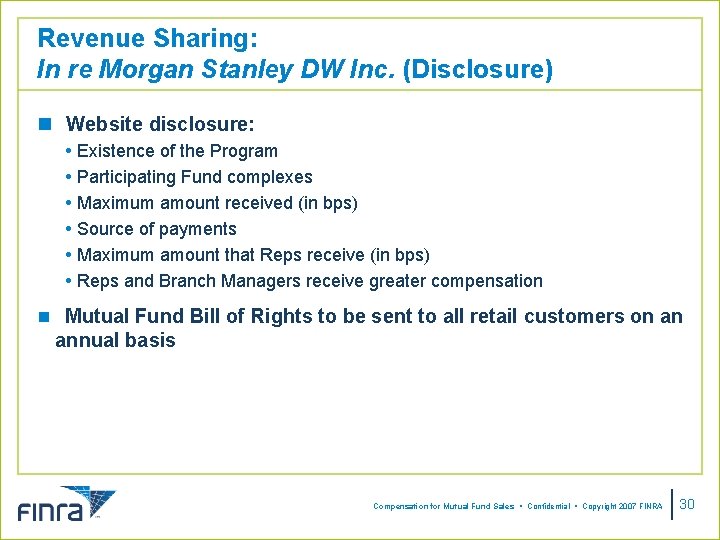
Revenue Sharing: In re Morgan Stanley DW Inc. (Disclosure) n Website disclosure: Existence of the Program Participating Fund complexes Maximum amount received (in bps) Source of payments Maximum amount that Reps receive (in bps) Reps and Branch Managers receive greater compensation n Mutual Fund Bill of Rights to be sent to all retail customers on an annual basis Compensation for Mutual Fund Sales Confidential Copyright 2007 FINRA 30
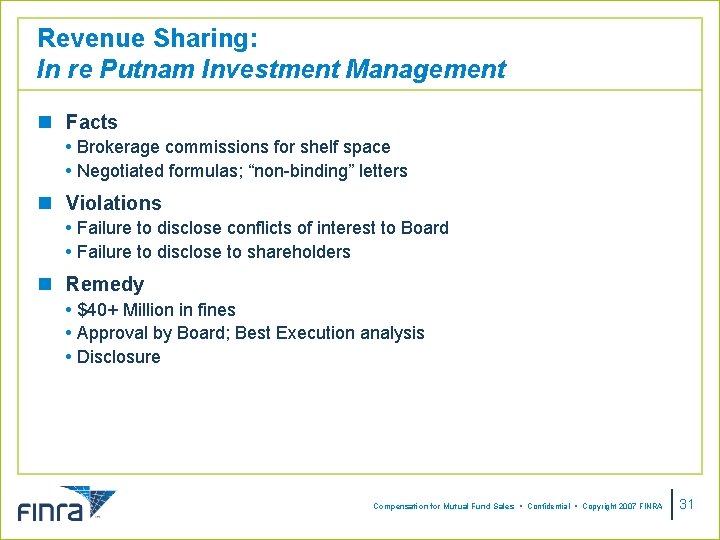
Revenue Sharing: In re Putnam Investment Management n Facts Brokerage commissions for shelf space Negotiated formulas; “non-binding” letters n Violations Failure to disclose conflicts of interest to Board Failure to disclose to shareholders n Remedy $40+ Million in fines Approval by Board; Best Execution analysis Disclosure Compensation for Mutual Fund Sales Confidential Copyright 2007 FINRA 31
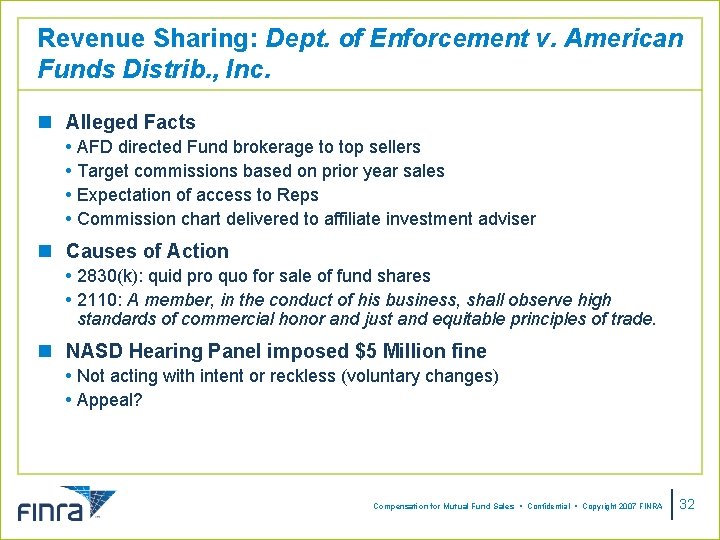
Revenue Sharing: Dept. of Enforcement v. American Funds Distrib. , Inc. n Alleged Facts AFD directed Fund brokerage to top sellers Target commissions based on prior year sales Expectation of access to Reps Commission chart delivered to affiliate investment adviser n Causes of Action 2830(k): quid pro quo for sale of fund shares 2110: A member, in the conduct of his business, shall observe high standards of commercial honor and just and equitable principles of trade. n NASD Hearing Panel imposed $5 Million fine Not acting with intent or reckless (voluntary changes) Appeal? Compensation for Mutual Fund Sales Confidential Copyright 2007 FINRA 32
A Changing Landscape n Separation of investment management from distribution n Citigroup/Legg Mason n Merrill Lynch/Blackrock n Pressure on Individuals Compliance Officers (See In re Capital. Works Investment Partners and Mark Correnti) In re Treadway Compensation for Mutual Fund Sales Confidential Copyright 2007 FINRA 33
Conclusion n Brokerage Firms, Advisers and their Reps demand compensation n Tremendous competition to grow assets and access distribution n Heightened potential for conflicts of interest n Follow the money Compensation for Mutual Fund Sales Confidential Copyright 2007 FINRA 34
Todd Cipperman, Esq. Todd Cipperman is the principal of Cipperman & Company, which provides legal consulting services to investment managers, investment advisers, broker-dealers, mutual funds, hedge funds, and technology providers. Cipperman & Company provides a wide range of services for the industry including regulatory advice, product development, distribution arrangements, compliance programs, and client and vendor agreements. Mr. Cipperman has more than 15 years of experience in the investment management and financial services industries. As a principal of Cipperman & Company, he has represented a wide range of investment management clients with a focus on distribution issues facing advisers and brokerdealers. He previously served as general counsel of a public mutual fund and financial technology firm, including its $65 Billion proprietary mutual fund family. He has also served as general counsel of one of the largest international equity managers. He spent several years in private practice on Wall Street representing both buy and sell side clients in investment management and capital markets transactions. He is a graduate of the University of Pennsylvania Law School and Cornell University. 150 S. Warner Road Suite 140 King of Prussia, PA 19406 tcipperman@cipperman. com www. cipperman. com Compensation for Mutual Fund Sales Confidential Copyright 2007 FINRA 35