
Mutations What you need to know DNA Definition
- Slides: 16
Mutations What you need to know
DNA
Definition of Mutation 1. A random change in an organism’s DNA Can be inherited – passed down from a parent to their offspring Can be caused by mutagens – mutation causing agents in the environment Some mutagens are carcinogens
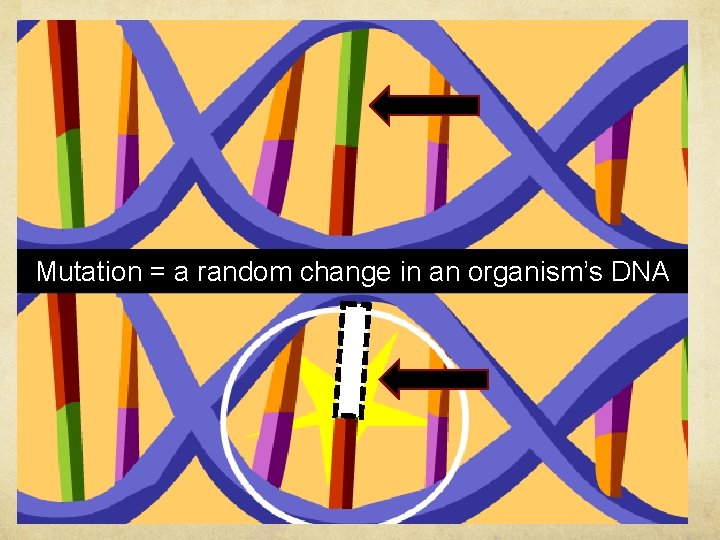
Mutation = a random change in an organism’s DNA
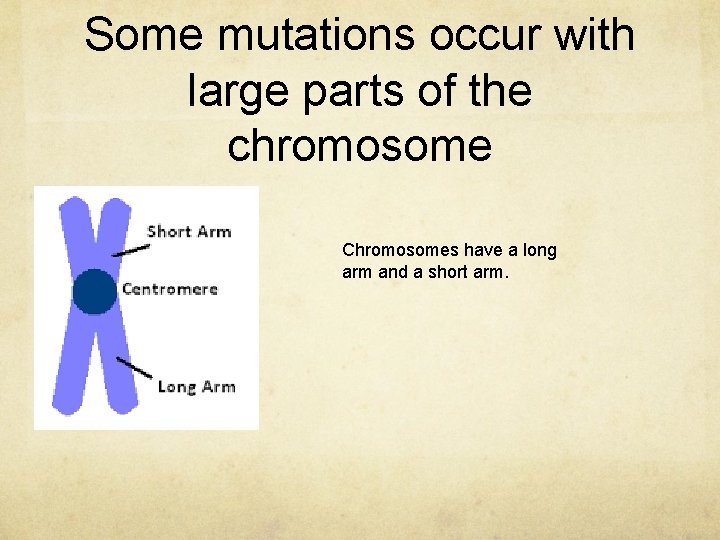
Some mutations occur with large parts of the chromosome Chromosomes have a long arm and a short arm.
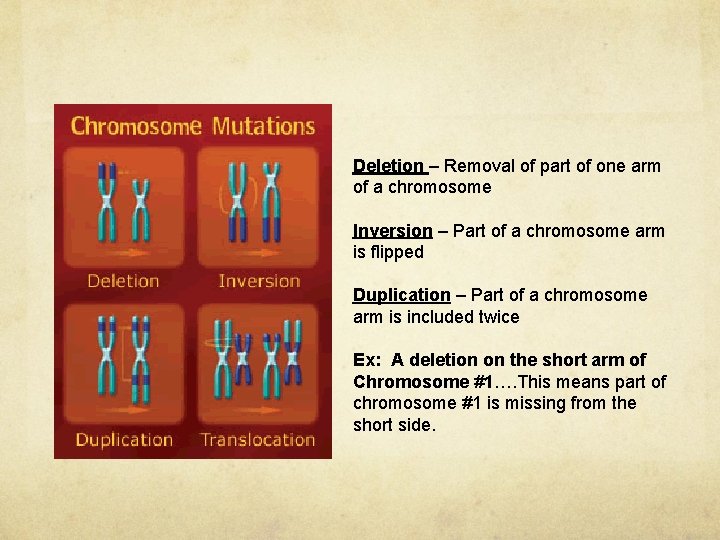
Deletion – Removal of part of one arm of a chromosome Inversion – Part of a chromosome arm is flipped Duplication – Part of a chromosome arm is included twice Ex: A deletion on the short arm of Chromosome #1…. This means part of chromosome #1 is missing from the short side.
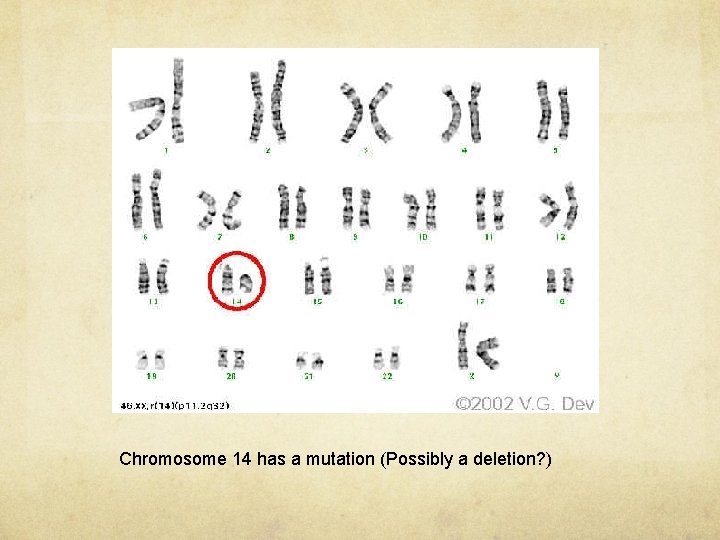
Chromosome 14 has a mutation (Possibly a deletion? )
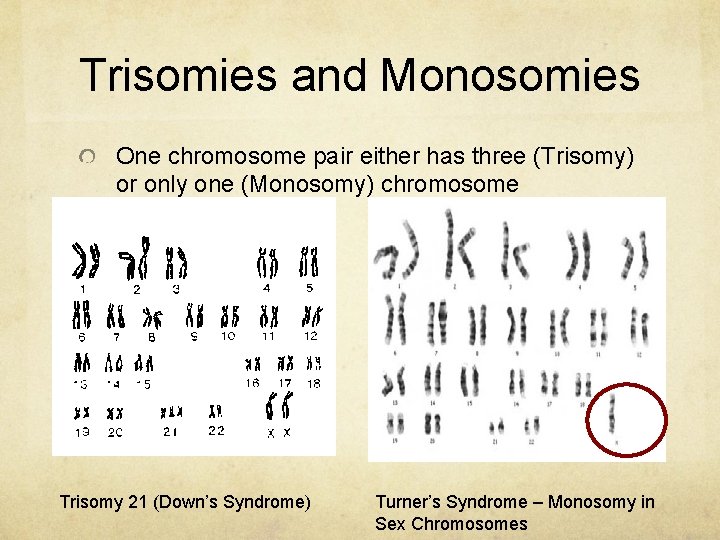
Trisomies and Monosomies One chromosome pair either has three (Trisomy) or only one (Monosomy) chromosome Trisomy 21 (Down’s Syndrome) Turner’s Syndrome – Monosomy in Sex Chromosomes
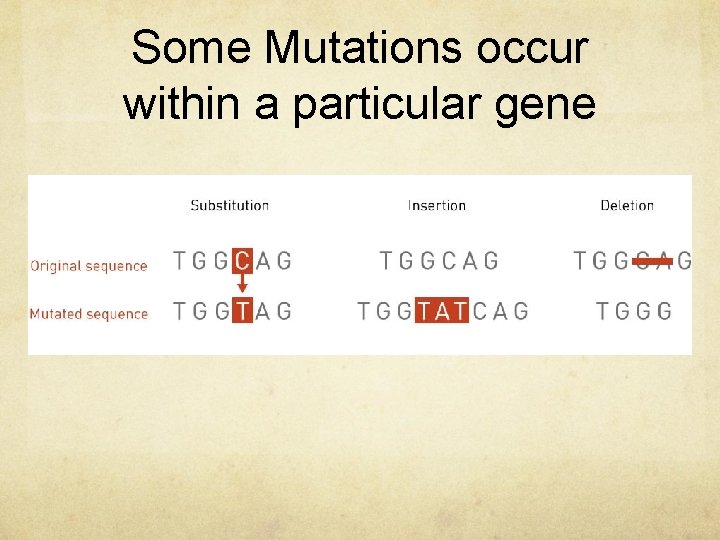
Some Mutations occur within a particular gene
Result of a Mutation? The job of DNA is to hold a code that tells your body to make a certain protein. These may be pigments (coloring), enzymes (help chemical reactions in your body happen), or other proteins If your DNA has a mutation in a gene, your body may not correctly make that protein. This can cause no problems, small problems, or very big problems for your body. A mutation in a big part of a chromosome will cause a syndrome – a group of associated disorders
What Can Mutations Do?
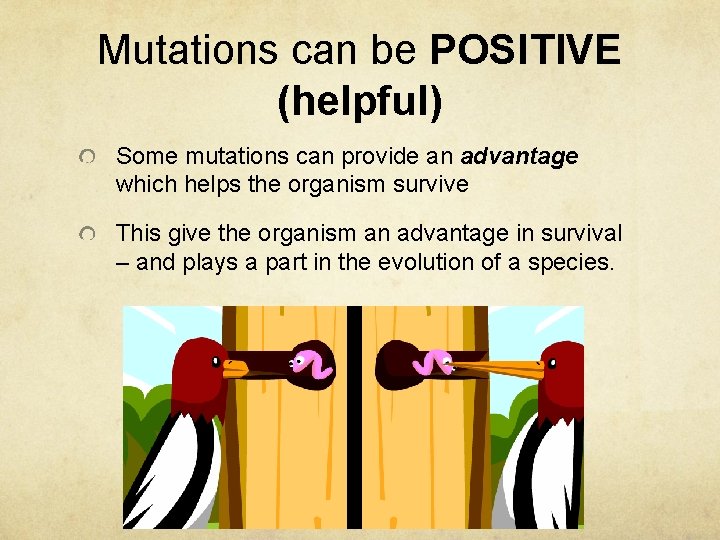
Mutations can be POSITIVE (helpful) Some mutations can provide an advantage which helps the organism survive This give the organism an advantage in survival – and plays a part in the evolution of a species.
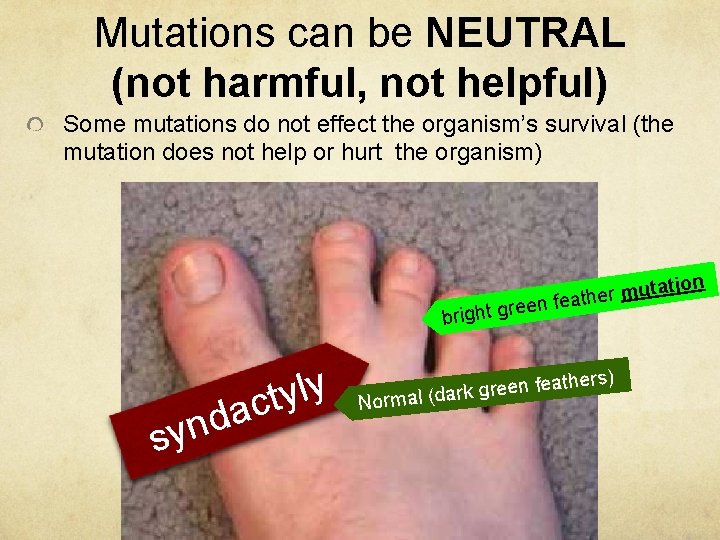
Mutations can be NEUTRAL (not harmful, not helpful) Some mutations do not effect the organism’s survival (the mutation does not help or hurt the organism) tion a t u m r e eath t green f brigh d n y s y l y t ac athers e f n e e r g k r Normal (da )
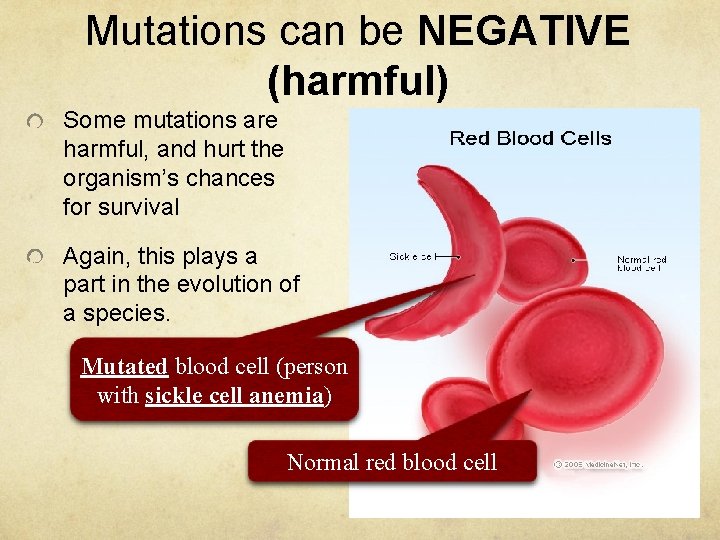
Mutations can be NEGATIVE (harmful) Some mutations are harmful, and hurt the organism’s chances for survival Again, this plays a part in the evolution of a species. Mutated blood cell (person with sickle cell anemia) Normal red blood cell
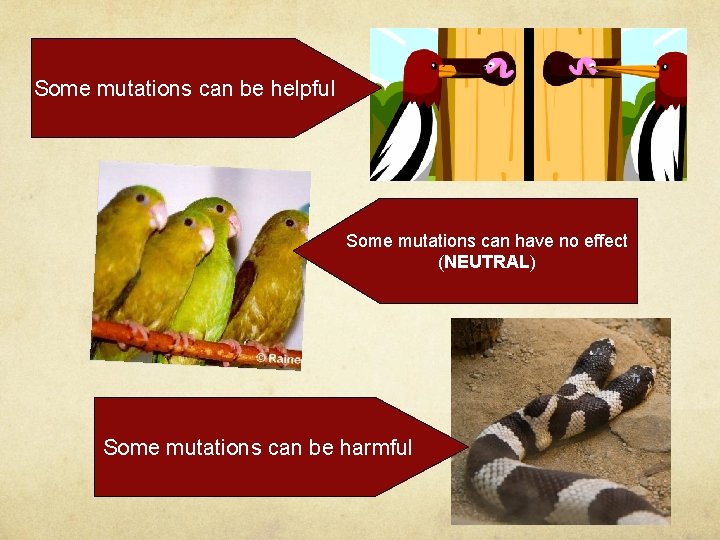
Some mutations can be helpful Some mutations can have no effect (NEUTRAL) Some mutations can be harmful
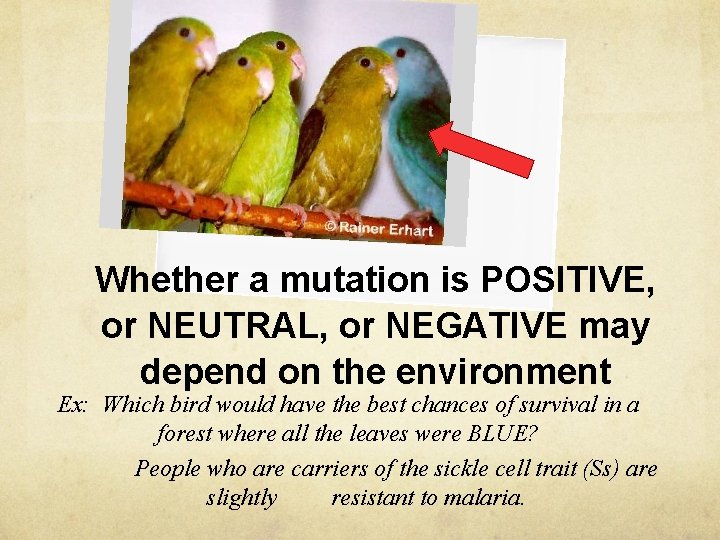
Whether a mutation is POSITIVE, or NEUTRAL, or NEGATIVE may depend on the environment Ex: Which bird would have the best chances of survival in a forest where all the leaves were BLUE? People who are carriers of the sickle cell trait (Ss) are slightly resistant to malaria.