
MUTATIONS MUTATIONS The alteration of an organisms DNA
- Slides: 34
MUTATIONS
MUTATIONS • The alteration of an organism’s DNA • Wide range of mutations • Most mutations are automatically repaired by the organism’s enzymes… • …therefore they have no effect.
MUTATIONS • However…when the mutation is NOT repaired… • The resulting altered chromosome/gene structure is passed to ALL subsequent daughter cells of the mutant cell… • Mutations can be good or bad.
When are mutations inherited? • Mutations that occur in regular body cells (somatic cells) will affect all daughter cells, but will not be passed to offspring • Can contribute to aging process • May lead to cancer…
When are mutations inherited? For example: • Mutation in lung cell will lead to cancer, but cancer isn’t passed on to offspring
When are mutations inherited? • Mutations will only be passed on to offspring if they occur in the gamete (sex cells) • Results in genetic disorders
When are mutations inherited? • Lethal mutations result in the death of the organism • Often miscarriage
What causes mutations? • Malfunction during the process of meiosis • Exposure to a physical or chemical agent • Called a mutagen • Examples: x-rays, chemicals (asbestos, formaldahyde), UV rays,
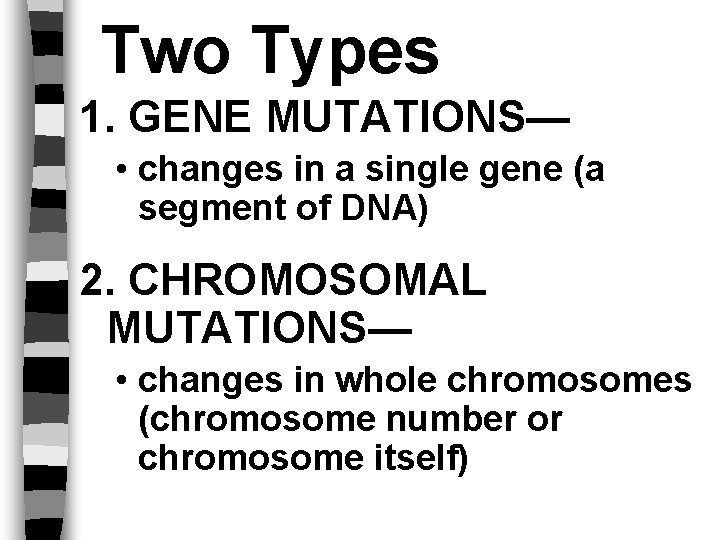
Two Types 1. GENE MUTATIONS— • changes in a single gene (a segment of DNA) 2. CHROMOSOMAL MUTATIONS— • changes in whole chromosomes (chromosome number or chromosome itself)
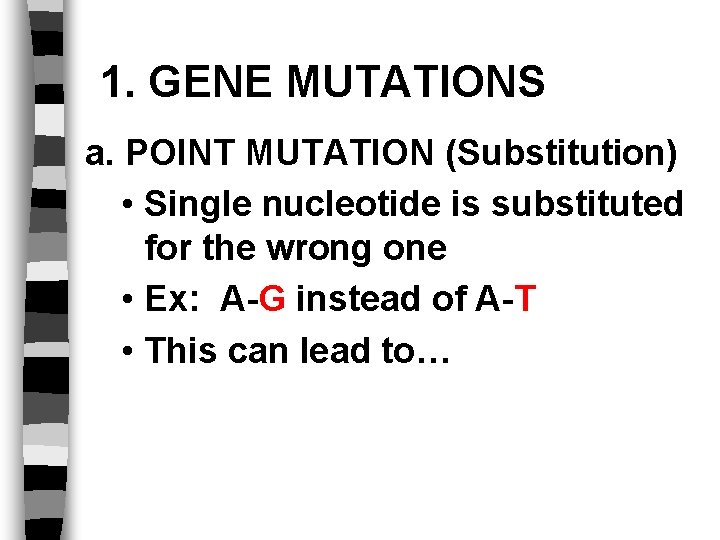
1. GENE MUTATIONS a. POINT MUTATION (Substitution) • Single nucleotide is substituted for the wrong one • Ex: A-G instead of A-T • This can lead to…
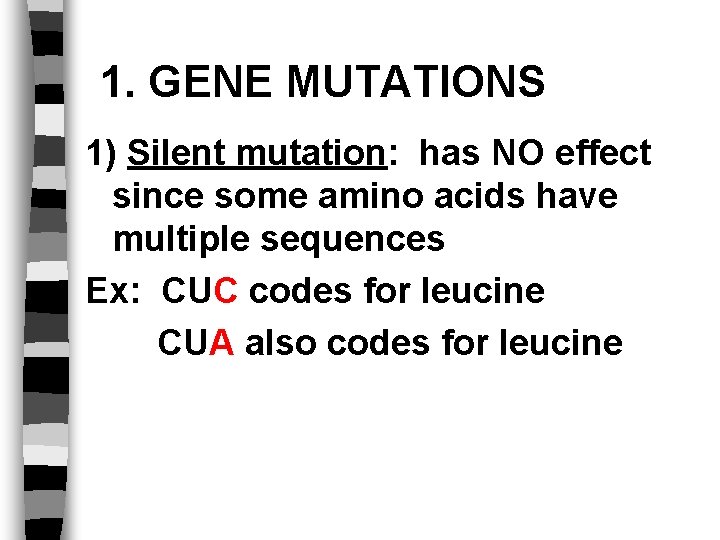
1. GENE MUTATIONS 1) Silent mutation: has NO effect since some amino acids have multiple sequences Ex: CUC codes for leucine CUA also codes for leucine
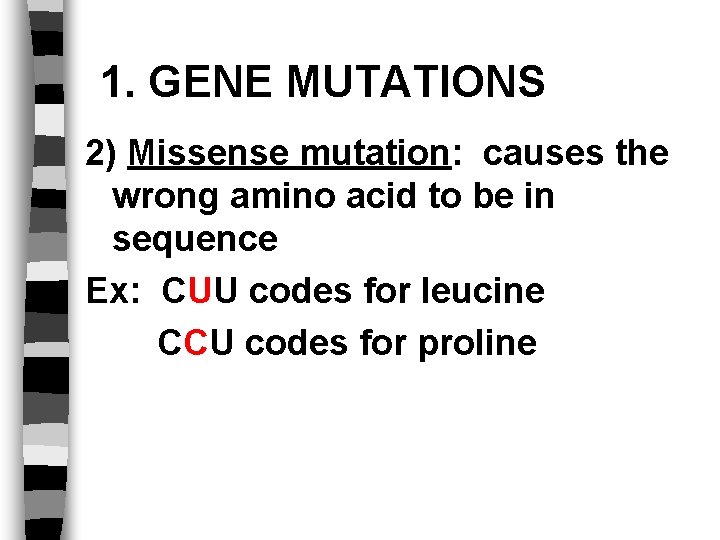
1. GENE MUTATIONS 2) Missense mutation: causes the wrong amino acid to be in sequence Ex: CUU codes for leucine CCU codes for proline
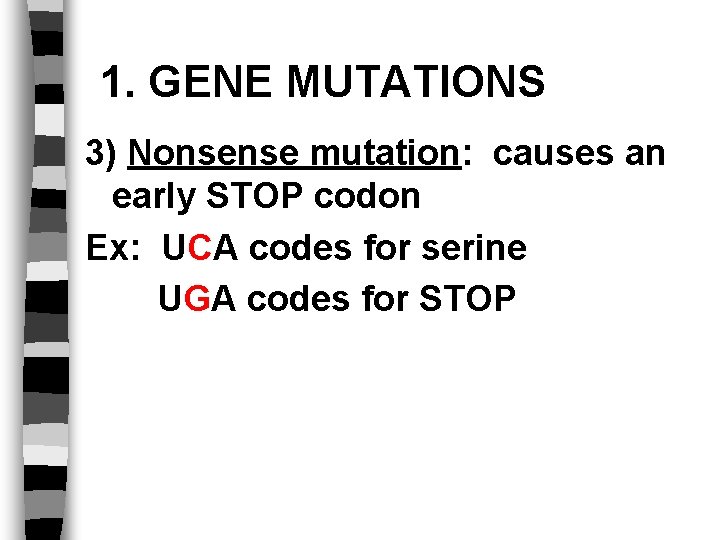
1. GENE MUTATIONS 3) Nonsense mutation: causes an early STOP codon Ex: UCA codes for serine UGA codes for STOP
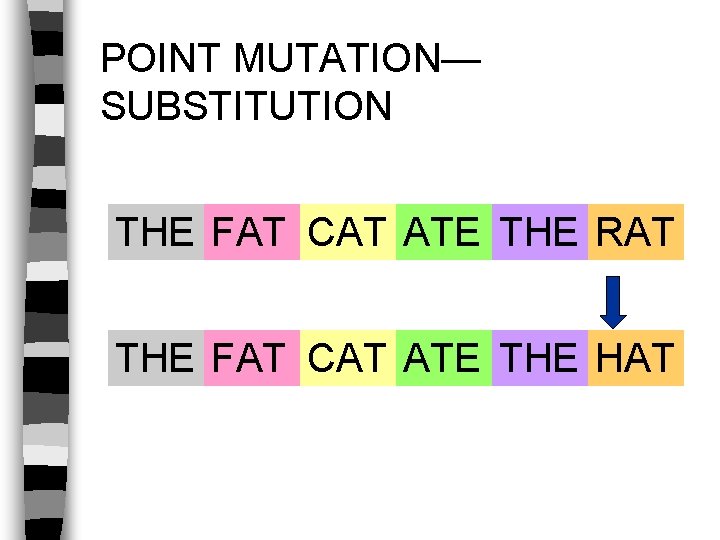
POINT MUTATION— SUBSTITUTION THE FAT CAT ATE THE RAT THE FAT CAT ATE THE HAT
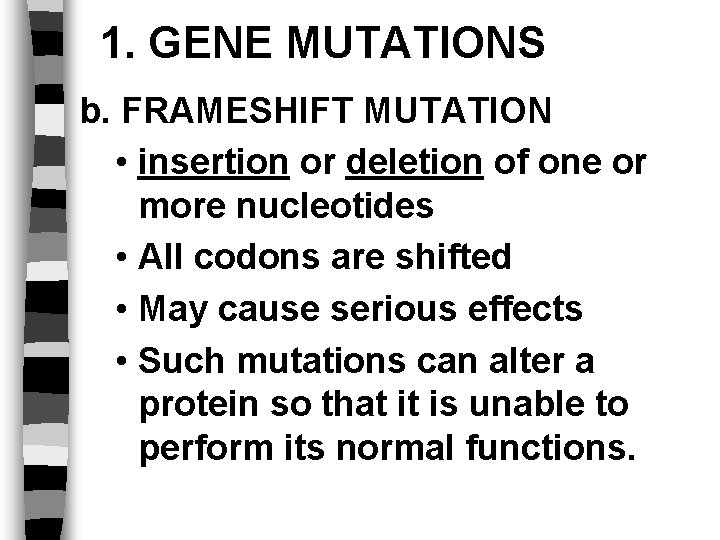
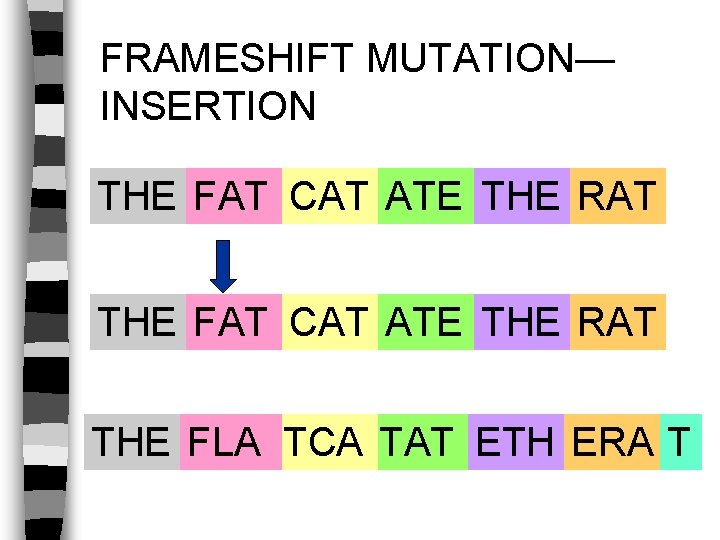
1. GENE MUTATIONS b. FRAMESHIFT MUTATION • insertion or deletion of one or more nucleotides • All codons are shifted • May cause serious effects • Such mutations can alter a protein so that it is unable to perform its normal functions.
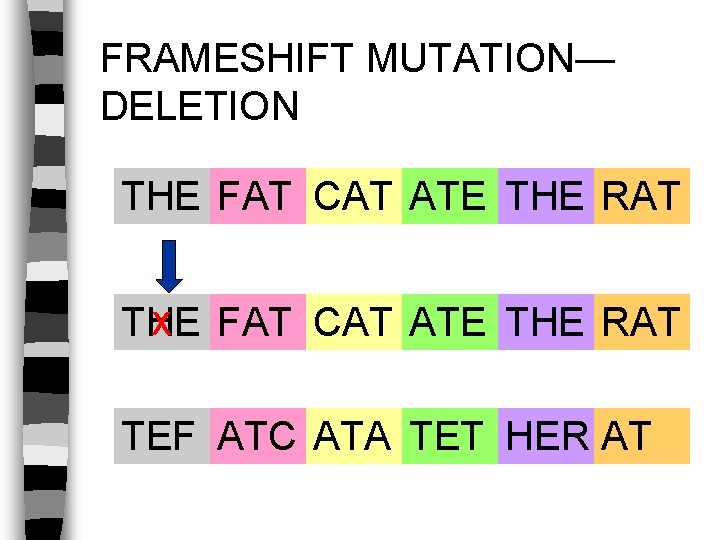
FRAMESHIFT MUTATION— DELETION THE FAT CAT ATE THE RAT X FAT CAT ATE THE RAT THE TEF ATC ATA TET HER AT
FRAMESHIFT MUTATION— INSERTION THE FAT CAT ATE THE RAT THE FLA TCA TAT ETH ERA T
Disorders caused by GENE MUTATIONS • • • Sickle-cell disease Tay-Sachs disease Huntington’s disease Cystic Fibrosis Albinism
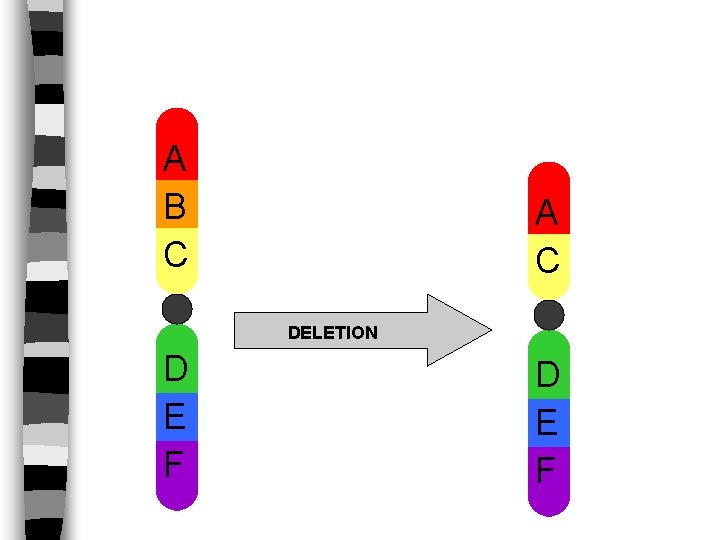
2. CHROMOSOMAL MUTATIONS a. DELETION • Involves loss of a part or whole chromosome
A B C A C DELETION D E F
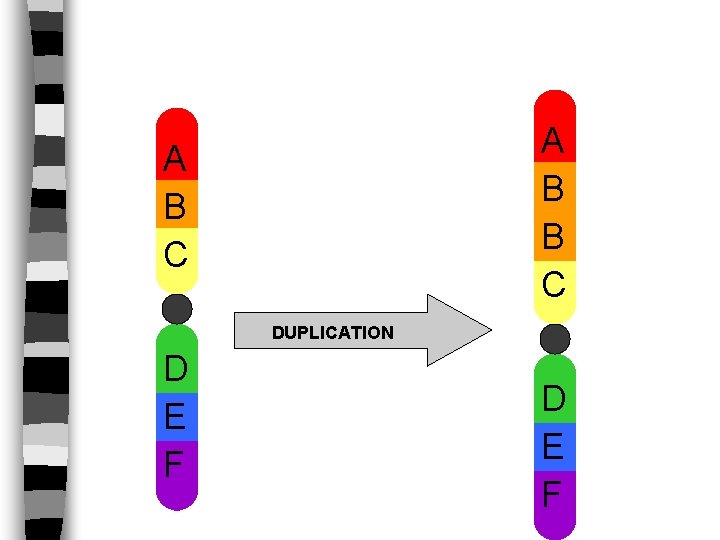
2. CHROMOSOMAL MUTATIONS b. DUPLICATION • Opposite of deletion • A segment of the chromosome is repeated
A B B C A B C DUPLICATION D E F
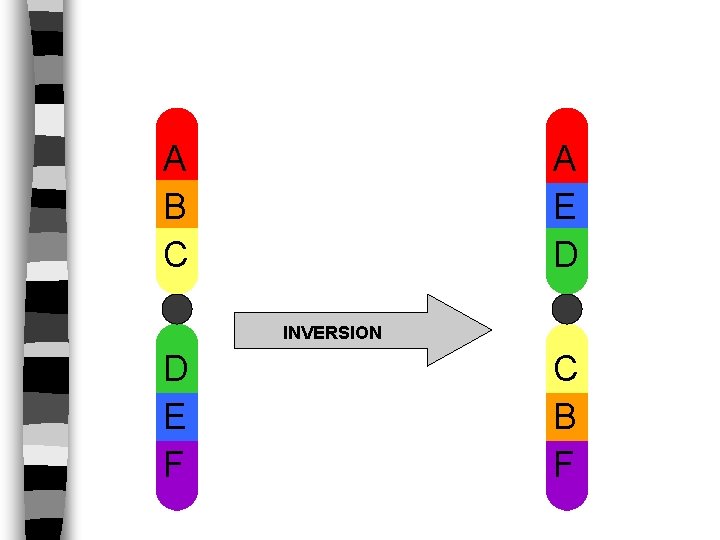
2. CHROMOSOMAL MUTATIONS c. INVERSION • Direction of genes is reversed within chromosome (part is upside-down)
A B C A E D INVERSION D E F C B F
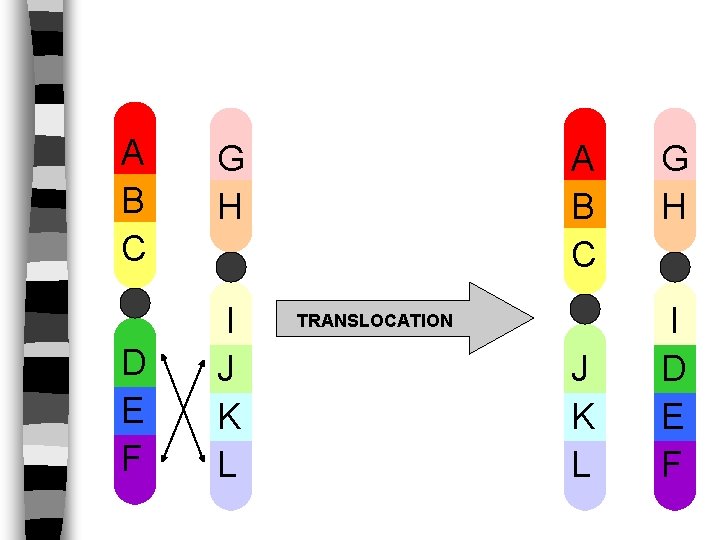
2. CHROMOSOMAL MUTATIONS d. TRANSLOCATION • When part of a chromosome breaks off and relocates to another part (non-homologous)
A B C G H D E F I J K L A B C TRANSLOCATION J K L G H I D E F
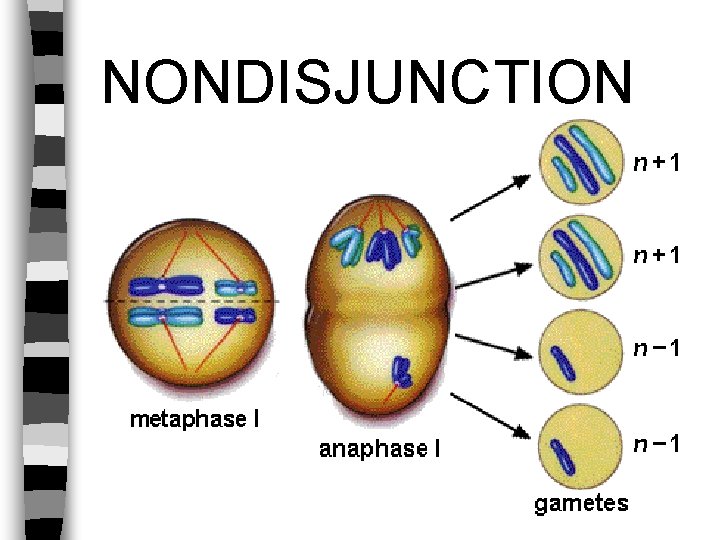
2. CHROMOSOMAL MUTATIONS e. NONDISJUNCTION • Results in too few or too many chromosomes in a cell…
NONDISJUNCTION • MONOSOMY • Having only ONE copy of a chromosome instead of TWO • EX: Turner’s syndrome (has only one X chromosome)
NONDISJUNCTION • TRISOMY • Having THREE copies of a chromosome instead of TWO • EX: Down Syndrome (3 copies of chromosome #21, trisomy 21)
NONDISJUNCTION
Disorders caused by CHROMOSOMAL MUTATIONS • NONDISJUNCTION of Sex Chromosomes: • Klinefelter’s syndrome (male) • Turner’s syndrome (female) • NONDISJUNCTION of Autosomal Chromosomes: • Down Syndrome (Trisomy 21)
Where can mutations occur? Somatic Cells (Body Cells) Germ Cells (Sex Cells)
Somatic Cells (Body Cells) • During or before mitosis • All new cells will also be altered • The change is permanent • Only effects organism, not offspring
Germ Cells (Sex Cells) • Changes can occur in egg/sperm before, during or after meiosis • Altered egg/sperm may be fertilized —passing change to offspring • Changes may or may not be harmful • Harmful changes cause birth defects