
MUTATION Dr H B Mahesha Associate Professor and
MUTATION Dr. H. B. Mahesha Associate Professor and Head Department of Sericulture Yuvaraja’s College University of Mysore, India. 08 March 2021 www. hbmahesh. weebly. com 1
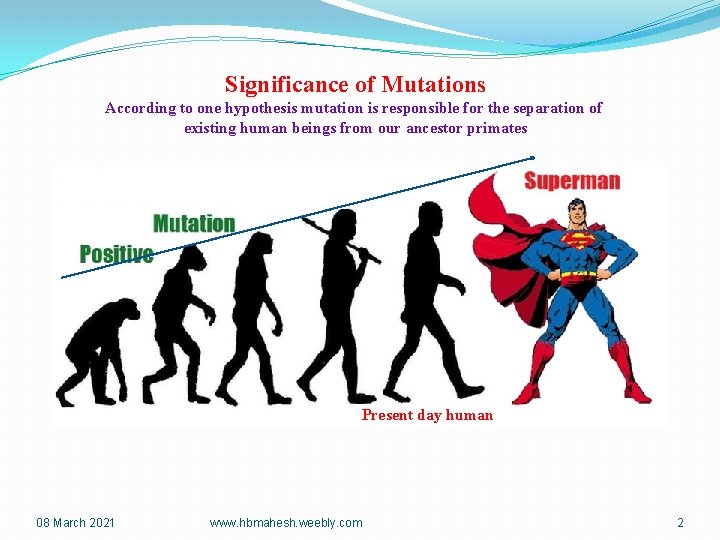
Significance of Mutations According to one hypothesis mutation is responsible for the separation of existing human beings from our ancestor primates Present day human 08 March 2021 www. hbmahesh. weebly. com 2
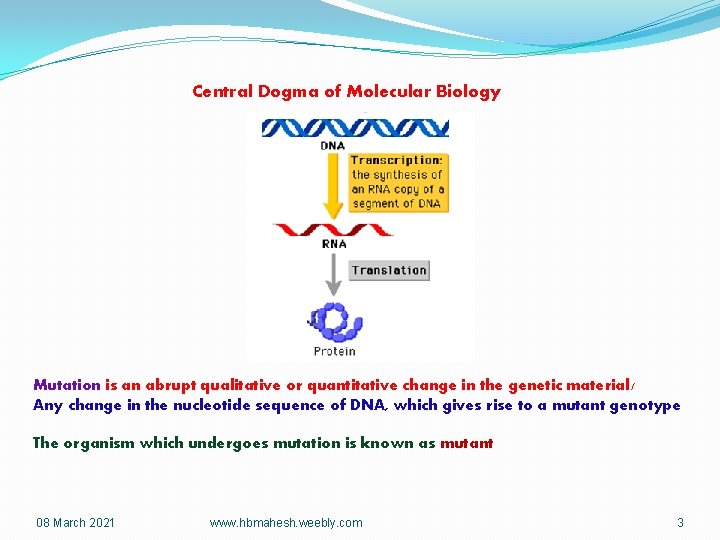
Central Dogma of Molecular Biology Mutation is an abrupt qualitative or quantitative change in the genetic material/ Any change in the nucleotide sequence of DNA, which gives rise to a mutant genotype The organism which undergoes mutation is known as mutant 08 March 2021 www. hbmahesh. weebly. com 3
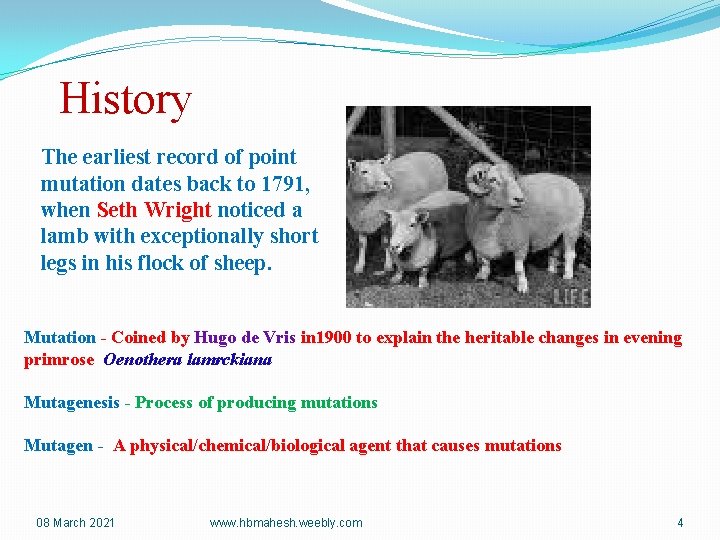
History The earliest record of point mutation dates back to 1791, when Seth Wright noticed a lamb with exceptionally short legs in his flock of sheep. Mutation - Coined by Hugo de Vris in 1900 to explain the heritable changes in evening primrose Oenothera lamrckiana Mutagenesis - Process of producing mutations Mutagen - A physical/chemical/biological agent that causes mutations 08 March 2021 www. hbmahesh. weebly. com 4
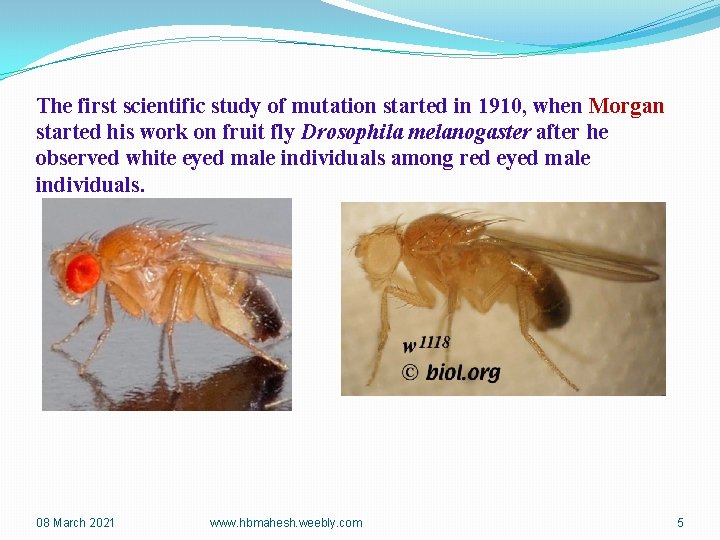
The first scientific study of mutation started in 1910, when Morgan started his work on fruit fly Drosophila melanogaster after he observed white eyed male individuals among red eyed male individuals. 08 March 2021 www. hbmahesh. weebly. com 5
Classification Based on the origin: Natural / Artificial (induced) Based on the type of cells: Somatic/Gametic Based on type of chromosomes: Autosomal / Allosomal Based on direction: Forward/Reverse Based on size: Point/Gross Silent Mutations: - has no detectable effect of phenotype Leaky mutations: - Causes amino acid substitution, eventually it reduces the activity of an enzyme. Nonsense Mutations or Chain termination Mutation: - Causes premature termination of polypeptide chain. etc. , 08 March 2021 www. hbmahesh. weebly. com 6
Natural Mutation Spontaneous mutations occur suddenly in the nature and their origin is unknown. They are also called as background mutations and have been reported in many organisms such as Oenothera, Maize, Drosophila, Mice, Man etc. , For example TAUTOMERISM Frequency of total mutations - 10 -7 to 10 -12/organism ( i. e. , 0. 0000001 - 0. 0000001) Frequency of detectable mutations - 1 in 106 (i. e. , 0. 000001) 08 March 2021 www. hbmahesh. weebly. com 7
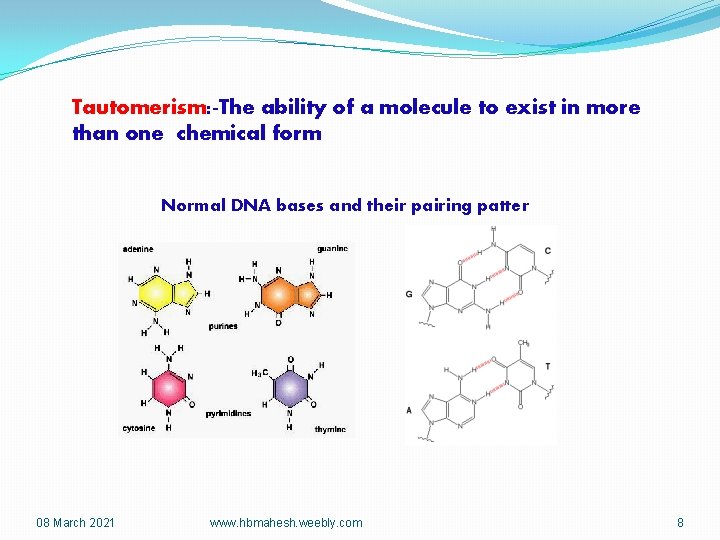
Tautomerism: -The ability of a molecule to exist in more than one chemical form Normal DNA bases and their pairing patter 08 March 2021 www. hbmahesh. weebly. com 8
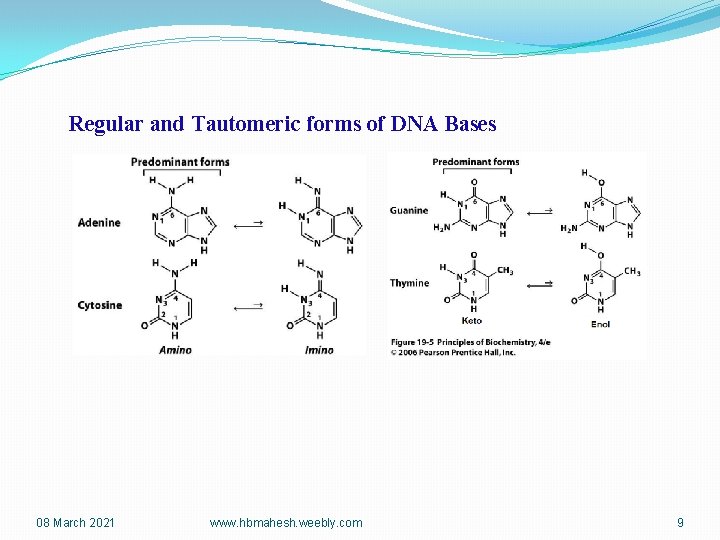
Regular and Tautomeric forms of DNA Bases 08 March 2021 www. hbmahesh. weebly. com 9
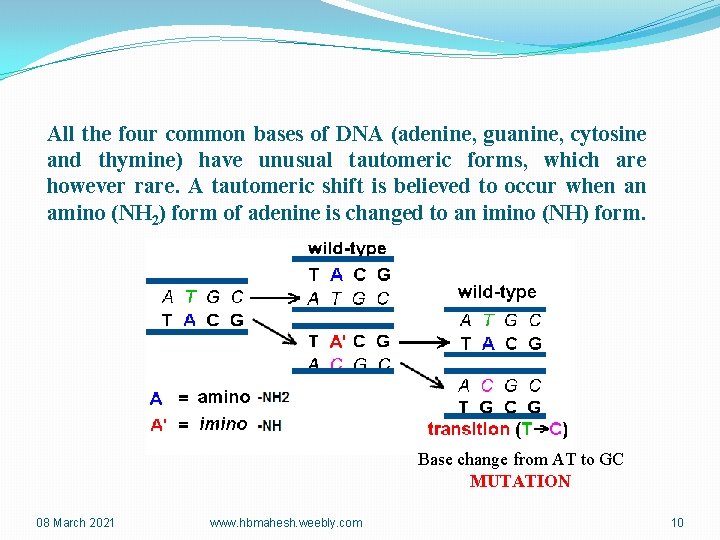
All the four common bases of DNA (adenine, guanine, cytosine and thymine) have unusual tautomeric forms, which are however rare. A tautomeric shift is believed to occur when an amino (NH 2) form of adenine is changed to an imino (NH) form. Base change from AT to GC MUTATION 08 March 2021 www. hbmahesh. weebly. com 10
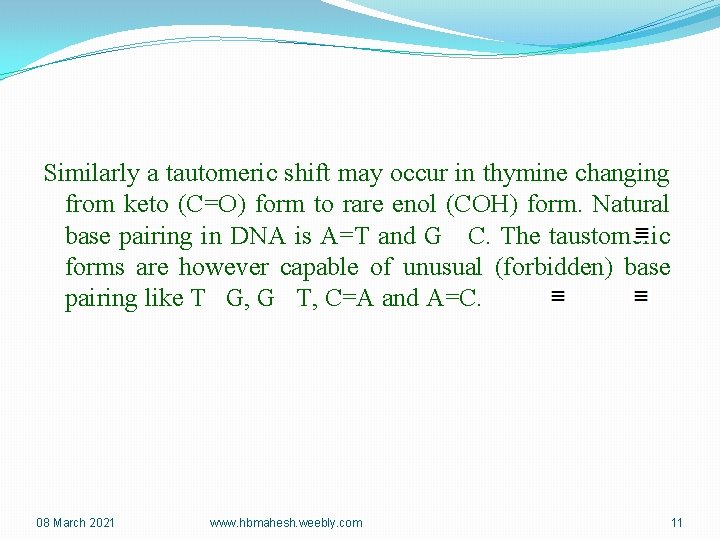
Similarly a tautomeric shift may occur in thymine changing from keto (C=O) form to rare enol (COH) form. Natural base pairing in DNA is A=T and G C. The taustomeric forms are however capable of unusual (forbidden) base pairing like T G, G T, C=A and A=C. 08 March 2021 www. hbmahesh. weebly. com 11
Induced Mutation can be induced artificially in the living organisms by exposing them to abnormal environment such as radiations, certain physical conditions (i. e. temperature) and chemicals. 08 March 2021 www. hbmahesh. weebly. com 12
Mutagens The substances or agents which induce mutations are called mutagens or mutagenic agents. They may be physical, chemical or biological. 1. Physical –Radiations: i. Ionizing-X-rays, gamma, Alpha, Beeta, protons, nutrons etc. , ii. Non Ionizing -U Temperature- V 08 March 2021 www. hbmahesh. weebly. com 13
2. Chemical – Base Analogues: 2, aminopurine, 5 -bromourasil etc. , Base Modifying agents: Nitrous acid, Hydroxylamine etc. , Distortion producing agents: Proflavin, acridine orange etc. , 08 March 2021 www. hbmahesh. weebly. com 14
3. Biological Mutagens: They may be viral or bacterial. H. Pylori- implicated in stomach cancer Hepatitis B virus- implicated in liver cancer H. papiloma virus-implicated in cervical cancer Human T-cell lymphocytic virus implicated in lymphoma 08 March 2021 www. hbmahesh. weebly. com 15
Point Mutation / Gene Mutation A mutation that changes only one small area or one nucleotide in a gene Earliest record of point mutation dates back to 1791 by Seth Wright. Since then mutations have been reported in E. coli, Neurospora, Pea, Maize, Rodents, Fowls, Man, etc. , 08 March 2021 www. hbmahesh. weebly. com 16
Frame Shift Mutation A mutation that inserts or deletes a single base (normally single rarely more) will change the reading frame for the entire subsequent sequence. A change of reading frame is called Frame shift mutation. 08 March 2021 www. hbmahesh. weebly. com 17
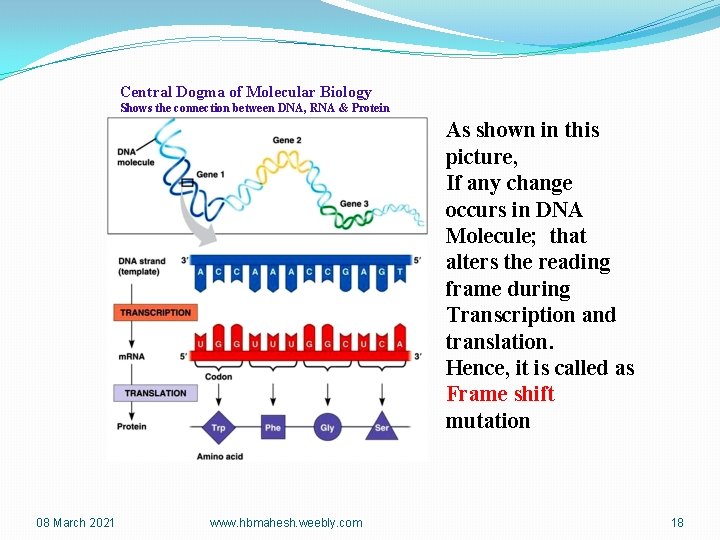
Central Dogma of Molecular Biology Shows the connection between DNA, RNA & Protein As shown in this picture, If any change occurs in DNA Molecule; that alters the reading frame during Transcription and translation. Hence, it is called as Frame shift mutation 08 March 2021 www. hbmahesh. weebly. com 18
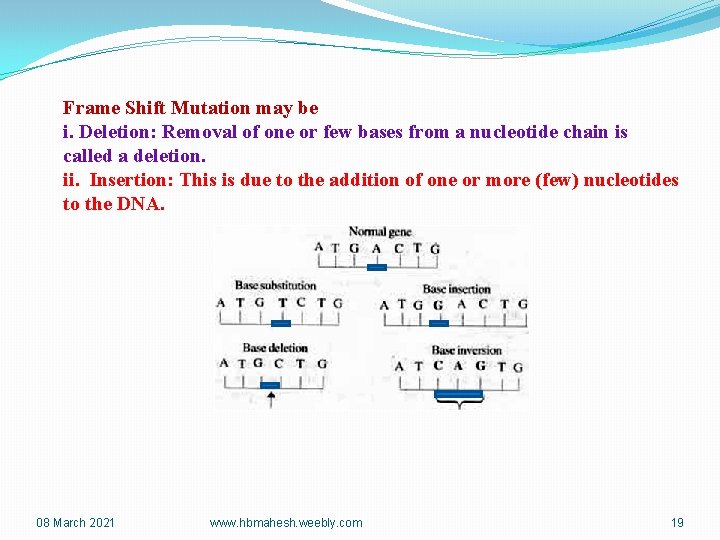
Frame Shift Mutation may be i. Deletion: Removal of one or few bases from a nucleotide chain is called a deletion. ii. Insertion: This is due to the addition of one or more (few) nucleotides to the DNA. 08 March 2021 www. hbmahesh. weebly. com 19
Substitution: - A nitrogenous base of a codon is replaced by another base is called substitution mutation. They maybe 1. Transition 2. Transversion 08 March 2021 www. hbmahesh. weebly. com 20
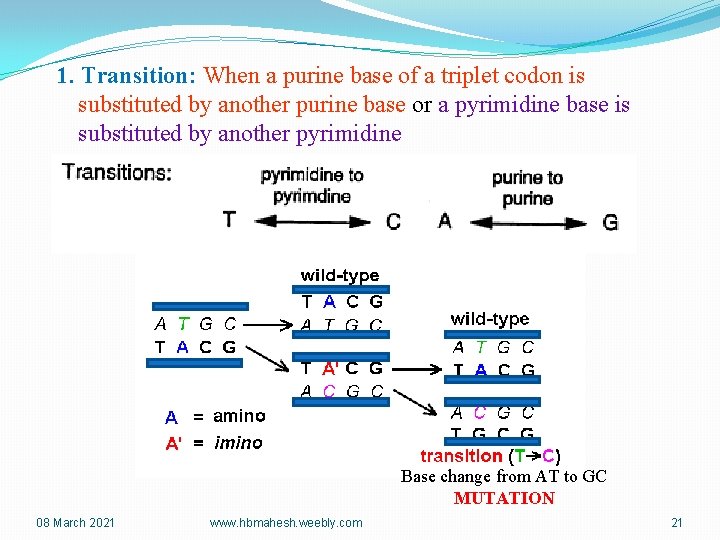
1. Transition: When a purine base of a triplet codon is substituted by another purine base or a pyrimidine base is substituted by another pyrimidine Base change from AT to GC MUTATION 08 March 2021 www. hbmahesh. weebly. com 21
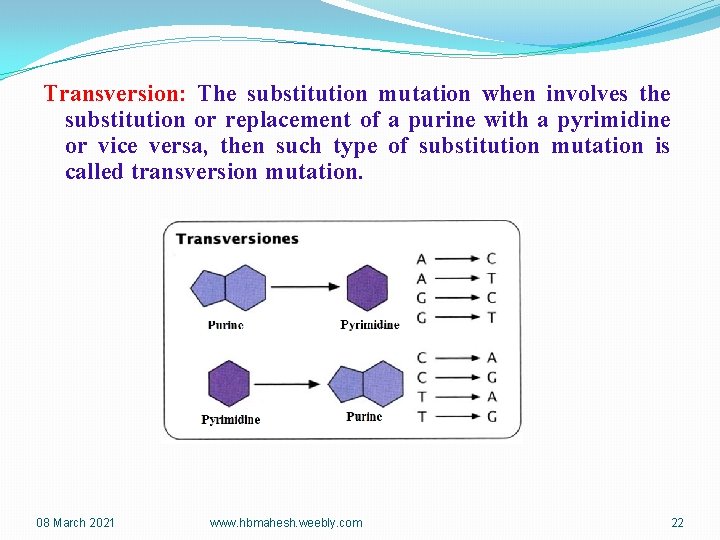
Transversion: The substitution mutation when involves the substitution or replacement of a purine with a pyrimidine or vice versa, then such type of substitution mutation is called transversion mutation. 08 March 2021 www. hbmahesh. weebly. com 22
Chemical Mutagenesis Test for mutagenic effects of chemical agents are almost as old as modern genetics. In 1934, Morgan tried to produce mutations in Drosophila by treating with alcohol and ether, but without success. After a number of attempts by many workers the search for chemical agents met with only during Second World War. Types: Copy Errors by Base Analogues Direct Effect on DNA Agents Producing Distorsions in DNA 08 March 2021 www. hbmahesh. weebly. com 23
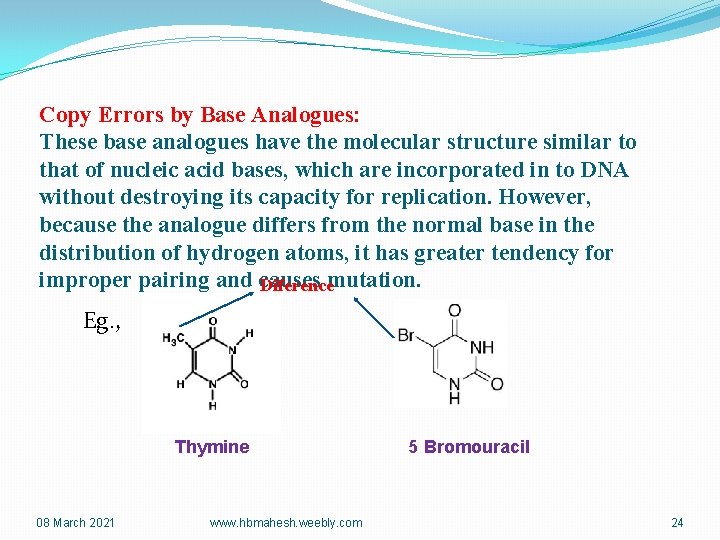
Copy Errors by Base Analogues: These base analogues have the molecular structure similar to that of nucleic acid bases, which are incorporated in to DNA without destroying its capacity for replication. However, because the analogue differs from the normal base in the distribution of hydrogen atoms, it has greater tendency for improper pairing and causes Diferencemutation. Eg. , Thymine 08 March 2021 www. hbmahesh. weebly. com 5 Bromouracil 24
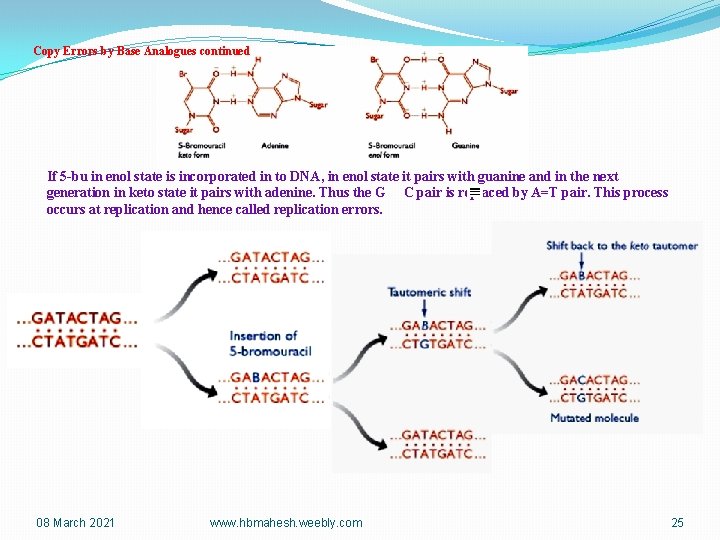
Copy Errors by Base Analogues continued If 5 -bu in enol state is incorporated in to DNA, in enol state it pairs with guanine and in the next generation in keto state it pairs with adenine. Thus the G C pair is replaced by A=T pair. This process occurs at replication and hence called replication errors. 08 March 2021 www. hbmahesh. weebly. com 25
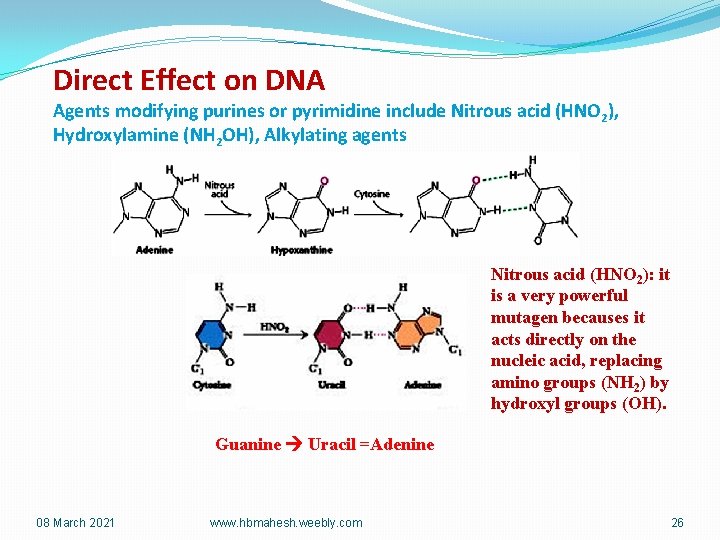
Direct Effect on DNA Agents modifying purines or pyrimidine include Nitrous acid (HNO 2), Hydroxylamine (NH 2 OH), Alkylating agents Nitrous acid (HNO 2): it is a very powerful mutagen becauses it acts directly on the nucleic acid, replacing amino groups (NH 2) by hydroxyl groups (OH). Guanine Uracil =Adenine 08 March 2021 www. hbmahesh. weebly. com 26
Hydroxylamine(NH 2 OH): It reacts specifically with cytosine & converts it to a modified base that pairs only with adenine so that a G C pair ultimately becomes an A = T pair Cytocin ----->Modified Base pairs with Adenine (NH OH) 2 Alkylating Agents: Like ethyl methane sulfonate (EMS), ethyl ethane sulfonate (EES) have been used extensively in genetic engineering research. These alkylating agents impair the normal hydrogen bonding of the bases causing mispairing of G with T, leading to transition of A=T > G C and G C to A=T. also induces recessive lethal mutations, specific locus mutation, translocations, dominant lethal and partial and complete chromosomal loss in Drosophila melanogaster. EMS causes lethal mutations, deletion, translocation, dominant lethal in silkworm Bombyx mori. 08 March 2021 www. hbmahesh. weebly. com 27
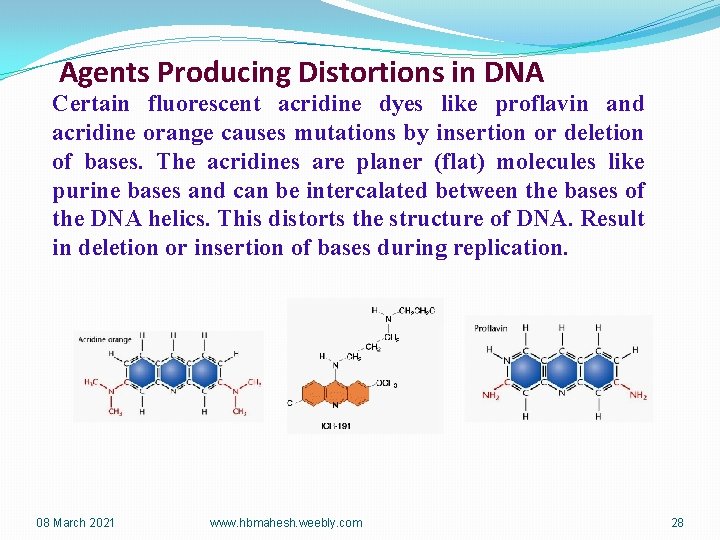
Agents Producing Distortions in DNA Certain fluorescent acridine dyes like proflavin and acridine orange causes mutations by insertion or deletion of bases. The acridines are planer (flat) molecules like purine bases and can be intercalated between the bases of the DNA helics. This distorts the structure of DNA. Result in deletion or insertion of bases during replication. 08 March 2021 www. hbmahesh. weebly. com 28
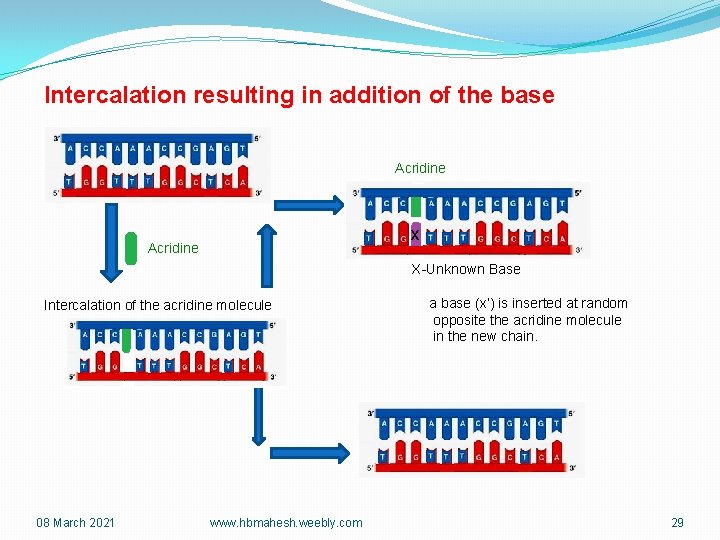
Intercalation resulting in addition of the base Acridine x Acridine X-Unknown Base Intercalation of the acridine molecule 08 March 2021 www. hbmahesh. weebly. com a base (x’) is inserted at random opposite the acridine molecule in the new chain. 29
RADIATION MUTAGENESIS Ionizing radiations: - High-energy radiation capable of producing ionization in substances through which it passes. Ionization: - Any process that leads to the dissociation of a neutral atom, molecule or other species into ions; the state of being ionized. Eg. , X-rays, α, β, gamma rays, fast moving particles etc. , Non Ionizing radiations: - Uv, Radio waves, Visible Light 08 March 2021 www. hbmahesh. weebly. com 30
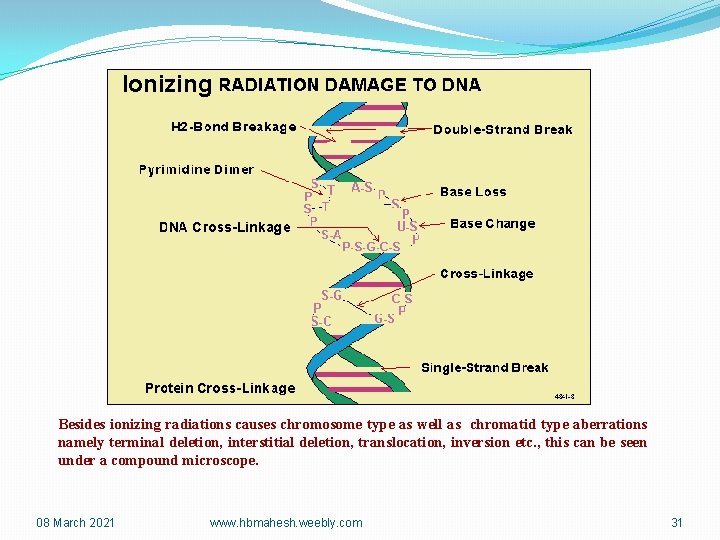
Ionizing Besides ionizing radiations causes chromosome type as well as chromatid type aberrations namely terminal deletion, interstitial deletion, translocation, inversion etc. , this can be seen under a compound microscope. 08 March 2021 www. hbmahesh. weebly. com 31
Effect of Non Ionizing radiation on DNA molecule UV light causing nitrogen bases to become highly reactive free radicals. The resulting unstability causes conversion of one base to another (a purine to another purine or a pyrimidine to another pyrimidine). 08 March 2021 www. hbmahesh. weebly. com 32
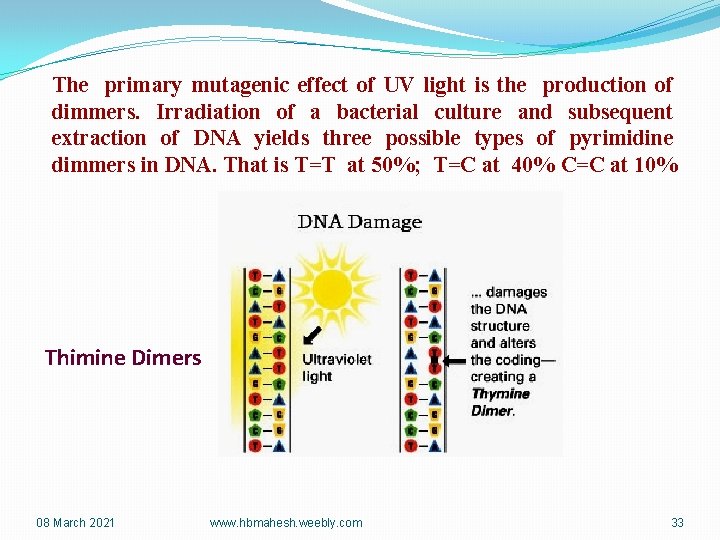
The primary mutagenic effect of UV light is the production of dimmers. Irradiation of a bacterial culture and subsequent extraction of DNA yields three possible types of pyrimidine dimmers in DNA. That is T=T at 50%; T=C at 40% C=C at 10% Thimine Dimers 08 March 2021 www. hbmahesh. weebly. com 33
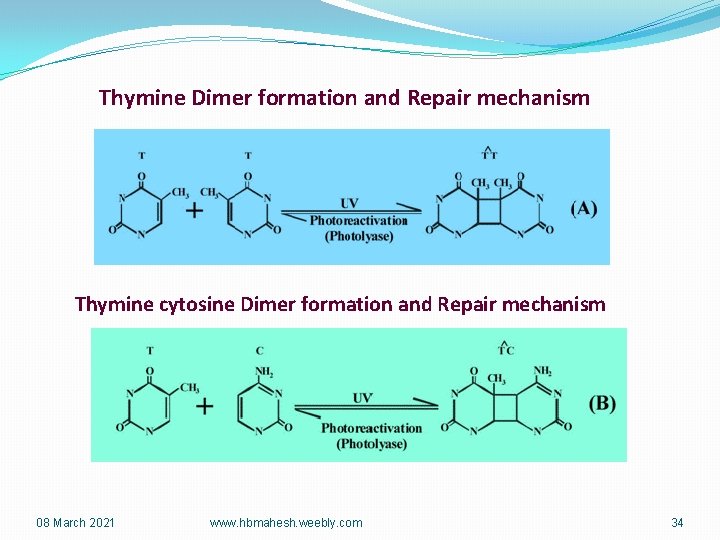
Thymine Dimer formation and Repair mechanism Thymine cytosine Dimer formation and Repair mechanism 08 March 2021 www. hbmahesh. weebly. com 34

08 March 2021 www. hbmahesh. weebly. com 35
Acknowledgements to 1. Internet 2. Molecular biology by David Freifelder 3. Cell Biology by C B Powar 08 March 2021 www. hbmahesh. weebly. com 36
- Slides: 36