
Mutation and Genetic Change 1 What is the
- Slides: 26
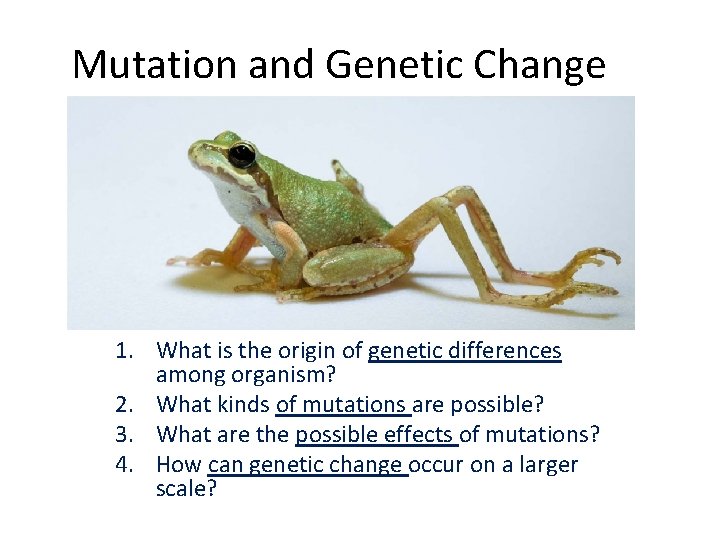
Mutation and Genetic Change 1. What is the origin of genetic differences among organism? 2. What kinds of mutations are possible? 3. What are the possible effects of mutations? 4. How can genetic change occur on a larger scale?
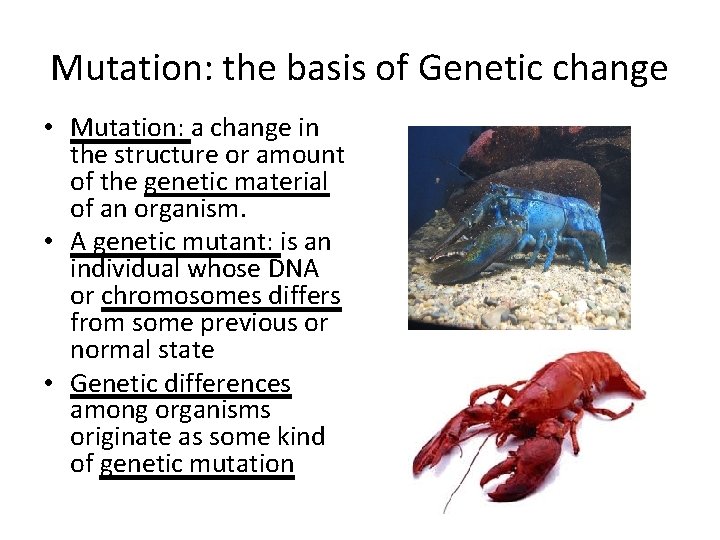
Mutation: the basis of Genetic change • Mutation: a change in the structure or amount of the genetic material of an organism. • A genetic mutant: is an individual whose DNA or chromosomes differs from some previous or normal state • Genetic differences among organisms originate as some kind of genetic mutation
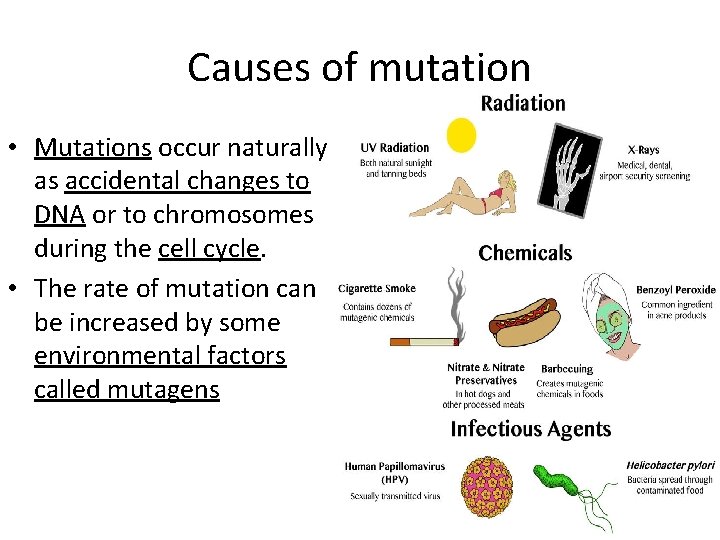
Causes of mutation • Mutations occur naturally as accidental changes to DNA or to chromosomes during the cell cycle. • The rate of mutation can be increased by some environmental factors called mutagens
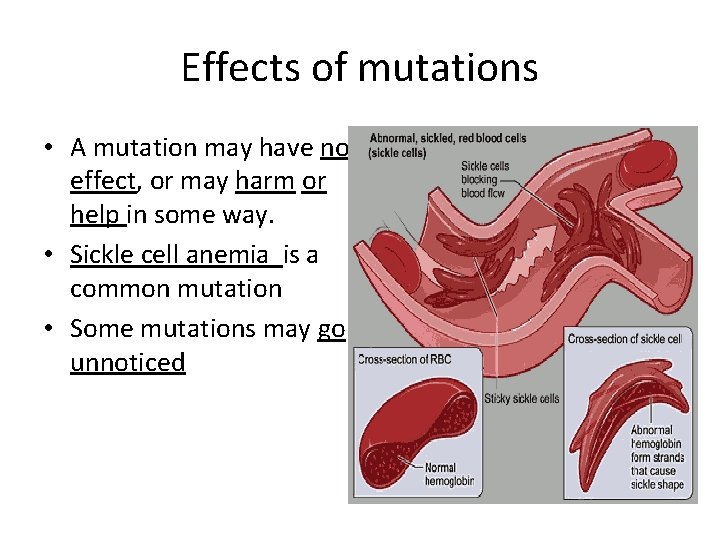
Effects of mutations • A mutation may have no effect, or may harm or help in some way. • Sickle cell anemia is a common mutation • Some mutations may go unnoticed
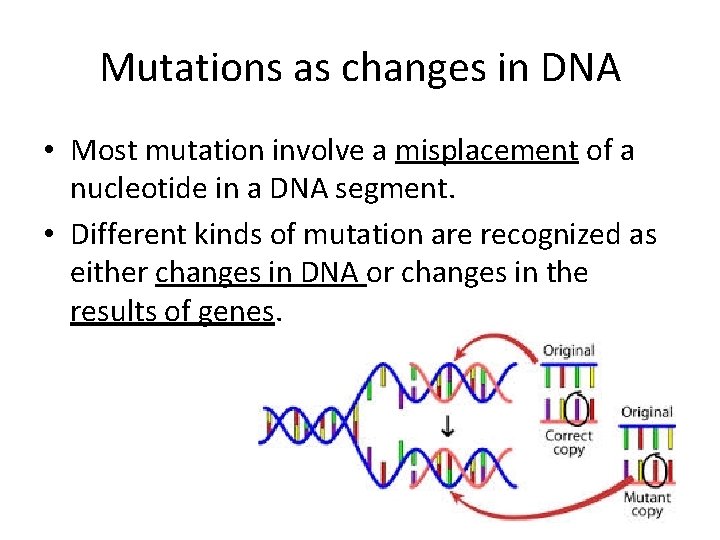
Mutations as changes in DNA • Most mutation involve a misplacement of a nucleotide in a DNA segment. • Different kinds of mutation are recognized as either changes in DNA or changes in the results of genes.
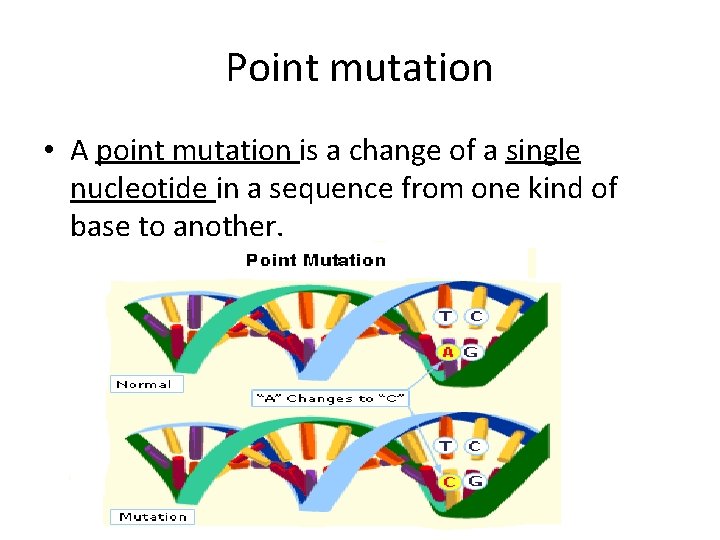
Point mutation • A point mutation is a change of a single nucleotide in a sequence from one kind of base to another.
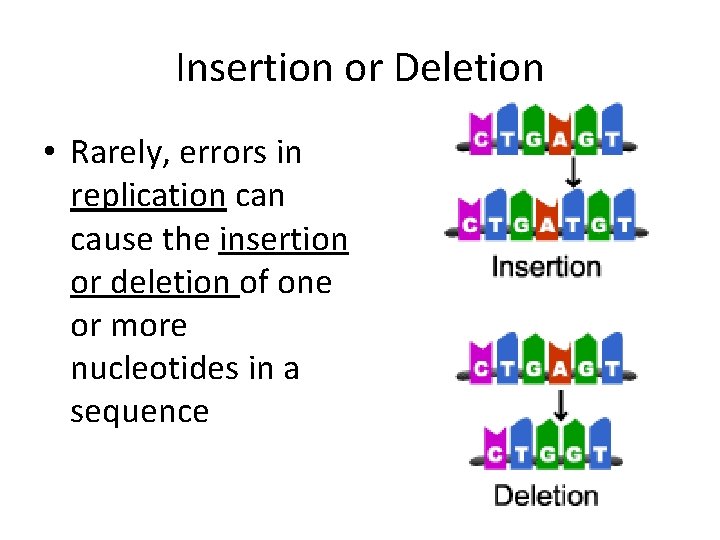
Insertion or Deletion • Rarely, errors in replication cause the insertion or deletion of one or more nucleotides in a sequence
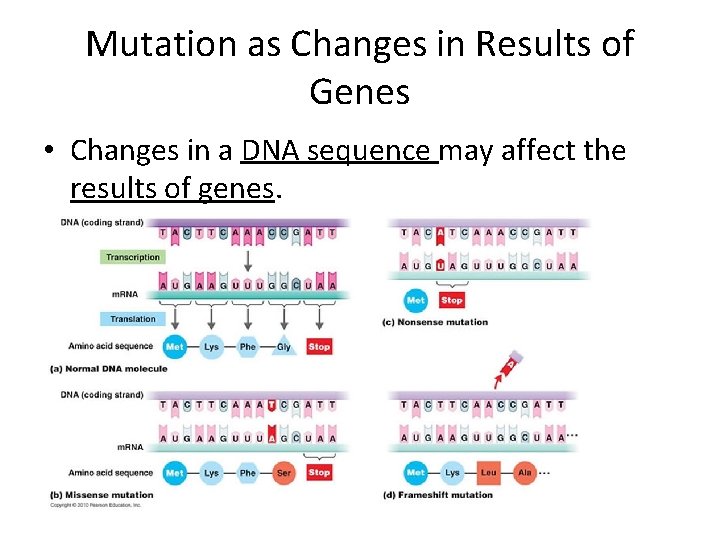
Mutation as Changes in Results of Genes • Changes in a DNA sequence may affect the results of genes.
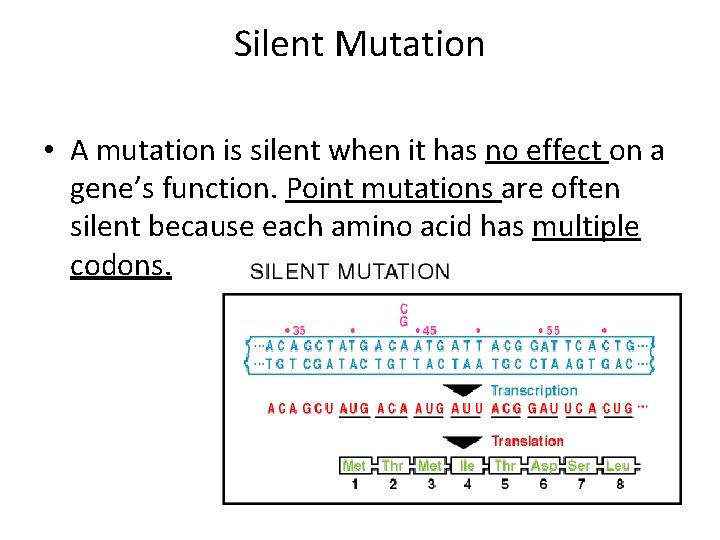
Silent Mutation • A mutation is silent when it has no effect on a gene’s function. Point mutations are often silent because each amino acid has multiple codons.
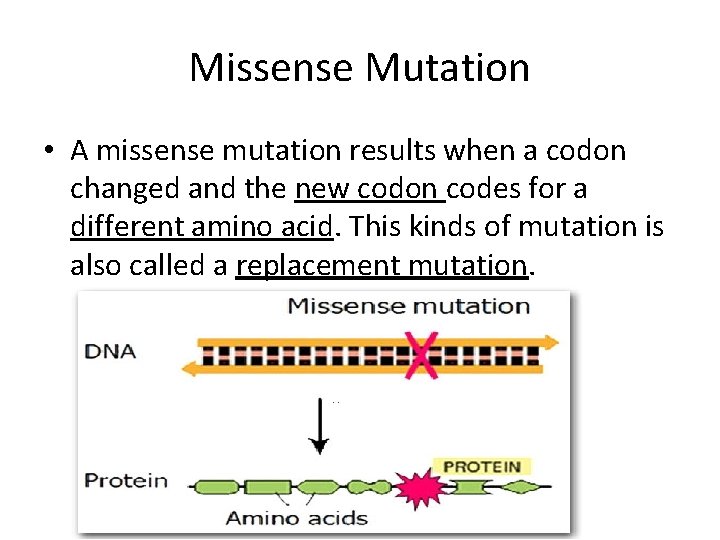
Missense Mutation • A missense mutation results when a codon changed and the new codon codes for a different amino acid. This kinds of mutation is also called a replacement mutation.
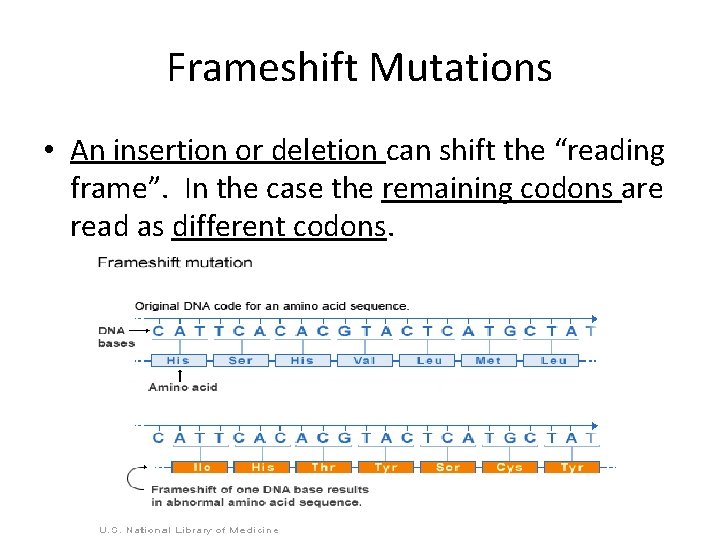
Frameshift Mutations • An insertion or deletion can shift the “reading frame”. In the case the remaining codons are read as different codons.
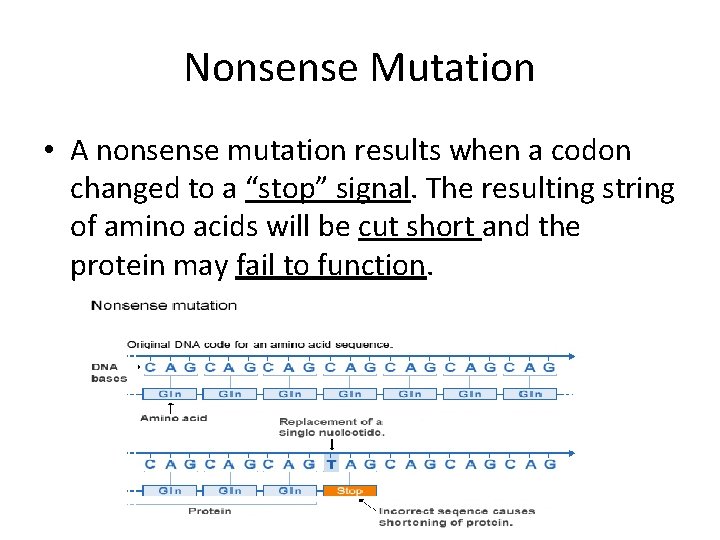
Nonsense Mutation • A nonsense mutation results when a codon changed to a “stop” signal. The resulting string of amino acids will be cut short and the protein may fail to function.
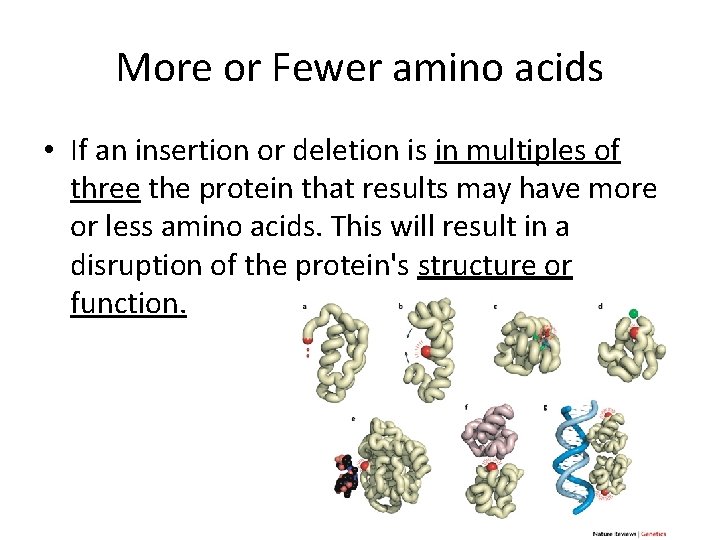
More or Fewer amino acids • If an insertion or deletion is in multiples of three the protein that results may have more or less amino acids. This will result in a disruption of the protein's structure or function.
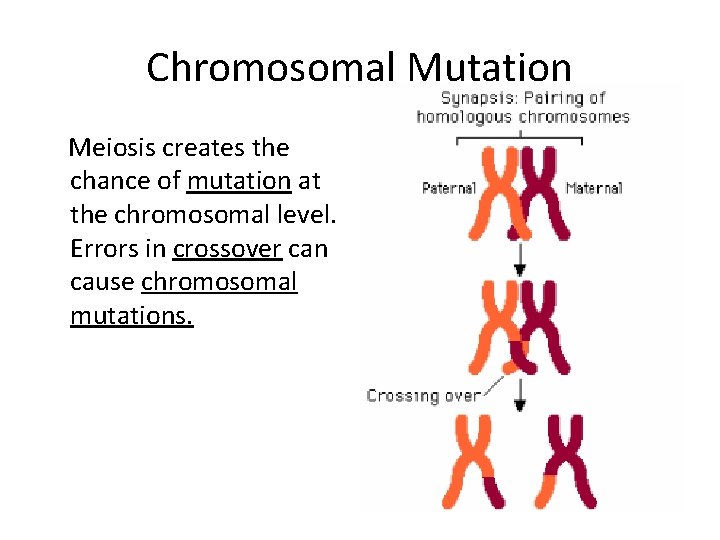
Chromosomal Mutation Meiosis creates the chance of mutation at the chromosomal level. Errors in crossover can cause chromosomal mutations.
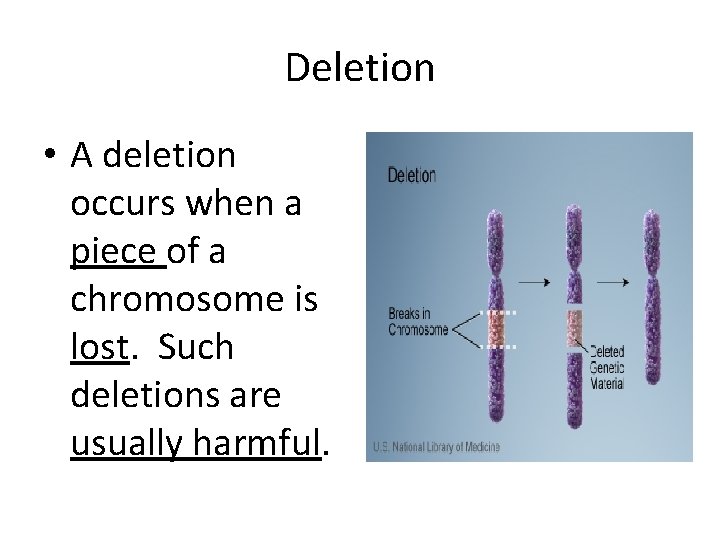
Deletion • A deletion occurs when a piece of a chromosome is lost. Such deletions are usually harmful.
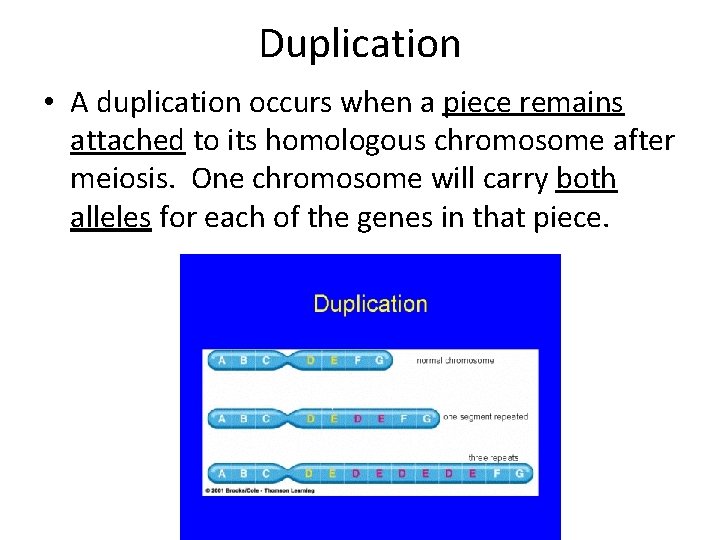
Duplication • A duplication occurs when a piece remains attached to its homologous chromosome after meiosis. One chromosome will carry both alleles for each of the genes in that piece.
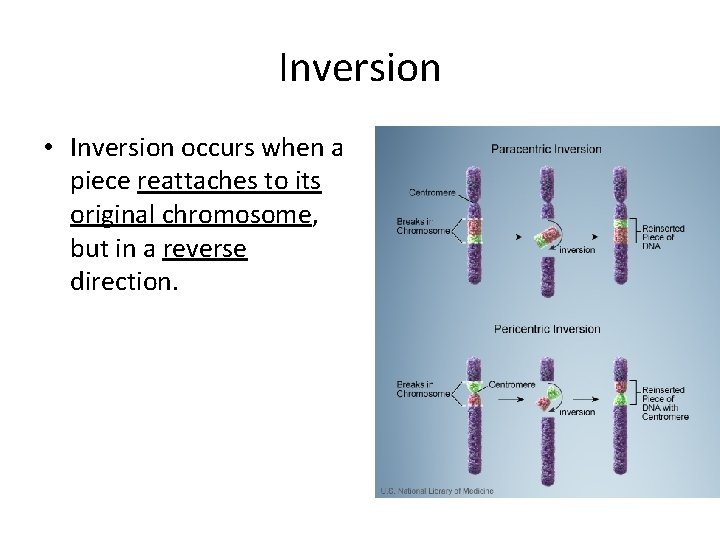
Inversion • Inversion occurs when a piece reattaches to its original chromosome, but in a reverse direction.
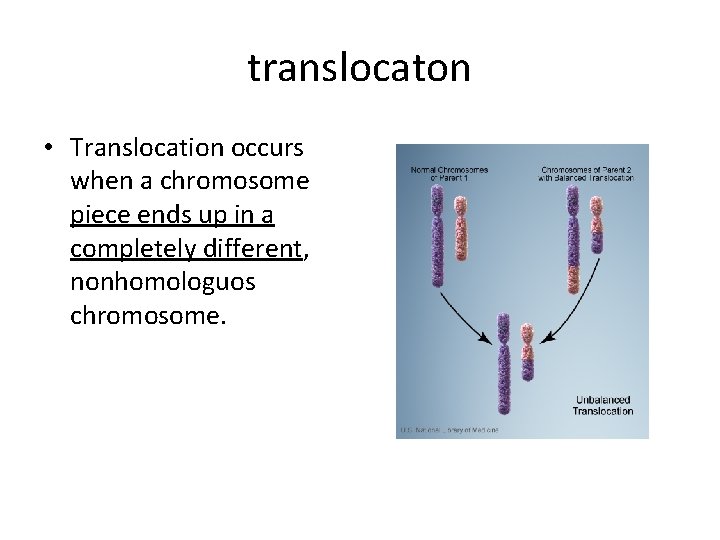
translocaton • Translocation occurs when a chromosome piece ends up in a completely different, nonhomologuos chromosome.
Effects of Genetic change • The results of genetic change may be harmful, beneficial or neutral. Most changes are neutral and may not be passed on to offspring. • Mutations that occur in gametes (sex cells) can be passed on, but mutation in somatic cells (body cells) only affect the individuals in which they occur
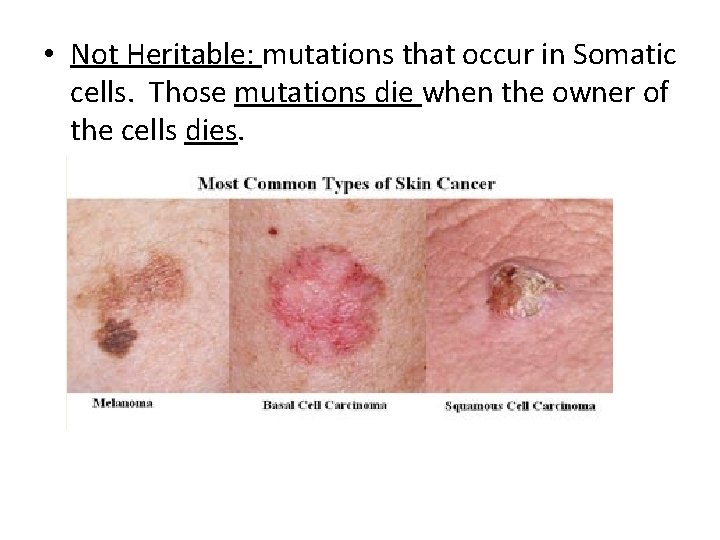
• Not Heritable: mutations that occur in Somatic cells. Those mutations die when the owner of the cells dies.
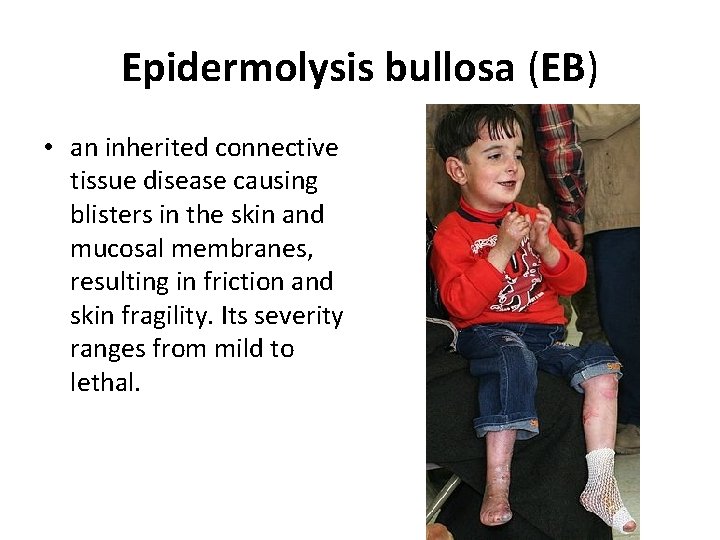
Epidermolysis bullosa (EB) • an inherited connective tissue disease causing blisters in the skin and mucosal membranes, resulting in friction and skin fragility. Its severity ranges from mild to lethal.
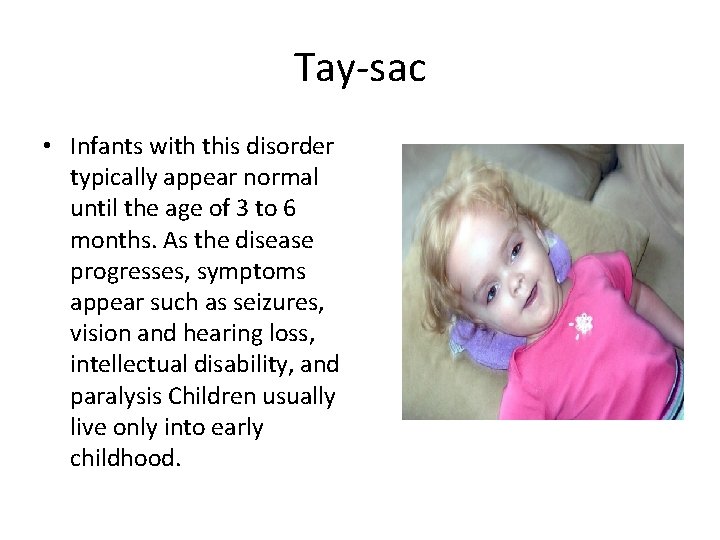
Tay-sac • Infants with this disorder typically appear normal until the age of 3 to 6 months. As the disease progresses, symptoms appear such as seizures, vision and hearing loss, intellectual disability, and paralysis Children usually live only into early childhood.
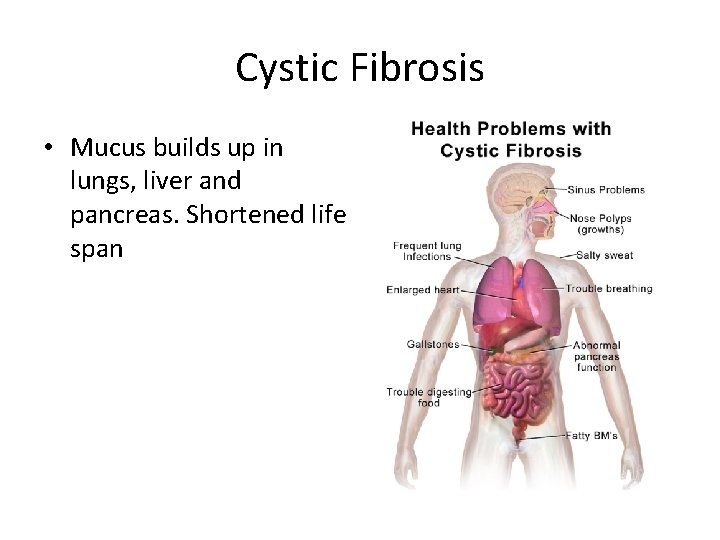
Cystic Fibrosis • Mucus builds up in lungs, liver and pancreas. Shortened life span
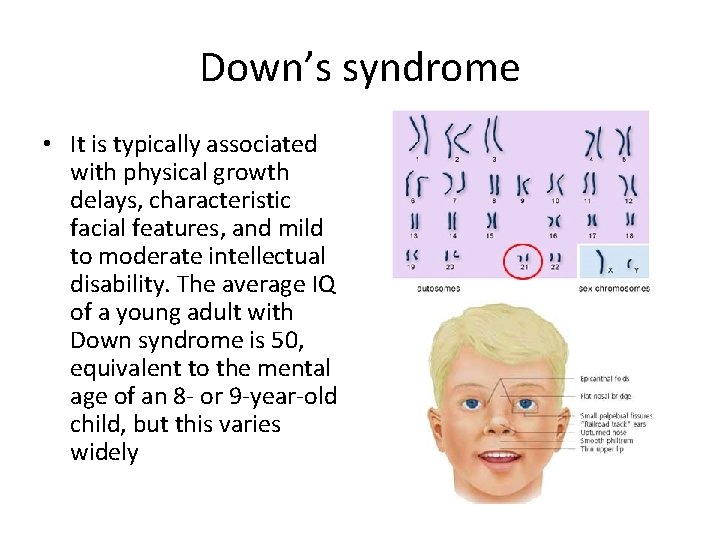
Down’s syndrome • It is typically associated with physical growth delays, characteristic facial features, and mild to moderate intellectual disability. The average IQ of a young adult with Down syndrome is 50, equivalent to the mental age of an 8 - or 9 -year-old child, but this varies widely
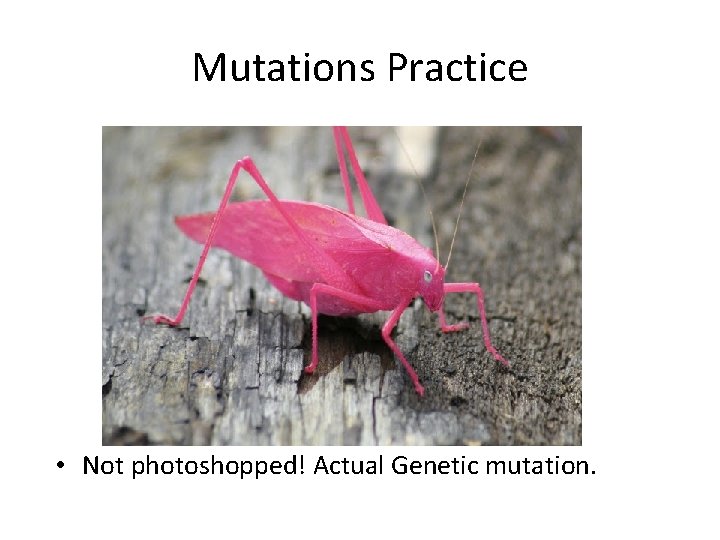
Mutations Practice • Not photoshopped! Actual Genetic mutation.
TOTD 1. What are the possible effects of mutations?