
Mustapha Abiodun Akinkunmi Ph D Hon Commissioner of
Mustapha Abiodun Akinkunmi, Ph. D. Hon. Commissioner of Finance Lagos State INTERNAL REVENUE GENERATION NOVEMBER 2015
Contents 1. Lagos State Performance Review 2. Overview of Enabling Factors 3. Snapshot of Specific Reforms 4. Key Challenges & Takeaways 2
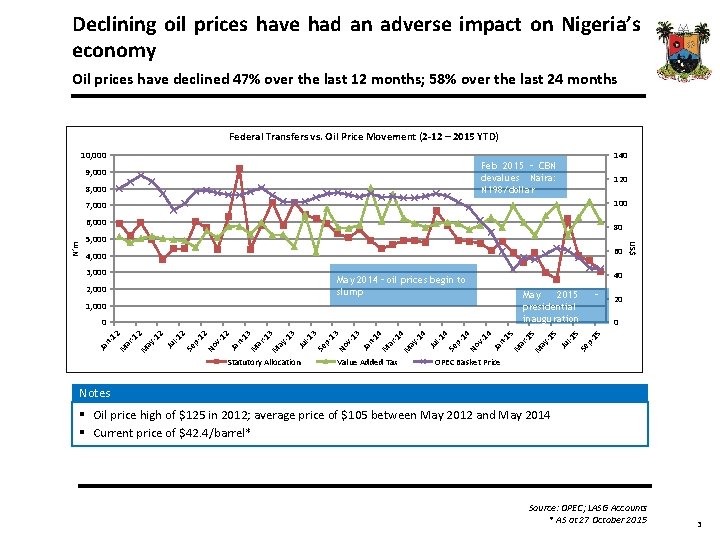
Declining oil prices have had an adverse impact on Nigeria’s economy Oil prices have declined 47% over the last 12 months; 58% over the last 24 months Federal Transfers vs. Oil Price Movement (2 -12 – 2015 YTD) 10, 000 140 Feb 2015 – CBN devalues Naira: N 198/dollar 9, 000 8, 000 120 100 7, 000 80 5, 000 60 4, 000 40 May 2014 – oil prices begin to slump 0 15 5 20 p- l-1 -1 – Se Ju 5 -1 ar 15 M n- 14 Ja v- 4 14 No p- Se l-1 4 -1 ay M Value Added Tax Ju 4 -1 14 ar M n- 13 Ja v- 13 No 3 Se l-1 Statutory Allocation p- 3 -1 ay Ju 3 -1 M 13 ar M n- 12 Ja v- 12 No 2 Se p- 2 -1 l-1 Ju 2 ay ar -1 M M Ja n- 12 0 5 May 2015 presidential inauguration 1, 000 ay 2, 000 M 3, 000 US$ N’m 6, 000 OPEC Basket Price Notes § Oil price high of $125 in 2012; average price of $105 between May 2012 and May 2014 § Current price of $42. 4/barrel* Source: OPEC; LASG Accounts * AS at 27 October 2015 3
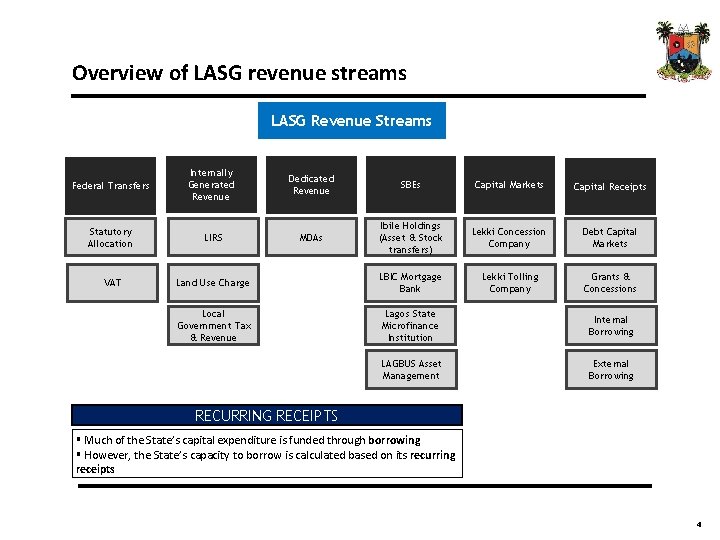
Overview of LASG revenue streams LASG Revenue Streams Federal Transfers Internally Generated Revenue Dedicated Revenue SBEs Capital Markets Capital Receipts Statutory Allocation LIRS MDAs Ibile Holdings (Asset & Stock transfers) Lekki Concession Company Debt Capital Markets VAT Land Use Charge LBIC Mortgage Bank Lekki Tolling Company Grants & Concessions Local Government Tax & Revenue Lagos State Microfinance Institution Internal Borrowing LAGBUS Asset Management External Borrowing RECURRING RECEIPTS § Much of the State’s capital expenditure is funded through borrowing § However, the State’s capacity to borrow is calculated based on its recurring receipts 4
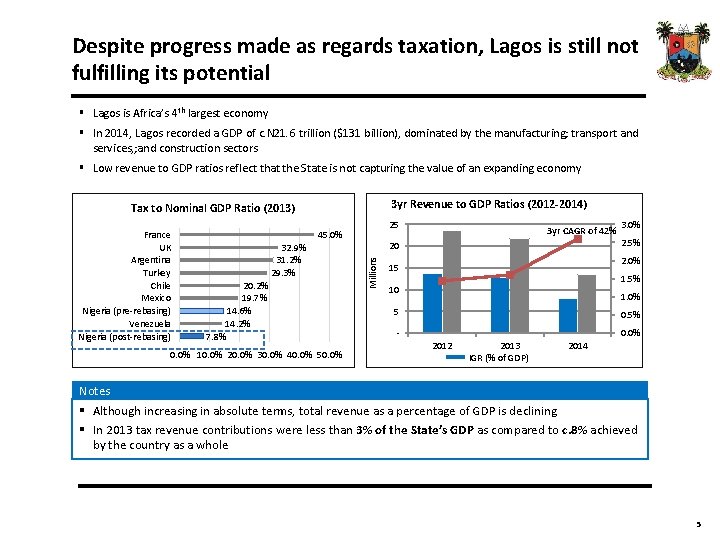
Despite progress made as regards taxation, Lagos is still not fulfilling its potential § Lagos is Africa’s 4 th largest economy § In 2014, Lagos recorded a GDP of c. N 21. 6 trillion ($131 billion), dominated by the manufacturing; transport and services, ; and construction sectors § Low revenue to GDP ratios reflect that the State is not capturing the value of an expanding economy 3 yr Revenue to GDP Ratios (2012 -2014) Tax to Nominal GDP Ratio (2013) 25 45. 0% 32. 9% 31. 2% 29. 3% 20. 2% 19. 7% 14. 6% 14. 2% 7. 8% 0. 0% 10. 0% 20. 0% 30. 0% 40. 0% 50. 0% 3 yr CAGR of 42% 20 Millions France UK Argentina Turkey Chile Mexico Nigeria (pre-rebasing) Venezuela Nigeria (post-rebasing) 3. 0% 2. 5% 2. 0% 15 1. 5% 10 1. 0% 5 0. 5% - 0. 0% 2012 2013 IGR (% of GDP) 2014 Notes § Although increasing in absolute terms, total revenue as a percentage of GDP is declining § In 2013 tax revenue contributions were less than 3% of the State’s GDP as compared to c. 8% achieved by the country as a whole 5
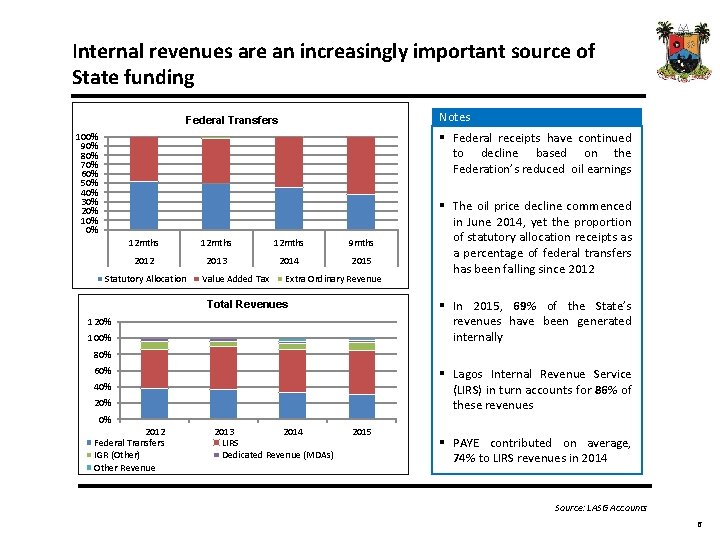
Internal revenues are an increasingly important source of State funding Notes Federal Transfers § Federal receipts have continued to decline based on the Federation’s reduced oil earnings 100% 90% 80% 70% 60% 50% 40% 30% 20% 10% 0% 12 mths 9 mths 2012 2013 2014 2015 Statutory Allocation Value Added Tax Extra Ordinary Revenue § The oil price decline commenced in June 2014, yet the proportion of statutory allocation receipts as a percentage of federal transfers has been falling since 2012 § In 2015, 69% of the State’s revenues have been generated internally Total Revenues 120% 100% 80% 60% § Lagos Internal Revenue Service (LIRS) in turn accounts for 86% of these revenues 40% 20% 0% 2012 Federal Transfers IGR (Other) Other Revenue 2013 2014 LIRS Dedicated Revenue (MDAs) 2015 § PAYE contributed on average, 74% to LIRS revenues in 2014 Source: LASG Accounts 6
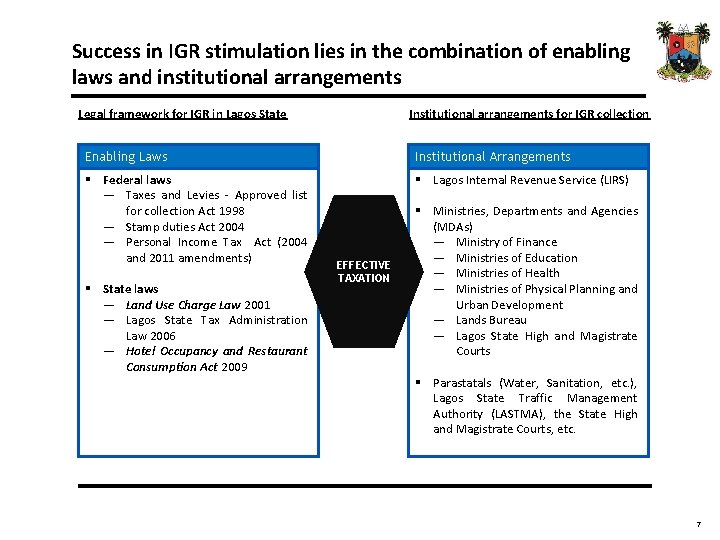
Success in IGR stimulation lies in the combination of enabling laws and institutional arrangements Legal framework for IGR in Lagos State Institutional arrangements for IGR collection Enabling Laws Institutional Arrangements § Federal laws — Taxes and Levies - Approved list for collection Act 1998 — Stamp duties Act 2004 — Personal Income Tax Act (2004 and 2011 amendments) § Lagos Internal Revenue Service (LIRS) § State laws — Land Use Charge Law 2001 — Lagos State Tax Administration Law 2006 — Hotel Occupancy and Restaurant Consumption Act 2009 EFFECTIVE TAXATION § Ministries, Departments and Agencies (MDAs) — Ministry of Finance — Ministries of Education — Ministries of Health — Ministries of Physical Planning and Urban Development — Lands Bureau — Lagos State High and Magistrate Courts § Parastatals (Water, Sanitation, etc. ), Lagos State Traffic Management Authority (LASTMA), the State High and Magistrate Courts, etc. 7
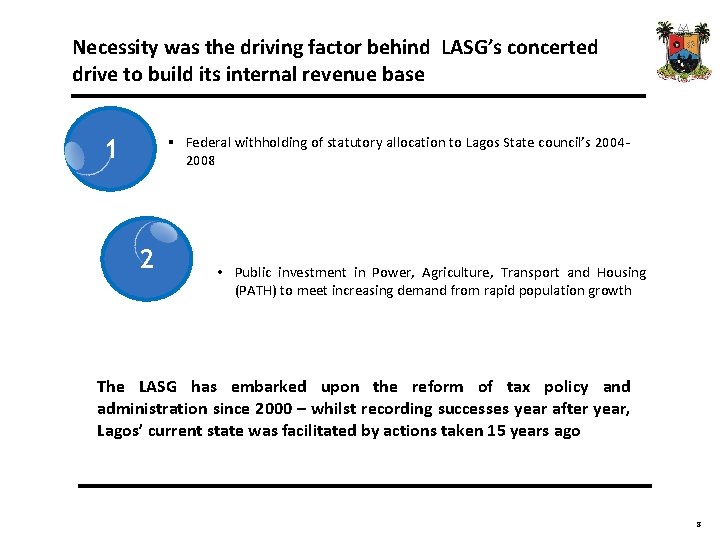
Necessity was the driving factor behind LASG’s concerted drive to build its internal revenue base § Federal withholding of statutory allocation to Lagos State council’s 20042008 1 2 • Public investment in Power, Agriculture, Transport and Housing (PATH) to meet increasing demand from rapid population growth The LASG has embarked upon the reform of tax policy and administration since 2000 – whilst recording successes year after year, Lagos’ current state was facilitated by actions taken 15 years ago 8
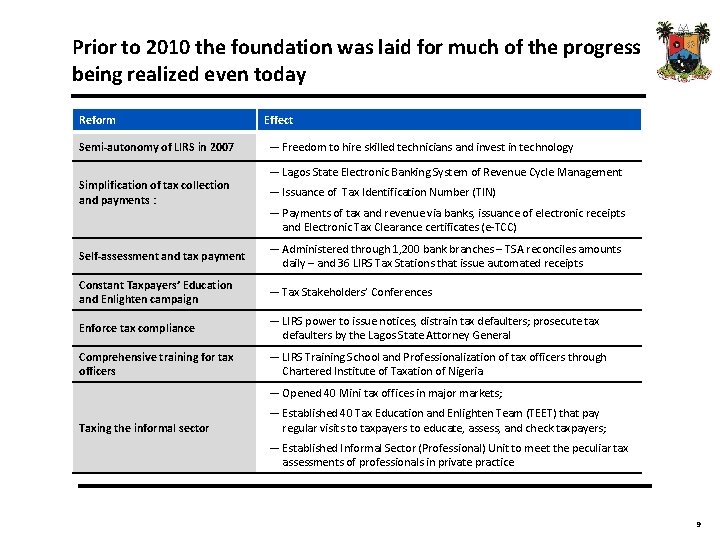
Prior to 2010 the foundation was laid for much of the progress being realized even today Reform Semi-autonomy of LIRS in 2007 Simplification of tax collection and payments : Effect — Freedom to hire skilled technicians and invest in technology — Lagos State Electronic Banking System of Revenue Cycle Management — Issuance of Tax Identification Number (TIN) — Payments of tax and revenue via banks, issuance of electronic receipts and Electronic Tax Clearance certificates (e-TCC) Self-assessment and tax payment — Administered through 1, 200 bank branches – TSA reconciles amounts daily – and 36 LIRS Tax Stations that issue automated receipts Constant Taxpayers’ Education and Enlighten campaign — Tax Stakeholders’ Conferences Enforce tax compliance — LIRS power to issue notices, distrain tax defaulters; prosecute tax defaulters by the Lagos State Attorney General Comprehensive training for tax officers — LIRS Training School and Professionalization of tax officers through Chartered Institute of Taxation of Nigeria — Opened 40 Mini tax offices in major markets; Taxing the informal sector — Established 40 Tax Education and Enlighten Team (TEET) that pay regular visits to taxpayers to educate, assess, and check taxpayers; — Established Informal Sector (Professional) Unit to meet the peculiar tax assessments of professionals in private practice 9
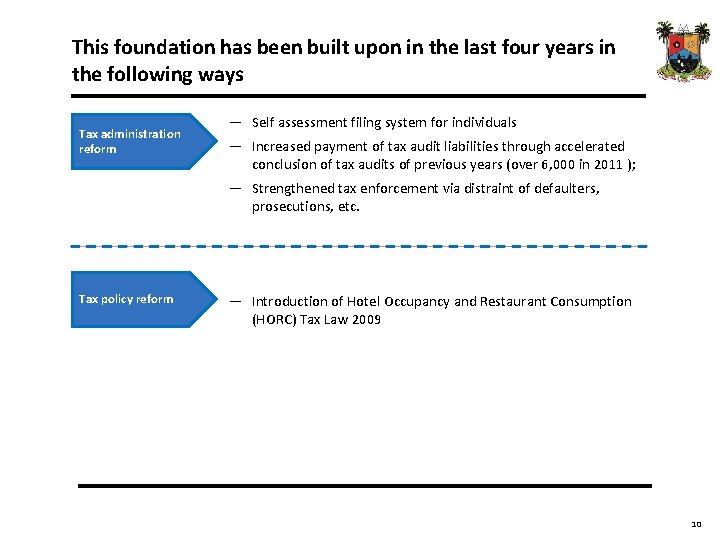
This foundation has been built upon in the last four years in the following ways Tax administration reform — Self assessment filing system for individuals — Increased payment of tax audit liabilities through accelerated conclusion of tax audits of previous years (over 6, 000 in 2011 ); — Strengthened tax enforcement via distraint of defaulters, prosecutions, etc. Tax policy reform — Introduction of Hotel Occupancy and Restaurant Consumption (HORC) Tax Law 2009 10
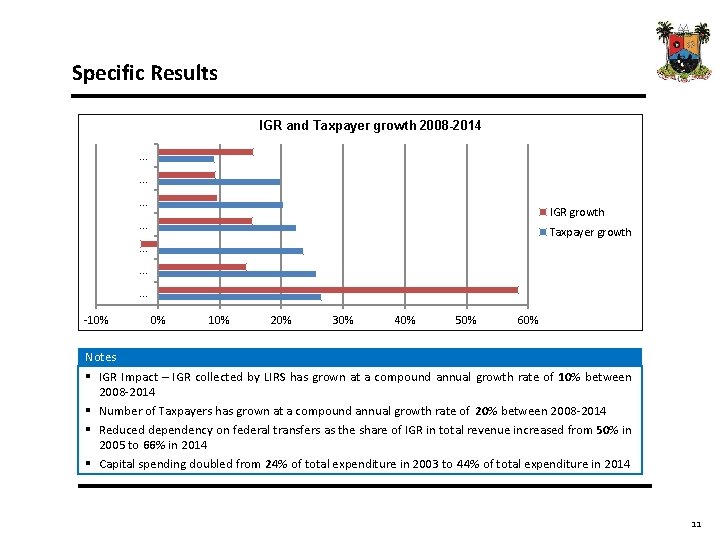
Specific Results IGR and Taxpayer growth 2008 -2014. . IGR growth . . . Taxpayer growth . . -10% 0% 10% 20% 30% 40% 50% 60% Notes § IGR Impact – IGR collected by LIRS has grown at a compound annual growth rate of 10% between 2008 -2014 § Number of Taxpayers has grown at a compound annual growth rate of 20% between 2008 -2014 § Reduced dependency on federal transfers as the share of IGR in total revenue increased from 50% in 2005 to 66% in 2014 § Capital spending doubled from 24% of total expenditure in 2003 to 44% of total expenditure in 2014 11
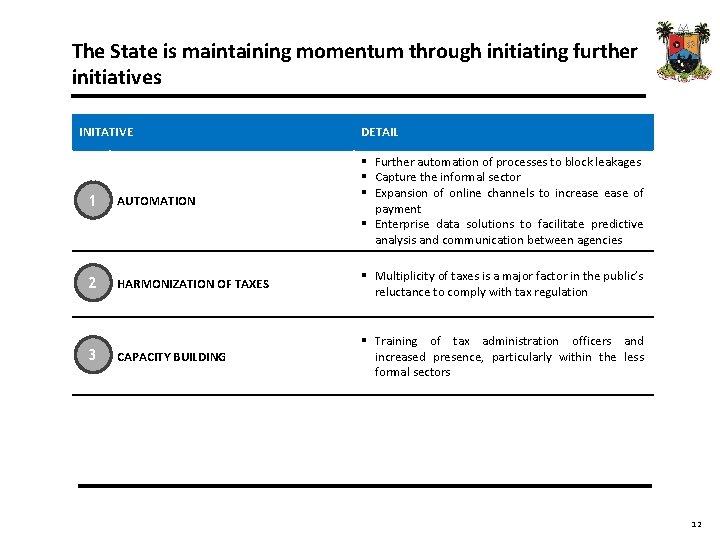
The State is maintaining momentum through initiating further initiatives INITATIVE DETAIL 1 AUTOMATION § Further automation of processes to block leakages § Capture the informal sector § Expansion of online channels to increase of payment § Enterprise data solutions to facilitate predictive analysis and communication between agencies 2 HARMONIZATION OF TAXES § Multiplicity of taxes is a major factor in the public’s reluctance to comply with tax regulation CAPACITY BUILDING § Training of tax administration officers and increased presence, particularly within the less formal sectors 3 12
Challenges and issues § Efforts to increase IGR is seen by the private sector as excessive taxation and thus adversely impacts the business climate in Lagos state — “Lagos state is simply enforcing Federal tax laws” § The role of federal government in tax policy formulation undermines IGR collection — Personal Income Tax Act 2011 § There is a dire need for a comprehensive tax administration reform strategy 13
Key success factors 1 Strong and sustained government commitment at the highest level 2 Coordination with other MDAs across the state is critical to provide additional information to LIRS for audit 3 4 Regular and constant taxpayers’ education campaign on tax procedures and exhibition of how taxes are spent by the government Staff training and capacity building to reduce reliance on external consultants 14

THANK YOU NOVEMBER 2015
- Slides: 15