
Mustansiriyah University Block Cipher Class Third Year Faculty
Mustansiriyah University Block Cipher Class: Third Year Faculty of Engineering DES Block Algorithm Course name: Data Encryption Computer Engineering Dep. Lecturer: Fatimah Al-Ubaidy DES Block Cipher The Data Encryption Standard (DES): This algorithm adopted in 1977 by the National Institute of Standards and Technology (NIST). The algorithm itself is referred to as the Data Encryption Algorithm (DEA). For DES, data are encrypted in 64 -bit blocks using a 56 -bit key. The algorithm transforms 64 -bit input in a series of steps into a 64 -bit output. The same steps, with the same key, are used to reverse the encryption. DES encryption algorithm: The general structure of the DES consists of (1) key schedule, (2) round function and (3) initial and final permutation. Step 1: Plaintext is broken into blocks of length 64 bits. Step 2: The 64 -bit block undergoes an initial permutation (IP) using initial permutation IP table, IP(M). Step 3: The 64 -bit permuted input is divided into two 32 -bit blocks: left (L) and right (R). The initial values of the left and right blocks are denoted L 0 and R 0. Step 4: There are 16 rounds of operations on the L and R blocks. During each round, the following formula is applied: Ln = Rn-1 Rn = Ln-1 XOR F(Rn-1, Kn) 1
Mustansiriyah University Block Cipher Class: Third Year Faculty of Engineering DES Block Algorithm Course name: Data Encryption Computer Engineering Dep. Lecturer: Fatimah Al-Ubaidy DES Block Cipher Step 5: The function F(. ) represents the heart of the DES algorithm. This function implements the following operations: 1 -Expansion: The right 32 -bit half-block is expanded to 48 bits using the expansion permutation (E) table, E(Rn-1). 2 -Key mixing: The expanded result is combined with a subkey using an XOR operation. Sixteen 48 -bit subkeys (one for each round) are derived from the main key using the key schedule, Kn + E(Rn-1). 3 -Substitution: After mixing in the subkeys, the block is divided into eight 6 -bit pieces and fed into the substitution boxes (S-boxes), which implements nonlinear transformation. Each 6 -bit piece uses as an address in the S-boxes where the first and last bits are used to address the ith row and the middle four bits to address the jth column in the S-boxes. The output of each S-box is 4 -bit length piece. The output of all eight S-boxes is then combined into 32 bit section. Kn + E(Rn-1) = B 1 B 2 B 3 B 4 B 5 B 6 B 7 B 8 S(Kn + E(Rn-1)) = S 1(B 1)S 2(B 2)S 3(B 3)S 4(B 4)S 5(B 5)S 6(B 6)S 7(B 7)S 8(B 8) 4 -Permutation: The 32 bits outputs from the S-boxes are rearranged using the P-box, F=P(S(Kn + E(Rn-1))) Step 6: The results from the final DES round (i. e. , L 16 and R 16) are recombined into a 64 -bit value and rearranged using an inverse initial permutation (IP-1) table. The output from IP-1 is the 64 -bit ciphertext block. 2
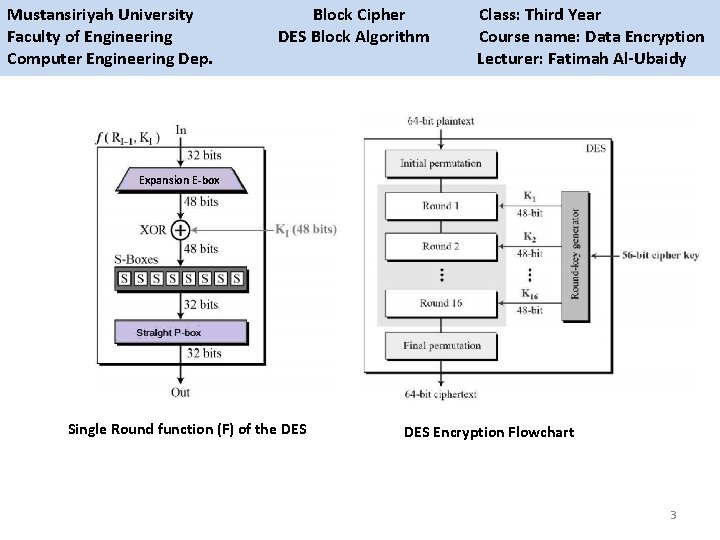
Mustansiriyah University Block Cipher Class: Third Year Faculty of Engineering DES Block Algorithm Course name: Data Encryption Computer Engineering Dep. Lecturer: Fatimah Al-Ubaidy Expansion E-box Single Round function (F) of the DES Encryption Flowchart 3
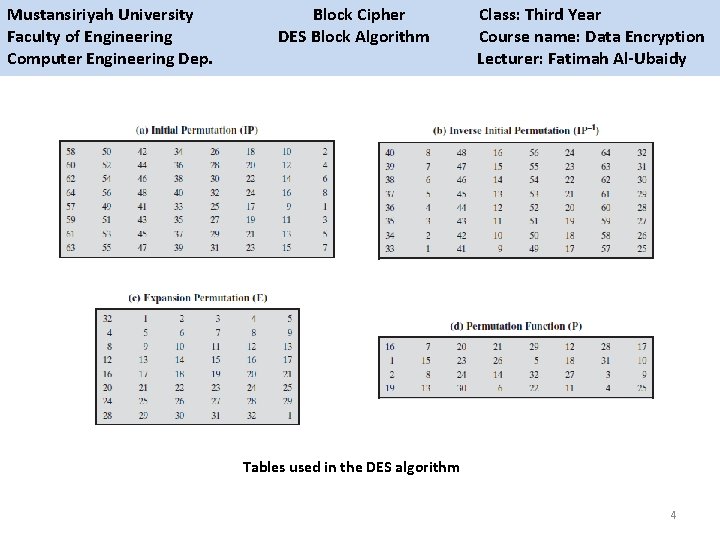
Mustansiriyah University Block Cipher Class: Third Year Faculty of Engineering DES Block Algorithm Course name: Data Encryption Computer Engineering Dep. Lecturer: Fatimah Al-Ubaidy Tables used in the DES algorithm 4
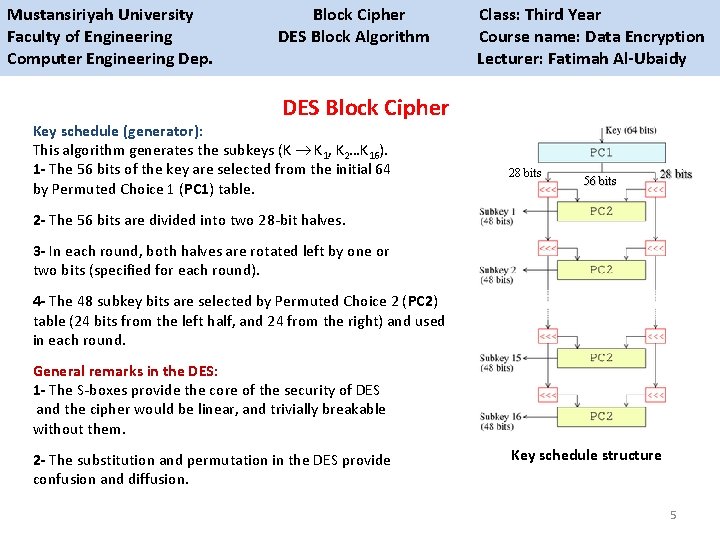
Mustansiriyah University Block Cipher Class: Third Year Faculty of Engineering DES Block Algorithm Course name: Data Encryption Computer Engineering Dep. Lecturer: Fatimah Al-Ubaidy DES Block Cipher Key schedule (generator): This algorithm generates the subkeys (K K 1, K 2…K 16). 1 - The 56 bits of the key are selected from the initial 64 by Permuted Choice 1 (PC 1) table. 28 bits 56 bits 2 - The 56 bits are divided into two 28 -bit halves. 3 - In each round, both halves are rotated left by one or two bits (specified for each round). 4 - The 48 subkey bits are selected by Permuted Choice 2 (PC 2) table (24 bits from the left half, and 24 from the right) and used in each round. General remarks in the DES: 1 - The S-boxes provide the core of the security of DES and the cipher would be linear, and trivially breakable without them. 2 - The substitution and permutation in the DES provide confusion and diffusion. Key schedule structure 5
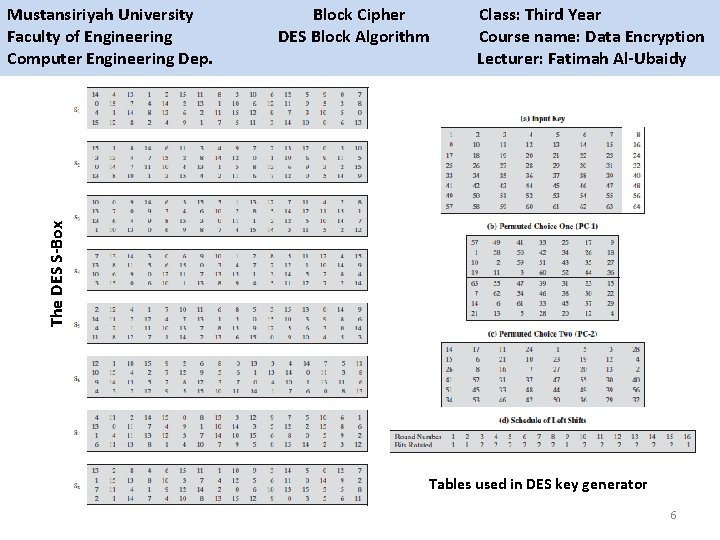
The DES S-Box Mustansiriyah University Block Cipher Class: Third Year Faculty of Engineering DES Block Algorithm Course name: Data Encryption Computer Engineering Dep. Lecturer: Fatimah Al-Ubaidy Tables used in DES key generator 6
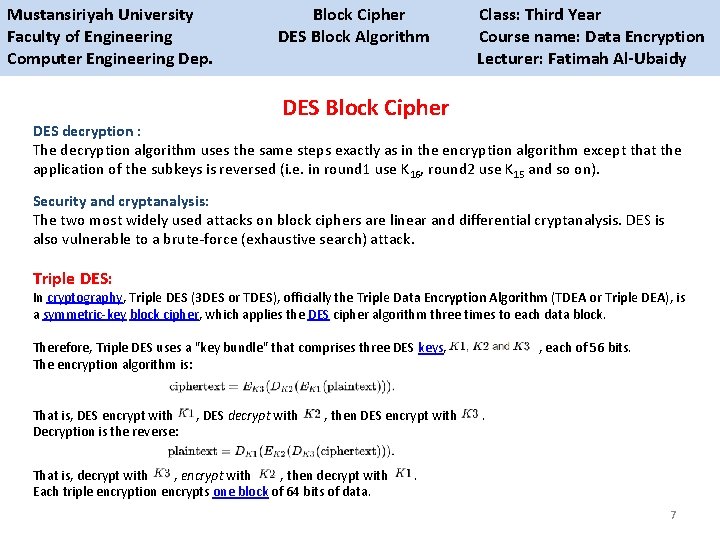
Mustansiriyah University Block Cipher Class: Third Year Faculty of Engineering DES Block Algorithm Course name: Data Encryption Computer Engineering Dep. Lecturer: Fatimah Al-Ubaidy DES Block Cipher DES decryption : The decryption algorithm uses the same steps exactly as in the encryption algorithm except that the application of the subkeys is reversed (i. e. in round 1 use K 16, round 2 use K 15 and so on). Security and cryptanalysis: The two most widely used attacks on block ciphers are linear and differential cryptanalysis. DES is also vulnerable to a brute-force (exhaustive search) attack. Triple DES: In cryptography, Triple DES (3 DES or TDES), officially the Triple Data Encryption Algorithm (TDEA or Triple DEA), is a symmetric-key block cipher, which applies the DES cipher algorithm three times to each data block. Therefore, Triple DES uses a "key bundle" that comprises three DES keys, , each of 56 bits. The encryption algorithm is: That is, DES encrypt with , DES decrypt with , then DES encrypt with . Decryption is the reverse: That is, decrypt with , encrypt with , then decrypt with . Each triple encryption encrypts one block of 64 bits of data. 7
- Slides: 7