
Musicals Lucy Ashley Typical Instrumentation Used During musicals
- Slides: 5
Musicals Lucy Ashley
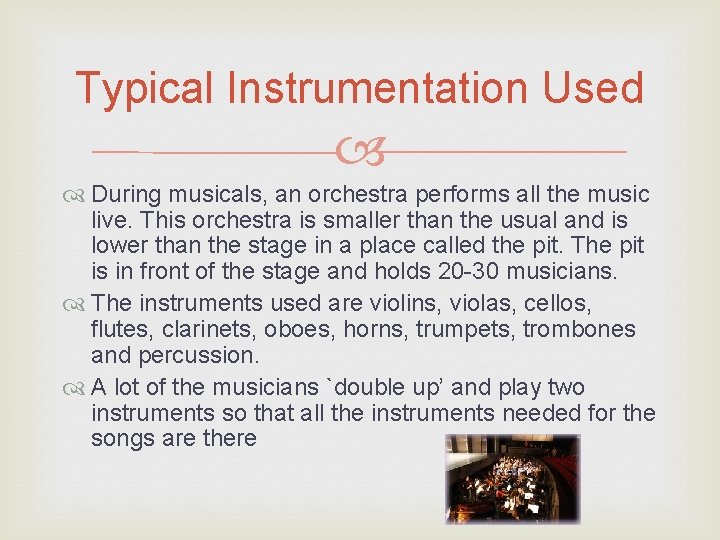
Typical Instrumentation Used During musicals, an orchestra performs all the music live. This orchestra is smaller than the usual and is lower than the stage in a place called the pit. The pit is in front of the stage and holds 20 -30 musicians. The instruments used are violins, violas, cellos, flutes, clarinets, oboes, horns, trumpets, trombones and percussion. A lot of the musicians `double up’ and play two instruments so that all the instruments needed for the songs are there
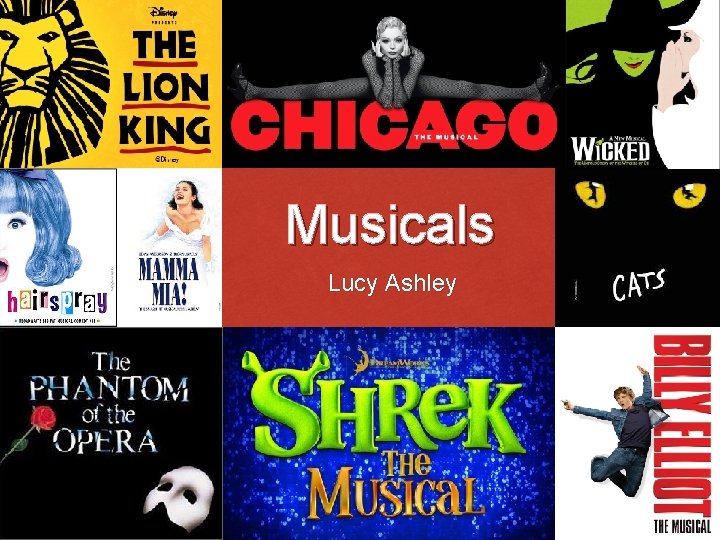
Historical Context Theatre itself can be traced back to Ancient Greece where music and dance were included in comedies and tragedies during the 5 th Century BCE. Theatre developed over time into operas and eventually light hearted musical comedies. The style of musicals caught on in the 1930 s and boomed in the 40 s. The “Golden Age” was the 1940 s - 1960 s. Broadway took off and musicals were more popular than ever. “The Golden Age” saw the start of hit musicals such as West Side Story and The Sound of Music. The 90 s and 2000 s brought us many more musicals that we recognise today such as The Lion King, Wicked, Grease and Hairspray. Today, the style of musicals is very popular and Broadway and The West End are massive. Musicals will only get more popular as the songs and choreography appeal to a very wide audience; everyone from children to Grandparents enjoy going to see musicals.
Where Did it Start? Musicals began in England in the early 19 th Century when performers started combining Operettas with Music Hall style music and dance. However, it was Broadway in the 1900 s that took this unique style and twisted it into the genre we recognise today. Today, London and New York are still the centre of theatre industry, with the minimum earning on Broadway and The West End as $1, 422 per week.
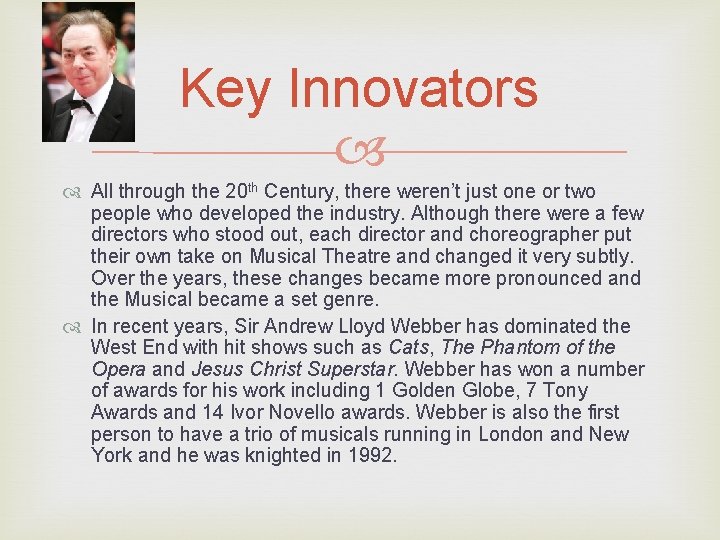
Key Innovators All through the 20 th Century, there weren’t just one or two people who developed the industry. Although there were a few directors who stood out, each director and choreographer put their own take on Musical Theatre and changed it very subtly. Over the years, these changes became more pronounced and the Musical became a set genre. In recent years, Sir Andrew Lloyd Webber has dominated the West End with hit shows such as Cats, The Phantom of the Opera and Jesus Christ Superstar. Webber has won a number of awards for his work including 1 Golden Globe, 7 Tony Awards and 14 Ivor Novello awards. Webber is also the first person to have a trio of musicals running in London and New York and he was knighted in 1992.