
Musical Numerology in PostTonal Theory MATH 105 Term
- Slides: 17
Musical Numerology in Post-Tonal Theory MATH 105 Term Project Audrey Yim, Maria Flores, Kailee Whitten and Theresa Ellsworth
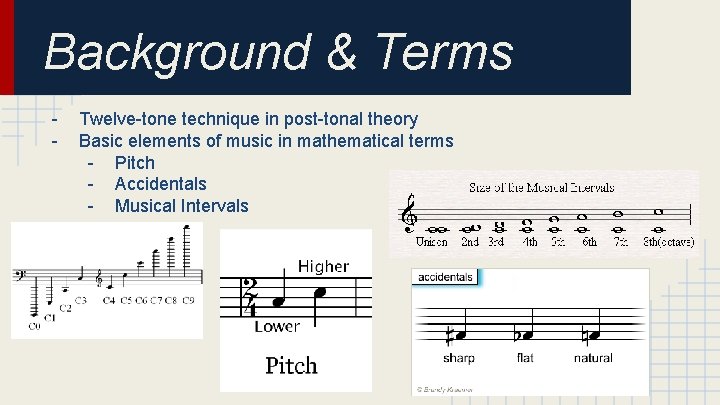
Background & Terms - Twelve-tone technique in post-tonal theory Basic elements of music in mathematical terms - Pitch - Accidentals - Musical Intervals
Tonal Theory and Post Tonal Theory Tonal theory = defines a note as the primary or “tonic”, which all other notes functioning relative to their tonic in a strict order VS. Post-tonal theory = involves the breakdown of hierarchy where all notes and harmonies function according to their unique relationships
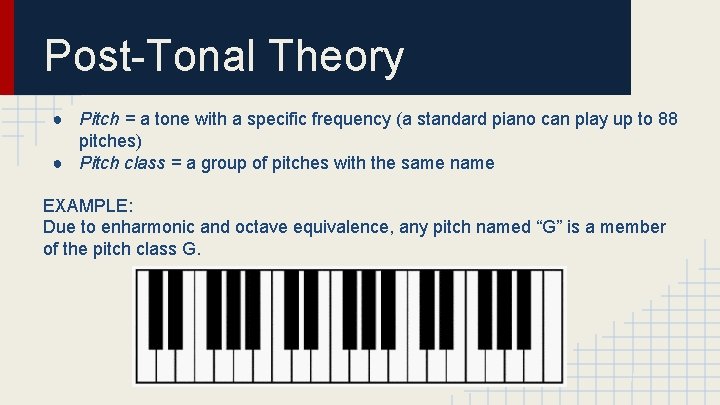
Post-Tonal Theory ● Pitch = a tone with a specific frequency (a standard piano can play up to 88 pitches) ● Pitch class = a group of pitches with the same name EXAMPLE: Due to enharmonic and octave equivalence, any pitch named “G” is a member of the pitch class G.
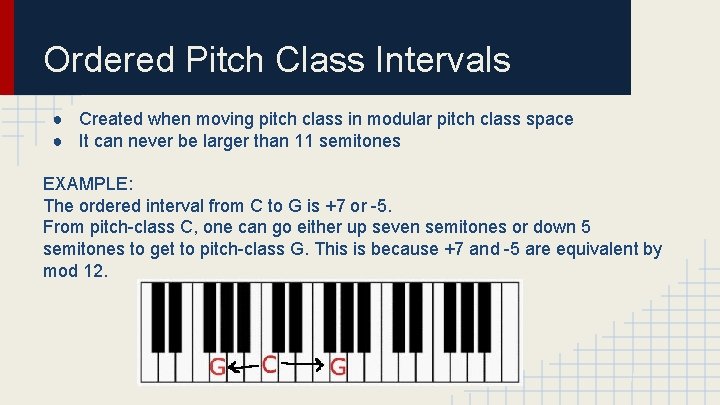
Ordered Pitch Class Intervals ● Created when moving pitch class in modular pitch class space ● It can never be larger than 11 semitones EXAMPLE: The ordered interval from C to G is +7 or -5. From pitch-class C, one can go either up seven semitones or down 5 semitones to get to pitch-class G. This is because +7 and -5 are equivalent by mod 12.
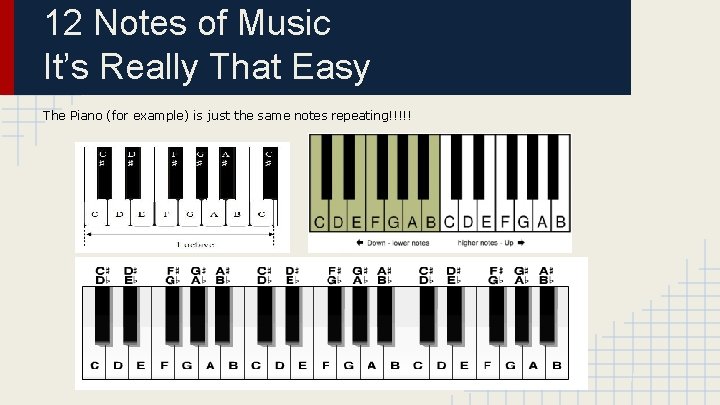
12 Notes of Music It’s Really That Easy The Piano (for example) is just the same notes repeating!!!!!
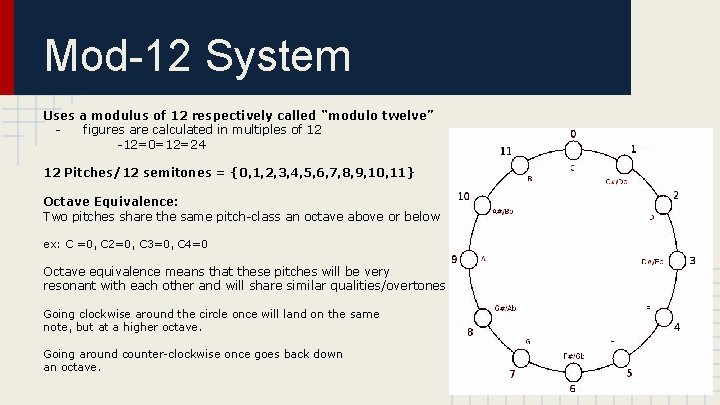
Mod-12 System Uses a modulus of 12 respectively called “modulo twelve” figures are calculated in multiples of 12 -12=0=12=24 12 Pitches/12 semitones = {0, 1, 2, 3, 4, 5, 6, 7, 8, 9, 10, 11} Octave Equivalence: Two pitches share the same pitch-class an octave above or below ex: C =0, C 2=0, C 3=0, C 4=0 Octave equivalence means that these pitches will be very resonant with each other and will share similar qualities/overtones Going clockwise around the circle once will land on the same note, but at a higher octave. Going around counter-clockwise once goes back down an octave.
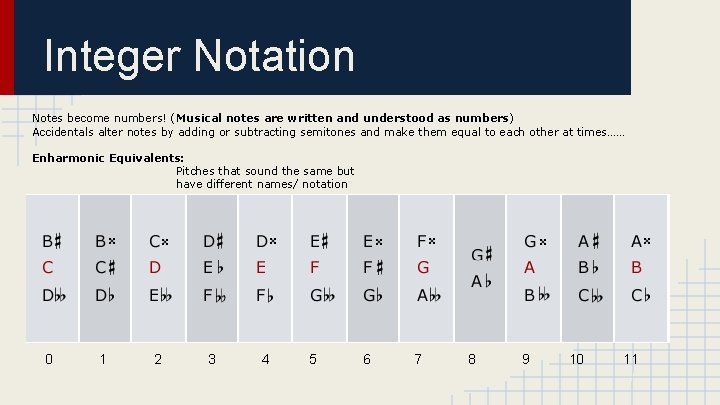
Integer Notation Notes become numbers! (Musical notes are written and understood as numbers) Accidentals alter notes by adding or subtracting semitones and make them equal to each other at times…… Enharmonic Equivalents: Pitches that sound the same but have different names/ notation 0 1 2 3 4 5 6 7 8 9 10 11
Here’s A Little Fun Example. . . https: //www. youtube. com/watch? v=zh 348 ymn. Yis …. . AMAZING
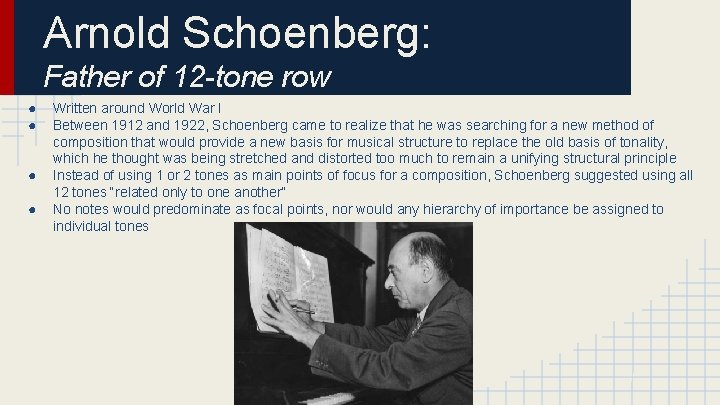
Arnold Schoenberg: Father of 12 -tone row ● ● Written around World War I Between 1912 and 1922, Schoenberg came to realize that he was searching for a new method of composition that would provide a new basis for musical structure to replace the old basis of tonality, which he thought was being stretched and distorted too much to remain a unifying structural principle Instead of using 1 or 2 tones as main points of focus for a composition, Schoenberg suggested using all 12 tones “related only to one another” No notes would predominate as focal points, nor would any hierarchy of importance be assigned to individual tones
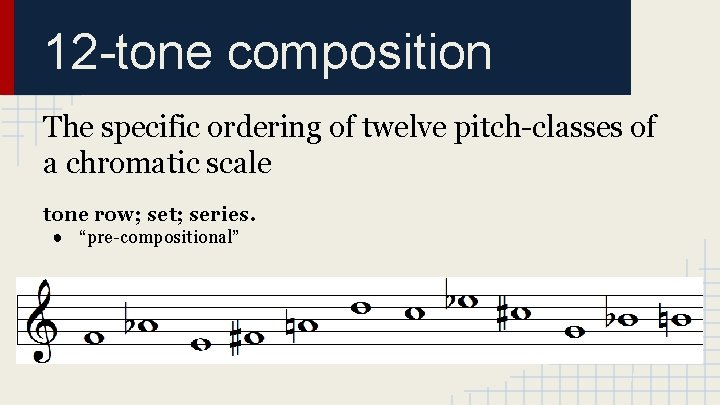
12 -tone composition The specific ordering of twelve pitch-classes of a chromatic scale tone row; set; series. ● “pre-compositional”
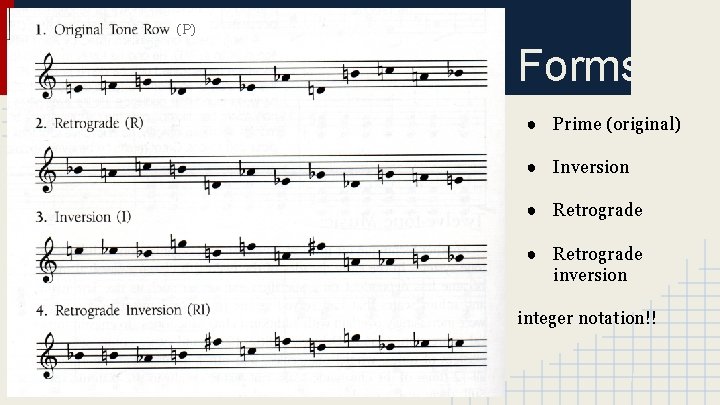
(P) Forms ● Prime (original) ● Inversion ● Retrograde inversion integer notation!!
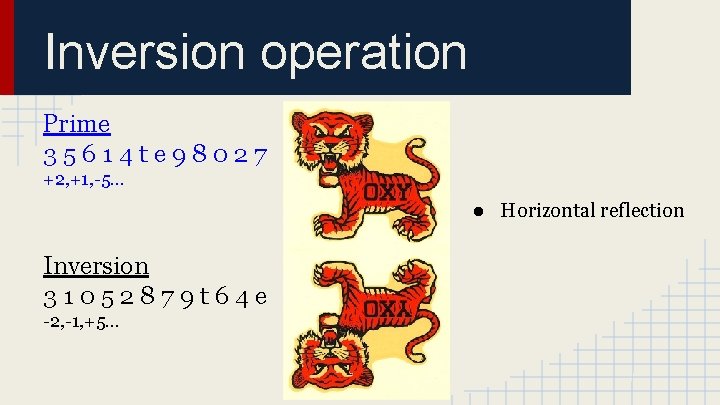
Inversion operation Prime 35614 te 98027 +2, +1, -5. . . ● Horizontal reflection Inversion 31052879 t 64 e -2, -1, +5. . .
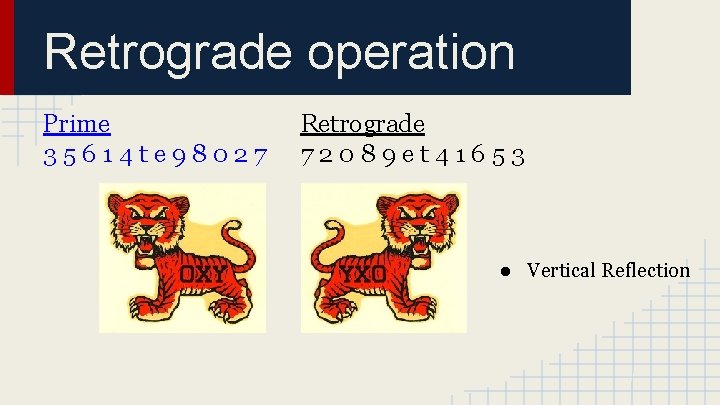
Retrograde operation Prime 35614 te 98027 Retrograde 72089 et 41653 ● Vertical Reflection
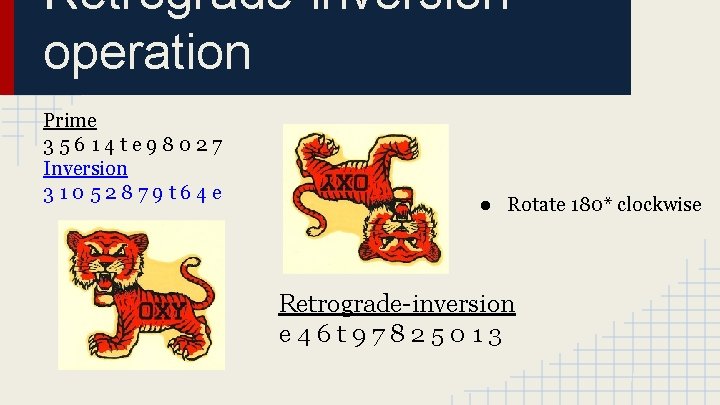
Retrograde-inversion operation Prime 35614 te 98027 Inversion 31052879 t 64 e ● Rotate 180* clockwise Retrograde-inversion e 46 t 97825013
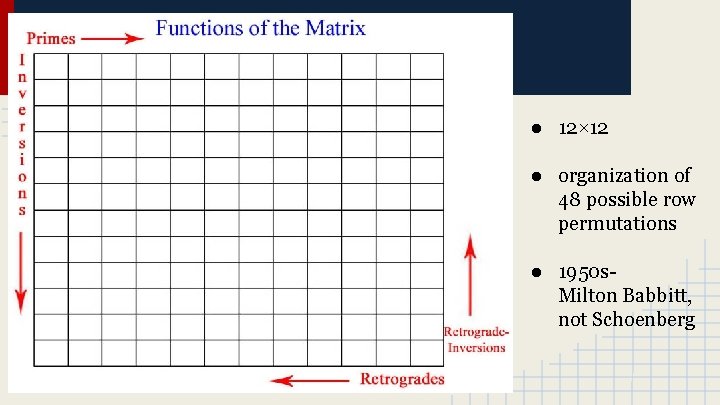
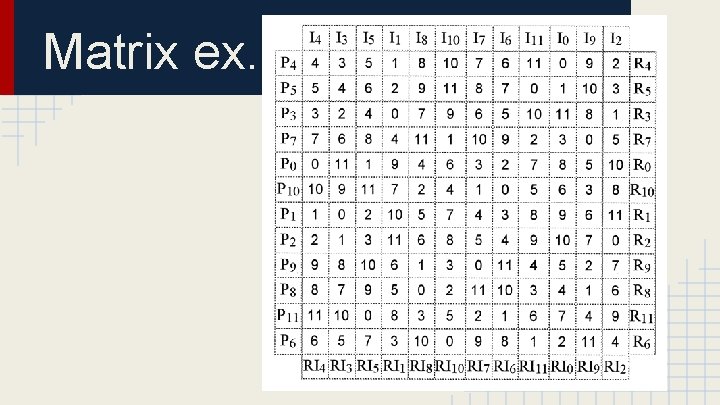
● 12× 12 ● organization of 48 possible row permutations ● 1950 s. Milton Babbitt, not Schoenberg
Matrix ex. )