
Music Video Dream Dizzee Rascal 2004 Riptide Vance
- Slides: 33
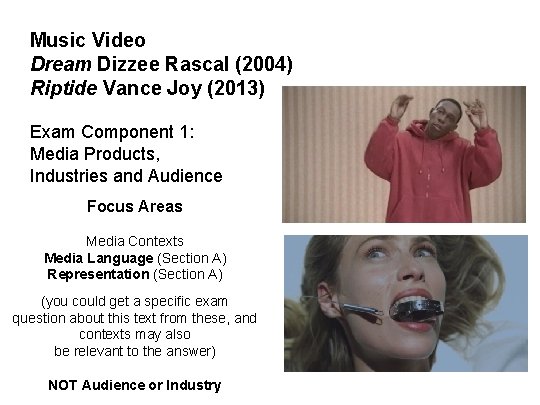
Music Video Dream Dizzee Rascal (2004) Riptide Vance Joy (2013) Exam Component 1: Media Products, Industries and Audience Focus Areas Media Contexts Media Language (Section A) Representation (Section A) (you could get a specific exam question about this text from these, and contexts may also be relevant to the answer) NOT Audience or Industry
Possible exam questions (2 hr 15 m) Section A (advised to spend 90 m on this section) Analysing Media Language and Representation (90 m) 1. Compare how media language helps to construct ideologies in XXXX (an unseen text) and the ‘Dream’ music video you have studied [15] 2. How do XXXX (unseen text) and the ‘Dream’ music video you have studied use representations to position audiences? [30]
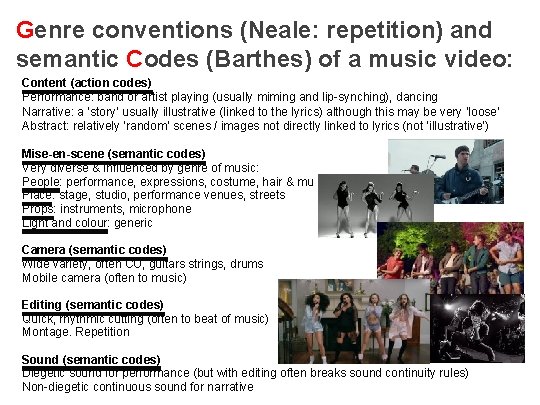
Genre conventions (Neale: repetition) and semantic Codes (Barthes) of a music video: Content (action codes) Performance: band or artist playing (usually miming and lip-synching), dancing Narrative: a ‘story’ usually illustrative (linked to the lyrics) although this may be very ‘loose’ Abstract: relatively ‘random’ scenes / images not directly linked to lyrics (not ‘illustrative’) Mise-en-scene (semantic codes) Very diverse & influenced by genre of music: People: performance, expressions, costume, hair & mu Place: stage, studio, performance venues, streets Props: instruments, microphone Light and colour: generic Camera (semantic codes) Wide variety, often CU, guitars strings, drums Mobile camera (often to music) Editing (semantic codes) Quick, rhythmic cutting (often to beat of music) Montage. Repetition Sound (semantic codes) Diegetic sound for performance (but with editing often breaks sound continuity rules) Non-diegetic continuous sound for narrative
TASK: Create 1 m of a music video Must include elements of: • Performance: band or artist playing (usually miming and lip-synching) • Narrative: a ‘story’ usually illustrative (linked to the lyrics) although this may be very ‘loose’ The actual coursework brief will have quite strict rules on what songs you can choose (but with a bit of thought and research there are thousands to choose from). For this task: • Any song you like Deadline will be on Google Classroom
Economic Context: purpose of a music video? For producers (industry) Profit motive: To make the record company (usually) money Music videos were originally, and remain, a form of marketing for the specific song used to encourage audience to buy it They also help construct the artist’s image or star persona to appeal to the audience Music videos are also now products (or ‘art’) in their own right, from DVD release (on its way out) to streaming and online views For audiences: pleasure motive: Escapist entertainment (U&G). Identification (Gauntlett). Fandom (Jenkins).
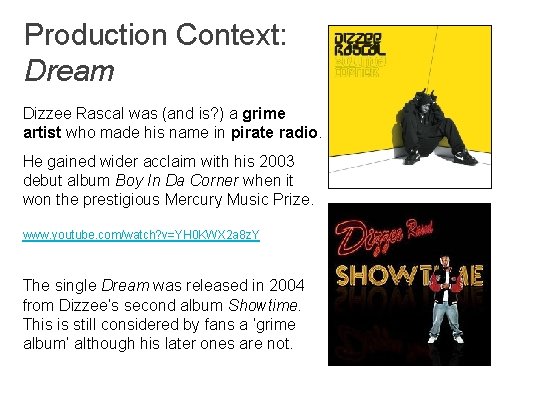
Production Context: Dream Dizzee Rascal was (and is? ) a grime artist who made his name in pirate radio. He gained wider acclaim with his 2003 debut album Boy In Da Corner when it won the prestigious Mercury Music Prize. www. youtube. com/watch? v=YH 0 KWX 2 a 8 z. Y The single Dream was released in 2004 from Dizzee’s second album Showtime. This is still considered by fans a ‘grime album’ although his later ones are not.
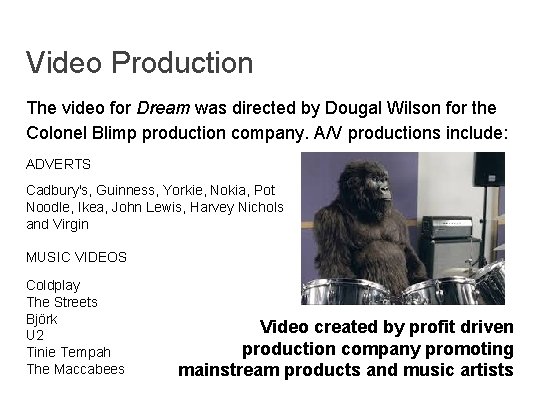
Video Production The video for Dream was directed by Dougal Wilson for the Colonel Blimp production company. A/V productions include: ADVERTS Cadbury's, Guinness, Yorkie, Nokia, Pot Noodle, Ikea, John Lewis, Harvey Nichols and Virgin MUSIC VIDEOS Coldplay The Streets Björk U 2 Tinie Tempah The Maccabees Video created by profit driven production company promoting mainstream products and music artists
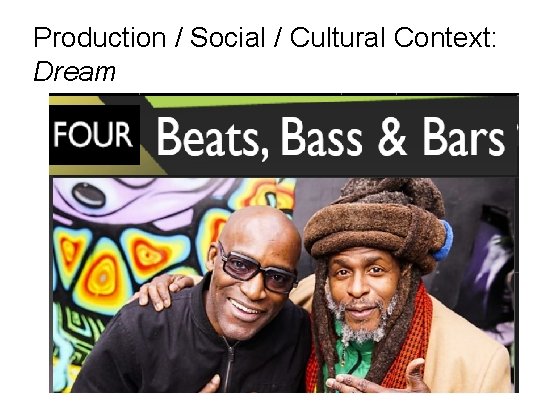
Production / Social / Cultural Context: Dream
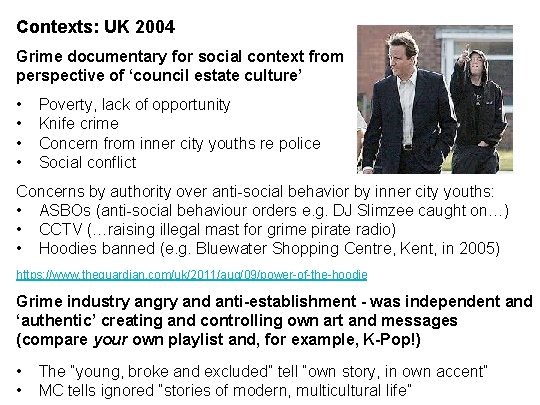
Contexts: UK 2004 Grime documentary for social context from perspective of ‘council estate culture’ • • Poverty, lack of opportunity Knife crime Concern from inner city youths re police Social conflict Concerns by authority over anti-social behavior by inner city youths: • ASBOs (anti-social behaviour orders e. g. DJ Slimzee caught on…) • CCTV (…raising illegal mast for grime pirate radio) • Hoodies banned (e. g. Bluewater Shopping Centre, Kent, in 2005) https: //www. theguardian. com/uk/2011/aug/09/power-of-the-hoodie Grime industry angry and anti-establishment - was independent and ‘authentic’ creating and controlling own art and messages (compare your own playlist and, for example, K-Pop!) • • The “young, broke and excluded” tell “own story, in own accent” MC tells ignored “stories of modern, multicultural life”
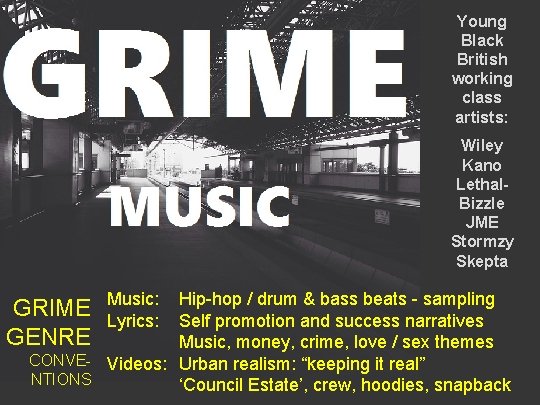
Young Black British working class artists: Wiley Kano Lethal. Bizzle JME Stormzy Skepta Hip-hop / drum & bass beats - sampling Self promotion and success narratives Music, money, crime, love / sex themes CONVE- Videos: Urban realism: “keeping it real” NTIONS ‘Council Estate’, crew, hoodies, snapback GRIME GENRE Music: Lyrics:
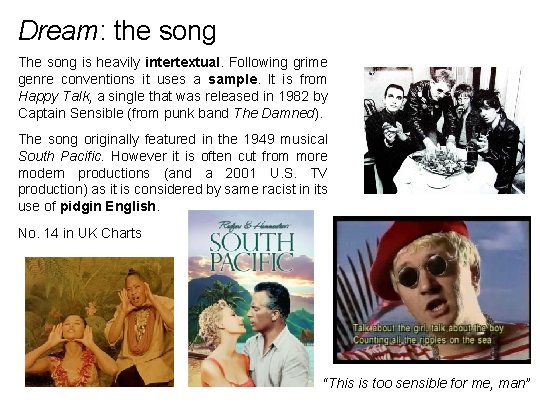
Dream: the song The song is heavily intertextual. Following grime genre conventions it uses a sample. It is from Happy Talk, a single that was released in 1982 by Captain Sensible (from punk band The Damned). The song originally featured in the 1949 musical South Pacific. However it is often cut from more modern productions (and a 2001 U. S. TV production) as it is considered by same racist in its use of pidgin English. No. 14 in UK Charts “This is too sensible for me, man”
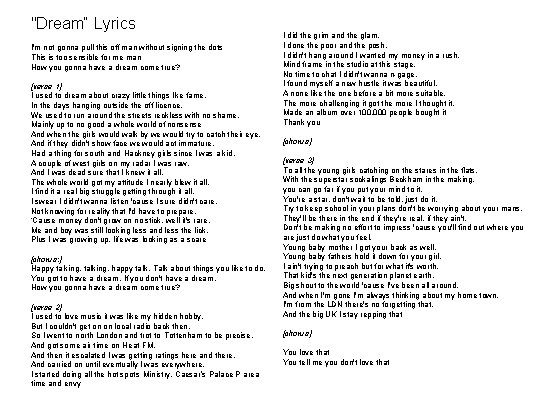
"Dream“ Lyrics I'm not gonna pull this off man without signing the dots This is too sensible for me man How you gonna have a dream come true? [verse 1] I used to dream about crazy little things like fame, In the days hanging outside the off licence, We used to run around the streets reckless with no shame, Mainly up to no good a whole world of nonsense And when the girls would walk by we would try to catch their eye, And if they didn't show face we would act immature, Had a thing for south and Hackney girls since I was a kid, A couple of west girls on my radar I was raw, And I was dead sure that I knew it all, The whole world got my attitude I nearly blew it all, I find it a real big struggle getting through it all, I swear I didn't wanna listen 'cause I sure didn't care, Not knowing for reality that I'd have to prepare, ‘Cause money don't grow on no stick, well it's rare, Me and boy was still looking less and less the lick, Plus I was growing up, life was looking as a scare [chorus: ] Happy talking, happy talk , Talk about things you like to do, You got to have a dream , If you don't have a dream, How you gonna have a dream come true? [verse 2] I used to love music it was like my hidden hobby, But I couldn't get on on local radio back then, So I went to north London and trot to Tottenham to be precise, And got some air time on Heat FM, And then it escalated I was getting ratings here and there, And carried on until eventually I was everywhere, I started doing all the hot spots Ministry, Caesar’s Palace P area time and envy I did the grim and the glam, I done the poor and the posh, I didn't hang around I wanted my money in a rush, Mind frame in the studio at this stage, No time to chat I didn't wanna n-gage, I found myself a new hustle it was beautiful, A none like the one before a bit more suitable, The more challenging it got the more I thought it, Made an album over 100, 000 people bought it Thank you [chorus] [verse 3] To all the young girls catching on the stares in the flats, With the superstar sockalings Beckham in the making, you can go far if you put your mind to it, You're a star, don't wait to be told, just do it, Try to keep school in your plans don't be worrying about your mans, They'll be there in the end if they're real, if they ain't, Don't be making no effort to impress 'cause you'll find out where you are just do what you feel, Young baby mother I got your back as well, Young baby fathers hold it down for your girl, I ain't trying to preach but for what it's worth, That kid's the next generation planet earth, Big shout to the world 'cause I've been all around, And when I'm gone I'm always thinking about my home town, I'm from the LDN there's no forgetting that, And the big UK I stay repping that [chorus] You love that You tell me you don't love that
Genre: music video conventions in Dream • • • Performance: artist miming and lip-synching, direct address using frontality, generic costume and performance style Green screen technology used to put artist into story Narrative: ‘story’ illustrating lyrics (often directly e. g. pirate radio station, “young baby-mothers”) Chronological (linear) story with temporal ellipsis A generic story of ‘rags to riches’ with triumph over humble or troubled background (esp. a convention in rap grime genres). Dizzee a creative role model working hard and following a ‘dream’ (challenges age / ethnicity stereotypes, but perhaps also ‘American Dream’ myth that anyone can make it if they work hard? )
Codes & BOs: Mise-en-scene semantic / symbolic codes Overall style No attempt at verisimilitude: a ‘childlike’ fable with a simple moral message. Postmodern: playful, anti-realist and heavily intertextual. People (puppets discussed in ‘props’) Presenter and Dizzee: binary opposites (class, ethnicity, age, gender) • • middle-class, white, middle-aged matriarchal woman (bigger) upright posture, aloof, 50’s dress and hair, RP accent (“he’s such a raascal”) She sings ‘old’ song Happy Talk and reacts to DR’s story – from patronising to bemused to…”just do it”. Is she changing her views on his ‘type’ and society or is she happy he is ‘conforming’? • • working-class, black, male youth (comes out of / returns to a ‘box’) ‘street’ (or roadman) body language, hair and costume (hoodie – symbol of youth identity and rebellion). Black / slang accent (“gonna” “repping”). Binary opposite of ‘reckless’ v hard work.
Codes & BOs: Mise-en-scene semantic / symbolic codes Place 1950 s / 2000 s – binary opposites, two ‘civilisations’? • • 1950 s middle-class living room striped wallpaper, floral curtains • • Modern deprived inner city environment (‘council estate culture’) stereotypical ‘streets’ with graffiti, off-licence, broken sign • • Recording studio Pirate radio (illegal) - police can’t get in, place of power for Dizzee • • Nightclub / performance venue Disco ball and everyone, including police, come together to dance – connoting possibility of music creating a harmonious society?
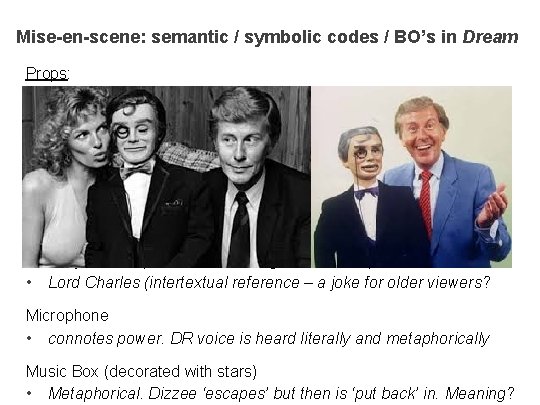
Mise-en-scene: semantic / symbolic codes / BO’s in Dream Props: Puppets a metaphor for social control (youth v authority hierarchy? ) Very stereotypical characters (Hall) – both used and subverted • exaggeratedly ‘old-fashioned posh’ white middle-class presenter • aimless youth “reckless…no shame” who skate, steal a TV, spray graffiti, try to “catch the eye” of girls. Mainly black but also white. • brutal police with truncheon (then police car & helicopter) • drunken Scot with red hair wearing tartan (lager) • baby-mother (Van Zoonen and gender issues) • Lord Charles (intertextual reference – a joke for older viewers? Microphone • connotes power. DR voice is heard literally and metaphorically Music Box (decorated with stars) • Metaphorical. Dizzee ‘escapes’ but then is ‘put back’ in. Meaning?
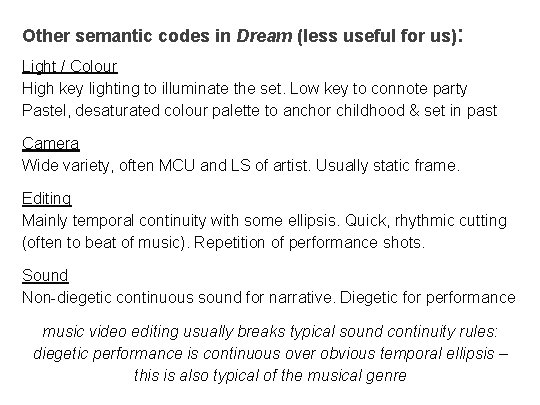
Other semantic codes in Dream (less useful for us): Light / Colour High key lighting to illuminate the set. Low key to connote party Pastel, desaturated colour palette to anchor childhood & set in past Camera Wide variety, often MCU and LS of artist. Usually static frame. Editing Mainly temporal continuity with some ellipsis. Quick, rhythmic cutting (often to beat of music). Repetition of performance shots. Sound Non-diegetic continuous sound for narrative. Diegetic for performance music video editing usually breaks typical sound continuity rules: diegetic performance is continuous over obvious temporal ellipsis – this is also typical of the musical genre
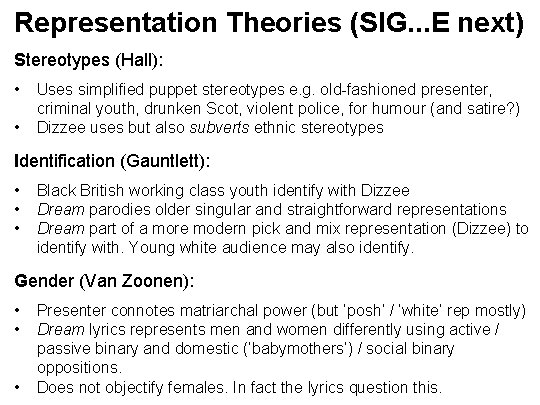
Representation Theories (SIG. . . E next) Stereotypes (Hall): • • Uses simplified puppet stereotypes e. g. old-fashioned presenter, criminal youth, drunken Scot, violent police, for humour (and satire? ) Dizzee uses but also subverts ethnic stereotypes Identification (Gauntlett): • • • Black British working class youth identify with Dizzee Dream parodies older singular and straightforward representations Dream part of a more modern pick and mix representation (Dizzee) to identify with. Young white audience may also identify. Gender (Van Zoonen): • • • Presenter connotes matriarchal power (but ‘posh’ / ‘white’ rep mostly) Dream lyrics represents men and women differently using active / passive binary and domestic (‘babymothers’) / social binary oppositions. Does not objectify females. In fact the lyrics question this.
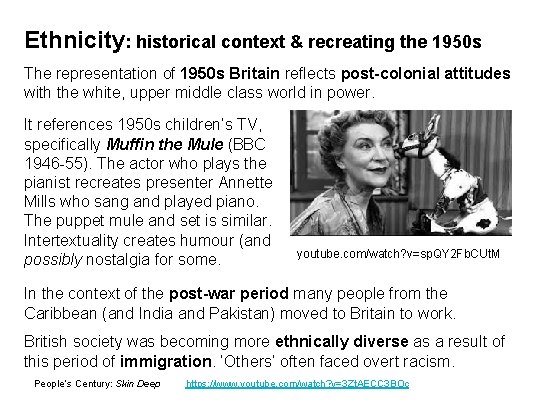
Ethnicity: historical context & recreating the 1950 s The representation of 1950 s Britain reflects post-colonial attitudes with the white, upper middle class world in power. It references 1950 s children’s TV, specifically Muffin the Mule (BBC 1946 -55). The actor who plays the pianist recreates presenter Annette Mills who sang and played piano. The puppet mule and set is similar. Intertextuality creates humour (and possibly nostalgia for some. youtube. com/watch? v=sp. QY 2 Fb. CUt. M In the context of the post-war period many people from the Caribbean (and India and Pakistan) moved to Britain to work. British society was becoming more ethnically diverse as a result of this period of immigration. ‘Others’ often faced overt racism. People’s Century: Skin Deep https: //www. youtube. com/watch? v=3 Zt. AECC 3 BOc
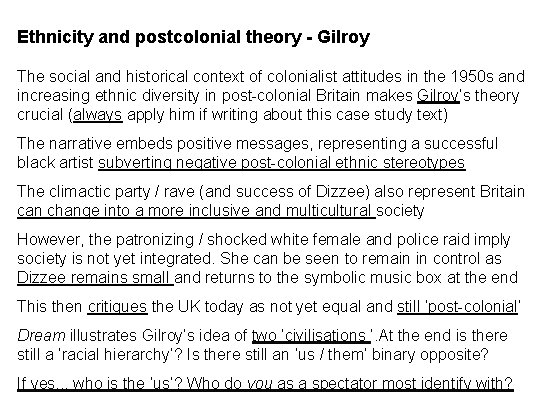
Ethnicity and postcolonial theory - Gilroy The social and historical context of colonialist attitudes in the 1950 s and increasing ethnic diversity in post-colonial Britain makes Gilroy’s theory crucial (always apply him if writing about this case study text) The narrative embeds positive messages, representing a successful black artist subverting negative post-colonial ethnic stereotypes The climactic party / rave (and success of Dizzee) also represent Britain can change into a more inclusive and multicultural society However, the patronizing / shocked white female and police raid imply society is not yet integrated. She can be seen to remain in control as Dizzee remains small and returns to the symbolic music box at the end This then critiques the UK today as not yet equal and still ‘post-colonial’ Dream illustrates Gilroy’s idea of two ‘civilisations ’. At the end is there still a ‘racial hierarchy’? Is there still an ‘us / them’ binary opposite? If yes. . . who is the ‘us’? Who do you as a spectator most identify with?
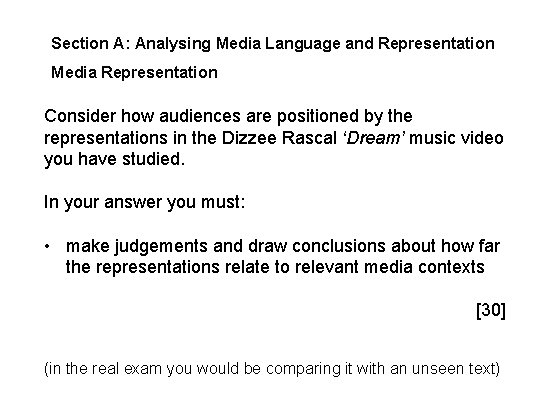
Section A: Analysing Media Language and Representation Media Representation Consider how audiences are positioned by the representations in the Dizzee Rascal ‘Dream’ music video you have studied. In your answer you must: • make judgements and draw conclusions about how far the representations relate to relevant media contexts [30] (in the real exam you would be comparing it with an unseen text)
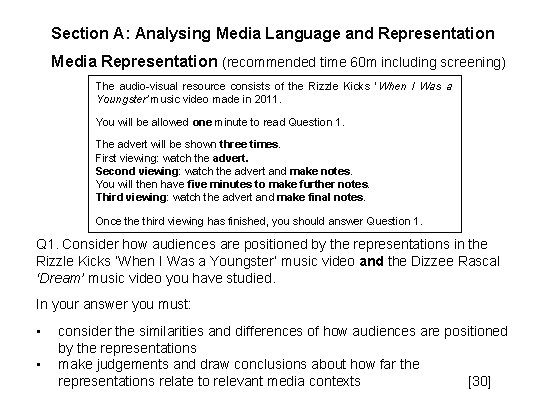
Section A: Analysing Media Language and Representation Media Representation (recommended time 60 m including screening) The audio-visual resource consists of the Rizzle Kicks ‘When I Was a Youngster’ music video made in 2011. You will be allowed one minute to read Question 1. The advert will be shown three times. First viewing: watch the advert. Second viewing: watch the advert and make notes. You will then have five minutes to make further notes. Third viewing: watch the advert and make final notes. Once third viewing has finished, you should answer Question 1. Q 1. Consider how audiences are positioned by the representations in the Rizzle Kicks ‘When I Was a Youngster’ music video and the Dizzee Rascal ‘Dream’ music video you have studied. In your answer you must: • • consider the similarities and differences of how audiences are positioned by the representations make judgements and draw conclusions about how far the representations relate to relevant media contexts [30]
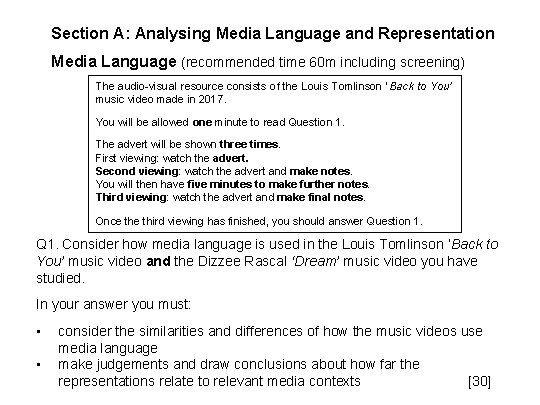
Section A: Analysing Media Language and Representation Media Language (recommended time 60 m including screening) The audio-visual resource consists of the Louis Tomlinson ‘Back to You’ music video made in 2017. You will be allowed one minute to read Question 1. The advert will be shown three times. First viewing: watch the advert. Second viewing: watch the advert and make notes. You will then have five minutes to make further notes. Third viewing: watch the advert and make final notes. Once third viewing has finished, you should answer Question 1. Q 1. Consider how media language is used in the Louis Tomlinson ‘Back to You’ music video and the Dizzee Rascal ‘Dream’ music video you have studied. In your answer you must: • • consider the similarities and differences of how the music videos use media language make judgements and draw conclusions about how far the representations relate to relevant media contexts [30]
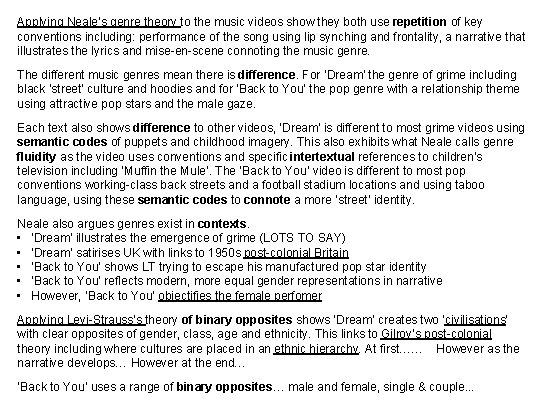
Applying Neale’s genre theory to the music videos show they both use repetition of key conventions including: performance of the song using lip synching and frontality, a narrative that illustrates the lyrics and mise-en-scene connoting the music genre. The different music genres mean there is difference. For ‘Dream’ the genre of grime including black ‘street’ culture and hoodies and for ‘Back to You’ the pop genre with a relationship theme using attractive pop stars and the male gaze. Each text also shows difference to other videos, ‘Dream’ is different to most grime videos using semantic codes of puppets and childhood imagery. This also exhibits what Neale calls genre fluidity as the video uses conventions and specific intertextual references to children’s television including ‘Muffin the Mule’. The ‘Back to You’ video is different to most pop conventions working-class back streets and a football stadium locations and using taboo language, using these semantic codes to connote a more ‘street’ identity. Neale also argues genres exist in contexts. • ‘Dream’ illustrates the emergence of grime (LOTS TO SAY) • ‘Dream’ satirises UK with links to 1950 s post-colonial Britain • ‘Back to You’ shows LT trying to escape his manufactured pop star identity • ‘Back to You’ reflects modern, more equal gender representations in narrative • However, ‘Back to You’ objectifies the female perfomer Applying Levi-Strauss’s theory of binary opposites shows ‘Dream’ creates two ‘civilisations’ with clear opposites of gender, class, age and ethnicity. This links to Gilroy’s post-colonial theory including where cultures are placed in an ethnic hierarchy. At first…… However as the narrative develops… However at the end… ‘Back to You’ uses a range of binary opposites… male and female, single & couple. . .
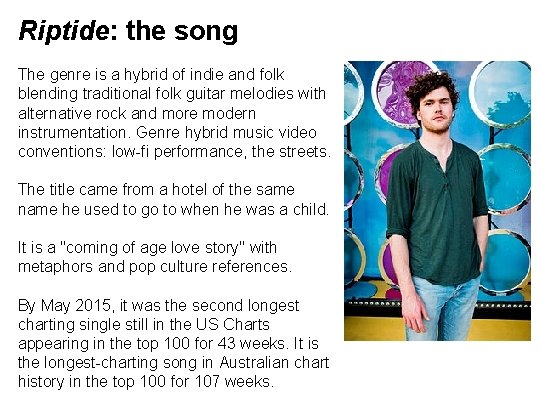
Production Context: Riptide Vance Joy (real name James Keogh) is an Australian singer-songwriter. He released his debut EP and signed a five -album deal with Atlantic Records in 2013. The single "Riptide" became a success on Australian commercial radio then a global hit selling over 1 million copies. The song features in Inbetweeners 2 and other TV including a Go. Pro TV advertising campaign in the USA. The video is directed by Basil and Gorun and has over 278 million You. Tube views.
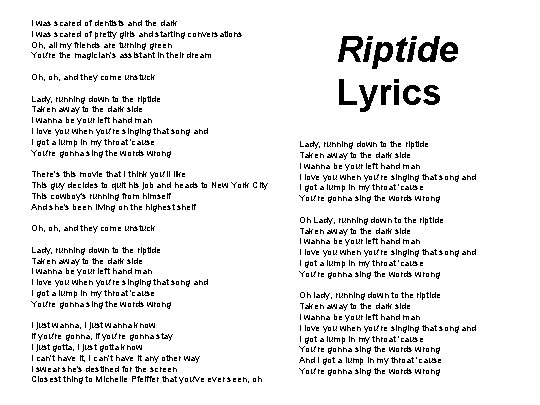
Riptide: the song The genre is a hybrid of indie and folk blending traditional folk guitar melodies with alternative rock and more modern instrumentation. Genre hybrid music video conventions: low-fi performance, the streets. The title came from a hotel of the same name he used to go to when he was a child. It is a "coming of age love story" with metaphors and pop culture references. By May 2015, it was the second longest charting single still in the US Charts appearing in the top 100 for 43 weeks. It is the longest-charting song in Australian chart history in the top 100 for 107 weeks.
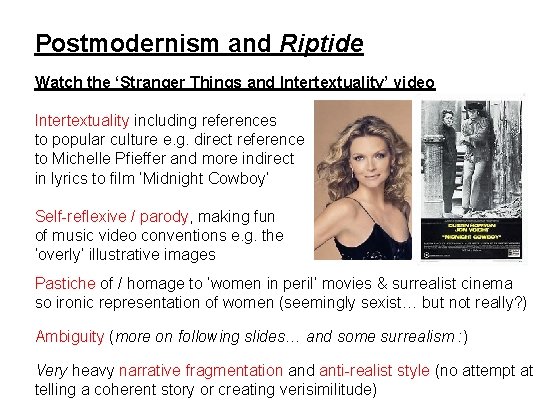
I was scared of dentists and the dark I was scared of pretty girls and starting conversations Oh, all my friends are turning green You're the magician's assistant in their dream Oh, oh, and they come unstuck Lady, running down to the riptide Taken away to the dark side I wanna be your left hand man I love you when you're singing that song and I got a lump in my throat 'cause You're gonna sing the words wrong There's this movie that I think you'll like This guy decides to quit his job and heads to New York City This cowboy's running from himself And she's been living on the highest shelf Oh, oh, and they come unstuck Lady, running down to the riptide Taken away to the dark side I wanna be your left hand man I love you when you're singing that song and I got a lump in my throat 'cause You're gonna sing the words wrong I just wanna, I just wanna know If you're gonna, if you're gonna stay I just gotta, I just gotta know I can't have it, I can't have it any other way I swear she's destined for the screen Closest thing to Michelle Pfeiffer that you've ever seen, oh Riptide Lyrics Lady, running down to the riptide Taken away to the dark side I wanna be your left hand man I love you when you're singing that song and I got a lump in my throat 'cause You're gonna sing the words wrong Oh lady, running down to the riptide Taken away to the dark side I wanna be your left hand man I love you when you're singing that song and I got a lump in my throat 'cause You're gonna sing the words wrong And I got a lump in my throat 'cause You're gonna sing the words wrong
Postmodernism (links to Y 2 theorist Baudrillard) Some features of a postmodern text (think Stranger Things, Deadpool, Shazam!, The Simpsons, Quentin Tarantino films) • • Intertextuality – acknowledgement of existing media texts References to popular culture Self-reflexive (the text is ‘about’ the text) Parody / Pastiche / Homage Irony Ambiguity Narrative fragmentation or temporal distortion Anti-realist Dream and Riptide are both ‘postmodern’ music videos, but use different techniques for different reasons (or, is it more that Riptide is ‘like it is’ because of the economic context? Is it a low-budget effort to support an emerging artist? )
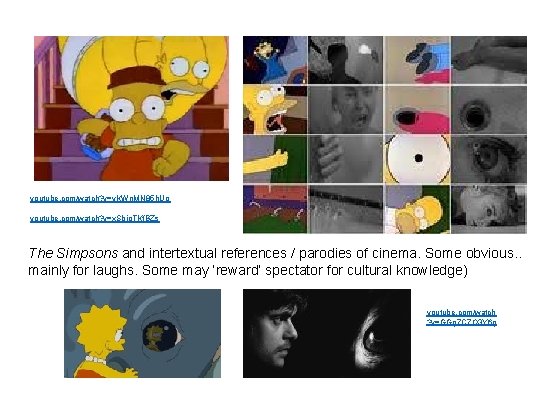
youtube. com/watch? v=y. KWn. MN 85 h. Ug youtube. com/watch? v=x. Sbjo. TKf. BZs The Simpsons and intertextual references / parodies of cinema. Some obvious. . mainly for laughs. Some may ‘reward’ spectator for cultural knowledge) youtube. com/watch ? v=GGg 7 C 7 O 3 Y 6 g
Postmodernism and Riptide Watch the ‘Stranger Things and Intertextuality’ video Intertextuality including references to popular culture e. g. direct reference to Michelle Pfieffer and more indirect in lyrics to film ‘Midnight Cowboy’ Self-reflexive / parody, making fun of music video conventions e. g. the ‘overly’ illustrative images Pastiche of / homage to ‘women in peril’ movies & surrealist cinema so ironic representation of women (seemingly sexist… but not really? ) Ambiguity (more on following slides… and some surrealism : ) Very heavy narrative fragmentation and anti-realist style (no attempt at telling a coherent story or creating verisimilitude)
Media Language Neale: genre repetition (editing pace) but mainly difference. Rejects performance and a clearly defined narrative. Fragmentation and ambiguity. Some short coherent narrative sequences (e. g. girl goes missing in graveyard)…but meaning? Many shots ‘illustrate’ the lyrics as jokes (or visual metaphors) This style and content shows music video genre is fluid – more like the dream logic of surrealist cinema (e. g. Luis Bunuel). Montage editing (repetition). But different with contrasting shots juxtaposed. This invites audience interpretation (e. g. Soviet director Sergei Eisenstein’s theory of ‘intellectual montage’ where juxtapositions generate new meanings) Preferred meaning: unique and arty / ‘intellectual’. Fans of video possibly identify (Gauntlett) as non-mainstream or ‘clever’?
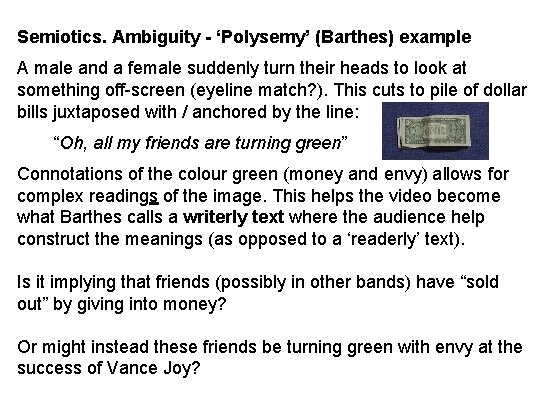
Semiotics. Ambiguity - ‘Polysemy’ (Barthes) example A male and a female suddenly turn their heads to look at something off-screen (eyeline match? ). This cuts to pile of dollar bills juxtaposed with / anchored by the line: “Oh, all my friends are turning green” Connotations of the colour green (money and envy) allows for complex readings of the image. This helps the video become what Barthes calls a writerly text where the audience help construct the meanings (as opposed to a ‘readerly’ text). Is it implying that friends (possibly in other bands) have “sold out” by giving into money? Or might instead these friends be turning green with envy at the success of Vance Joy?
Representation Issues: Gender (Van Zoonen) Does Riptide reinforce a patriarchal world view or is subverting the objectification of women? If this not easy… more evidence of ambiguity! Women are repeatedly presented as an object to be watched (a woman undresses out of her swimming costume, many disembodied shots of women’s bodies). Are these for the male gaze, or do they subvert it by being knowing and ironic? The lip-sync woman at first has immaculate make-up and is lit in a flattering way arguably conforming to social norms of beauty. She becomes more disheveled (her make-up smudges) and vacant as she sings “the words wrong”. What does this represent about women? Is it more an intertextual reference (David Lynch)? If it is, for what meaning? www. youtube. com/watch? v=QP-X 1 e. ZLEt. Q www. youtube. com/watch? v=sen. NDipdm. Po www. youtube. com/watch? v=SJndr 9 m. RGg. E There are images of violence e. g. a female hand being stabbed by a knife. The lip-synching woman also clutches at her own bloody neck (? ) Meaning? Are these trivialising or normalising violence. More intertextual references (Luis Bunuel ‘eye scene’ or Dario Argento and giallo genre)?