
Music of the Protestant Reformation A Pedagogical Analysis
- Slides: 20
Music of the Protestant Reformation: A Pedagogical Analysis of Hymns
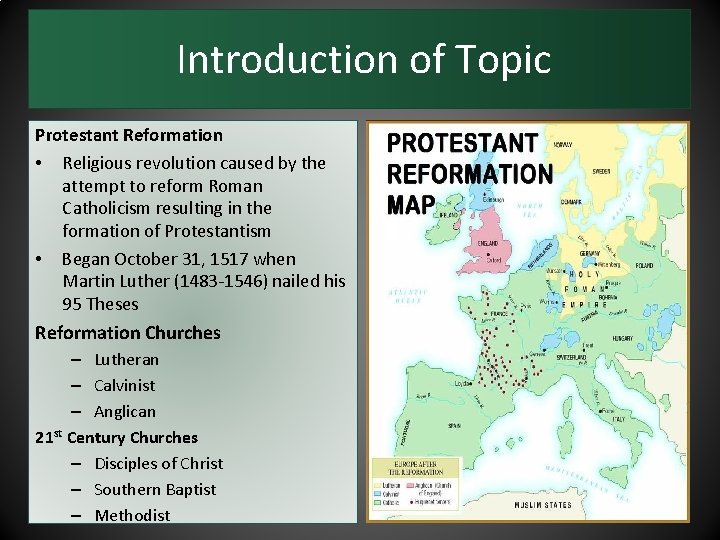
Introduction of Topic Protestant Reformation • Religious revolution caused by the attempt to reform Roman Catholicism resulting in the formation of Protestantism • Began October 31, 1517 when Martin Luther (1483 -1546) nailed his 95 Theses Reformation Churches – Lutheran – Calvinist – Anglican 21 st Century Churches – Disciples of Christ – Southern Baptist – Methodist
Purpose With the intent of improving music pedagogy, the purpose of this research was to investigate the music of the Protestant Reformation (1517 -1600)
Problems 1. Trace the origins of the Lutheran, Calvinist, and Anglican Church, 2. Discuss protestant reform as it relates to music, and 3. Identify reformation hymns included in the Disciples of Christ, Southern Baptist, and Methodist hymnals.
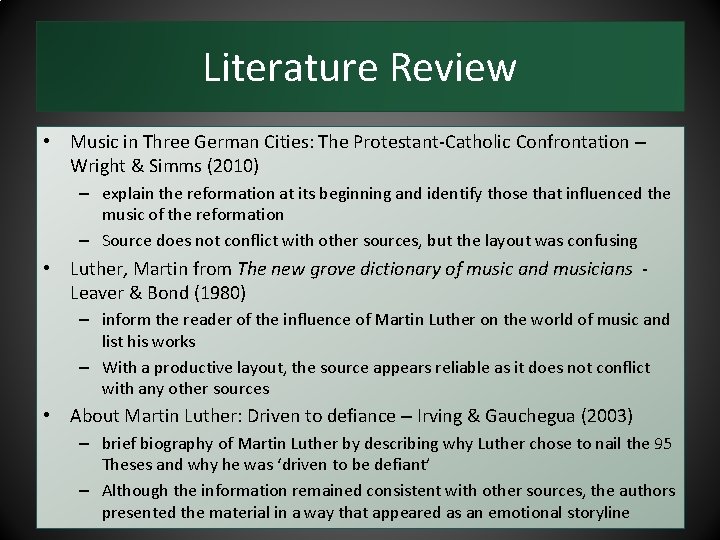
Literature Review • Music in Three German Cities: The Protestant-Catholic Confrontation – Wright & Simms (2010) – explain the reformation at its beginning and identify those that influenced the music of the reformation – Source does not conflict with other sources, but the layout was confusing • Luther, Martin from The new grove dictionary of music and musicians Leaver & Bond (1980) – inform the reader of the influence of Martin Luther on the world of music and list his works – With a productive layout, the source appears reliable as it does not conflict with any other sources • About Martin Luther: Driven to defiance – Irving & Gauchegua (2003) – brief biography of Martin Luther by describing why Luther chose to nail the 95 Theses and why he was ‘driven to be defiant’ – Although the information remained consistent with other sources, the authors presented the material in a way that appeared as an emotional storyline
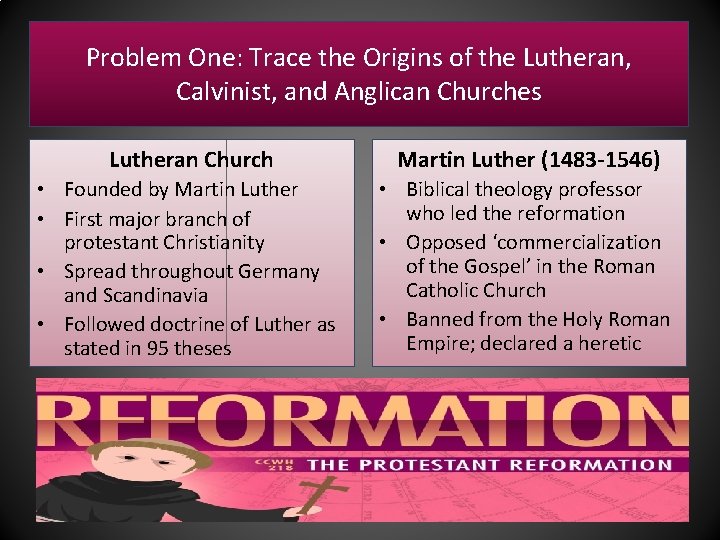
Problem One: Trace the Origins of the Lutheran, Calvinist, and Anglican Churches Lutheran Church Martin Luther (1483 -1546) • Founded by Martin Luther • First major branch of protestant Christianity • Spread throughout Germany and Scandinavia • Followed doctrine of Luther as stated in 95 theses • Biblical theology professor who led the reformation • Opposed ‘commercialization of the Gospel’ in the Roman Catholic Church • Banned from the Holy Roman Empire; declared a heretic
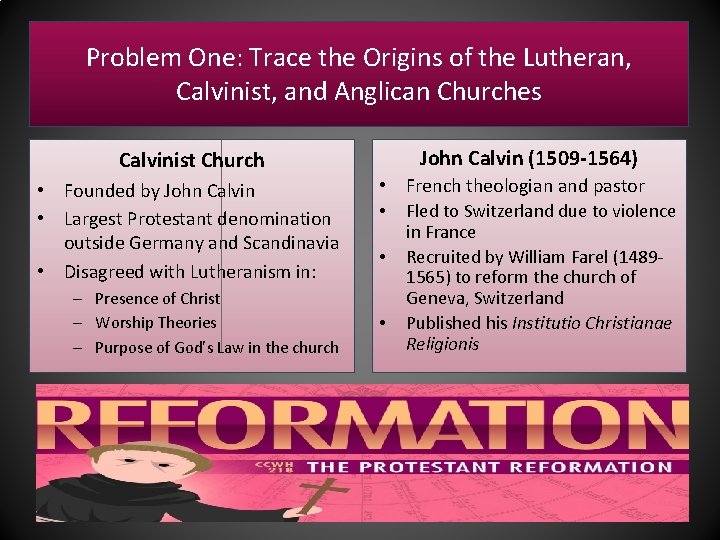
Problem One: Trace the Origins of the Lutheran, Calvinist, and Anglican Churches Calvinist Church • Founded by John Calvin • Largest Protestant denomination outside Germany and Scandinavia • Disagreed with Lutheranism in: – Presence of Christ – Worship Theories – Purpose of God’s Law in the church John Calvin (1509 -1564) • French theologian and pastor • Fled to Switzerland due to violence • • in France Recruited by William Farel (14891565) to reform the church of Geneva, Switzerland Published his Institutio Christianae Religionis
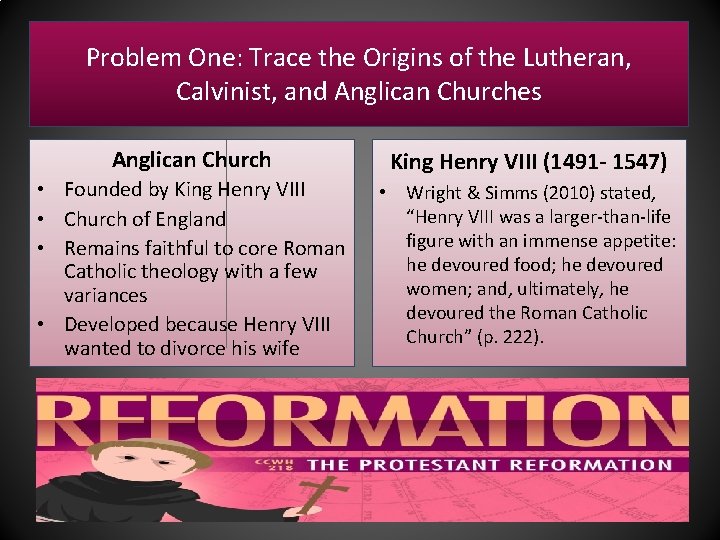
Problem One: Trace the Origins of the Lutheran, Calvinist, and Anglican Churches Anglican Church • Founded by King Henry VIII • Church of England • Remains faithful to core Roman Catholic theology with a few variances • Developed because Henry VIII wanted to divorce his wife King Henry VIII (1491 - 1547) • Wright & Simms (2010) stated, “Henry VIII was a larger-than-life figure with an immense appetite: he devoured food; he devoured women; and, ultimately, he devoured the Roman Catholic Church” (p. 222).
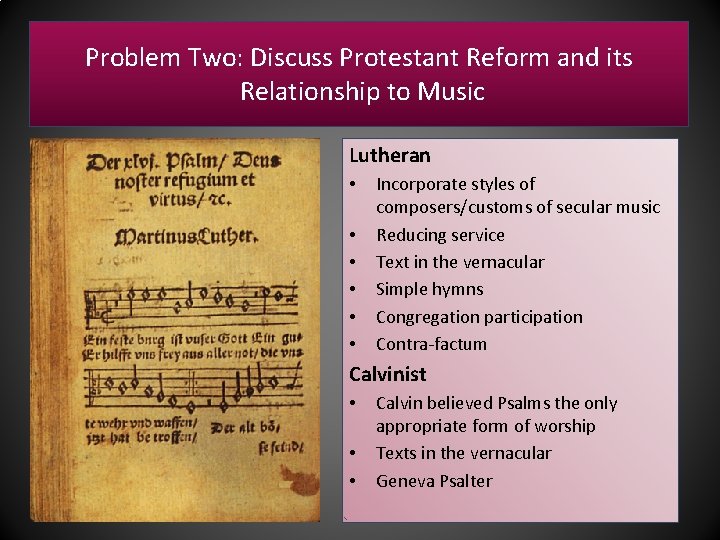
Problem Two: Discuss Protestant Reform and its Relationship to Music Lutheran • • • Incorporate styles of composers/customs of secular music Reducing service Text in the vernacular Simple hymns Congregation participation Contra-factum Calvinist • • • Calvin believed Psalms the only appropriate form of worship Texts in the vernacular Geneva Psalter
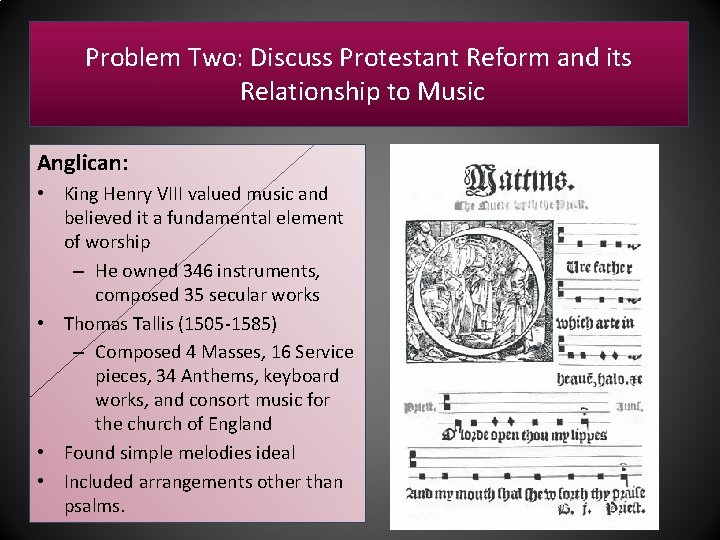
Problem Two: Discuss Protestant Reform and its Relationship to Music Anglican: • King Henry VIII valued music and believed it a fundamental element of worship – He owned 346 instruments, composed 35 secular works • Thomas Tallis (1505 -1585) – Composed 4 Masses, 16 Service pieces, 34 Anthems, keyboard works, and consort music for the church of England • Found simple melodies ideal • Included arrangements other than psalms.
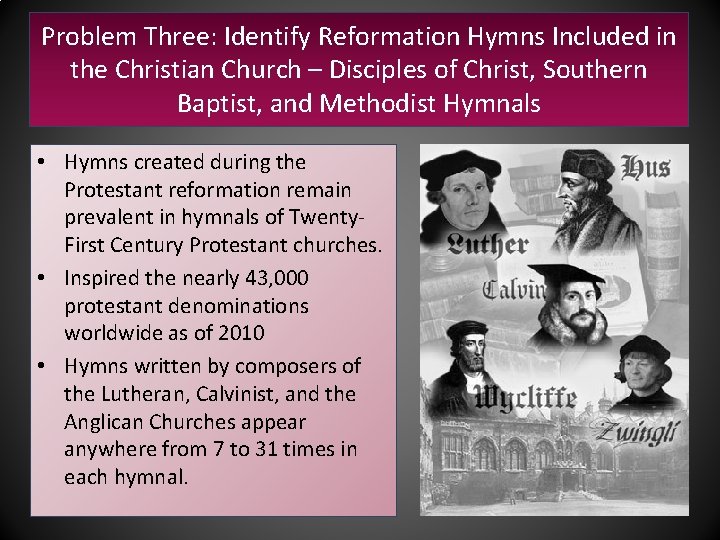
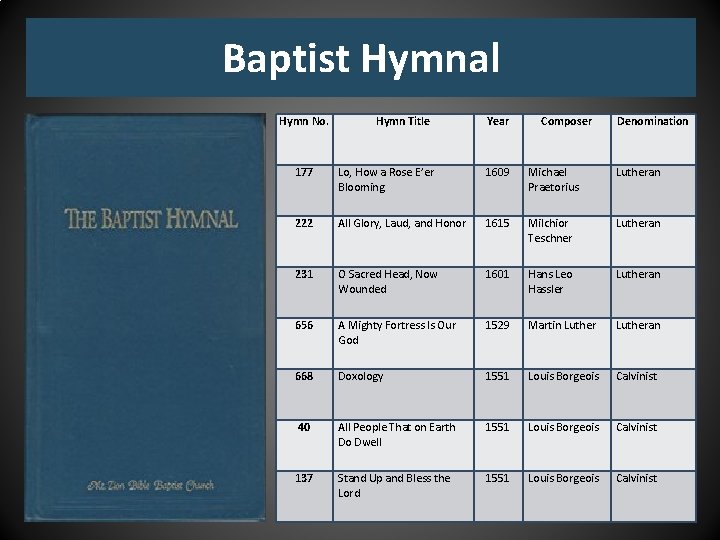
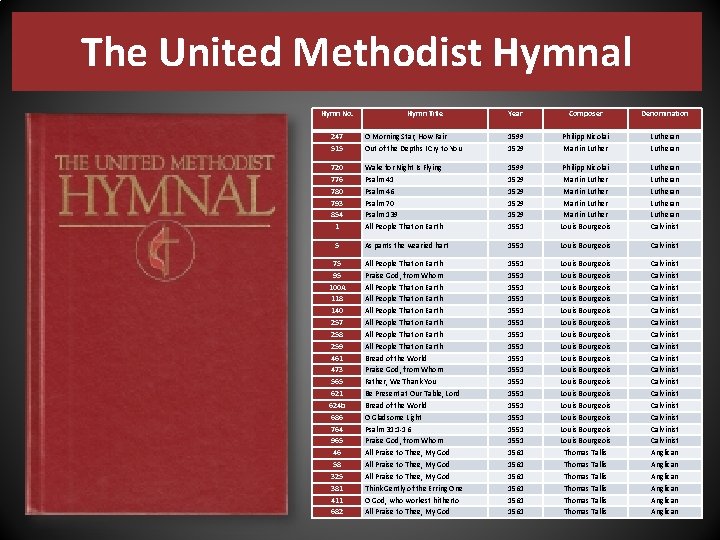
Problem Three: Identify Reformation Hymns Included in the Christian Church – Disciples of Christ, Southern Baptist, and Methodist Hymnals • Hymns created during the Protestant reformation remain prevalent in hymnals of Twenty. First Century Protestant churches. • Inspired the nearly 43, 000 protestant denominations worldwide as of 2010 • Hymns written by composers of the Lutheran, Calvinist, and the Anglican Churches appear anywhere from 7 to 31 times in each hymnal.
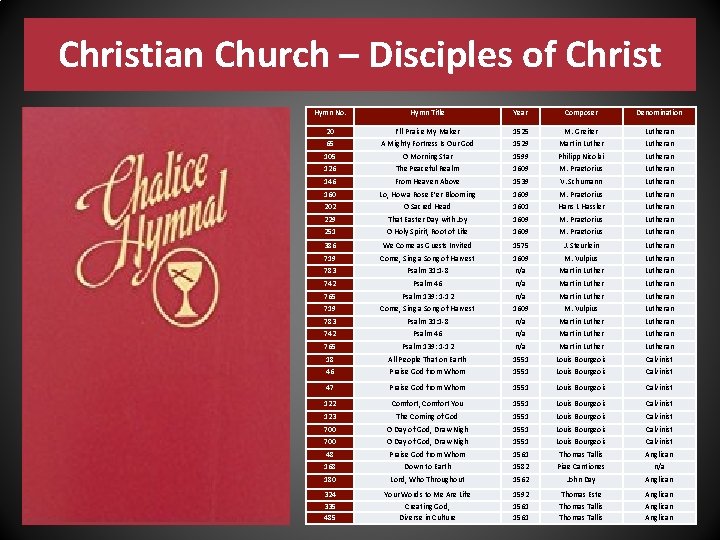
Christian Church – Disciples of Christ Hymn No. Hymn Title Year Composer Denomination 20 65 I’ll Praise My Maker A Mighty Fortress Is Our God 1525 1529 M. Greiter Martin Lutheran 105 O Morning Star 1599 Philipp Nicolai Lutheran 126 The Peaceful Realm 1609 M. Praetorius Lutheran 146 From Heaven Above 1539 V. Schumann Lutheran 160 Lo, How a Rose E’er Blooming 1609 M. Praetorius Lutheran 202 O Sacred Head 1601 Hans L Hassler Lutheran 229 That Easter Day with Joy 1609 M. Praetorius Lutheran 251 O Holy Spirit, Root of Life 1609 M. Praetorius Lutheran 386 We Come as Guests Invited 1575 J. Steurlein Lutheran 719 Come, Sing a Song of Harvest 1609 M. Vulpius Lutheran 783 Psalm 31: 1 -8 n/a Martin Lutheran 742 Psalm 46 n/a Martin Lutheran 765 Psalm 139: 1 -12 n/a Martin Lutheran 18 All People That on Earth 1551 Louis Bourgeois Calvinist 46 Praise God from Whom 1551 Louis Bourgeois Calvinist 47 Praise God from Whom 1551 Louis Bourgeois Calvinist 122 Comfort, Comfort You 1551 Louis Bourgeois Calvinist 123 The Coming of God 1551 Louis Bourgeois Calvinist 700 O Day of God, Draw Nigh 1551 Louis Bourgeois Calvinist 48 Praise God from Whom 1561 Thomas Tallis Anglican 168 Down to Earth 1582 Piae Cantiones n/a 180 Lord, Who Throughout 1562 John Day Anglican 324 Your Words to Me Are Life 1592 Thomas Este Anglican 335 485 Creating God, Diverse in Culture 1561 Thomas Tallis Anglican
Baptist Hymnal Hymn No. Hymn Title Year Composer Denomination 177 Lo, How a Rose E’er Blooming 1609 Michael Praetorius Lutheran 222 All Glory, Laud, and Honor 1615 Milchior Teschner Lutheran 231 O Sacred Head, Now Wounded 1601 Hans Leo Hassler Lutheran 656 A Mighty Fortress Is Our God 1529 Martin Lutheran 668 Doxology 1551 Louis Borgeois Calvinist 40 All People That on Earth Do Dwell 1551 Louis Borgeois Calvinist 137 Stand Up and Bless the Lord 1551 Louis Borgeois Calvinist
The United Methodist Hymnal Hymn No. Hymn Title Year Composer Denomination 247 515 O Morning Star, How Fair Out of the Depths I Cry to You 1599 1529 Philipp Nicolai Martin Lutheran 720 776 780 793 854 1 Wake for Night Is Flying Psalm 41 Psalm 46 Psalm 70 Psalm 139 All People That on Earth 1599 1529 1551 Philipp Nicolai Martin Luther Louis Bourgeois Lutheran Lutheran Calvinist As pants the wearied hart 1551 Louis Bourgeois Calvinist All People That on Earth Praise God, from Whom All People That on Earth All People That on Earth Bread of the World Praise God, from Whom Father, We Thank You Be Present at Our Table, Lord Bread of the World O Gladsome Light Psalm 31: 1 -16 Praise God, from Whom All Praise to Thee, My God Think Gently of the Erring One O God, who workest hitherto All Praise to Thee, My God 1551 1551 1551 1551 1561 1561 Louis Bourgeois Louis Bourgeois Louis Bourgeois Louis Bourgeois Thomas Tallis Thomas Tallis Calvinist Calvinist Calvinist Calvinist Anglican Anglican 5 75 95 100 A 118 140 257 258 259 461 473 565 621 624 b 686 764 965 46 58 325 381 411 682
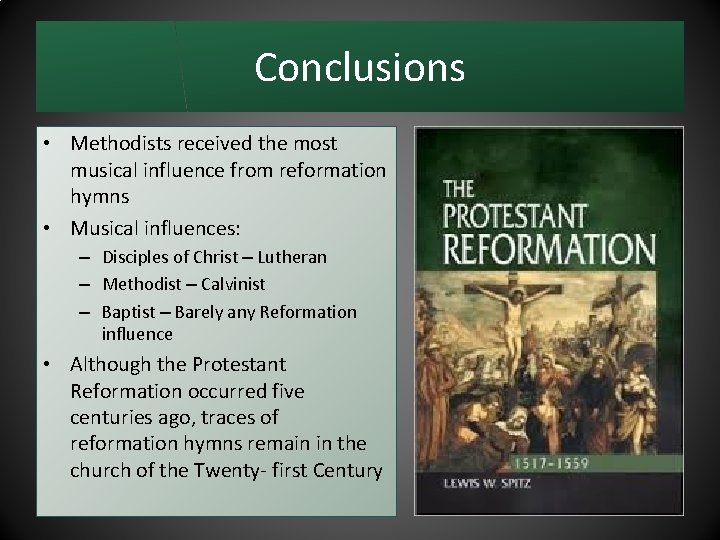
Conclusions • Methodists received the most musical influence from reformation hymns • Musical influences: – Disciples of Christ – Lutheran – Methodist – Calvinist – Baptist – Barely any Reformation influence • Although the Protestant Reformation occurred five centuries ago, traces of reformation hymns remain in the church of the Twenty- first Century
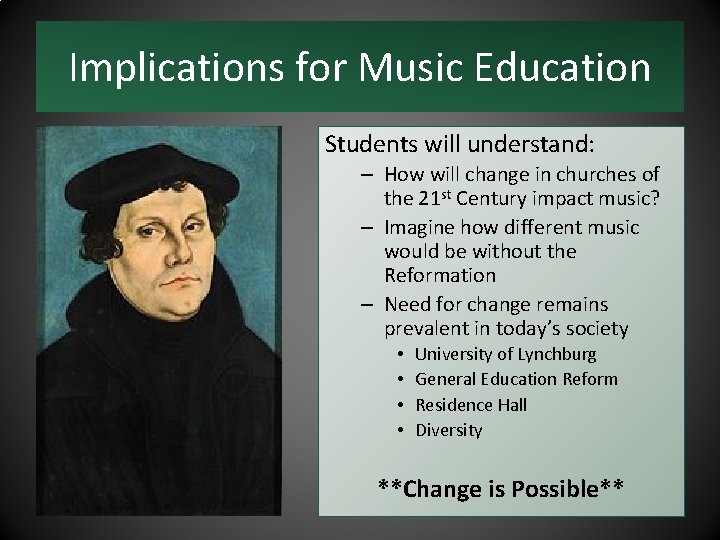
Implications for Music Education Students will understand: – How will change in churches of the 21 st Century impact music? – Imagine how different music would be without the Reformation – Need for change remains prevalent in today’s society • • University of Lynchburg General Education Reform Residence Hall Diversity **Change is Possible**
Future Studies Future lessons may include • Lesson format containing information on other hymn books, other denominations, different influences/origins • In depth analysis of musical influences Suggestions • Explain facts about the compositions that allow the student or performer to better understand historical context of the work – Have students think of things in need of reform today
Bibliography • • • • Becker, S. , Pfaff, S. , & Rubin, J. (2015). Martin Luther. Salem press biographical encyclopedia. Hackensack, NJ: Salem Press. Bouwsma, W. J. (1988). John Calvin: A sixteenth-century portrait. New York: Oxford University Press. Breen, Q. (1968). John Calvin; A study in French humanism. Hamden, CT: Archon Books. Harland, M. (2008). Baptist hymnal. Nashville, TN: Life. Way Worship. Irving, A. & Gauchegua, E. (2003). About Martin Luther: Driven to defiance. Retrieved from: http: //www. pbs. org/empires/martinluther/about_driv. html Kranz, N. (2005). Martin Luther stands in history as leader of the protestant reformation. Journal of Undergraduate Research at Minnesota State University, 5(13), 1 -4. Retrieved from: http: //cornerstone. lib. mnsu. edu/cgi/viewcontent. cgi? article=1142&context=jur Leaver, R. & Bond, A. (1980). Luther, Martin. In S. Sadie (Ed. ), The new grove dictionary of music and musicians Vol. 11 (pp. 365 -371). New York: Macmillan Publishers Limited. Loewe, J. (2013). ‘Musica est optimum’: Martin Luther’s theory of music. Music & letters, 94(4), 573 -605. Marsden, G. (2009). Henry VIII miracle king. History Today, 59(3), 54. Merrick, D. (1995). Chalice hymnal. St. Louis, MO: Chalice Press. Mullan, D. (2014). Martin Luther in Nineteenth-Century France. Journal of religious history 38 (4), 495 -515. Sascha, O. , Steven, P. , & Jared, R. (2015). Causes and consequences of the Protestant Reformation. Orange, CA: Chapman University, Economic Science Institute. Wedd, G. (1999). Anglicanism: A Dialogue Between Present and Past. Contemporary Review, 275(1602), 15. Wright, C. & Simms, B. (2010). Music in Western Civilization. Boston, MA: Schimer Cengage Learning. Young, C. (1989). The united methodist hymnal. Nashville, TN: United Methodist Publishing House.
Who Receives Thanks • Dr. Ramsey, for countless hours of instruction and support • The entire Music Faculty for the knowledge and encouragement they provide me with every day.
Music of the Protestant Reformation: A Pedagogical Analysis of Hymns Questions?