
Music of Japan Map of East Asia China

- Slides: 21
Music of Japan
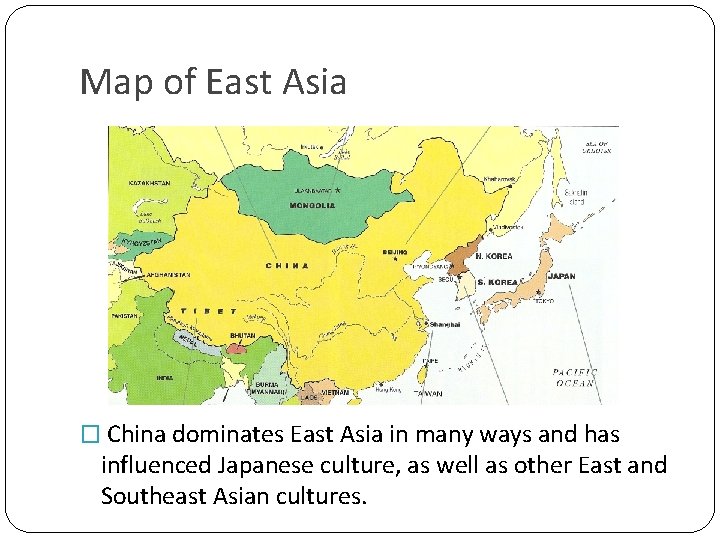
Map of East Asia � China dominates East Asia in many ways and has influenced Japanese culture, as well as other East and Southeast Asian cultures.
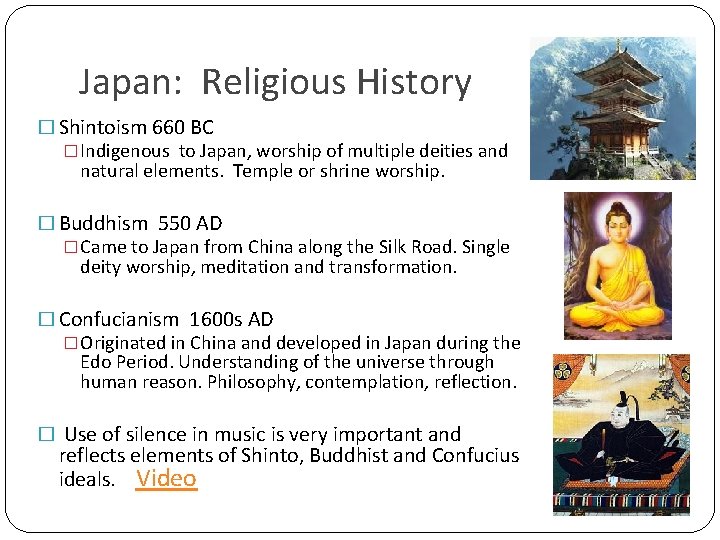
Japan: Religious History � Shintoism 660 BC �Indigenous to Japan, worship of multiple deities and natural elements. Temple or shrine worship. � Buddhism 550 AD �Came to Japan from China along the Silk Road. Single deity worship, meditation and transformation. � Confucianism 1600 s AD �Originated in China and developed in Japan during the Edo Period. Understanding of the universe through human reason. Philosophy, contemplation, reflection. � Use of silence in music is very important and reflects elements of Shinto, Buddhist and Confucius ideals. Video
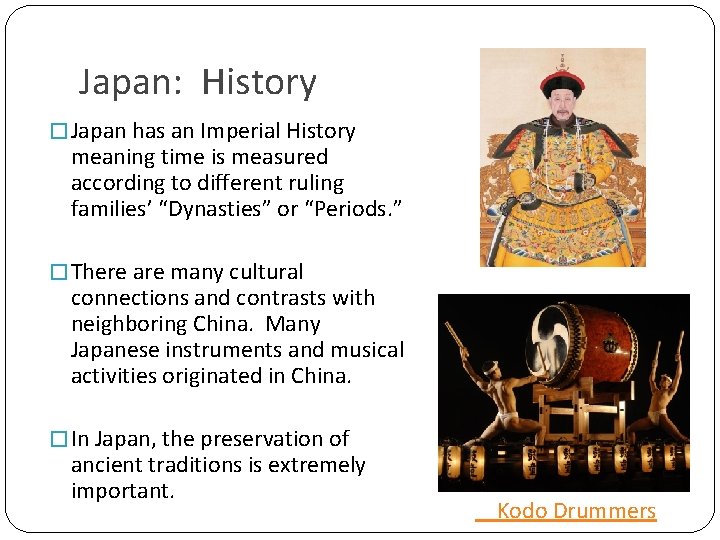
Japan: History � Japan has an Imperial History meaning time is measured according to different ruling families’ “Dynasties” or “Periods. ” � There are many cultural connections and contrasts with neighboring China. Many Japanese instruments and musical activities originated in China. � In Japan, the preservation of ancient traditions is extremely important. Kodo Drummers
Japan: The Edo Period �The Edo Period (1603 -1868) �Many of the musical examples in this unit developed in the Edo Period, a time of great artistic development in Japan. �Kabuki Theater �Bunraku Puppet Theater �Sokyoko Vocal and Instrumental ensembles �Other sites include: �Noh Theater (14 th century) �Gagaku Court Music (6 th century)
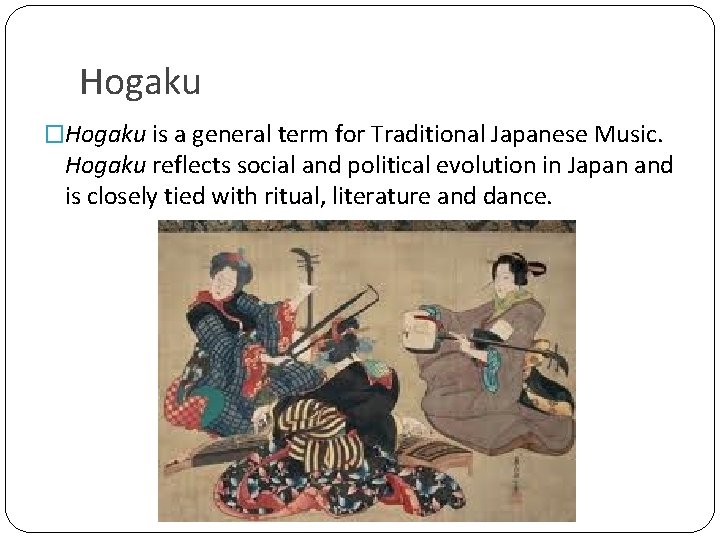
Hogaku �Hogaku is a general term for Traditional Japanese Music. Hogaku reflects social and political evolution in Japan and is closely tied with ritual, literature and dance.
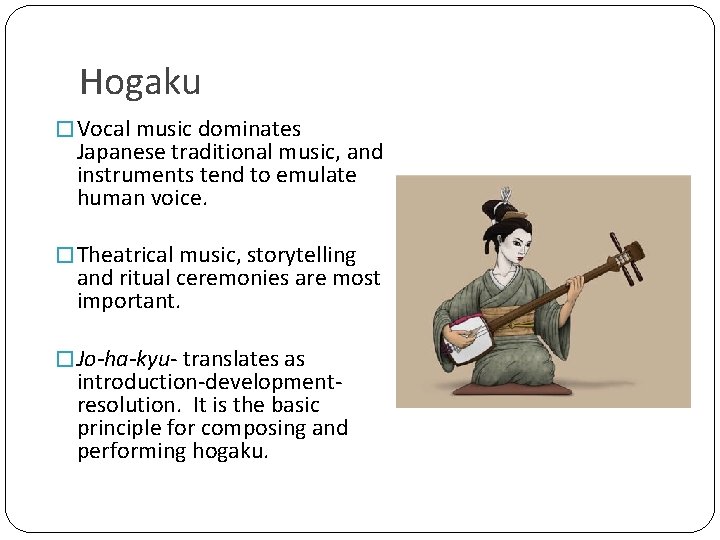
Hogaku � Vocal music dominates Japanese traditional music, and instruments tend to emulate human voice. � Theatrical music, storytelling and ritual ceremonies are most important. � Jo-ha-kyu- translates as introduction-developmentresolution. It is the basic principle for composing and performing hogaku.
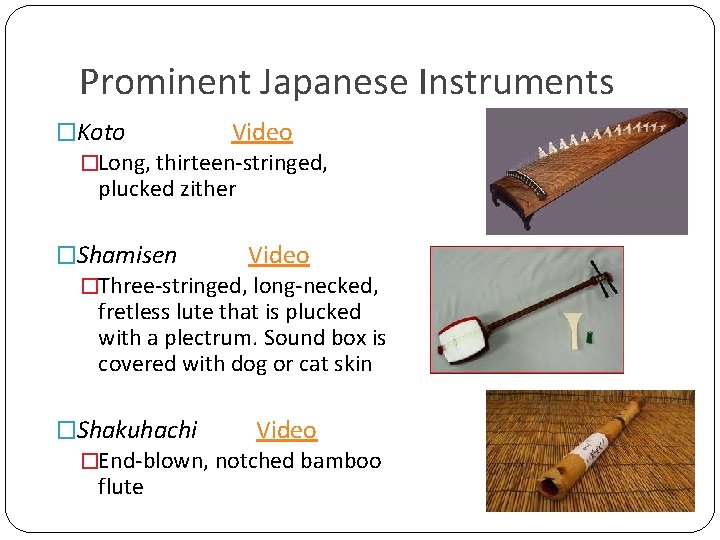
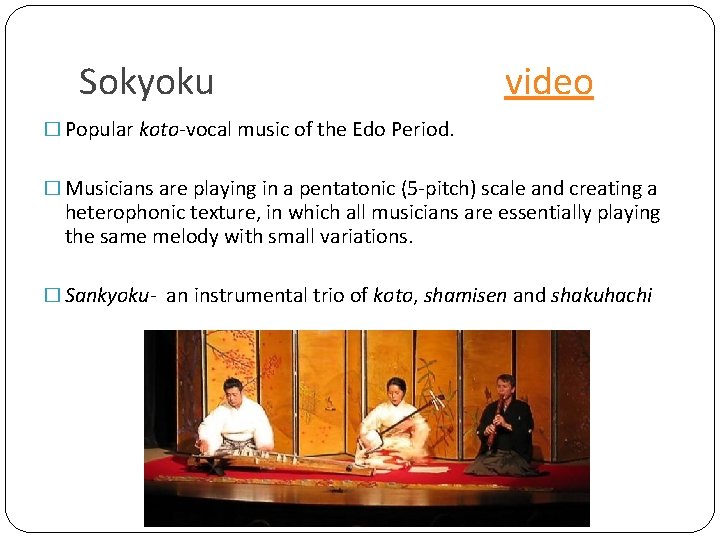
Prominent Japanese Instruments �Koto Video �Long, thirteen-stringed, plucked zither �Shamisen Video �Three-stringed, long-necked, fretless lute that is plucked with a plectrum. Sound box is covered with dog or cat skin �Shakuhachi Video �End-blown, notched bamboo flute
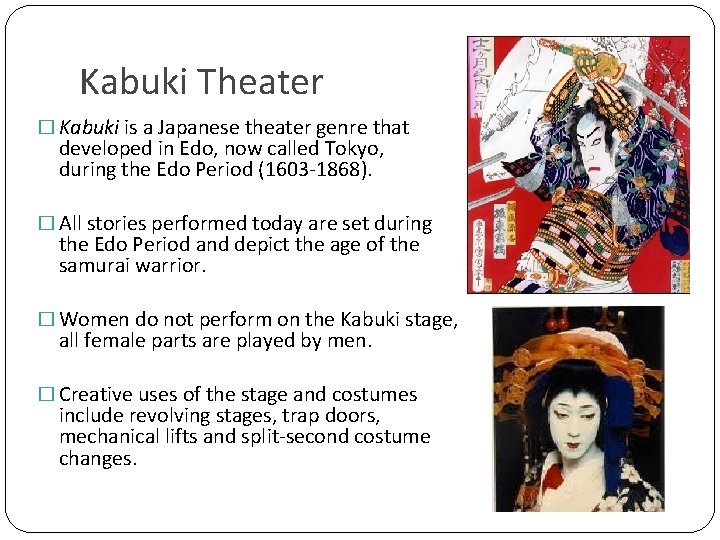
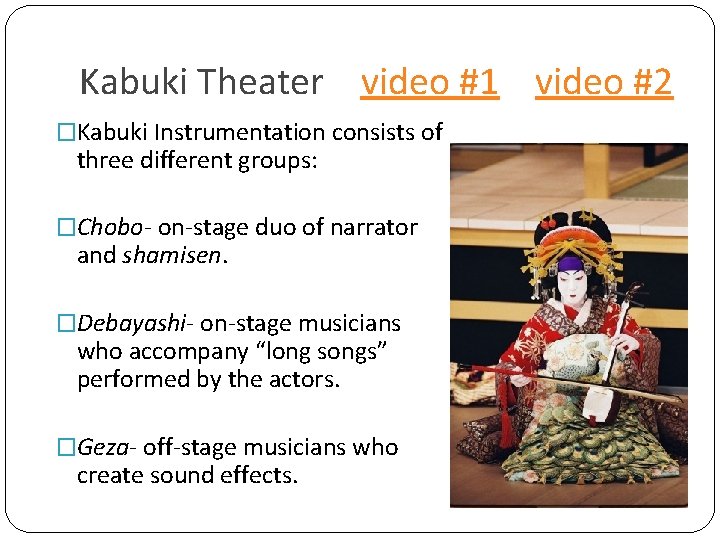
Kabuki Theater � Kabuki is a Japanese theater genre that developed in Edo, now called Tokyo, during the Edo Period (1603 -1868). � All stories performed today are set during the Edo Period and depict the age of the samurai warrior. � Women do not perform on the Kabuki stage, all female parts are played by men. � Creative uses of the stage and costumes include revolving stages, trap doors, mechanical lifts and split-second costume changes.
Kabuki Theater video #1 video #2 �Kabuki Instrumentation consists of three different groups: �Chobo- on-stage duo of narrator and shamisen. �Debayashi- on-stage musicians who accompany “long songs” performed by the actors. �Geza- off-stage musicians who create sound effects.
Listening Activity: Kabuki Theater �Listen to “Kabuki Dojoji” found in the Japan Audio File. Follow the Listening Guide in your book as you listen. �What Sounds are you hearing? �What Behaviors are associated with this musical activity? �What Conceptions or Ideas govern the sounds and behaviors of this musical activity?
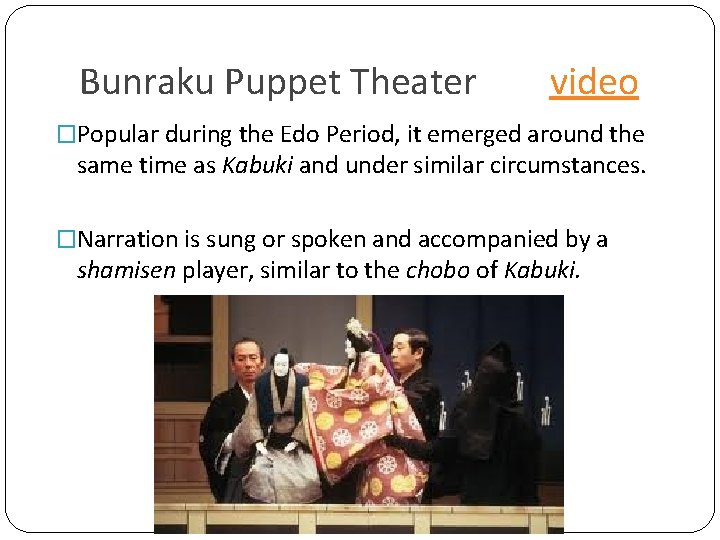
Bunraku Puppet Theater video �Popular during the Edo Period, it emerged around the same time as Kabuki and under similar circumstances. �Narration is sung or spoken and accompanied by a shamisen player, similar to the chobo of Kabuki.
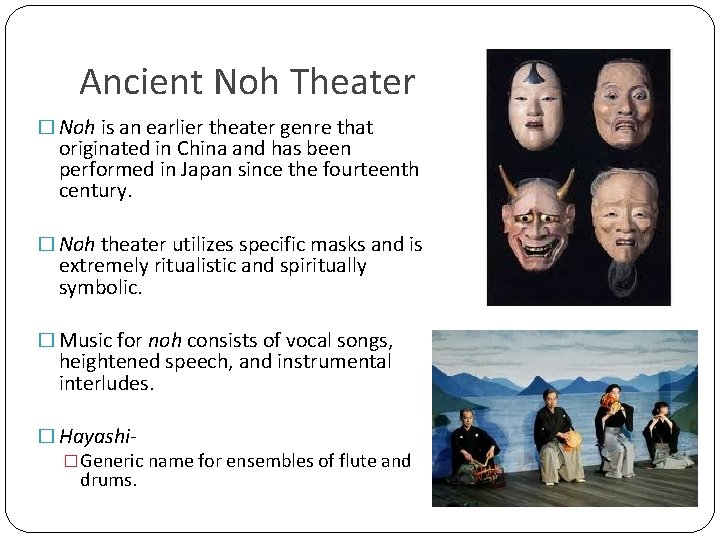
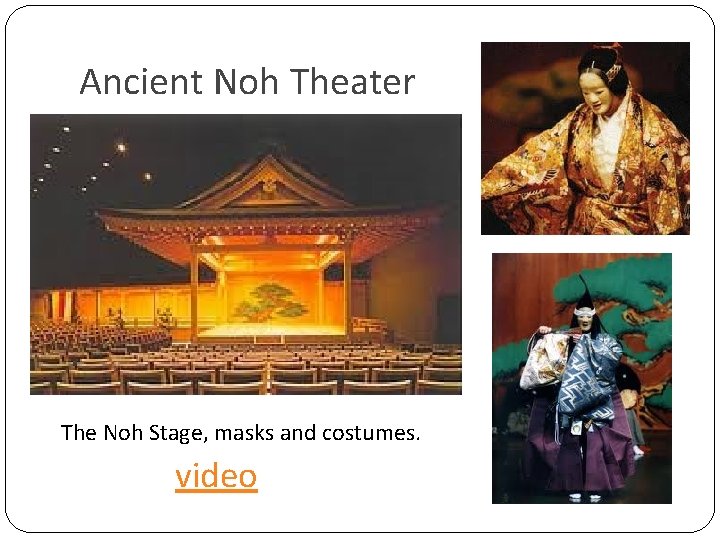
Ancient Noh Theater � Noh is an earlier theater genre that originated in China and has been performed in Japan since the fourteenth century. � Noh theater utilizes specific masks and is extremely ritualistic and spiritually symbolic. � Music for noh consists of vocal songs, heightened speech, and instrumental interludes. � Hayashi�Generic name for ensembles of flute and drums.
Ancient Noh Theater The Noh Stage, masks and costumes. video
Listening Activity: Noh Theater � Listen to “Noh Hagoromo” found in the Japan Audio File. Follow the Listening Guide in your book as you listen. � What Sounds are you hearing? � What Behaviors are associated with this musical activity? � What Conceptions or Ideas govern the sounds and behaviors of this musical activity?
Sokyoku video � Popular koto-vocal music of the Edo Period. � Musicians are playing in a pentatonic (5 -pitch) scale and creating a heterophonic texture, in which all musicians are essentially playing the same melody with small variations. � Sankyoku- an instrumental trio of koto, shamisen and shakuhachi
Listening Activity: Sokyoku �Listen to “Sokyoku” found in the Japan Audio File. Follow the Listening Guide in your book as you listen. �What Sounds are you hearing? �What Behaviors are associated with this musical activity? �What Conceptions or Ideas govern the sounds and behaviors of this musical activity?
Listening Activity: Sokyoku #2 �Listen to “Jiuta Chidori” found in the Japan Audio File. Follow the Listening Guide in your book as you listen. �What Sounds are you hearing? �What Behaviors are associated with this musical activity? �What Conceptions or Ideas govern the sounds and behaviors of this musical activity?
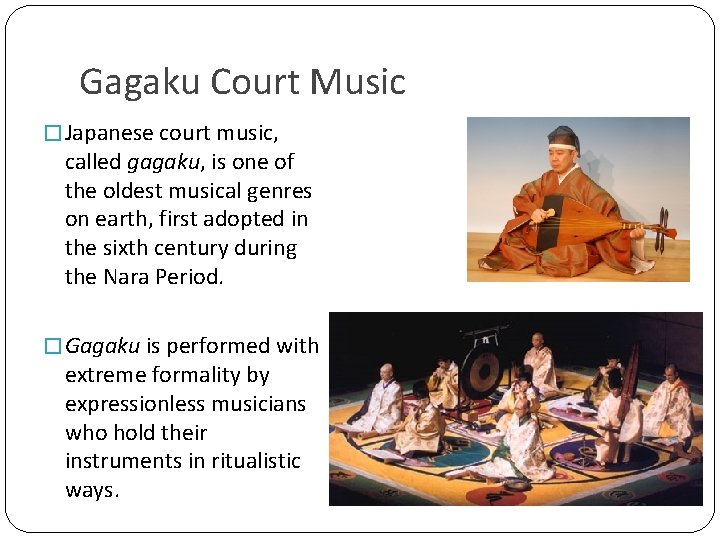
Gagaku Court Music � Japanese court music, called gagaku, is one of the oldest musical genres on earth, first adopted in the sixth century during the Nara Period. � Gagaku is performed with extreme formality by expressionless musicians who hold their instruments in ritualistic ways.
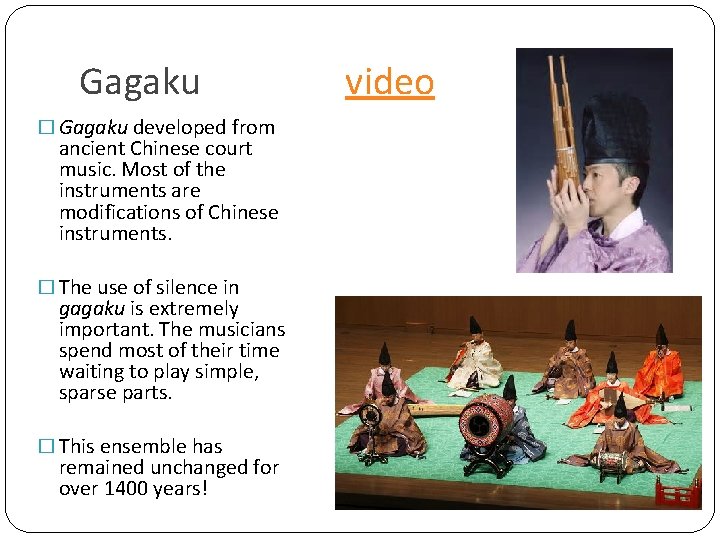
Gagaku � Gagaku developed from ancient Chinese court music. Most of the instruments are modifications of Chinese instruments. � The use of silence in gagaku is extremely important. The musicians spend most of their time waiting to play simple, sparse parts. � This ensemble has remained unchanged for over 1400 years! video
Listening Activity: Gagaku �Listen to “Gagaku” found in the Japan Audio File. Follow the Listening Guide in your book as you listen. �What Sounds are you hearing? �What Behaviors are associated with this musical activity? �What Conceptions or Ideas govern the sounds and behaviors of this musical activity?