
MUSIC NOTES Noise Versus Music What is the
- Slides: 32
MUSIC NOTES
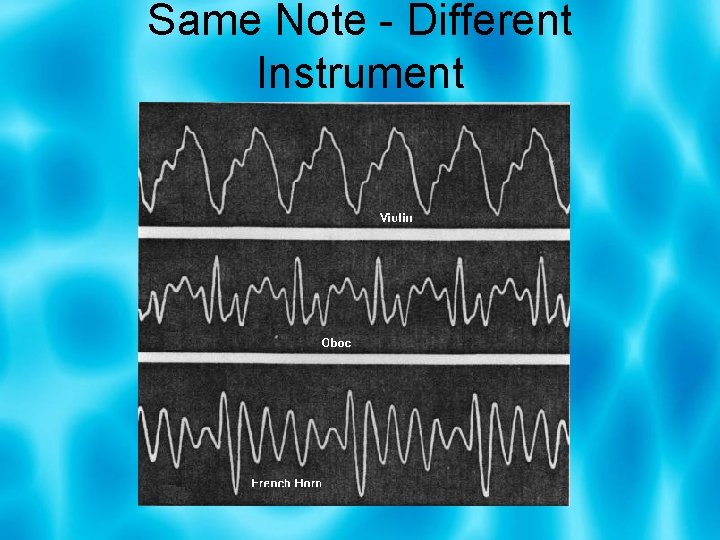
Noise Versus Music What is the difference between noise and music? Answer: The appearance of the waveform.
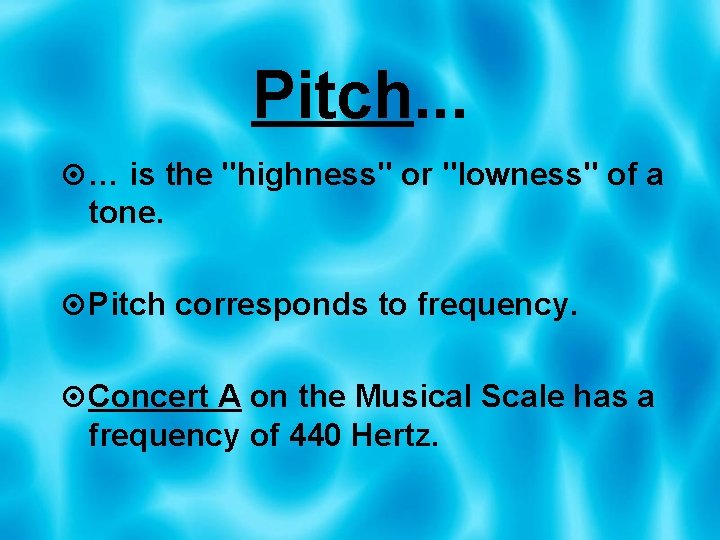
Pitch. . . … is the "highness" or "lowness" of a tone. Pitch corresponds to frequency. Concert A on the Musical Scale has a frequency of 440 Hertz.
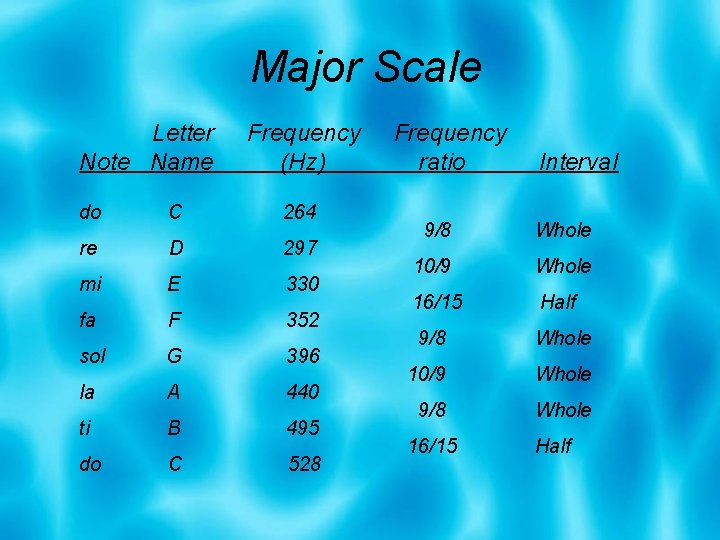
Major Scale Letter Note Name Frequency (Hz) do C 264 re D 297 mi E 330 fa F 352 sol G 396 la A 440 ti B 495 do C 528 Frequency ratio Interval 9/8 Whole 10/9 Whole 16/15 Half 9/8 Whole 10/9 Whole 9/8 Whole 16/15 Half
Same Note - Different Instrument
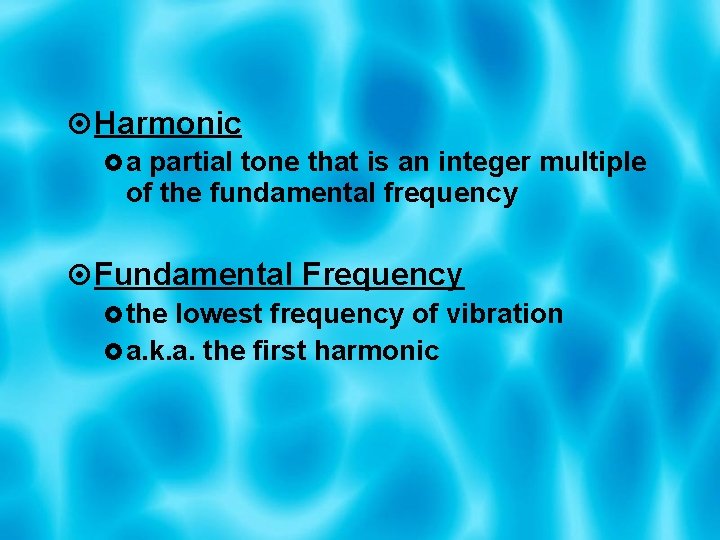
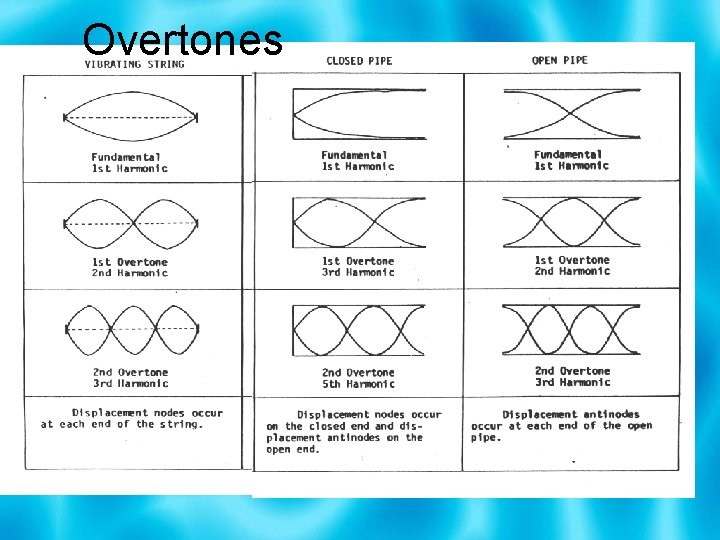
Harmonic a partial tone that is an integer multiple of the fundamental frequency Fundamental Frequency the lowest frequency of vibration a. k. a. the first harmonic
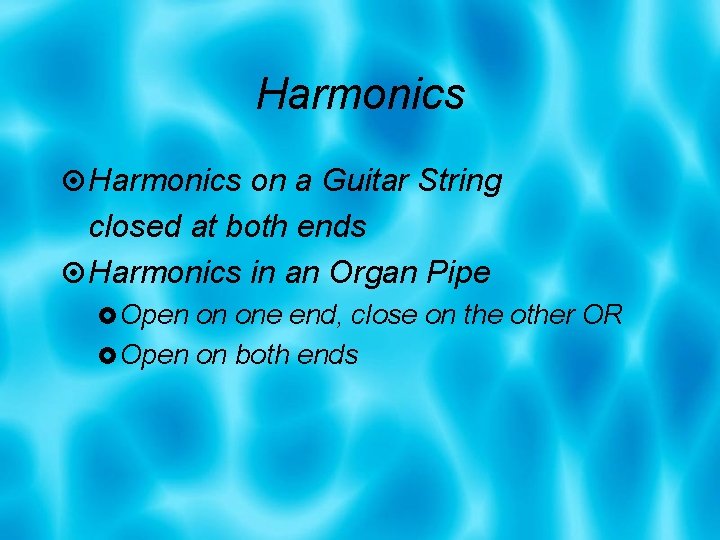
Harmonics on a Guitar String closed at both ends Harmonics in an Organ Pipe Open on one end, close on the other OR Open on both ends
Overtones
Example Problem Example: What is the wavelength and frequencies of the fundamental and the first two overtones of a. 3 m long closed pipe? (For v=340 m/s) How about for an open pipe?
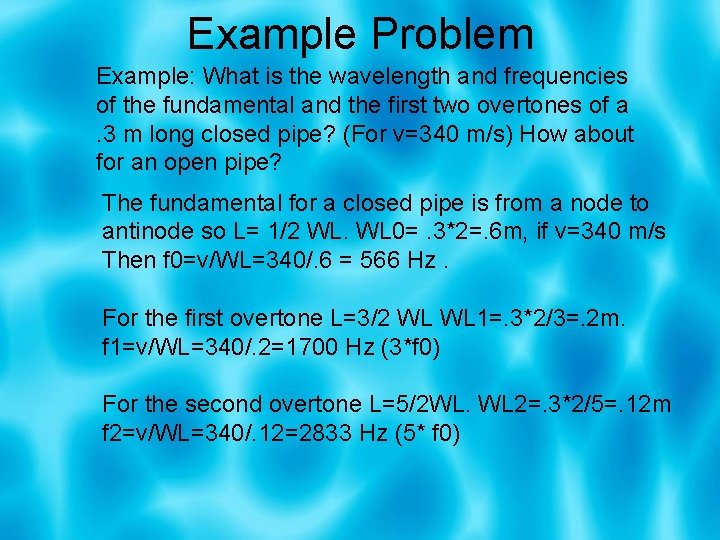
Example Problem Example: What is the wavelength and frequencies of the fundamental and the first two overtones of a. 3 m long closed pipe? (For v=340 m/s) How about for an open pipe? The fundamental for a closed pipe is from a node to antinode so L= 1/2 WL. WL 0=. 3*2=. 6 m, if v=340 m/s Then f 0=v/WL=340/. 6 = 566 Hz. For the first overtone L=3/2 WL WL 1=. 3*2/3=. 2 m. f 1=v/WL=340/. 2=1700 Hz (3*f 0) For the second overtone L=5/2 WL. WL 2=. 3*2/5=. 12 m f 2=v/WL=340/. 12=2833 Hz (5* f 0)
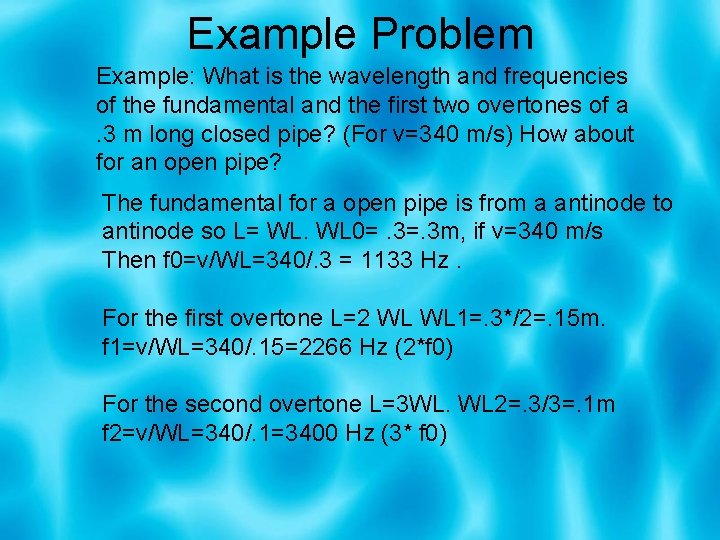
Example Problem Example: What is the wavelength and frequencies of the fundamental and the first two overtones of a. 3 m long closed pipe? (For v=340 m/s) How about for an open pipe? The fundamental for a open pipe is from a antinode to antinode so L= WL. WL 0=. 3 m, if v=340 m/s Then f 0=v/WL=340/. 3 = 1133 Hz. For the first overtone L=2 WL WL 1=. 3*/2=. 15 m. f 1=v/WL=340/. 15=2266 Hz (2*f 0) For the second overtone L=3 WL. WL 2=. 3/3=. 1 m f 2=v/WL=340/. 1=3400 Hz (3* f 0)
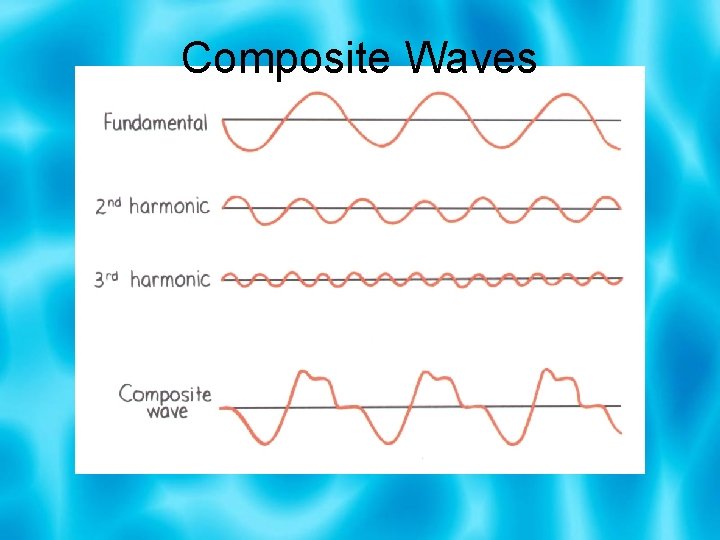
Composite Waves
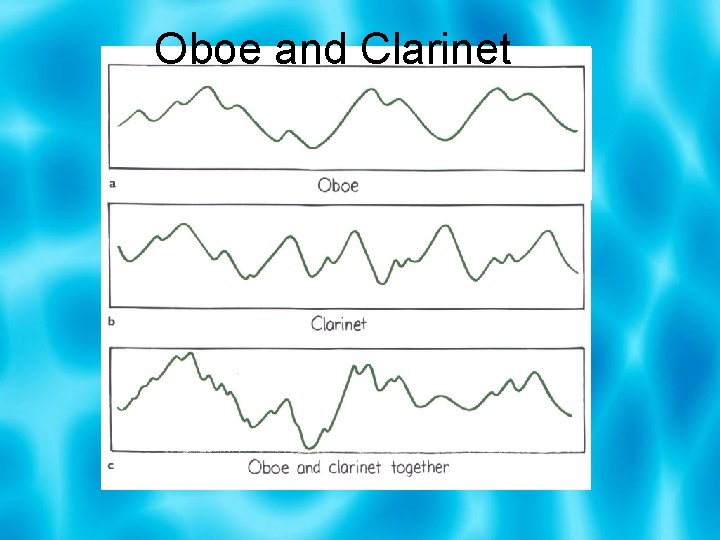
Oboe and Clarinet
superposition
Example Problem Example: Graph a note that is 256 Hz and a half as strong second harmonic:
Example: Graph a note that is 256 Hz and a half as strong second harmonic: Second harmonic means f 2= 3 f 0 = 768 Hz at half the amplitude.
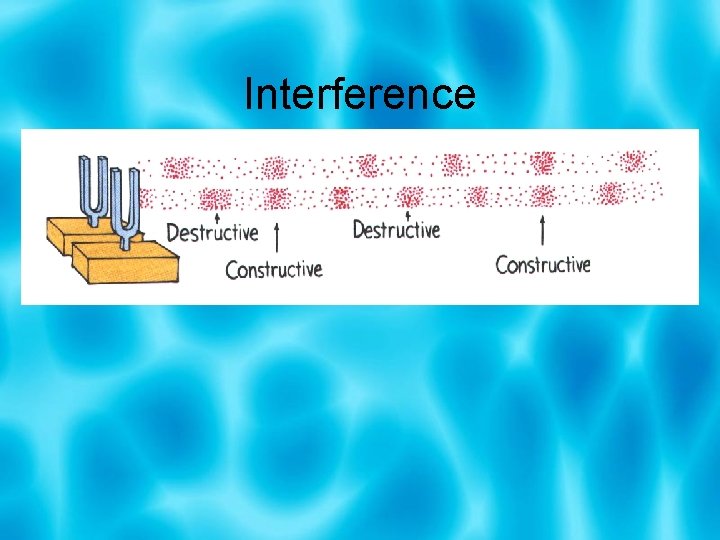
Interference
Beats - the periodic variation in loudness of two sounds played together The beat frequency is equal to the difference in the frequency of the two sounds. What is the beat frequency when a 262 Hz and a 266 Hz tuning fork are sounded together?
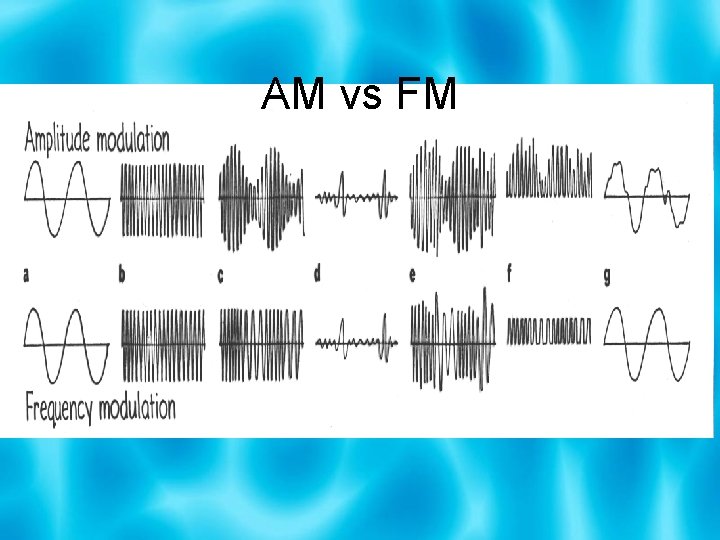
Radio Broadcasts Modulation - an impression of the sound wave on a higher frequency radio wave AM Amplitude Modulation 535 k. Hz to 1605 k. Hz FM Frequency Modulation 88 MHz to 108 MHz
AM vs FM
SOUND/MUSIC NOTES notes SOURCE Sonogram (frequency vs loudness) Oscilliscope (time vs. pressure) Explanation:
SOUND/MUSIC NOTES SOURCE Sonogram (frequency vs loudness) Oscilliscope (time vs. pressure) Explanation:
SOUND/MUSIC NOTES SOURCE Sonogram (frequency vs loudness) Oscilliscope (time vs. pressure) Explanation:
SOUND/MUSIC NOTES SOURCE Sonogram (frequency vs loudness) Oscilliscope (time vs. pressure) Explanation:
SOUND/MUSIC NOTES SOURCE Sonogram (frequency vs loudness) Oscilliscope (time vs. pressure) Explanation:
SOUND/MUSIC NOTES SOURCE Sonogram (frequency vs loudness) Oscilliscope (time vs. pressure) Explanation:
SOUND/MUSIC NOTES SOURCE Sonogram (frequency vs loudness) Oscilliscope (time vs. pressure) Explanation:
SOUND/MUSIC NOTES SOURCE Sonogram (frequency vs loudness) Oscilliscope (time vs. pressure) Explanation:
SOUND/MUSIC NOTES SOURCE Sonogram (frequency vs loudness) Oscilliscope (time vs. pressure) Explanation:
SOUND/MUSIC NOTES SOURCE Sonogram (frequency vs loudness) Oscilliscope (time vs. pressure) Explanation:
SOUND/MUSIC NOTES SOURCE Sonogram (frequency vs loudness) Oscilliscope (time vs. pressure) Explanation:
SOUND/MUSIC NOTES SOURCE Sonogram (frequency vs loudness) Oscilliscope (time vs. pressure) Explanation: