
Music Channels Kris Boratyn Timeline of music video

Music Channels Kris Boratyn

Timeline of music video history 1900 – Edison invents the gramophone in the USA: first shift from music as a solely live and audiovisual experience to recorded audio on various forms of disc. 1920 s – Fischinger experiments with sound/vision synchronization on film. 1927 – First sound film, ‘The Jazz Singer (Alan Crosland, USA. ) 1930 s – Creation of first ‘soundies’ (threeminute American musical films). 1940 s – peak period of MGM Hollywood musical. 1954 – Elvis Presley records ‘That’s All Right (Mama)’. 1960 – Scopitone introduced in France.
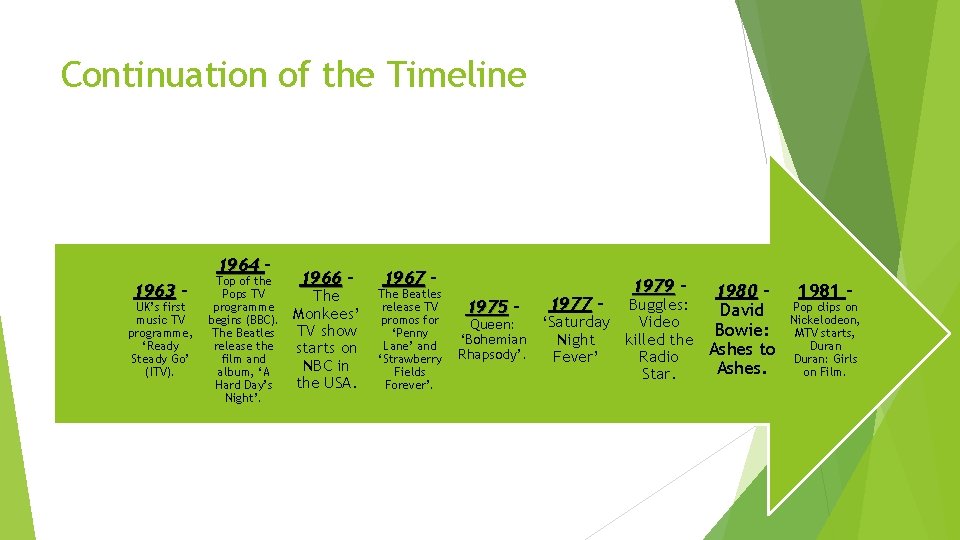
Continuation of the Timeline 1964 – 1963 – UK’s first music TV programme, ‘Ready Steady Go’ (ITV). Top of the Pops TV programme begins (BBC). The Beatles release the film and album, ‘A Hard Day’s Night’. 1966 – The Monkees’ TV show starts on NBC in the USA. 1967 – The Beatles release TV promos for ‘Penny Lane’ and ‘Strawberry Fields Forever’. 1977 – 1979 – 1980 – Buggles: 1975 – David ‘Saturday Video Queen: Bowie: ‘Bohemian Night killed the Ashes to Rhapsody’. Fever’ Radio Ashes. Star. 1981 – Pop clips on Nickelodeon, MTV starts, Duran: Girls on Film.
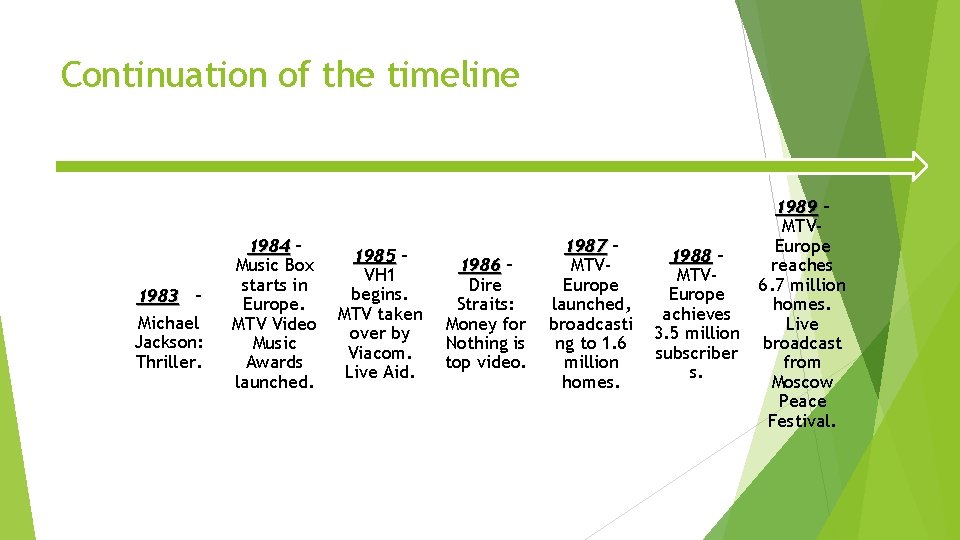
Continuation of the timeline 1983 – Michael Jackson: Thriller. 1984 – Music Box starts in Europe. MTV Video Music Awards launched. 1985 – VH 1 begins. MTV taken over by Viacom. Live Aid. 1986 – Dire Straits: Money for Nothing is top video. 1987 – MTVEurope launched, broadcasti ng to 1. 6 million homes. 1988 – MTVEurope achieves 3. 5 million subscriber s. 1989 – MTVEurope reaches 6. 7 million homes. Live broadcast from Moscow Peace Festival.

Continuation of the timeline 1994 – 1990 – Madonna: Vogue, wins best director award. Launch of MTVUnplugged. 1991 – Madonna : Justify My love. REM: Everybody 1992 – hurts, wins MTV best launches The 1993 – director Real World, MTV award, a fly-on-thelaunches launch of wall documentary TV series VH 1 in the UK. following the Beavis Launch of lives of and MTVseven people Butthead. Europe sharing a Music New York loft. awards. 1997 – MTV UK and Ireland launches as standalone channel. 1998 – Launch of Celebrity Death match. 1999 – Fatboy Slim: Praise You, wins best director award. 2000 – Launch of Jackass. 2001 – Launch of MTV dance.
The Rise of Music TV 1981 -2003 The growth of MTV in the USA was rapid. American artists soon realised the potential of the medium and followed the British invasion with promo clips of their own. In the early years, however, assumptions about the demographics of the audience led to dominance by white acts and a preponderance of male rock. Despite the success of the high-budget productions of Michael Jackson, such as ‘Thriller 'in 1983 and ‘Bad’ in 1987, it was almost the end of the decade before any other black artists’ work broke through. The reluctance to play black videos served to ensure that rap videos were able to attract only very small budgets and tended to be distributed through alternative means not finding a mass audience. Gangsta rap was seen as enormously threatening to the white audience and it was only through using crossover in the shape of Run DMC and Aerosmith’s Walk this Way (1986) and later the humour of the work of Mc Hammer and Coolio, that rap became acceptable and eligible for bigger-budget videos.
Recent developments: Music television in the UK By 1984, MTV channel was established as central to the music business and instituted its own version of the Oscars, the Video Music Awards, with a whole set of categories from best video and best direction to most experimental, best choreography and best special effects. Until recently, there were few rivals in Europe to MTV’s dominance, with the main alternatives in the UK being its own spin-offs, such as VH 1, aimed at an older audience, CMT (country Music television, clearly targeting a niche market) and some video jukebox channels (such as the Box where the viewers call in on a premium phone line to select their choice from a rolling onscreen menu). However, in the last few years, there has been evidence that MTV’s grip on the UK market may not be so secure. MTV needed to differentiate itself from the video jukebox style of its rivals, by becoming a provider of original programming on its main channels in addition to the round-the-clock videos on others. However, BSky. B made early inroads, particularly with Scuzz, its rival to Kerrang!, where a distinct identity was quickly created through its comedy items such as Mullet Man and Cuddly Snuff, where teddies are given gruesome deaths by, for example, being tied to fireworks.
Recent developments: Music television in the UK At the beginning of 2004, there were 23 English-language music channels available on the BSky. B platform in the UK, significantly more than in the USA.
- Slides: 8