
Music Attention Affect Background music Expectations about future
Music, Attention, Affect • Background music – Expectations about future outcomes – Enhance/reduce affective impact of activities • Affective reactions • Cognitive processing activities – Memory recall
Music and Activity • • • Foreshadowing or accompanying Congruent or incongruent Expectation of events Memory of events Commonly used in film, theatre, opera, etc.

Effectiveness • Thayer & Levenson (1983) – Background music and behavioural effect – Monitored physiological (GSR) reaction – Film on industrial accident – Relaxing “documentary” or “horror” music – Higher physiological arousal with horror music • Music alters degree of internal arousal
Effectiveness • Marshall & Cohen (1988) – Film of moving geometric figures (2 triangles & circle) • Personality traits associated with figures (Heider & Simmel, 1944) – Affective impressions of figures changed with background music • e. g. , large triangle more “agitated and aggressive” with louder, more active music; smaller triangle more salient with “weak” music – Mood dimensions of music direct viewers’ attention to figures’ activity levels
Boltz, Schulkind & Kantra (1991) • Background music and film scenes • Music either: – Accompanied scene’s outcome • Accentuated affective meaning – Foreshadowed the scene • Created expectations about future course of events – Congruent or incongruent with events of scene
Memory Recall • Expectancy violations from moodincongruent relations --> better recall in foreshadowing condition • Mood-congruent relations --> better recall in accompanying condition • Selective-attending processes

Memory Assistance • Scenes not recalled on recognition task • Details recalled when cued by background music
Perceptual Processing • Pre-attentive processing – Break perceptual input into units – Direct attention to relevant stimuli • Gestalt psychology • Applicable to audiovisual objects – Music paired with visuals
Music in Commercials • Contextualizing element • Interpret images in ways consistent with music • Help organize complex imagery – Extract salient details from background “noise”
Teaser Ads • Television ads • Highly visual – Limited explanatory content – Rely on imagery to induce attitude to brand • “Mickey-mousing” – Film scoring technique – Visual action mirrored/paired with auditory track
Hung (2001) • 30 sec. TV ad for upscale Singapore shopping mall (Raffles) – Attractive young men & women, formal dress, in studio settings • Paired with one of two music tracks – Vivaldi’s L’Amoroso in E-major or Garbage’s Supervixen
Results • Music produced differences in affective state – Questionnaires for image and emotion scale • Vivaldi – “Successful”, “imaginative”, “calm” • Garbage – “Daring”, “annoying”, “boring” • Music affects meaning perceptions

Focus Group Discussion • Raffles-Vivaldi – Upscale & exclusive; darker; designer boutiques • Raffles-Garbage – Youth, “in mall” for 20 -30 year olds; brighter • Music tempo – Same for Vivaldi and Garbage – But Garbage perceived to be faster – Carried over to RG commercial; scene cuts perceived as quicker
Knowledge Attribution • Vivaldi = Baroque, Garbage = Brit pop • Association source? – Vivaldi due to music or subjects’ (18 -22 year olds) conditioned expectations? – e. g. , Classical music “old and stuffy” • Hung suggests two music selections should come from same genre
Sexual Appeals • Overt sexual information • Images and/or verbal elements (US) – Nudity, behaviour, physical attractiveness, double entendre, etc. • Evokes sexual thoughts, physiological response, and/or affect (UR --> CR)
Picking Your Target Audience • Difficult to utilize sex appeal across sexes in same ad • e. g. , female • e. g. , male

Perceptual Processing • Sexual content reduces viewers’ perception and/or processing of brand • Attention directed at sexual content • Ad does attract attention, just not focused on the product
Emotional Impact • Positive correlation between positive arousal from sexual content and ad evaluation • Influencing factors – Gender, explicitness of appeal • Attitudes influenced by relevance of sexual content to product
Elaboration Likelihood Model • ELM used to understand role of sexual appeals in persuasion • Persuasion along a continuum of elaboration • Central route processing – Persuasion from extensive issue-relevant thinking – Sexual content distracts from effortful elaboration – Lack of consideration of brand
Highly Attractive Models • Studies show humans prefer attractive to unattractive people – Attractiveness as US • But, research on the effectiveness of HAMs in advertisement is inconsistent
Convergence • Convergence of product and message communicated by model’s image • Model-product match-up • Traditional view: HAMs most effectively matched with attractiveness-relevant products • But: different types of attractiveness-relevant products may not all work with HAMs
Methodologies • Older studies – HAMs vs. unattractive models (UMs) • More realistic, ecologically valid approach – HAMs vs. normally attractive models (NAMs)
Bower & Landreth (2001) • HAMS and NAMs • Different types of attractiveness-relevant products
Topics of Investigation • Beautiful people perceived as having better, trouble-free lives – NAMS may fit better with problem-solving attractiveness-relevant products • Does model-product matching influence ad effectiveness through product argument or from model credibility?

Issues • Model attractiveness and trustworthiness • Model expertise for attractivenessenhancing vs. problem-solving products • Matching model with product information
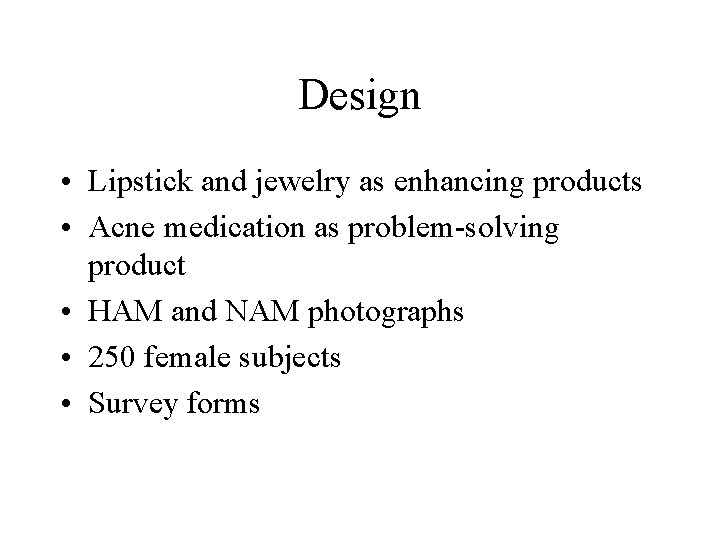
Design • Lipstick and jewelry as enhancing products • Acne medication as problem-solving product • HAM and NAM photographs • 250 female subjects • Survey forms

Results • HAMs well suited to pairings with attractiveness-enhancing products • HAMs and NAMs equally effective in ads for problem-solving products – Kahle & Homer (1985) showed attractive celebrities more effective for selling razors – Confound? • No correlation between trustworthiness and attractiveness
Laneige • Advertisement • Comment?
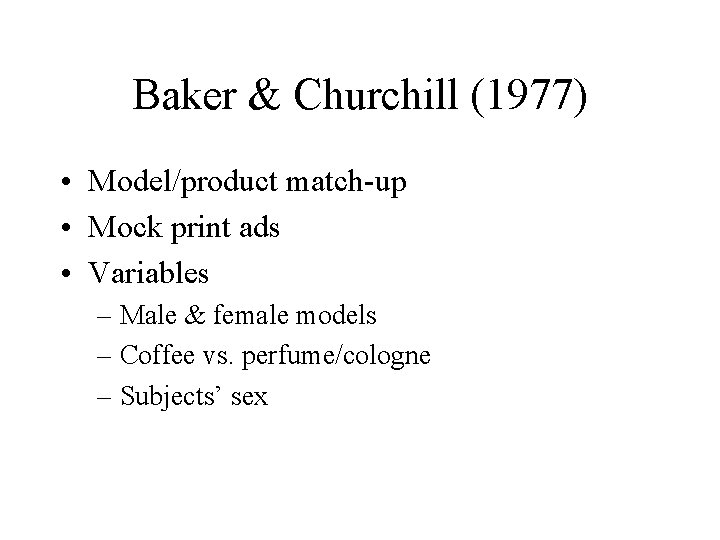
Baker & Churchill (1977) • Model/product match-up • Mock print ads • Variables – Male & female models – Coffee vs. perfume/cologne – Subjects’ sex
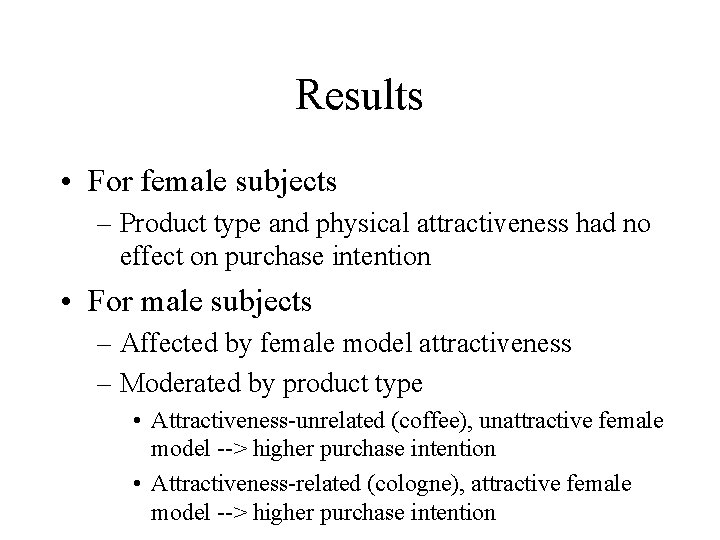
Results • For female subjects – Product type and physical attractiveness had no effect on purchase intention • For male subjects – Affected by female model attractiveness – Moderated by product type • Attractiveness-unrelated (coffee), unattractive female model --> higher purchase intention • Attractiveness-related (cologne), attractive female model --> higher purchase intention
Decorative Models • Model irrelevant/unnecessary • Smith & Engle (1968) – Sexy vs. unsexy model with automobile – Sexy model makes male and female subjects rate car as more: • Appealing, lively, youthful, faster • Steadman (1969) – Mock advertisements with erotic/non-erotic models – Erotic ads inhibited delayed recall (7 days)
Match-up? • Paris Hilton
HAMs in Marketing • Negative consequences? • Body image issues – Negative feelings
Do Women Care? • Richins (1991) – Young adult females • Half compare themselves frequently with models in clothing & cosmetics ads • One third report the ads produce personal dissatisfaction with their own appearance • Ingrassia (1995) – ~90% of white junior & high school girls have some level of dissatisfaction with weight
Transfer? • Negative feelings from HAMs • Affect on brand? – Transfer? • Female consumers have complained of HAM use – Special K models – Calvin Klein jean ad use of Kate Moss – Culture jamming (Ad Busters)
Social Comparison Jealously (SCJ) • Jealousy and envy produced by comparison to perceived superior • Negative effects – Depression – Helplessness – Desire for revenge – Frustration – Anxiety
Behavioural Consequences • Derogation/disparaging of comparison other • Attempt to preserve self-esteem
“What is Beautiful is Good” • Dion et al. (1972) – College men and women – Physically attractive people have more socially desirable traits – e. g. , strength, sexual warmth, sensitivity, kindness, poise, modesty, better character • Belief: beautiful people lead better lives • SCJ may attenuate this belief
HAM Derogation & Endorser Effectiveness • Negative feelings from SCJ • Impact on HAM effectiveness? • Derogation of HAM at: – Individual level – Effectiveness as persuader • HAM works on product via: – Spokesperson expertise and/or – Product effectiveness argument
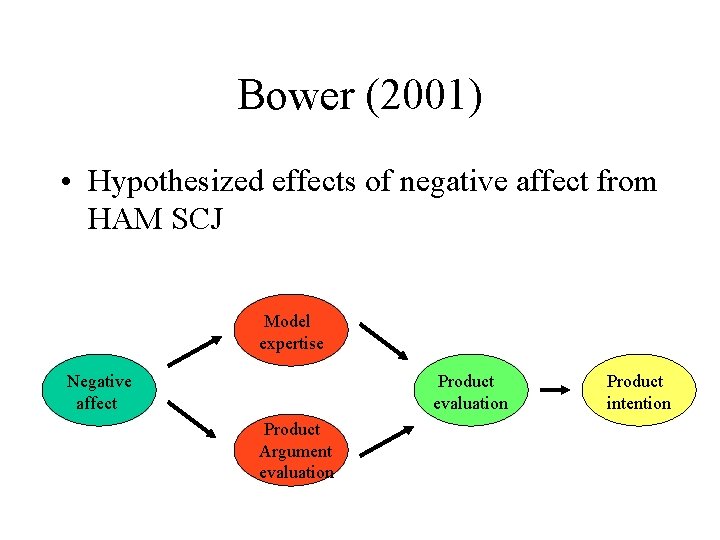
Bower (2001) • Hypothesized effects of negative affect from HAM SCJ Model expertise Negative affect Product evaluation Product Argument evaluation Product intention
Study 1 • 130 undergraduate women • HAM and treadmill photo • Measures for – Model beauty – Subject comparison – Negative affect – HAM expertise – Product assessment – Derogatory assessment
Comparator/Non-comparator • Does the subject compare herself to HAM? • If yes – Increased negative affect – Decreased evaluation of HAM as credible spokesperson & product argument • If no – No SCJ effect
Study 2 • Treadmill might have biased toward body image • 110 undergraduate women • HAM and hair highlighting kit photo • Relative few comparators – Comparators find model more attractive than themselves and show negative affect – Not significant effect on product vs. noncomparators
Conclusions • Comparator/non-comparator important • If comparator, SCJ of HAM has negative impact on brand • Should be somewhat cautious of results – Model type – Product – Race of subject and model
Societal Marketing • Social causes – e. g. , Conservation, equal rights, etc. • Public service announcement (PSA) – Increase public awareness – Change beliefs, attitudes, behaviours – Observed by large cross-section of population – “Help-self” (use fear) or “help-other” PSAs

PSAs and Sexual Content • Sexual content increases attention to ad but interferes with product knowledge • PSAs poorly remembered and often ignored • Can sexual content increase attention to PSAs?
PSA and Sexual Content • Israeli beach
Reichert, Heckler & Jackson (2001) • Sexual and non-sexual PSAs for 13 social marketing topics – e. g. , healthy eating, reading, HIV prevention • Mock print ads – Dominant visual, headline, core message – Images of heterosexual couples from photo archives – Sexual or non-sexual visual and headline

Measures • Questionnaires • Thoughts and cognitions – Free responding immediately after viewing each PSA • Persuasion and communication – Attitude, belief, and behavioural intention scales – Measures of attention, interest, impact on thinking about topic
Results • Sexual PSAs generate more favourable executionrelated thoughts than non-sexual PSAs • Sexual and non-sexual PSAs generated same level of message-related thoughts • Sexual PSAs stimulated less elaboration (e. g. , additional thoughts on topic) than non-sexual PSAs • Subjects were more likely to agree with PSAs using sexual appeals
Conclusions • Sexual appeals persuasive for social marketing campaigns – Best when sexual appeal relevant to topic – Long term persuasion due to cognitive processes, so sexual PSAs’ effectiveness may be temporary • Sexual appeals are attention getting, likeable, dynamic, and focus interest on ad’s topic – Good in saturated market • Sexual appeal decreases elaboration of message content

PSA • Guardian Angel
- Slides: 52