
Music 101 THE HISTORY OF RECORDING TECHNOLOGY Group

- Slides: 21
Music 101 THE HISTORY OF RECORDING TECHNOLOGY
Group Members Biannos, Ella (Researched digital recording technology) Ciaccio, Salvatore (Presented, researched early recording technology) Di Liberto, Maria (Presented, designed slideshow) Martinelli, Maria (Located You. Tube examples) Martinelli, Theresa (Located timeline and other web pages, assisted with slideshow design) Rezza, Nicolo (Researched microphones and speakers)
A Brief History or Recording Technology https: //www. youtube. com/watch? v=Dm. L 3 inc 301 Y ♫
Phonautograph - 1857 ♫ The phonautograph was invented by Leon Scott. ♫ It was the first form of recording. ♫ It was for visual study only and could not play back the sound. The frequency was made by air pressure. ♫ A horn directed sound to a flexible diaphragm placed at the narrow end. A stylus and lever assembly was attached to the diaphragm and allowed the point of the stylus to scratch out a line on the cylinder (coated with “lampblack”) beneath it. ♫ Recording medium was a sheet of soot-coated paper wrapped around a rotating cylinder carried on a threaded rod. (History of Sound Recording)
Phonautograph - 1874 ♫ Attempting to discover how the ear detected sound, Alexander Graham Bell used a human ear (including the internal parts) from a cadaver, attaching a stylus to the eardrum and using it to make a recording ♫ It recorded on a moving glass strip, coated with a film of carbon, so there are probably no original recordings from it. (History of Sound Recording) [Martinelli, T. ]
Early Recordings and Equipment https: //www. youtube. com/watch? v=CJXDtrq 4 Mc. Y Edison Wax Museum Recording Session https: //www. youtube. com/watch? v=g 3 q. PT 30 Lej. M Original Edison Tinfoil Recording https: //www. youtube. com/watch? x-yt-cl=84503534&x-ytts=1421914688&v=4 l. J 6 Pwb 15 JY Alexander Graham Bell’s Voice
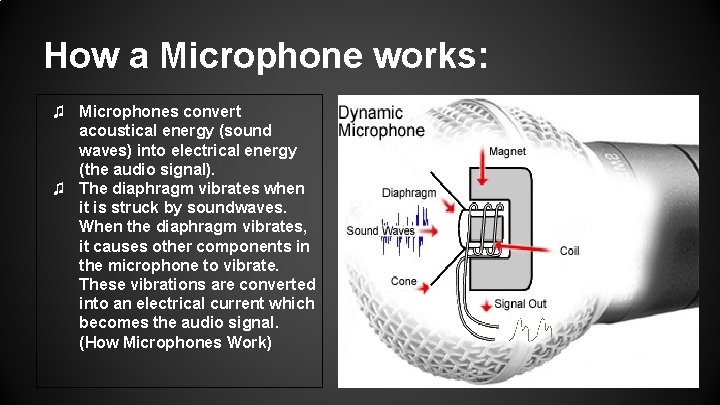
How a Microphone works: ♫ Microphones convert acoustical energy (sound waves) into electrical energy (the audio signal). ♫ The diaphragm vibrates when it is struck by soundwaves. When the diaphragm vibrates, it causes other components in the microphone to vibrate. These vibrations are converted into an electrical current which becomes the audio signal. (How Microphones Work)
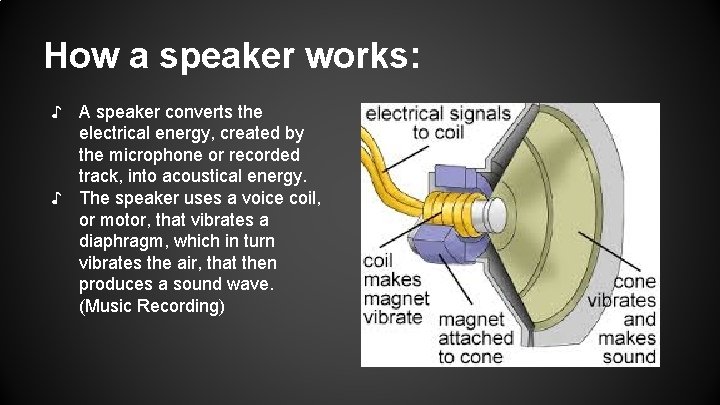
How a speaker works: ♪ A speaker converts the electrical energy, created by the microphone or recorded track, into acoustical energy. ♪ The speaker uses a voice coil, or motor, that vibrates a diaphragm, which in turn vibrates the air, that then produces a sound wave. (Music Recording)
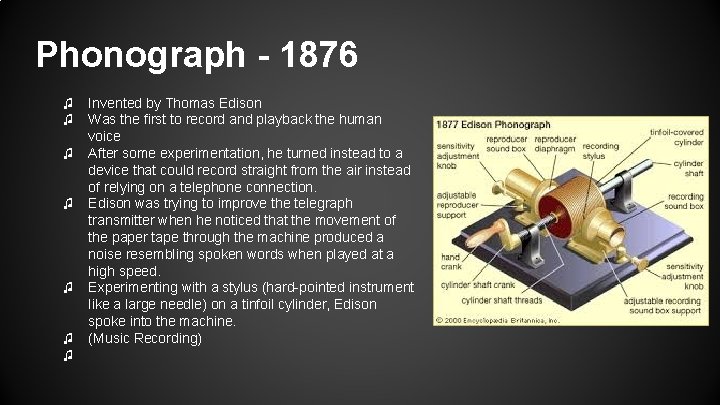
Phonograph - 1876 ♫ Invented by Thomas Edison ♫ Was the first to record and playback the human voice ♫ After some experimentation, he turned instead to a device that could record straight from the air instead of relying on a telephone connection. ♫ Edison was trying to improve the telegraph transmitter when he noticed that the movement of the paper tape through the machine produced a noise resembling spoken words when played at a high speed. ♫ Experimenting with a stylus (hard-pointed instrument like a large needle) on a tinfoil cylinder, Edison spoke into the machine. ♫ (Music Recording) ♫
Gramophone - 1888 ♫ Thousands of records could be inexpensively pressed from one master. ♫ The gramophone imprinted grooves on the flat side of a disc rather than the outside of a cylinder. Telegraphone -1899 -1900 ♫ Danish inventor Valdemar Poulsen’s Magnetic Recording (today’s audio and video files) ♫ Poulsen envisioned that it would be useful for office dictation and telephone recording, but his "telegraphone" never took off.
Wax Cylinder ♫ The stylus pushes into the wax and, when the cylinder is rotated, cuts a groove. The stylus also moves up and down very slightly as it vibrates with the sound and so the wax now contains a recording of the sound in the groove ♫ We play the sound back by using the stylus to translate the groove back into vibrations onto the diaphragm and this in turn to the horn from which the sound can be heard. (History of Music Recording)
Magnetic Tape Recordings - 1940’s ♫ Engineers used to editing optical film saw that it was easy, and cheap, to work with. ♫ The first practical magnetic tape recorder was the 'K 1', which was first demonstrated in 1935. How it works: ♫ Magnetic strips of tape are ran through a magnetic head that aligns metal pieces in a specific order. The process is then reversed, playing the iron strips with data on them in the correct order. (Music Recording)
History of Magnetic Recording Tape https: //www. youtube. com/watch? x-yt-cl=84503534&x-ytts=1421914688&v=Gf. AA 1 Ax. XUno ♫
Multitrack Tape Recordings - Late 1940’s ♫ As engineers reduced the size of tape recorder heads, it became possible to mount two or three heads on a single recorder and record multiple simultaneous tracks on a single tape. ♫ In the studio, groups of musicians or singers could be separated into two or three groups, recording the rhythm section and the rest of the band separately. ♫ More and more tracks were added to recorders to allow 24 or more tracks to be recorded on a single, very wide tape ♫ (Music Recording)
A Brief History of Recording to ca. 1950 Article from the AHRC Research Centre for the History and Analysis of Recorded Music http: //www. charm. rhul. ac. uk/history/p 20_4_1. html ♫ [Rezza, N. ]
Making Vinyl Records https: //www. youtube. com/watch? v=p. Kb. Aksbv. Uq. Q ♫
The 8 -Track - Late 1960’s/ Early 70’s ♫ Required only one hand minimal accuracy to insert into or remove from the players. ♫ Designed for extreme simplicity of operation. ♫ Once in the machine, the tape played automatically and required no rewinding. (History of Sound Recording)
Vinyl • The vinyl record is a type of gramophone record, most popular from the 1950 s to the 1990 s • Vinyl were prized by audiophiles because of better reproduction of analog recordings, however the drawback was greater sensitivity to scratches and dust. A vinyl gramophone or phonograph record consists of a disc of polyvinyl chloride plastic, engraved on both sides with a single concentric spiral groove in which a sapphire or diamond needle, stylus, is intended to run, from the outside edge towards the centre (History of Music Recording)
Cassette Tapes - 1970’s ♫ For a time, the cassette was the most popular home music format for both home recording and pre-recorded listening applications. ♫ The 90 -minute tape became the best-selling blank tape. ♫ Two full albums could usually be recorded on a single 90 -minute cassette. ♫ Magnetic tape ♫ (History of Sound Recording)
CD’s & Digital Recordings ♫ Phillips and Sony (among others) had been working on ways to record TV signals with a laser onto a reflective disc. ♫ The CD was not an immediate hit, and it took nearly a decade for it to displace the audio cassette, but in the 1990 s it became the most popular home format ♫ Recordable CDs were not generally available until the mid-1990 s (History of Sound Recording)
Works Cited "Music Recording. " Encyclopedia Britannica Online Academic Edition. Encyclopedia Britannica Inc. , 2014. Web. 10 Apr. 2014. "How Microphones Work. " Media College - Video, Audio and Multimedia Resources. N. p. , n. d. Web. 10 Apr. 2014. “History of Sound Recording. ” Wikipedia, . N. p. . Web. 6 Mar 2014. http: //en. wikipedia. org/wiki/History_of_sound_recording>.