
MUSCULOSKELETAL SYSTEM INTRODUCTION Bones Framework movement and protection
MUSCULOSKELETAL SYSTEM
INTRODUCTION Bones Framework, movement, and protection Joints Where bones come together Muscles Movement
BONES – FORMATION AND STRUCTURE Osseous Tissue – connective tissue Osteocytes – bone cells Collagen – connective tissue strands Calcium Slats Cartilaginous Tissue – more flexible than osseous tissue Osteoblasts – immature osteocytes Osteoclasts – reabsorb/digest bone tissue Calcium & Phosphorus – required for bone formation Long Bones Short Bones Flat Bones Sesamoid Bones

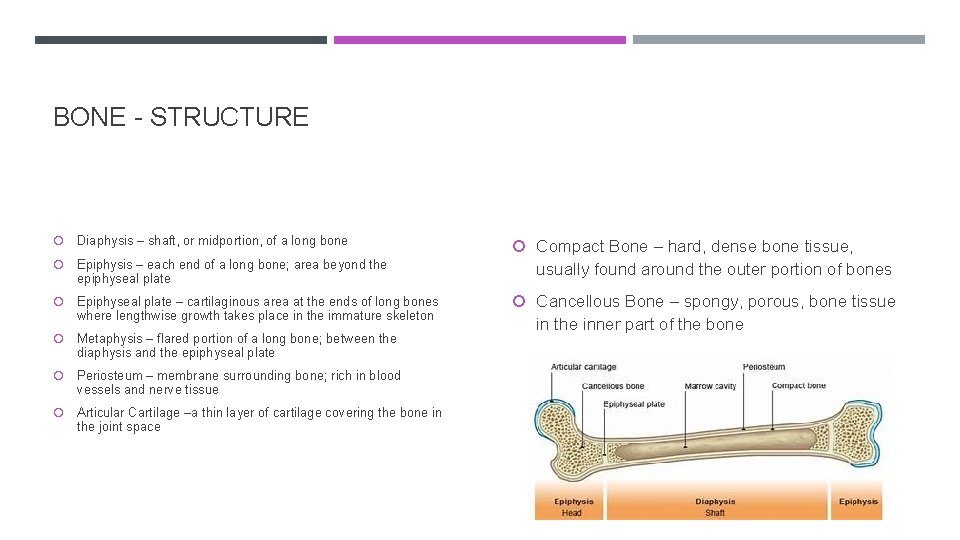
BONE - STRUCTURE Diaphysis – shaft, or midportion, of a long bone Epiphysis – each end of a long bone; area beyond the epiphyseal plate Epiphyseal plate – cartilaginous area at the ends of long bones where lengthwise growth takes place in the immature skeleton Metaphysis – flared portion of a long bone; between the diaphysis and the epiphyseal plate Periosteum – membrane surrounding bone; rich in blood vessels and nerve tissue Articular Cartilage –a thin layer of cartilage covering the bone in the joint space Compact Bone – hard, dense bone tissue, usually found around the outer portion of bones Cancellous Bone – spongy, porous, bone tissue in the inner part of the bone

BONES – PROCESSES AND DEPRESSIONS Processes Depressions, Passages, and Cavities Bone processes are enlarged areas that extend Many bones have openings or hollow regions for out from ones to serve as attachments for muscles and tendons blood vessels and nerves. Bone Head – rounded end of a bone separated from the body of the bone by a neck; usually covered by articular cartilage Foramen – opening for blood vessels and nerves Tubercle – rounded process on many bones for attachment of tendons and muscles Sinus – hollow cavity in a bone Condyle – rounded knuckle-like process at the joint – usually covered by articular cartilage. Fossa – shallow cavity in or on a bone Fissure – narrow, deep, slit-like opening
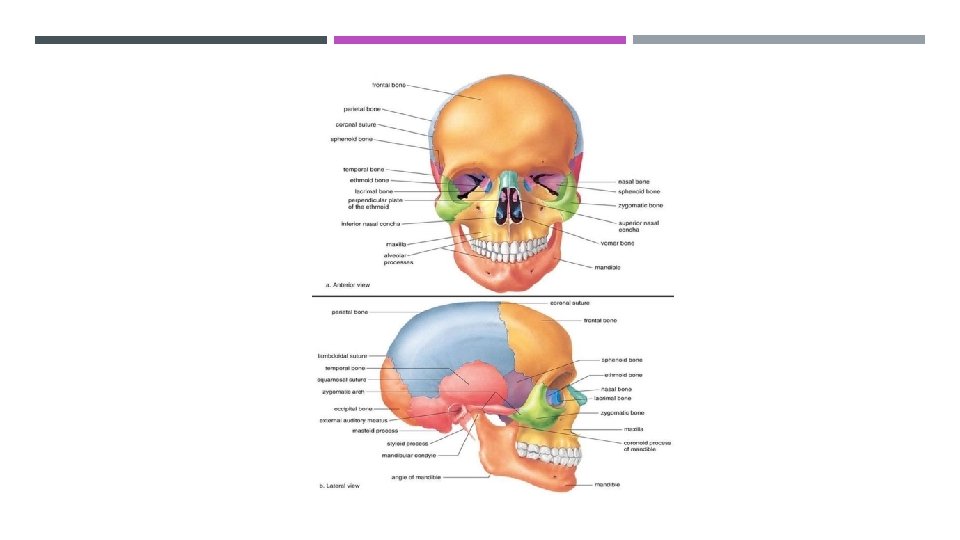
CRANIAL BONES Terms Bones Sutures – immovable joint Frontal Bone – forms the forehead and the roof of the bony sockets that contain the eyes Fontanelles – soft spot Parietal Bone – two bones (one on each side of the skull) that form the roof and upper part of the sides of the cranium Temporal Bone – two bones that form the lower sides and base of the cranium Occipital Bone – forms the back and base of the skull and joins the parietal and temporal bones forming a suture Sphenoid Bone – the bat shaped bone that extends behind the eyes and forms part of the base of the skull – it’s the anchor that joins the frontal, occipital, and ethmoid bones Ethmoid Bone – the thin, delicate bone that supports the nasal cavity and forms part of the orbits of the eyes
FACIAL BONES Nasal – two slender bone that support the bridge of the nose Lacrimal – two small, thin bones located at the corner of each eye Maxillary – two large bones that compose the upper jawbones (maxillae) Mandibular – lower jawbone (mandible) Zygomatic – two bones on each side of the face, that form the high portion of the cheek Vomer – thin, single flat bone that forms the lower portion of the nasal septum Sinuses – located in specific places within the cranial and facial bones to lighten the skull and warm and moisten air as it passes through.
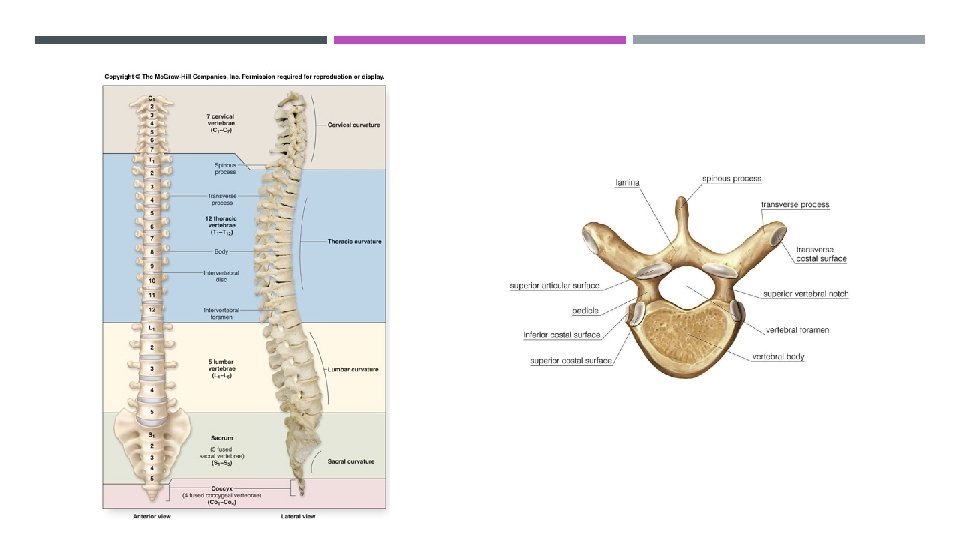
BONES- VERTEBRAL COLUMN Cervical (C 1 -C 7) Thoracic (T 1 -T 12) Lumbar (L 1 -L 5) Sacral Coccyx Vertebral Body – inner, thick, round anterior portion of a vertebra Intervertebral Disc – pad of cartilage that provides flexibility and shock absorption – located between vertebra Spinous Process Transverse Process Lamina Neural Canal
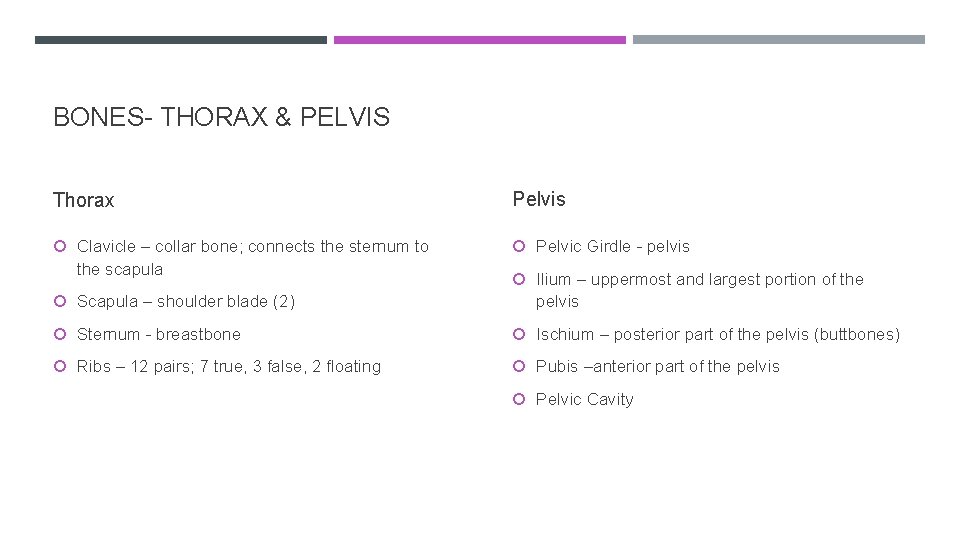
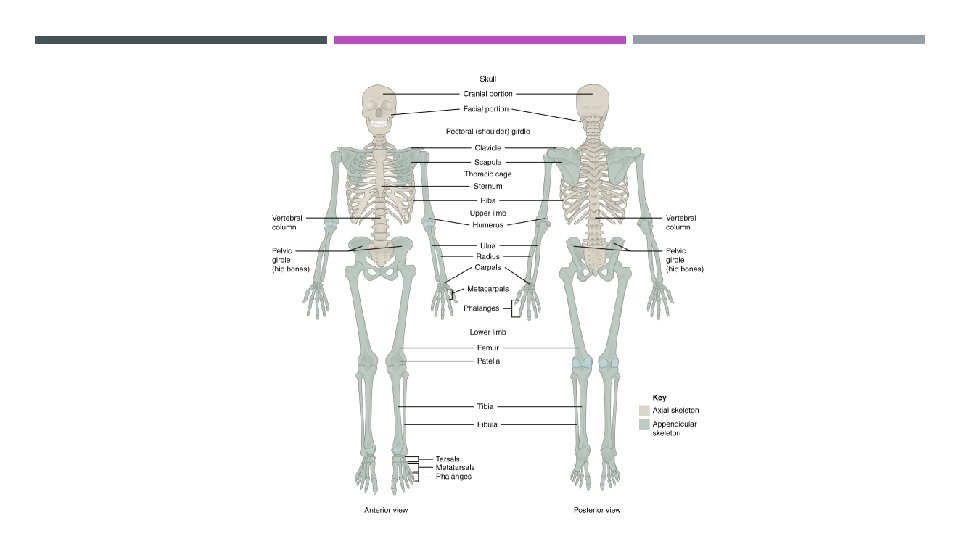
BONES- THORAX & PELVIS Thorax Pelvis Clavicle – collar bone; connects the sternum to Pelvic Girdle - pelvis the scapula Scapula – shoulder blade (2) Ilium – uppermost and largest portion of the pelvis Sternum - breastbone Ischium – posterior part of the pelvis (buttbones) Ribs – 12 pairs; 7 true, 3 false, 2 floating Pubis –anterior part of the pelvis Pelvic Cavity
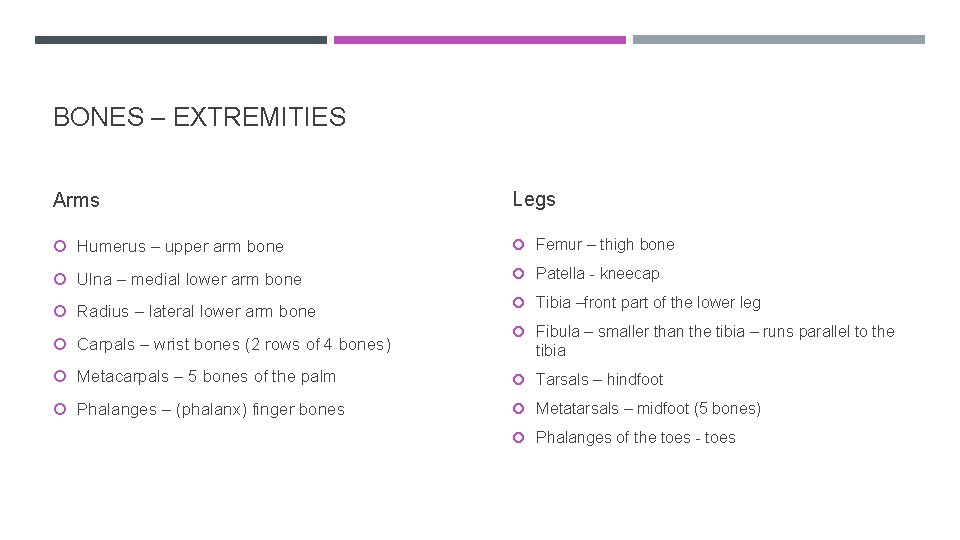
BONES – EXTREMITIES Arms Legs Humerus – upper arm bone Femur – thigh bone Ulna – medial lower arm bone Patella - kneecap Radius – lateral lower arm bone Carpals – wrist bones (2 rows of 4 bones) Tibia –front part of the lower leg Fibula – smaller than the tibia – runs parallel to the tibia Metacarpals – 5 bones of the palm Tarsals – hindfoot Phalanges – (phalanx) finger bones Metatarsals – midfoot (5 bones) Phalanges of the toes - toes
COMMON BONE ISSUES Fracture Osteomalacia Osteomyelitis Osteoporosis
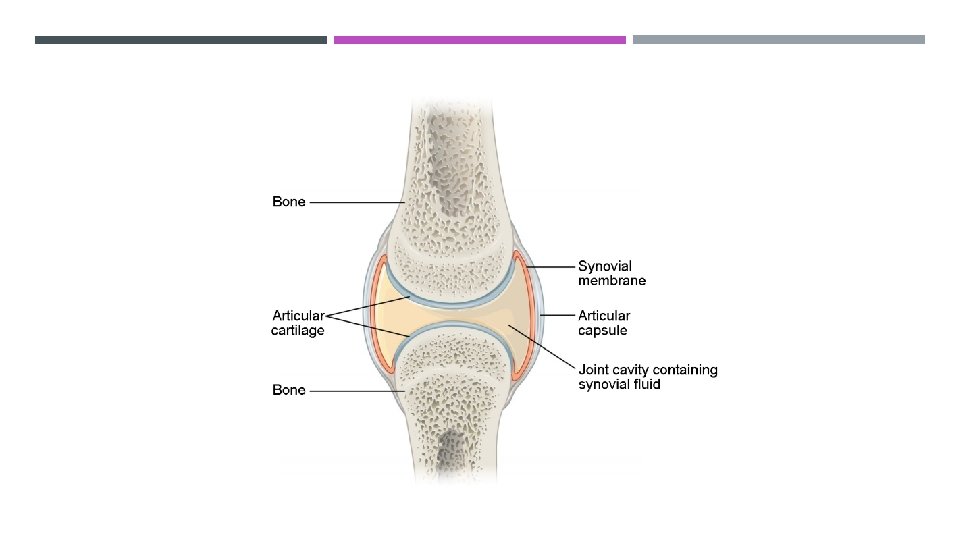
JOINTS Suture Joints – immovable joint Synovial Joints – freely movable joint Joint Capsule – surrounds a synovial joint; composed of fibrous tissue Ligaments – connective tissue binding bones to other bones; supports, strengthens, and stabilizes the joint Articular Cartilage – smooth, white tissue that covers the surface of a joint Synovial Membrane – tissue lining the synovial cavity; produces synovial fluid Synovial Fluid – viscous (sticky) fluid in the synovial cavity Tendons – connective tissue that binds muscles to bones Ligaments – connective tissue binding bone to bone Bursa – sac of fluid near a joint; promotes smooth sliding of one tissue against another
COMMON JOINT ISSUES Gout Osteoarthritis Rheumatoid Arthritis Bunion Carpal Tunnel Dislocation Herniation Sprain
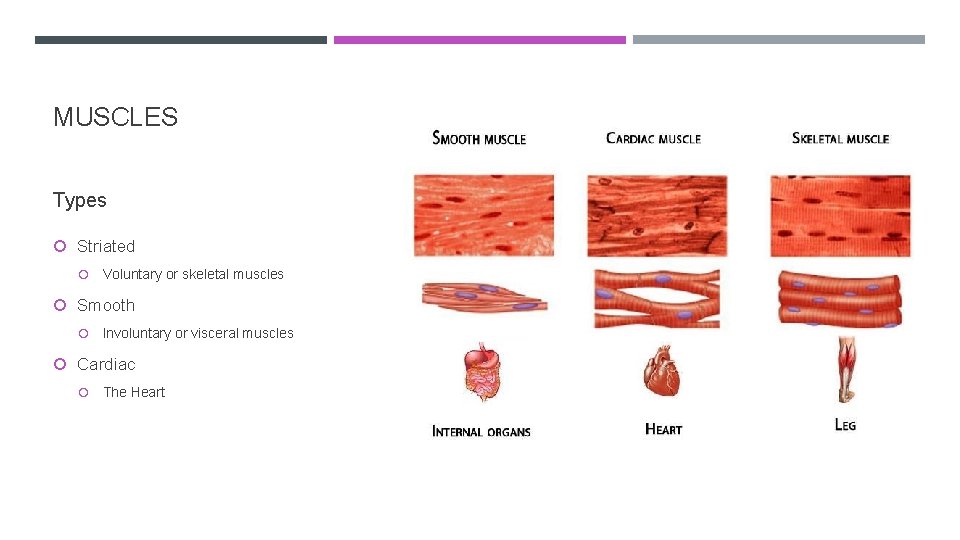
MUSCLES Types Striated Voluntary or skeletal muscles Smooth Involuntary or visceral muscles Cardiac The Heart
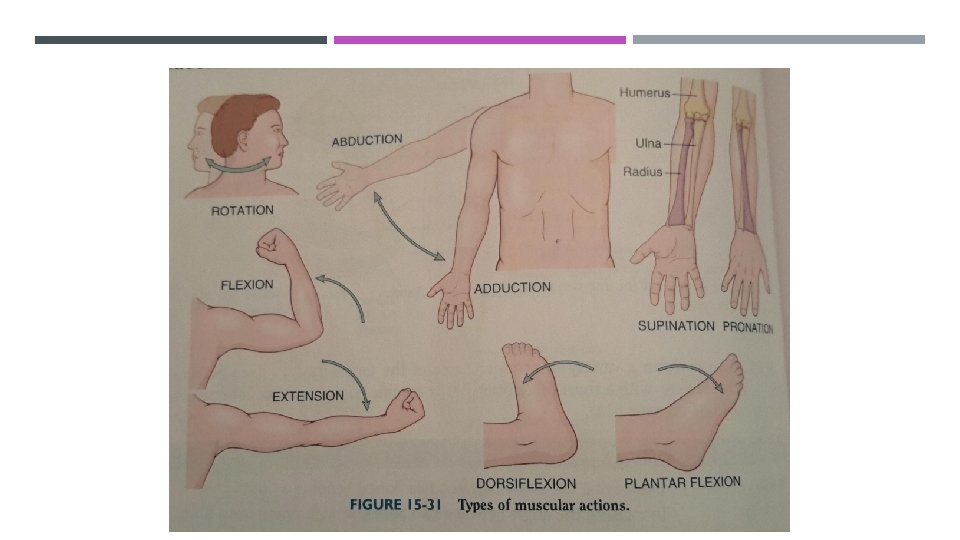
MUSCLES – ACTIONS Flexion – decreasing the angle between two bones; bending a limb Extension – increasing the angle between two bones; straightening a limb Abduction – movement away from the midline of the body Adduction – Movement toward to the midline of the body Rotation – circular movement around the axis Dorsiflexion – decreasing the angle of the joint so that the foot bends backward (upward) Plantar Flexion – Motion that extends the foot downward toward the ground. Supination – applied to the hand/forearm; turning the palm up. Applied to the foot; outward roll Pronation – applied to the hand/forearm; turning the palm down. Applied to the foot; inward roll.
COMMON MUSCLE ISSUES Muscular Dystrophy Polymyositis
- Slides: 22