
Musculoskeletal System CPT copyright 2011 American Medical Association
- Slides: 35
Musculoskeletal System
CPT® copyright 2011 American Medical Association. All rights reserved. Fee schedules, relative value units, conversion factors and/or related components are not assigned by the AMA, are not part of CPT®, and the AMA is not recommending their use. The AMA does not directly or indirectly practice medicine or dispense medical services. The AMA assumes no liability for data contained or not contained herein. CPT is a registered trademark of the American Medical Association.
Objectives • Understand the components of the musculoskeletal system • �Define key terms • �Understand the most common pathologies affecting these organs • �Understand orthopedic surgeries and how they relate to pathologies • �Recognize common eponyms and acronyms • �Identify when other sections of CPT® or ICD-9 -CM should be accessed • �Know when HCPCS Level II codes or modifiers are appropriate
Anatomy Skeleton – Axial • Skull • Chest • Spine – Appendicular • Upper and lower limbs • Shoulders • Pelvis
Anatomy – Skeleton • Body’s framework • Bones store calcium and produce blood cells – Muscles • Assist with heat production • Posture – Ligaments – attach bones to other bones – Tendons – attach muscles to bones – Cartilage – Acts as a cushion between bones in a joint
Muscles • Types of Muscles – Striated – Smooth – Cardiac • Naming Conventions – – – Size Shape Location Action Number of attachments Direction of fibers
Axilla • Armpit area • Anatomic Landmarks – Posterior axillary fold – Anterior axillary fold
Fracture Eponyms • • • Colles’ Fracture Smith’s Fracture Jones’ Fracture Salter-Harris Fracture Dupuytren’s Fracture Monteggia’s Fracture
Treatments • Manipulation • Reduction • Fixation • Internal • External • Cast application
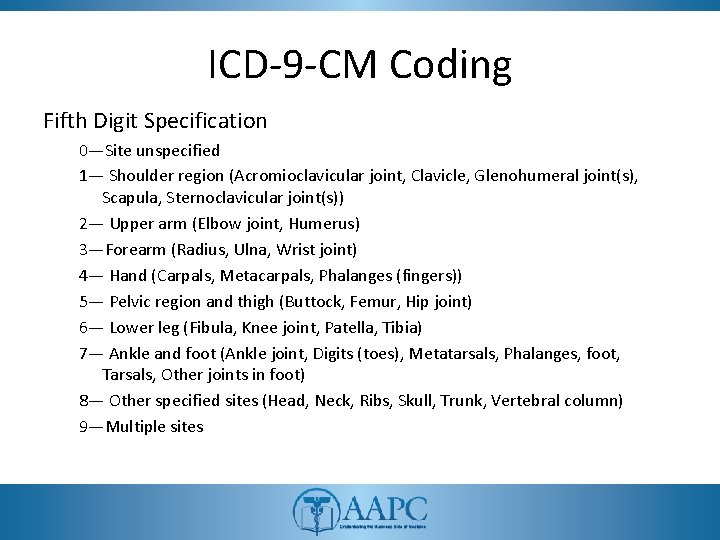
ICD-9 -CM Coding Fifth Digit Specification 0—Site unspecified 1— Shoulder region (Acromioclavicular joint, Clavicle, Glenohumeral joint(s), Scapula, Sternoclavicular joint(s)) 2— Upper arm (Elbow joint, Humerus) 3—Forearm (Radius, Ulna, Wrist joint) 4— Hand (Carpals, Metacarpals, Phalanges (fingers)) 5— Pelvic region and thigh (Buttock, Femur, Hip joint) 6— Lower leg (Fibula, Knee joint, Patella, Tibia) 7— Ankle and foot (Ankle joint, Digits (toes), Metatarsals, Phalanges, foot, Tarsals, Other joints in foot) 8— Other specified sites (Head, Neck, Ribs, Skull, Trunk, Vertebral column) 9—Multiple sites
Arthropathies and Related Disorders • Systemic lupus erythematosus • Arthropathy – Rheumatoid arthritis – Osteoarthritis • Internal derangements of the knee – MCL and ACL – Bucket handle tear
Dorsopathies • 4 th digit – type of disorder • 5 th digit – area of spine • Diseases – Spondylosis – Displacement of vertebral disc – Degenerative disc disease – Spinal stenosis – Symptoms
Rheumatism, Excluding Back • Enthesopathies – Capsulitis – Tendonitis – Tenosynovitis – Bursitis – Synovitis • Compartment Syndrome • Bunion
Osteopathies, Chondropathies, and Acquired Musculoskeletal Deformities • • Osteomyelitis Osteochondroses Osteoporosis Curvature of the spine
Injury and Poisoning • Sprains and Strains • Fractures – Comminuted – Impacted – Simple – Greenstick – Pathologic – Compression – Torus or Incomplete
Injury and Poisoning • Compartment Syndrome • Rotator Cuff Tear • Nursemaid’s Elbow
Musculoskeletal System • Table of Contents – Listing of headings and subheadings • Anatomic Illustrations – Useful when coding from this subsection • Knowledge of anatomy and terminology will be key
Musculoskeletal System Formatted by anatomic site – – – – General Head, Neck (soft tissues) and Thorax Back and Flank Spine (vertebral column) Abdomen Shoulder, Humerus and Elbow Forearm and Wrist Hand Fingers Pelvis and Hip Joint Femur and Ankle Joint Foot and Toes Application of Casts and Strapping Endoscopy/Arthroscopy
Musculoskeletal System • “General” subheading – Many different anatomic sites • Other subheadings – Divided by anatomic site, procedure type, condition and description • Incision, excision, introduction or Removal, Repair, Revision and/or Reconstruction, Fracture and/or dislocation, Arthrodesis, Amputation
Guidelines • Types of fracture treatment – Closed means the fracture site is not surgically exposed – Three methods • Without manipulation • With or without traction
Guidelines • Types of Fracture Treatment (cont) – Open – used when fractured bone is surgically exposed • Internal fixation may be used • Percutaneous skeletal fixation – Not open or closed • Pin placed across the fracture site
Guidelines • Traction – The application of a pulling force to hold a bone in alignment • Skeletal – Use of internal devices • Skin – Strapping or tape
General • Not specific to anatomic site • Incision of soft tissue abscess – Associated with deep tissue • Wound Exploration – Traumatic wounds – Include surgical exploration/enlargement, debridement, removal of foreign bodies, ligation/coagulation minor blood vessels
General • Excision Category – Biopsy • Muscle or Bone – Typically includes • Local anesthesia • Incision • Removal of tissue, sutures
General • Introduction or Removal Category – Aspiration, Insertion, Application • • • Removal foreign body muscle/tendon sheath Injections into tendon, ligament, ganglion cyst Aspiration/injection into joint Insertion pins/wires Grafts/Implants
General • Grafts – Bone – Cartilage – Fascia Lata • Taken from thigh area – Tendon – Tissue • Fat, dermis, fatty tissue from tendon compartment
General • Other Procedures • Bone Grafts – Based on where graft is obtained • Free osteocutaneous flaps – Based on part of the body flap is taken from • Monitoring of interstitial fluid pressure
Anatomical Subheadings • Based on anatomic site • Divided based on procedure – Incision – Excision – fracture • Read notes carefully
Spine • Cervical C 1 -C 7 – C 1 Atlas – C 2 Axis • Thoracic T 1 -T 12 • Lumbar L 1 -L 5
Spinal Instrumentation • Segmental – Attachment at each end of repair area and at least one other attachment in the area being repaired • Non-segmental – Attachment of device at each end of the area being repaired
Application of Casts and Strapping • Use these codes when physician – Applies an initial cast/strapping/splint prior to definitive treatment by another physician – Applies a subsequent cast, strapping or splint – Treats a sprain and doesn’t expect to provide other type of treatment
Endoscopy/Arthroscopy • Divided by body area – Elbow – Shoulder – Knee • Surgical endoscopy/arthroscopy includes a diagnostic endoscopy/arthroscopy • Multiple surgical procedures performed through scope may be reported • “Separate procedure” – included in more extensive procedures
HCPCS Level II • Orthotic and Prosthetic • Basic Orthopedic Supplies – Crutches – Canes – Walkers – Traction Devices – Wheelchairs – Other orthopedic supplies
Modifiers • 50 – Bilateral – RT – right – LT – left • 59 – Distinct Procedural Service • FA-F 9 – Specifies Finger • TA-T 9 – Specifies Toe
The End