
MUSCULOSKELETAL SYSTEM ANATOMY AND PHYSIOLOGY PYRAMID POINTS Components
- Slides: 25
MUSCULOSKELETAL SYSTEM ANATOMY AND PHYSIOLOGY
PYRAMID POINTS • • Components of the musculoskeletal system Characteristics of the bones and joints Function of the synovial fluid The process of muscle contraction and relaxation
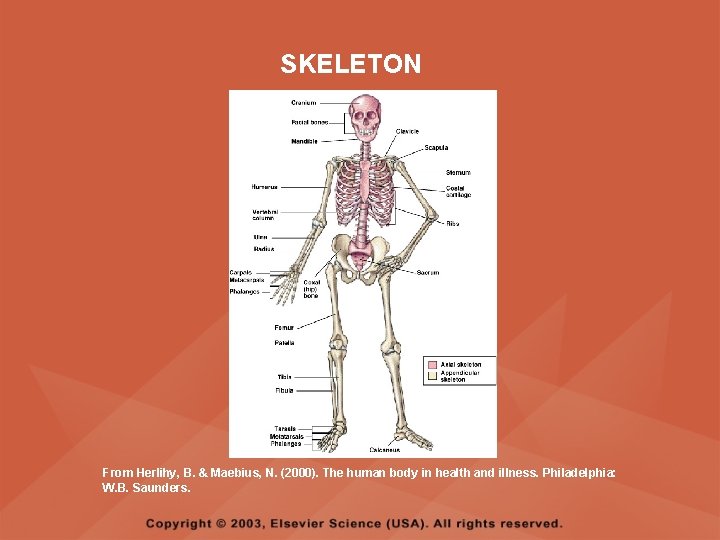
SKELETON From Herlihy, B. & Maebius, N. (2000). The human body in health and illness. Philadelphia: W. B. Saunders.
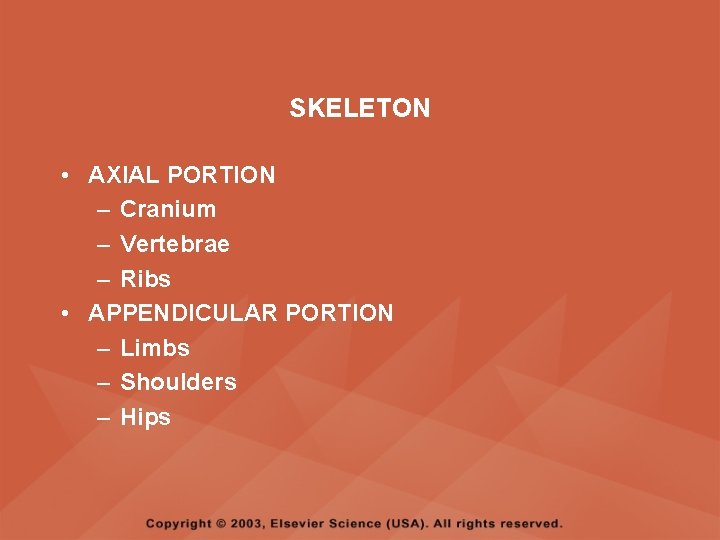
SKELETON • AXIAL PORTION – Cranium – Vertebrae – Ribs • APPENDICULAR PORTION – Limbs – Shoulders – Hips
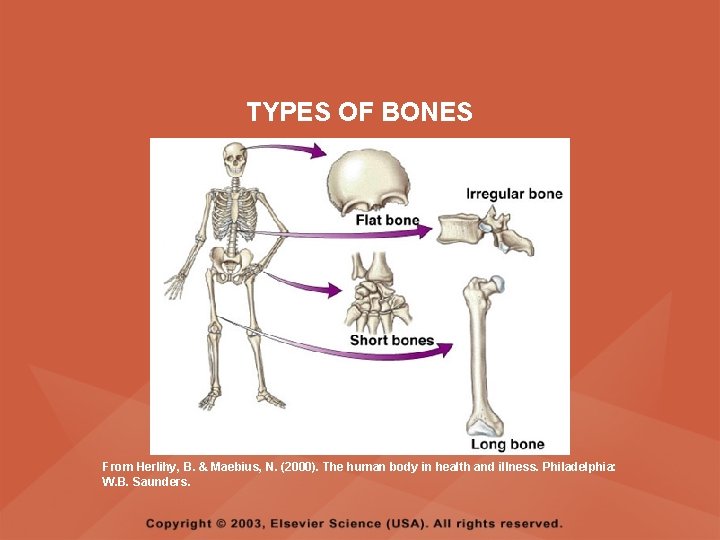
TYPES OF BONES • • Long Short Flat Irregular
TYPES OF BONES From Herlihy, B. & Maebius, N. (2000). The human body in health and illness. Philadelphia: W. B. Saunders.
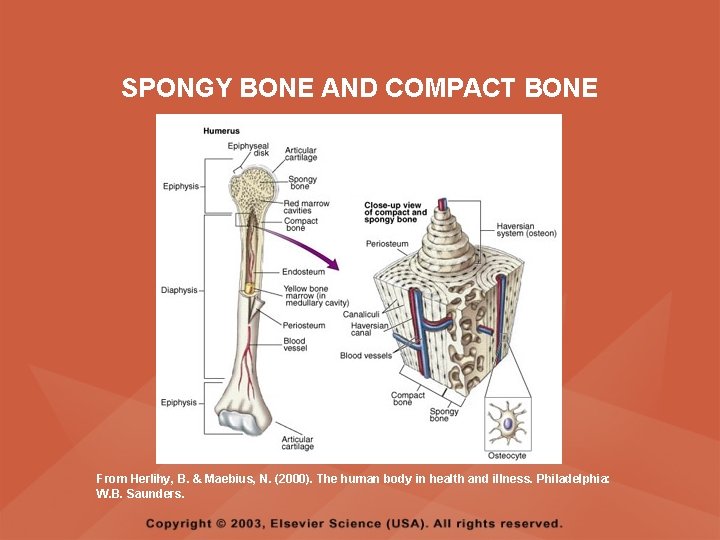
SPONGY BONE • Located in the ends of long bones and the center of flat and irregular bones • Can withstand forces applied in many directions
DENSE (COMPACT) BONE • Covers spongy bone • Cylinder around a central marrow cavity • Can withstand force predominantly in one direction
SPONGY BONE AND COMPACT BONE From Herlihy, B. & Maebius, N. (2000). The human body in health and illness. Philadelphia: W. B. Saunders.
CHARACTERISTICS OF BONES • Support and protect structures of the body • Provide attachments for muscles, tendons, and ligaments • Contain tissue in the central cavities which aids in the formation of blood cells • Assists in regulating calcium and phosphate concentrations
BONE GROWTH • The length of bone growth is a result of the ossification of the epiphyseal cartilage at the ends of bones, and bone growth stops between the ages of 18 and 25 years • The width of bone growth is a result of the activity of osteoblasts and occurs throughout life but does slow down with the aging process • Bone absorption around the bone marrow continues throughout life; therefore, bones become weaker with aging
TYPES OF JOINTS • SYNARTHROSIS – Fibrous or fixed joints – No movement associated with these joints • AMPHIARTHROSIS – Cartilaginous joints – Slightly movable joints
TYPES OF JOINTS • DIARTHROSIS – Synovial joints – Ball-and-socket joints • CONDYLOID – Freely movable joints – Allow frictionless, painless movement
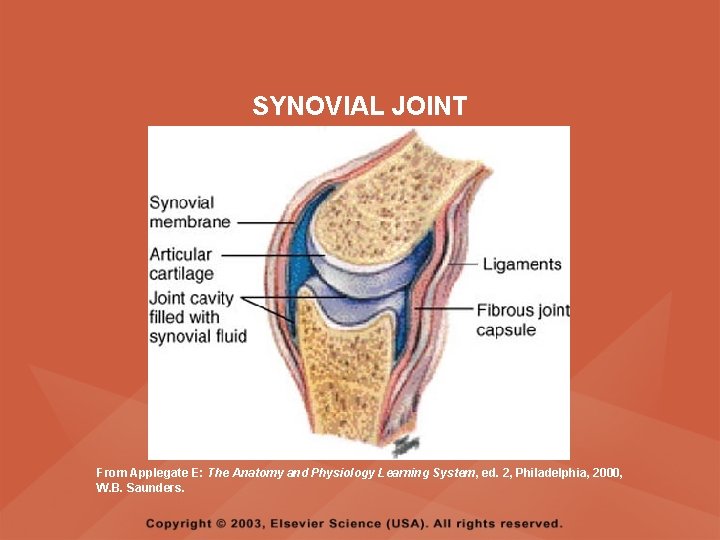
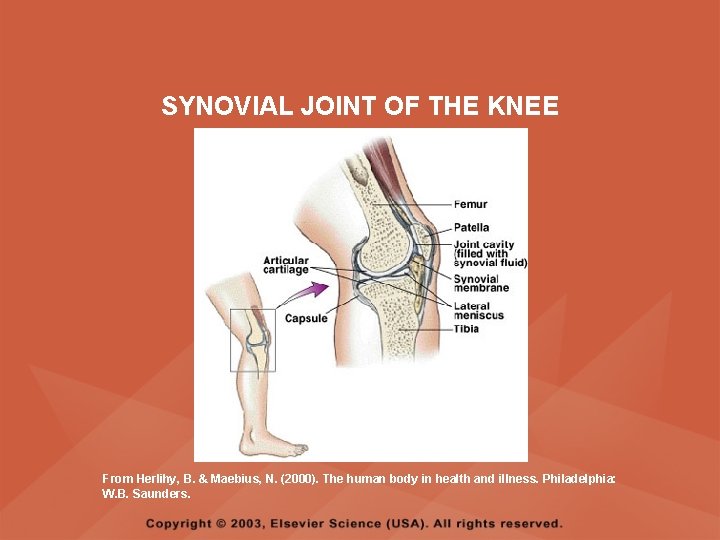
CHARACTERISTICS OF THE JOINTS • • • Allow the movement between bones Formed where two bones join Surfaces are covered with cartilage Enclosed in a capsule Contain a cavity filled with synovial fluid Ligaments hold the bone and joint in the correct position • Articulation is the meeting point of two or more joints
SYNOVIAL FLUID • Found in the joint capsule • Formed by synovial membrane, which lines the joint capsule • Lubricates the cartilage • Cushion for shocks
SYNOVIAL JOINT From Applegate E: The Anatomy and Physiology Learning System, ed. 2, Philadelphia, 2000, W. B. Saunders.
SYNOVIAL JOINT OF THE KNEE From Herlihy, B. & Maebius, N. (2000). The human body in health and illness. Philadelphia: W. B. Saunders.
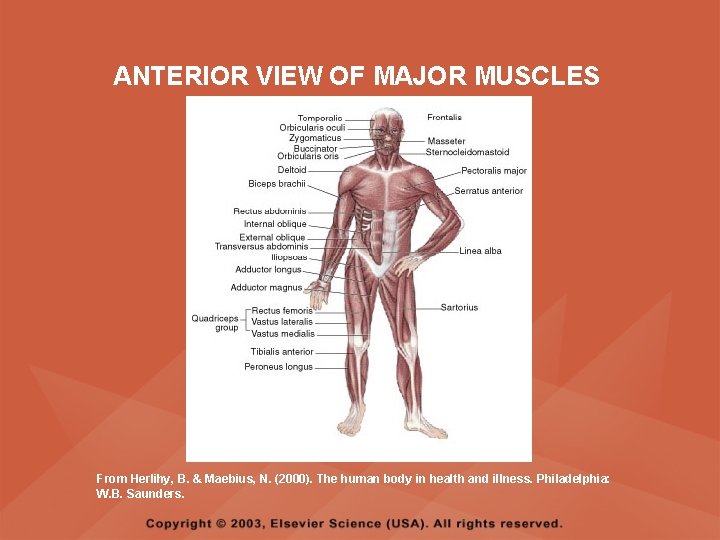
ANTERIOR VIEW OF MAJOR MUSCLES From Herlihy, B. & Maebius, N. (2000). The human body in health and illness. Philadelphia: W. B. Saunders.
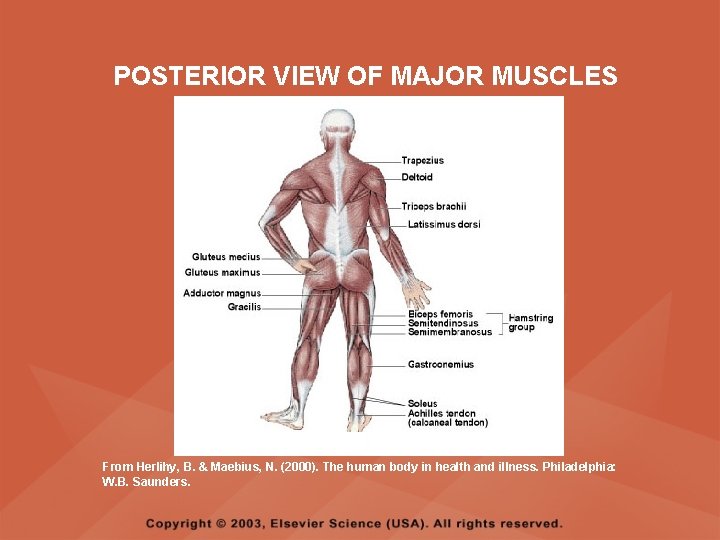
POSTERIOR VIEW OF MAJOR MUSCLES From Herlihy, B. & Maebius, N. (2000). The human body in health and illness. Philadelphia: W. B. Saunders.
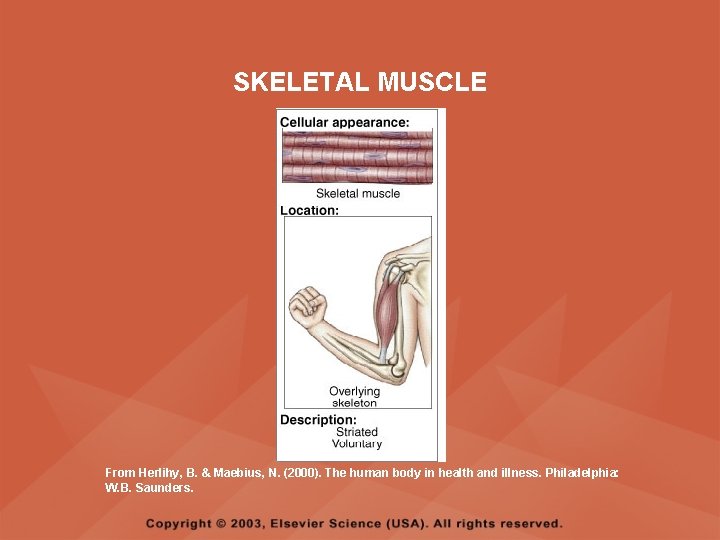
SKELETAL MUSCLE From Herlihy, B. & Maebius, N. (2000). The human body in health and illness. Philadelphia: W. B. Saunders.
CHARACTERISTICS OF MUSCLES • • Made up of bundles of muscle fibers Provide the force to move bones Assist in maintaining posture Assist with heat production
PROCESS OF CONTRACTION AND RELAXATION • Muscle contraction and relaxation require large amounts of adenosine triphosphate (ATP) • Contraction also requires calcium, which functions as a catalyst • Acetylcholine released by the motor end plate of the motor neuron initiates an action potential • Acetylcholine is then destroyed by acetylcholinesterase
PROCESS OF CONTRACTION AND RELAXATION • Calcium is required to contract muscle fibers and acts as a catalyst for the enzyme needed for the sliding together action of actin and myosin • Following contraction, ATP transports calcium out, in order to allow actin and myosin to slide apart and allow the muscle to relax
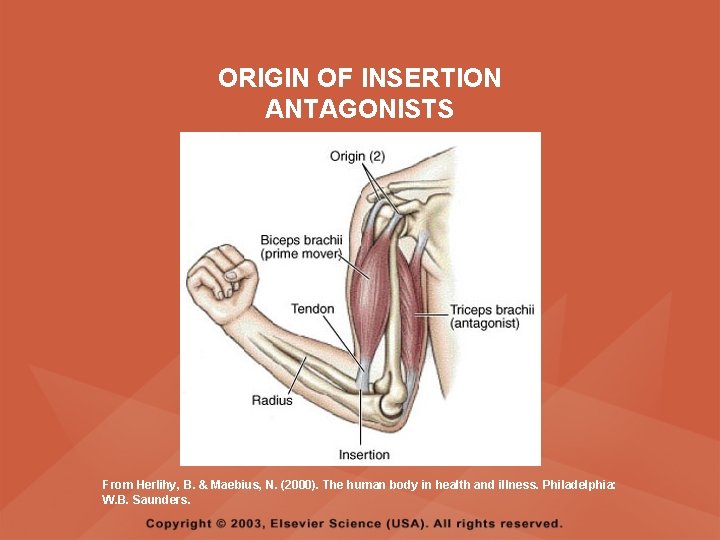
SKELETAL MUSCLES • Are attached to two bones and cross at least one joint • The point of origin is the point of attachment on the bone closest to the trunk • The point of insertion is the point of attachment on the bone farthest from the trunk • Skeletal muscles act in groups • Prime movers contract to produce movement • Antagonists relax • Synergists contract to stabilize • Nerves activate and control the muscles
ORIGIN OF INSERTION ANTAGONISTS From Herlihy, B. & Maebius, N. (2000). The human body in health and illness. Philadelphia: W. B. Saunders.