
Muscular SystemExercise Info AnatomyPhysiology Benefits of Physical Activity
Muscular System-Exercise Info Anatomy/Physiology
Benefits of Physical Activity • Helps people achieve and maintain a healthy weight • Reduces feelings of stress, anxiety & depression • Builds and maintains healthy bones, muscles & joints • Boosts energy level Physical the risk of • Improves. Activity quality of Reduces sleep • Dying from heart disease or stroke • Developing high blood pressure, cholesterol & diabetes • Developing obesity • Developing osteoporosis – exercise builds strong bones & muscles
National Trends • 64% of adults are overweight in the U. S. • Approximately 30% of adults are obese. • 17 % of children ages 6 -18 are overweight. • Obesity is the second leading cause of unnecessary deaths. • Consumers spend $33 billion a year on the diet industry. • Every year, about 8 million Americans sign up for weight loss programs that offer a quick fix.
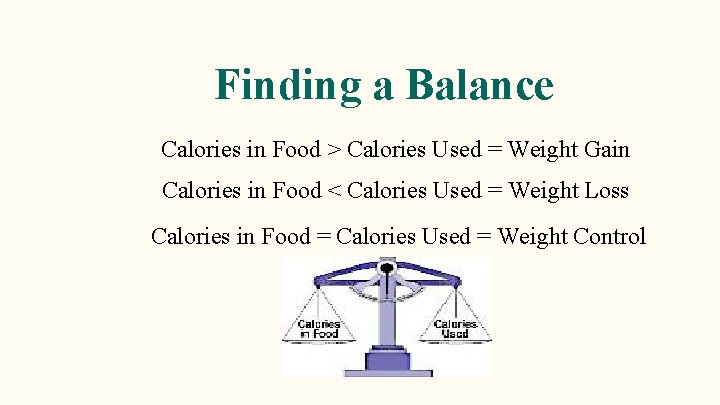
Finding a Balance Calories in Food > Calories Used = Weight Gain Calories in Food < Calories Used = Weight Loss Calories in Food = Calories Used = Weight Control
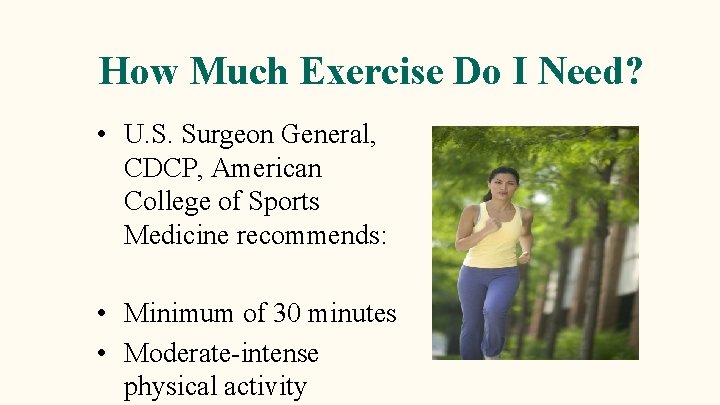
How Much Exercise Do I Need? • U. S. Surgeon General, CDCP, American College of Sports Medicine recommends: • Minimum of 30 minutes • Moderate-intense physical activity
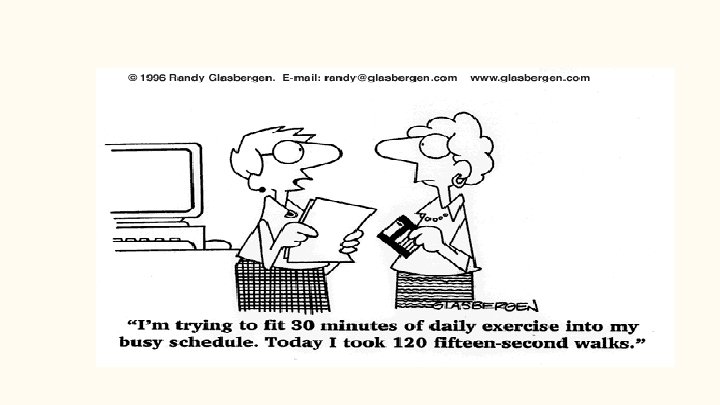
Exercise is Important… Why Don’t We Do It I don’t have enough time The gym is too intimidating I am too tired!! I get bored!! I Don’t Like It! I don’t know what to do! I need to take care of the family
Making Physical Activity a Part of Your Life. There are 1440 minutes in every day. . . Schedule 30 of them for physical activity.
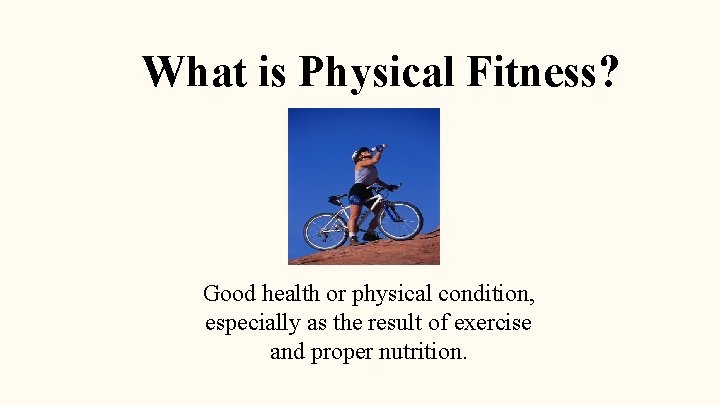
What is Physical Fitness? Good health or physical condition, especially as the result of exercise and proper nutrition.
Components of Fitness? 4 Components of Fitness: – – Aerobic Muscular Flexibility Body Composition
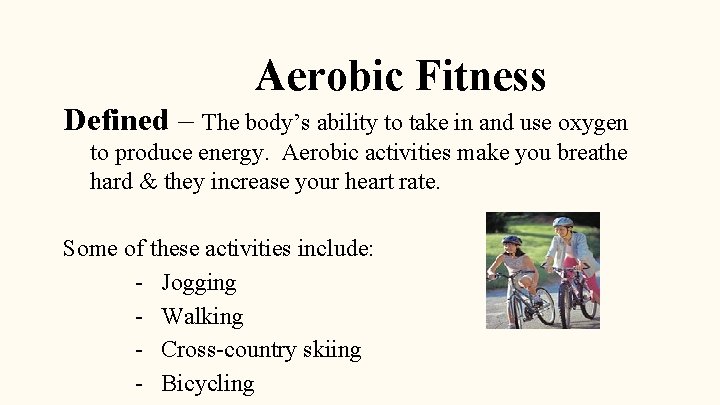
Aerobic Fitness Defined – The body’s ability to take in and use oxygen to produce energy. Aerobic activities make you breathe hard & they increase your heart rate. Some of these activities include: - Jogging - Walking - Cross-country skiing - Bicycling
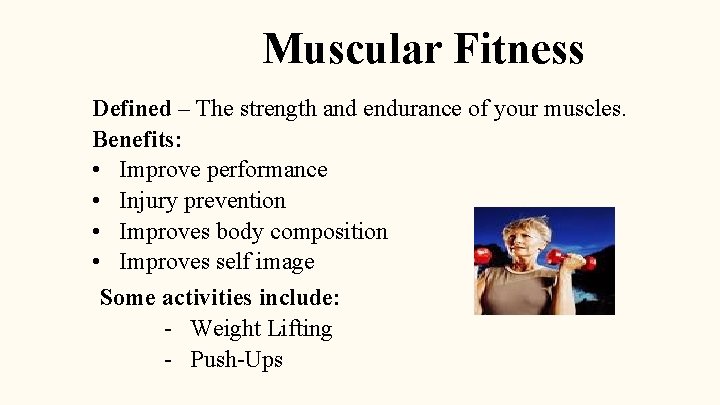
Muscular Fitness Defined – The strength and endurance of your muscles. Benefits: • Improve performance • Injury prevention • Improves body composition • Improves self image Some activities include: - Weight Lifting - Push-Ups

Flexibility Defined – The ability to bend joints and stretch muscles through a full range of motion. Some activities include: - Stretching (Sit & Reach) - Warm-up & Cool-down
Body Composition Defined – The amount of fat tissue relative to other tissue in your body. - Your body composition is based not on how much you weigh, but rather on how much of your weight is fat as opposed to muscle.
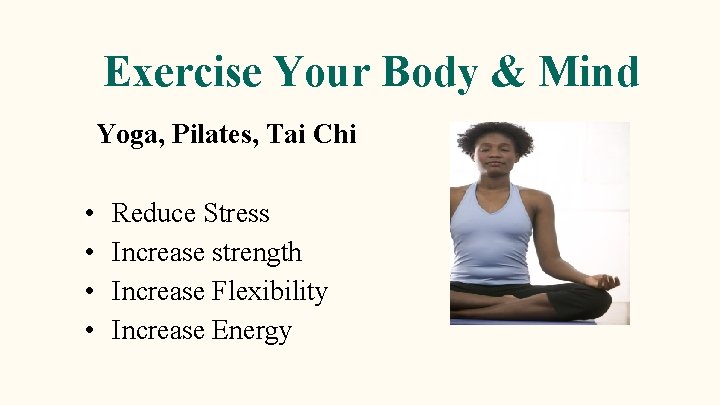
Exercise Your Body & Mind Yoga, Pilates, Tai Chi • • Reduce Stress Increase strength Increase Flexibility Increase Energy

What is the Best Exercise?

Measuring Physical Activity Intensity – Target Heart Rate Maximum Heart Rate (MHR) 220 – AGE = MHR Target Heart Rate MHR X. 60 = Minimum Heart Rate MHR X. 80 = Maximum Heart Rate
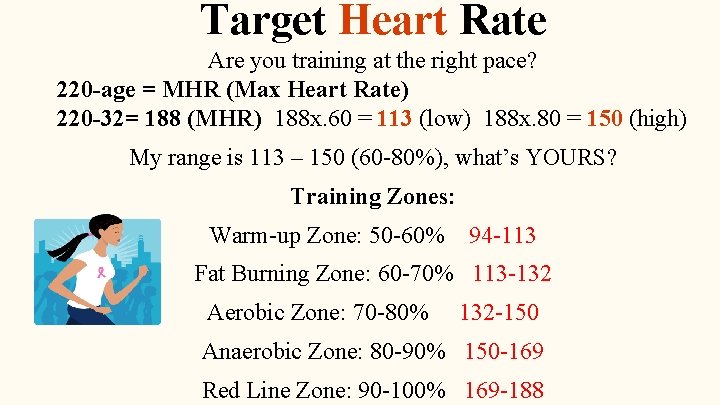
Target Heart Rate Are you training at the right pace? 220 -age = MHR (Max Heart Rate) 220 -32= 188 (MHR) 188 x. 60 = 113 (low) 188 x. 80 = 150 (high) My range is 113 – 150 (60 -80%), what’s YOURS? Training Zones: Warm-up Zone: 50 -60% 94 -113 Fat Burning Zone: 60 -70% 113 -132 Aerobic Zone: 70 -80% 132 -150 Anaerobic Zone: 80 -90% 150 -169 Red Line Zone: 90 -100% 169 -188
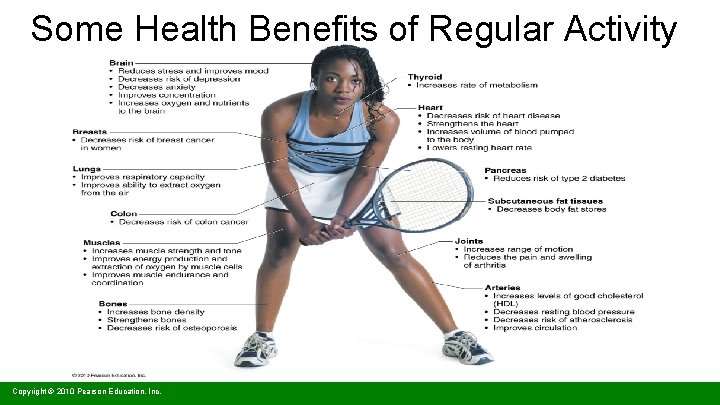
Some Health Benefits of Regular Activity Copyright © 2010 Pearson Education, Inc.
Cardiorespiratory Fitness • Aerobic exercise is any type of exercise that increases heart rate. • Aerobic capacity is the functional status of the cardiorespiratory system, measured as the maximum volume of oxygen consumed by the muscles during exercise (VO 2 max). • Graded exercise test is a test of aerobic capacity done by gradually increasing the pace on a treadmill or bike.
Copyright © 2010 Pearson Education, Inc.
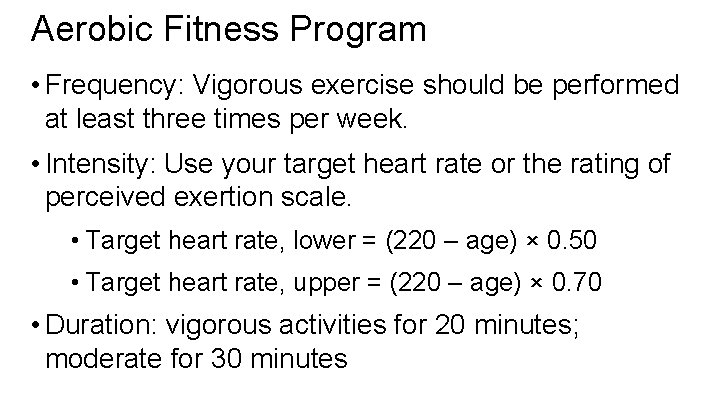
Aerobic Fitness Program • Frequency: Vigorous exercise should be performed at least three times per week. • Intensity: Use your target heart rate or the rating of perceived exertion scale. • Target heart rate, lower = (220 – age) × 0. 50 • Target heart rate, upper = (220 – age) × 0. 70 • Duration: vigorous activities for 20 minutes; moderate for 30 minutes
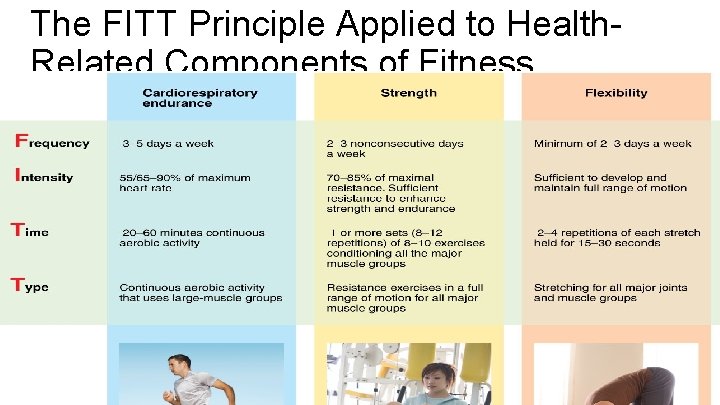
The FITT Principle Applied to Health. Related Components of Fitness Copyright © 2010 Pearson Education, Inc.

Rating of Perceived Exertion (RPE) Scale Copyright © 2010 Pearson Education, Inc.
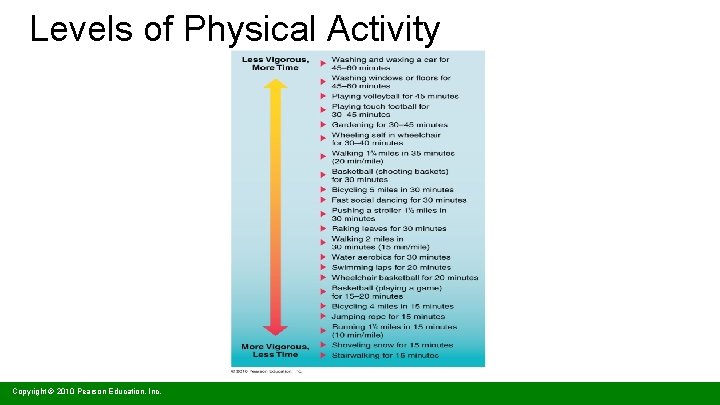
Levels of Physical Activity Copyright © 2010 Pearson Education, Inc.
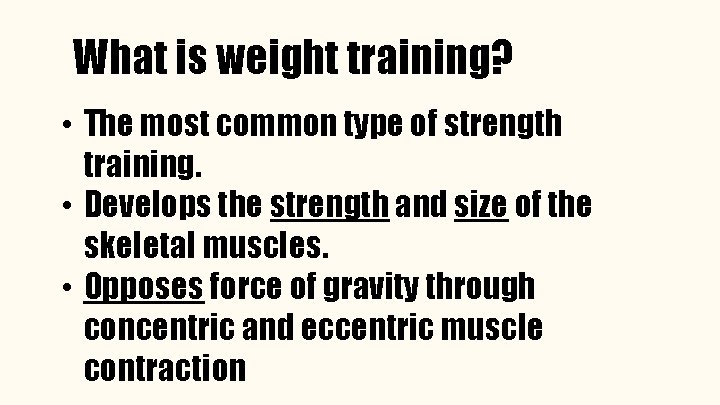
What is weight training? • The most common type of strength training. • Develops the strength and size of the skeletal muscles. • Opposes force of gravity through concentric and eccentric muscle contraction
Overall Benefits of Weight Training Increased: ▪ Muscles strength ▪ Tendon and Ligament strength ▪ Bone density ▪ Flexibility ▪ Tone ▪ Metabolic rate *how fast you burn calories ▪ Postural Support
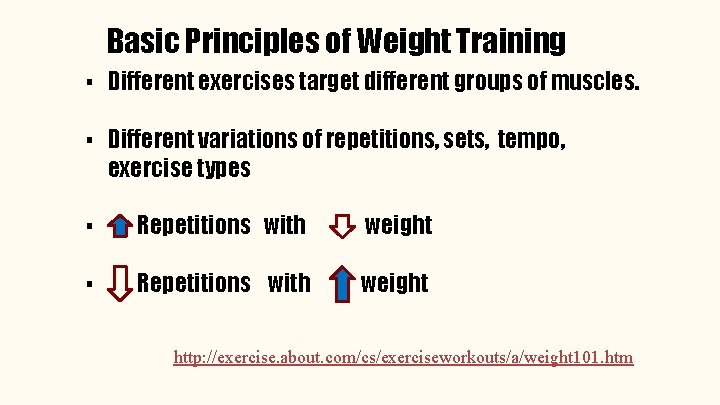
Basic Principles of Weight Training ▪ Different exercises target different groups of muscles. ▪ Different variations of repetitions, sets, tempo, exercise types ▪ Repetitions with weight http: //exercise. about. com/cs/exerciseworkouts/a/weight 101. htm
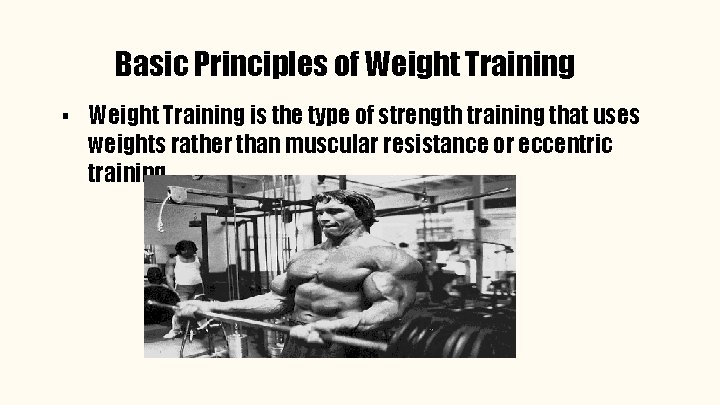
Basic Principles of Weight Training ▪ Weight Training is the type of strength training that uses weights rather than muscular resistance or eccentric training.

Types of Weight Training exercises. . • Isotonic exercise ▪ Iso meaning “same” ▪ Tonic meaning “strength” ▪ Weight training is mostly an Isotonic form of exercise. ▪ The force used by muscle to push or pull should not change until muscle fatigue sets in.
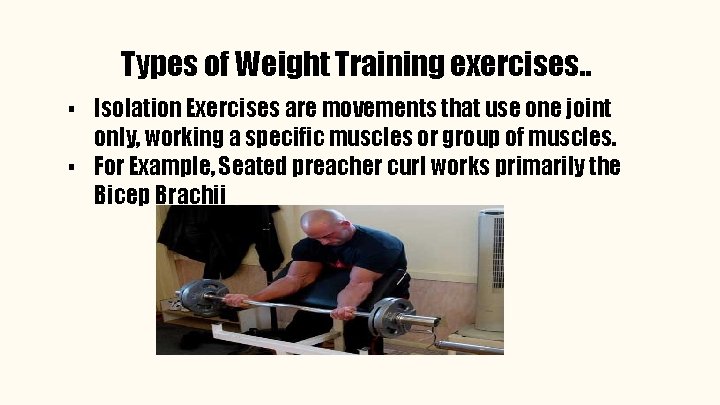
Types of Weight Training exercises. . ▪ Isolation Exercises are movements that use one joint only, working a specific muscles or group of muscles. ▪ For Example, Seated preacher curl works primarily the Bicep Brachii
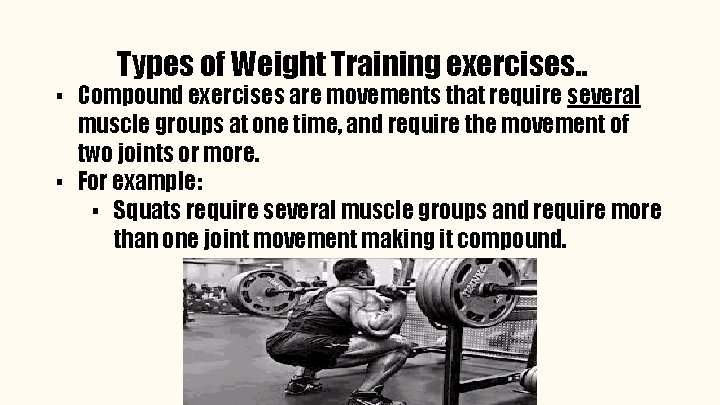
Types of Weight Training exercises. . ▪ Compound exercises are movements that require several muscle groups at one time, and require the movement of two joints or more. ▪ For example: ▪ Squats require several muscle groups and require more than one joint movement making it compound.
Free Weights Vs. Weighted Machines • Free Weights ▪ Free weights include mostly barbells, dumbbells, kettle bells, sandbags, and medicine balls. ▪ Able to work stabilizer muscles more due to no constraints of movement, unlike weighted machines. ▪ Can be used in any kind of position.
Free Weights Vs. Weighted Machines • Weighted Machines ▪ Weighted Machines are more commonly used and found in most commercial gyms ▪ Smith Machines ▪ Cable Machines ▪ Most Leg Machines ▪ Confined to moving in only one specific direction.
Compared to other types of Strength Training Isometric Training vs. Weight Training • Isometric Training only provides small gains of strength to the muscles being worked at the specific joint angles being worked. • Weight training strengthens the muscles throughout the range of motion of the joint being trained, from the beginning motion all the way to the end motion.
Compared to other types of Strength Training Bodybuilding and Weight Training ▪ Bodybuilding uses weight training for size, symmetry, and shape regardless if there is an increase in strength or not and aim to decrease body fat levels rapidly. ▪ Weight training aims to improve overall physical strength and anaerobic endurance while not paying attention to decreasing body fat below normal range.
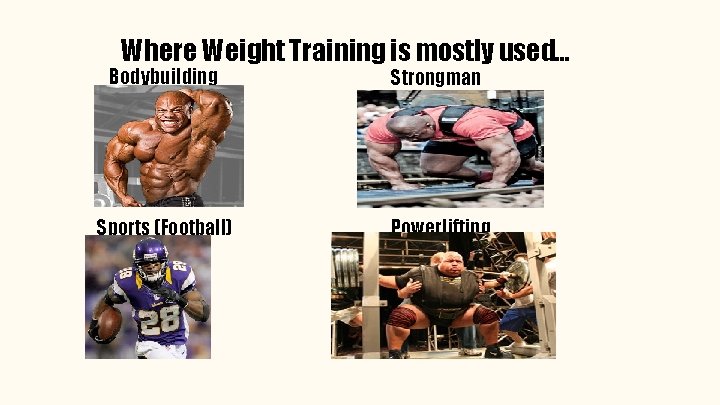
Where Weight Training is mostly used… Bodybuilding Strongman Sports (Football) Powerlifting
Proper Safety for Weight Training Stretching and Warming Up properly ▪ Warm up the body between 5 and 20 minutes ▪ Stretch the body to improve flexibility ▪ Static stretching can injure the body more, so stay away from this ▪ Utilize active movements to warm up the body ▪ Increase blood flow throughout the body ▪ Helps reduce the risk of injury during training.
Proper Safety for Weight Training Breathing and Hydration ▪ Breathing is important to help prevent injury also. ▪ Exhale during the exersion (hardest part) ▪ Inhale when lowering the weight/relaxing ▪ Hydration is important to help your body exert maximal effort ▪ Weigh yourself before and after your workout. You should be approximately the same weight, if not, you need to hydrate more ▪ Also, proper hydration helps reduce the risk of muscle cramps
Proper Form ▪ Always important to maintain proper form for each exercise ▪ Bad form can result in injury, minor or severe. ▪ Always remember to breathe properly as well!!
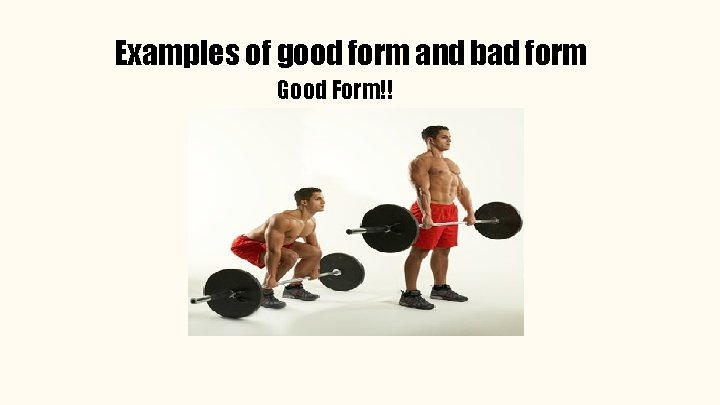
Examples of good form and bad form Good Form!!
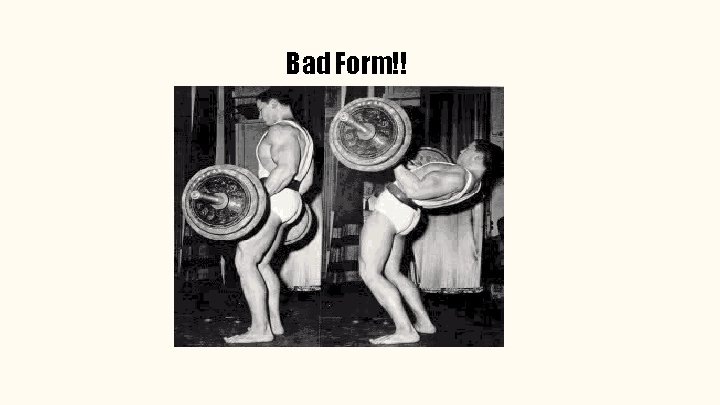
Bad Form!!
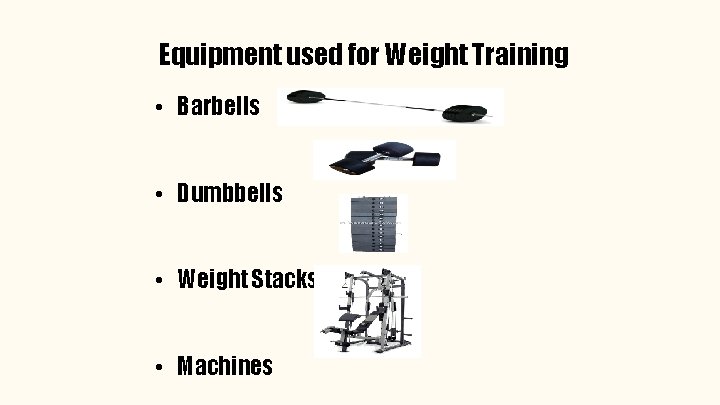
Equipment used for Weight Training • Barbells • Dumbbells • Weight Stacks • Machines
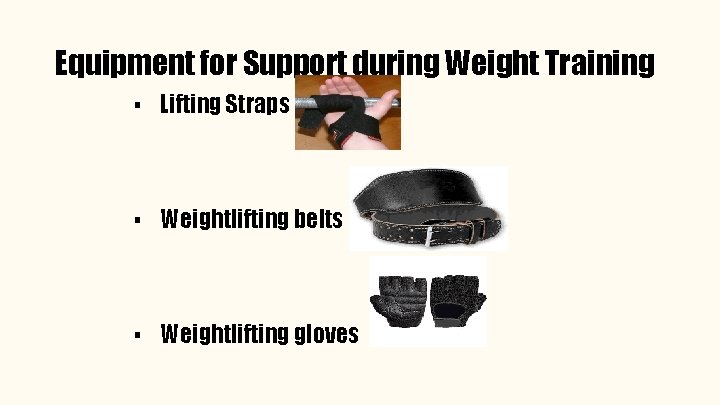
Equipment for Support during Weight Training ▪ Lifting Straps ▪ Weightlifting belts ▪ Weightlifting gloves
References 1. 2. 3. 4. 5. 6. 7. http: //en. wikipedia. org/wiki/Weight_training http: //www. mayoclinic. com/health/weight-training/HQ 01627 http: //exercise. about. com/cs/exerciseworkouts/a/weight 101. htm http: //www. dummies. com/how-to/health-fitness/weight-training. html Louis Walker Personal Trainers Bill Byron Bridget Melton, Georgia Southern University
- Slides: 47