
Muscular System You need to know Functions of
- Slides: 36
Muscular System
You need to know…. *Functions of the muscular system *3 Type of muscles *How muscles work * Muscle Make Up *Location and action of muscles *Joints *Common problems/prevention KINETIC CHAIN – Everything in the body affects everything else!
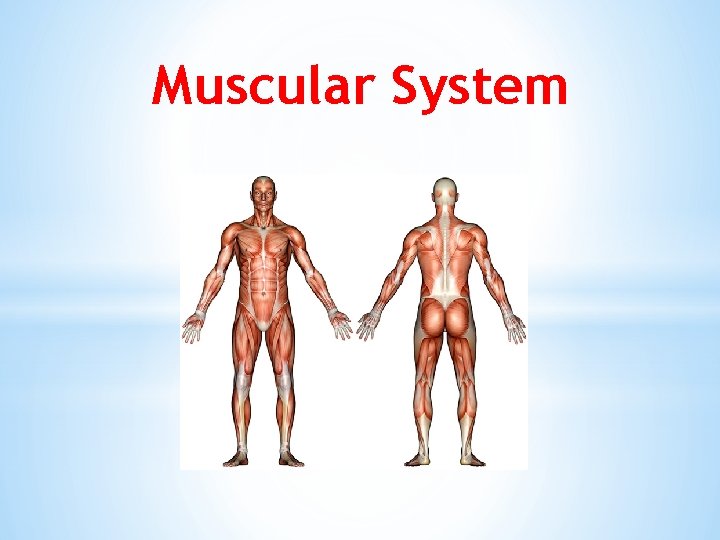
Muscular System *There is a total of 434 muscles in the body *Makes up 40 -55% of the total bodyweight *Distributed in pairs on the R & L sides of the body *75 muscle pairs are responsible for body movements and posture *Remaining muscles are used for activities like eye control and swallowing
What is the muscular system? • An organ system consisting of skeletal, smooth and cardiac muscles. • Permits movement of the body • Maintains posture • Circulates blood throughout the body.
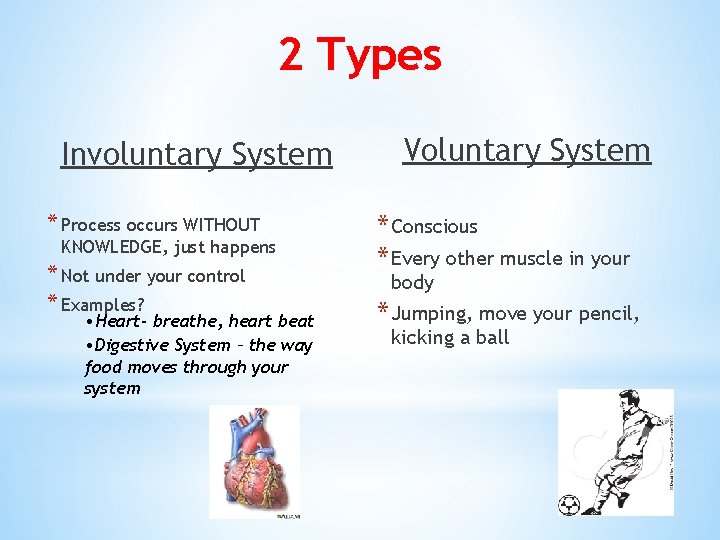
2 Types Involuntary System * Process occurs WITHOUT KNOWLEDGE, just happens * Not under your control * Examples? • Heart- breathe, heart beat • Digestive System – the way food moves through your system Voluntary System * Conscious * Every other muscle in your body * Jumping, move your pencil, kicking a ball
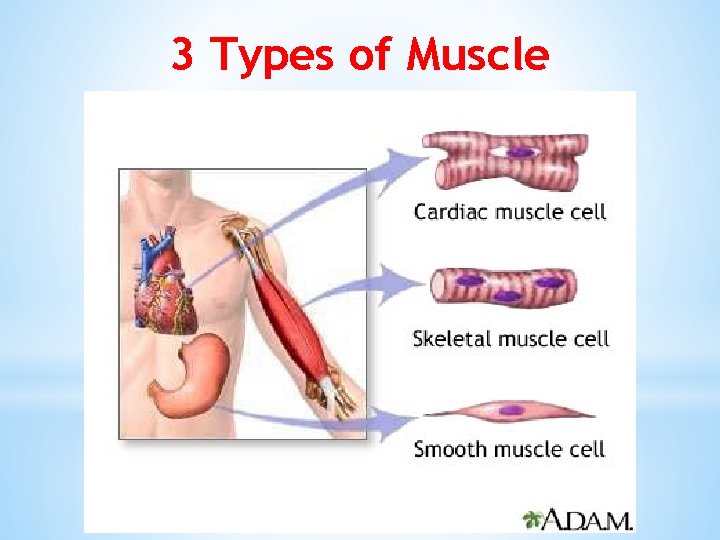
3 Types of Muscle
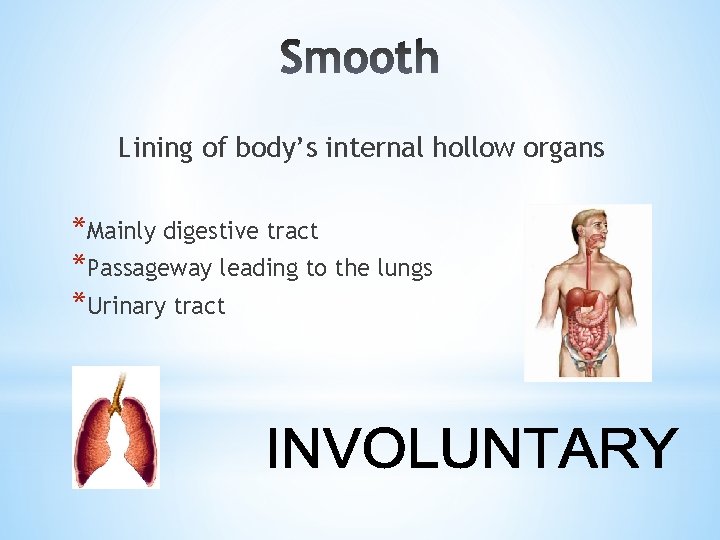
Lining of body’s internal hollow organs *Mainly digestive tract *Passageway leading to the lungs *Urinary tract
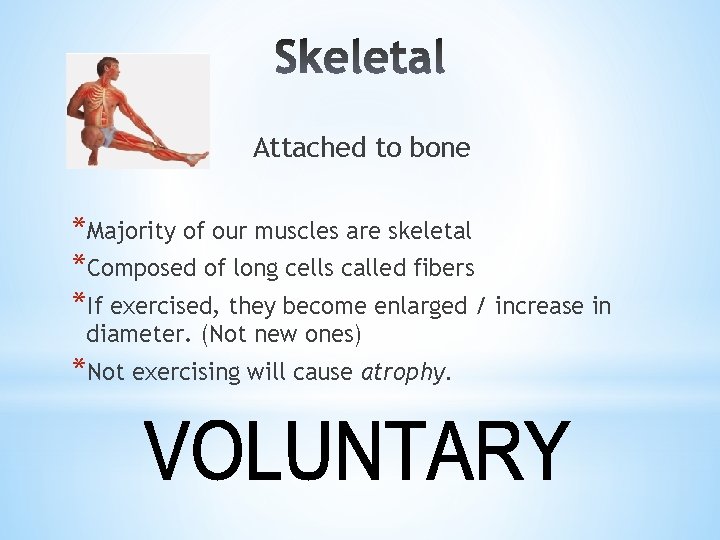
Attached to bone *Majority of our muscles are skeletal *Composed of long cells called fibers *If exercised, they become enlarged / increase in diameter. (Not new ones) *Not exercising will cause atrophy.
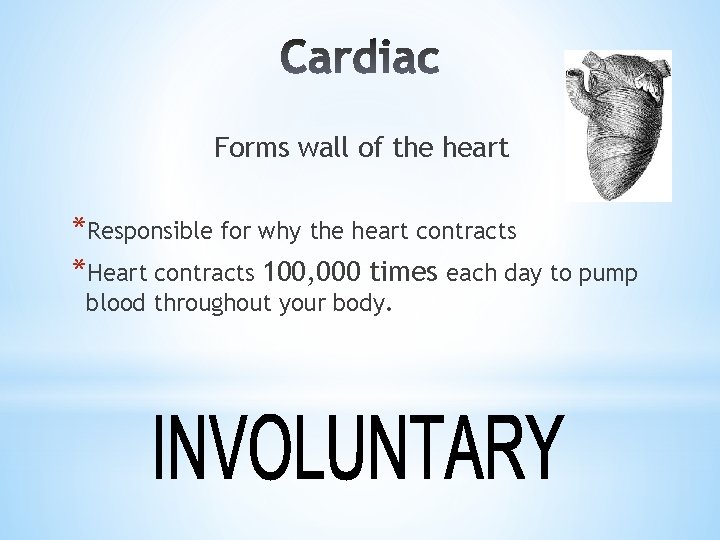
Forms wall of the heart *Responsible for why the heart contracts *Heart contracts 100, 000 times each day to pump blood throughout your body.
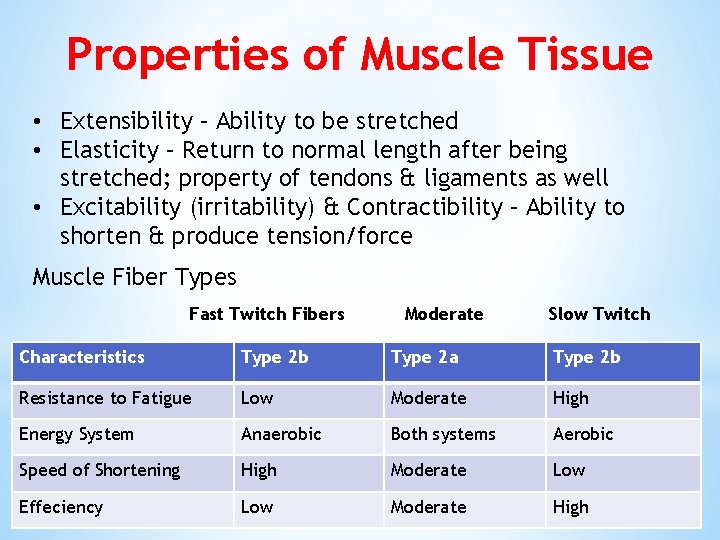
Properties of Muscle Tissue • Extensibility – Ability to be stretched • Elasticity – Return to normal length after being stretched; property of tendons & ligaments as well • Excitability (irritability) & Contractibility – Ability to shorten & produce tension/force Muscle Fiber Types Fast Twitch Fibers Moderate Slow Twitch Characteristics Type 2 b Type 2 a Type 2 b Resistance to Fatigue Low Moderate High Energy System Anaerobic Both systems Aerobic Speed of Shortening High Moderate Low Effeciency Low Moderate High
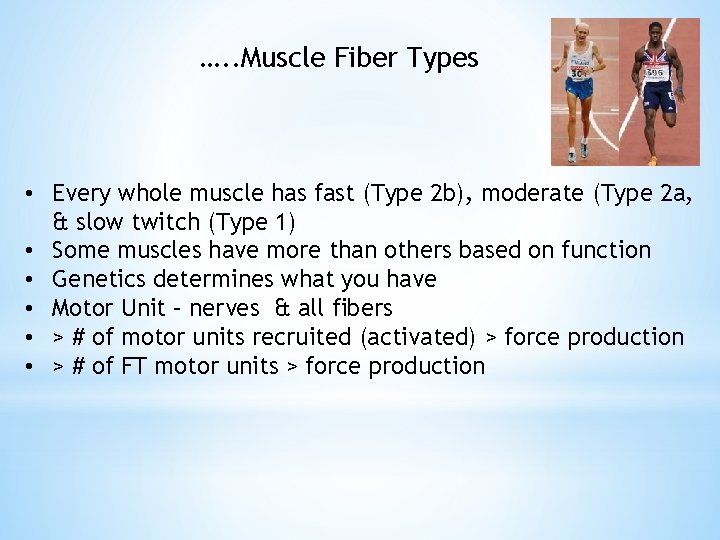
…. . Muscle Fiber Types • Every whole muscle has fast (Type 2 b), moderate (Type 2 a, & slow twitch (Type 1) • Some muscles have more than others based on function • Genetics determines what you have • Motor Unit – nerves & all fibers • > # of motor units recruited (activated) > force production • > # of FT motor units > force production
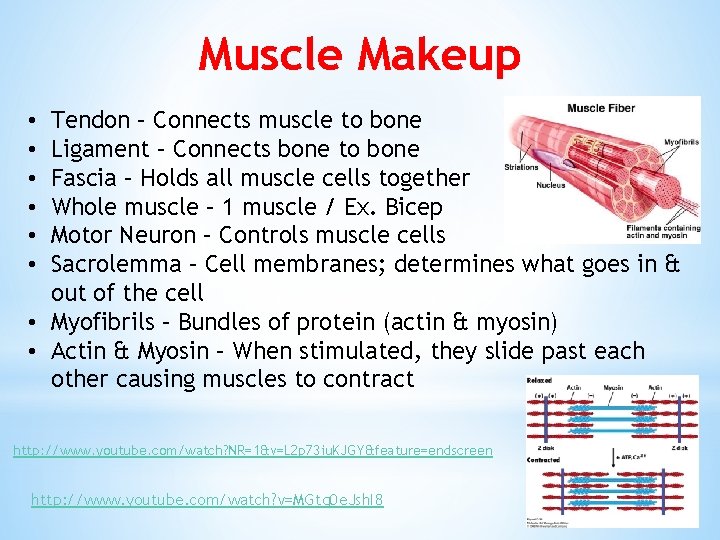
Muscle Makeup Tendon – Connects muscle to bone Ligament – Connects bone to bone Fascia – Holds all muscle cells together Whole muscle – 1 muscle / Ex. Bicep Motor Neuron – Controls muscle cells Sacrolemma – Cell membranes; determines what goes in & out of the cell • Myofibrils – Bundles of protein (actin & myosin) • Actin & Myosin – When stimulated, they slide past each other causing muscles to contract • • • http: //www. youtube. com/watch? NR=1&v=L 2 p 73 iu. KJGY&feature=endscreen http: //www. youtube. com/watch? v=MGtq 0 e. Jsh. I 8
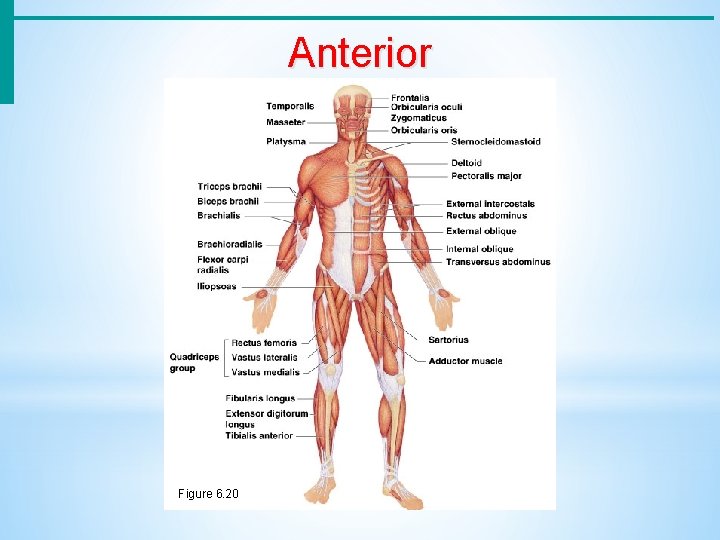
Anterior Figure 6. 20
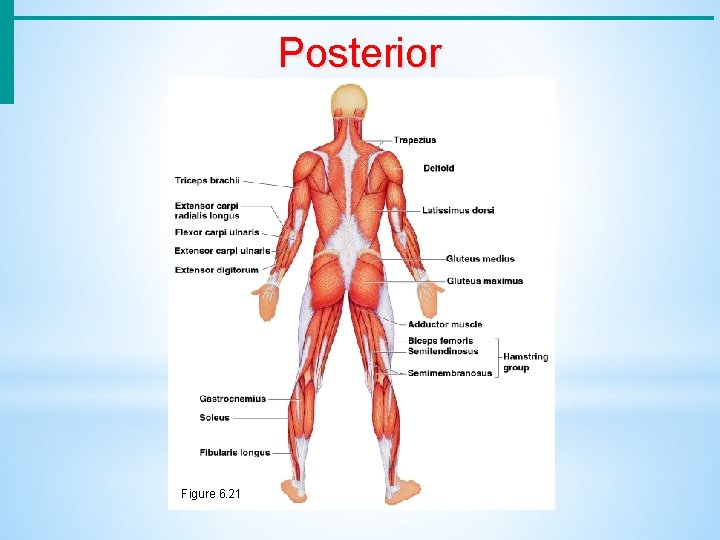
Posterior Figure 6. 21
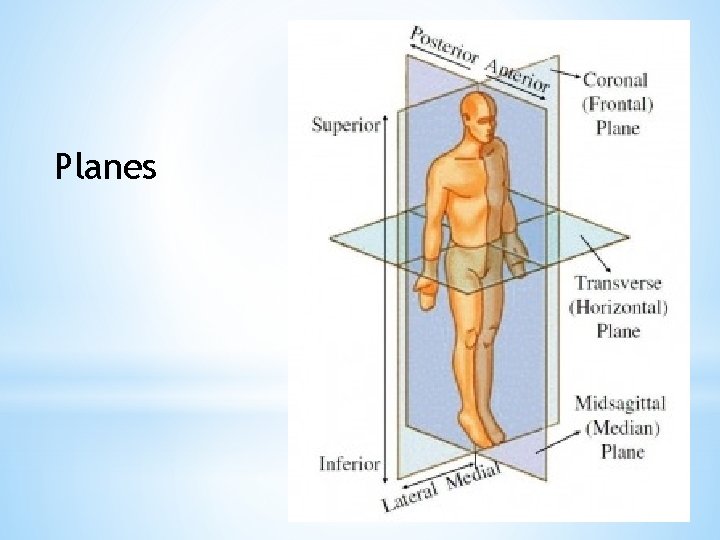
Planes
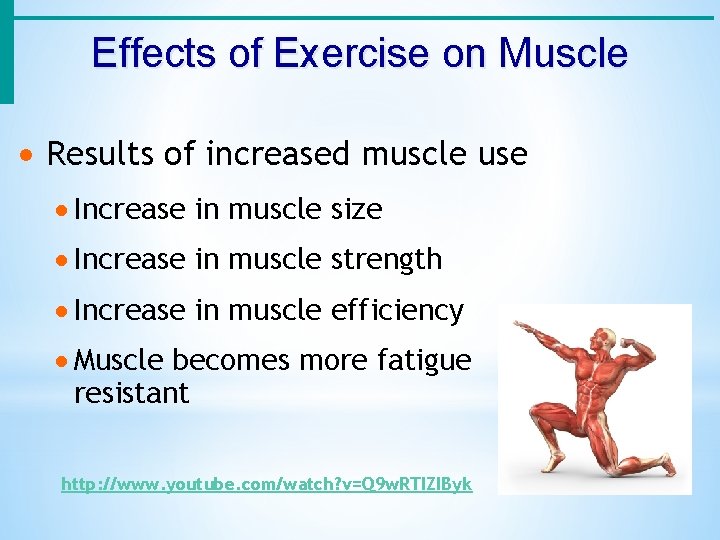
Effects of Exercise on Muscle · Results of increased muscle use · Increase in muscle size · Increase in muscle strength · Increase in muscle efficiency · Muscle becomes more fatigue resistant http: //www. youtube. com/watch? v=Q 9 w. RTIZIByk
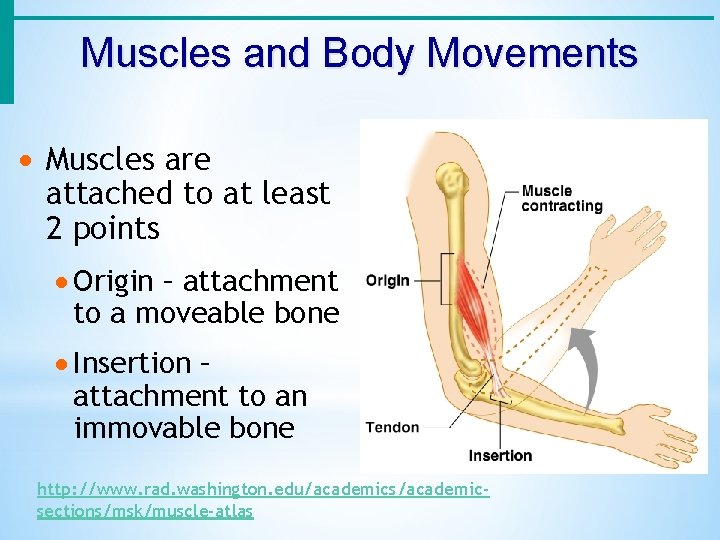
Muscles and Body Movements · Muscles are attached to at least 2 points · Origin – attachment to a moveable bone · Insertion – attachment to an immovable bone http: //www. rad. washington. edu/academicsections/msk/muscle-atlas
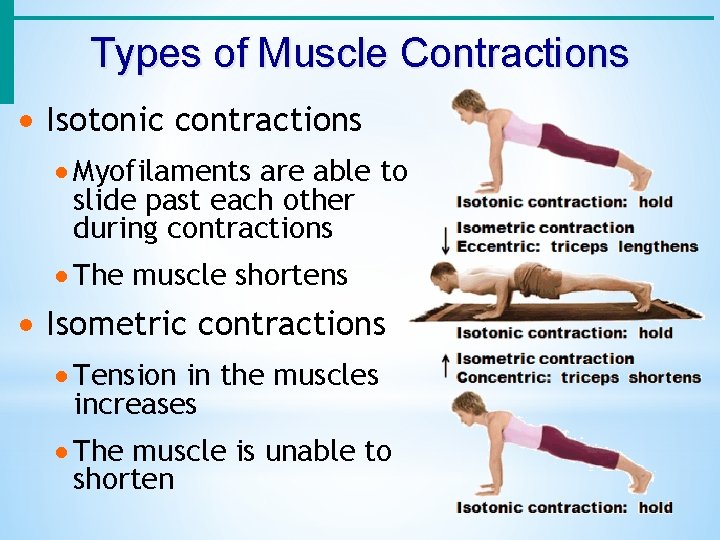
Types of Muscle Contractions · Isotonic contractions · Myofilaments are able to slide past each other during contractions · The muscle shortens · Isometric contractions · Tension in the muscles increases · The muscle is unable to shorten
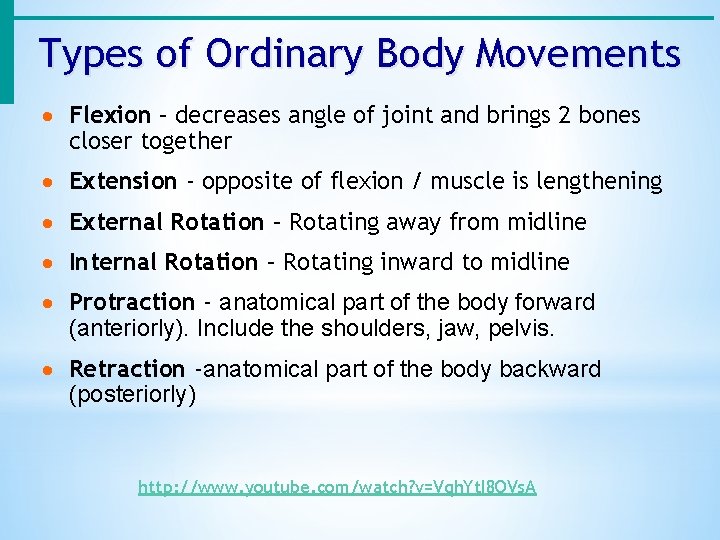
Types of Ordinary Body Movements · Flexion – decreases angle of joint and brings 2 bones closer together · Extension - opposite of flexion / muscle is lengthening · External Rotation – Rotating away from midline · Internal Rotation – Rotating inward to midline · Protraction - anatomical part of the body forward (anteriorly). Include the shoulders, jaw, pelvis. · Retraction -anatomical part of the body backward (posteriorly) http: //www. youtube. com/watch? v=Vqh. Yt. I 8 QVs. A
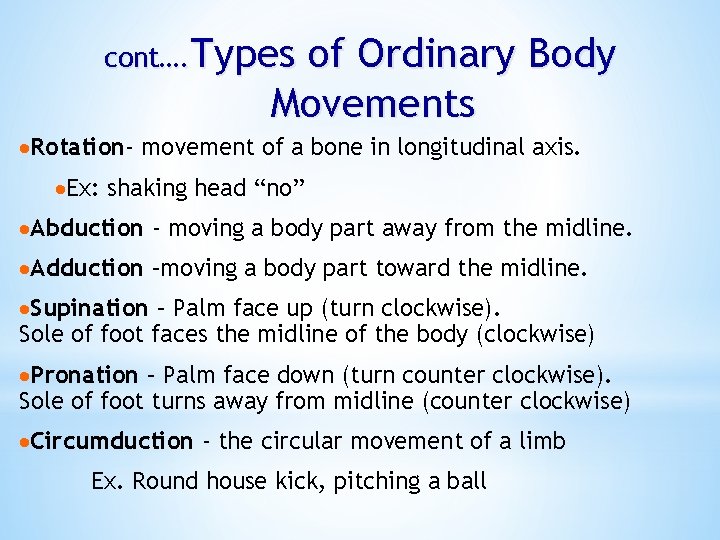
cont…. Types of Ordinary Body Movements ·Rotation- movement of a bone in longitudinal axis. ·Ex: shaking head “no” ·Abduction - moving a body part away from the midline. ·Adduction –moving a body part toward the midline. ·Supination – Palm face up (turn clockwise). Sole of foot faces the midline of the body (clockwise) ·Pronation – Palm face down (turn counter clockwise). Sole of foot turns away from midline (counter clockwise) ·Circumduction - the circular movement of a limb Ex. Round house kick, pitching a ball
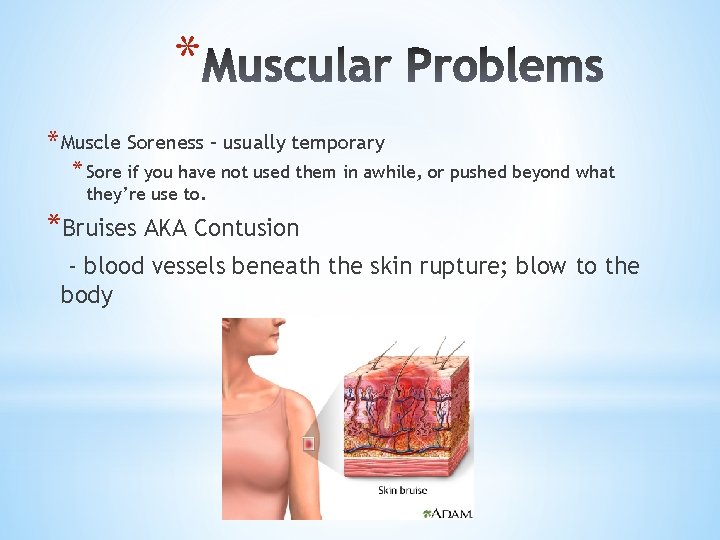
* * Muscle Soreness – usually temporary * Sore if you have not used them in awhile, or pushed beyond what they’re use to. *Bruises AKA Contusion - blood vessels beneath the skin rupture; blow to the body
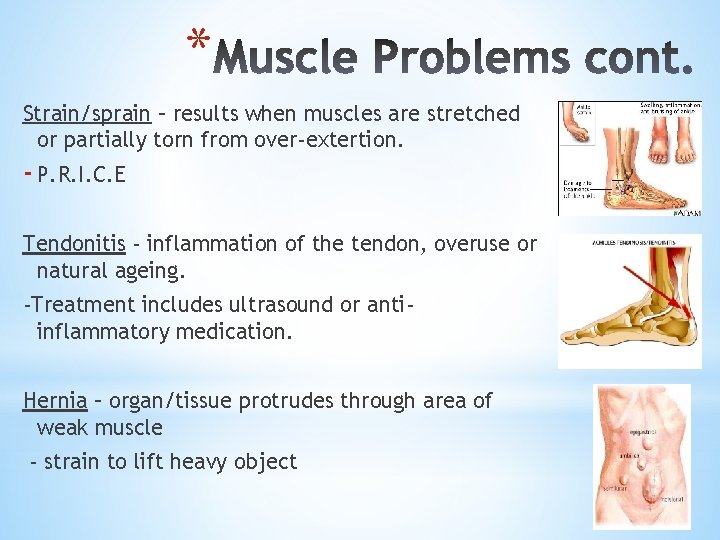
* Strain/sprain – results when muscles are stretched or partially torn from over-extertion. - P. R. I. C. E Tendonitis - inflammation of the tendon, overuse or natural ageing. -Treatment includes ultrasound or antiinflammatory medication. Hernia – organ/tissue protrudes through area of weak muscle - strain to lift heavy object
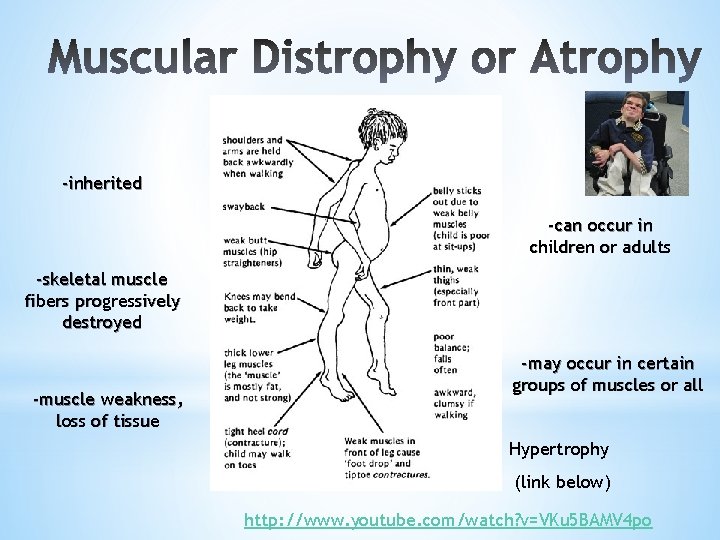
-inherited -can occur in children or adults -skeletal muscle fibers progressively destroyed -muscle weakness, loss of tissue -may occur in certain groups of muscles or all Hypertrophy (link below) http: //www. youtube. com/watch? v=VKu 5 BAMV 4 po
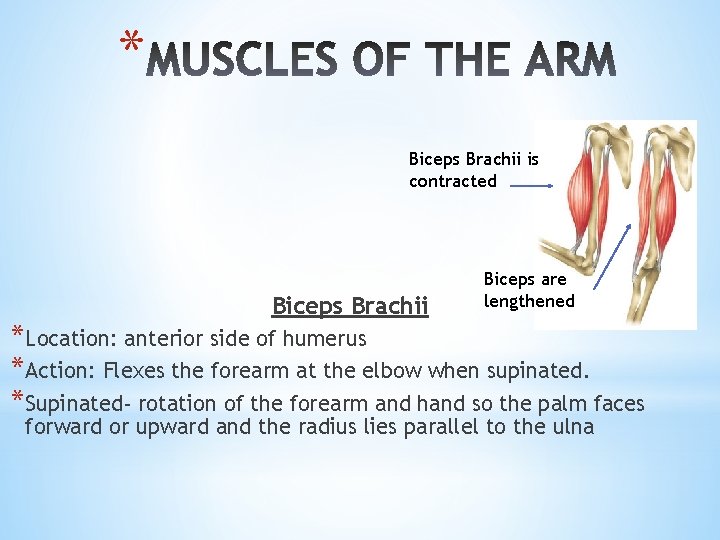
* Biceps Brachii is contracted Biceps Brachii Biceps are lengthened *Location: anterior side of humerus *Action: Flexes the forearm at the elbow when supinated. *Supinated- rotation of the forearm and hand so the palm faces forward or upward and the radius lies parallel to the ulna
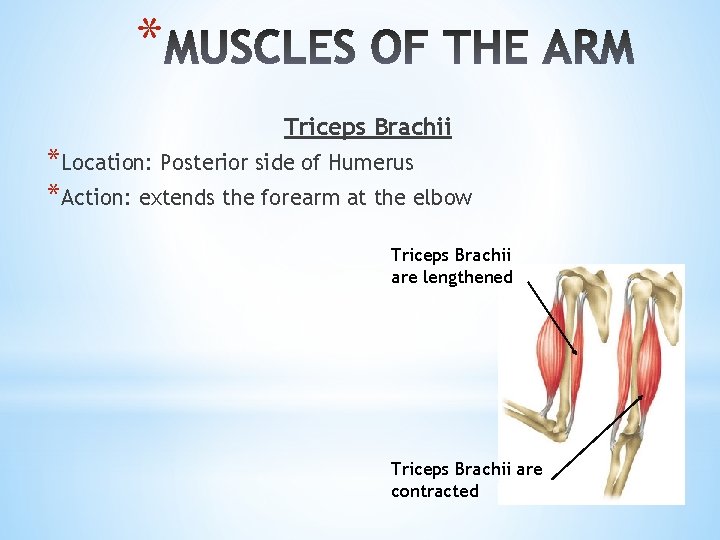
* Triceps Brachii *Location: Posterior side of Humerus *Action: extends the forearm at the elbow Triceps Brachii are lengthened Triceps Brachii are contracted
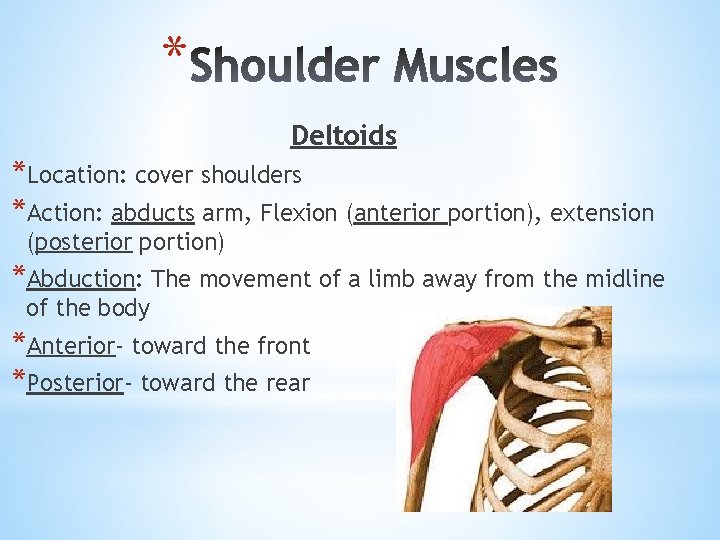
* Deltoids *Location: cover shoulders *Action: abducts arm, Flexion (anterior portion), extension (posterior portion) *Abduction: The movement of a limb away from the midline of the body *Anterior- toward the front *Posterior- toward the rear
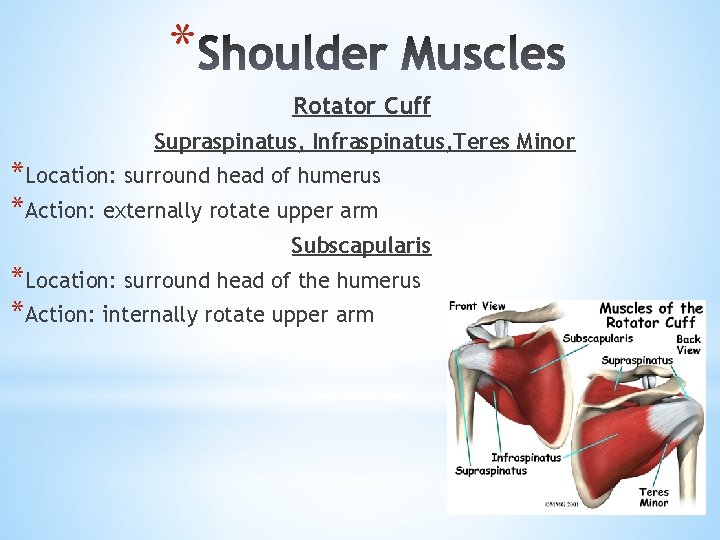
* Rotator Cuff Supraspinatus, Infraspinatus, Teres Minor *Location: surround head of humerus *Action: externally rotate upper arm Subscapularis *Location: surround head of the humerus *Action: internally rotate upper arm
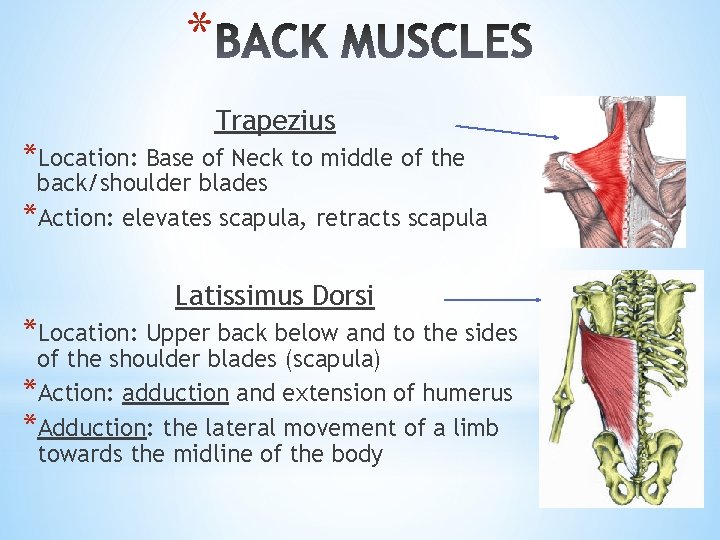
* Trapezius *Location: Base of Neck to middle of the back/shoulder blades *Action: elevates scapula, retracts scapula Latissimus Dorsi *Location: Upper back below and to the sides of the shoulder blades (scapula) *Action: adduction and extension of humerus *Adduction: the lateral movement of a limb towards the midline of the body
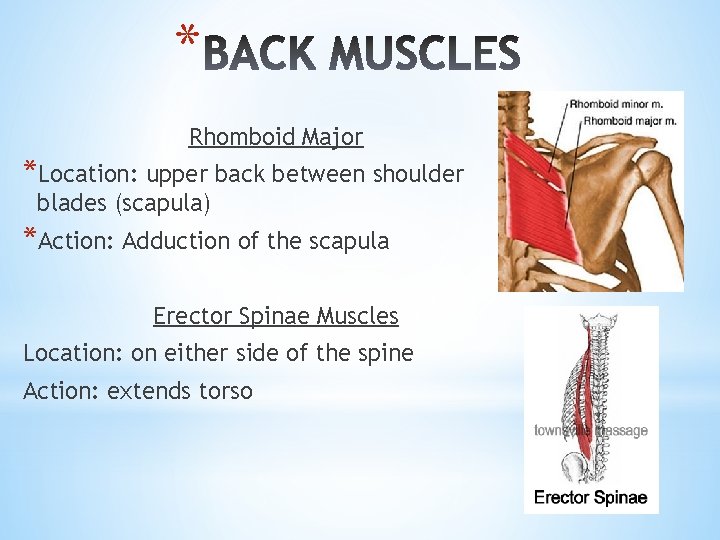
* Rhomboid Major *Location: upper back between shoulder blades (scapula) *Action: Adduction of the scapula Erector Spinae Muscles Location: on either side of the spine Action: extends torso
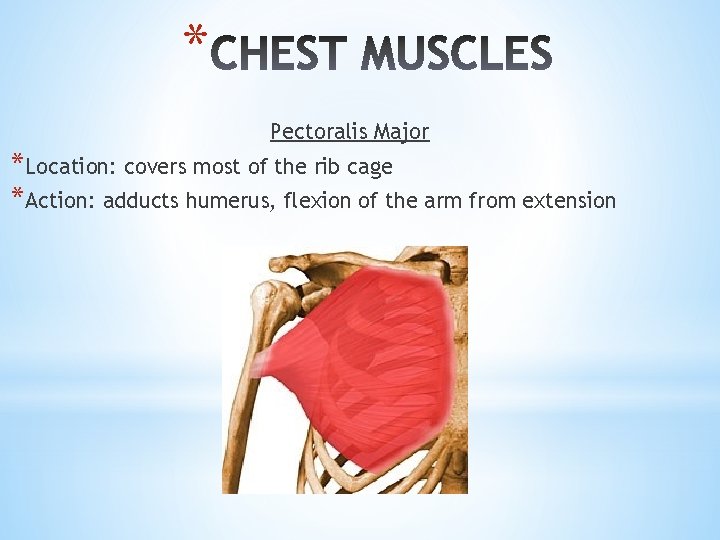
* Pectoralis Major *Location: covers most of the rib cage *Action: adducts humerus, flexion of the arm from extension
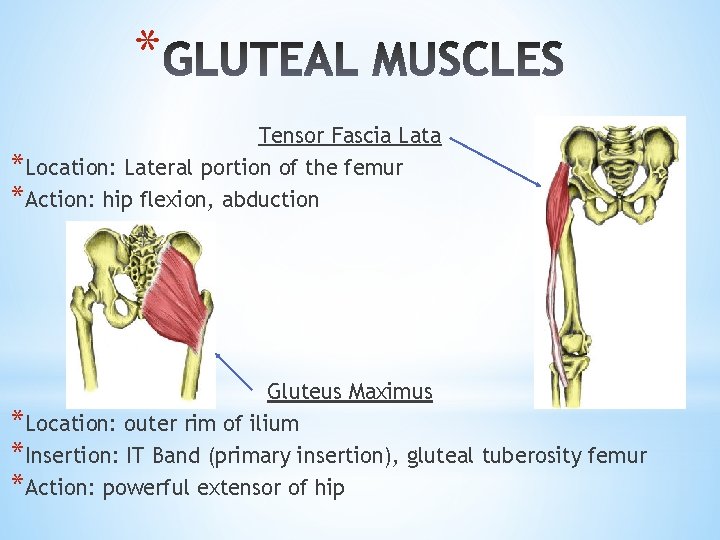
* Tensor Fascia Lata *Location: Lateral portion of the femur *Action: hip flexion, abduction Gluteus Maximus *Location: outer rim of ilium *Insertion: IT Band (primary insertion), gluteal tuberosity femur *Action: powerful extensor of hip
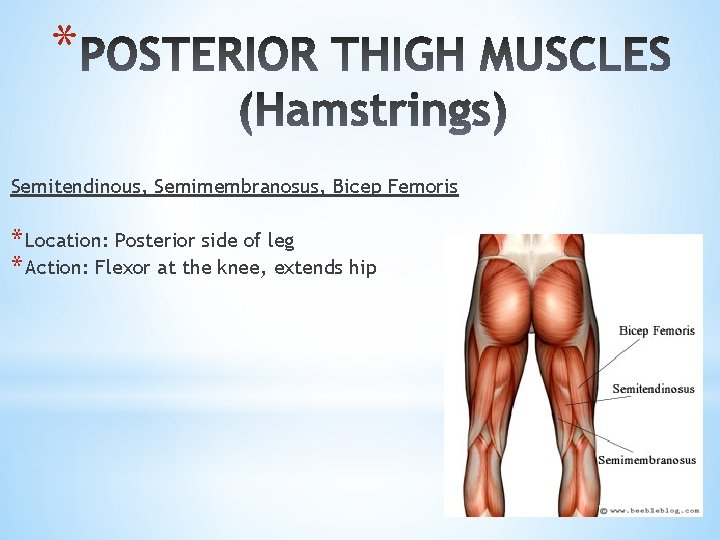
* Semitendinous, Semimembranosus, Bicep Femoris * Location: Posterior side of leg * Action: Flexor at the knee, extends hip
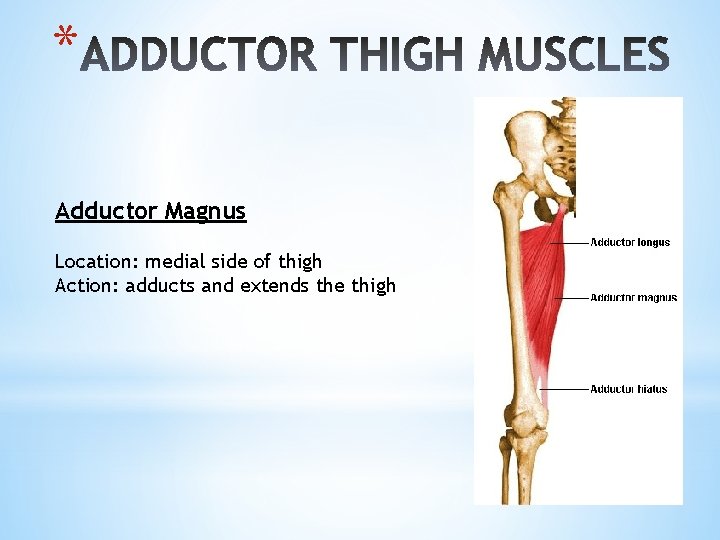
* Adductor Magnus Location: medial side of thigh Action: adducts and extends the thigh
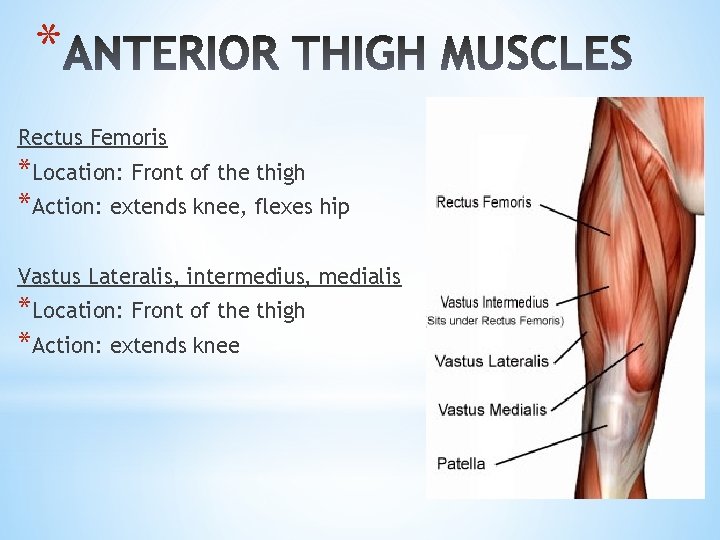
* Rectus Femoris *Location: Front of the thigh *Action: extends knee, flexes hip Vastus Lateralis, intermedius, medialis *Location: Front of the thigh *Action: extends knee
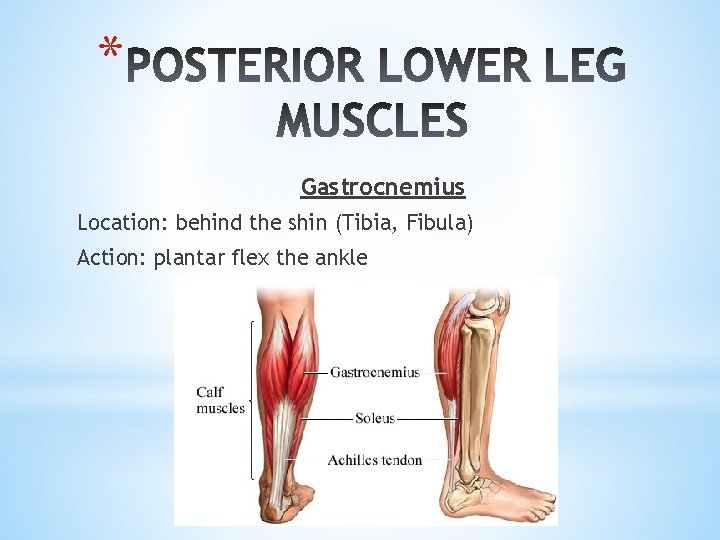
* Gastrocnemius Location: behind the shin (Tibia, Fibula) Action: plantar flex the ankle
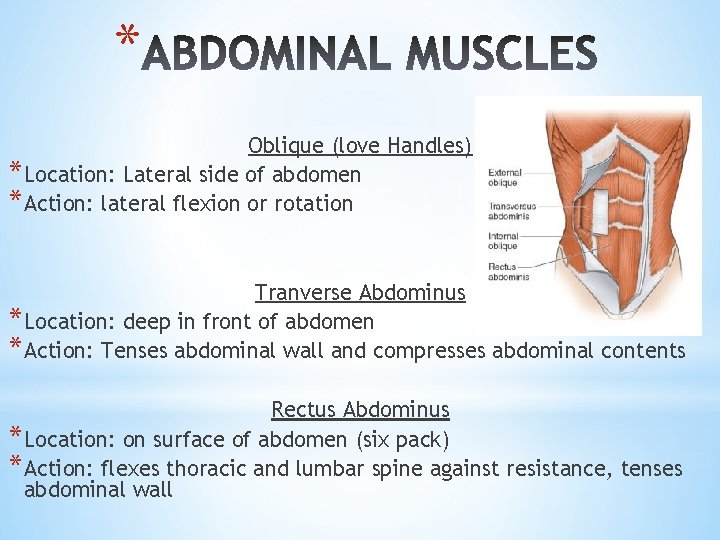
* Oblique (love Handles) *Location: Lateral side of abdomen *Action: lateral flexion or rotation Tranverse Abdominus *Location: deep in front of abdomen *Action: Tenses abdominal wall and compresses abdominal contents Rectus Abdominus *Location: on surface of abdomen (six pack) *Action: flexes thoracic and lumbar spine against resistance, tenses abdominal wall