
MUSCULAR SYSTEM the power system FACTS Nearly half

- Slides: 30
MUSCULAR SYSTEM “the power system”
FACTS: • Nearly half our weight comes from muscle tissue. • There are 650 different muscles in the human body. • Muscles give us form and shape. • Muscles produce most of our body heat.
THREE MAIN FUNCTIONS • Responsible for all body movement. • Responsible for body form and shape (posture) • Responsible for body heat and maintaining body temperature.
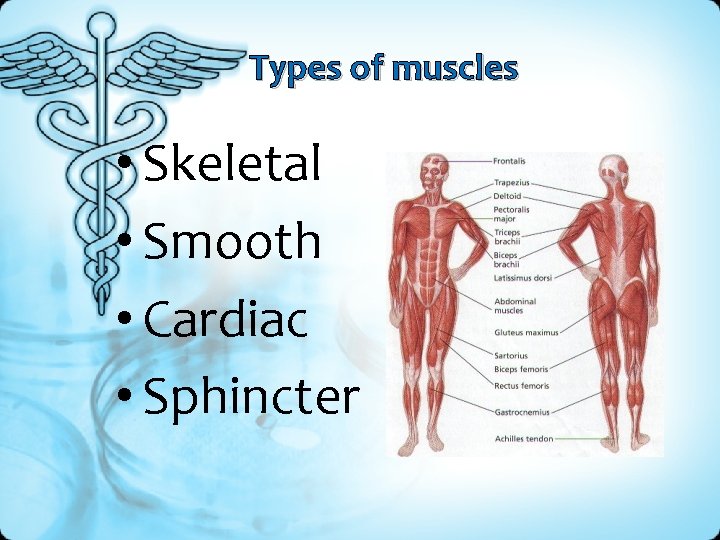
Types of muscles • Skeletal • Smooth • Cardiac • Sphincter
Skeletal Muscle • • Attached to bone Striated (striped) appearance VOLUNTARY Contract quickly, fatigue easily, can’t maintain contraction for long period of time
Skeletal Muscles • Each skeletal muscle cell contains many nuclei • Muscle cells are known as muscle fibers • Cell membrane is call sarcolemma • Cytoplasm is called sarcoplasm
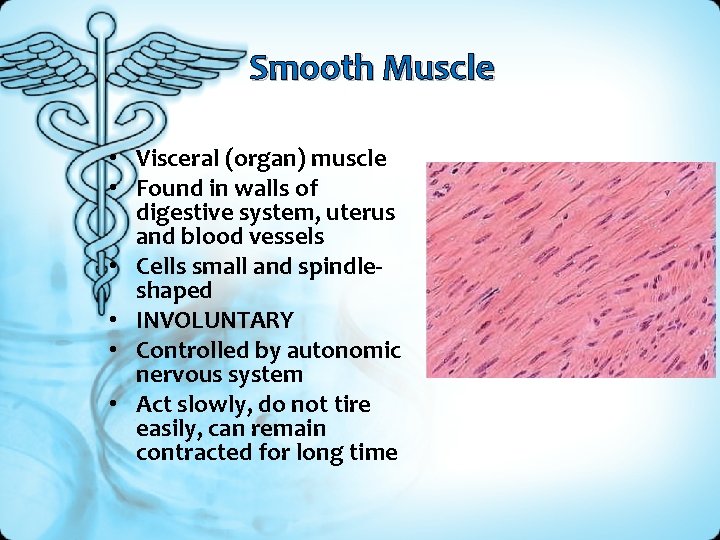
Smooth Muscle • Visceral (organ) muscle • Found in walls of digestive system, uterus and blood vessels • Cells small and spindleshaped • INVOLUNTARY • Controlled by autonomic nervous system • Act slowly, do not tire easily, can remain contracted for long time
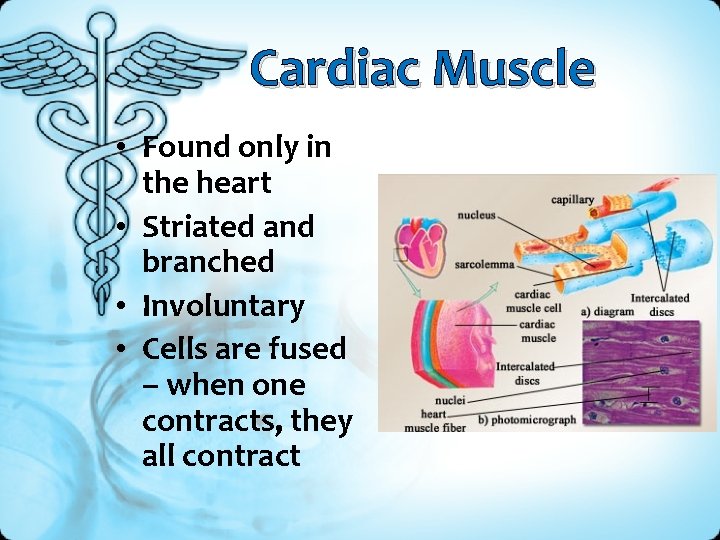
Cardiac Muscle • Found only in the heart • Striated and branched • Involuntary • Cells are fused – when one contracts, they all contract
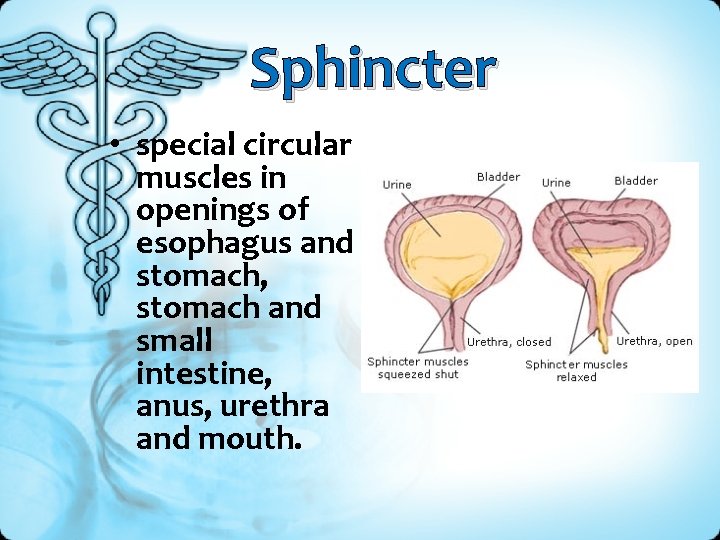
Sphincter • special circular muscles in openings of esophagus and stomach, stomach and small intestine, anus, urethra and mouth.
CHARACTERISTICS OF MUSCLES • CONTRACTIBILITY – the ability of a muscle to reduce the distance between the parts of its contents or the space it surrounds. • EXCITEABILITY (IRRITABILITY) – the ability to respond to certain stimuli by producing impulses.
CHARACTERISTICS OF MUSCLES • EXTENSIBILITY – the ability to be stretched. • ELASTICITY – ability of muscle to return to its original length when relaxing.
Naming Muscles • Location: – frontalis-forehead • Size: – gluteus maximus • Direction of fibers: • external abdominal oblique • Number of origins: – Biceps-two headed muscle in humerus • Location of origin and Insertion: sternocleidomastoid- origin in sternum
Naming muscles • Action flexor: – flexor carpi ulnaris- flexes the wrist • Extensor: – extensor carpi ulnaris- extends the wrist • Levator and Depressor: – depressor anguli oris-depresses the corner of the mouth, raises or lowers body parts
MOVEMENT • Muscles move bones by pulling on them. • As a muscle contracts, it pulls the insertion bone closer to the origin bone. Movement occurs at the joint between the origin and the insertion. • Rule: A muscle’s insertion bone moves toward its origin bone. • Groups of muscles usually contract to produce a single movement.
Muscle Contraction • Sarcolemma: muscle cell membrane • Synaptic Cleft: gap between the axon and the muscle cell.
Muscle Contraction • MOTOR UNIT – a motor neuron plus all the muscle fibers it stimulates. • NEUROMUSCULAR JUNCTION – the junction between the motor neuron’s fiber which transmits the impulse – and the muscle cell membrane. • ACETYLCHOLINE – chemical neurotransmitter, diffuses across the synaptic cleft (carries impulse across synaptic cleft)
• MUSCLE FATIGUE – caused by the accumulation of lactic acid in the muscles. • OXYGEN DEBT – after exercise, the amount of oxygen needed by the muscle to change lactic acid back to glucose. • MUSCLE TONE - When muscles are slightly contracted and ready to pull.
Muscle Efficiency • Improves: -Coordination of all muscles involved -Respiratory and circulatory system to supply needs of active muscular system -Elimination of excess fat -Joint movement involved with that muscle activity
Muscle Strength • Strength (capacity to do work) is increased with training • Muscle size increase due to change in the sarcoplasm (cytoplasm found in the individual skeletal muscle fibers) Not the increase in the number of muscle fiber cells
Muscle Attachments • Tendons: non-elastic cords that attach muscles to bones • Bones are connected at joints
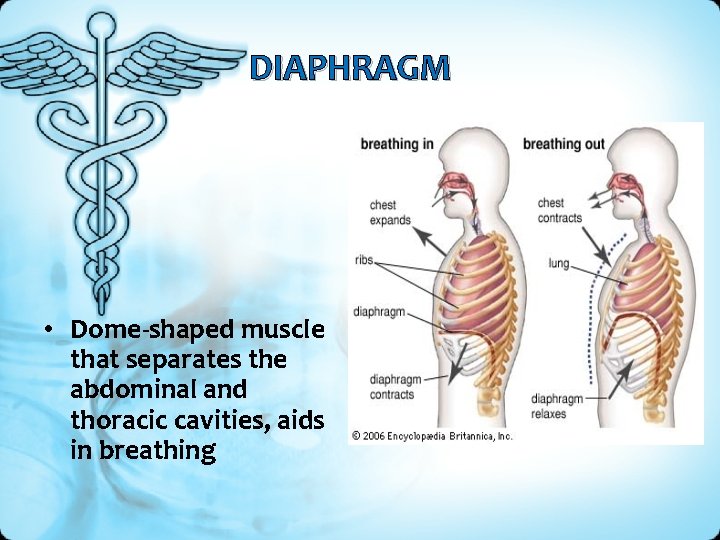
DIAPHRAGM • Dome-shaped muscle that separates the abdominal and thoracic cavities, aids in breathing
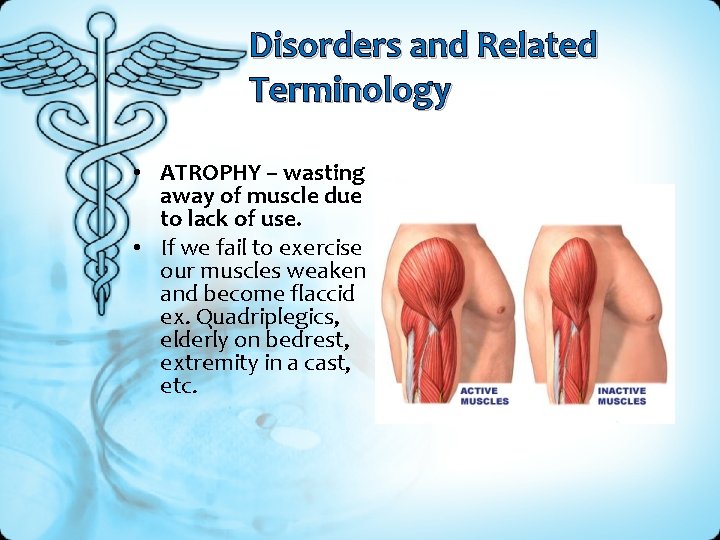
Disorders and Related Terminology • ATROPHY – wasting away of muscle due to lack of use. • If we fail to exercise our muscles weaken and become flaccid ex. Quadriplegics, elderly on bedrest, extremity in a cast, etc.
• Massage of these muscles is essential in providing the proper physiotherapy or a general sense of comfort and well-being to a patient, also prevents atrophy in debilitated patients
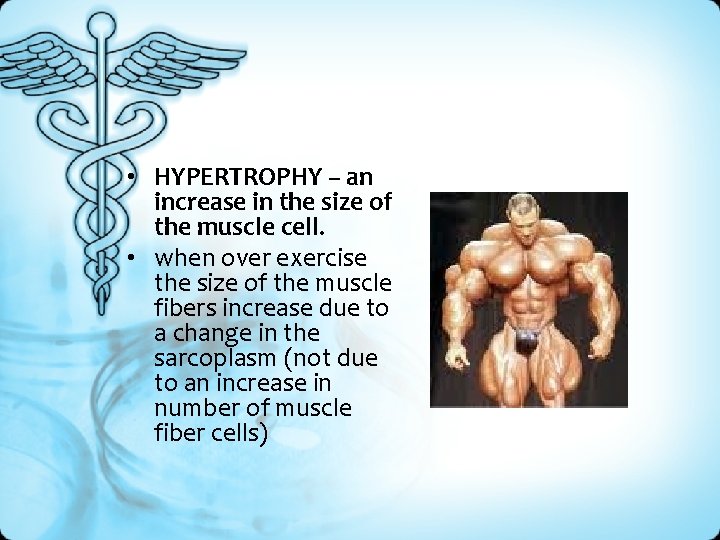
• HYPERTROPHY – an increase in the size of the muscle cell. • when over exercise the size of the muscle fibers increase due to a change in the sarcoplasm (not due to an increase in number of muscle fiber cells)
• STRAIN – tear in the muscle resulting from excessive use. Bleeding inside the muscle can result in pain and swelling. Ice packs will help stop bleeding and reduce swelling. – RICE : rest, ice, compression, elevation
• Rehabilitation: retaining of injured or unused muscles • MYALGIA – muscle pain
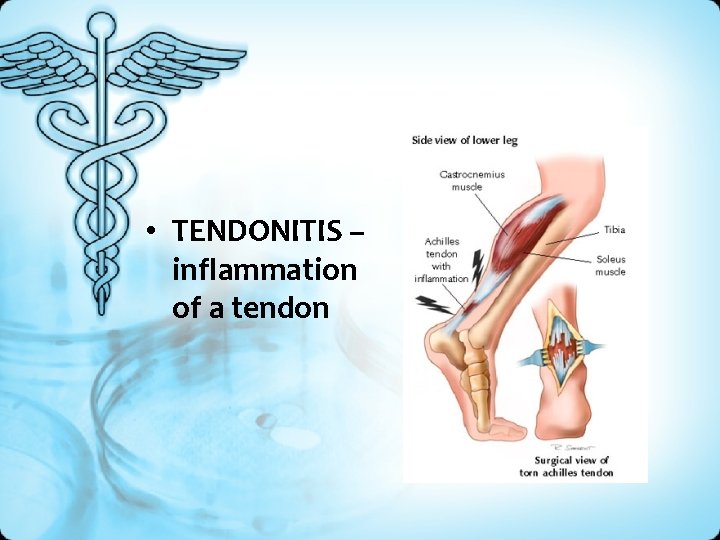
• TENDONITIS – inflammation of a tendon
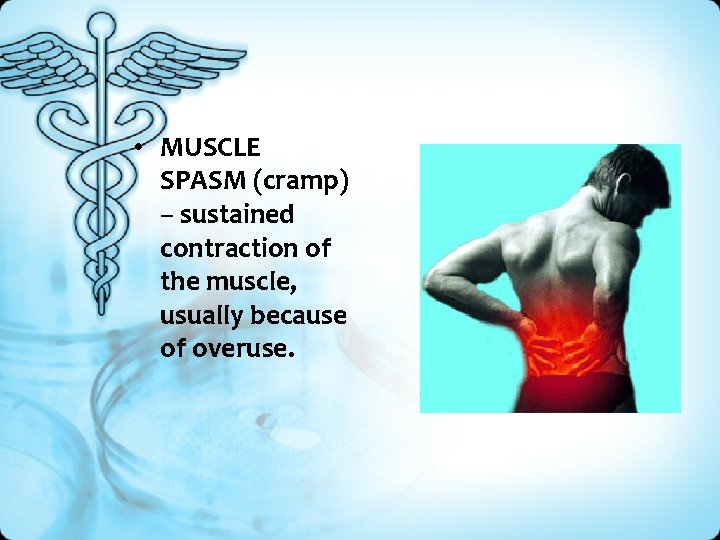
• MUSCLE SPASM (cramp) – sustained contraction of the muscle, usually because of overuse.
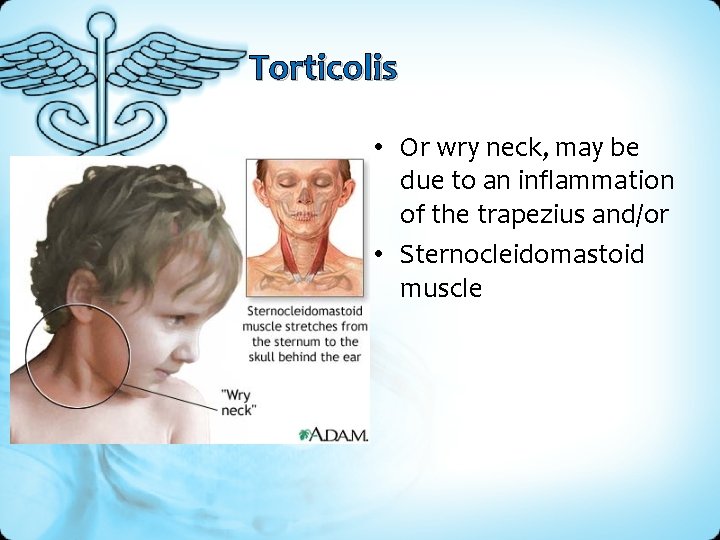
Torticolis • Or wry neck, may be due to an inflammation of the trapezius and/or • Sternocleidomastoid muscle
La belleza perece en la vida pero es inmortal en el arte. Leonardo Da Vinci