
Muscular System Outline 1 Skeletal Voluntary responsible for
Muscular System Outline

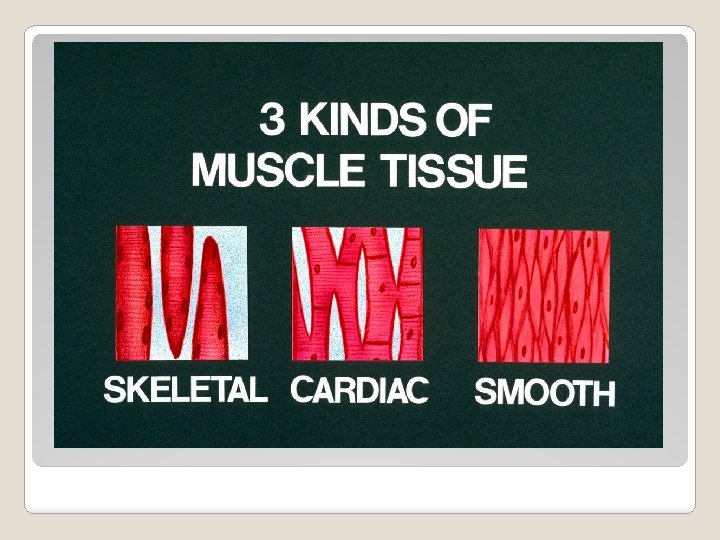
1. Skeletal – Voluntary; responsible for movement. 2. Smooth (Visceral) – Involuntary; movements of respiration, digestion, and urination. 3. Cardiac – Involuntary; heart muscle. 3 Types of Muscle Tissue
� Aid in movement � Provide and maintain posture � Protect internal organs � Provide movement of blood, food and waste products throughout the body � Open and close body openings � Produces heat Functions of Muscle
Contraction = movement and shortening of muscle Tonus = slight continuous contraction Flaccid = soft, not contracted Vocab
1. Mechanically – You telling your brain to activate a muscle. EX: Holding your pencil to write these notes. 2. Electrically – Using a machine to activate a muscle. EX: IFC in ATR. 3. Chemically – Drugs that activate a muscle. EX: Narcotics will dilate your pupils. Muscle stimulation
�Irritability or excitability: ability to respond to a stimulus �Contractility: ability to shorten �Extensibility: lengthen �Elasticity: length ability to stretch and ability to recoil to its resting Vocabulary

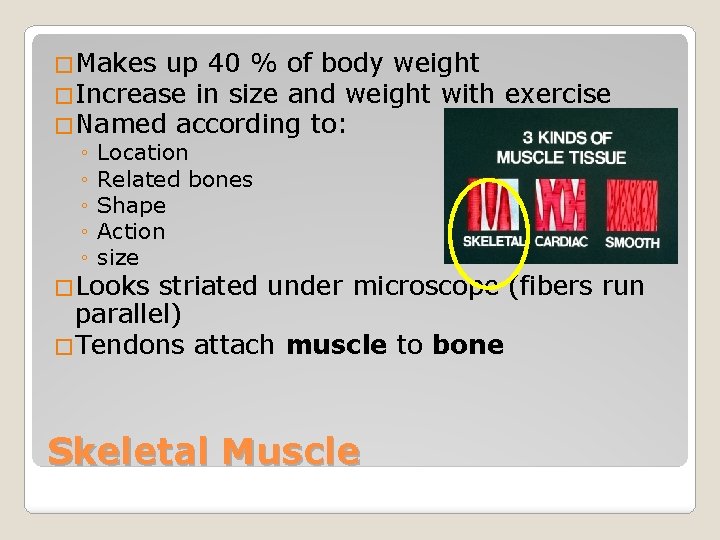
�Makes up 40 % of body weight �Increase in size and weight with exercise �Named according to: ◦ Location ◦ Related bones ◦ Shape ◦ Action ◦ size �Looks striated under microscope (fibers run parallel) �Tendons attach muscle to bone Skeletal Muscle
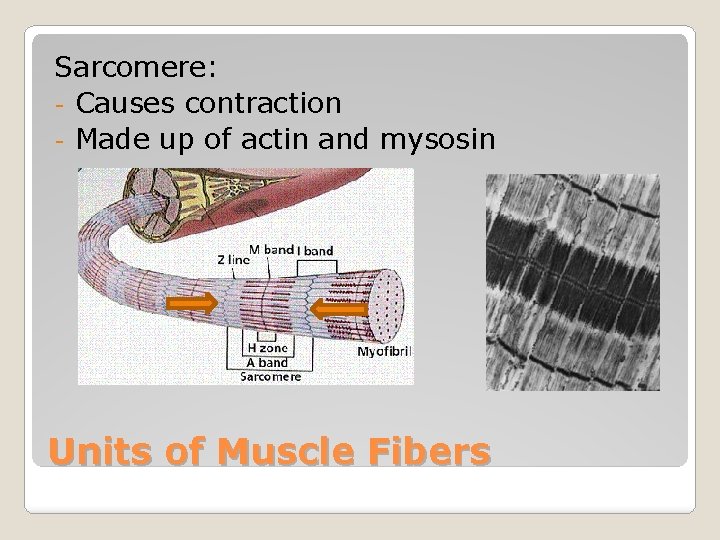
Sarcomere: - Causes contraction - Made up of actin and mysosin Units of Muscle Fibers
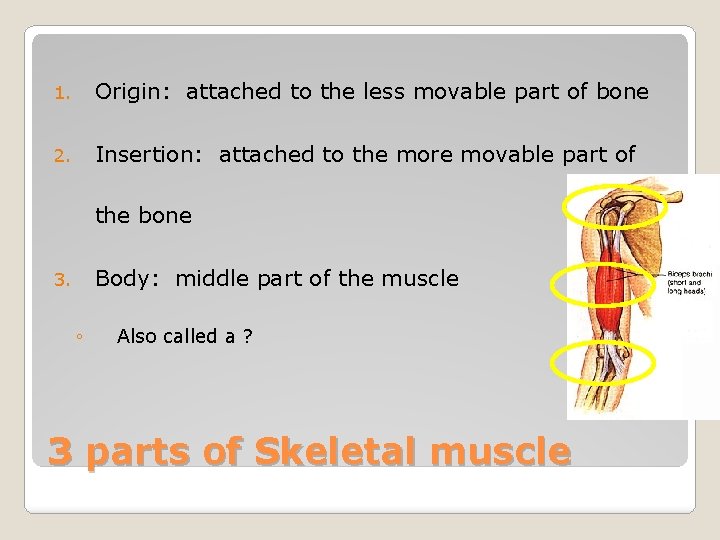
1. Origin: attached to the less movable part of bone 2. Insertion: attached to the more movable part of the bone Body: middle part of the muscle 3. ◦ Also called a ? 3 parts of Skeletal muscle
�Flexion = decreasing joint angle �Extension = increasing joint angle �Abduction = movement away from midline �Adduction = movement towards the midline �Pronation = turning palms down �Supination = turning palms up Movement Terms
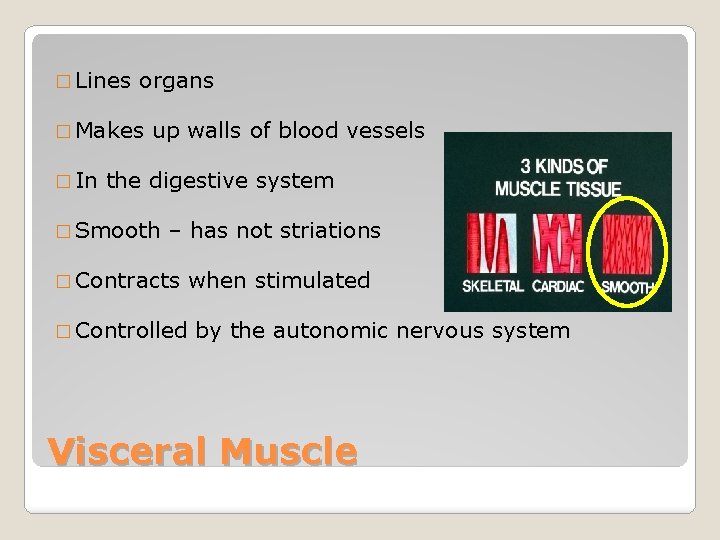
� Lines organs � Makes � In up walls of blood vessels the digestive system � Smooth – has not striations � Contracts � Controlled when stimulated by the autonomic nervous system Visceral Muscle
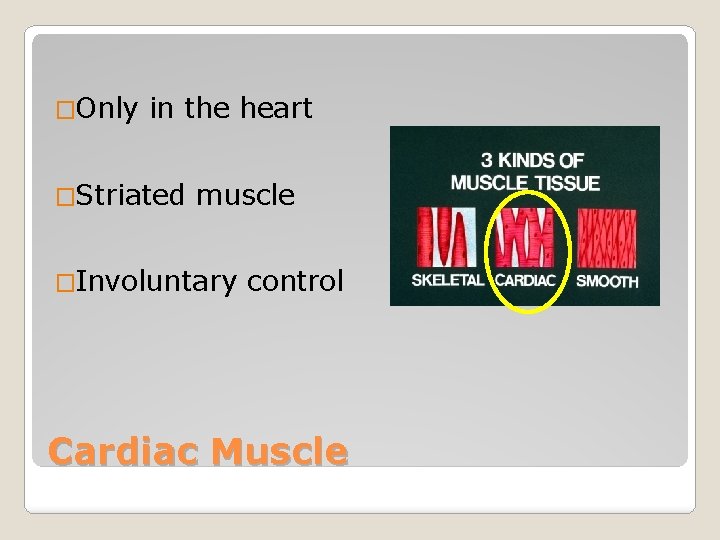
�Only in the heart �Striated muscle �Involuntary control Cardiac Muscle
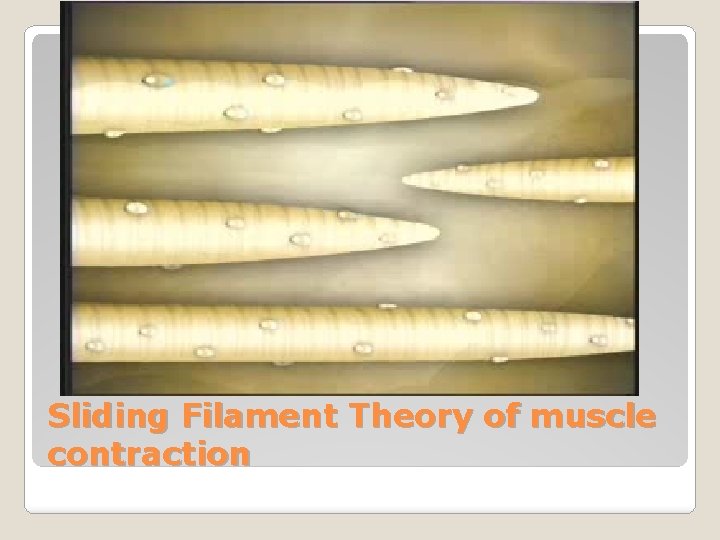
Sliding Filament Theory of muscle contraction
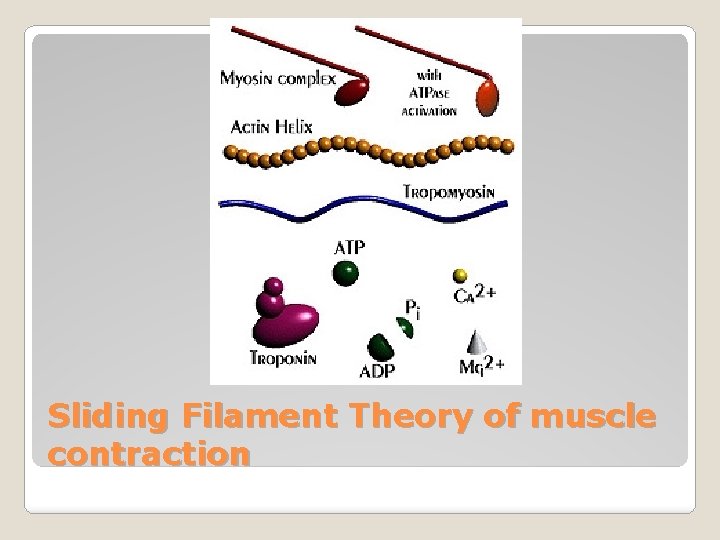
Sliding Filament Theory of muscle contraction
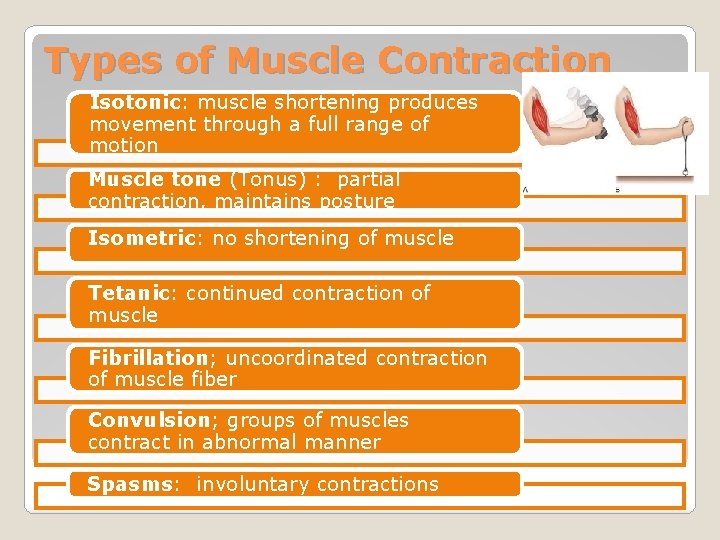
Types of Muscle Contraction Isotonic: muscle shortening produces movement through a full range of motion Muscle tone (Tonus) : partial contraction, maintains posture Isometric: no shortening of muscle Tetanic: continued contraction of muscle Fibrillation; uncoordinated contraction of muscle fiber Convulsion; groups of muscles contract in abnormal manner Spasms: involuntary contractions
- Slides: 17