
MUSCULAR SYSTEM MUSCLE FACTS v There are more
- Slides: 47
MUSCULAR SYSTEM
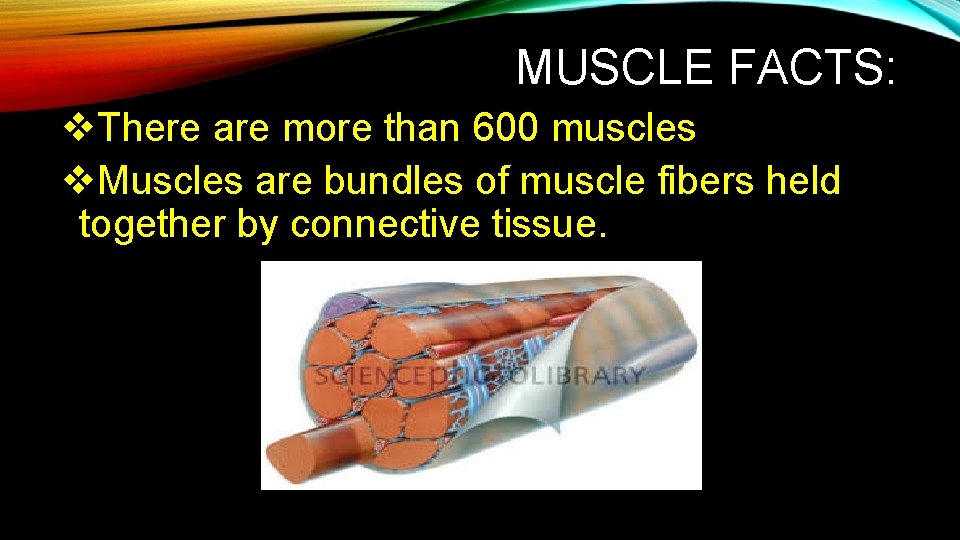
MUSCLE FACTS: v. There are more than 600 muscles v. Muscles are bundles of muscle fibers held together by connective tissue.
CHARACTERISTICS OF ALL MUSCLES: v. Excitability – irritability, the ability to respond to a stimulus such as a nerve impulse {receives & responds to stimuli}
CHARACTERISTICS OF ALL MUSCLES: v. Contractibility – muscle fibers that are stimulated by nerves contract (become short and thick), which causes movement {able to shorten & thicken}
CHARACTERISTICS OF ALL MUSCLES: v. Extensibility – the ability to be stretched {able to stretch without damage}
CHARACTERISTICS OF ALL MUSCLES: v. Elasticity –allows the muscle to return to its original shape after it has contracted or stretched {able to return to shape}
Muscles can be voluntary or involuntary. ØVoluntary – you have control over its action ØInvoluntary – they function without conscious thought or control
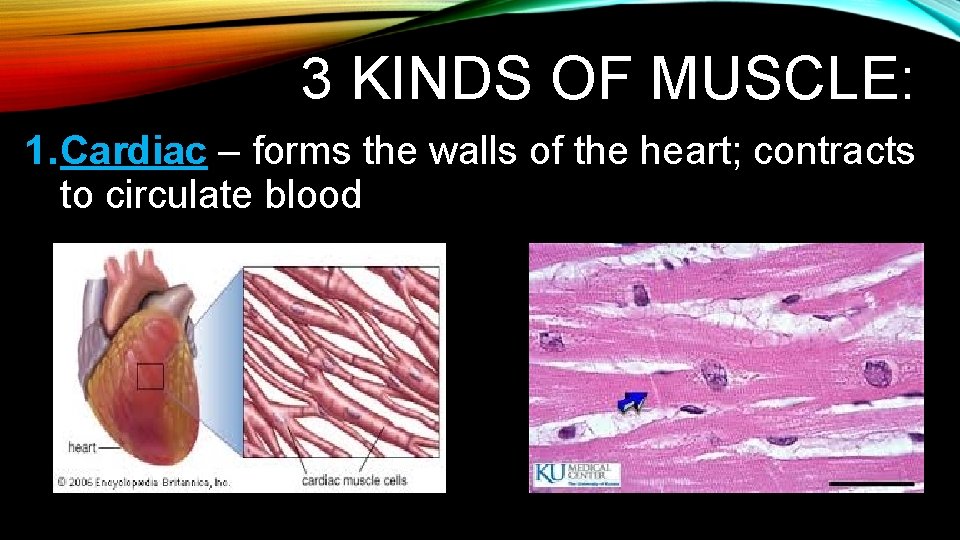
3 KINDS OF MUSCLE: 1. Cardiac – forms the walls of the heart; contracts to circulate blood
Is cardiac muscle voluntary or involuntary? üINVOLUNTARY
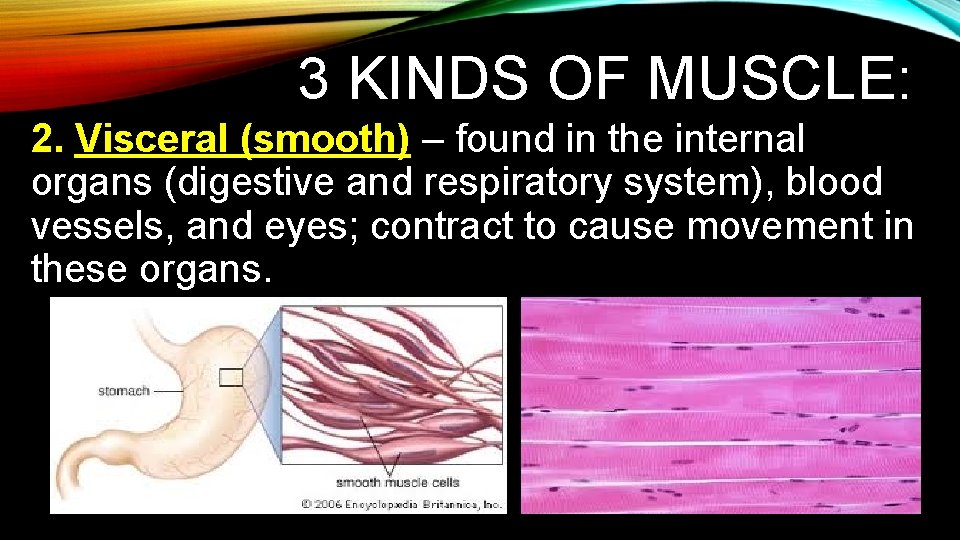
3 KINDS OF MUSCLE: 2. Visceral (smooth) – found in the internal organs (digestive and respiratory system), blood vessels, and eyes; contract to cause movement in these organs.
Is visceral muscle voluntary or involuntary? üINVOLUNTARY
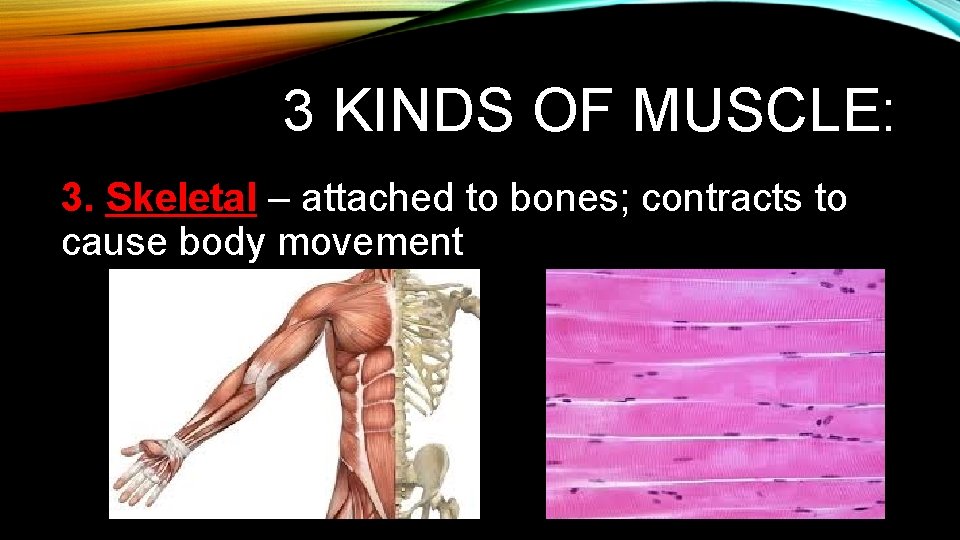
3 KINDS OF MUSCLE: 3. Skeletal – attached to bones; contracts to cause body movement
Is skeletal muscle voluntary or involuntary? üVOLUNTARY
FUNCTIONS OF SKELETAL MUSCLE: 1. Attach to bones to provide voluntary movement 2. Produce heat and energy for the body 3. Help maintain posture by holding the body erect 4. Protect internal organs
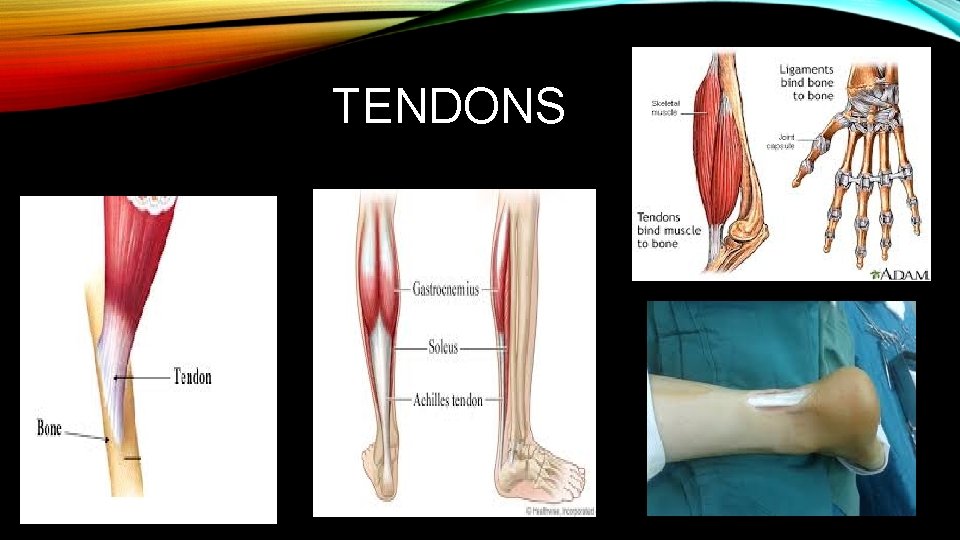
SKELETAL MUSCLE: Skeletal muscles attach to bones in different ways: • Tendons – strong, tough, fibrous connective tissue cords that can attach muscles to bones. ex: gastrocnemius on the calf attaches to heelbone by Achilles tendon
TENDONS
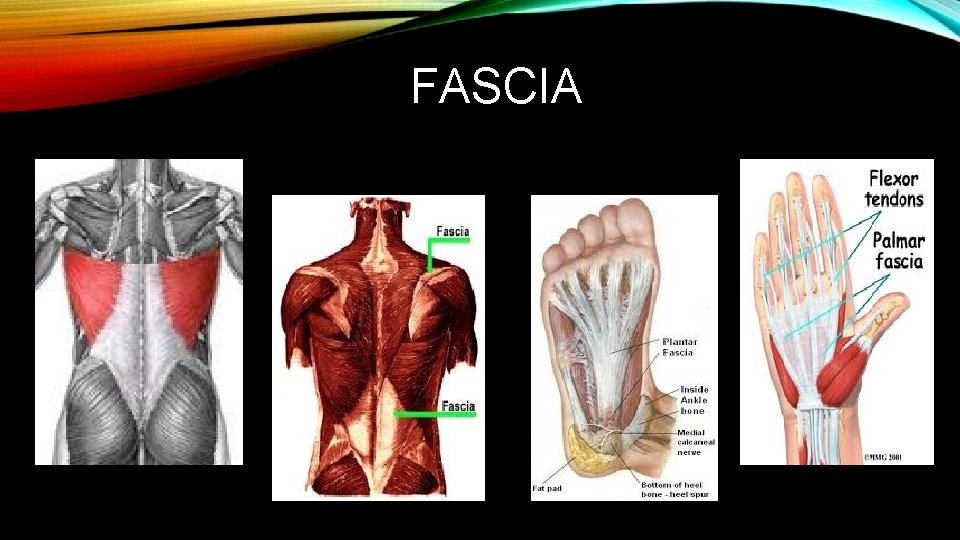
• Fascia – tough, sheetlike membrane that covers and protects the muscle tissue ex: deep muscles of the trunk and back are surrounded by the lumbodorsal fascia
FASCIA
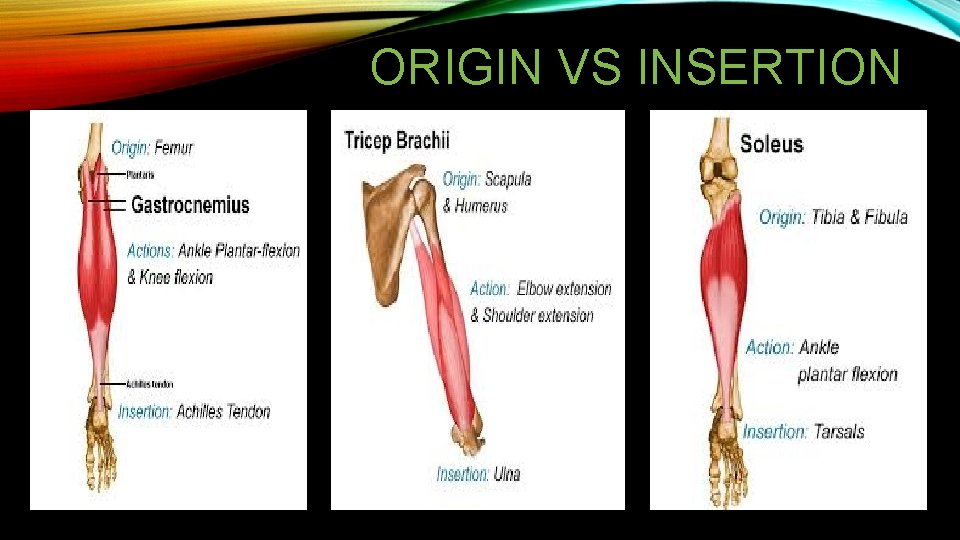
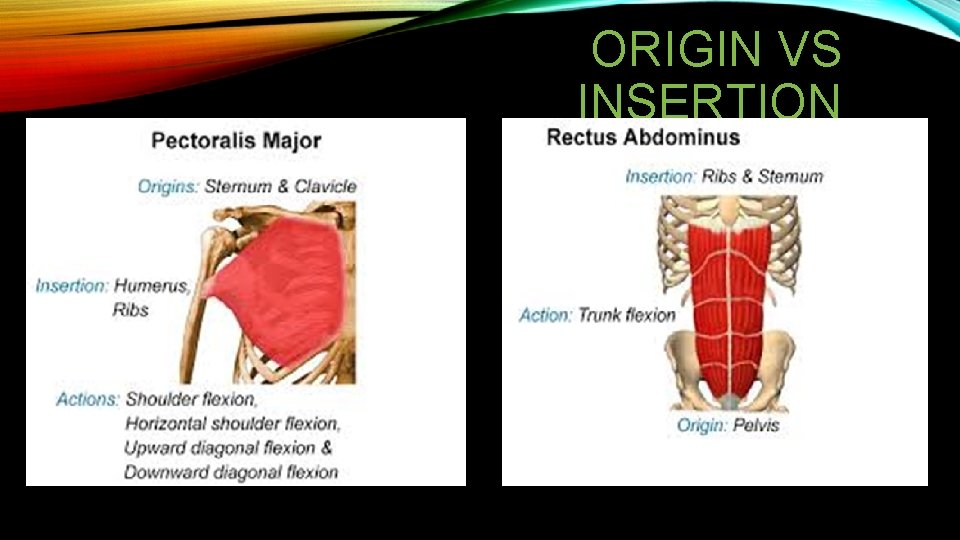
ORIGIN VS INSERTION: • When a muscle attaches to a bone, the end that does not move is called the origin. • The end that moves when the muscle contracts is called the insertion.
ORIGIN VS INSERTION: Example: the origin of the deltoid (shoulder muscle) is by the clavicle & scapula. Its insertion is on the humerus. When the deltoid contracts, the area by the scapula remains stationary, but the area by the humerus moves and abducts the arm away from the body.
ORIGIN VS INSERTION
ORIGIN VS INSERTION
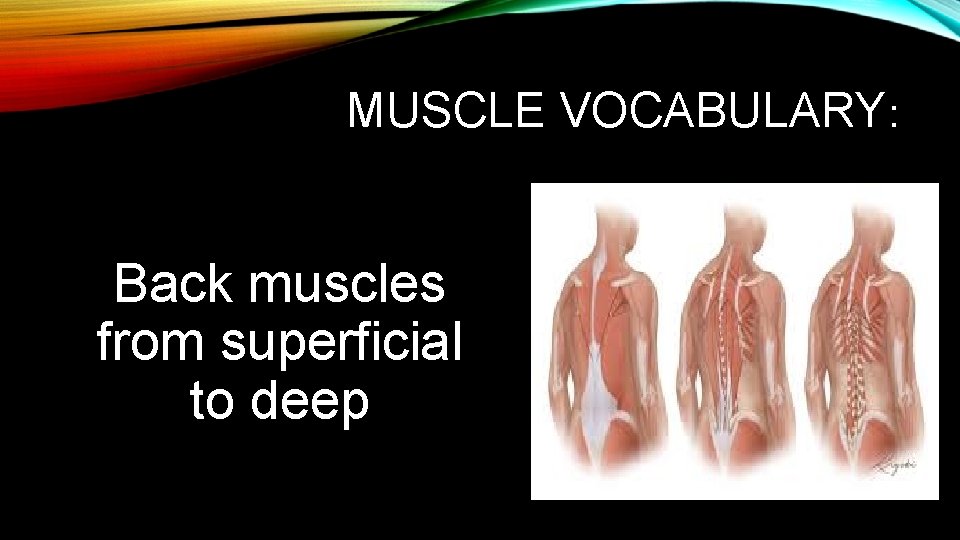
MUSCLE VOCABULARY: §Superficial – closer to the surface of the body §Deep – farther away from the surface of the body
MUSCLE VOCABULARY: Back muscles from superficial to deep
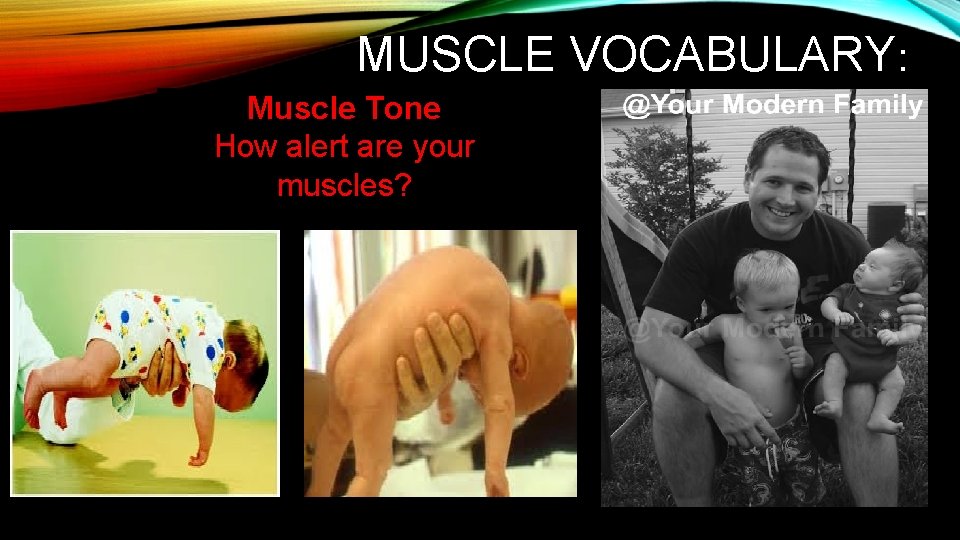
MUSCLE VOCABULARY: §Muscle tone – state of partial contraction or readiness to act. Muscles are partially contracted at all times, even when not in use. {the state of muscle tension inside a muscle when it’s at rest}
MUSCLE VOCABULARY: Muscle Tone How alert are your muscles?
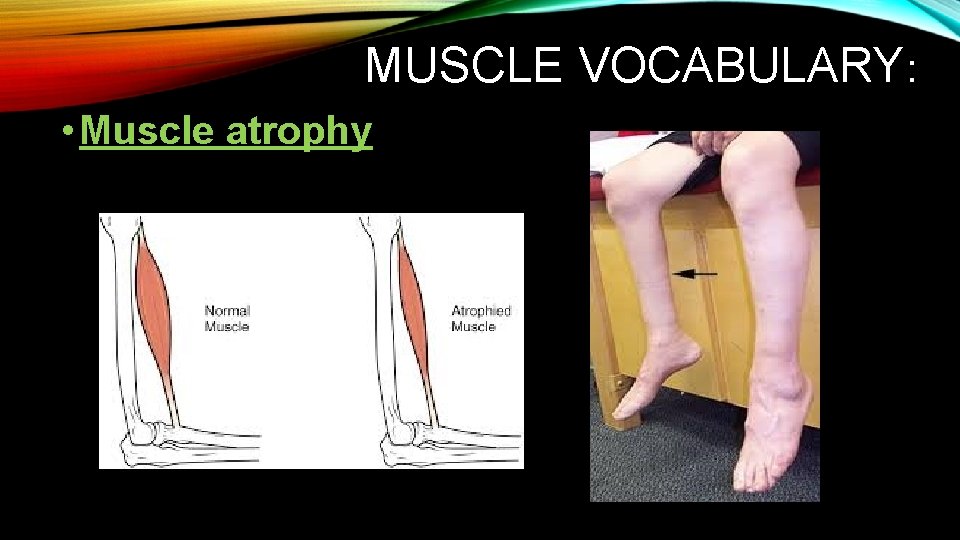
MUSCLE VOCABULARY: §Muscle atrophy – muscles shrink in size and lose strength; can occur in severe illness (paralysis) when muscles aren’t used for a longtime
MUSCLE VOCABULARY: • Muscle atrophy
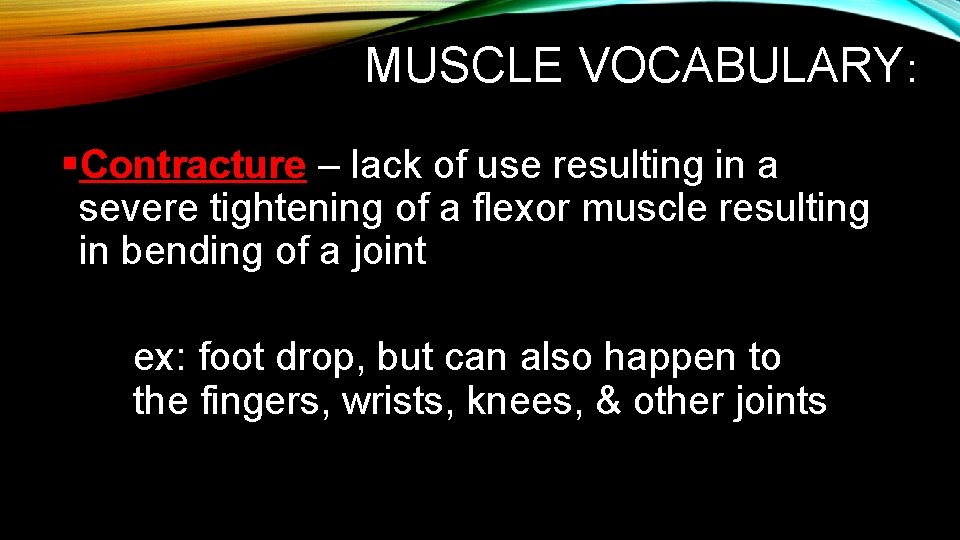
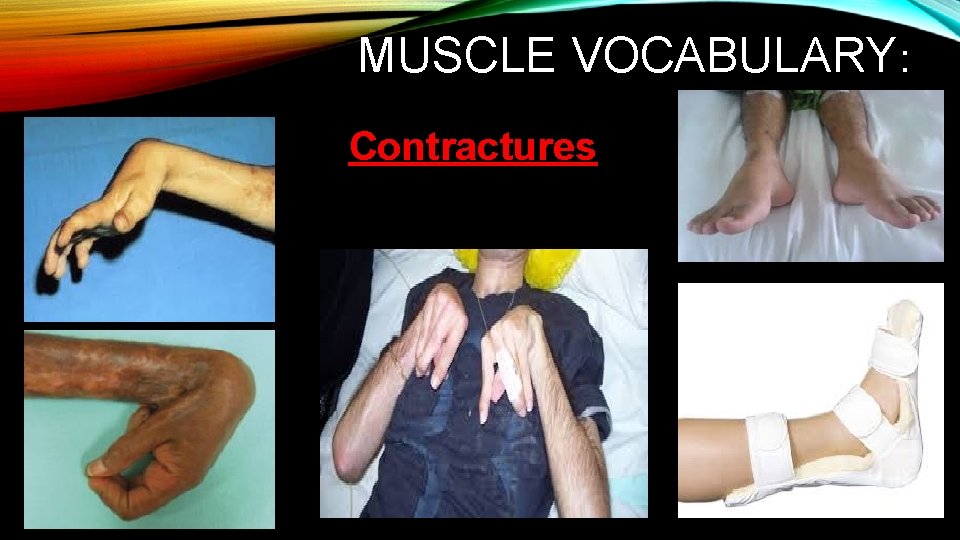
MUSCLE VOCABULARY: §Contracture – lack of use resulting in a severe tightening of a flexor muscle resulting in bending of a joint ex: foot drop, but can also happen to the fingers, wrists, knees, & other joints
MUSCLE VOCABULARY: Contractures
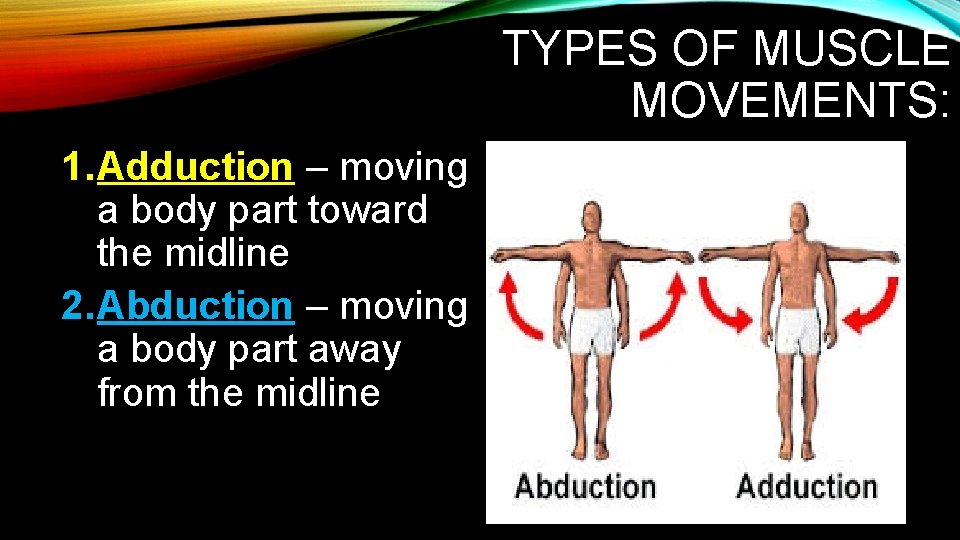
TYPES OF MUSCLE MOVEMENTS: 1. Adduction – moving a body part toward the midline 2. Abduction – moving a body part away from the midline
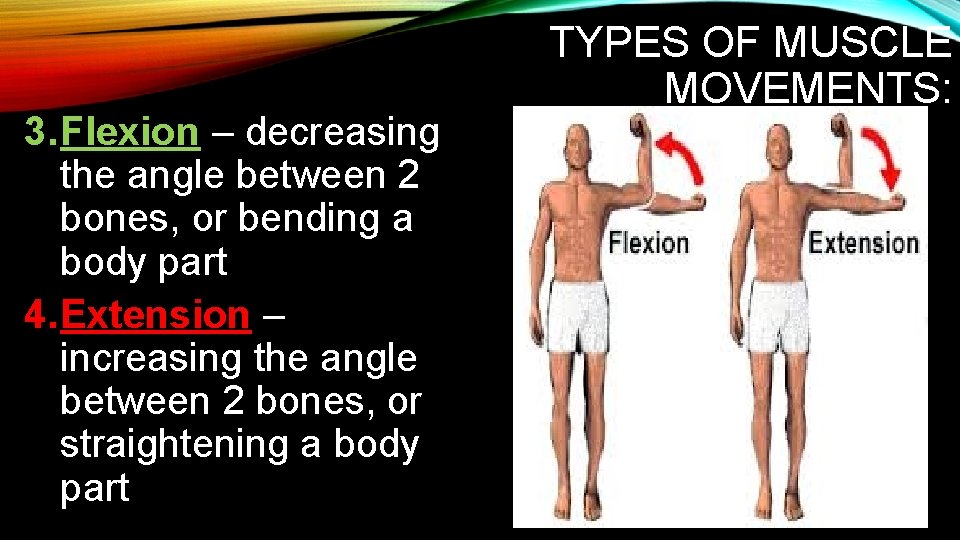
3. Flexion – decreasing the angle between 2 bones, or bending a body part 4. Extension – increasing the angle between 2 bones, or straightening a body part TYPES OF MUSCLE MOVEMENTS:
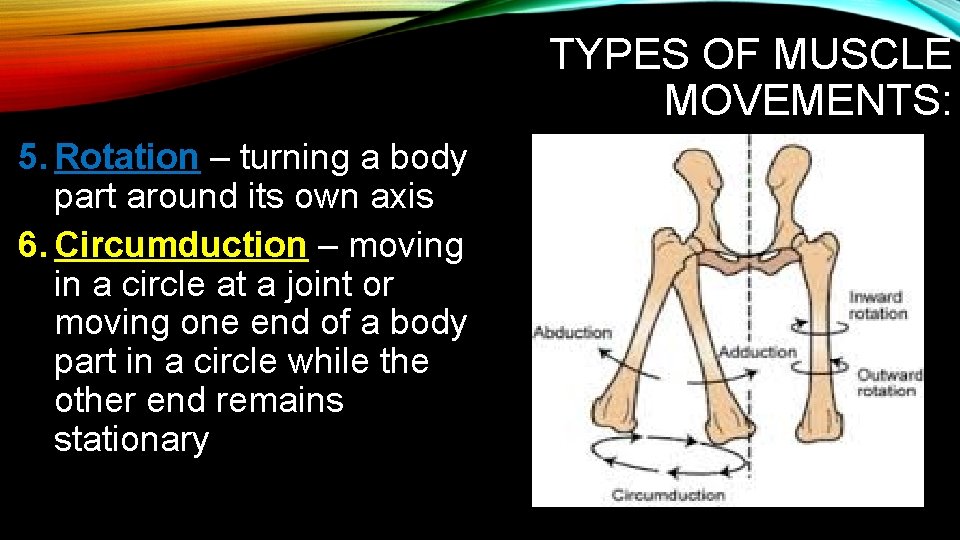
TYPES OF MUSCLE MOVEMENTS: 5. Rotation – turning a body part around its own axis 6. Circumduction – moving in a circle at a joint or moving one end of a body part in a circle while the other end remains stationary
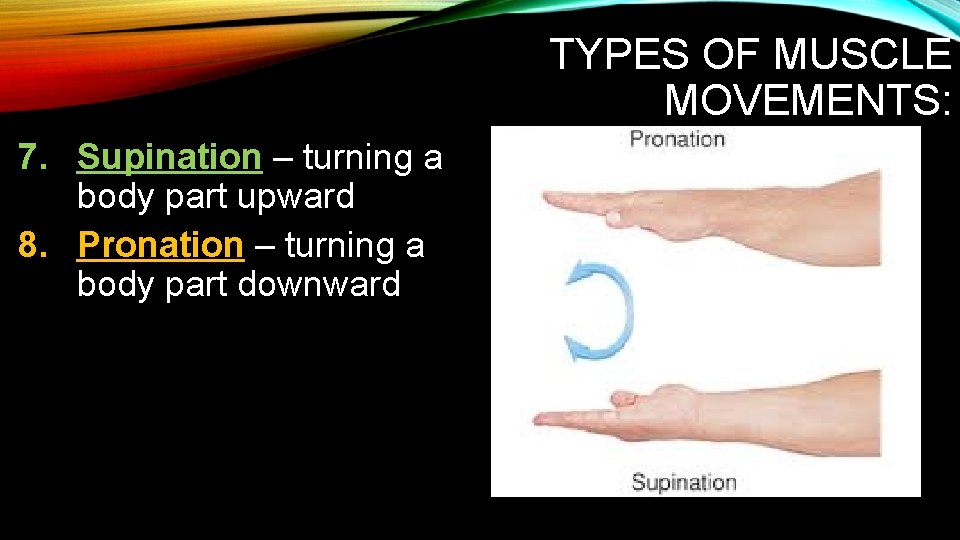
TYPES OF MUSCLE MOVEMENTS: 7. Supination – turning a body part upward 8. Pronation – turning a body part downward
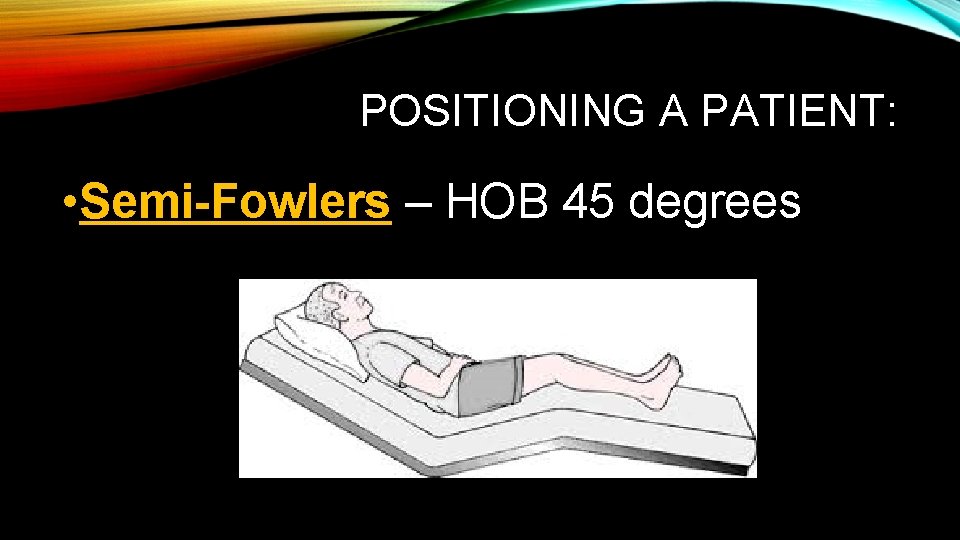
POSITIONING A PATIENT: • Semi-Fowlers – HOB 45 degrees
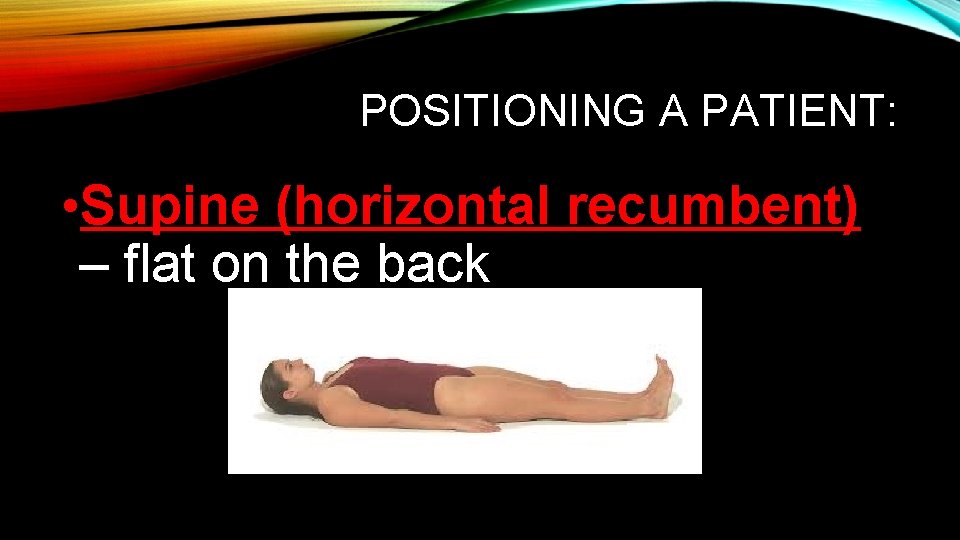
POSITIONING A PATIENT: • Supine (horizontal recumbent) – flat on the back
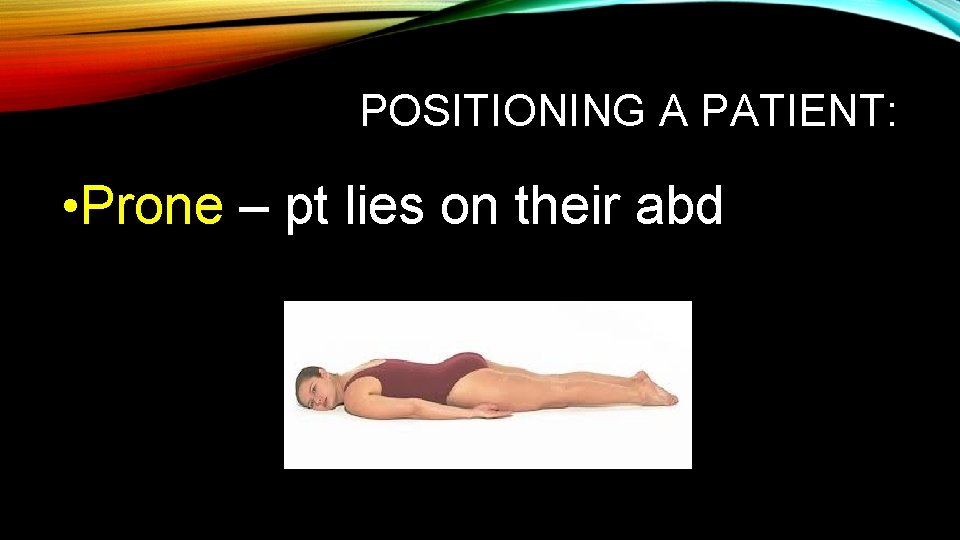
POSITIONING A PATIENT: • Prone – pt lies on their abd
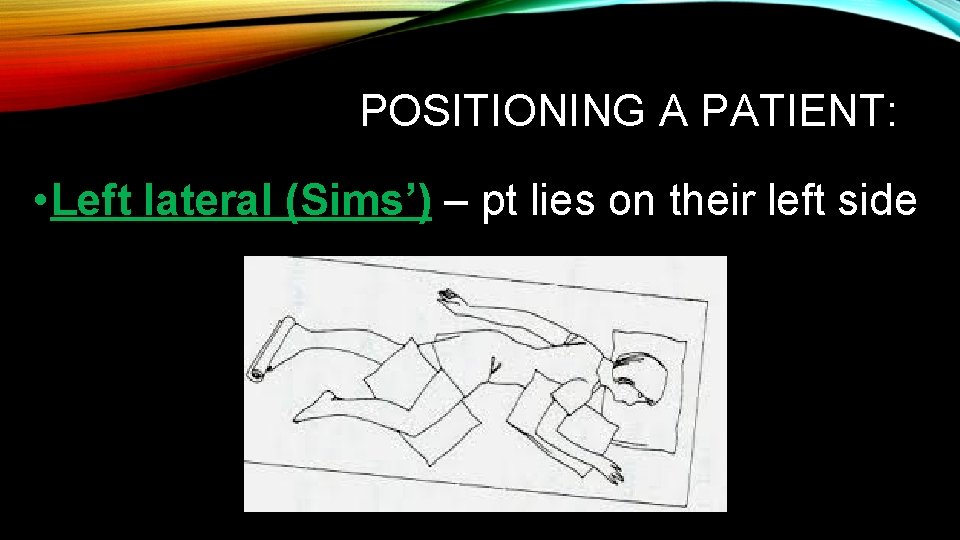
POSITIONING A PATIENT: • Left lateral (Sims’) – pt lies on their left side
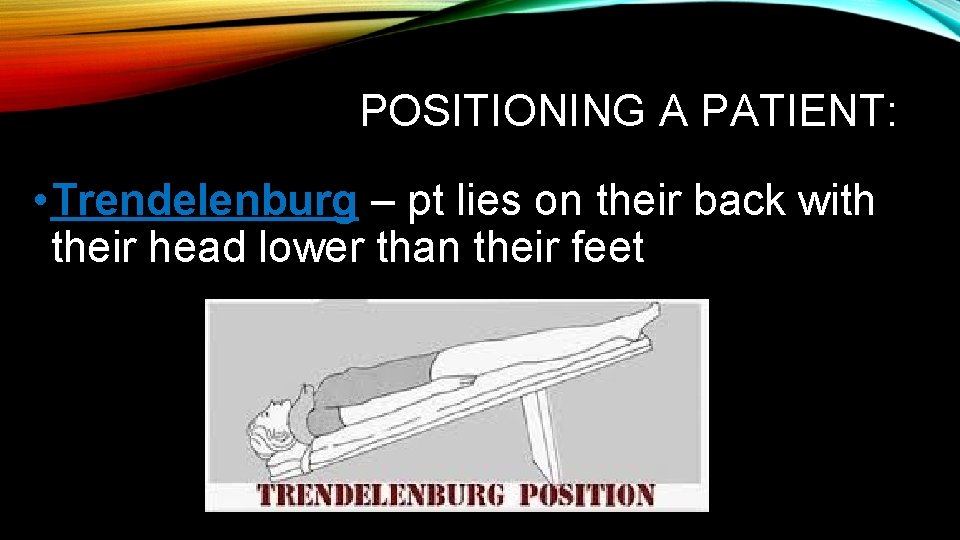
POSITIONING A PATIENT: • Trendelenburg – pt lies on their back with their head lower than their feet
DISEASES/DISORDERS : Fibromyalgia Øchronic, widespread pain in specific muscle sites ØSymptoms = pain, stiffness, numbness or tingling in arms or legs, sleep disturbances, headaches, depression ØCause = unknown; stress, weather, & poor physical fitness affect the condition ØTreatment = directed toward pain relief by - PT, massage, exercise, stress reduction, meds to relax muscles and relief pain
DISEASES/DISORDERS : Muscular Dystrophy ØGroup of inherited diseases that lead to chronic, progressive muscle atrophy ØUsually appears in childhood ØMost types result in total disability & early death ØMost common type is Duchene MD
DISEASES/DISORDERS : Duchenne Muscular Dystrophy ØCause = genetic defect; @ birth infant is healthy but as muscle cells die, child loses the ability to move ØOnset = 2 -5 years of age ØBy 9 -13 years, child is confined to wheelchair ØMuscle weakness affects heart & diaphragm = respiratory/cardiac failure = death
DISEASES/DISORDERS : Duchenne Muscular Dystrophy ØLife expectancy = late teens-early 20’s ØTreatment = no cure; PT used to slow the progress
DISEASES/DISORDERS : Myasthenia Gravis ØChronic condition where nerve impulses aren’t properly transmitted to muscles ØThis leads to progressive muscular weakness & paralysis ØIf MG affects respiratory muscles, it can be fatal
DISEASES/DISORDERS : Myasthenia Gravis ØCause = unknown; may be autoimmune (antibodies attack body’s own tissues) ØTreatment = no cure; only supportive care
DISEASES/DISORDERS : Muscle Spasms ØAKA muscle cramps ØSudden, painful, involuntary muscle contractions ØUsually occur in legs or feet ØCause = overexertion, low electrolyte levels, poor circulation ØTreatment = gentle pressure & stretching
DISEASES/DISORDERS : Strain ØOverstretching of or injury to a muscle and/or tendon ØFrequently occur in back, arms, legs ØCause = prolonged or sudden muscle exertion ØSymptoms = myalgia (muscle pain), swelling, limited movement ØTreatment = rest, muscle relaxants, pain meds, elevating the extremity, alternating hot & cold packs