
Muscular System Learning objectives All can state why
Muscular System Learning objectives All: can state why muscles need to work in pairs. Most: can explain how the muscles work in pairs. Some: can apply knowledge of muscles in relation to different joints in the body.
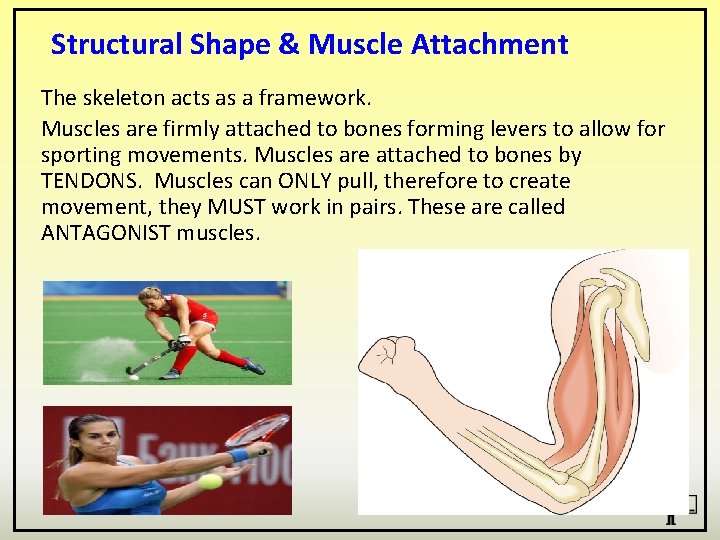
Structural Shape & Muscle Attachment The skeleton acts as a framework. Muscles are firmly attached to bones forming levers to allow for sporting movements. Muscles are attached to bones by TENDONS. Muscles can ONLY pull, therefore to create movement, they MUST work in pairs. These are called ANTAGONIST muscles.
Muscle contractions There are 2 types of muscle contractions: ISOMETRIC - no change in muscle length eg rugby scrum ISOTONIC – 2 types Eccentric = muscle lengthens Concentric = muscle shortens

Voluntary Muscles What happens when muscles contract? Muscles shorten when they contract and lengthen when they relax.
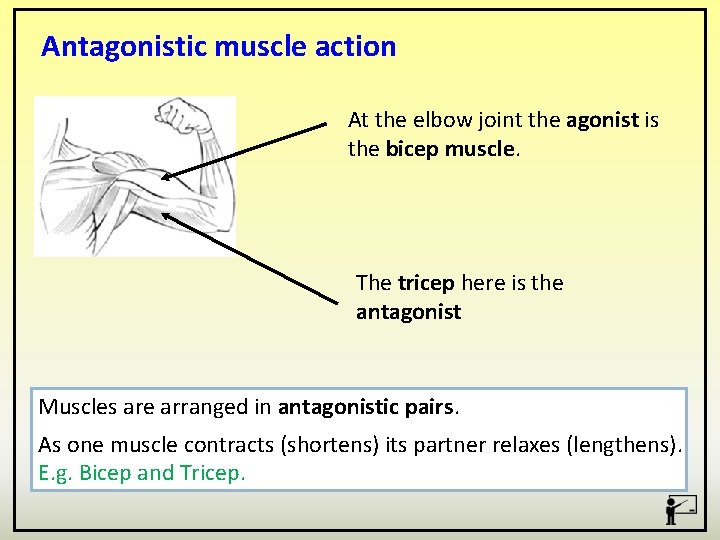
Antagonistic muscle action At the elbow joint the agonist is the bicep muscle. The tricep here is the antagonist Muscles are arranged in antagonistic pairs. As one muscle contracts (shortens) its partner relaxes (lengthens). E. g. Bicep and Tricep.

Antagonistic muscle action Gastrocnemius and Tibialis Anterior acting at the ankle joint. Hip Flexors and Gluteals acting at the hip joint. Hamstring and Quadricep acting at the knee joint.

Muscle attachment: Origin (Muscle tendon attaches to stationary bone) Insertion (Muscle tendon attaches to moving bone)
How movement occurs: How movement occurs 1 2 3 4 5 6
- Slides: 8