
Muscular and Skeletal System Use these to fill
- Slides: 17
Muscular and Skeletal System Use these to fill in your guided notes
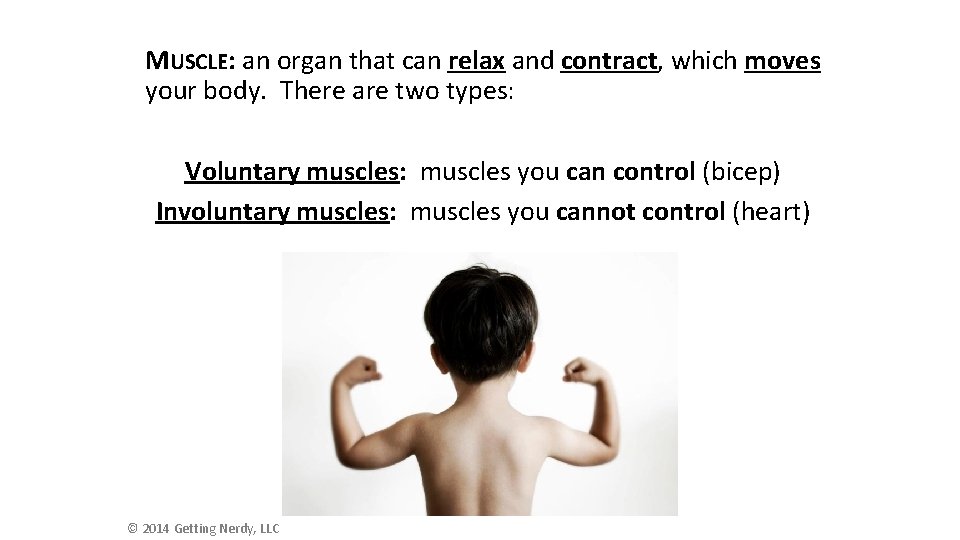
MUSCLE: an organ that can relax and contract, which moves your body. There are two types: Voluntary muscles: muscles you can control (bicep) Involuntary muscles: muscles you cannot control (heart) © 2014 Getting Nerdy, LLC
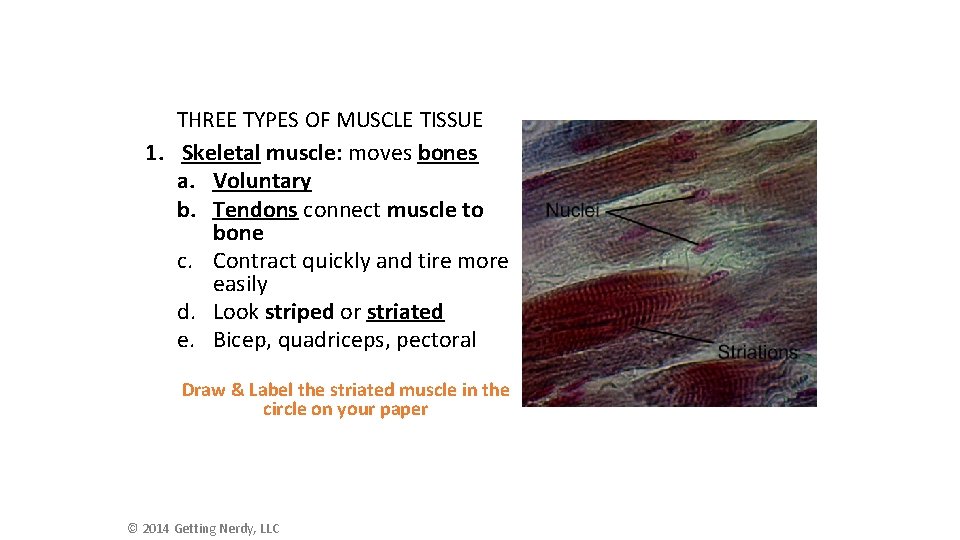
THREE TYPES OF MUSCLE TISSUE 1. Skeletal muscle: moves bones a. Voluntary b. Tendons connect muscle to bone c. Contract quickly and tire more easily d. Look striped or striated e. Bicep, quadriceps, pectoral Draw & Label the striated muscle in the circle on your paper © 2014 Getting Nerdy, LLC
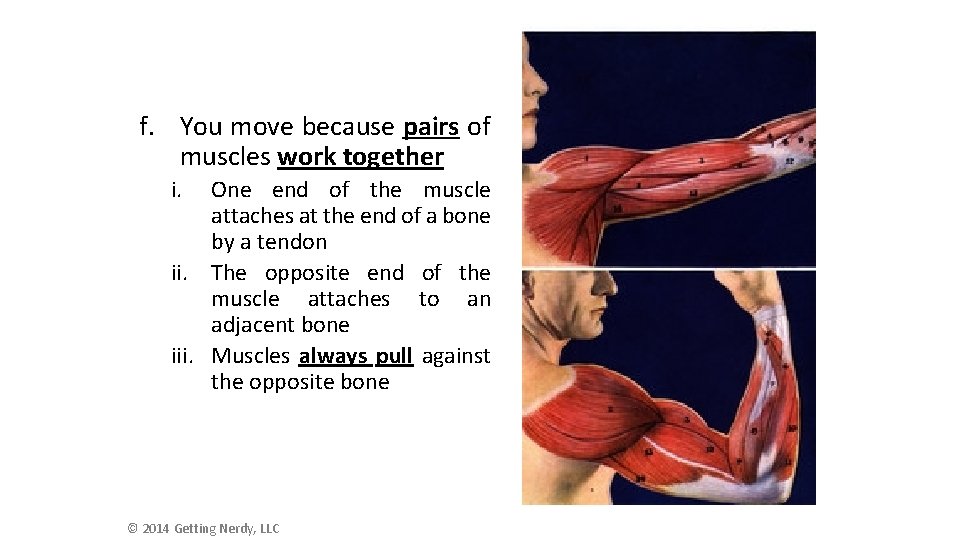
f. You move because pairs of muscles work together i. One end of the muscle attaches at the end of a bone by a tendon ii. The opposite end of the muscle attaches to an adjacent bone iii. Muscles always pull against the opposite bone © 2014 Getting Nerdy, LLC
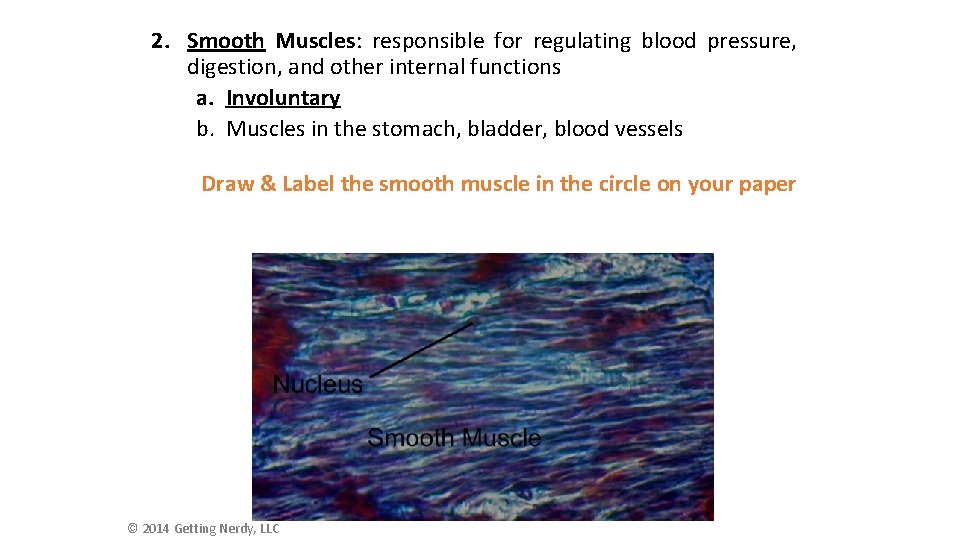
2. Smooth Muscles: responsible for regulating blood pressure, digestion, and other internal functions a. Involuntary b. Muscles in the stomach, bladder, blood vessels Draw & Label the smooth muscle in the circle on your paper © 2014 Getting Nerdy, LLC
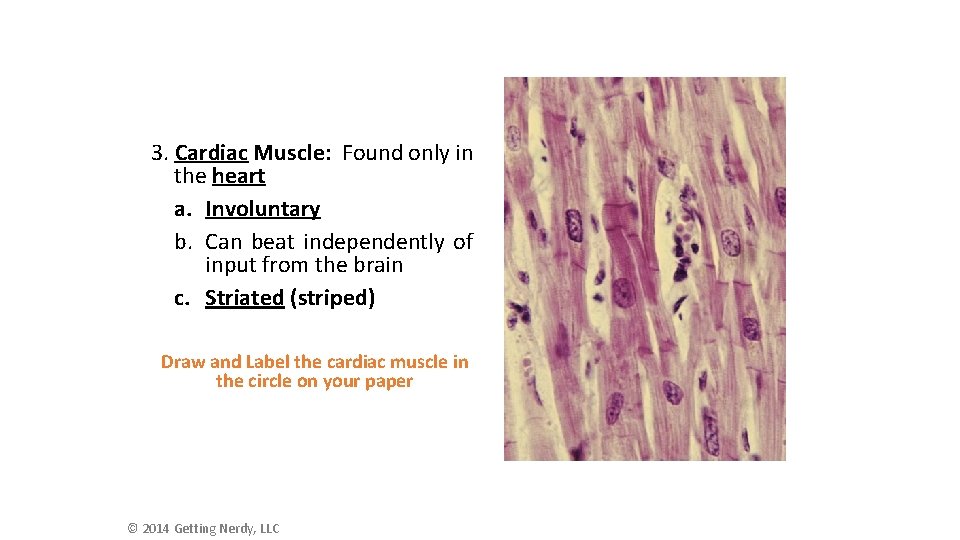
3. Cardiac Muscle: Found only in the heart a. Involuntary b. Can beat independently of input from the brain c. Striated (striped) Draw and Label the cardiac muscle in the circle on your paper © 2014 Getting Nerdy, LLC
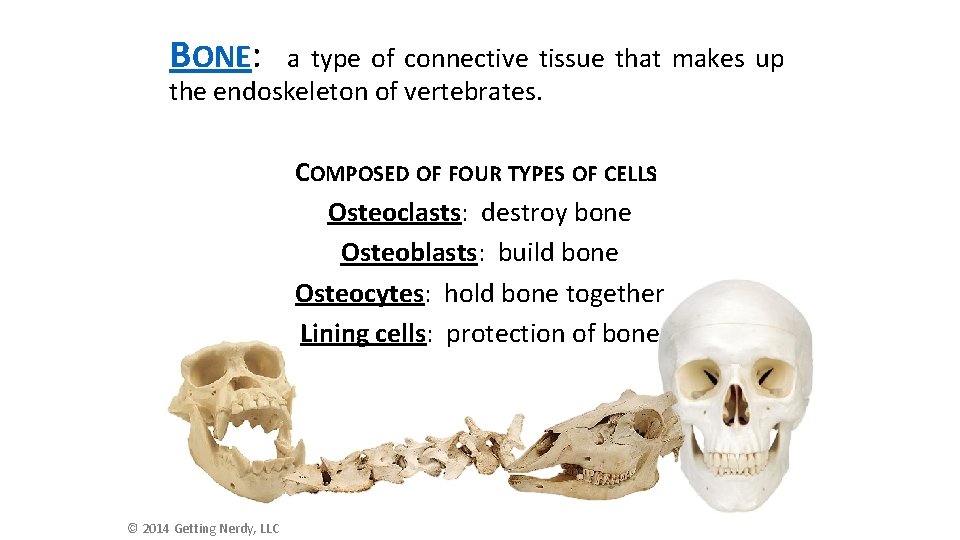
BONE: a type of connective tissue that makes up the endoskeleton of vertebrates. COMPOSED OF FOUR TYPES OF CELLS: Osteoclasts: destroy bone Osteoblasts: build bone Osteocytes: hold bone together Lining cells: protection of bone © 2014 Getting Nerdy, LLC
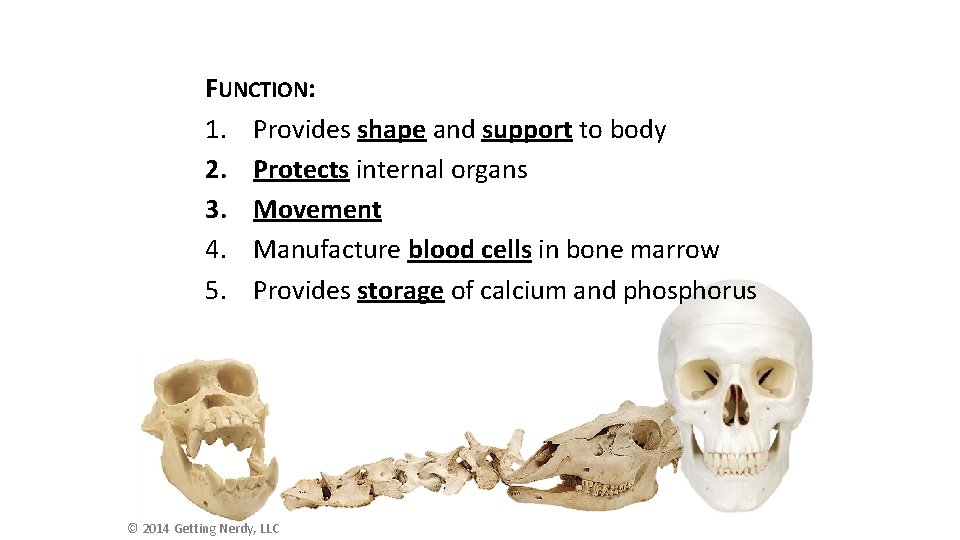
FUNCTION: 1. Provides shape and support to body 2. Protects internal organs 3. Movement 4. Manufacture blood cells in bone marrow 5. Provides storage of calcium and phosphorus © 2014 Getting Nerdy, LLC
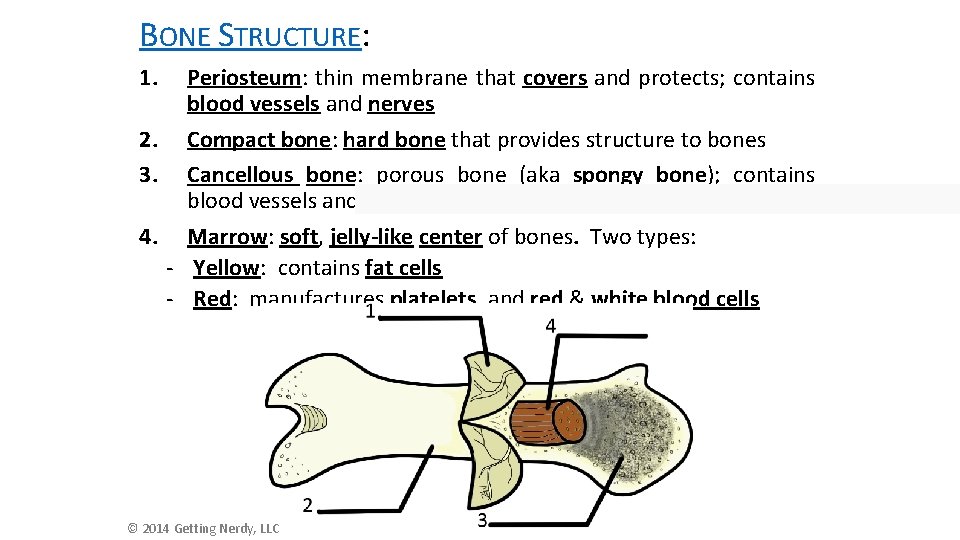
BONE STRUCTURE: 1. Periosteum: thin membrane that covers and protects; contains blood vessels and nerves 2. Compact bone: hard bone that provides structure to bones 3. Cancellous bone: porous bone (aka spongy bone); contains blood vessels and marrow 4. Marrow: soft, jelly-like center of bones. Two types: - Yellow: contains fat cells - Red: manufactures platelets, and red & white blood cells © 2014 Getting Nerdy, LLC
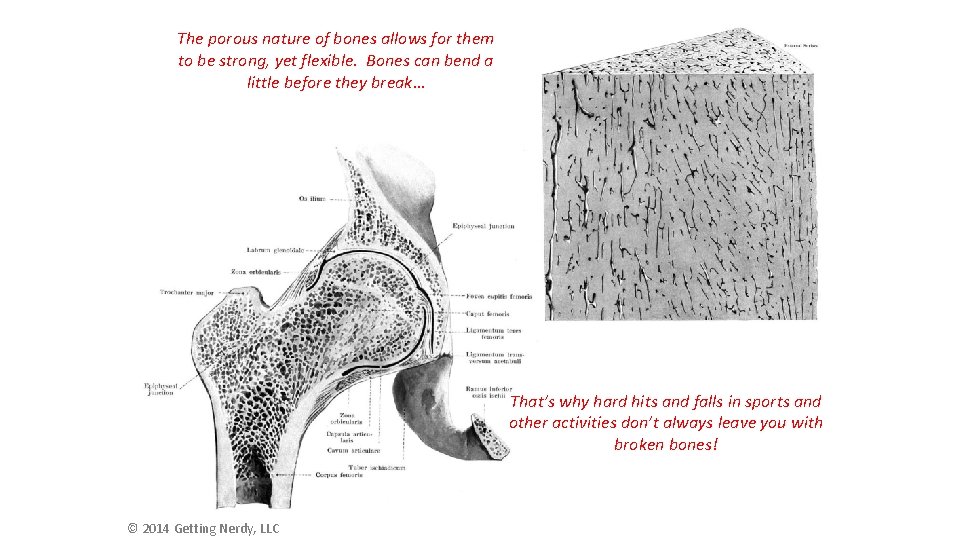
The porous nature of bones allows for them to be strong, yet flexible. Bones can bend a little before they break… That’s why hard hits and falls in sports and other activities don’t always leave you with broken bones! © 2014 Getting Nerdy, LLC
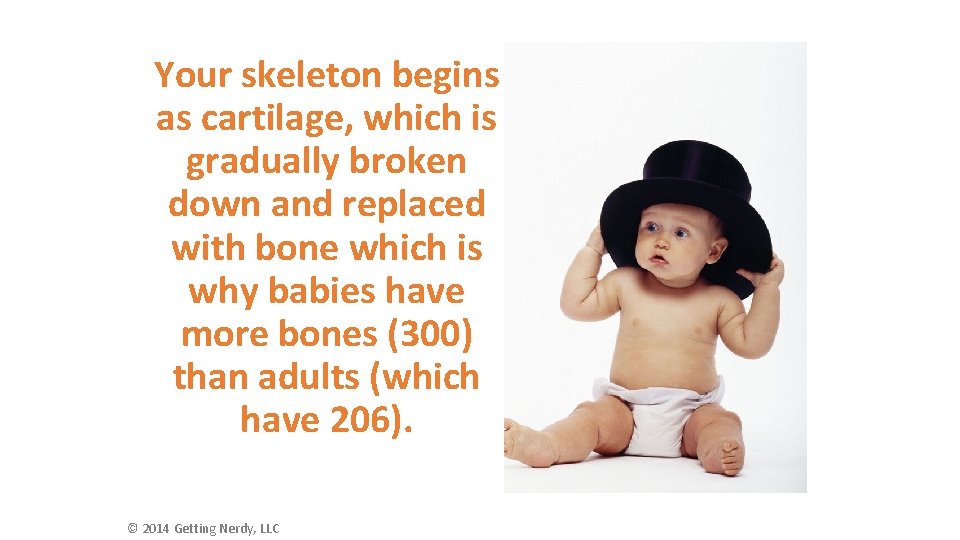
Your skeleton begins as cartilage, which is gradually broken down and replaced with bone which is why babies have more bones (300) than adults (which have 206). © 2014 Getting Nerdy, LLC
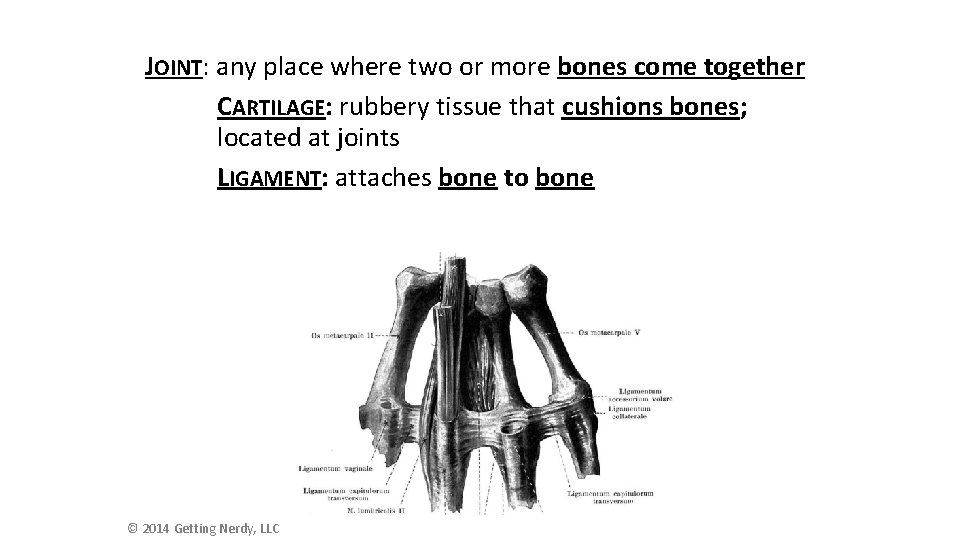
JOINT: any place where two or more bones come together CARTILAGE: rubbery tissue that cushions bones; located at joints LIGAMENT: attaches bone to bone © 2014 Getting Nerdy, LLC
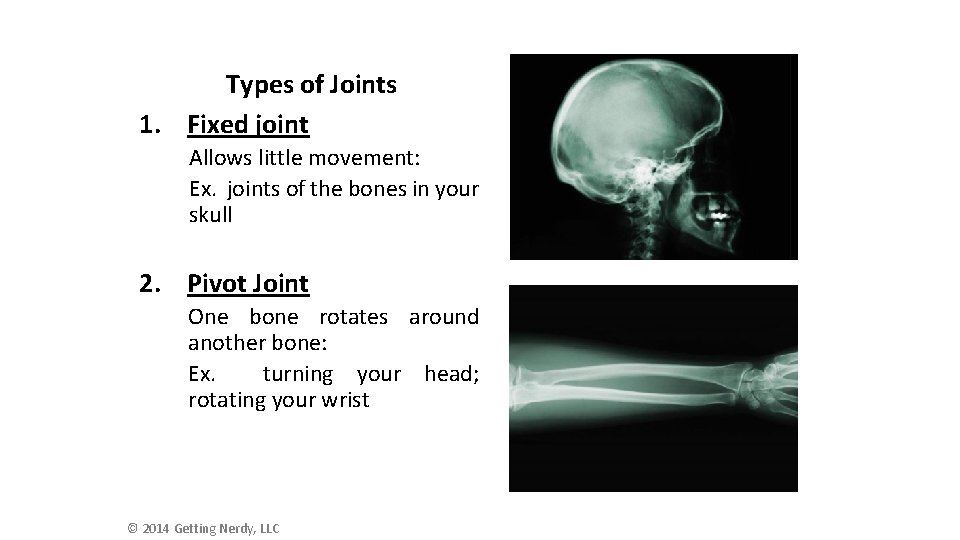
Types of Joints 1. Fixed joint Allows little movement: Ex. joints of the bones in your skull 2. Pivot Joint One bone rotates around another bone: Ex. turning your head; rotating your wrist © 2014 Getting Nerdy, LLC
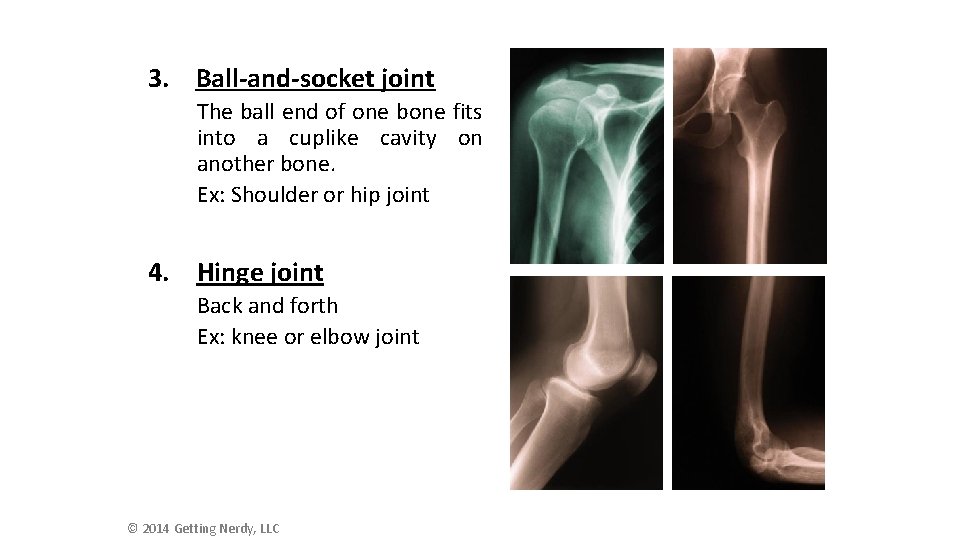
3. Ball-and-socket joint The ball end of one bone fits into a cuplike cavity on another bone. Ex: Shoulder or hip joint 4. Hinge joint Back and forth Ex: knee or elbow joint © 2014 Getting Nerdy, LLC
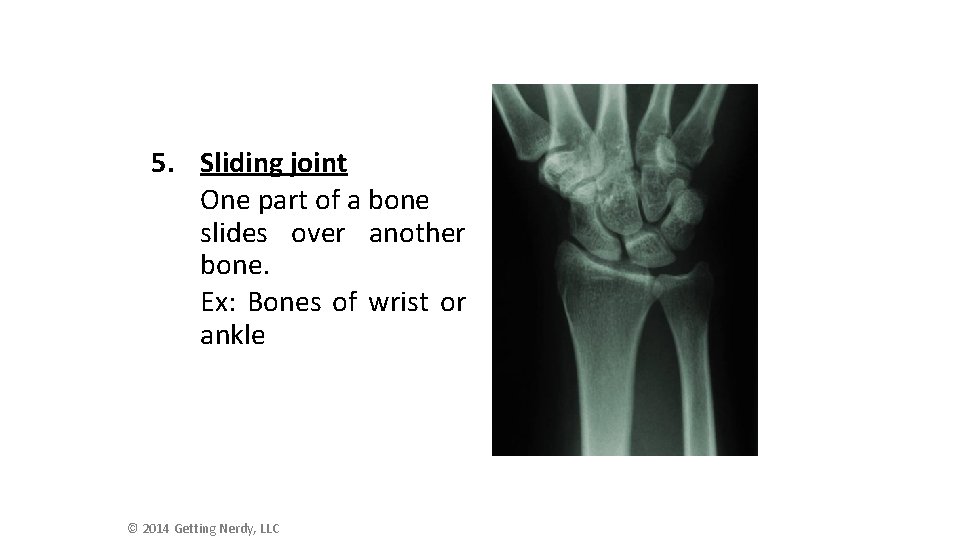
5. Sliding joint One part of a bone slides over another bone. Ex: Bones of wrist or ankle © 2014 Getting Nerdy, LLC
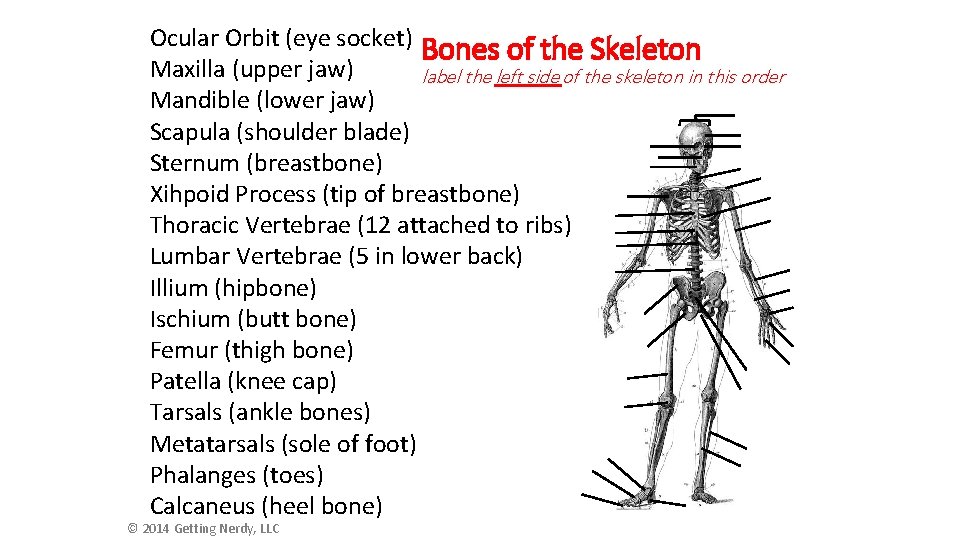
Ocular Orbit (eye socket) Bones of the Skeleton Maxilla (upper jaw) label the left side of the skeleton in this order Mandible (lower jaw) Scapula (shoulder blade) Sternum (breastbone) Xihpoid Process (tip of breastbone) Thoracic Vertebrae (12 attached to ribs) Lumbar Vertebrae (5 in lower back) Illium (hipbone) Ischium (butt bone) Femur (thigh bone) Patella (knee cap) Tarsals (ankle bones) Metatarsals (sole of foot) Phalanges (toes) Calcaneus (heel bone) © 2014 Getting Nerdy, LLC
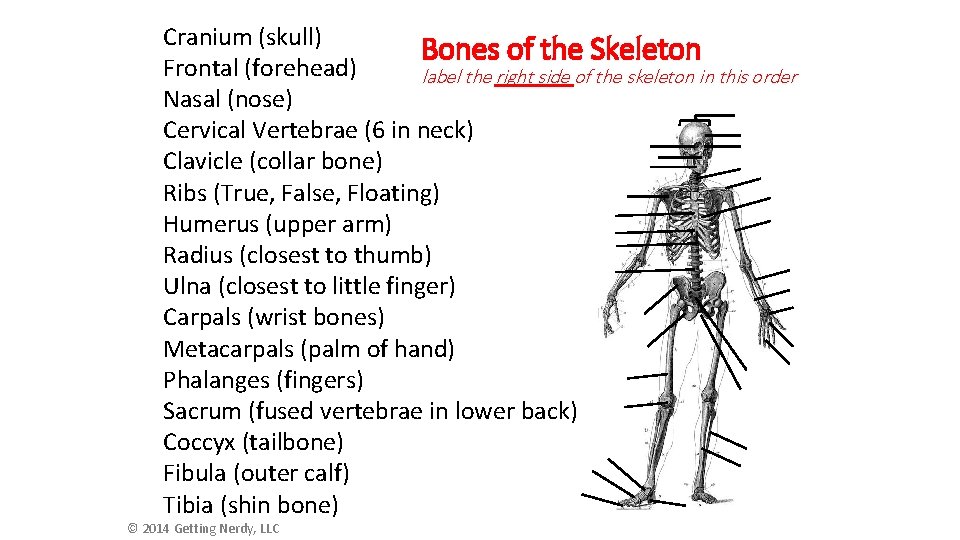
Cranium (skull) Bones of the Skeleton Frontal (forehead) label the right side of the skeleton in this order Nasal (nose) Cervical Vertebrae (6 in neck) Clavicle (collar bone) Ribs (True, False, Floating) Humerus (upper arm) Radius (closest to thumb) Ulna (closest to little finger) Carpals (wrist bones) Metacarpals (palm of hand) Phalanges (fingers) Sacrum (fused vertebrae in lower back) Coccyx (tailbone) Fibula (outer calf) Tibia (shin bone) © 2014 Getting Nerdy, LLC