
Muscles Skeletal Cardiac Smooth 09 Mar21 Muscles 1
- Slides: 69
Muscles Skeletal Cardiac Smooth 09 -Mar-21 Muscles 1
Muscles p Specialized tissue p Convert chemical energy into mechanical energy p The energy obtained from nutrients n Enable the muscles to contract p Move different skeletal bones around joints p Cardiac muscle to pump blood p Smooth muscle to contract eg- GIT 09 -Mar-21 Muscles 2
Types of Muscles p There are three types of muscles n Smooth n Skeletal (striated) n Cardiac (which is also striated) 09 -Mar-21 Muscles 3
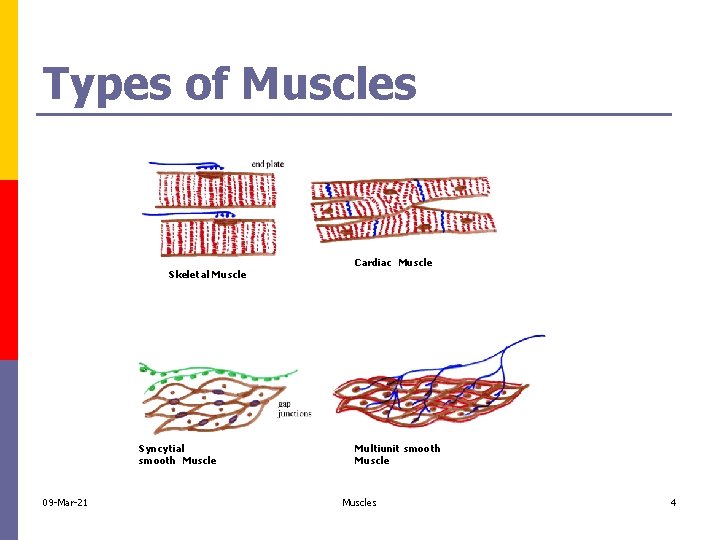
Types of Muscles Skeletal Muscle Syncytial smooth Muscle 09 -Mar-21 Cardiac Muscle Multiunit smooth Muscles 4
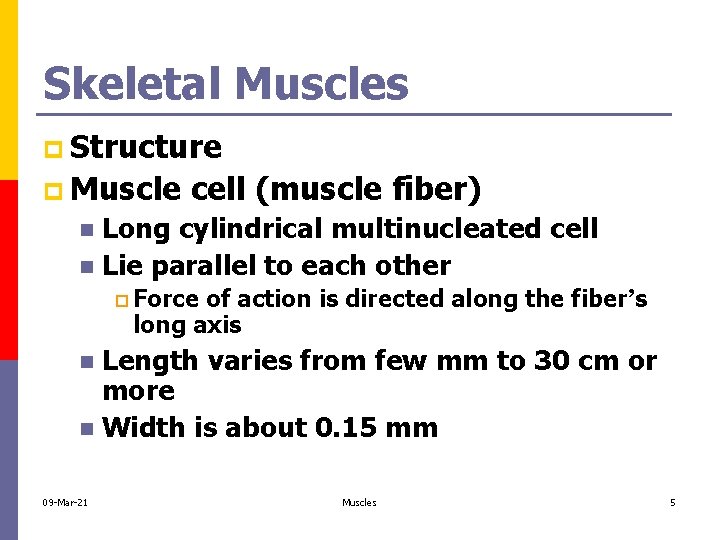
Skeletal Muscles p Structure p Muscle cell (muscle fiber) Long cylindrical multinucleated cell n Lie parallel to each other n p Force of action is directed along the fiber’s long axis Length varies from few mm to 30 cm or more n Width is about 0. 15 mm n 09 -Mar-21 Muscles 5
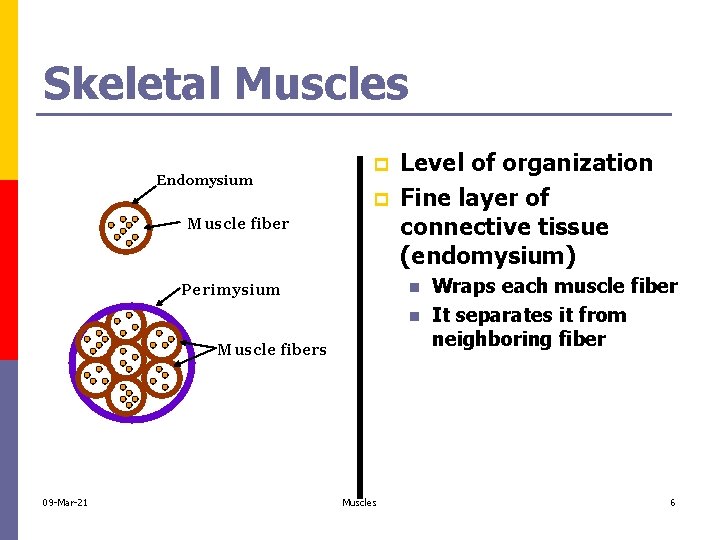
Skeletal Muscles Endomysium p p Muscle fiber Level of organization Fine layer of connective tissue (endomysium) n Perimysium n Muscle fibers 09 -Mar-21 Muscles Wraps each muscle fiber It separates it from neighboring fiber 6
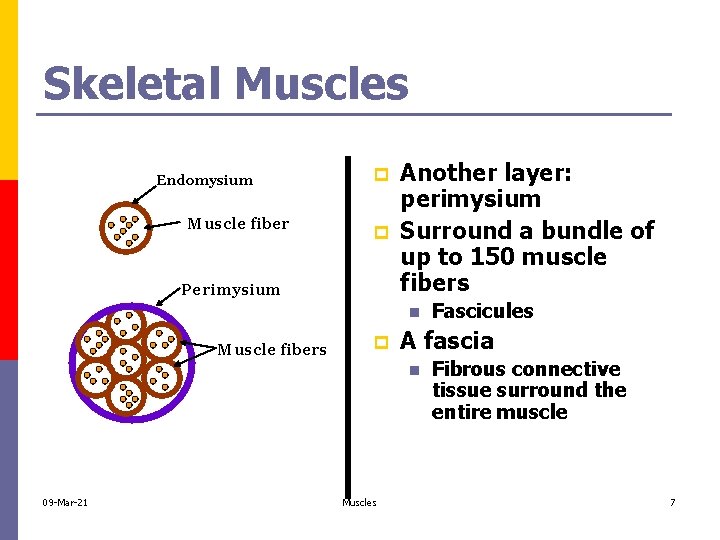
Skeletal Muscles Endomysium Muscle fiber p p Perimysium Another layer: perimysium Surround a bundle of up to 150 muscle fibers n Muscle fibers p A fascia n 09 -Mar-21 Muscles Fascicules Fibrous connective tissue surround the entire muscle 7
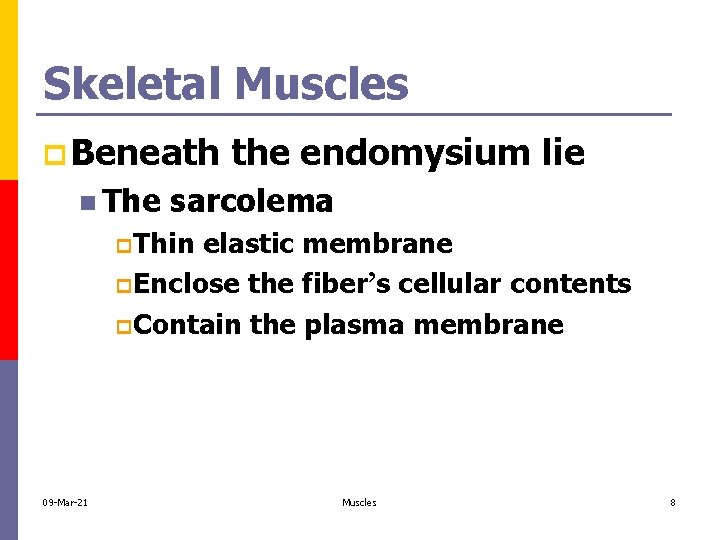
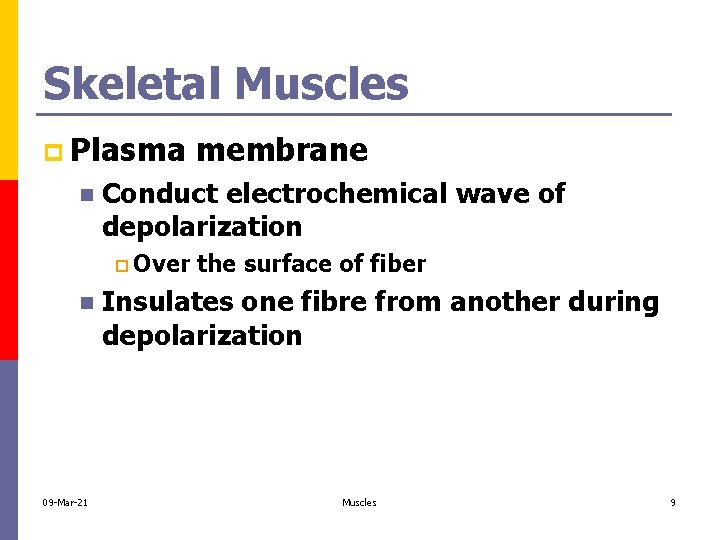
Skeletal Muscles p Beneath n The the endomysium lie sarcolema p Thin elastic membrane p Enclose the fiber’s cellular contents p Contain the plasma membrane 09 -Mar-21 Muscles 8
Skeletal Muscles p Plasma n Conduct electrochemical wave of depolarization p Over n 09 -Mar-21 membrane the surface of fiber Insulates one fibre from another during depolarization Muscles 9
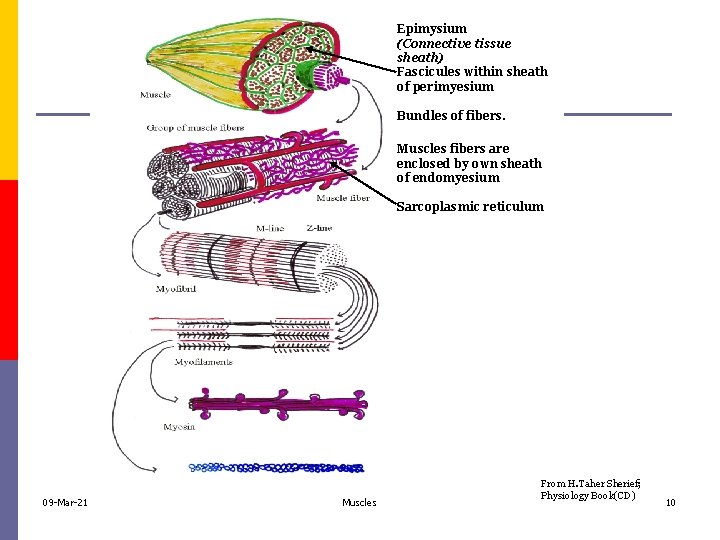
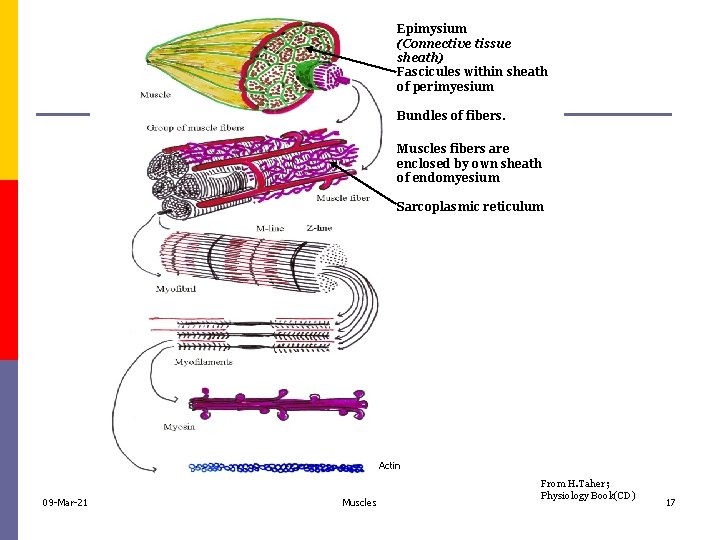
Epimysium (Connective tissue sheath) Fascicules within sheath of perimyesium Bundles of fibers. Muscles fibers are enclosed by own sheath of endomyesium Sarcoplasmic reticulum 09 -Mar-21 Muscles From H. Taher Sherief; Physiology Book(CD) 10
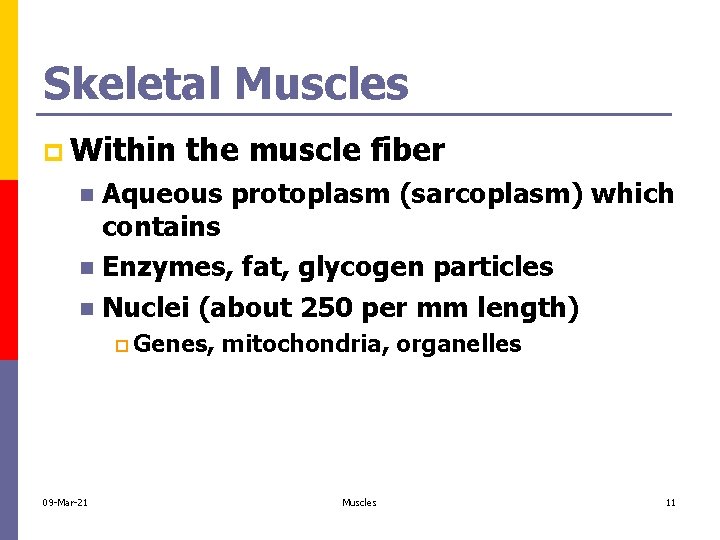
Skeletal Muscles p Within the muscle fiber Aqueous protoplasm (sarcoplasm) which contains n Enzymes, fat, glycogen particles n Nuclei (about 250 per mm length) n p Genes, 09 -Mar-21 mitochondria, organelles Muscles 11
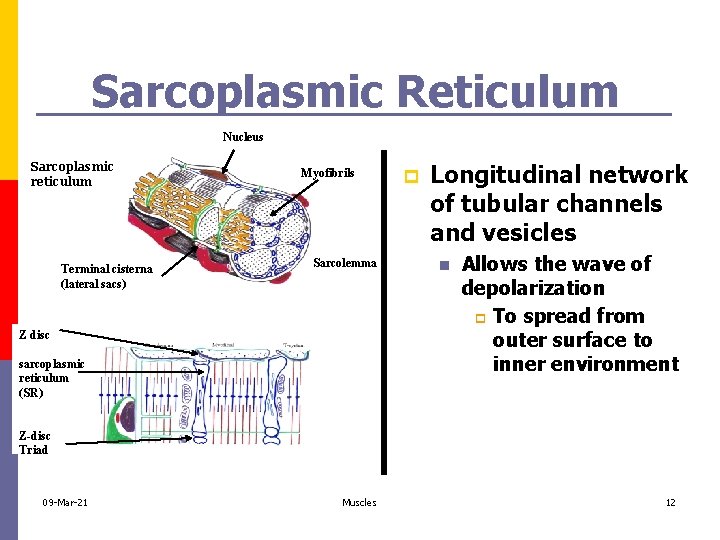
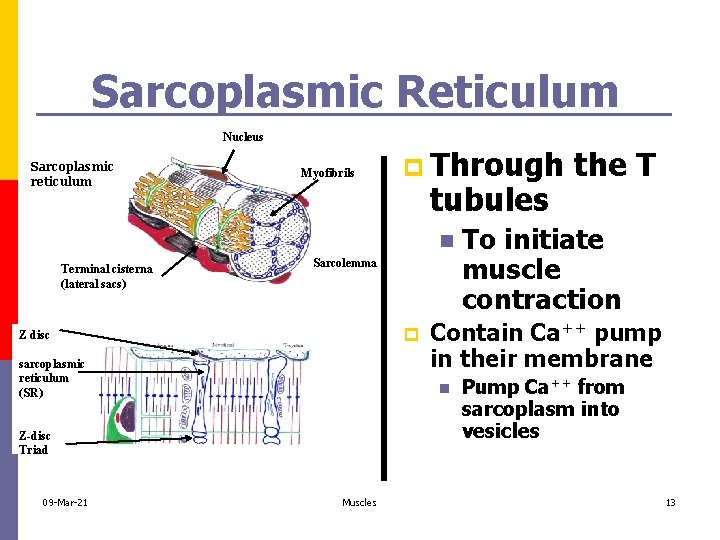
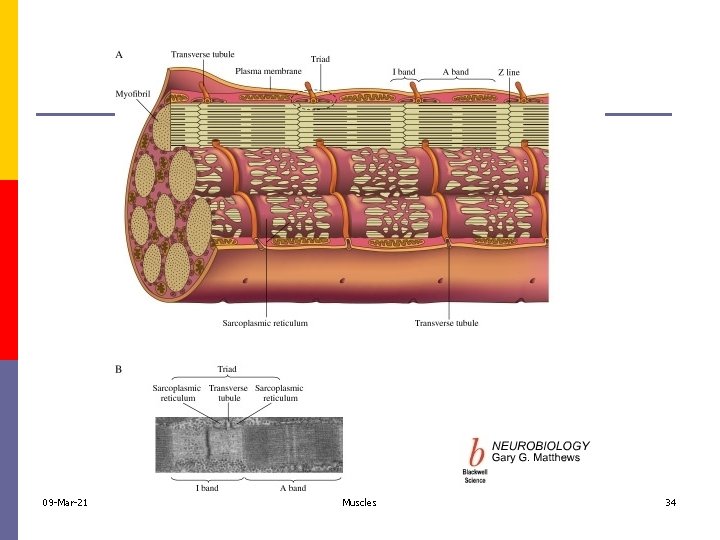
Sarcoplasmic Reticulum Nucleus Sarcoplasmic reticulum Terminal cisterna (lateral sacs) Myofibrils Sarcolemma Z disc sarcoplasmic reticulum (SR) p Longitudinal network of tubular channels and vesicles n Allows the wave of depolarization p To spread from outer surface to inner environment Z-disc Triad 09 -Mar-21 Muscles 12
Sarcoplasmic Reticulum Nucleus Sarcoplasmic reticulum Myofibrils p Through tubules n Terminal cisterna (lateral sacs) Sarcolemma p Z disc sarcoplasmic reticulum (SR) 09 -Mar-21 Muscles To initiate muscle contraction Contain Ca++ pump in their membrane n Z-disc Triad the T Pump Ca++ from sarcoplasm into vesicles 13
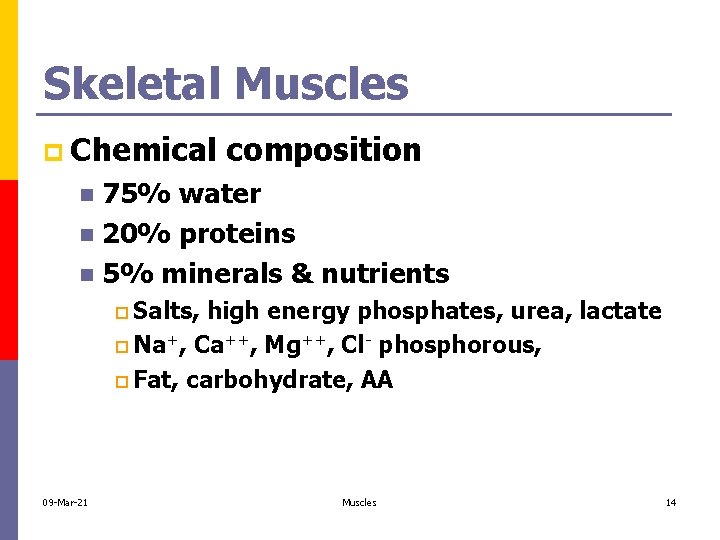
Skeletal Muscles p Chemical composition 75% water n 20% proteins n 5% minerals & nutrients n p Salts, high energy phosphates, urea, lactate p Na+, Ca++, Mg++, Cl- phosphorous, p Fat, carbohydrate, AA 09 -Mar-21 Muscles 14
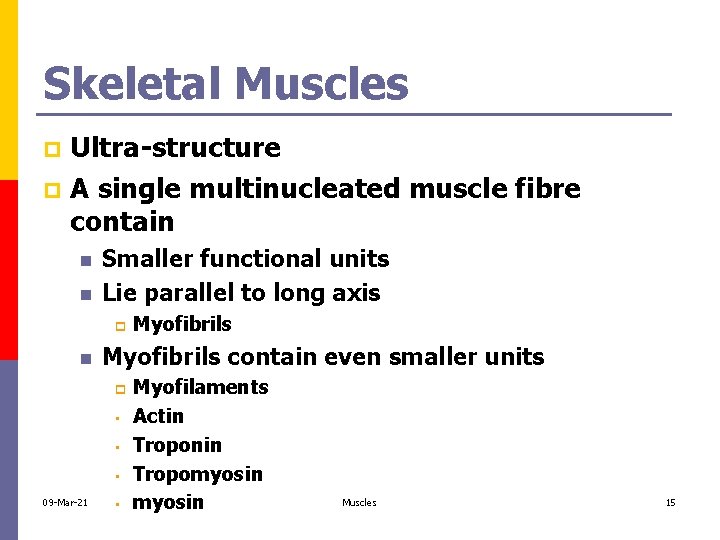
Skeletal Muscles Ultra-structure p A single multinucleated muscle fibre contain p n n Smaller functional units Lie parallel to long axis p n Myofibrils contain even smaller units p • • • 09 -Mar-21 Myofibrils • Myofilaments Actin Troponin Tropomyosin Muscles 15
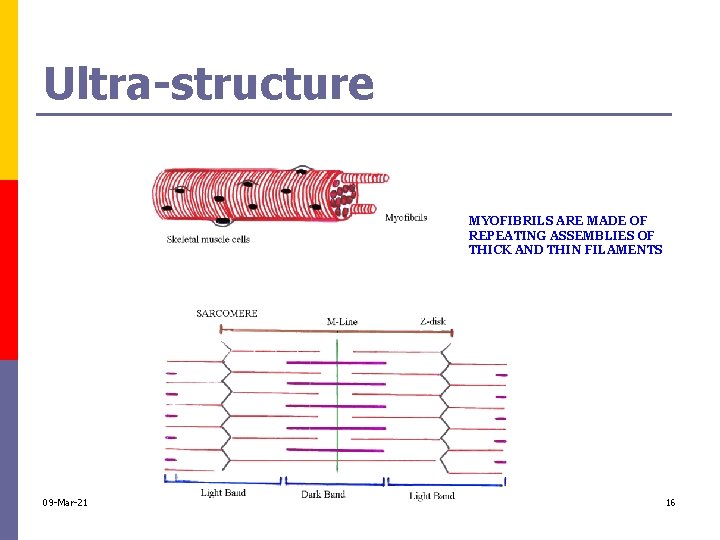
Ultra-structure MYOFIBRILS ARE MADE OF REPEATING ASSEMBLIES OF THICK AND THIN FILAMENTS 09 -Mar-21 Muscles 16
Epimysium (Connective tissue sheath) Fascicules within sheath of perimyesium Bundles of fibers. Muscles fibers are enclosed by own sheath of endomyesium Sarcoplasmic reticulum Actin 09 -Mar-21 Muscles From H. Taher ; Physiology Book(CD) 17
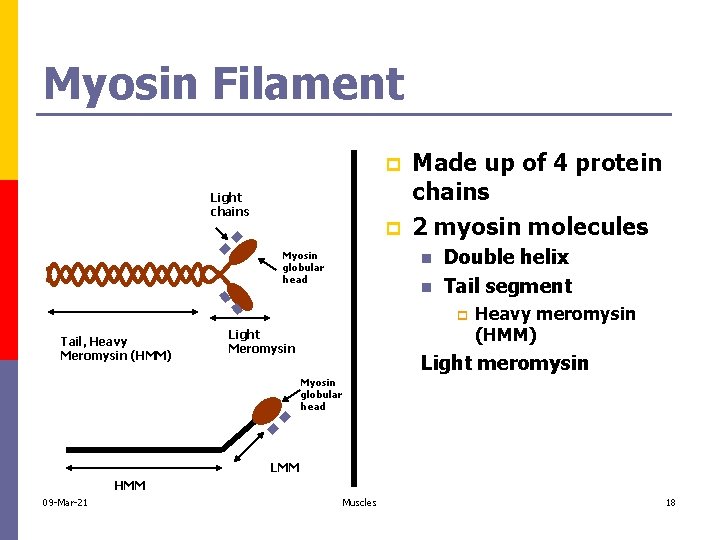
Myosin Filament p Light chains p Myosin globular head Made up of 4 protein chains 2 myosin molecules n n Double helix Tail segment p Tail, Heavy Meromysin (HMM) Light Meromysin Heavy meromysin (HMM) Light meromysin Myosin globular head LMM HMM 09 -Mar-21 Muscles 18
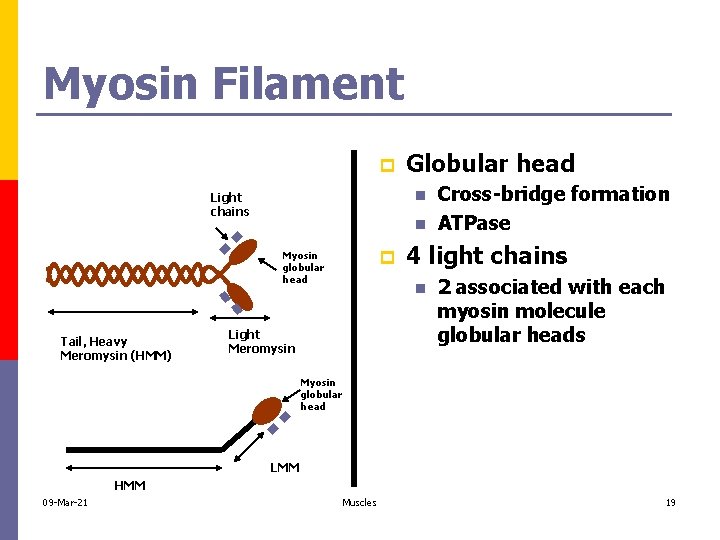
Myosin Filament p n Light chains n p Myosin globular head Tail, Heavy Meromysin (HMM) Globular head 4 light chains n Light Meromysin Cross-bridge formation ATPase 2 associated with each myosin molecule globular heads Myosin globular head LMM HMM 09 -Mar-21 Muscles 19
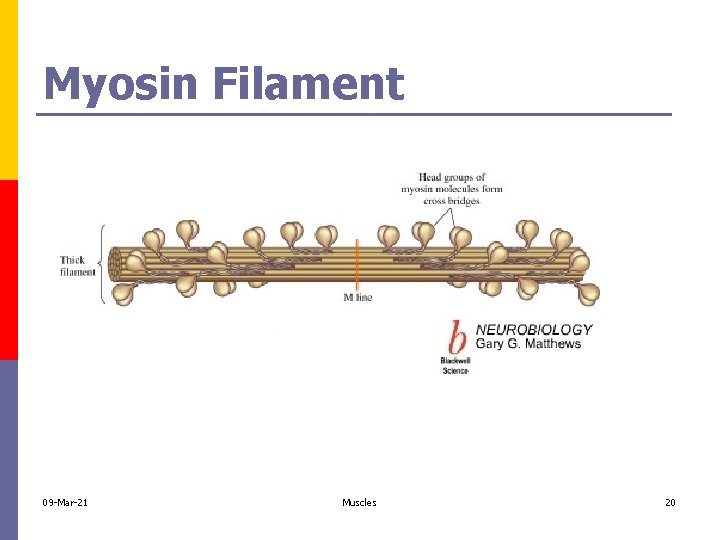
Myosin Filament 09 -Mar-21 Muscles 20
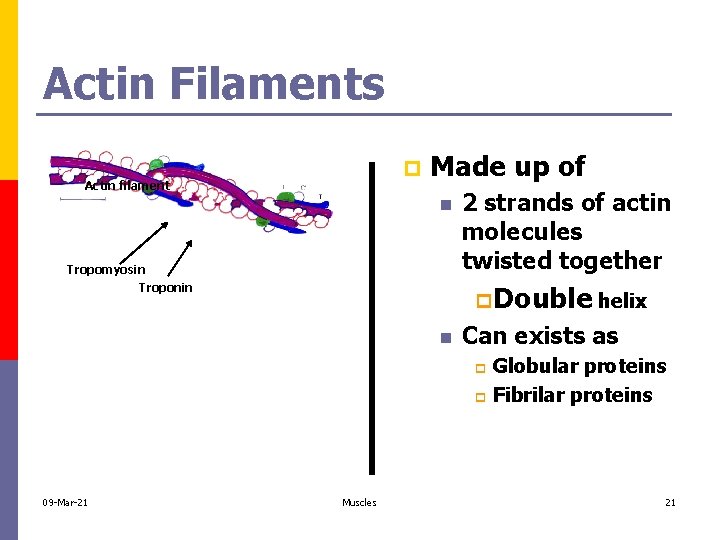
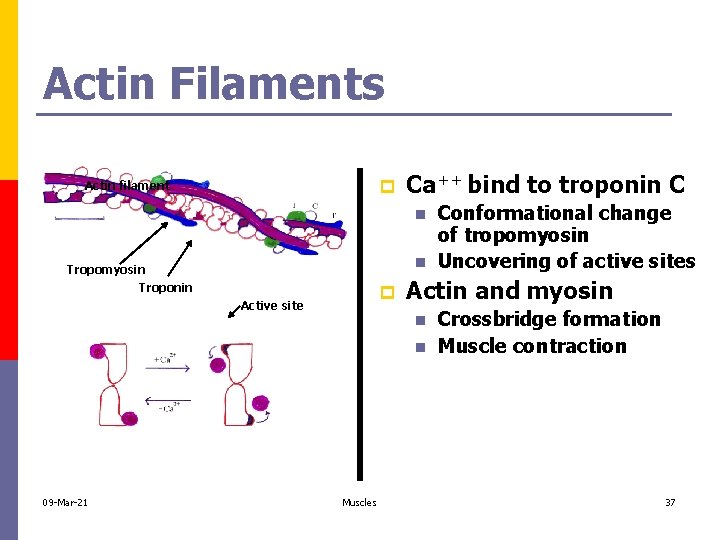
Actin Filaments p Actin filament Made up of n Tropomyosin Troponin 2 strands of actin molecules twisted together p Double helix n Can exists as Globular proteins p Fibrilar proteins p 09 -Mar-21 Muscles 21
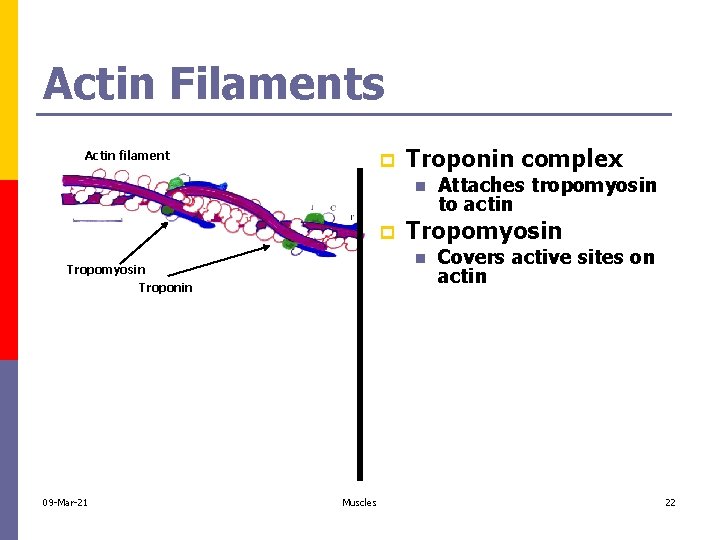
Actin Filaments Actin filament p Troponin complex n p 09 -Mar-21 Tropomyosin n Tropomyosin Troponin Muscles Attaches tropomyosin to actin Covers active sites on actin 22
Other Muscle Proteins p Others include -actinin distributed along Z band n -actinin found in actin filament n M protein n C protein n 09 -Mar-21 Muscles 23
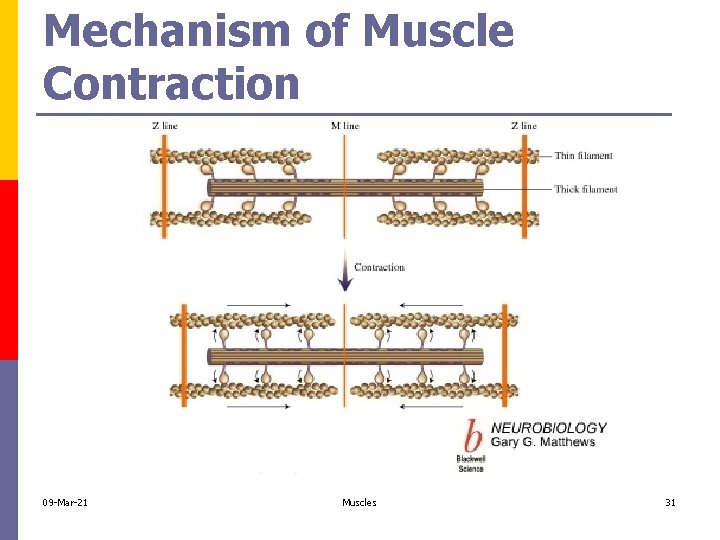
Muscle Contraction p Pure myosin and actin n n p Combine to form Actomyosin Sliding filament theory of muscle contraction 09 -Mar-21 Muscles 24
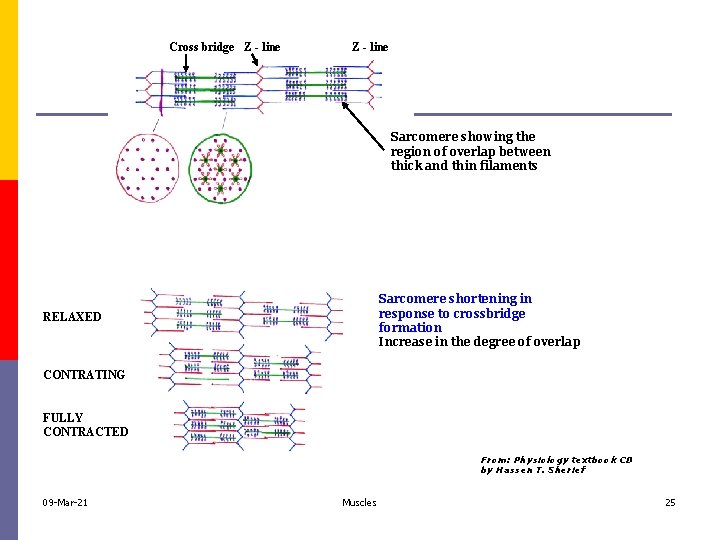
Cross bridge Z - line Sarcomere showing the region of overlap between thick and thin filaments Sarcomere shortening in response to crossbridge formation Increase in the degree of overlap RELAXED CONTRATING FULLY CONTRACTED From: Physiology textbook CD by Hassen T. Sherief 09 -Mar-21 Muscles 25
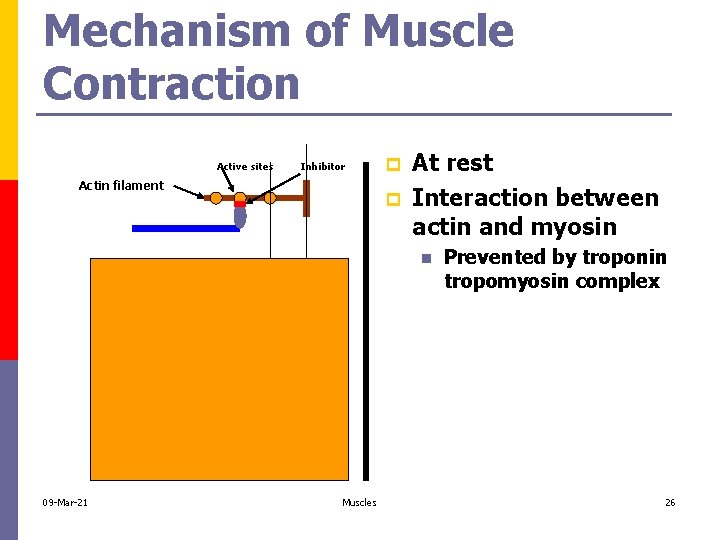
Mechanism of Muscle Contraction Active sites Inhibitor Actin filament p p At rest Interaction between actin and myosin n 09 -Mar-21 Muscles Prevented by troponin tropomyosin complex 26
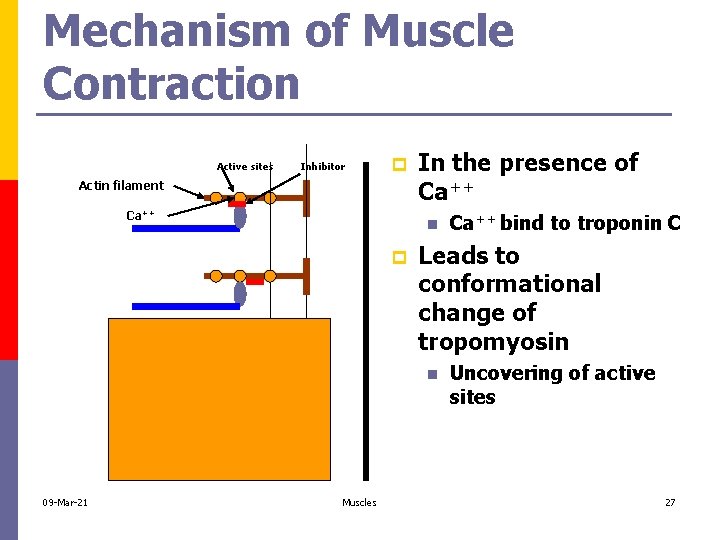
Mechanism of Muscle Contraction Active sites Inhibitor p Actin filament Ca++ In the presence of Ca++ n p Leads to conformational change of tropomyosin n 09 -Mar-21 Muscles Ca++ bind to troponin C Uncovering of active sites 27
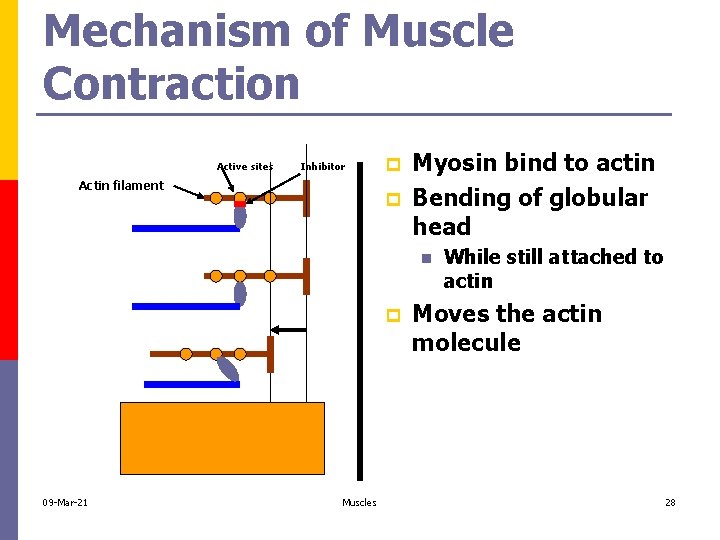
Mechanism of Muscle Contraction Active sites Inhibitor Actin filament p p Myosin bind to actin Bending of globular head n p 09 -Mar-21 Muscles While still attached to actin Moves the actin molecule 28
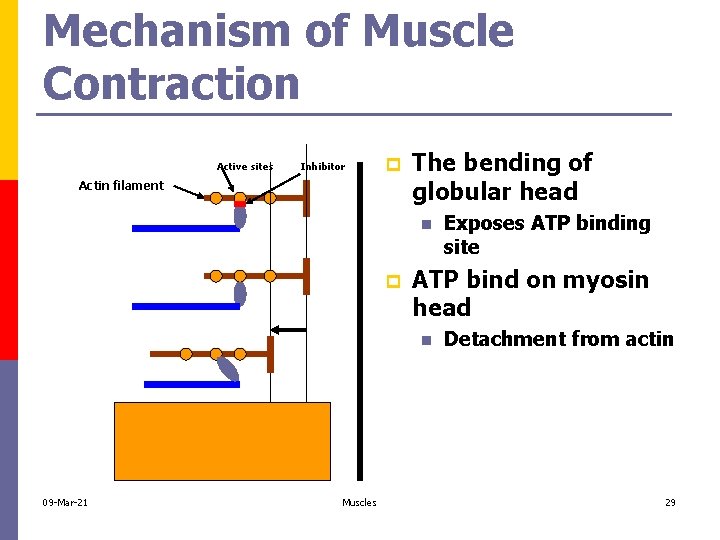
Mechanism of Muscle Contraction Active sites Inhibitor p Actin filament The bending of globular head n p ATP bind on myosin head n 09 -Mar-21 Muscles Exposes ATP binding site Detachment from actin 29
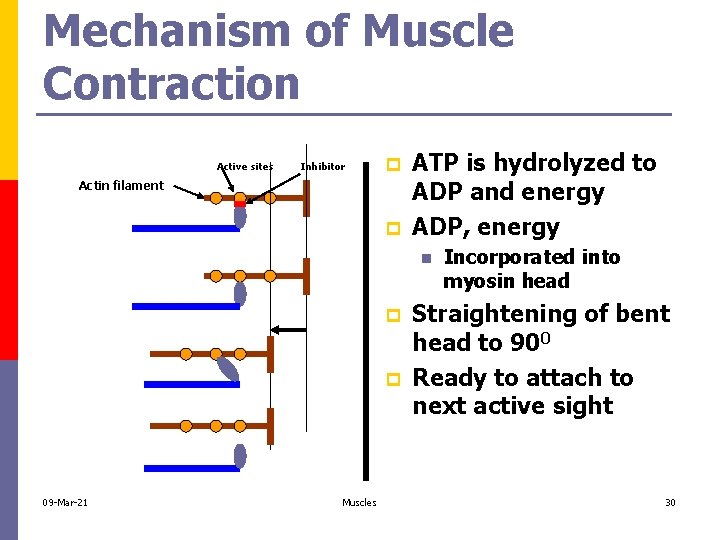
Mechanism of Muscle Contraction Active sites Inhibitor p Actin filament p ATP is hydrolyzed to ADP and energy ADP, energy n p p 09 -Mar-21 Muscles Incorporated into myosin head Straightening of bent head to 900 Ready to attach to next active sight 30
Mechanism of Muscle Contraction 09 -Mar-21 Muscles 31
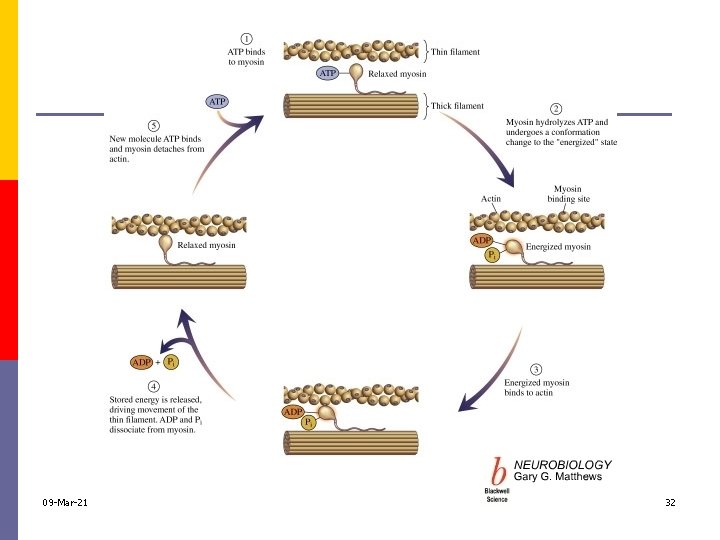
09 -Mar-21 Muscles 32
Excitation Contraction Coupling 09 -Mar-21 Muscles 33
09 -Mar-21 Muscles 34
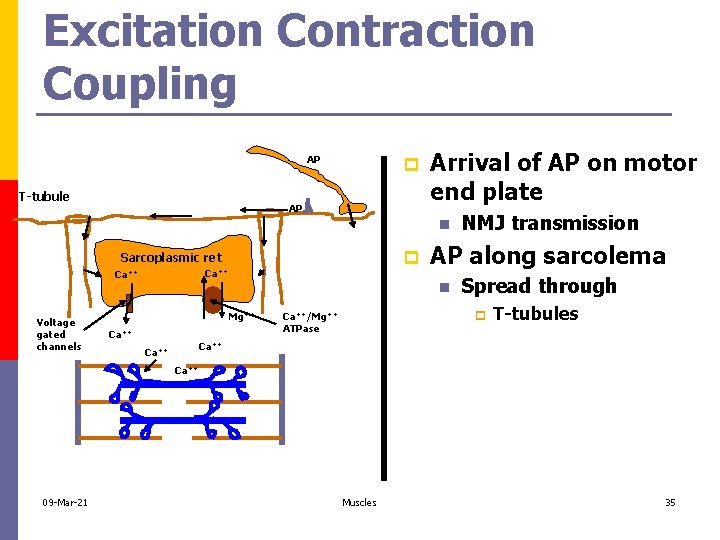
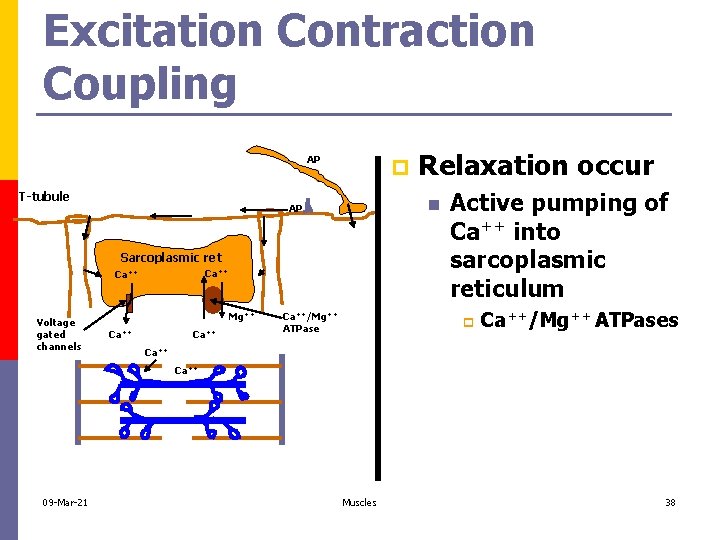
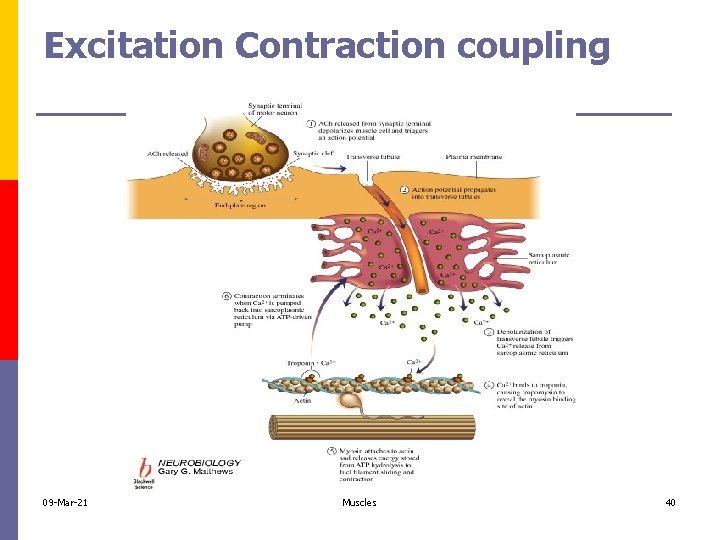
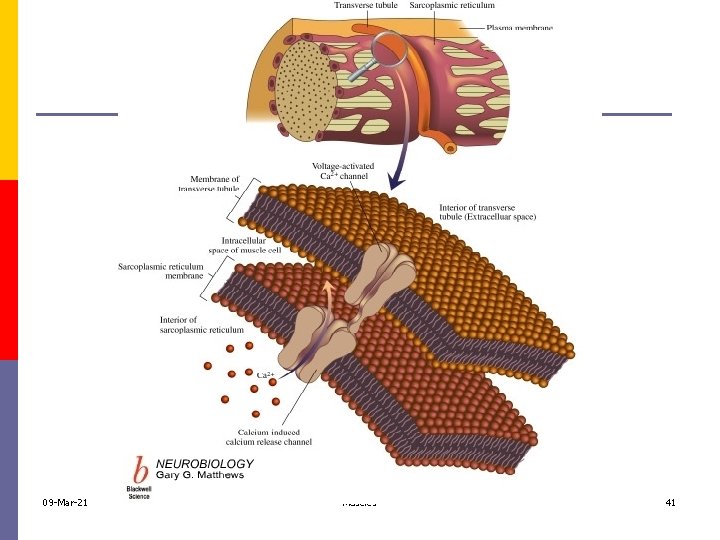
Excitation Contraction Coupling AP T-tubule p AP Arrival of AP on motor end plate n p Sarcoplasmic ret Ca++ Voltage gated channels AP along sarcolema n Mg++ Ca++ NMJ transmission Spread through p Ca++/Mg++ ATPase T-tubules Ca++ 09 -Mar-21 Muscles 35
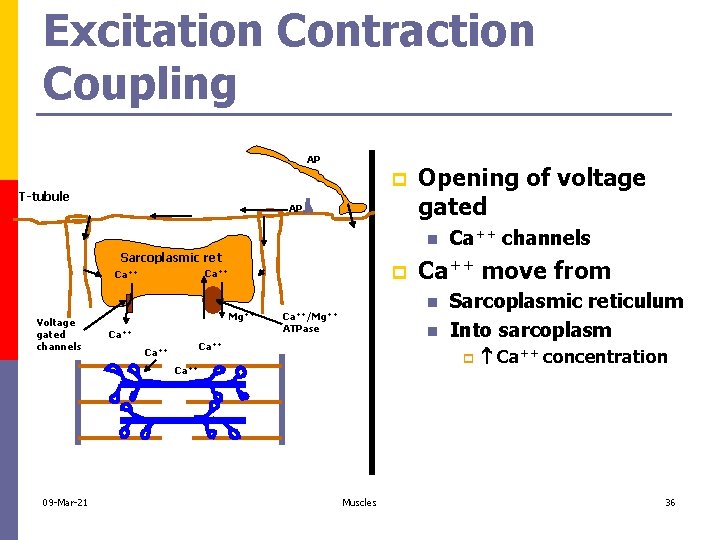
Excitation Contraction Coupling AP p T-tubule AP Opening of voltage gated n Sarcoplasmic ret Voltage gated channels p Ca++ Mg++ Ca++ n Ca++ Sarcoplasmic reticulum Into sarcoplasm p Ca++ 09 -Mar-21 Ca++ move from n Ca++/Mg++ ATPase Ca++ channels Muscles Ca++ concentration 36
Actin Filaments p Actin filament Ca++ bind to troponin C n n Tropomyosin Troponin p Active site Actin and myosin n n 09 -Mar-21 Muscles Conformational change of tropomyosin Uncovering of active sites Crossbridge formation Muscle contraction 37
Excitation Contraction Coupling AP T-tubule p n AP Sarcoplasmic ret Ca++ Voltage gated channels Mg++ Ca++ Relaxation occur Ca++/Mg++ ATPase Active pumping of Ca++ into sarcoplasmic reticulum p Ca++/Mg++ ATPases Ca++ 09 -Mar-21 Muscles 38
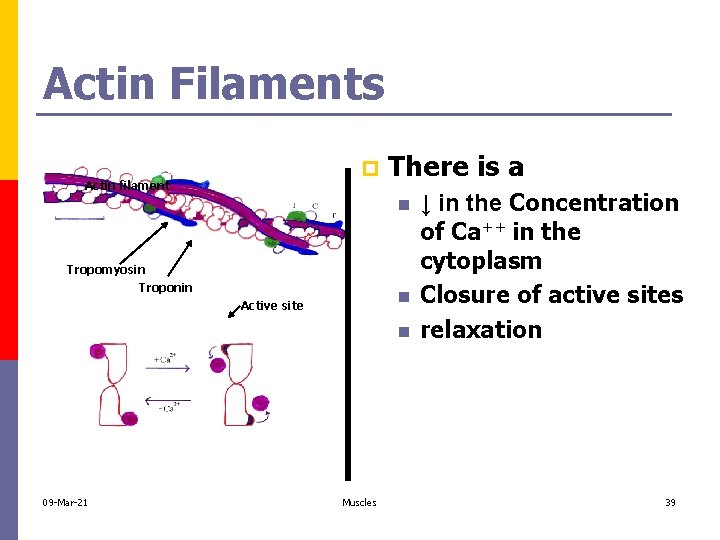
Actin Filaments p Actin filament There is a n Tropomyosin Troponin n Active site n 09 -Mar-21 Muscles ↓ in the Concentration of Ca++ in the cytoplasm Closure of active sites relaxation 39
Excitation Contraction coupling 09 -Mar-21 Muscles 40
09 -Mar-21 Muscles 41
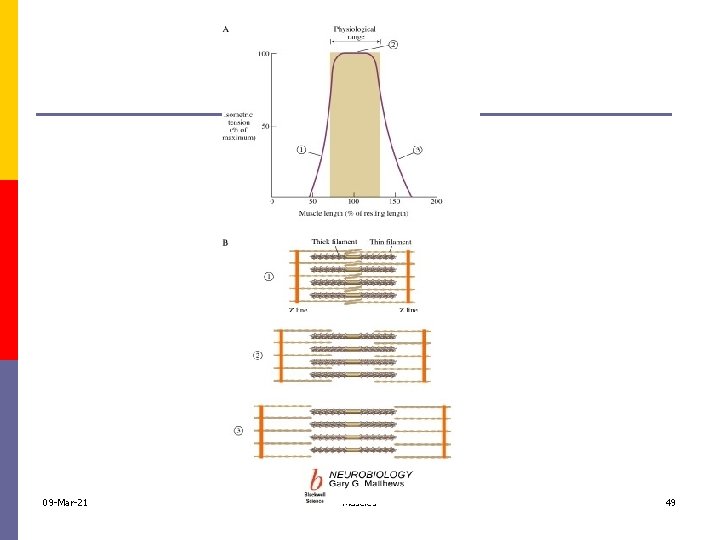
Length – Tension Relationship 09 -Mar-21 Muscles 42
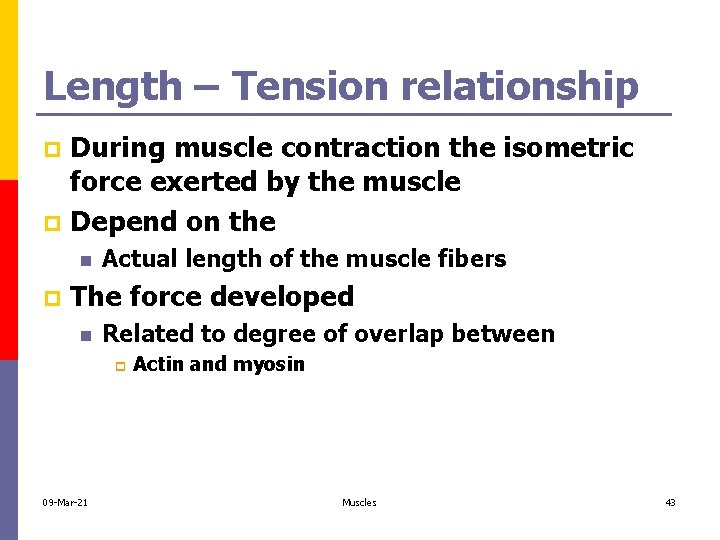
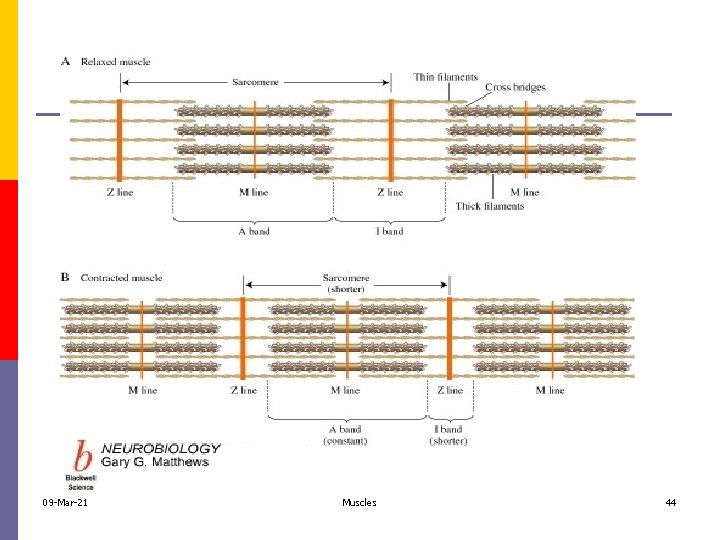
Length – Tension relationship During muscle contraction the isometric force exerted by the muscle p Depend on the p n p Actual length of the muscle fibers The force developed n Related to degree of overlap between p 09 -Mar-21 Actin and myosin Muscles 43
09 -Mar-21 Muscles 44
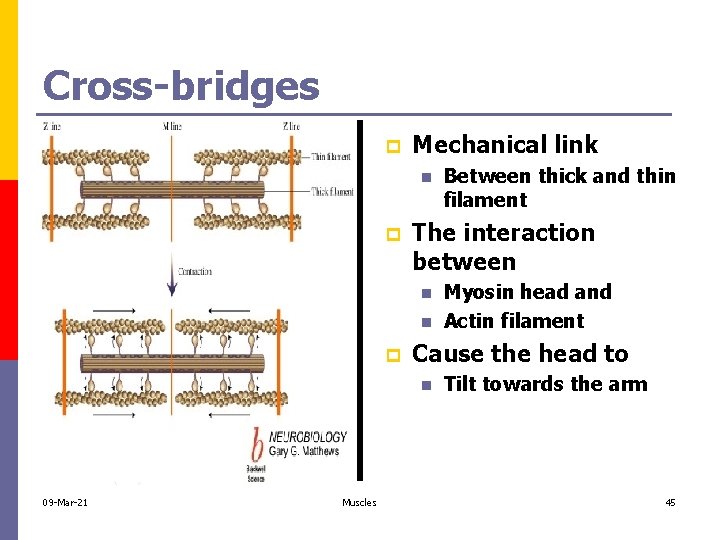
Cross-bridges p Mechanical link n p The interaction between n n p Muscles Myosin head and Actin filament Cause the head to n 09 -Mar-21 Between thick and thin filament Tilt towards the arm 45
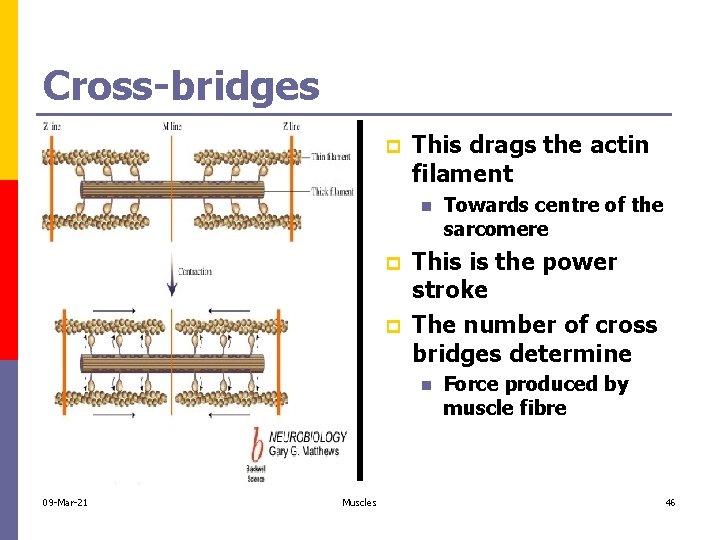
Cross-bridges p This drags the actin filament n p p This is the power stroke The number of cross bridges determine n 09 -Mar-21 Muscles Towards centre of the sarcomere Force produced by muscle fibre 46
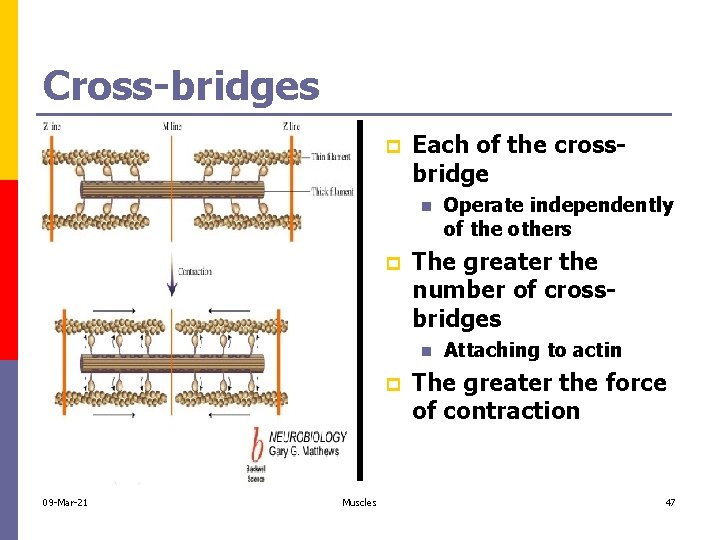
Cross-bridges p Each of the crossbridge n p The greater the number of crossbridges n p 09 -Mar-21 Muscles Operate independently of the others Attaching to actin The greater the force of contraction 47
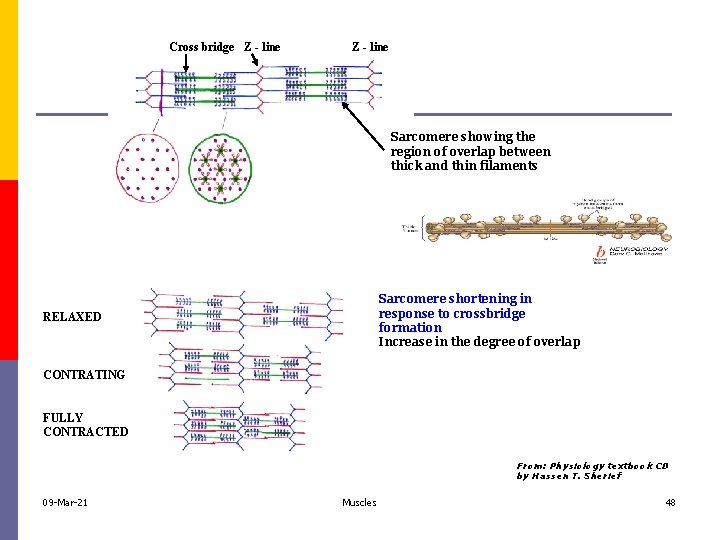
Cross bridge Z - line Sarcomere showing the region of overlap between thick and thin filaments Sarcomere shortening in response to crossbridge formation Increase in the degree of overlap RELAXED CONTRATING FULLY CONTRACTED From: Physiology textbook CD by Hassen T. Sherief 09 -Mar-21 Muscles 48
09 -Mar-21 Muscles 49
Smooth Muscles 09 -Mar-21 Muscles 50
Smooth Muscles p Responsible for contractility n Hollow organs p Blood vessels, GIT, urinary bladder, uterus Structure differ from that of skeletal muscle p Can develop isometric force per cross sectional area p n p Equal to or greater than that of skeletal muscle Speed of contraction n 09 -Mar-21 A fraction of that of skeletal muscle Muscles 51
Smooth Muscles p Does not show cross n Under microscope striation p It is also known as INVOLUNTARY muscle because n n n 09 -Mar-21 Its function is not under our voluntary will Its activities arises spontaneously Or through the autonomic nervous system Muscles 52
Smooth Muscles Smooth muscle from different tissue differ p In structure p n p Organization in sheets, bundles In property n 09 -Mar-21 Response to different types of stimuli, innervations Muscles 53
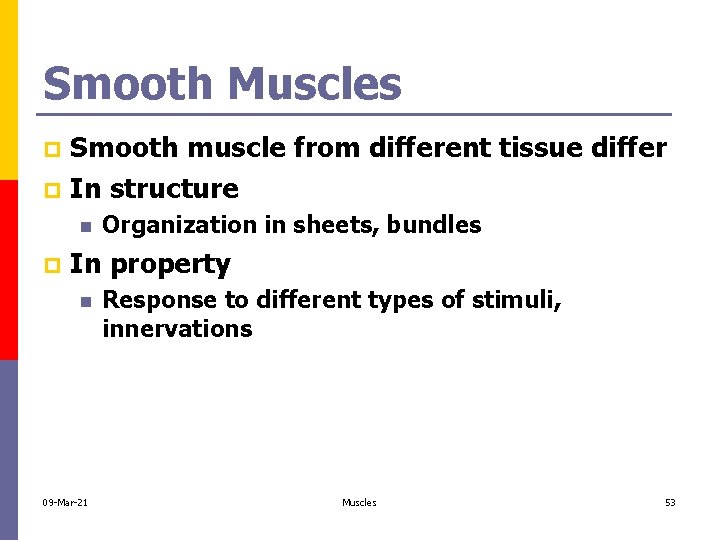
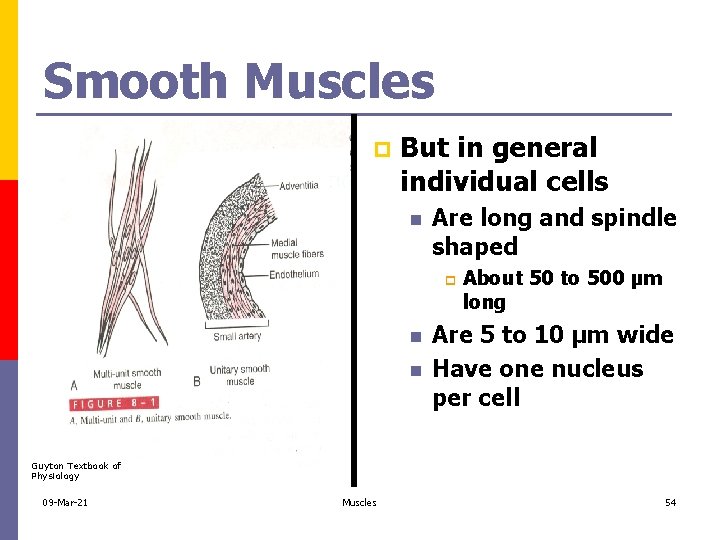
Smooth Muscles p But in general individual cells n Are long and spindle shaped p n n About 50 to 500 μm long Are 5 to 10 μm wide Have one nucleus per cell Guyton Textbook of Physiology 09 -Mar-21 Muscles 54
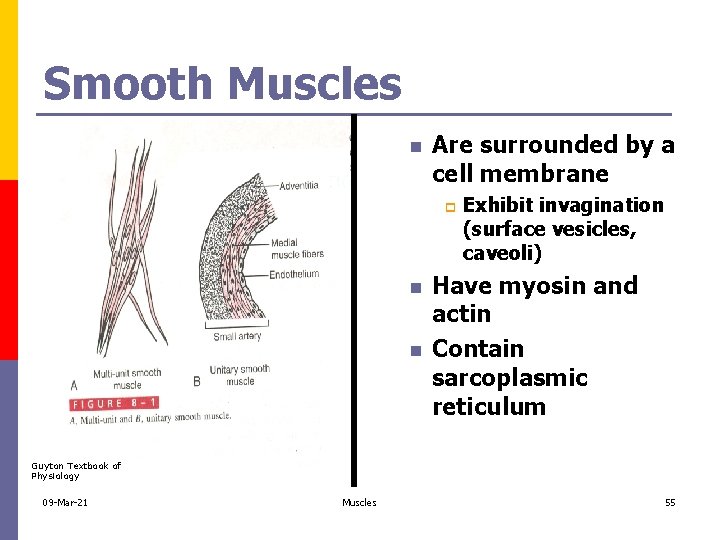
Smooth Muscles n Are surrounded by a cell membrane p n n Exhibit invagination (surface vesicles, caveoli) Have myosin and actin Contain sarcoplasmic reticulum Guyton Textbook of Physiology 09 -Mar-21 Muscles 55
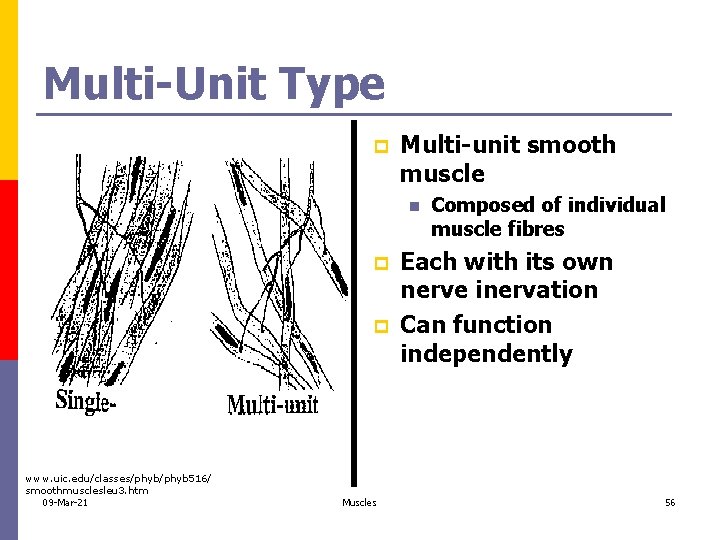
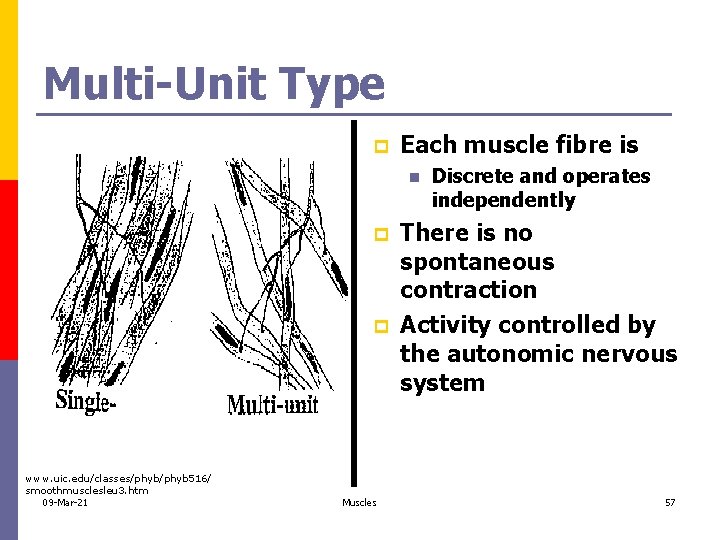
Multi-Unit Type p Multi-unit smooth muscle n p p www. uic. edu/classes/phyb 516/ smoothmusclesleu 3. htm 09 -Mar-21 Muscles Composed of individual muscle fibres Each with its own nerve inervation Can function independently 56
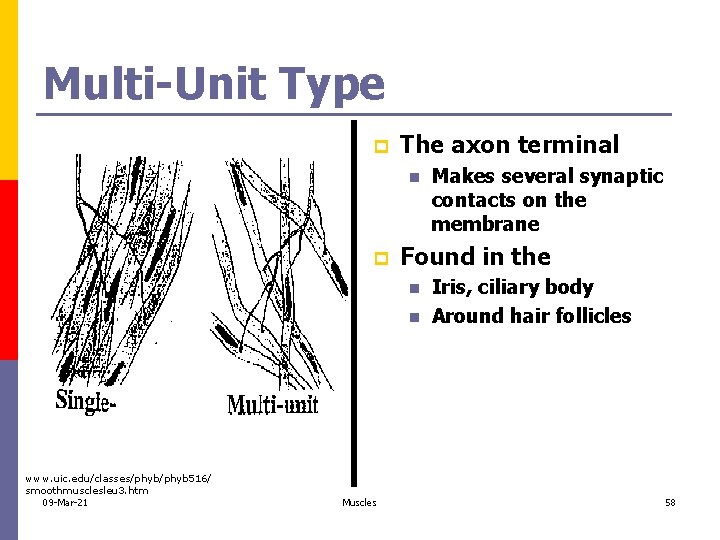
Multi-Unit Type p Each muscle fibre is n p p www. uic. edu/classes/phyb 516/ smoothmusclesleu 3. htm 09 -Mar-21 Muscles Discrete and operates independently There is no spontaneous contraction Activity controlled by the autonomic nervous system 57
Multi-Unit Type p The axon terminal n p Found in the n n www. uic. edu/classes/phyb 516/ smoothmusclesleu 3. htm 09 -Mar-21 Muscles Makes several synaptic contacts on the membrane Iris, ciliary body Around hair follicles 58
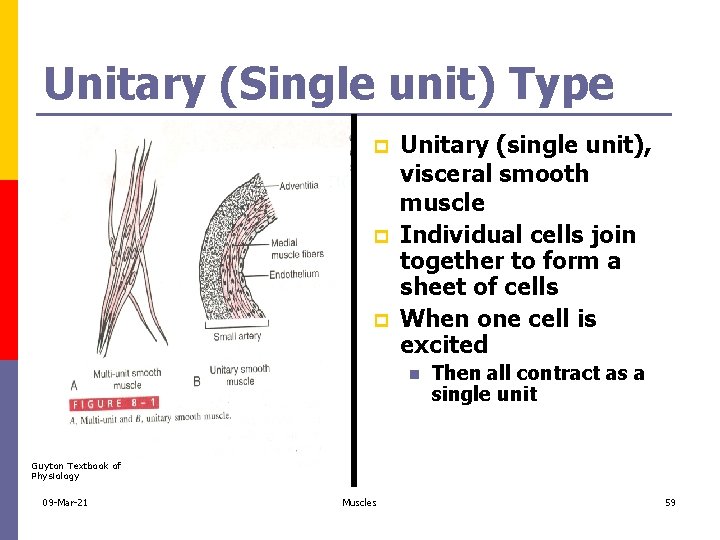
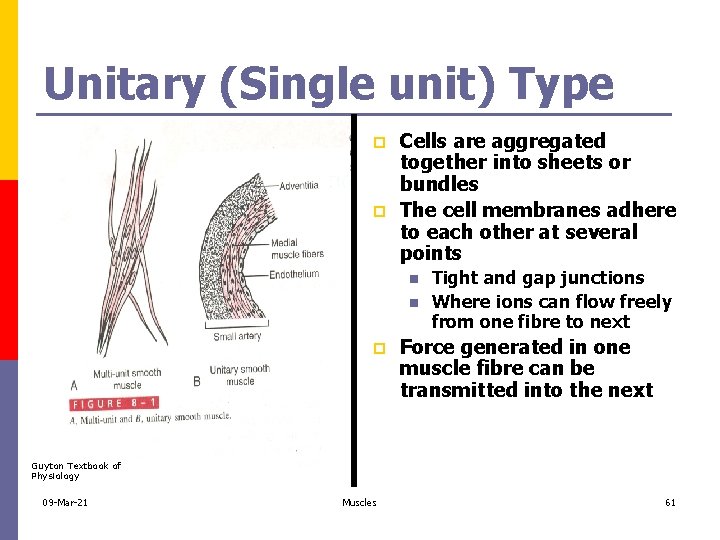
Unitary (Single unit) Type p p p Unitary (single unit), visceral smooth muscle Individual cells join together to form a sheet of cells When one cell is excited n Then all contract as a single unit Guyton Textbook of Physiology 09 -Mar-21 Muscles 59
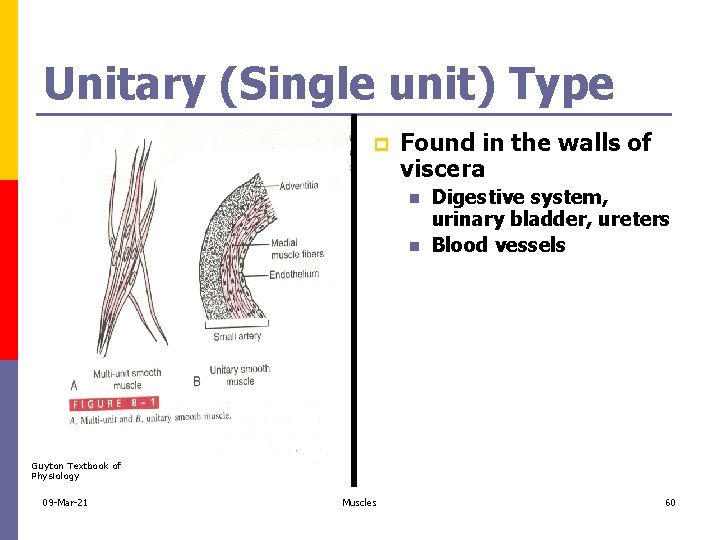
Unitary (Single unit) Type p Found in the walls of viscera n n Digestive system, urinary bladder, ureters Blood vessels Guyton Textbook of Physiology 09 -Mar-21 Muscles 60
Unitary (Single unit) Type p p Cells are aggregated together into sheets or bundles The cell membranes adhere to each other at several points n n p Tight and gap junctions Where ions can flow freely from one fibre to next Force generated in one muscle fibre can be transmitted into the next Guyton Textbook of Physiology 09 -Mar-21 Muscles 61
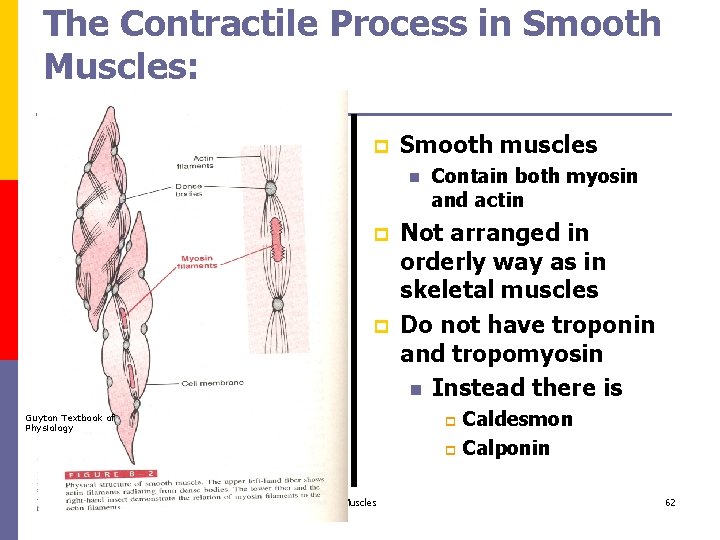
The Contractile Process in Smooth Muscles: p Smooth muscles n p p Not arranged in orderly way as in skeletal muscles Do not have troponin and tropomyosin n Instead there is Caldesmon p Calponin Guyton Textbook of Physiology 09 -Mar-21 Contain both myosin and actin p Muscles 62
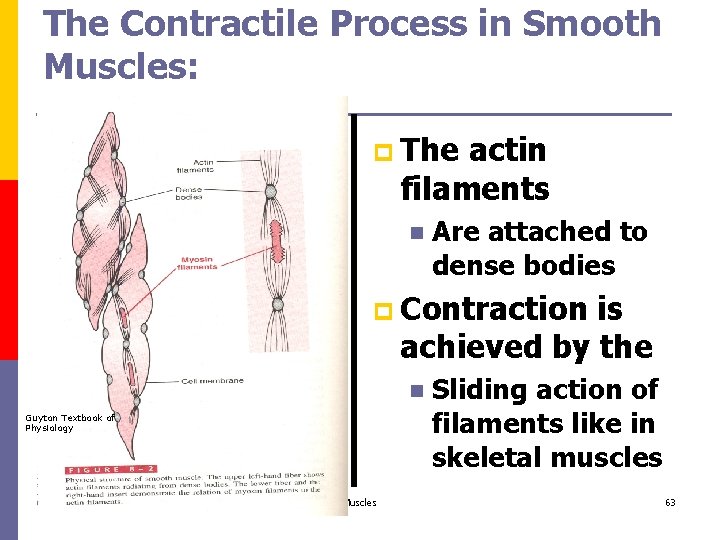
The Contractile Process in Smooth Muscles: p The actin filaments n Are attached to dense bodies p Contraction is achieved by the n Guyton Textbook of Physiology 09 -Mar-21 Muscles Sliding action of filaments like in skeletal muscles 63
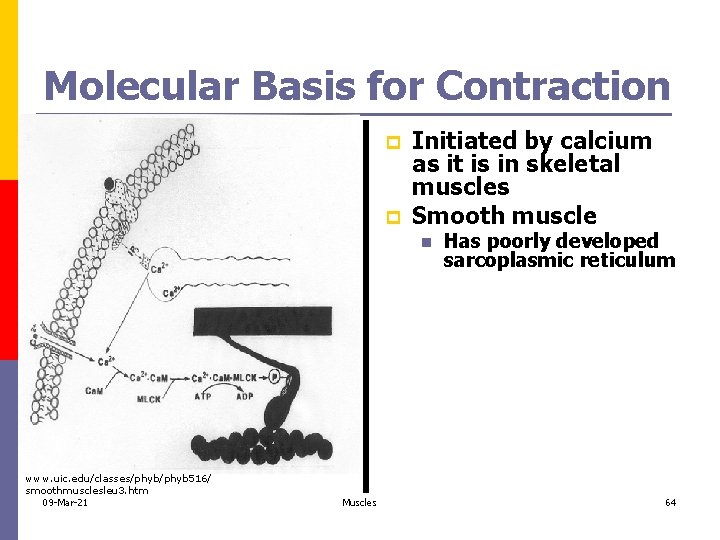
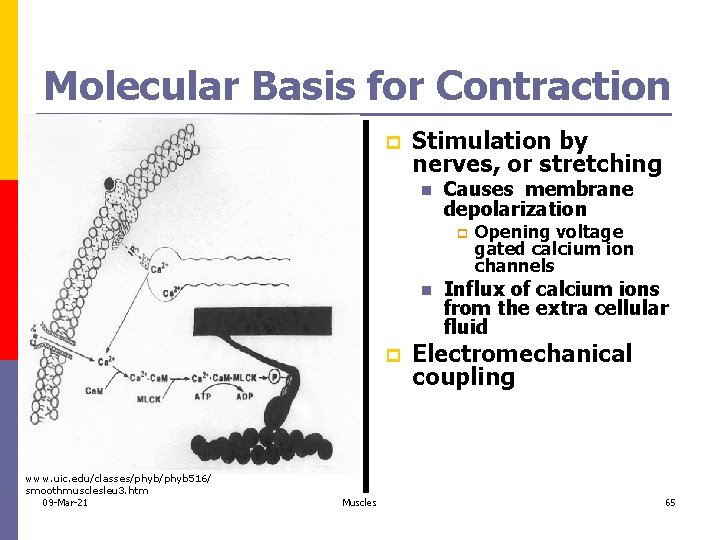
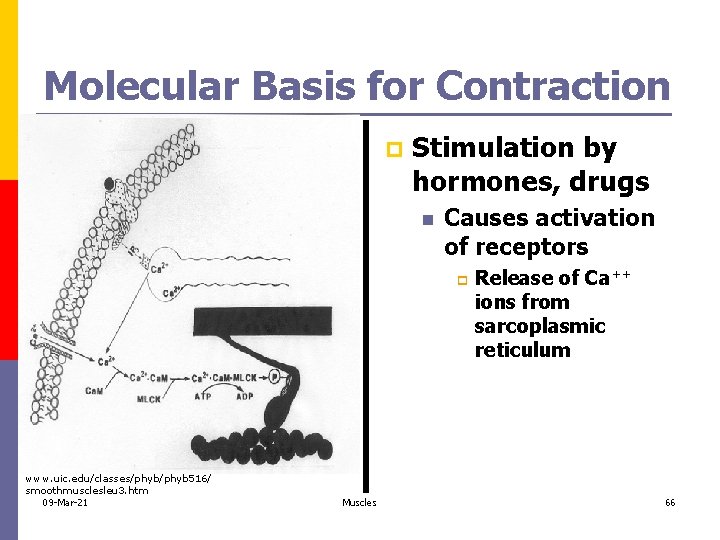
Molecular Basis for Contraction p p Initiated by calcium as it is in skeletal muscles Smooth muscle n www. uic. edu/classes/phyb 516/ smoothmusclesleu 3. htm 09 -Mar-21 Muscles Has poorly developed sarcoplasmic reticulum 64
Molecular Basis for Contraction p Stimulation by nerves, or stretching n Causes membrane depolarization p www. uic. edu/classes/phyb 516/ smoothmusclesleu 3. htm 09 -Mar-21 Muscles Opening voltage gated calcium ion channels Influx of calcium ions from the extra cellular fluid Electromechanical coupling 65
Molecular Basis for Contraction p Stimulation by hormones, drugs n Causes activation of receptors p www. uic. edu/classes/phyb 516/ smoothmusclesleu 3. htm 09 -Mar-21 Muscles Release of Ca++ ions from sarcoplasmic reticulum 66
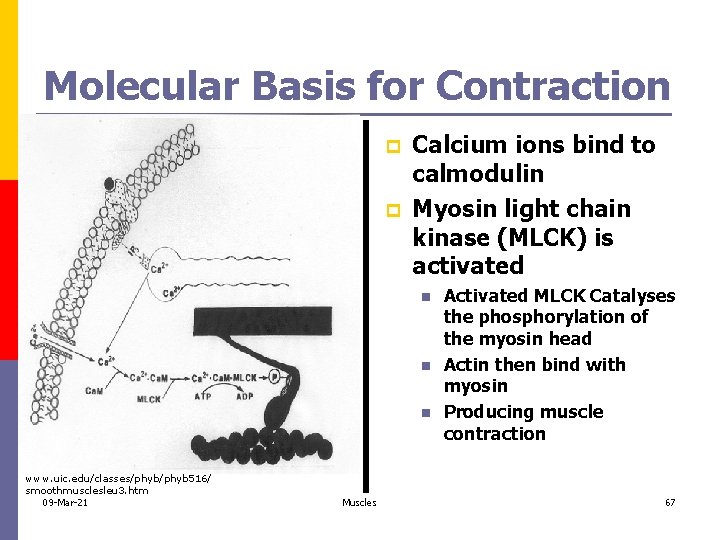
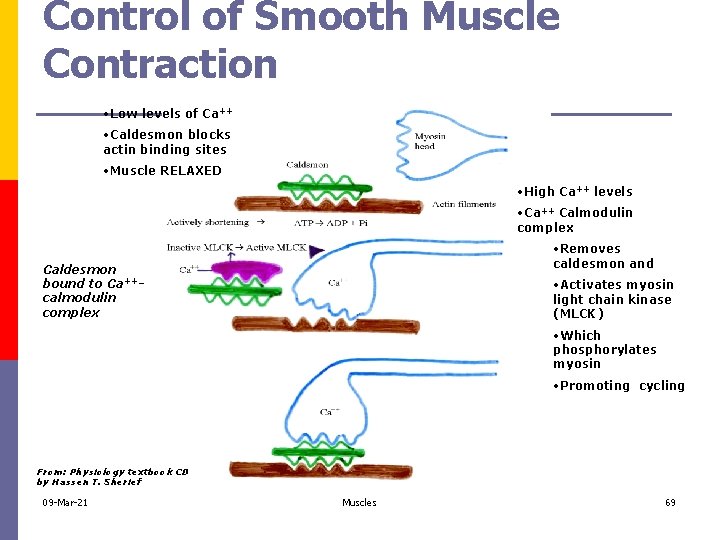
Molecular Basis for Contraction p p Calcium ions bind to calmodulin Myosin light chain kinase (MLCK) is activated n n n www. uic. edu/classes/phyb 516/ smoothmusclesleu 3. htm 09 -Mar-21 Muscles Activated MLCK Catalyses the phosphorylation of the myosin head Actin then bind with myosin Producing muscle contraction 67
Cessation of Contraction Myosin is de-phosphorylated by a phosphatase p However, the cross bridges remain attached to actin p n This produces sustained contraction p p Latch mechanism (phenomenon) Relaxation of smooth muscle occurs n 09 -Mar-21 When there is dissociation of calciumcalmodulin complex Muscles 68
Control of Smooth Muscle Contraction • Low levels of Ca++ • Caldesmon blocks actin binding sites • Muscle RELAXED • High Ca++ levels • Ca++ Calmodulin complex • Removes caldesmon and Caldesmon bound to Ca++calmodulin complex • Activates myosin light chain kinase (MLCK) • Which phosphorylates myosin • Promoting cycling From: Physiology textbook CD by Hassen T. Sherief 09 -Mar-21 Muscles 69