
Muscles of the Anterior Forearm Objectives Name and
Muscles of the Anterior Forearm
Objectives • Name and identify the muscles in the anterior (flexor/pronator) and posterior (extensor/supinator) compartments of the forearm, noting their relations. • Name and identify the neurovascular structures in the anterior and posterior compartments of the forearm, noting their relations. • Discuss the functions of the muscles in the anterior and posterior compartment of the forearm.
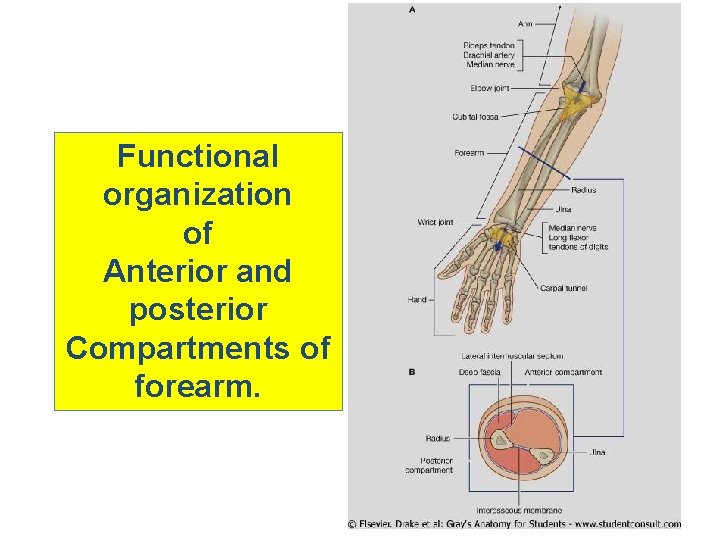
Functional organization of Anterior and posterior Compartments of forearm.
Names of the Muscles of forearm • Many of them • Long names: good guide to location and function • Location: ie. superficial / deep radial / ulnar (which side is the thumb on? ? ) • Function: ie. flexor / extensor adductor / abductor • Does it act on the thumb (pollux) or the fingers (digits)?
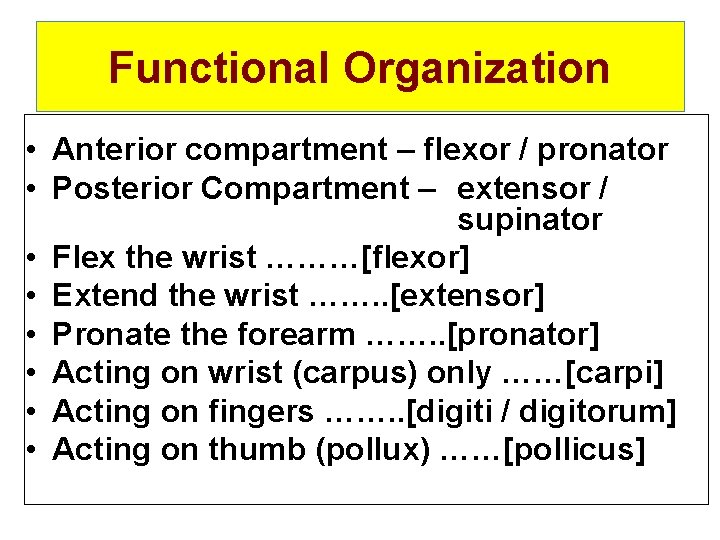
Functional Organization • Anterior compartment – flexor / pronator • Posterior Compartment – extensor / supinator • Flex the wrist ………[flexor] • Extend the wrist ……. . [extensor] • Pronate the forearm ……. . [pronator] • Acting on wrist (carpus) only ……[carpi] • Acting on fingers ……. . [digiti / digitorum] • Acting on thumb (pollux) ……[pollicus]
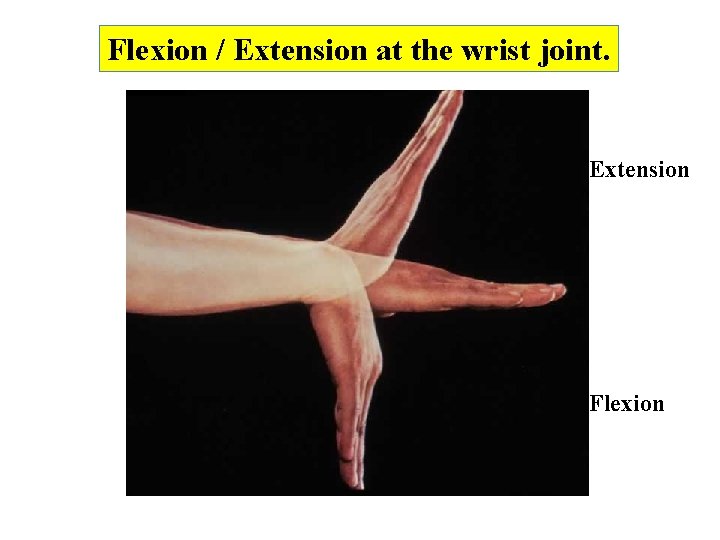
Flexion / Extension at the wrist joint. Extension Flexion
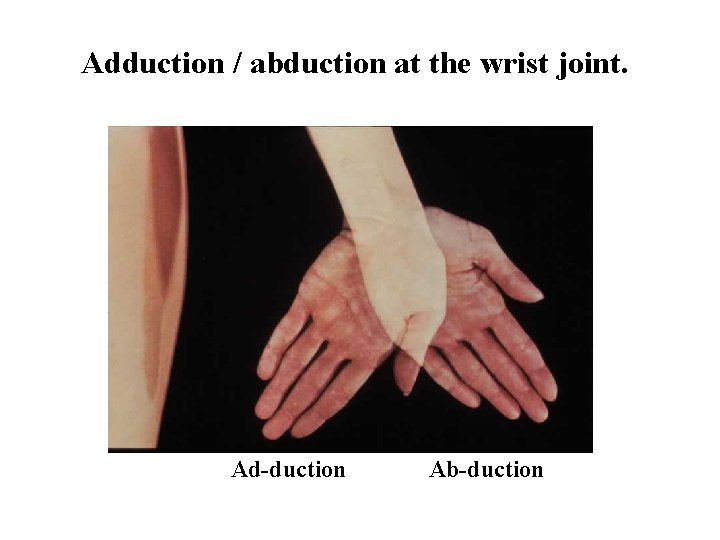
Adduction / abduction at the wrist joint. Ad-duction Ab-duction
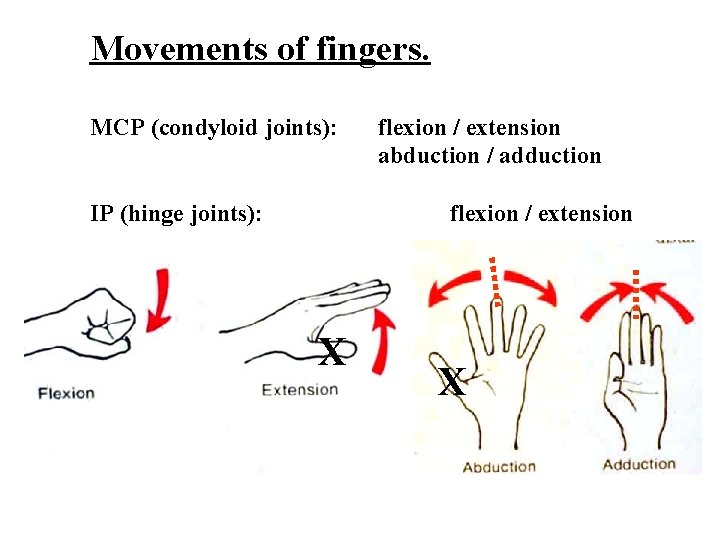
Movements of fingers. MCP (condyloid joints): IP (hinge joints): flexion / extension abduction / adduction flexion / extension X X
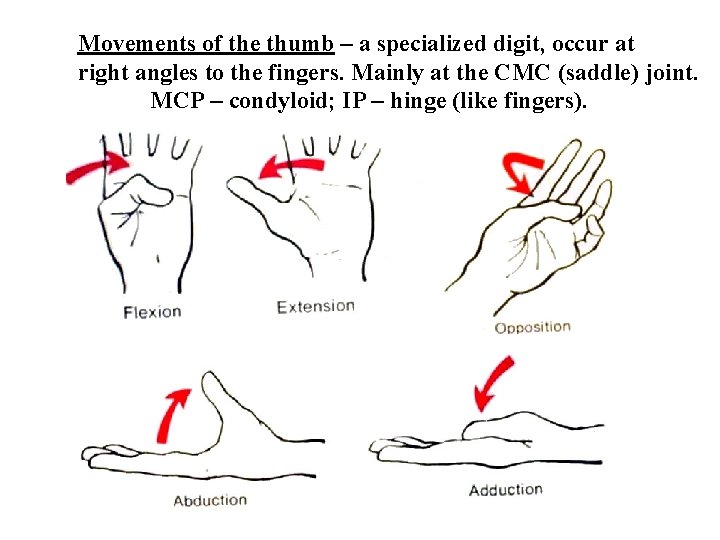
Movements of the thumb – a specialized digit, occur at right angles to the fingers. Mainly at the CMC (saddle) joint. MCP – condyloid; IP – hinge (like fingers).
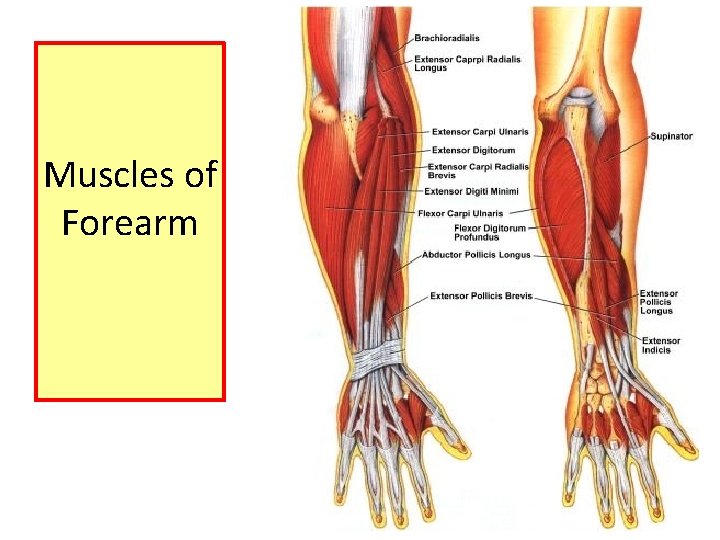
Muscles of Forearm
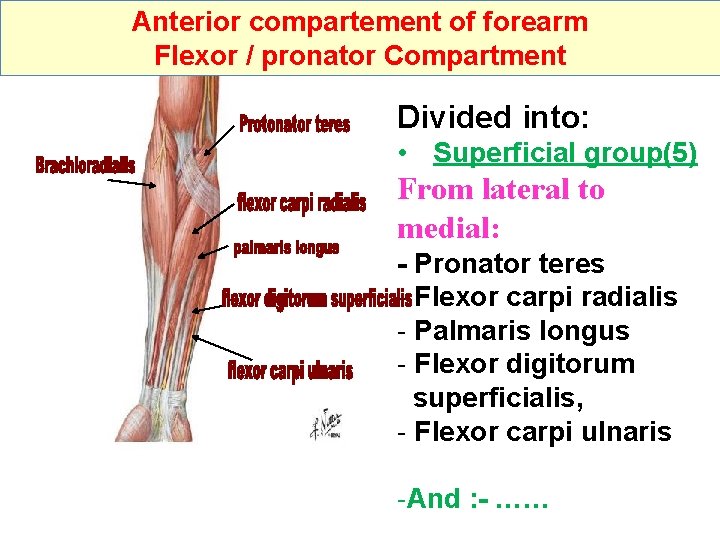
Anterior compartement of forearm Flexor / pronator Compartment Divided into: • Superficial group(5) From lateral to medial: - Pronator teres - Flexor carpi radialis - Palmaris longus - Flexor digitorum superficialis, - Flexor carpi ulnaris -And : - ……
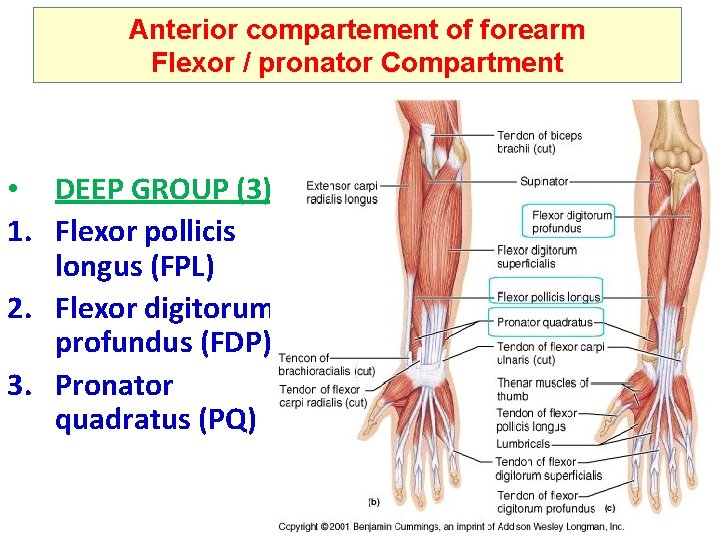
Anterior compartement of forearm Flexor / pronator Compartment • DEEP GROUP (3) 1. Flexor pollicis longus (FPL) 2. Flexor digitorum profundus (FDP) 3. Pronator quadratus (PQ)
SUPERFICIAL GROUP • ORIGINS: v All 5 muscles have a HUMERAL HEAD (arising from the front of medial epicondyle of humerus: Common flexor origin). • IN ADDITION: v 3 out of 5 muscles have an ULNAR HEAD: 1. PT & FDS: arise from medial border of coronoid process of ulna 2. FCU: arises from medial surface of olecranon process & posterior border of shaft of ulna v One muscle has a RADIAL HEAD: • FDS: arises from oblique line & anterior border of shaft of radius
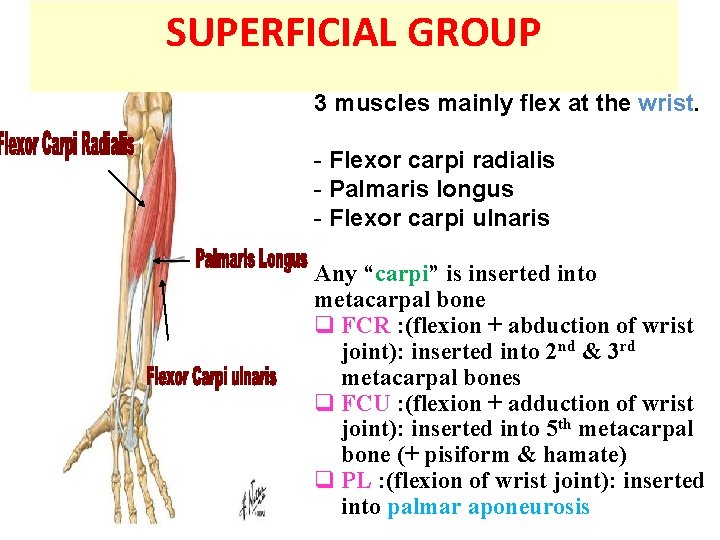
SUPERFICIAL GROUP Functional organization: 3 muscles mainly flex at the wrist. - Flexor carpi radialis - Palmaris longus - Flexor carpi ulnaris Any “carpi” is inserted into metacarpal bone q FCR : (flexion + abduction of wrist joint): inserted into 2 nd & 3 rd metacarpal bones q FCU : (flexion + adduction of wrist joint): inserted into 5 th metacarpal bone (+ pisiform & hamate) q PL : (flexion of wrist joint): inserted into palmar aponeurosis
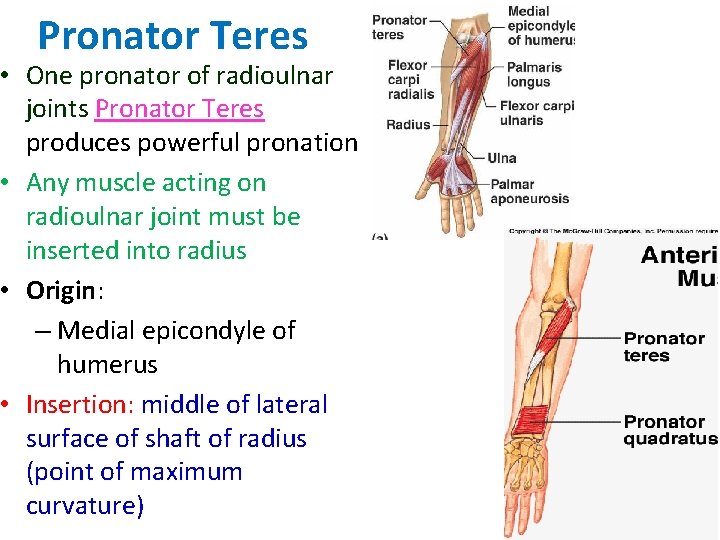
Pronator Teres • One pronator of radioulnar joints Pronator Teres produces powerful pronation • Any muscle acting on radioulnar joint must be inserted into radius • Origin: – Medial epicondyle of humerus • Insertion: middle of lateral surface of shaft of radius (point of maximum curvature)
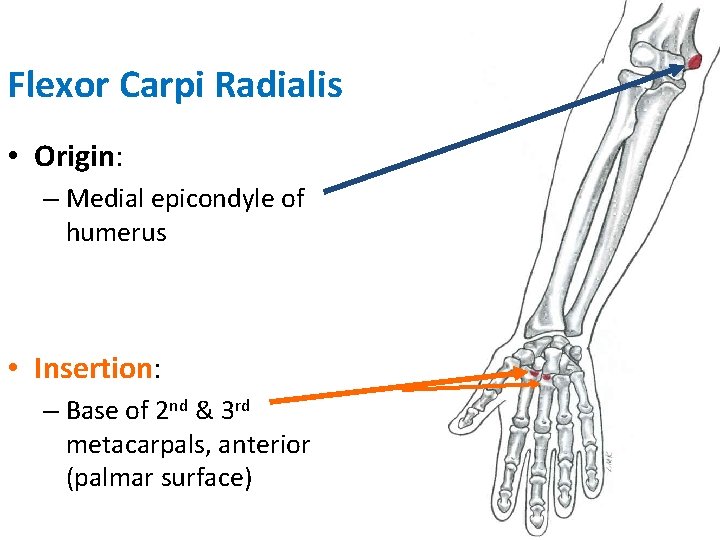
Flexor Carpi Radialis • Origin: – Medial epicondyle of humerus • Insertion: – Base of 2 nd & 3 rd metacarpals, anterior (palmar surface)
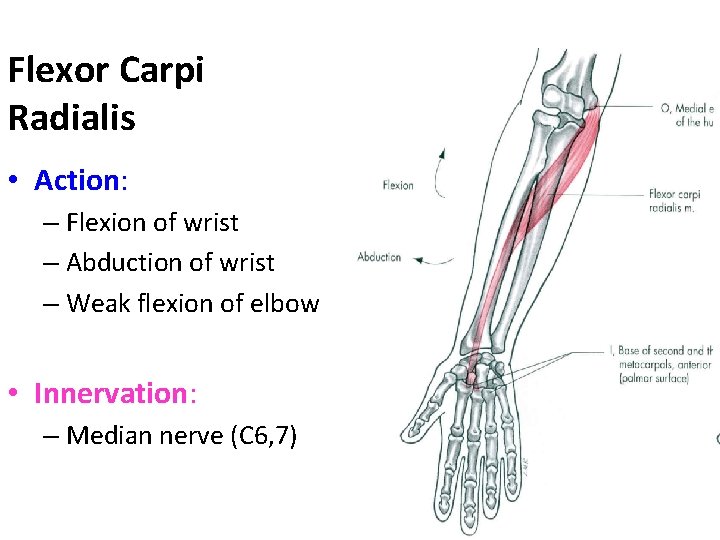
Flexor Carpi Radialis • Action: – Flexion of wrist – Abduction of wrist – Weak flexion of elbow • Innervation: – Median nerve (C 6, 7)
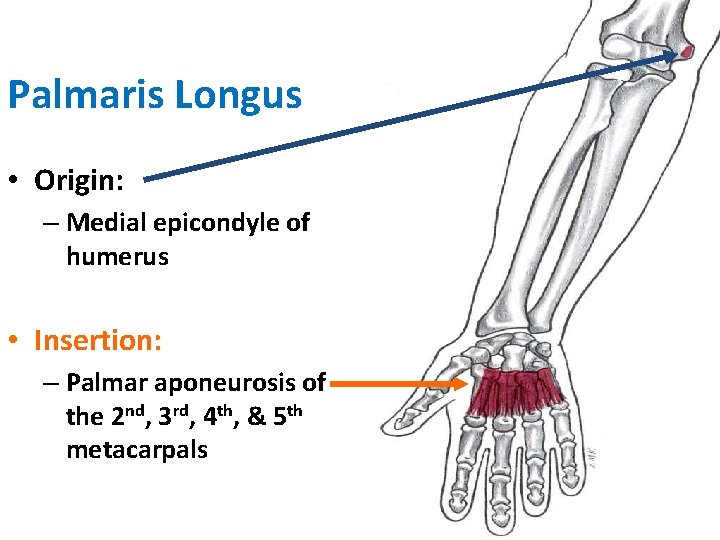
Palmaris Longus • Origin: – Medial epicondyle of humerus • Insertion: – Palmar aponeurosis of the 2 nd, 3 rd, 4 th, & 5 th metacarpals
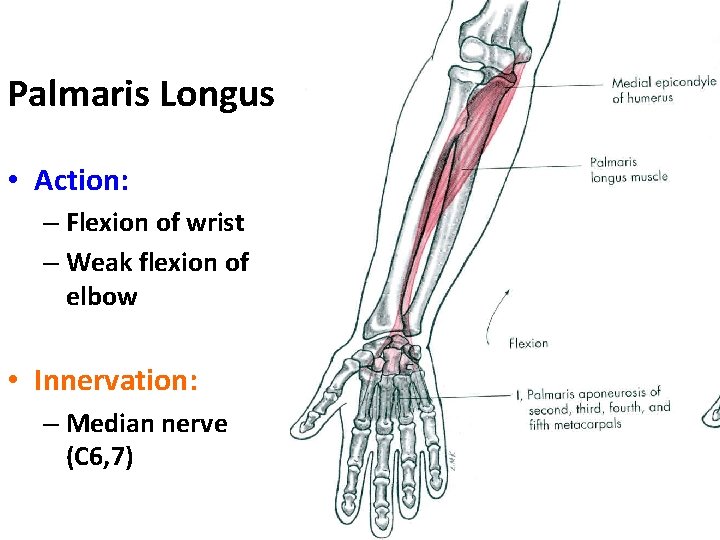
Palmaris Longus • Action: – Flexion of wrist – Weak flexion of elbow • Innervation: – Median nerve (C 6, 7)
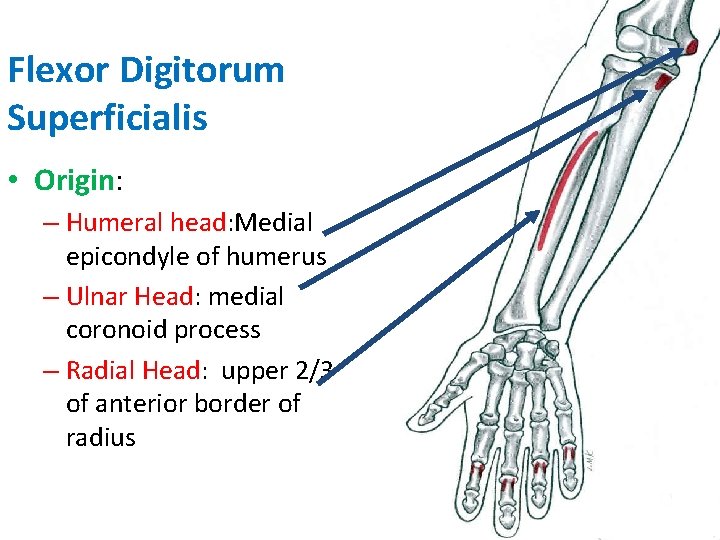
Flexor Digitorum Superficialis • Origin: – Humeral head: Medial epicondyle of humerus – Ulnar Head: medial coronoid process – Radial Head: upper 2/3 of anterior border of radius
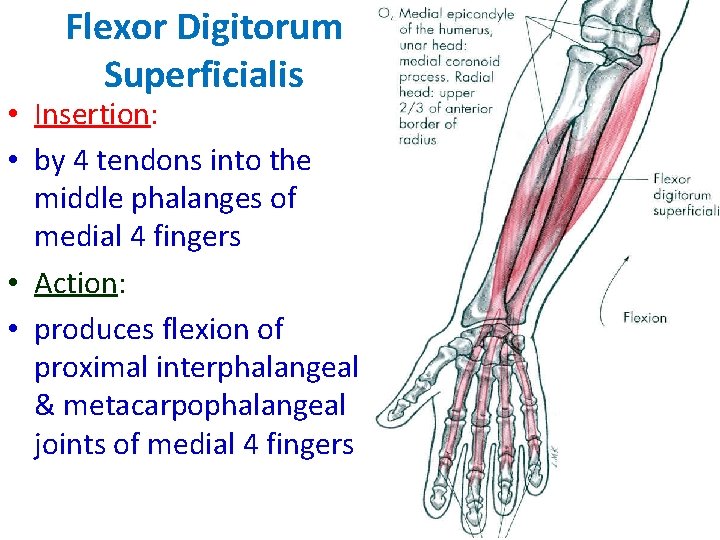
Flexor Digitorum Superficialis • Insertion: • by 4 tendons into the middle phalanges of medial 4 fingers • Action: • produces flexion of proximal interphalangeal & metacarpophalangeal joints of medial 4 fingers
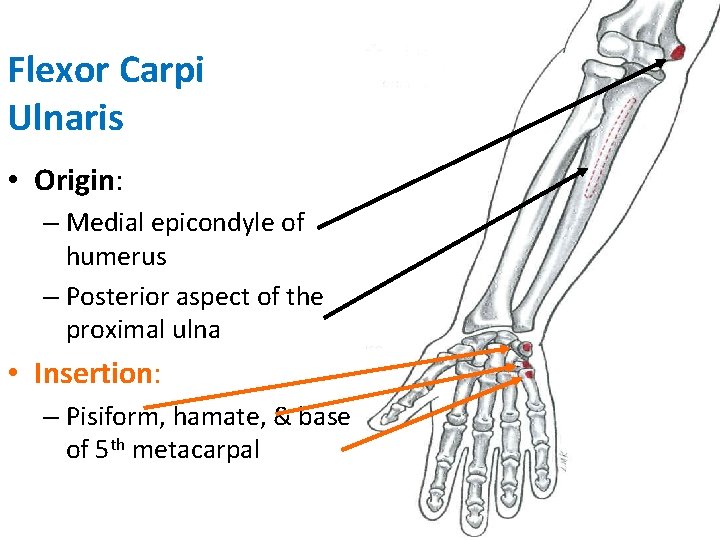
Flexor Carpi Ulnaris • Origin: – Medial epicondyle of humerus – Posterior aspect of the proximal ulna • Insertion: – Pisiform, hamate, & base of 5 th metacarpal
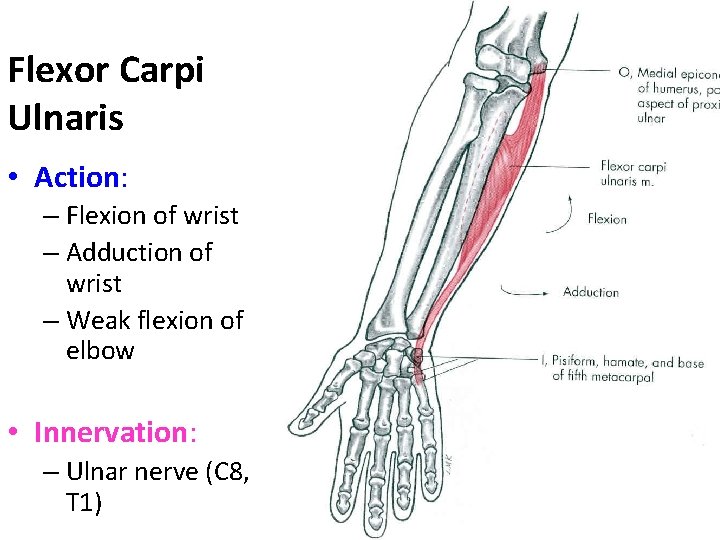
Flexor Carpi Ulnaris • Action: – Flexion of wrist – Adduction of wrist – Weak flexion of elbow • Innervation: – Ulnar nerve (C 8, T 1)
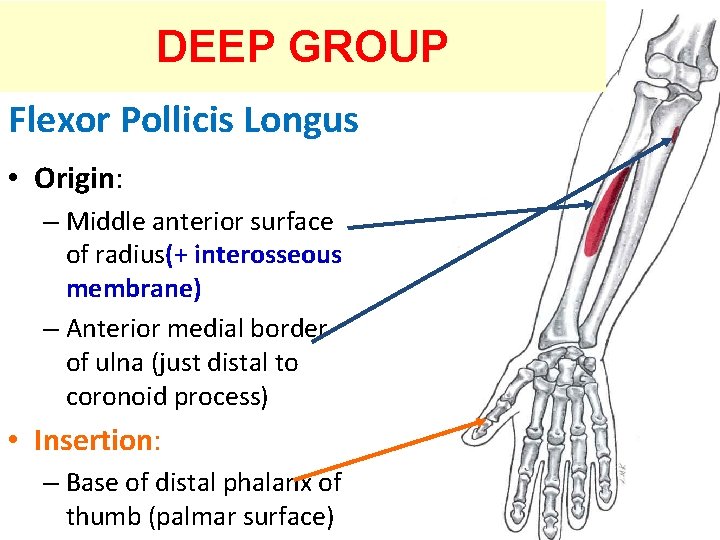
DEEP GROUP Flexor Pollicis Longus • Origin: – Middle anterior surface of radius(+ interosseous membrane) – Anterior medial border of ulna (just distal to coronoid process) • Insertion: – Base of distal phalanx of thumb (palmar surface)
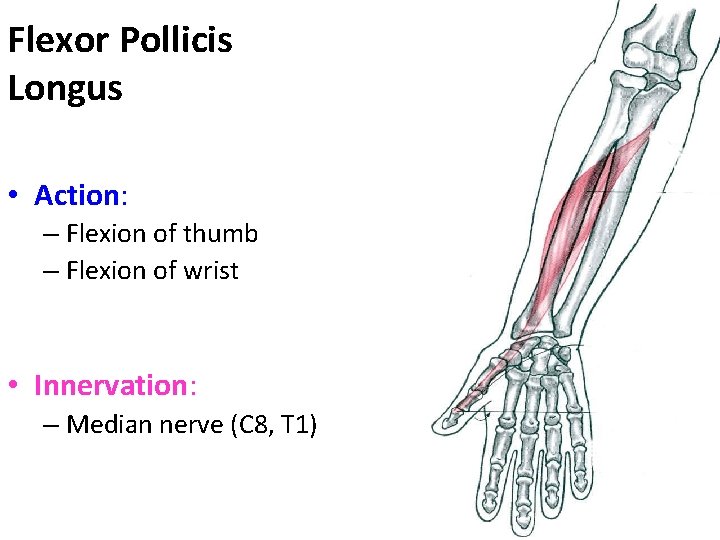
Flexor Pollicis Longus • Action: – Flexion of thumb – Flexion of wrist • Innervation: – Median nerve (C 8, T 1)
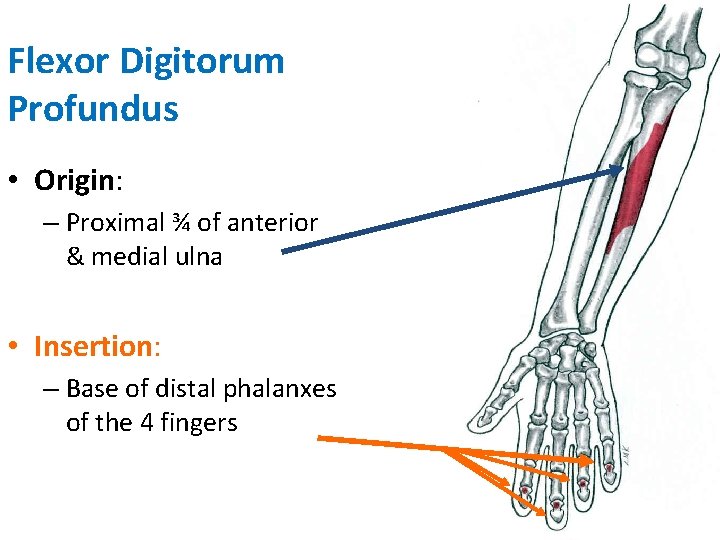
Flexor Digitorum Profundus • Origin: – Proximal ¾ of anterior & medial ulna • Insertion: – Base of distal phalanxes of the 4 fingers
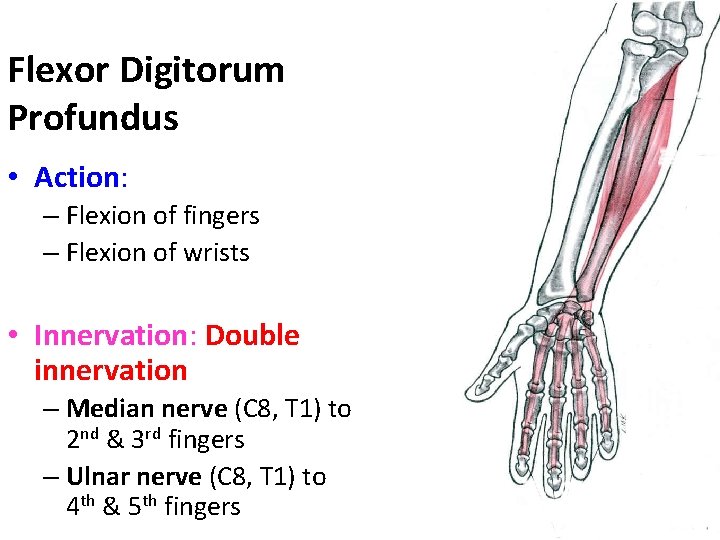
Flexor Digitorum Profundus • Action: – Flexion of fingers – Flexion of wrists • Innervation: Double innervation – Median nerve (C 8, T 1) to 2 nd & 3 rd fingers – Ulnar nerve (C 8, T 1) to 4 th & 5 th fingers
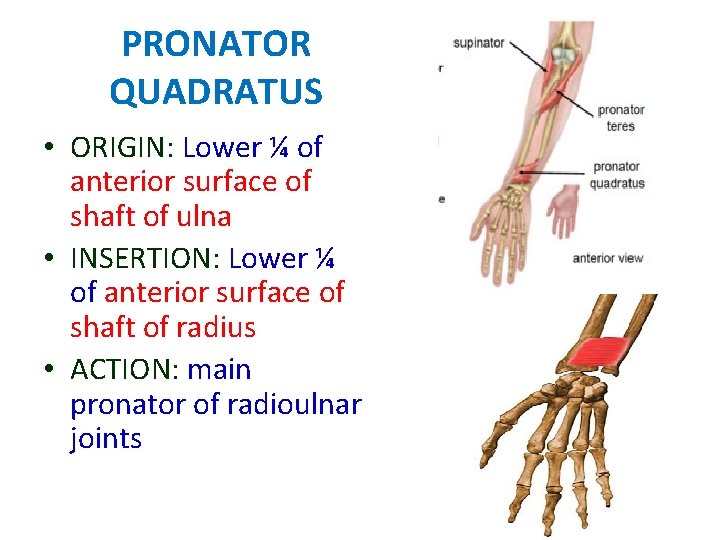
PRONATOR QUADRATUS • ORIGIN: Lower ¼ of anterior surface of shaft of ulna • INSERTION: Lower ¼ of anterior surface of shaft of radius • ACTION: main pronator of radioulnar joints
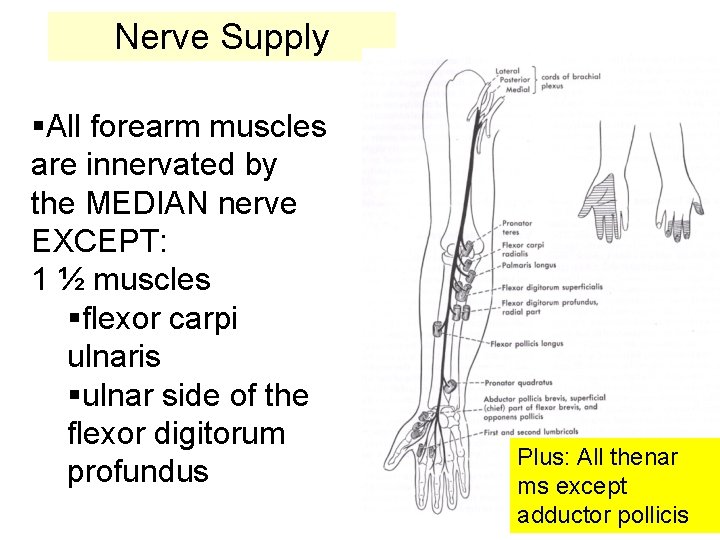
Nerve Supply §All forearm muscles are innervated by the MEDIAN nerve EXCEPT: 1 ½ muscles §flexor carpi ulnaris §ulnar side of the flexor digitorum profundus Plus: All thenar ms except adductor pollicis
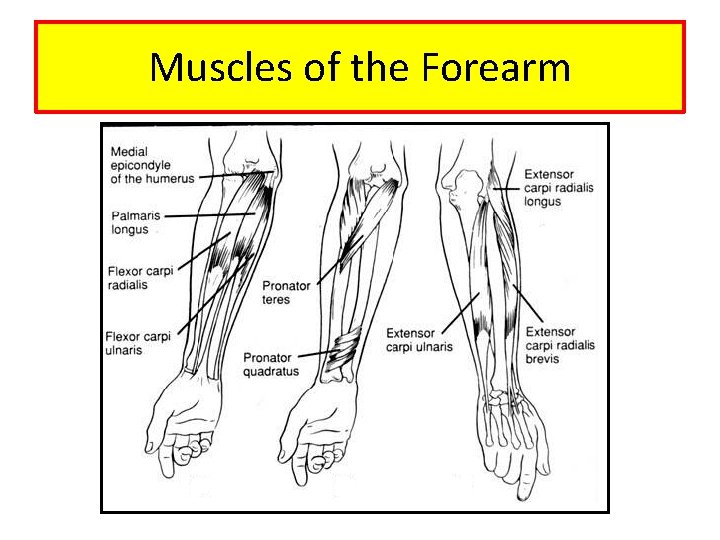
Muscles of the Forearm
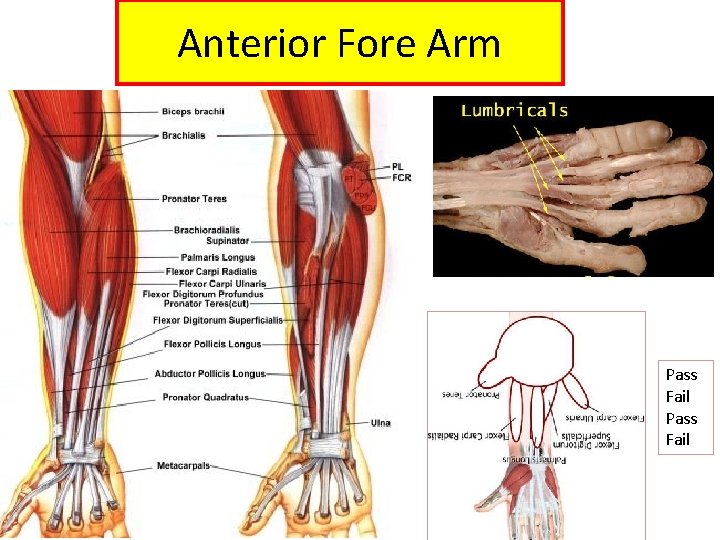
Anterior Fore Arm Pass Fail
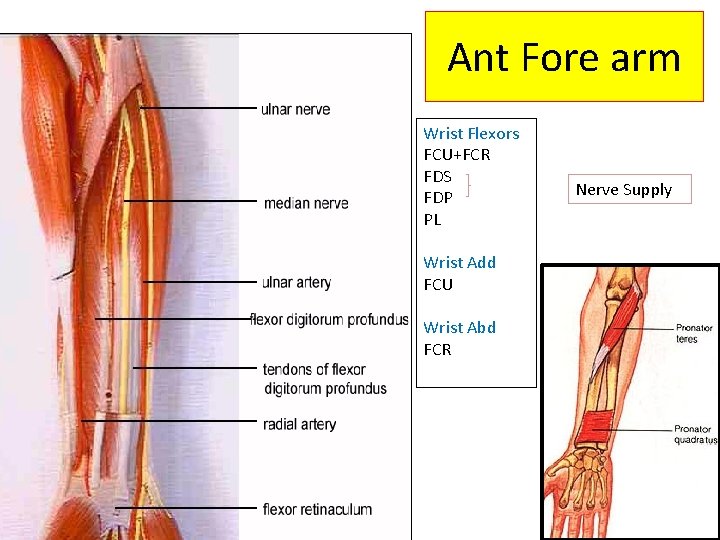
Ant Fore arm Wrist Flexors FCU+FCR FDS FDP PL Wrist Add FCU Wrist Abd FCR Nerve Supply
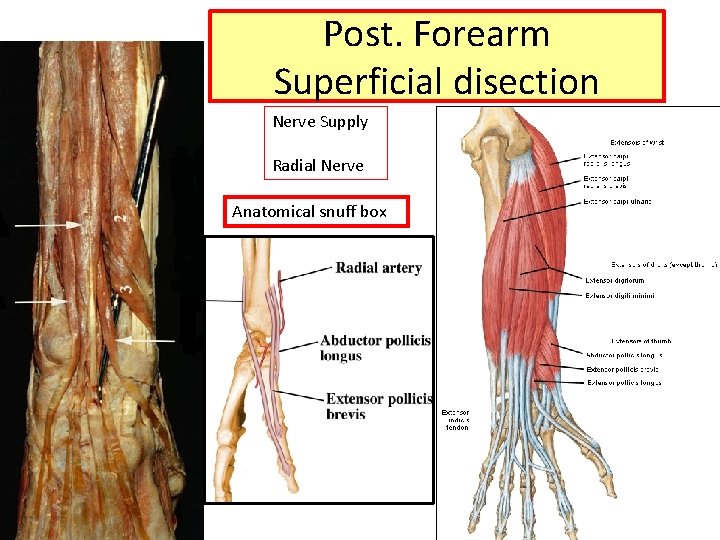
Post. Forearm Superficial disection Nerve Supply Radial Nerve Anatomical snuff box
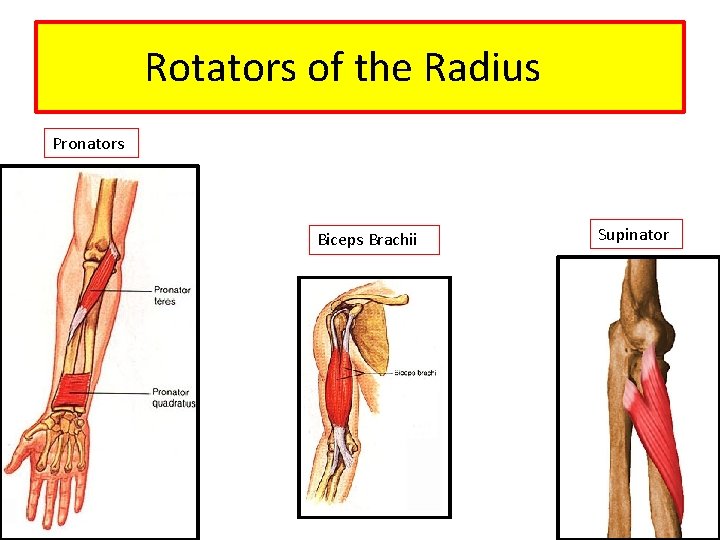
Rotators of the Radius Pronators Biceps Brachii Supinator
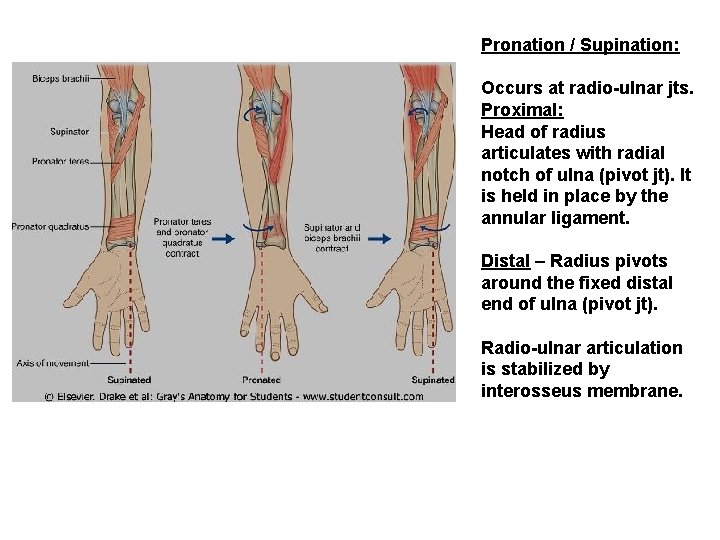
Pronation / Supination: Occurs at radio-ulnar jts. Proximal: Head of radius articulates with radial notch of ulna (pivot jt). It is held in place by the annular ligament. Distal – Radius pivots around the fixed distal end of ulna (pivot jt). Radio-ulnar articulation is stabilized by interosseus membrane.
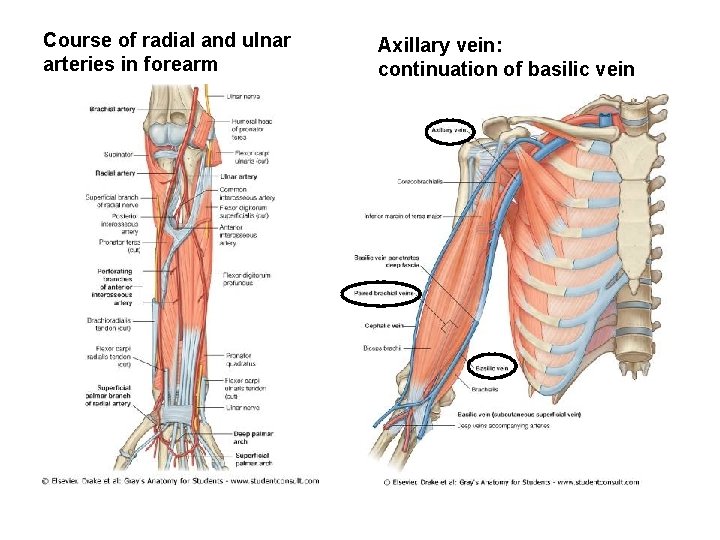
Course of radial and ulnar arteries in forearm Axillary vein: continuation of basilic vein
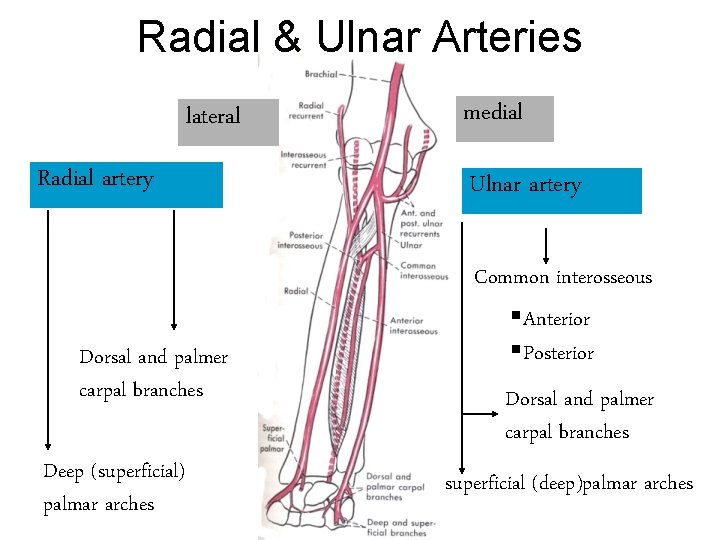
Radial & Ulnar Arteries lateral Radial artery Dorsal and palmer carpal branches Deep (superficial) palmar arches medial Ulnar artery Common interosseous §Anterior §Posterior Dorsal and palmer carpal branches superficial (deep)palmar arches
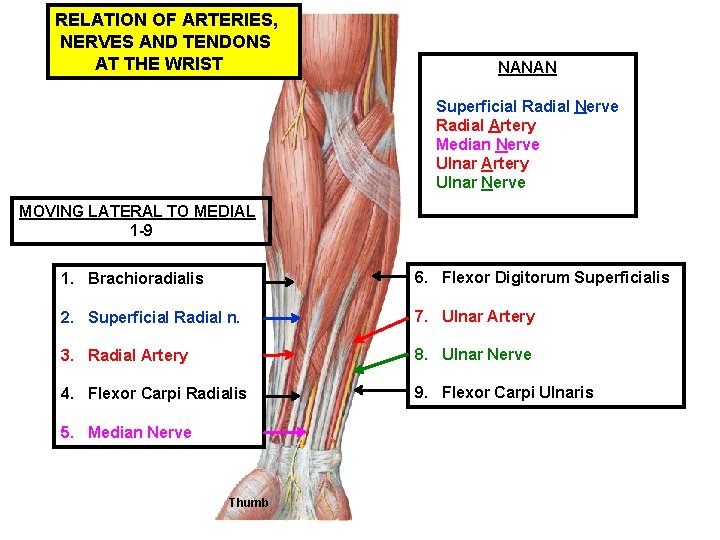
RELATION OF ARTERIES, NERVES AND TENDONS AT THE WRIST NANAN Superficial Radial Nerve Radial Artery Median Nerve Ulnar Artery Ulnar Nerve MOVING LATERAL TO MEDIAL 1 -9 1. Brachioradialis 6. Flexor Digitorum Superficialis 2. Superficial Radial n. 7. Ulnar Artery 3. Radial Artery 8. Ulnar Nerve 4. Flexor Carpi Radialis 9. Flexor Carpi Ulnaris 5. Median Nerve Thumb
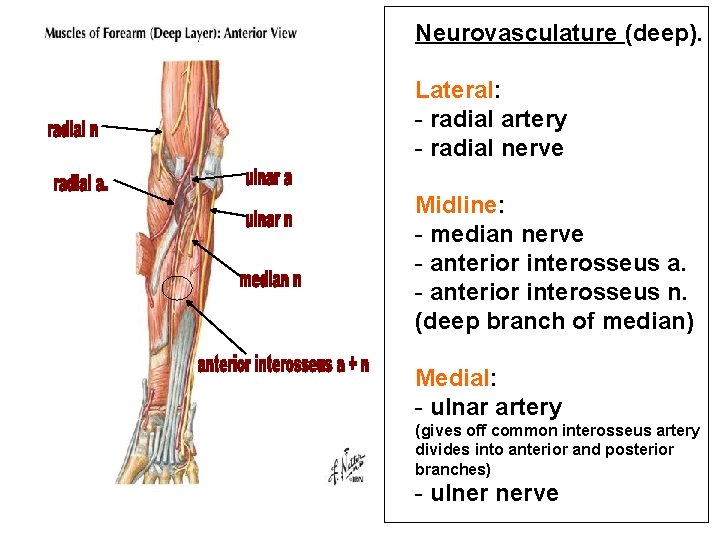
Neurovasculature (deep). Lateral: - radial artery - radial nerve Midline: - median nerve - anterior interosseus a. - anterior interosseus n. (deep branch of median) Medial: - ulnar artery (gives off common interosseus artery divides into anterior and posterior branches) - ulner nerve
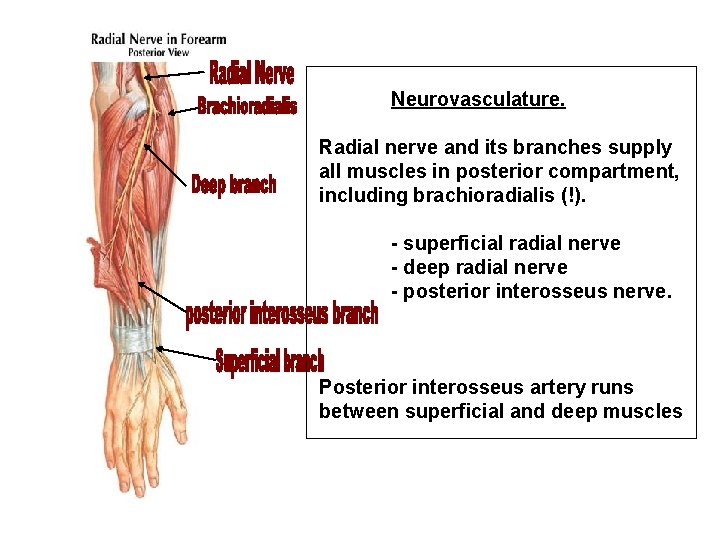
Neurovasculature. Radial nerve and its branches supply all muscles in posterior compartment, including brachioradialis (!). - superficial radial nerve - deep radial nerve - posterior interosseus nerve. Posterior interosseus artery runs between superficial and deep muscles
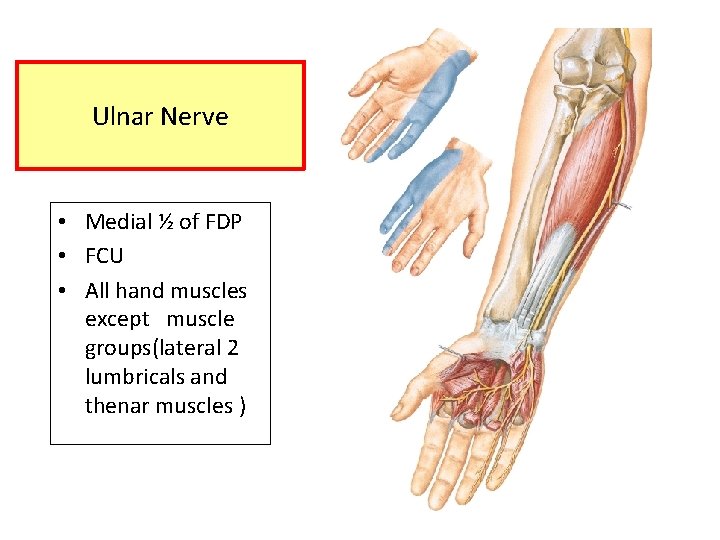
Ulnar Nerve • Medial ½ of FDP • FCU • All hand muscles except muscle groups(lateral 2 lumbricals and thenar muscles )

- Slides: 42