
MUSCLES OF BACK Department of Anatomy King Saud
MUSCLES OF BACK Department of Anatomy King Saud University Dr. Sameerah Shaheen Assistant Professor of Anatomy College of Medicine sshahee@ksu. edu. sa
OBJECTIVES At the end of the lecture, students should be able to: § Distinguish between the different groups of back § § muscles. Compare between groups of back muscles as regard their nerve supply and action. List the back muscles of each group. Describe the attachments of each muscle of the superficial group, as well as, its nerve supply and action. Describe the triangles of back and their clinical significance.
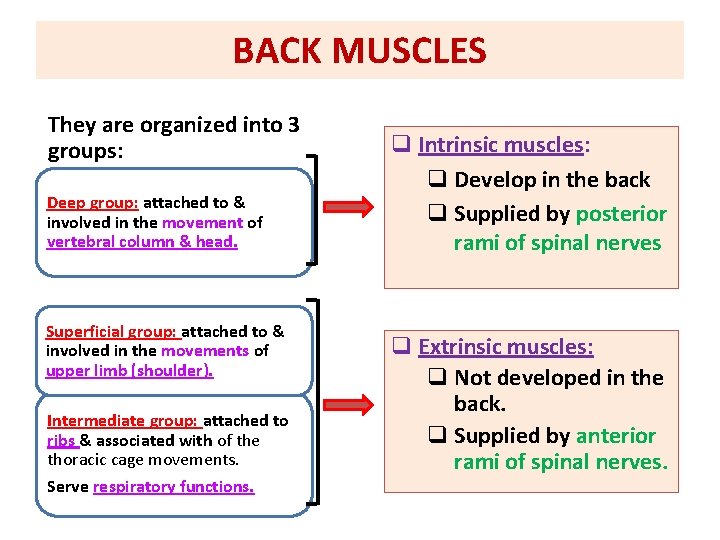
BACK MUSCLES They are organized into 3 groups: Deep group: attached to & involved in the movement of vertebral column & head. Superficial group: attached to & involved in the movements of upper limb (shoulder). Intermediate group: attached to ribs & associated with of the thoracic cage movements. Serve respiratory functions. q Intrinsic muscles: q Develop in the back q Supplied by posterior rami of spinal nerves rami q Extrinsic muscles: q Not developed in the back. q Supplied by anterior rami of spinal nerves. rami
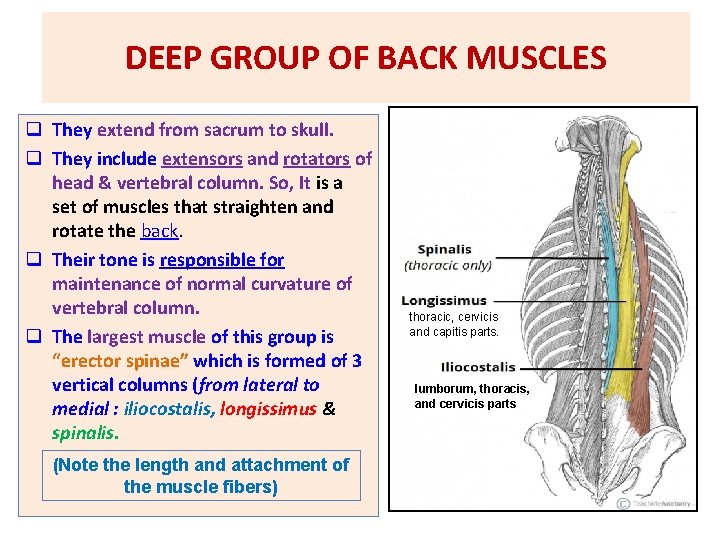
DEEP GROUP OF BACK MUSCLES q They extend from sacrum to skull. q They include extensors and rotators of head & vertebral column. So, It is a head & vertebral column. So, It set of muscles that straighten and rotate the back. q Their tone is responsible for maintenance of normal curvature of vertebral column. q The largest muscle of this group is largest muscle “erector spinae” which is formed of 3 “erector spinae” vertical columns (from lateral to medial : iliocostalis, longissimus & spinalis (Note the length and attachment of the muscle fibers) thoracic, cervicis and capitis parts. lumborum, thoracis, and cervicis parts

INTERMEDIATE GROUP OF BACK MUSCLES q It is separated from the deep group by thoracolumbar fascia. q It includes: • Serratus posterior superior (rib elevator). superior • Serratus posterior inferior (rib depressor). q Nerve supply: anterior rami of Nerve supply: thoracic spinal nerves (intercostal nerve). § Serratus posterior superior contributes in deep inspiration. § Serratus posterior inferior contributes in forced expiration.

SUPRERFICIAL GROUP OF BACK MUSCLES Includes two sets of muscles: They originate from the vertebral column and attach to the bones of the shoulder – the clavicle, scapula and humerus. q Muscles connecting vertebral column to scapula (move scapula through shoulder girdle joints) & include: 1. Trapezius. 2. Levator scapulae. 3. Rhomboid minor. 4. Rhomboid major. q Muscle connecting vertebral column to humerus (move humerus through shoulder joint), & include: • Latissimus dorsi.
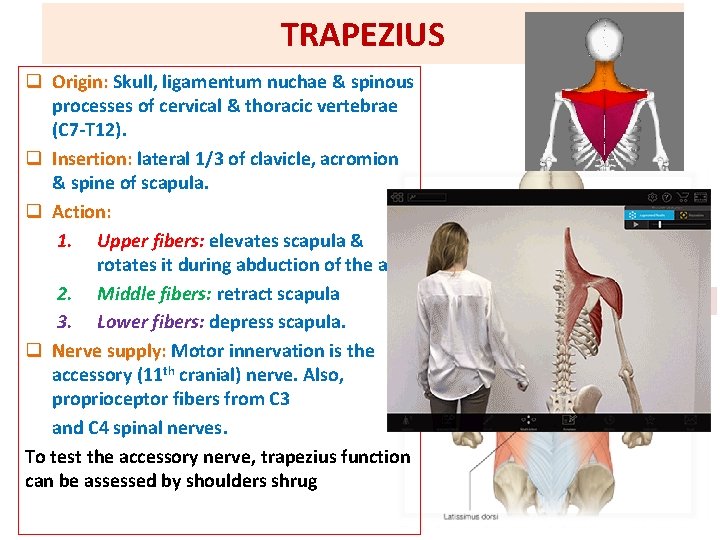
TRAPEZIUS q Origin: Skull, ligamentum nuchae & spinous Origin: processes of cervical & thoracic vertebrae (C 7 -T 12). q Insertion: lateral 1/3 of clavicle, acromion Insertion: & spine of scapula. q Action: 1. Upper fibers: elevates scapula & rotates it during abduction of the arm. 2. Middle fibers: retract scapula 3. Lower fibers: depress scapula. q Nerve supply: Motor innervation is the Nerve supply: accessory (11 th cranial) nerve. Also, proprioceptor fibers from C 3 and C 4 spinal nerves. To test the accessory nerve, trapezius function can be assessed by shoulders shrug Action Insertion Origin

LEVATOR SCAPULAE RHOMBOID MINOR & MAJOR q Origin: 1. Levator scapulae: cervical transverse processes C 1 -C 4, Insertion: medial border of Insertion: scapula. 2. Rhomboid major: thoracic spinous processes of T 2 -T 5 vertebrae, Insertion: medial border of the scapula, between the scapula spine and inferior angle 3. Rhomboid minor: the spinous processes of C 7 -T 1 vertebrae, Insertion: medial border of Insertion: scapula at the level of the spine of scapula. 4. Nerve supply: dorsal scapular nerve. Nerve supply: Actions: 5. Levator scapulae: elevates scapula. 6. Rhomboid minor & major: retract & rotate scapula. Retraction Moving arm+shoulder j. posteriorly
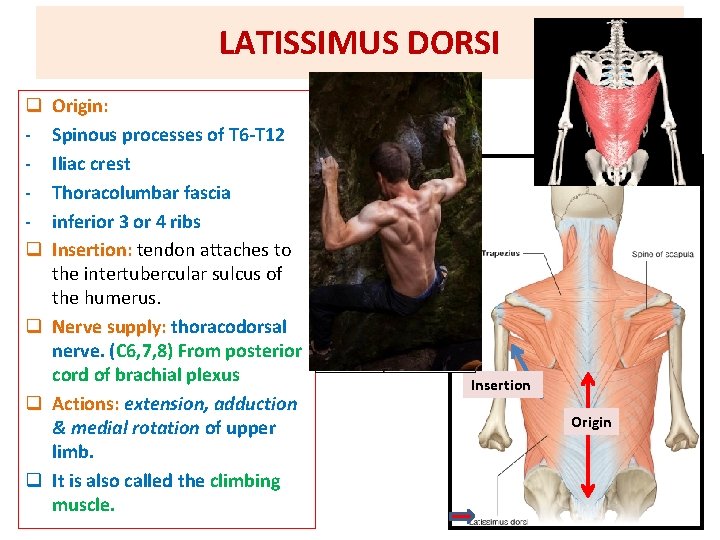
LATISSIMUS DORSI Origin: Spinous processes of T 6 -T 12 Iliac crest Thoracolumbar fascia inferior 3 or 4 ribs Insertion: tendon attaches to Insertion: the intertubercular sulcus of the humerus. q Nerve supply: thoracodorsal Nerve supply: nerve. (C 6, 7, 8) From posterior cord of brachial plexus q Actions: extension, adduction & medial rotation of upper limb. q It is also called the climbing muscle. q q Insertion Origin
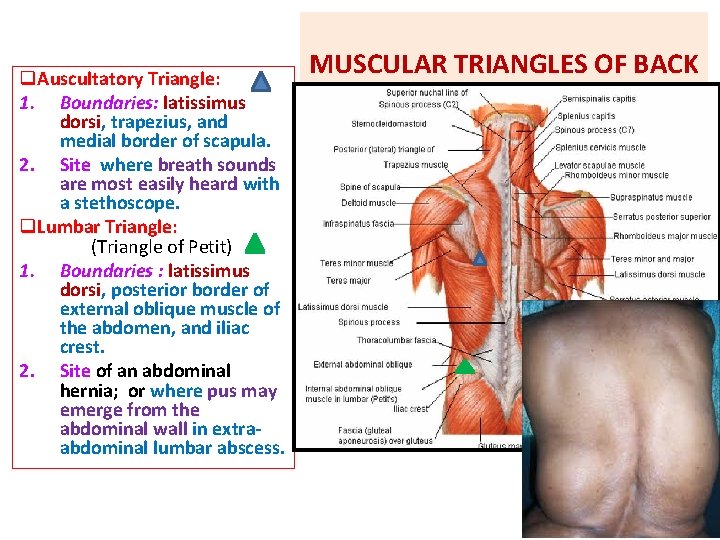
q. Auscultatory Triangle: 1. Boundaries: latissimus Boundaries: dorsi, trapezius, and medial border of scapula. 2. Site where breath sounds are most easily heard with are most easily heard a stethoscope. q. Lumbar Triangle: (Triangle of Petit) 1. Boundaries : latissimus dorsi, posterior border of external oblique muscle of the abdomen, and iliac crest. 2. Site of an abdominal hernia; or where pus may emerge from the abdominal wall in extraabdominal lumbar abscess. MUSCULAR TRIANGLES OF BACK
SUMMARY q BACK MUSCLES: 1. Deep group: attached to & moves vertebral column, supplied by posterior rami of spinal nerves. 2. Intermediate group: attached to & moves ribs, supplied by anterior rami of spinal nerves. 3. Superficial group: - Origin: vertebral column. - Insertion: scapula (EXCEPT latissimus dorsi: humerus). - Action: moves scapula (EXCEPT latissimus dorsi: moves humerus). - Nerve supply: anterior rami of spinal nerves through brachial plexus (EXCEPT trapezius: 11 th cranial nerve).

THANK YOU
QUESTION 1 q. Which one of the following muscles of back that rotates the humerus medially ? 1. Trapezius. 2. Latissimus dorsi. 3. Rhomboid major. 4. Serratus posterior superior.
QUESTION 2 q. Regarding back muscles, which one of the following statements is correct? 1. All back muscles are supplied by posterior rami of spinal nerves. 2. Muscles of intermediate group move vertebral column. 3. Muscles of superficial group are involved in upper limb movements. 4. Muscles of deep group serve respiratory functions.
- Slides: 14