
MUSCLES AND MOVEMENT To know the meaning of

- Slides: 31
MUSCLES AND MOVEMENT To know the meaning of origin and insertion of a variety of muscles To understand the different muscular movements To be able to develop a mind map on joints and movements.
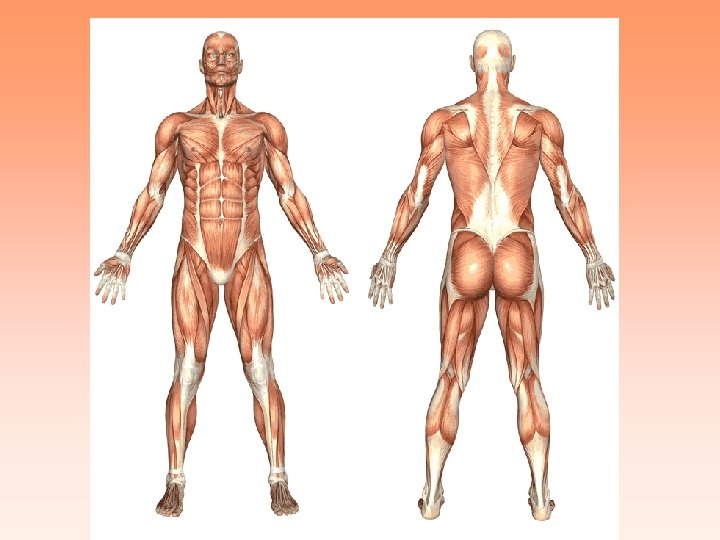
STARTER IN PAIRS IDENIFTY THE TYPE OF MOVEMENTS OCCURING AT EACH JOINT. http: //www. wisconline. com/objects/index_tj. asp? obj. ID=AP 12004
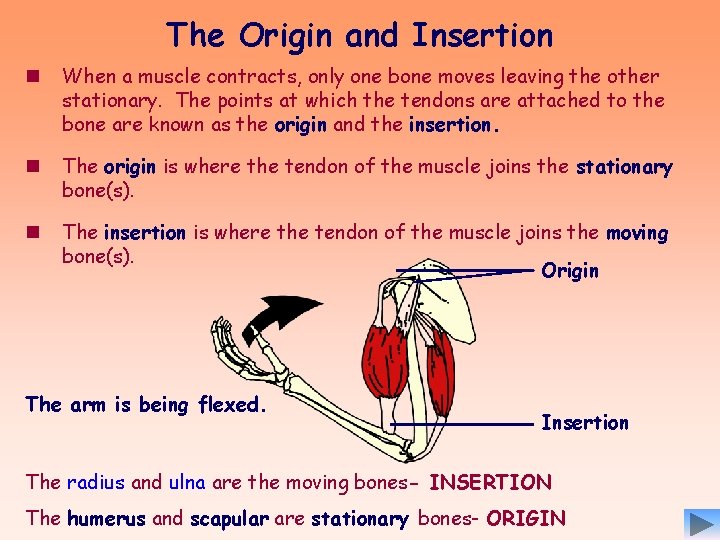
The Origin and Insertion n When a muscle contracts, only one bone moves leaving the other stationary. The points at which the tendons are attached to the bone are known as the origin and the insertion. n The origin is where the tendon of the muscle joins the stationary bone(s). n The insertion is where the tendon of the muscle joins the moving bone(s). Origin The arm is being flexed. Insertion The radius and ulna are the moving bones- INSERTION The humerus and scapular are stationary bones- ORIGIN
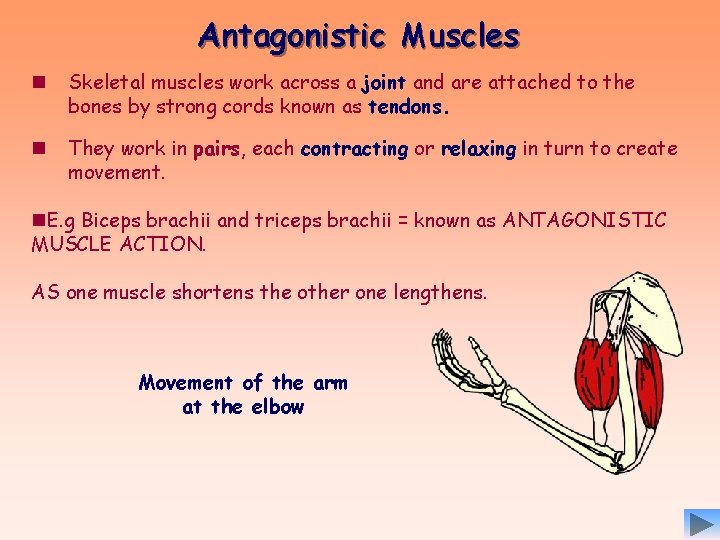
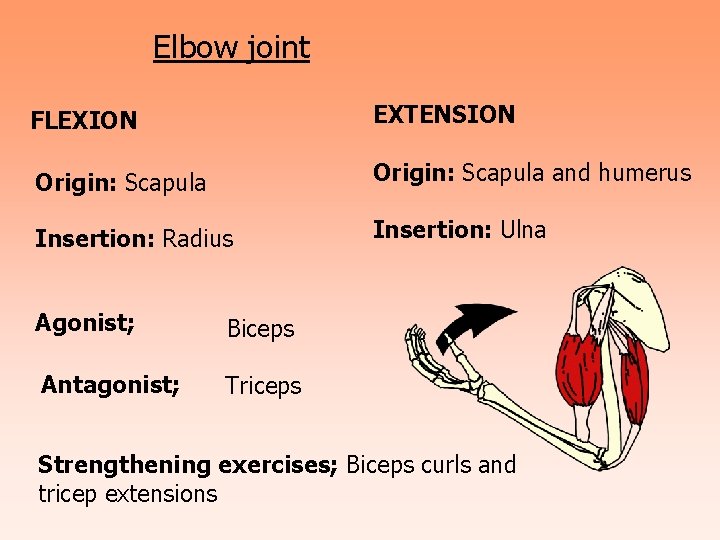
Antagonistic Muscles n Skeletal muscles work across a joint and are attached to the bones by strong cords known as tendons. n They work in pairs, each contracting or relaxing in turn to create movement. n. E. g Biceps brachii and triceps brachii = known as ANTAGONISTIC MUSCLE ACTION. AS one muscle shortens the other one lengthens. Movement of the arm at the elbow
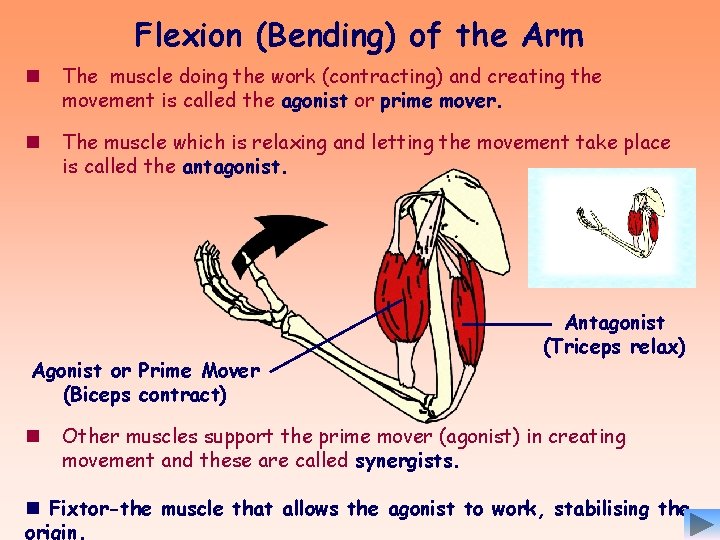
Flexion (Bending) of the Arm n The muscle doing the work (contracting) and creating the movement is called the agonist or prime mover. n The muscle which is relaxing and letting the movement take place is called the antagonist. Agonist or Prime Mover (Biceps contract) n Antagonist (Triceps relax) Other muscles support the prime mover (agonist) in creating movement and these are called synergists. n Fixtor-the muscle that allows the agonist to work, stabilising the origin.
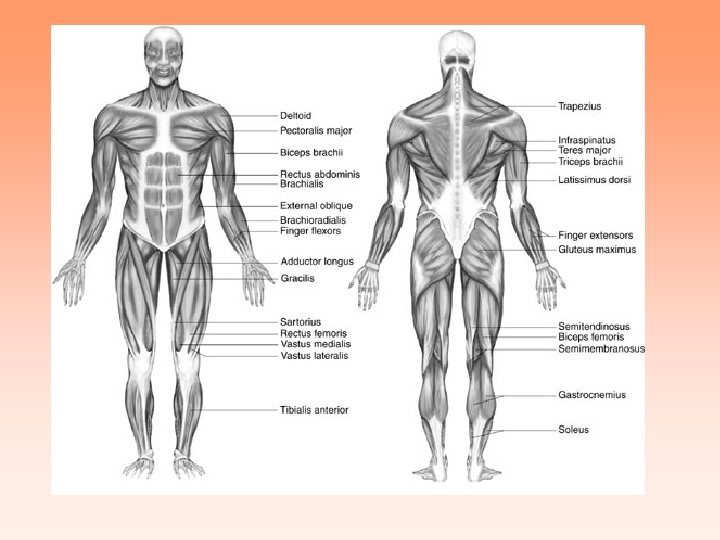
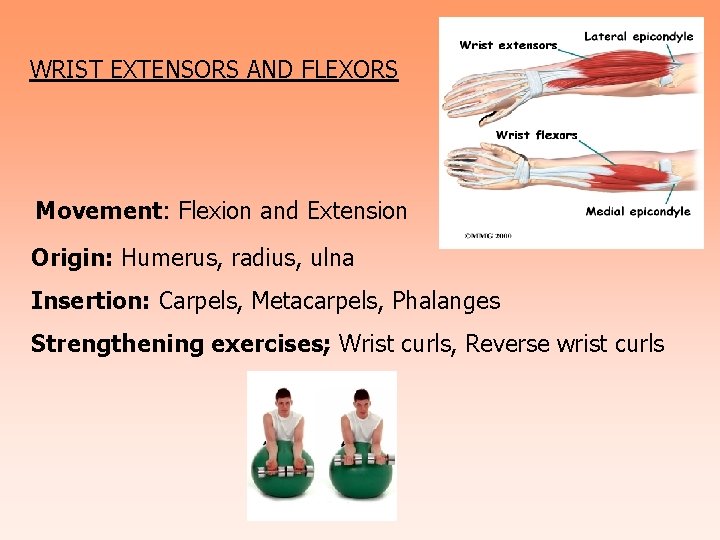
WRIST EXTENSORS AND FLEXORS Movement: Flexion and Extension Origin: Humerus, radius, ulna Insertion: Carpels, Metacarpels, Phalanges Strengthening exercises; Wrist curls, Reverse wrist curls
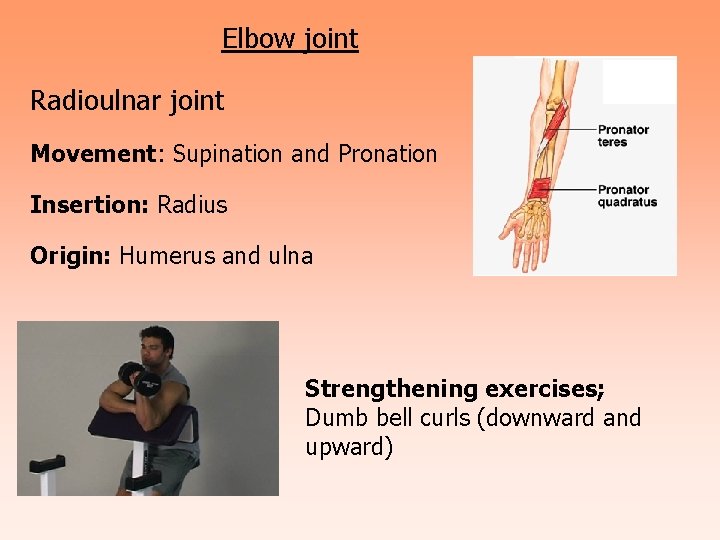
Elbow joint Radioulnar joint Movement: Supination and Pronation Insertion: Radius Origin: Humerus and ulna Strengthening exercises; Dumb bell curls (downward and upward)
Elbow joint FLEXION EXTENSION Origin: Scapula and humerus Insertion: Radius Insertion: Ulna Agonist; Biceps Antagonist; Triceps Strengthening exercises; Biceps curls and tricep extensions
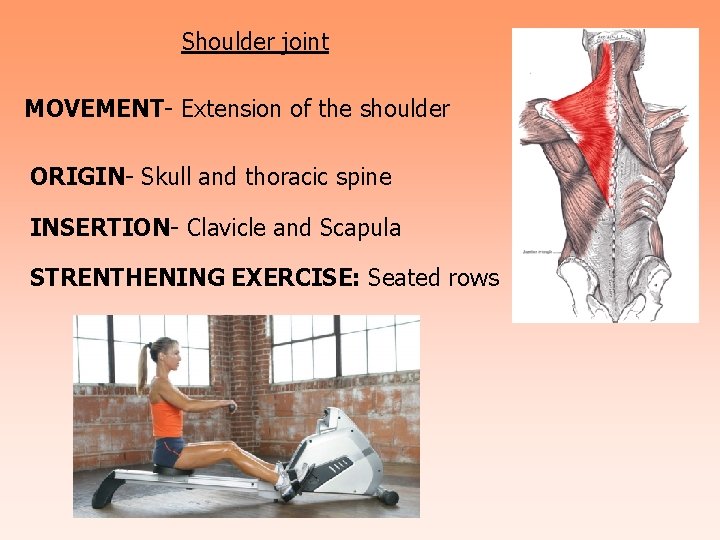
Shoulder joint MOVEMENT- Extension of the shoulder ORIGIN- Skull and thoracic spine INSERTION- Clavicle and Scapula STRENTHENING EXERCISE: Seated rows
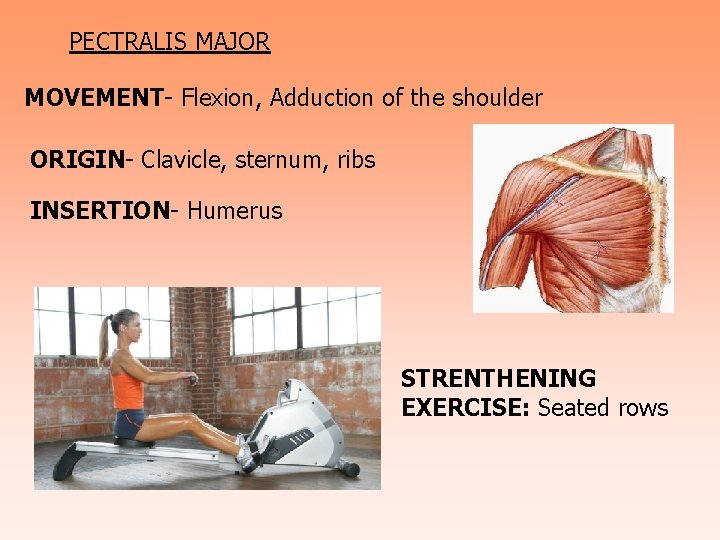
PECTRALIS MAJOR MOVEMENT- Flexion, Adduction of the shoulder ORIGIN- Clavicle, sternum, ribs INSERTION- Humerus STRENTHENING EXERCISE: Seated rows
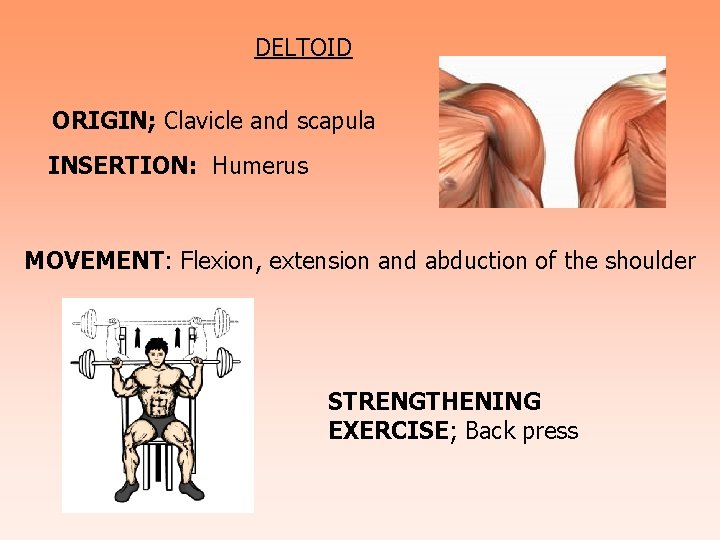
DELTOID ORIGIN; Clavicle and scapula INSERTION: Humerus MOVEMENT: Flexion, extension and abduction of the shoulder STRENGTHENING EXERCISE; Back press
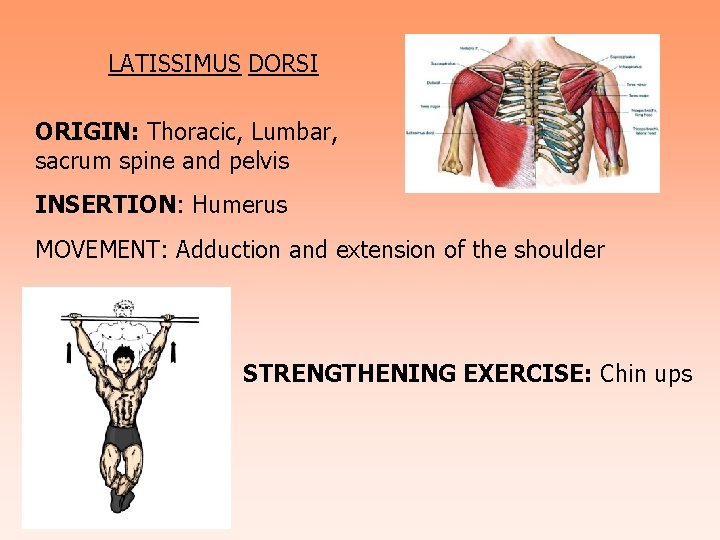
LATISSIMUS DORSI ORIGIN: Thoracic, Lumbar, sacrum spine and pelvis INSERTION: Humerus MOVEMENT: Adduction and extension of the shoulder STRENGTHENING EXERCISE: Chin ups
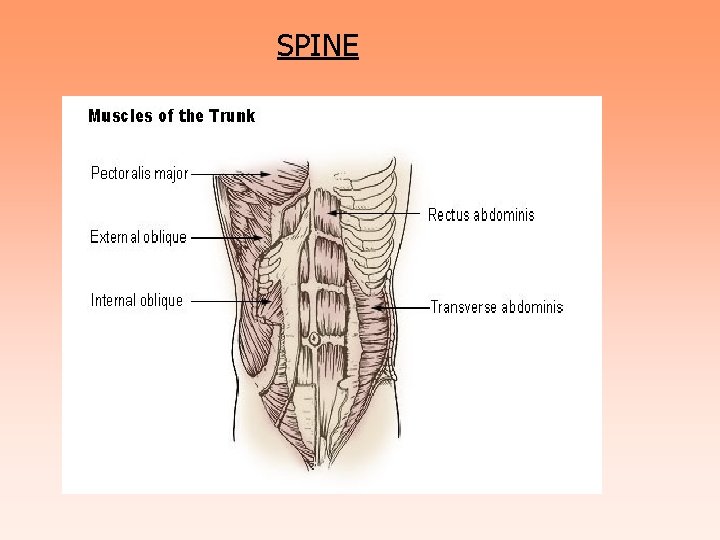
SPINE
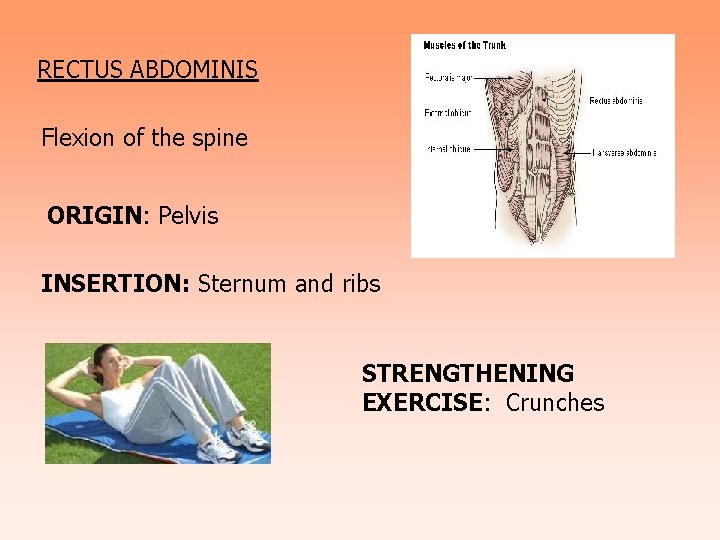
RECTUS ABDOMINIS Flexion of the spine ORIGIN: Pelvis INSERTION: Sternum and ribs STRENGTHENING EXERCISE: Crunches
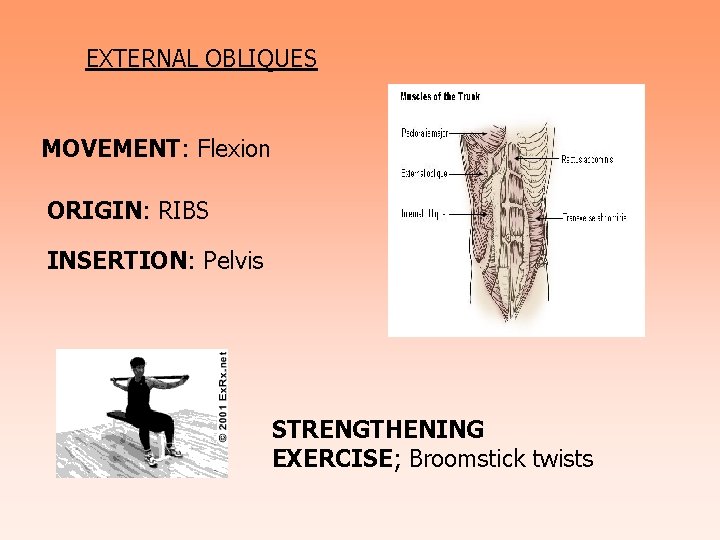
EXTERNAL OBLIQUES MOVEMENT: Flexion ORIGIN: RIBS INSERTION: Pelvis STRENGTHENING EXERCISE; Broomstick twists
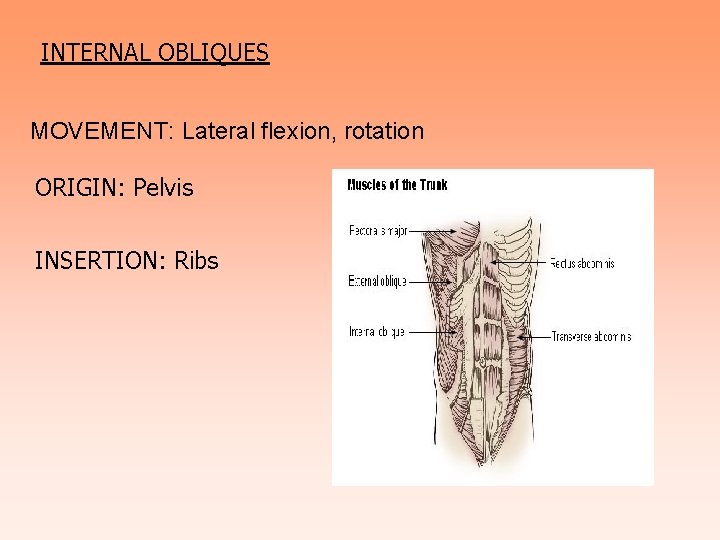
INTERNAL OBLIQUES MOVEMENT: Lateral flexion, rotation ORIGIN: Pelvis INSERTION: Ribs
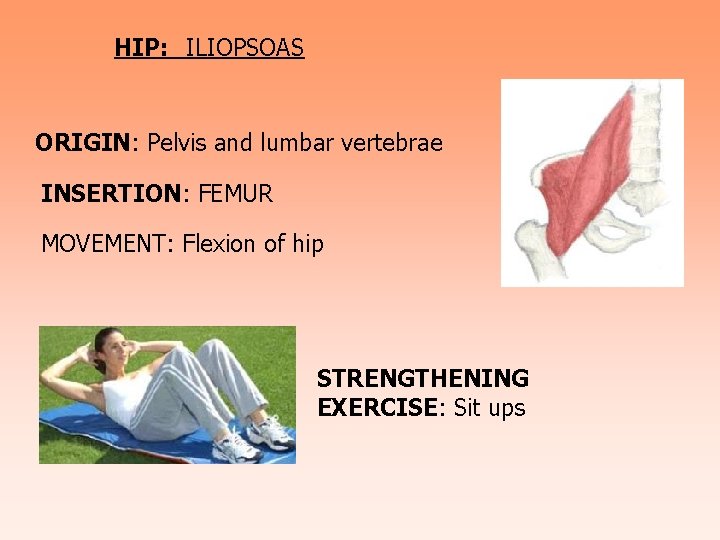
HIP: ILIOPSOAS ORIGIN: Pelvis and lumbar vertebrae INSERTION: FEMUR MOVEMENT: Flexion of hip STRENGTHENING EXERCISE: Sit ups
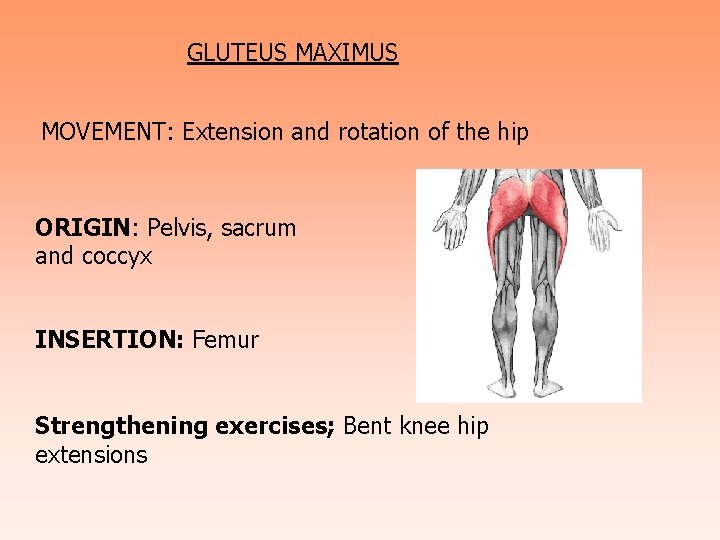
GLUTEUS MAXIMUS MOVEMENT: Extension and rotation of the hip ORIGIN: Pelvis, sacrum and coccyx INSERTION: Femur Strengthening exercises; Bent knee hip extensions
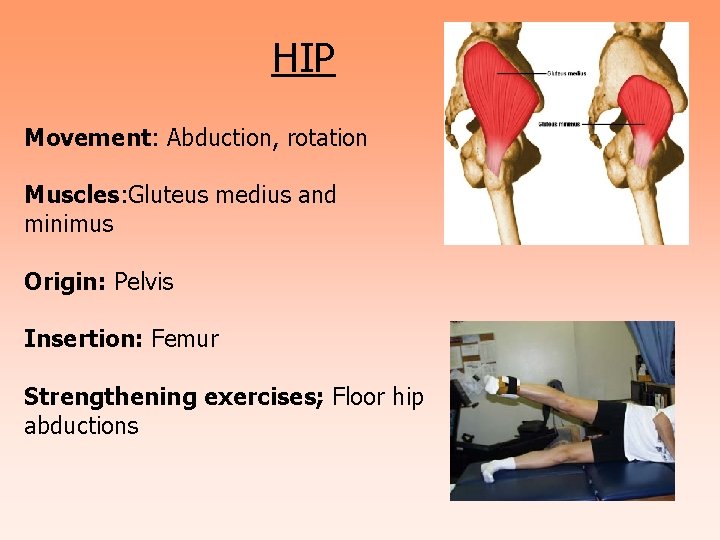
HIP Movement: Abduction, rotation Muscles: Gluteus medius and minimus Origin: Pelvis Insertion: Femur Strengthening exercises; Floor hip abductions
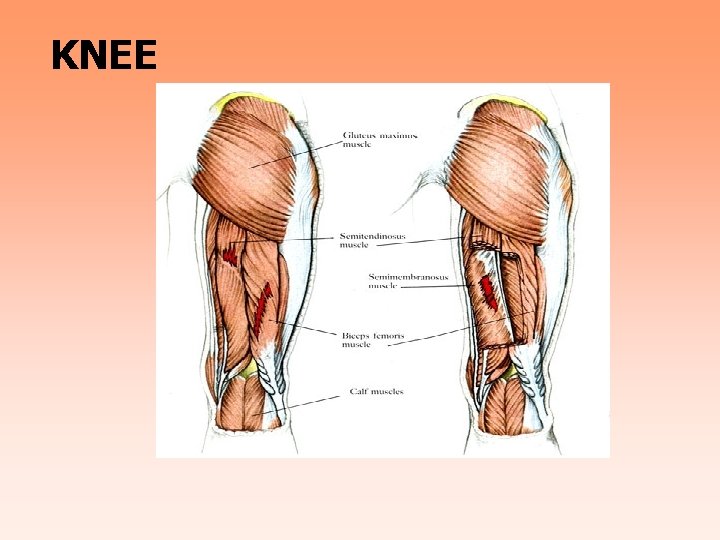
KNEE
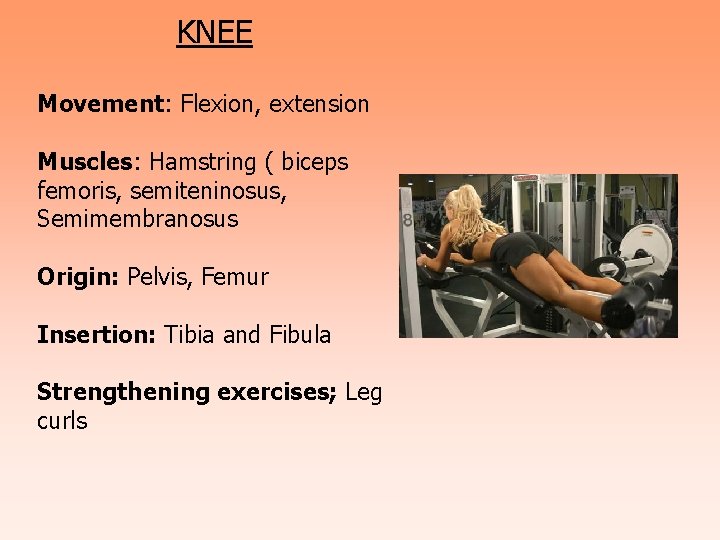
KNEE Movement: Flexion, extension Muscles: Hamstring ( biceps femoris, semiteninosus, Semimembranosus Origin: Pelvis, Femur Insertion: Tibia and Fibula Strengthening exercises; Leg curls
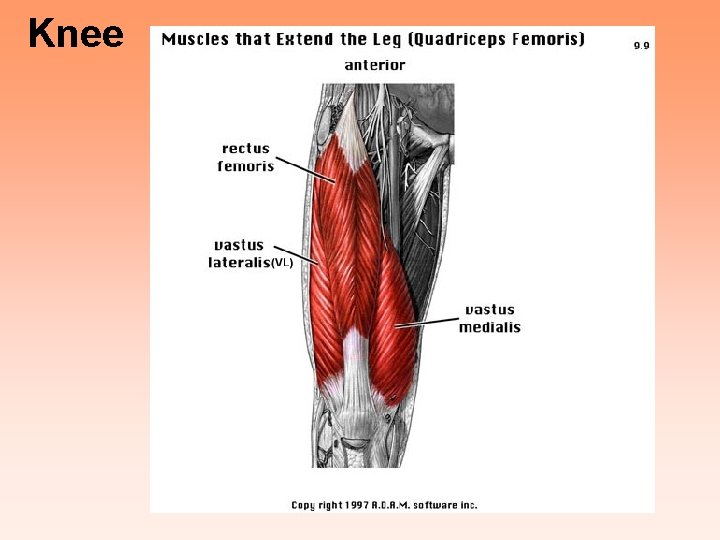
Knee
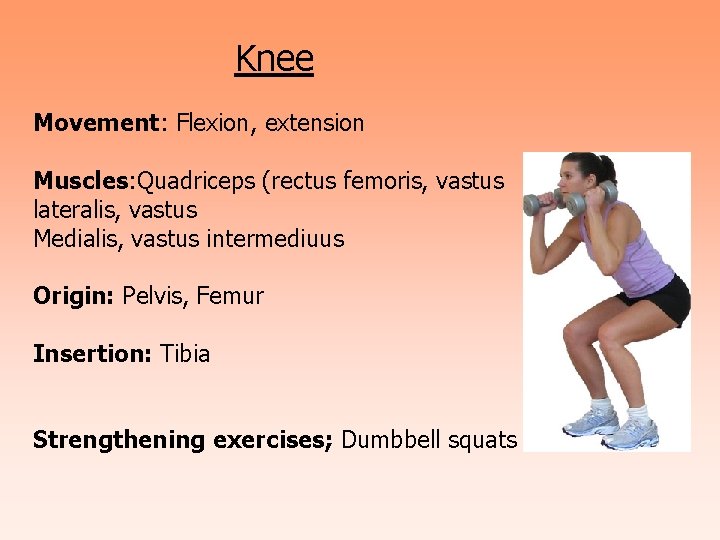
Knee Movement: Flexion, extension Muscles: Quadriceps (rectus femoris, vastus lateralis, vastus Medialis, vastus intermediuus Origin: Pelvis, Femur Insertion: Tibia Strengthening exercises; Dumbbell squats
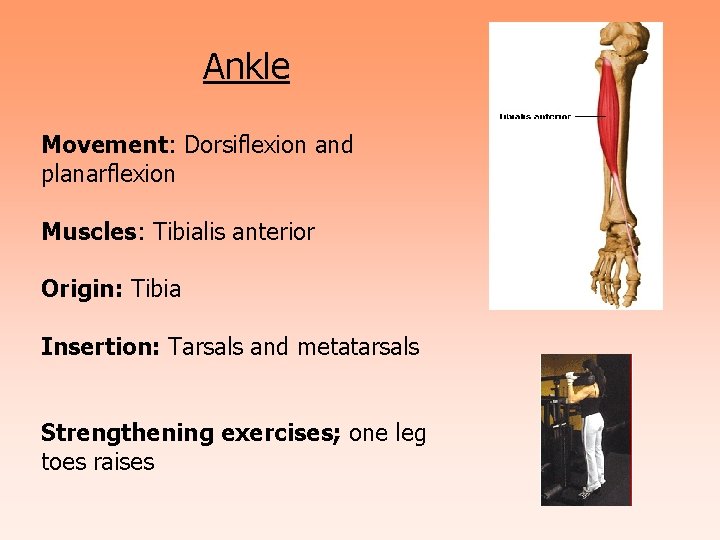
Ankle Movement: Dorsiflexion and planarflexion Muscles: Tibialis anterior Origin: Tibia Insertion: Tarsals and metatarsals Strengthening exercises; one leg toes raises
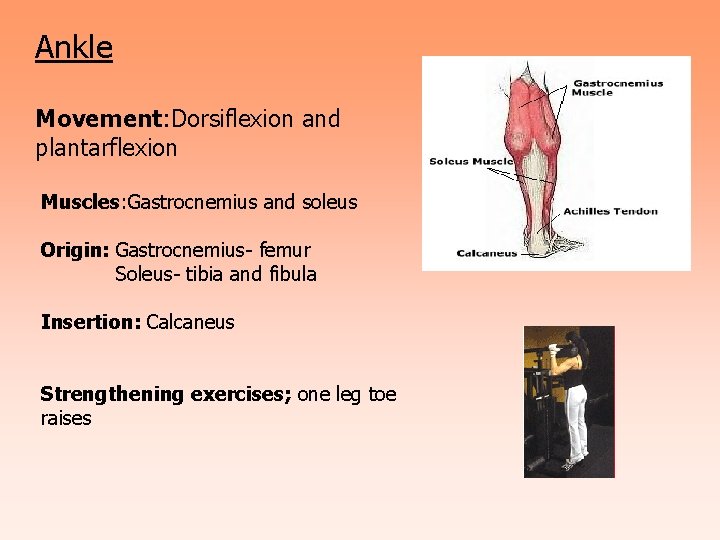
Ankle Movement: Dorsiflexion and plantarflexion Muscles: Gastrocnemius and soleus Origin: Gastrocnemius- femur Soleus- tibia and fibula Insertion: Calcaneus Strengthening exercises; one leg toe raises
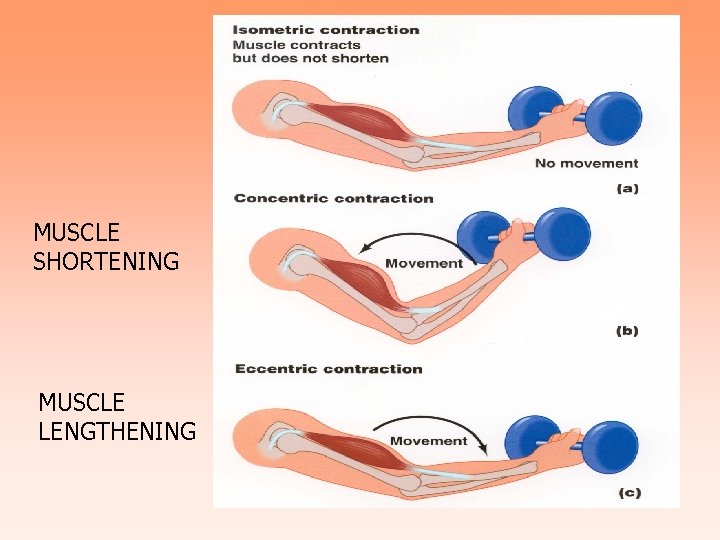
TYPES OF MUSCULAR CONTRACTION ISOTONIC- the muscle is moving while contracting, it can be divided into concentric and eccentric contractions CONCENTRIC- contractions involve the muscle shortening while contracting e. g biceps brachii in elbow flexion ECCENTRIC- contraction involves muscle lengthening whilst contracting e. g. bicep brachii in elbow extension
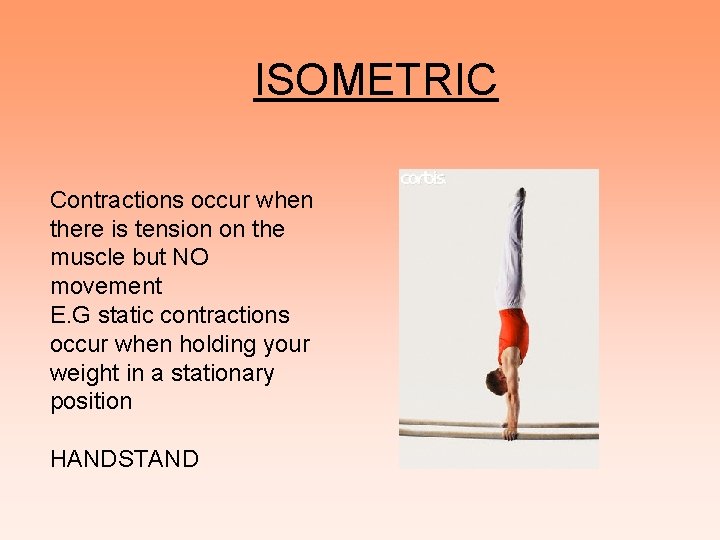
ISOMETRIC Contractions occur when there is tension on the muscle but NO movement E. G static contractions occur when holding your weight in a stationary position HANDSTAND
MUSCLE SHORTENING MUSCLE LENGTHENING
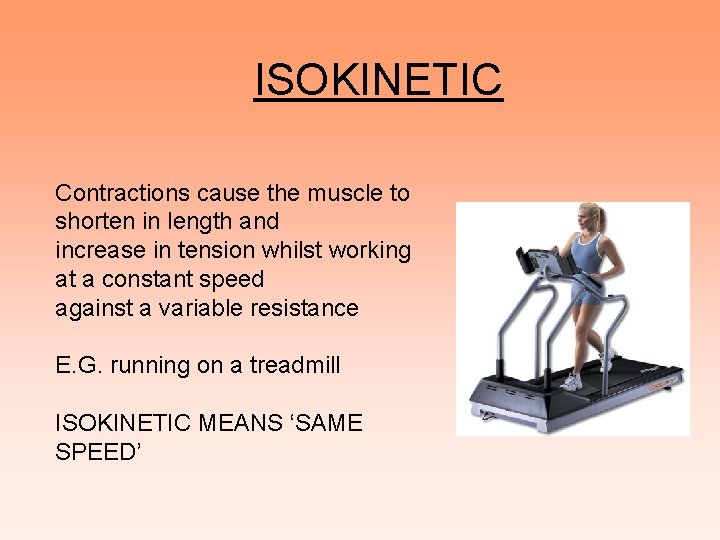
ISOKINETIC Contractions cause the muscle to shorten in length and increase in tension whilst working at a constant speed against a variable resistance E. G. running on a treadmill ISOKINETIC MEANS ‘SAME SPEED’