
Muscle Tissue Muscle Tissue wellvascularized tissues that are


- Slides: 9
Muscle Tissue
Muscle Tissue • well-vascularized tissues • that are responsible for most types of body movement. • Muscle cells possess myofilaments, elaborate versions of the actin and myosin filaments that bring about movement or contraction in all cell types. • There are three kinds of muscle tissue: skeletal, cardiac, and smooth.
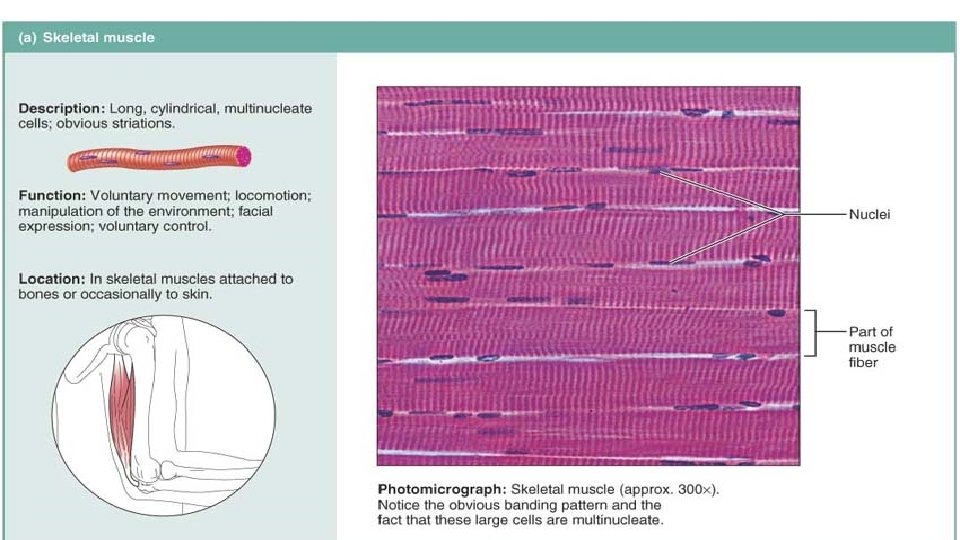
Skeletal muscle • is packaged by connective tissue sheets into organs called skeletal muscles that are attached to the bones of the skeleton. • causing body movements. • Skeletal muscle cells, also called muscle fibers, are long, cylindrical cells that contain many nuclei.
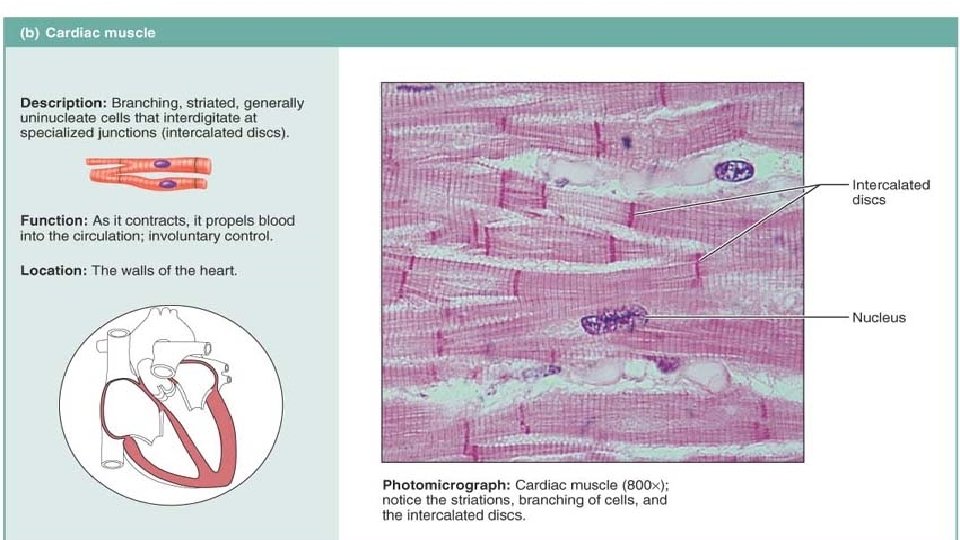
Cardiac muscle • is found only in the wall of the heart. • Its contractions help propel blood through the blood vessels to all parts of the body. • Like skeletal muscle cells, cardiac muscle cells are striated. • However, they differ structurally in that cardiac cells : (1) are uninucleate and (2) are branching cells that fit together tightly at unique junctions called intercalated discs
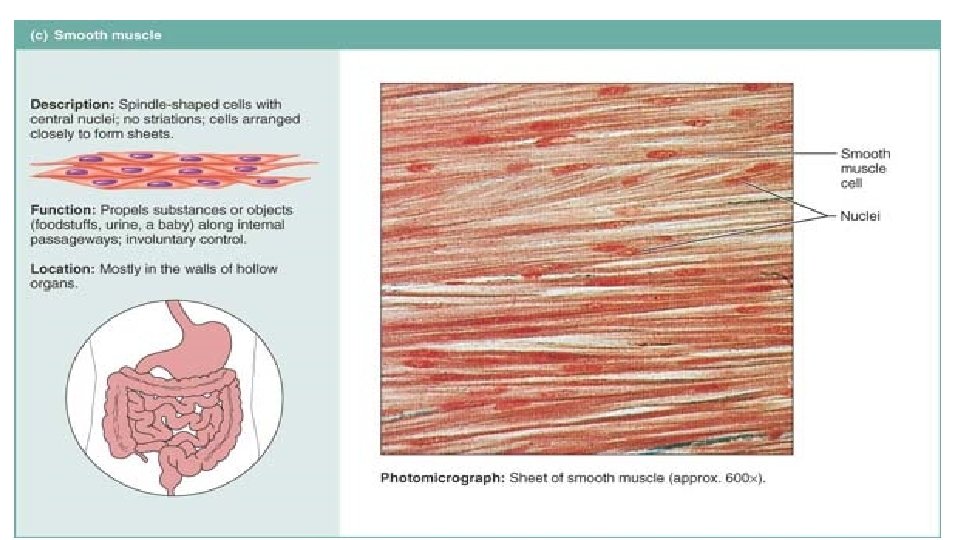
Smooth muscle • is so named because its cells have no visible striations. • Individual smooth muscle cells are spindle shaped and contain one centrally located nucleus • Smooth muscle is found mainly in the walls of hollow organs other than the heart (digestive and urinary tract organs, uterus, and blood vessels). • It acts to squeeze substances through these organs by alternately contracting and relaxing.
Sub-Chapter Test