
MUSCLE TISSUE MUSCLE TISSUE Specialized for contraction to

- Slides: 9
MUSCLE TISSUE
MUSCLE TISSUE Specialized for contraction to produce movement. Muscle cells are elongated and called muscle fibers. 3 Types 1. Skeletal 2. Cardiac 3. Smooth
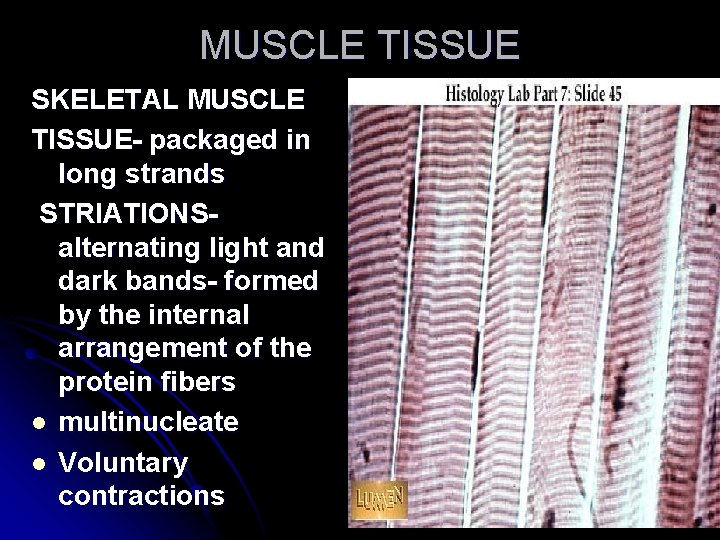
MUSCLE TISSUE SKELETAL MUSCLE TISSUE- packaged in long strands STRIATIONSalternating light and dark bands- formed by the internal arrangement of the protein fibers l multinucleate l Voluntary contractions
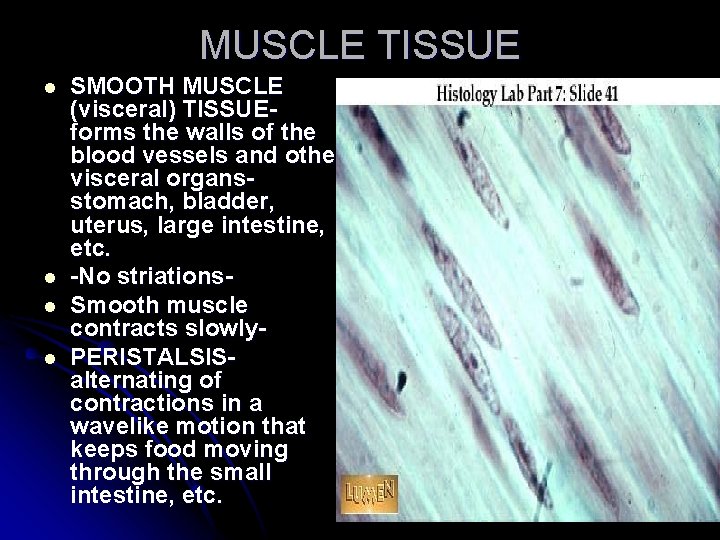
MUSCLE TISSUE l l SMOOTH MUSCLE (visceral) TISSUEforms the walls of the blood vessels and other visceral organsstomach, bladder, uterus, large intestine, etc. -No striations. Smooth muscle contracts slowly. PERISTALSISalternating of contractions in a wavelike motion that keeps food moving through the small intestine, etc.
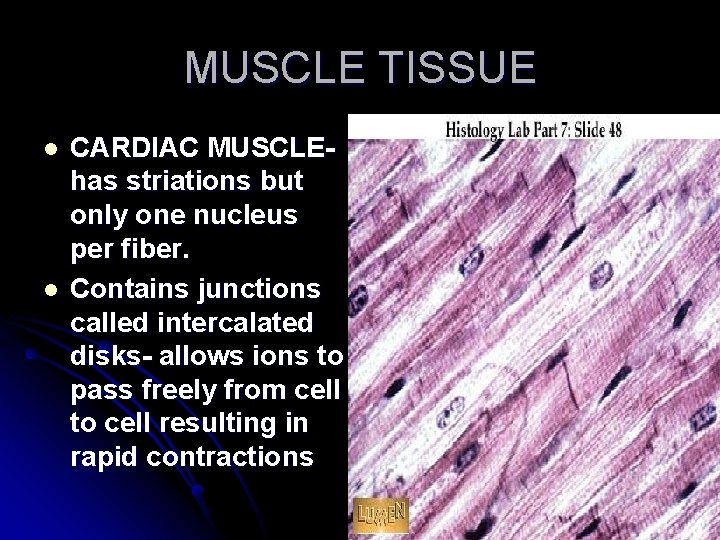
MUSCLE TISSUE l l CARDIAC MUSCLEhas striations but only one nucleus per fiber. Contains junctions called intercalated disks- allows ions to pass freely from cell to cell resulting in rapid contractions
NERVOUS TISSUE NERVE TISSUE- (neurons) have well-developed properties of conductivity and irritability. - Sends and carries electrochemical signals throughout the body. - Nerve cells can be as long as 3 feet. - have a fatty covering called a MYELIN SHEATH - 2 types of nerve tissue 1. NEURON (or nerve cell) 2. NEUROGLIA
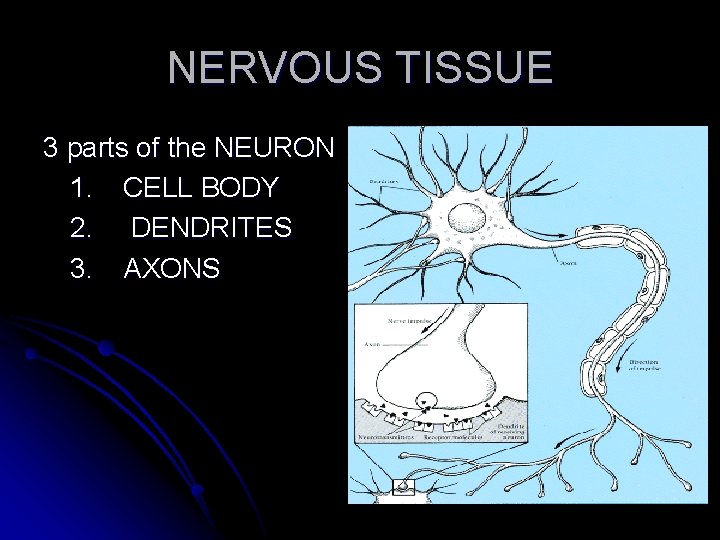
NERVOUS TISSUE 3 parts of the NEURON 1. CELL BODY 2. DENDRITES 3. AXONS
NERVOUS TISSUE CELL BODY- center of the neuron, contains the nucleus as well as other organelles l DENDRITES- receive signals and direct them towards the cell body l AXONS- sends signals away from the cell body to other parts of the body (brain or muscles) l
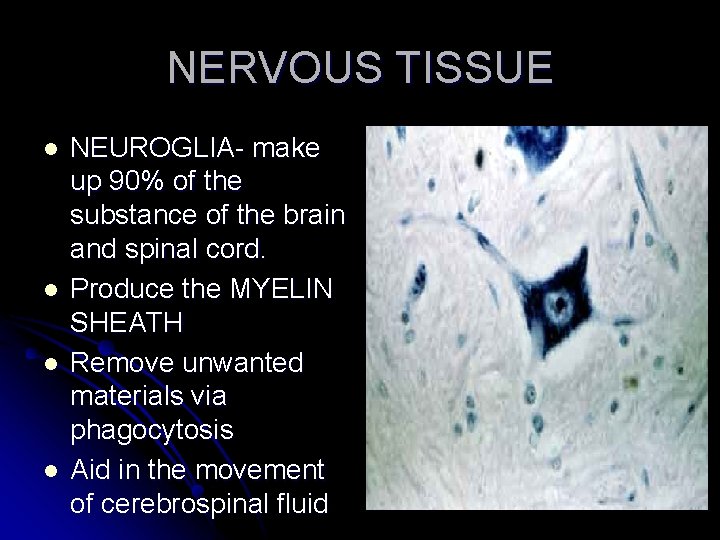
NERVOUS TISSUE l l NEUROGLIA- make up 90% of the substance of the brain and spinal cord. Produce the MYELIN SHEATH Remove unwanted materials via phagocytosis Aid in the movement of cerebrospinal fluid