
Muscle Relaxation What is muscle Relaxation A cognitive
- Slides: 26
Muscle Relaxation
What is muscle Relaxation? A cognitive behavior strategy in which muscles are alternately tensed and then relaxed in a systematic fashion. Ignoring all uncomfortable sensations coming from the muscles To an immediate relaxation of that particular muscle group
Why use muscle Relaxation? An alternate way to get rid of all stress with in the body Most commonly used with in these particular muscle groups: Kneck Hands Stomach Chest Feet Back
Why use muscle Relaxation cont. Helps improve overall flexibility of the body Reduces the tension of certain muscle area with excessive use. Maintains a sense of of maximum stability with in the body ◦ Know the limit for how far a particular muscle can stretch in any given situation.
Let’s relax our muscles one at a time. Muscles of the hands ◦ Bend the right hand at the wrist and hold the tension for approx 5 sec Relax ◦ Do the same for the left hand…… Relax ◦ Tighten both hands into fists and hold as if you were as angry as could be. Feel the tension spread up the arms toward the shoulders Relax
Continue Relaxing: Neck: Feet: Chest: Stomach: Back: Whole body:
Deep Breathing
What is Deep Breathing? It is simply what it says Breath in through your nose for about 10 seconds Breath out through your mouth for about 10 seconds
Why Deep Breathe? Benefits Include: ◦ STRESS RELIEF (Depression and anxiety too) ◦ Helps your immune system ◦ Possibly aids in weight loss
How it Works Sympathetic Nervous System – Fight Parasympathetic Nervous System – Relax During times of stress the Sympathetic Nervous System is active Deep Breathing is a fast way to activate your Parasympathetic Nervous System
How it works (Cont’d) Deep Breathing brings in oxygen that all cells need Deep Breathing pushes out excess carbon dioxide How many of you feel better after exercising?
“Quote” “While this is not life threatening, it does tell me that my patient is not inhaling enough oxygen or exhaling enough carbon dioxide, which can have consequences such as fatigue, mental fog and decreased tissue function. I often note “needs to breathe” on a patient’s chart. Not the shallow chest breathing many of us default into, but deep, meaningful breaths, or “belly breathing. ”” Marcelle Pick, OB/GYN NP
Lets Practice It Feet shoulder width anchored to the ground Arms relaxed at your sides Shoulders slightly forward and relaxed Head “above the clouds” Imagine your stomach is a small balloon
Breathe In, Breathe Out Clear your mind Close your eyes and breathe in through your nose for 10 seconds – Count in your head Breathe out for through your mouth for 10 seconds – Count in your head Repeat 5 Times
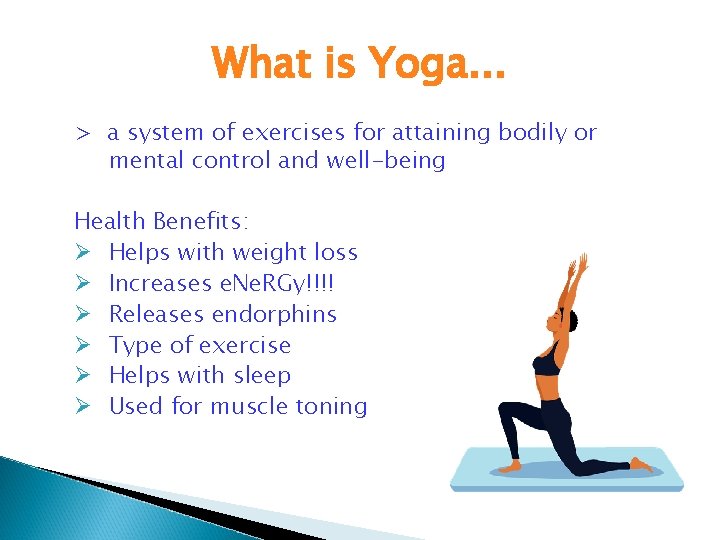
What is Yoga. . . > a system of exercises for attaining bodily or mental control and well-being Health Benefits: Ø Helps with weight loss Ø Increases e. Ne. RGy!!!! Ø Releases endorphins Ø Type of exercise Ø Helps with sleep Ø Used for muscle toning
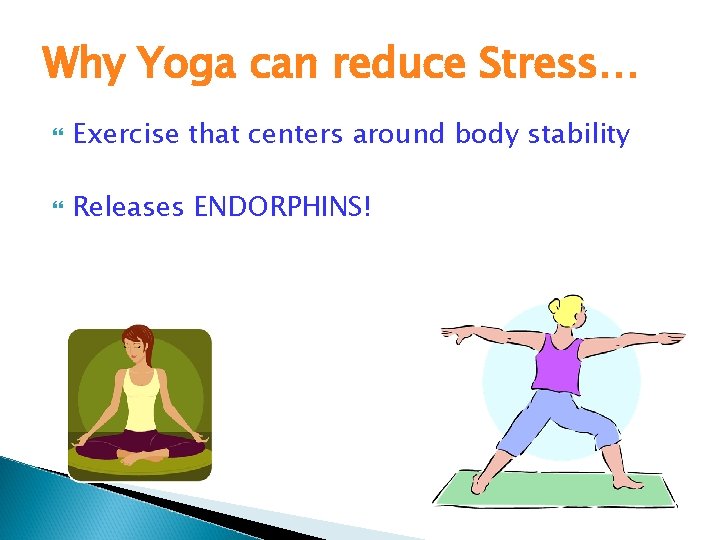
Why Yoga can reduce Stress… Exercise that centers around body stability Releases ENDORPHINS!
Release of Endorphins. . Make People HAPPY Endorphins are released into the bloodstream by the pituitary Endorphins enter nociceptive afferents (neurons which carry pain impulses to the brain)
Releasing Endorphins. . Endorphins then bind to opioid (type of endorphin) receptors in the neurons. These receptors are the same as the receptors which drugs like morphine bind to. Endorphins have an opposite effect on the receptors and therefore block the release of neurotransmitter molecules from the nerve terminal.
Releasing Endorphins. . NO PAIN SIGNALS REACH THE BRAIN!! The endorphins are therefore said to have a reduced effect on stress.
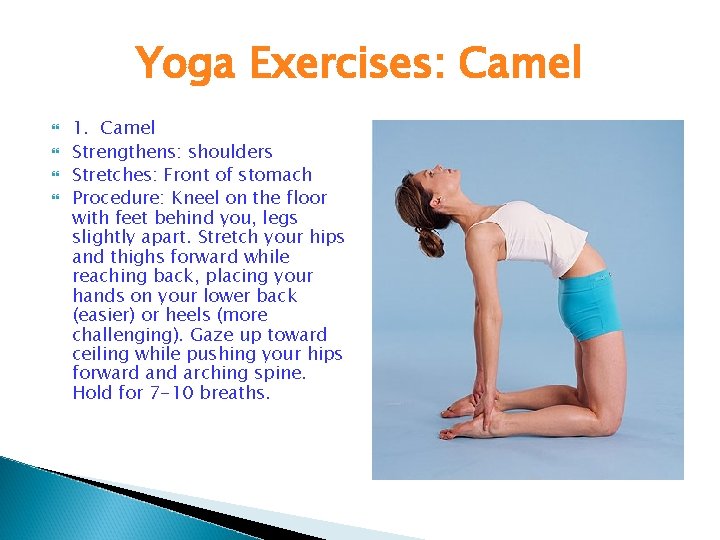
Yoga Exercises: Camel 1. Camel Strengthens: shoulders Stretches: Front of stomach Procedure: Kneel on the floor with feet behind you, legs slightly apart. Stretch your hips and thighs forward while reaching back, placing your hands on your lower back (easier) or heels (more challenging). Gaze up toward ceiling while pushing your hips forward and arching spine. Hold for 7 -10 breaths.
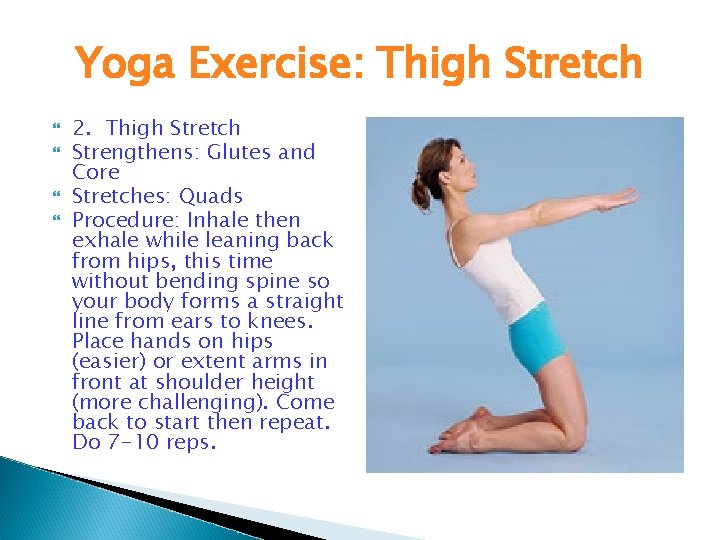
Yoga Exercise: Thigh Stretch 2. Thigh Stretch Strengthens: Glutes and Core Stretches: Quads Procedure: Inhale then exhale while leaning back from hips, this time without bending spine so your body forms a straight line from ears to knees. Place hands on hips (easier) or extent arms in front at shoulder height (more challenging). Come back to start then repeat. Do 7 -10 reps.
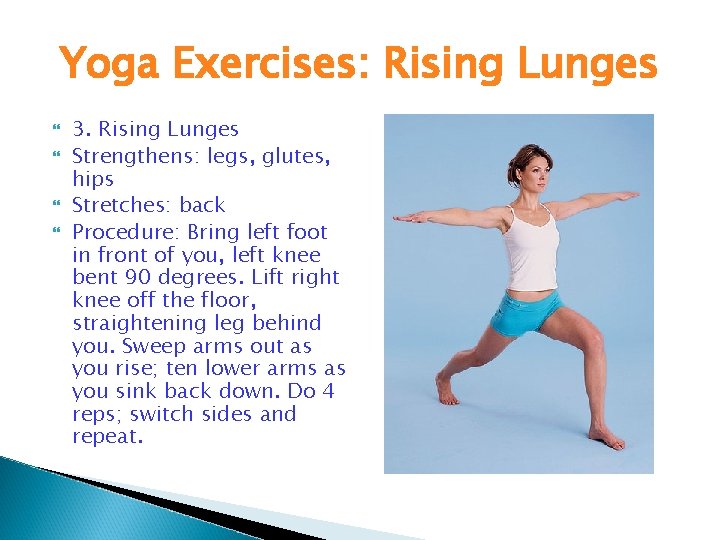
Yoga Exercises: Rising Lunges 3. Rising Lunges Strengthens: legs, glutes, hips Stretches: back Procedure: Bring left foot in front of you, left knee bent 90 degrees. Lift right knee off the floor, straightening leg behind you. Sweep arms out as you rise; ten lower arms as you sink back down. Do 4 reps; switch sides and repeat.
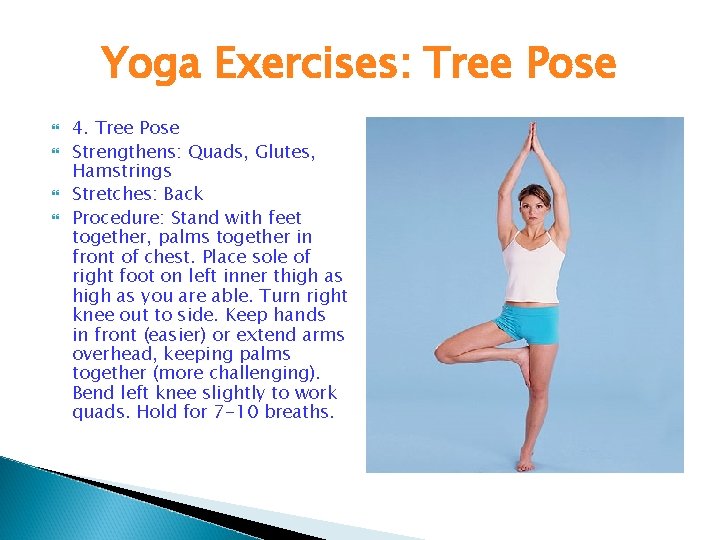
Yoga Exercises: Tree Pose 4. Tree Pose Strengthens: Quads, Glutes, Hamstrings Stretches: Back Procedure: Stand with feet together, palms together in front of chest. Place sole of right foot on left inner thigh as you are able. Turn right knee out to side. Keep hands in front (easier) or extend arms overhead, keeping palms together (more challenging). Bend left knee slightly to work quads. Hold for 7 -10 breaths.
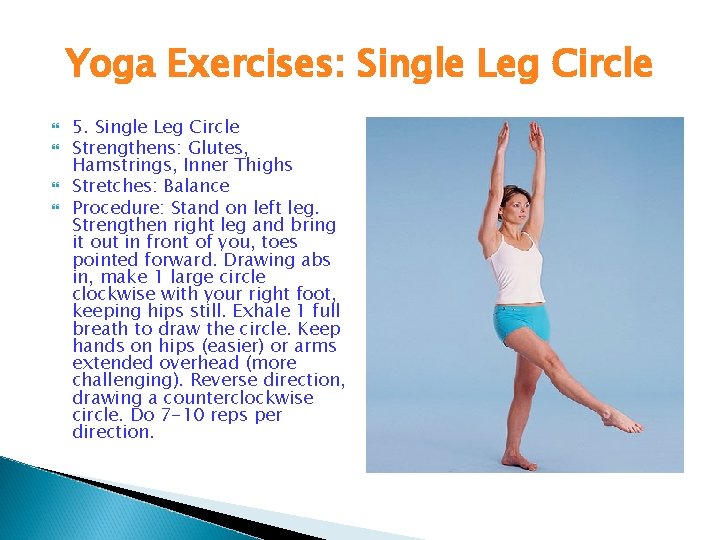
Yoga Exercises: Single Leg Circle 5. Single Leg Circle Strengthens: Glutes, Hamstrings, Inner Thighs Stretches: Balance Procedure: Stand on left leg. Strengthen right leg and bring it out in front of you, toes pointed forward. Drawing abs in, make 1 large circle clockwise with your right foot, keeping hips still. Exhale 1 full breath to draw the circle. Keep hands on hips (easier) or arms extended overhead (more challenging). Reverse direction, drawing a counterclockwise circle. Do 7 -10 reps per direction.
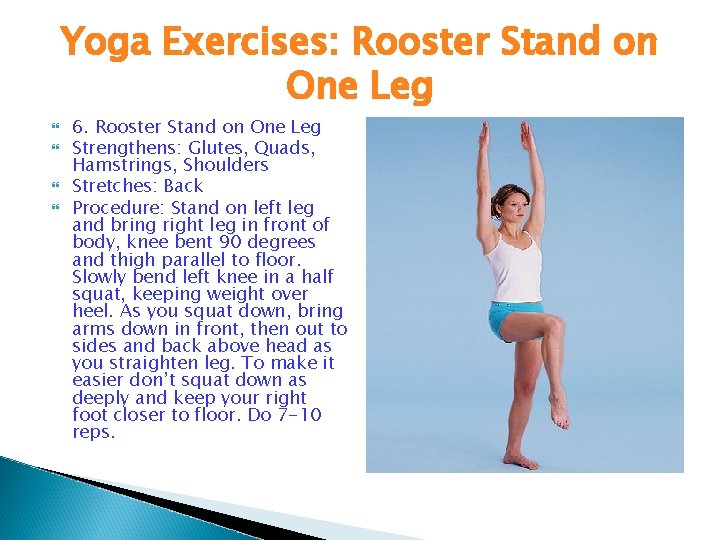
Yoga Exercises: Rooster Stand on One Leg 6. Rooster Stand on One Leg Strengthens: Glutes, Quads, Hamstrings, Shoulders Stretches: Back Procedure: Stand on left leg and bring right leg in front of body, knee bent 90 degrees and thigh parallel to floor. Slowly bend left knee in a half squat, keeping weight over heel. As you squat down, bring arms down in front, then out to sides and back above head as you straighten leg. To make it easier don’t squat down as deeply and keep your right foot closer to floor. Do 7 -10 reps.