
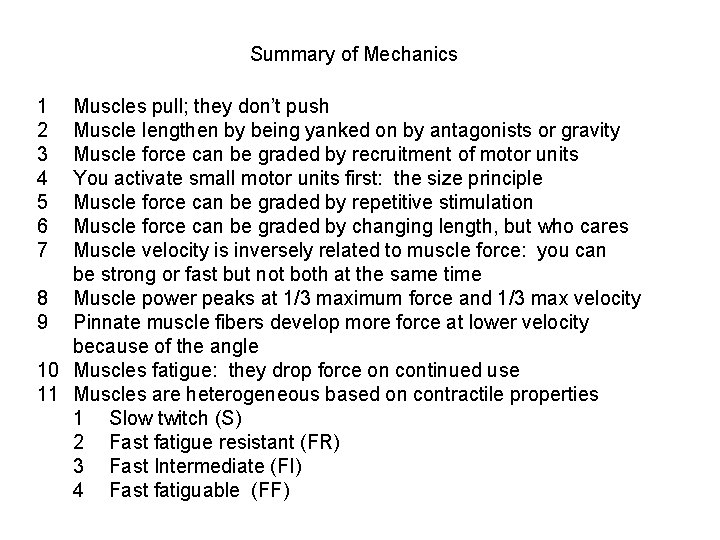
MUSCLE PHYSIOLOGY REVIEW Summary of Mechanics 1 2

- Slides: 24
MUSCLE PHYSIOLOGY REVIEW
Summary of Mechanics 1 2 3 4 5 6 7 Muscles pull; they don’t push Muscle lengthen by being yanked on by antagonists or gravity Muscle force can be graded by recruitment of motor units You activate small motor units first: the size principle Muscle force can be graded by repetitive stimulation Muscle force can be graded by changing length, but who cares Muscle velocity is inversely related to muscle force: you can be strong or fast but not both at the same time 8 Muscle power peaks at 1/3 maximum force and 1/3 max velocity 9 Pinnate muscle fibers develop more force at lower velocity because of the angle 10 Muscles fatigue: they drop force on continued use 11 Muscles are heterogeneous based on contractile properties 1 Slow twitch (S) 2 Fast fatigue resistant (FR) 3 Fast Intermediate (FI) 4 Fast fatiguable (FF)
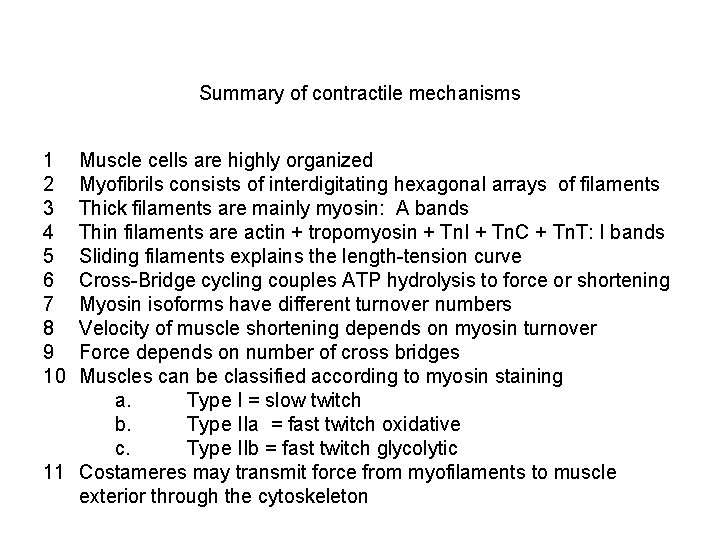
Summary of contractile mechanisms 1 2 3 4 5 6 7 8 9 10 Muscle cells are highly organized Myofibrils consists of interdigitating hexagonal arrays of filaments Thick filaments are mainly myosin: A bands Thin filaments are actin + tropomyosin + Tn. I + Tn. C + Tn. T: I bands Sliding filaments explains the length-tension curve Cross-Bridge cycling couples ATP hydrolysis to force or shortening Myosin isoforms have different turnover numbers Velocity of muscle shortening depends on myosin turnover Force depends on number of cross bridges Muscles can be classified according to myosin staining a. Type I = slow twitch b. Type IIa = fast twitch oxidative c. Type IIb = fast twitch glycolytic 11 Costameres may transmit force from myofilaments to muscle exterior through the cytoskeleton
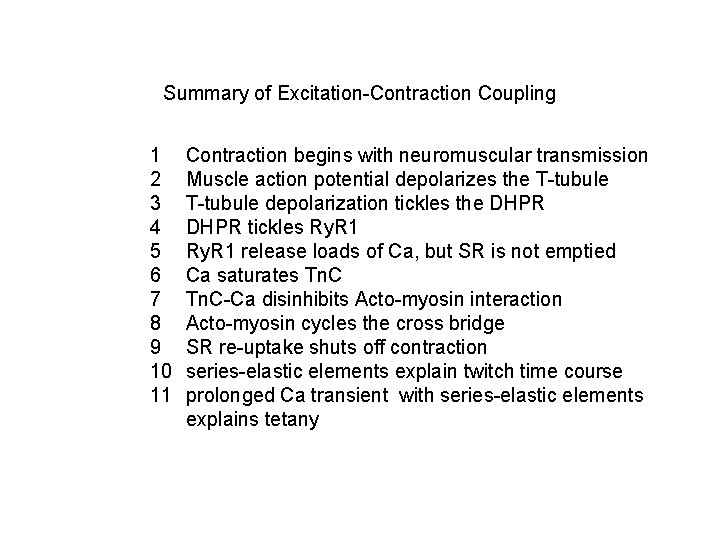
Summary of Excitation-Contraction Coupling 1 2 3 4 5 6 7 8 9 10 11 Contraction begins with neuromuscular transmission Muscle action potential depolarizes the T-tubule depolarization tickles the DHPR tickles Ry. R 1 release loads of Ca, but SR is not emptied Ca saturates Tn. C-Ca disinhibits Acto-myosin interaction Acto-myosin cycles the cross bridge SR re-uptake shuts off contraction series-elastic elements explain twitch time course prolonged Ca transient with series-elastic elements explains tetany
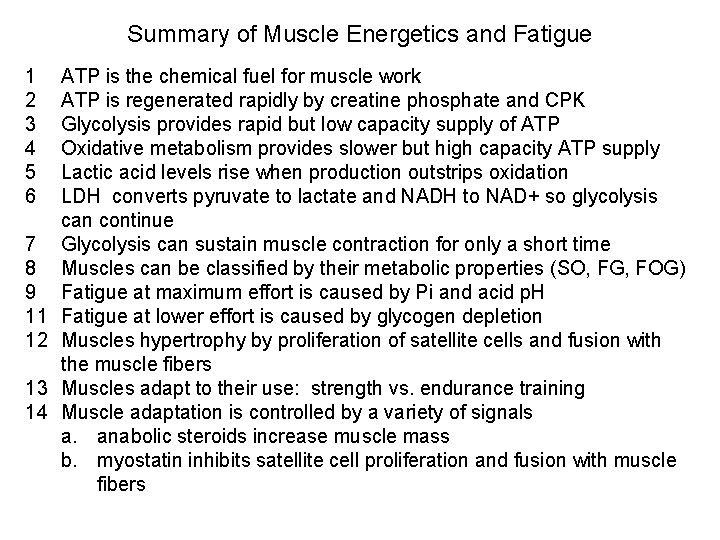
Summary of Muscle Energetics and Fatigue 1 2 3 4 5 6 7 8 9 11 12 13 14 ATP is the chemical fuel for muscle work ATP is regenerated rapidly by creatine phosphate and CPK Glycolysis provides rapid but low capacity supply of ATP Oxidative metabolism provides slower but high capacity ATP supply Lactic acid levels rise when production outstrips oxidation LDH converts pyruvate to lactate and NADH to NAD+ so glycolysis can continue Glycolysis can sustain muscle contraction for only a short time Muscles can be classified by their metabolic properties (SO, FG, FOG) Fatigue at maximum effort is caused by Pi and acid p. H Fatigue at lower effort is caused by glycogen depletion Muscles hypertrophy by proliferation of satellite cells and fusion with the muscle fibers Muscles adapt to their use: strength vs. endurance training Muscle adaptation is controlled by a variety of signals a. anabolic steroids increase muscle mass b. myostatin inhibits satellite cell proliferation and fusion with muscle fibers
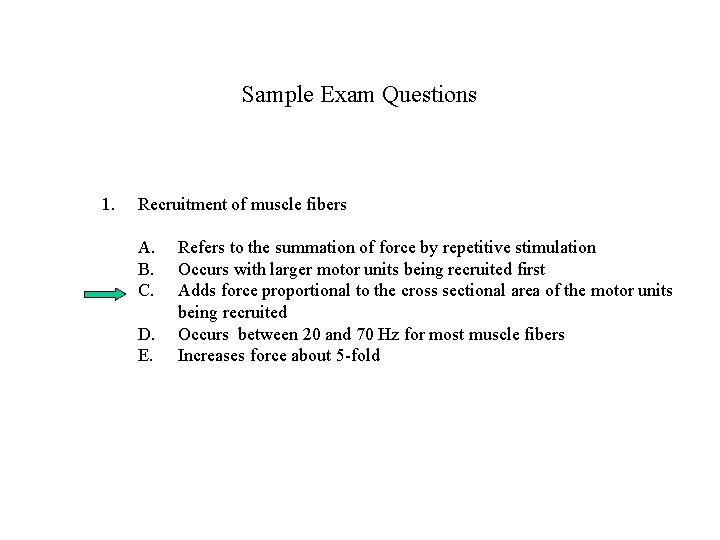
Sample Exam Questions 1. Recruitment of muscle fibers A. B. C. D. E. Refers to the summation of force by repetitive stimulation Occurs with larger motor units being recruited first Adds force proportional to the cross sectional area of the motor units being recruited Occurs between 20 and 70 Hz for most muscle fibers Increases force about 5 -fold
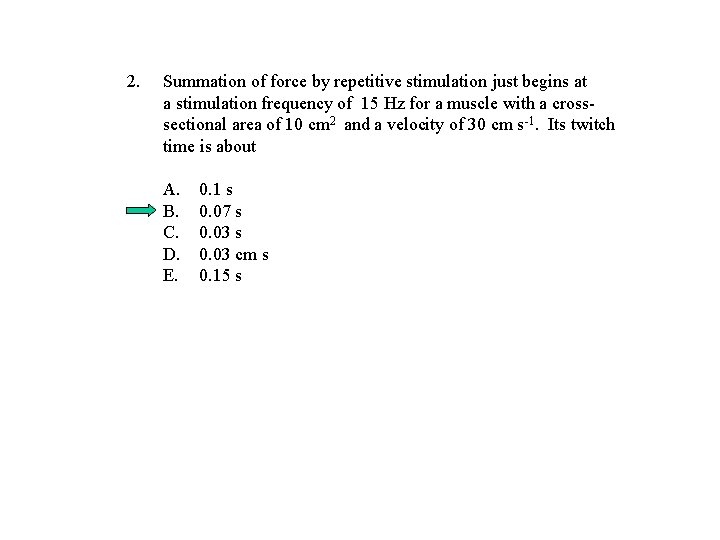
2. Summation of force by repetitive stimulation just begins at a stimulation frequency of 15 Hz for a muscle with a crosssectional area of 10 cm 2 and a velocity of 30 cm s-1. Its twitch time is about A. B. C. D. E. 0. 1 s 0. 07 s 0. 03 cm s 0. 15 s
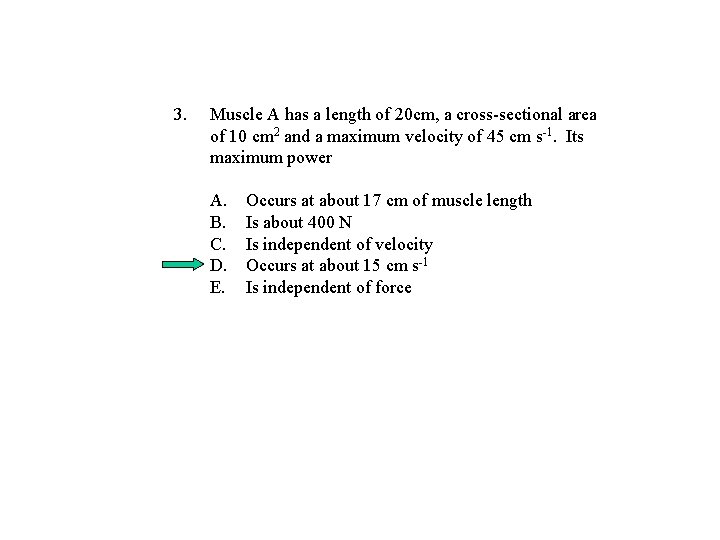
3. Muscle A has a length of 20 cm, a cross-sectional area of 10 cm 2 and a maximum velocity of 45 cm s-1. Its maximum power A. B. C. D. E. Occurs at about 17 cm of muscle length Is about 400 N Is independent of velocity Occurs at about 15 cm s-1 Is independent of force
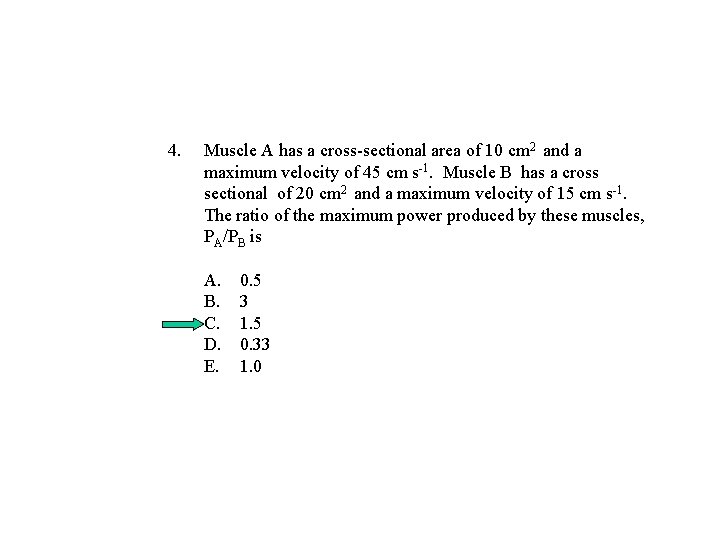
4. Muscle A has a cross-sectional area of 10 cm 2 and a maximum velocity of 45 cm s-1. Muscle B has a cross sectional of 20 cm 2 and a maximum velocity of 15 cm s-1. The ratio of the maximum power produced by these muscles, PA/PB is A. B. C. D. E. 0. 5 3 1. 5 0. 33 1. 0
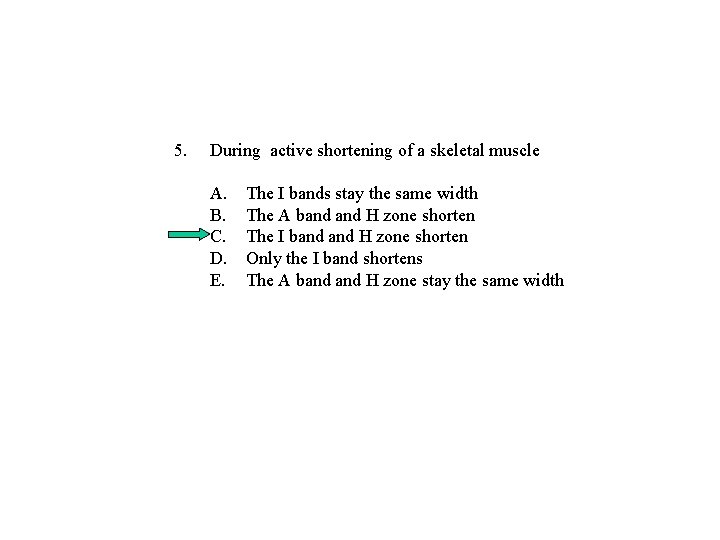
5. During active shortening of a skeletal muscle A. B. C. D. E. The I bands stay the same width The A band H zone shorten The I band H zone shorten Only the I band shortens The A band H zone stay the same width
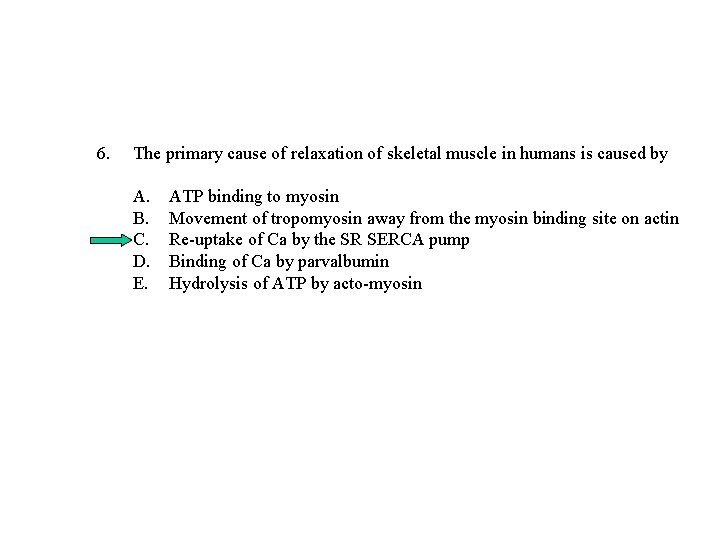
6. The primary cause of relaxation of skeletal muscle in humans is caused by A. B. C. D. E. ATP binding to myosin Movement of tropomyosin away from the myosin binding site on actin Re-uptake of Ca by the SR SERCA pump Binding of Ca by parvalbumin Hydrolysis of ATP by acto-myosin
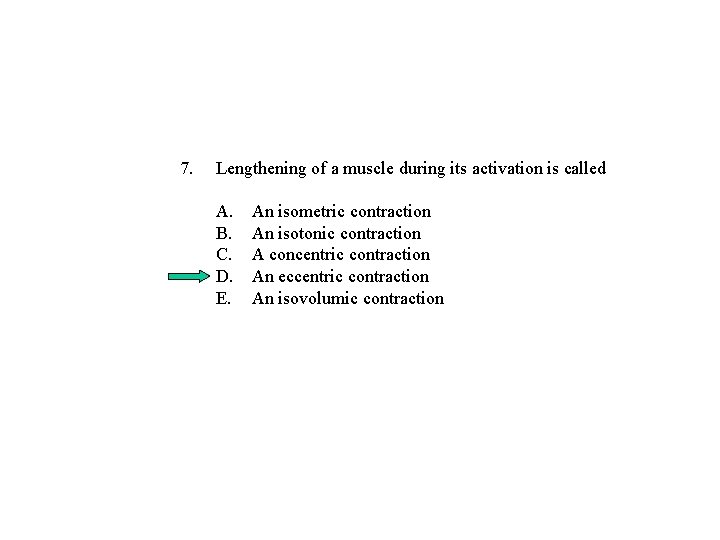
7. Lengthening of a muscle during its activation is called A. B. C. D. E. An isometric contraction An isotonic contraction A concentric contraction An eccentric contraction An isovolumic contraction
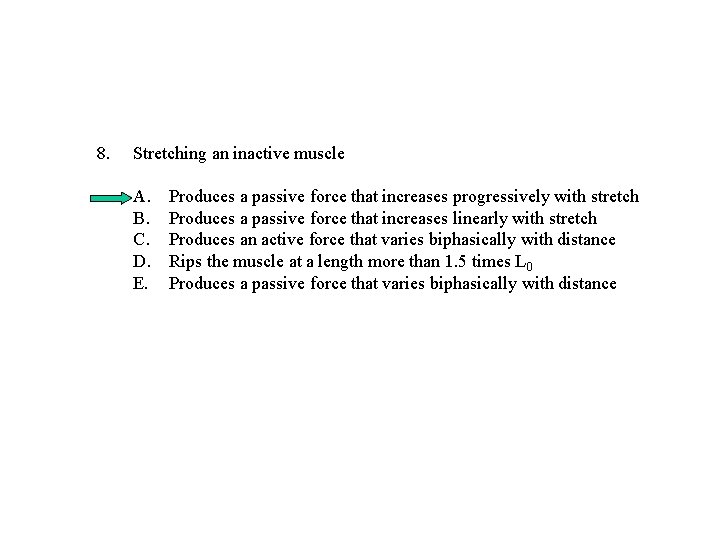
8. Stretching an inactive muscle A. B. C. D. E. Produces a passive force that increases progressively with stretch Produces a passive force that increases linearly with stretch Produces an active force that varies biphasically with distance Rips the muscle at a length more than 1. 5 times L 0 Produces a passive force that varies biphasically with distance
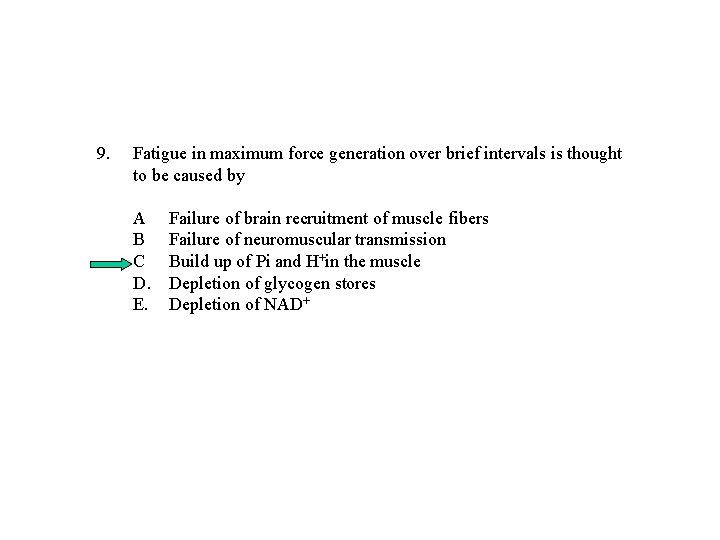
9. Fatigue in maximum force generation over brief intervals is thought to be caused by A B C D. E. Failure of brain recruitment of muscle fibers Failure of neuromuscular transmission Build up of Pi and H+in the muscle Depletion of glycogen stores Depletion of NAD+
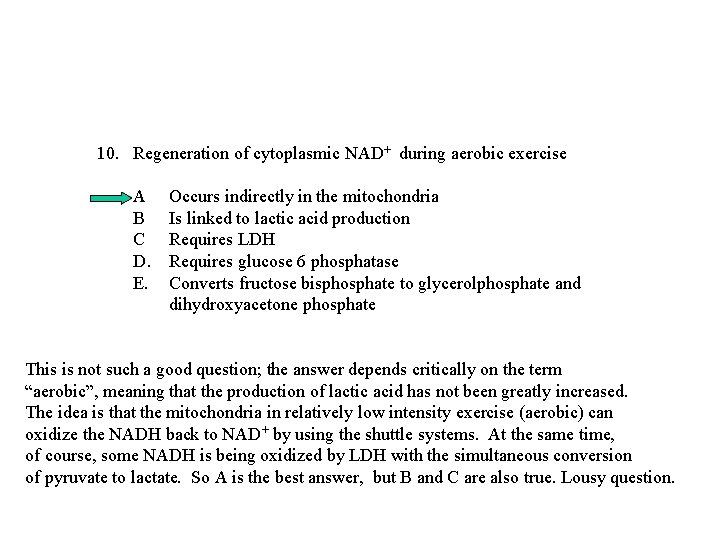
10. Regeneration of cytoplasmic NAD+ during aerobic exercise A B C D. E. Occurs indirectly in the mitochondria Is linked to lactic acid production Requires LDH Requires glucose 6 phosphatase Converts fructose bisphosphate to glycerolphosphate and dihydroxyacetone phosphate This is not such a good question; the answer depends critically on the term “aerobic”, meaning that the production of lactic acid has not been greatly increased. The idea is that the mitochondria in relatively low intensity exercise (aerobic) can oxidize the NADH back to NAD+ by using the shuttle systems. At the same time, of course, some NADH is being oxidized by LDH with the simultaneous conversion of pyruvate to lactate. So A is the best answer, but B and C are also true. Lousy question.
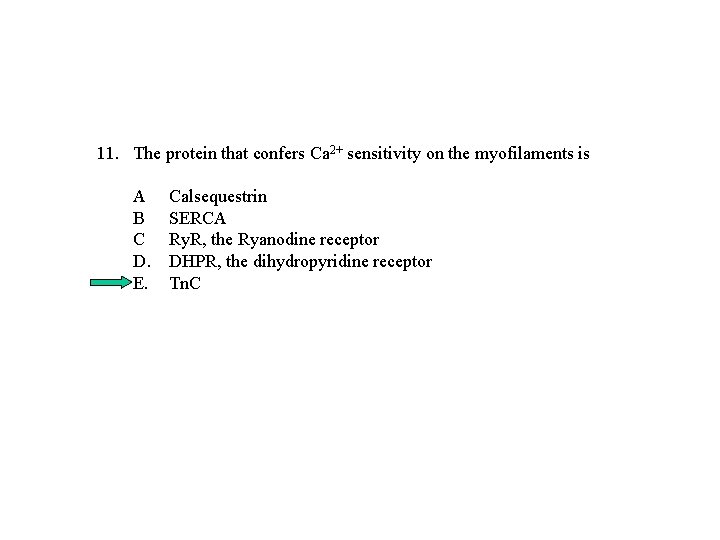
11. The protein that confers Ca 2+ sensitivity on the myofilaments is A B C D. E. Calsequestrin SERCA Ry. R, the Ryanodine receptor DHPR, the dihydropyridine receptor Tn. C
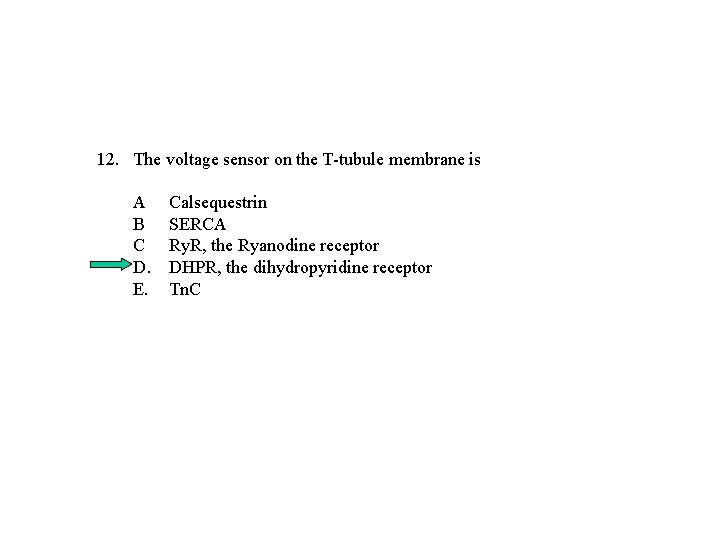
12. The voltage sensor on the T-tubule membrane is A B C D. E. Calsequestrin SERCA Ry. R, the Ryanodine receptor DHPR, the dihydropyridine receptor Tn. C
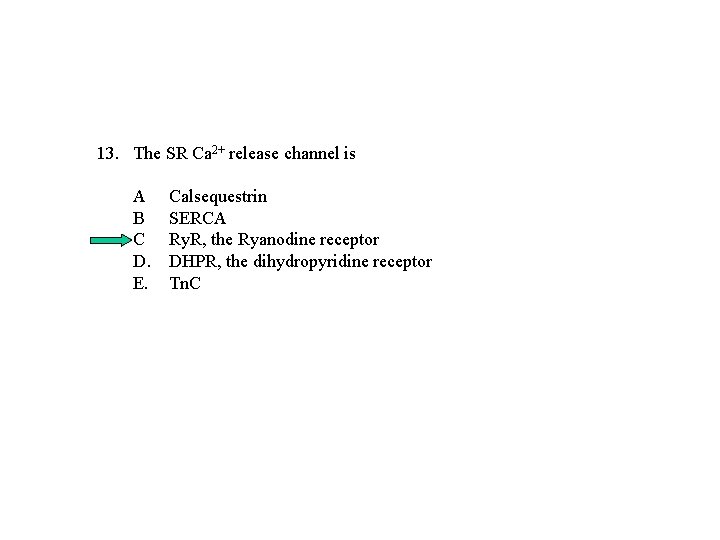
13. The SR Ca 2+ release channel is A B C D. E. Calsequestrin SERCA Ry. R, the Ryanodine receptor DHPR, the dihydropyridine receptor Tn. C
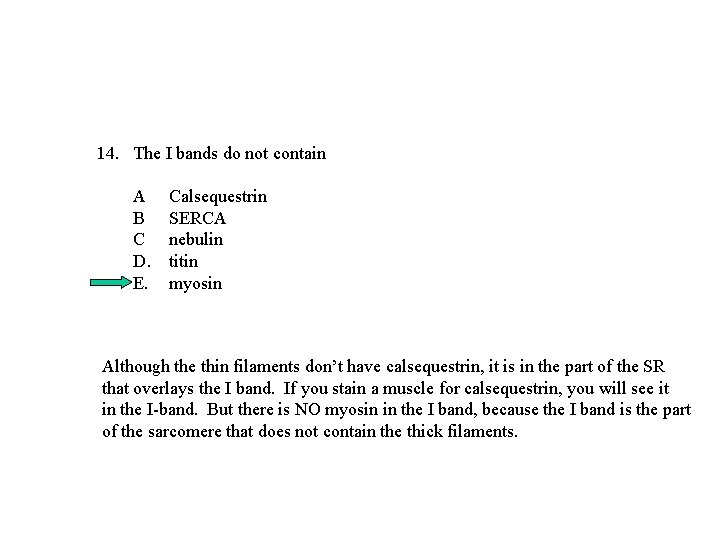
14. The I bands do not contain A B C D. E. Calsequestrin SERCA nebulin titin myosin Although the thin filaments don’t have calsequestrin, it is in the part of the SR that overlays the I band. If you stain a muscle for calsequestrin, you will see it in the I-band. But there is NO myosin in the I band, because the I band is the part of the sarcomere that does not contain the thick filaments.
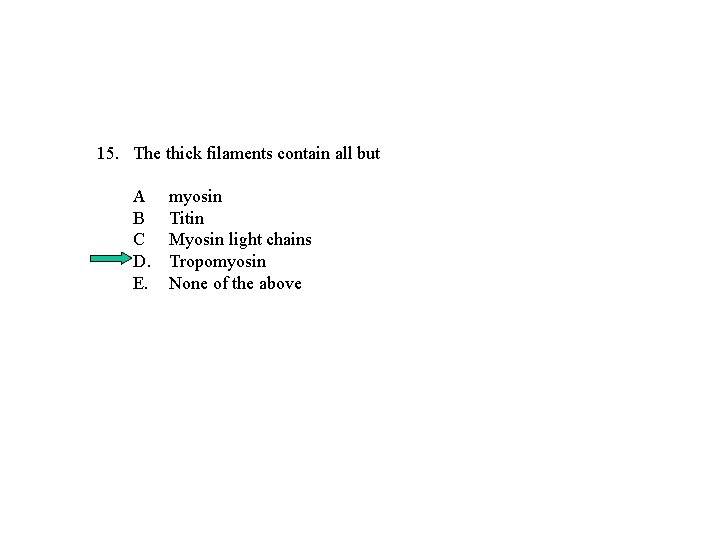
15. The thick filaments contain all but A B C D. E. myosin Titin Myosin light chains Tropomyosin None of the above
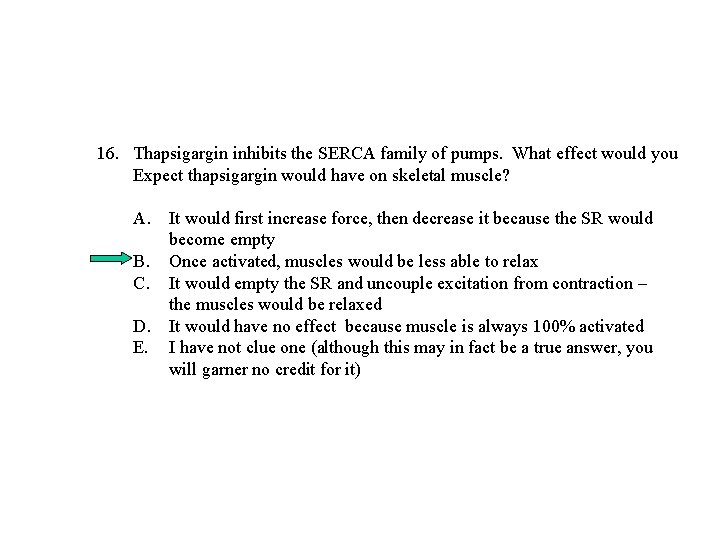
16. Thapsigargin inhibits the SERCA family of pumps. What effect would you Expect thapsigargin would have on skeletal muscle? A. It would first increase force, then decrease it because the SR would become empty B. Once activated, muscles would be less able to relax C. It would empty the SR and uncouple excitation from contraction – the muscles would be relaxed D. It would have no effect because muscle is always 100% activated E. I have not clue one (although this may in fact be a true answer, you will garner no credit for it)
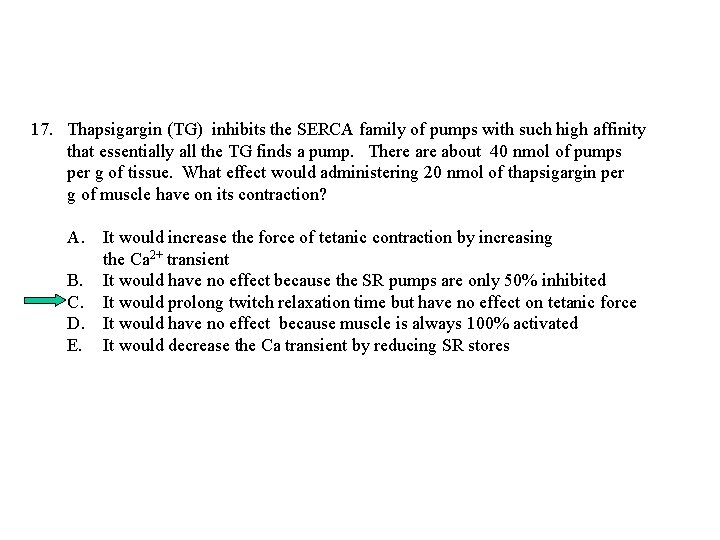
17. Thapsigargin (TG) inhibits the SERCA family of pumps with such high affinity that essentially all the TG finds a pump. There about 40 nmol of pumps per g of tissue. What effect would administering 20 nmol of thapsigargin per g of muscle have on its contraction? A. It would increase the force of tetanic contraction by increasing the Ca 2+ transient B. It would have no effect because the SR pumps are only 50% inhibited C. It would prolong twitch relaxation time but have no effect on tetanic force D. It would have no effect because muscle is always 100% activated E. It would decrease the Ca transient by reducing SR stores
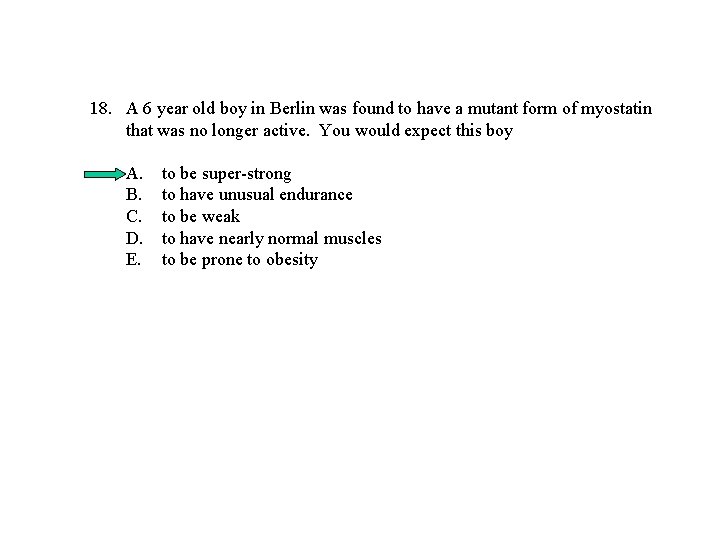
18. A 6 year old boy in Berlin was found to have a mutant form of myostatin that was no longer active. You would expect this boy A. B. C. D. E. to be super-strong to have unusual endurance to be weak to have nearly normal muscles to be prone to obesity
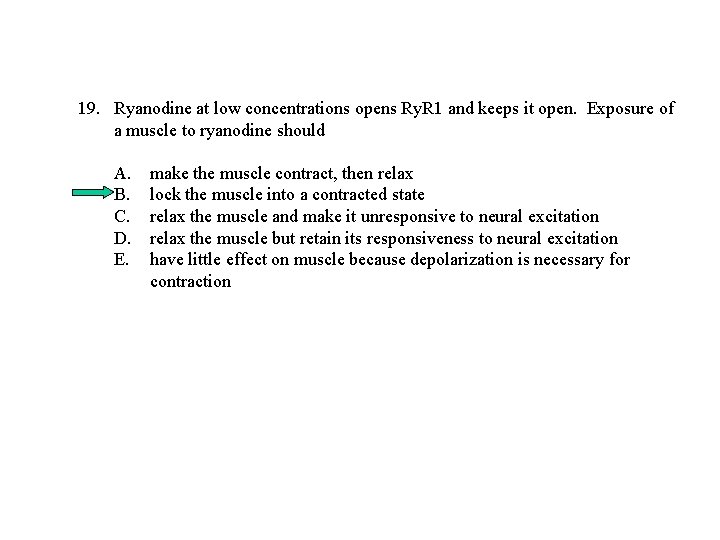
19. Ryanodine at low concentrations opens Ry. R 1 and keeps it open. Exposure of a muscle to ryanodine should A. B. C. D. E. make the muscle contract, then relax lock the muscle into a contracted state relax the muscle and make it unresponsive to neural excitation relax the muscle but retain its responsiveness to neural excitation have little effect on muscle because depolarization is necessary for contraction