
Muscle Fiber Microscopic Structure T Rick Objectives 1
Muscle Fiber – Microscopic Structure T. Rick
Objectives 1. Describe the neuromuscular junction and state the function of each part. 2. Describe the structure of the sarcomere. 3. Explain the following terms of ions and charges: polarization, depolarization, and repolarization.
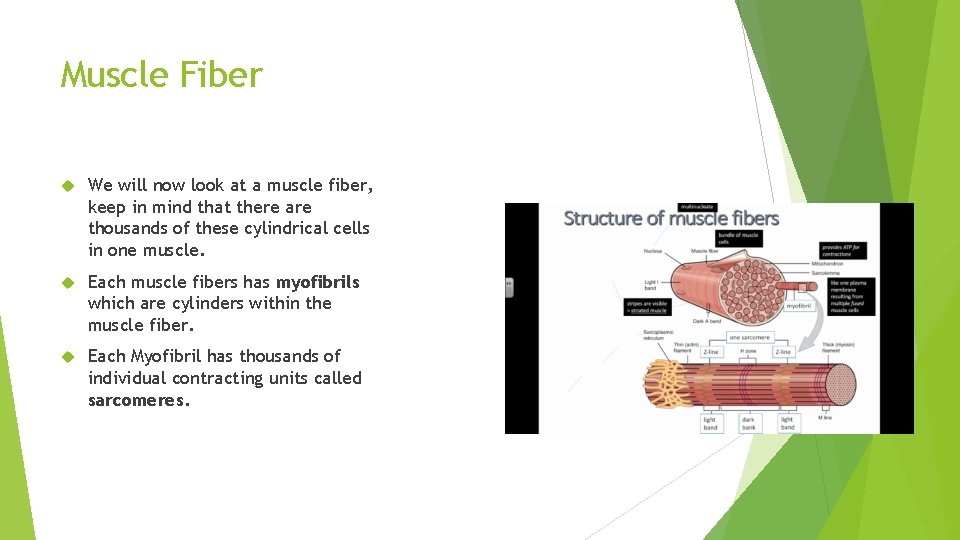
Muscle Fiber We will now look at a muscle fiber, keep in mind that there are thousands of these cylindrical cells in one muscle. Each muscle fibers has myofibrils which are cylinders within the muscle fiber. Each Myofibril has thousands of individual contracting units called sarcomeres.
Neuromuscular Junction
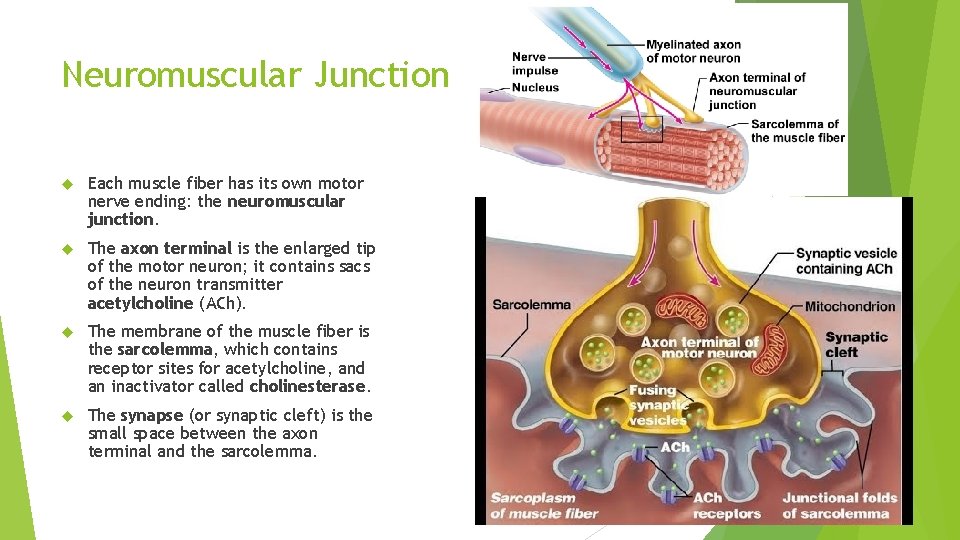
Neuromuscular Junction Each muscle fiber has its own motor nerve ending: the neuromuscular junction. The axon terminal is the enlarged tip of the motor neuron; it contains sacs of the neuron transmitter acetylcholine (ACh). The membrane of the muscle fiber is the sarcolemma, which contains receptor sites for acetylcholine, and an inactivator called cholinesterase. The synapse (or synaptic cleft) is the small space between the axon terminal and the sarcolemma.
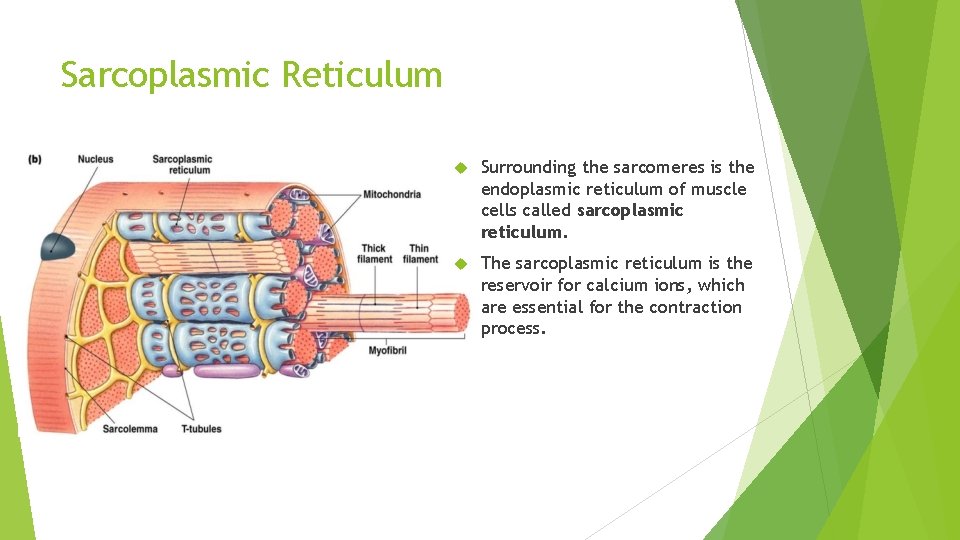
Sarcoplasmic Reticulum Surrounding the sarcomeres is the endoplasmic reticulum of muscle cells called sarcoplasmic reticulum. The sarcoplasmic reticulum is the reservoir for calcium ions, which are essential for the contraction process.
Sarcomeres
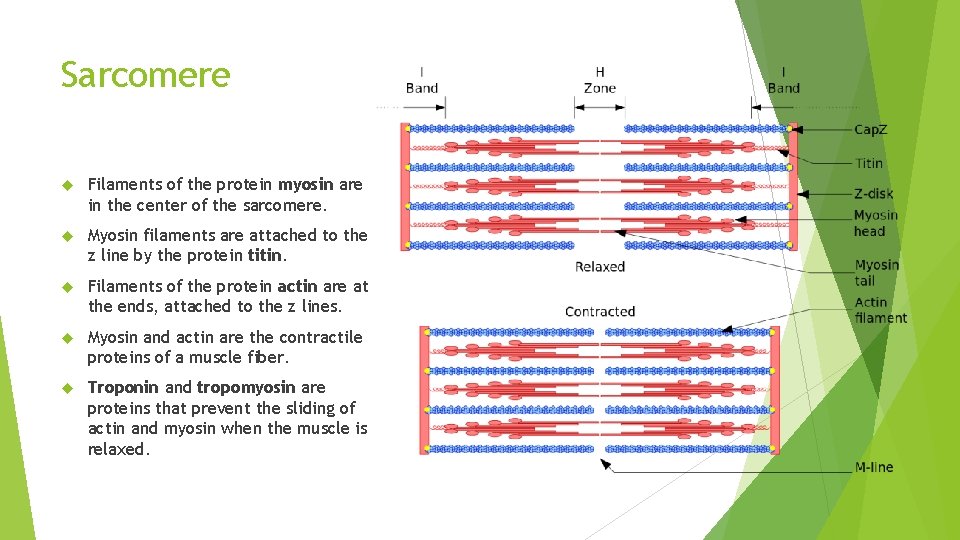
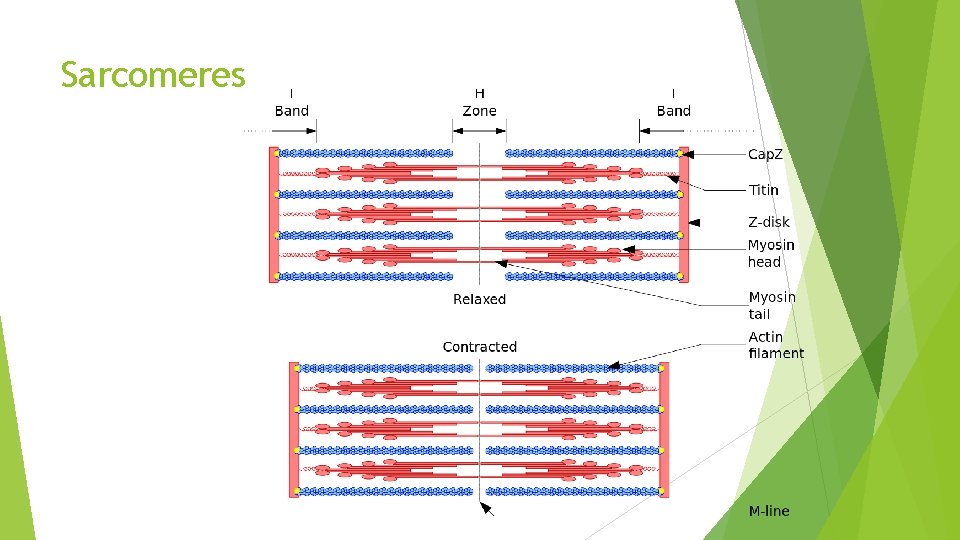
Sarcomere Filaments of the protein myosin are in the center of the sarcomere. Myosin filaments are attached to the z line by the protein titin. Filaments of the protein actin are at the ends, attached to the z lines. Myosin and actin are the contractile proteins of a muscle fiber. Troponin and tropomyosin are proteins that prevent the sliding of actin and myosin when the muscle is relaxed.
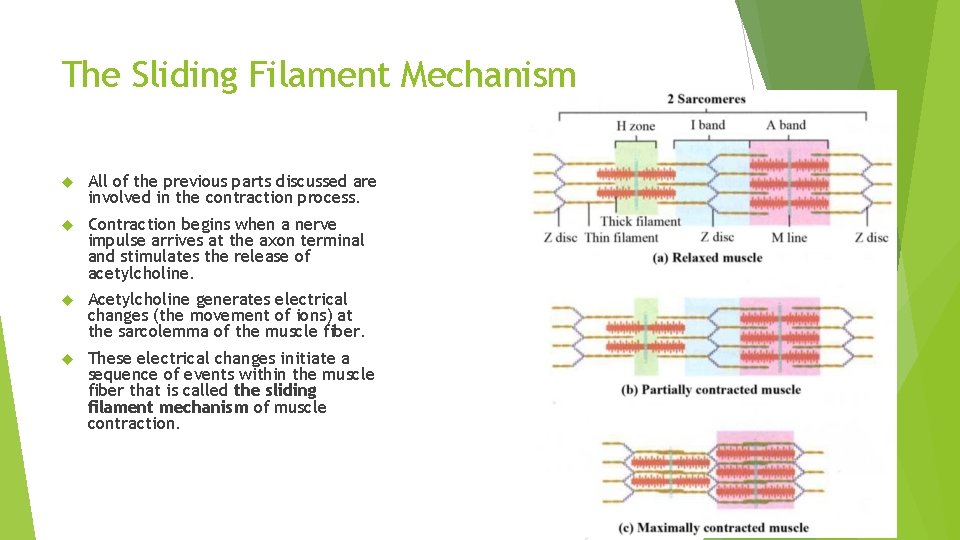
The Sliding Filament Mechanism All of the previous parts discussed are involved in the contraction process. Contraction begins when a nerve impulse arrives at the axon terminal and stimulates the release of acetylcholine. Acetylcholine generates electrical changes (the movement of ions) at the sarcolemma of the muscle fiber. These electrical changes initiate a sequence of events within the muscle fiber that is called the sliding filament mechanism of muscle contraction.
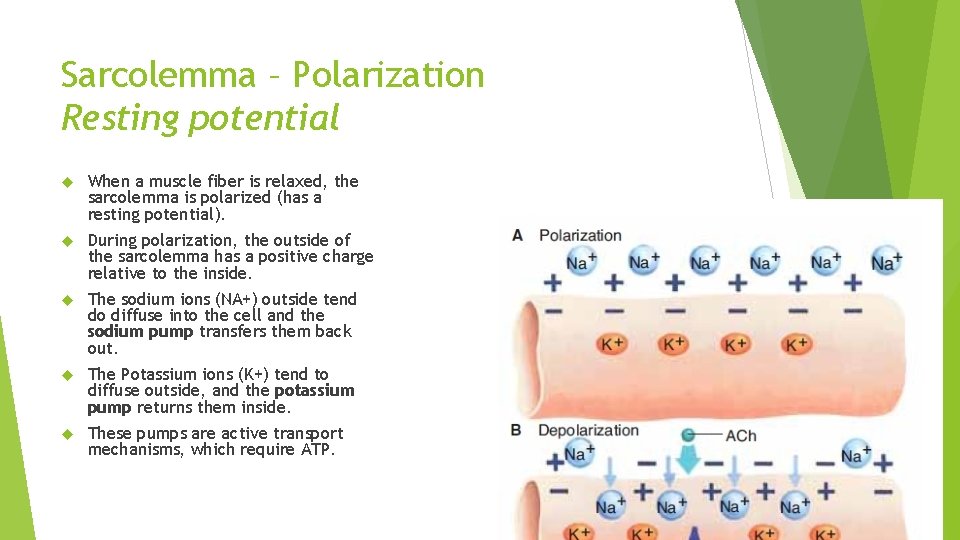
Sarcolemma – Polarization Resting potential When a muscle fiber is relaxed, the sarcolemma is polarized (has a resting potential). During polarization, the outside of the sarcolemma has a positive charge relative to the inside. The sodium ions (NA+) outside tend do diffuse into the cell and the sodium pump transfers them back out. The Potassium ions (K+) tend to diffuse outside, and the potassium pump returns them inside. These pumps are active transport mechanisms, which require ATP.
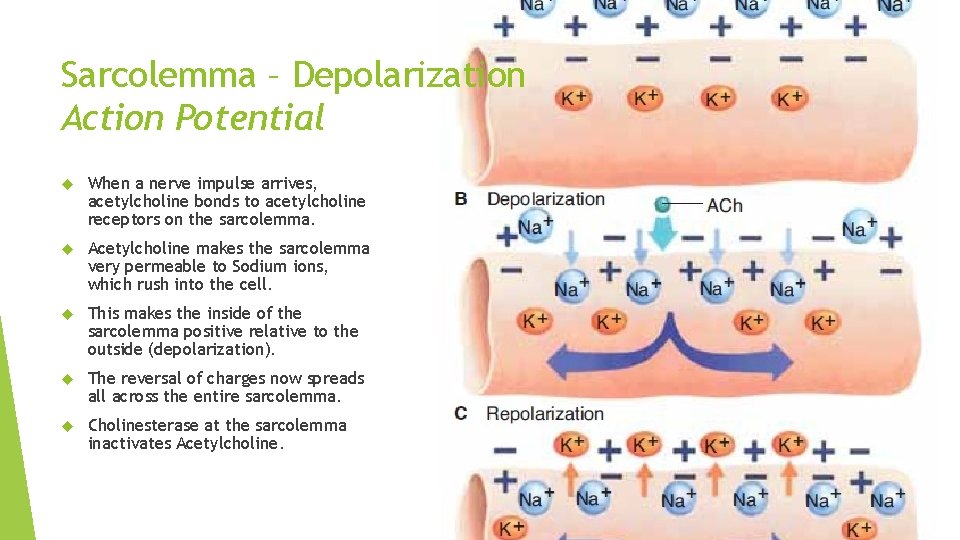
Sarcolemma – Depolarization Action Potential When a nerve impulse arrives, acetylcholine bonds to acetylcholine receptors on the sarcolemma. Acetylcholine makes the sarcolemma very permeable to Sodium ions, which rush into the cell. This makes the inside of the sarcolemma positive relative to the outside (depolarization). The reversal of charges now spreads all across the entire sarcolemma. Cholinesterase at the sarcolemma inactivates Acetylcholine.
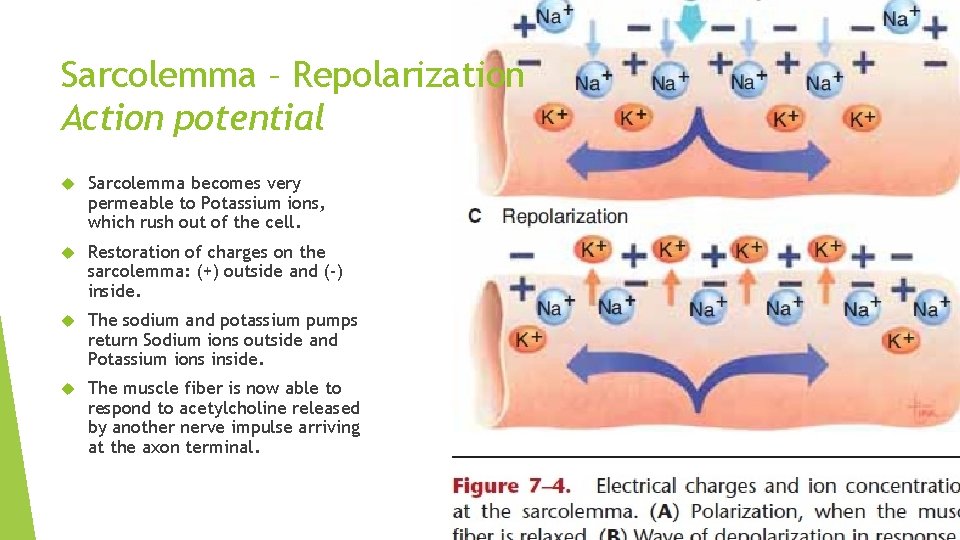
Sarcolemma – Repolarization Action potential Sarcolemma becomes very permeable to Potassium ions, which rush out of the cell. Restoration of charges on the sarcolemma: (+) outside and (-) inside. The sodium and potassium pumps return Sodium ions outside and Potassium ions inside. The muscle fiber is now able to respond to acetylcholine released by another nerve impulse arriving at the axon terminal.
- Slides: 12