
Muscle disease for the generalist Richard Petty INS
- Slides: 31
Muscle disease for the ‘generalist’ Richard Petty INS
Responses to disease processes § Not very much! l l Pain Stiffness / cramp / contracture Weakness and fatiguability Bulk increased or decreased § Evolution critical § FH critical
Evolution § Birth and early development - ask parents § school day activities l esp with metabolic myopathies and dystrophies of later onset § Bath / chair / stairs l esp coming down stairs, 2 at a time? , nail scissors, doing hair, using key
Pedigree § Draw it out l NAD insufficient, full pedigree reminds patients § Question all diagnoses (MS v ALD) § Remember X-linkage and mitochondrial patterns when analysing § Examine other family members if present, esp with HMSN, mitochondrial disorders § Ask informed questions of pedigree - deafness if ? mitochondrial, cataracts if ? Myotonic Dystrophy
Pain § § Restricted to exercising muscle? Time relation to exercise ? aerobic / anaerobic Associated with cramp / contracture or weakness Associated pigmenturia?
Weakness and fatiguability. . . § § § Important and difficult! Define terms. . Fatiguability important, diurnal variation Are there attacks (periodic disorders) Effect on everyday life to quantify weakness
Examination § Functional tasks, always watch gait (esp useful for UMN, PD gaits) § Distribution of weakness l beware bilateral facial weakness and ptosis § Asymmetry § Look for / elicit fasciculation (may be normal), myotonia, § Diffuse or selective § Timed tasks esp if therapy considered
Myotonic Dystrophy § § § Autosomal Dominant disorder 1: 8, 000 Multisystem Exhibits anticipation Molecular mechanism understood Certain diagnosis with simple inexpensive ‘blood test’
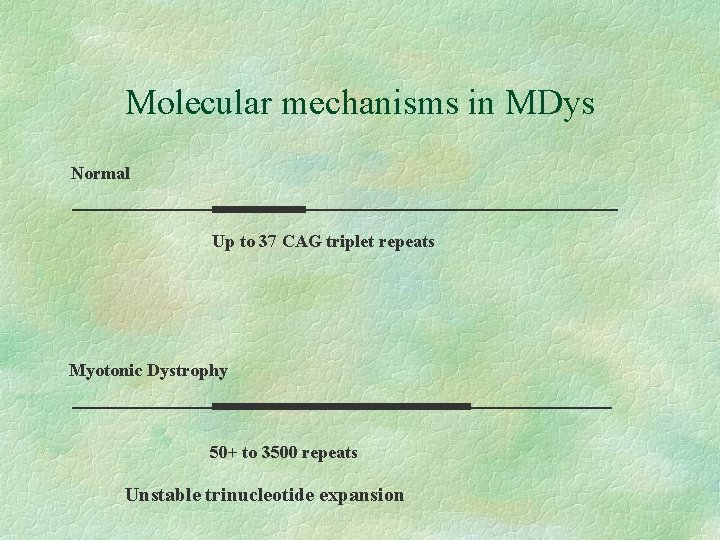
Molecular mechanisms in MDys Normal Up to 37 CAG triplet repeats Myotonic Dystrophy 50+ to 3500 repeats Unstable trinucleotide expansion
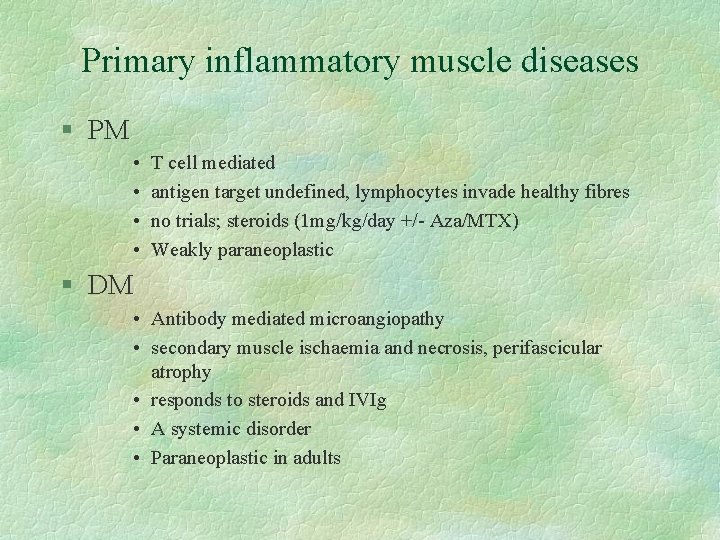
Primary inflammatory muscle diseases § PM • • T cell mediated antigen target undefined, lymphocytes invade healthy fibres no trials; steroids (1 mg/kg/day +/- Aza/MTX) Weakly paraneoplastic § DM • Antibody mediated microangiopathy • secondary muscle ischaemia and necrosis, perifascicular atrophy • responds to steroids and IVIg • A systemic disorder • Paraneoplastic in adults
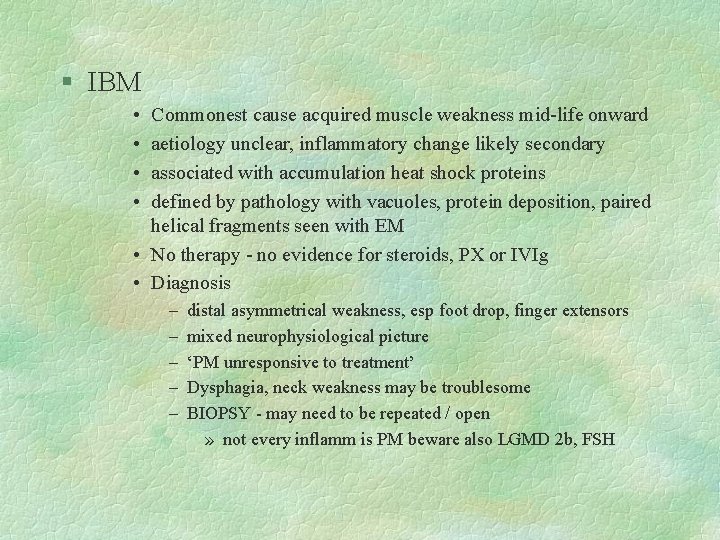
§ IBM • • Commonest cause acquired muscle weakness mid-life onward aetiology unclear, inflammatory change likely secondary associated with accumulation heat shock proteins defined by pathology with vacuoles, protein deposition, paired helical fragments seen with EM • No therapy - no evidence for steroids, PX or IVIg • Diagnosis – – – distal asymmetrical weakness, esp foot drop, finger extensors mixed neurophysiological picture ‘PM unresponsive to treatment’ Dysphagia, neck weakness may be troublesome BIOPSY - may need to be repeated / open » not every inflamm is PM beware also LGMD 2 b, FSH
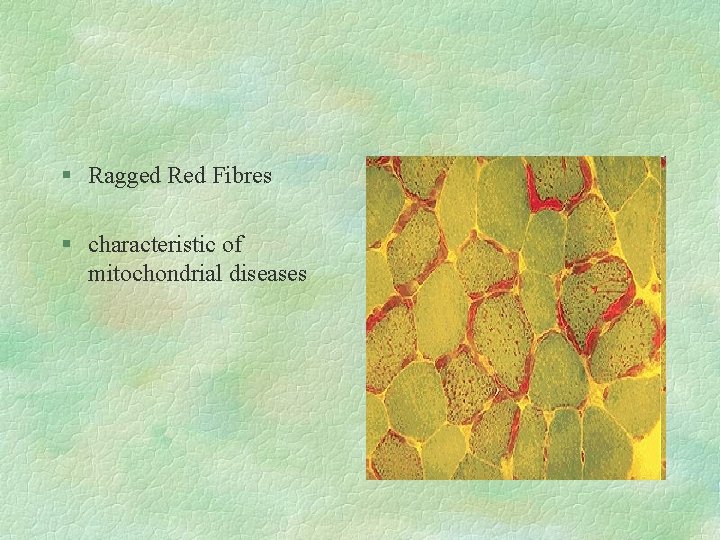
§ Ragged Red Fibres § characteristic of mitochondrial diseases
Mitochondrial disease § Now defined by site of biochemical defect § Historically morphology, and misused as a term for disorders resulting from mt. DNA mutations / deletions § Both nuclear and mt genomes involved § Many mitochondria per cell, many copies mt. DNA per mitochondrion
Mt DNA disorders § Majority heteroplasmic § Dogma remains l determinants of tissue distribution include ‘bottleneck’, and ability of tissue to weed out abnormal mt. DNA molecules l tissue involvement determined by demands on OXPHOS, proportion abnormal mt. DNA
§ Features include l l l l l Brain; myoclonus, seizures, deafness, ataxia, movement disorders Eye; Pigmentary retinopathy Muscle; fatiguable weakness, pain, neuropathies Endocrine; diabetes, short stature, Renal; Fanconi syndrome, CRF Cardiac; conduction defects, dilated cardiomyopathies Respiratory muscle involvement Gut motility disorders Lactic acidosis § 1: 8000 + § Syndromes recognised (possibly a minority of cases)
Deletions / duplications § CPEO plus § Kearns-Sayre
Point mutations § § § MELAS MERRF Lebers optic atrophy NARP Pure myopathy HOCM
Index of suspicion? § § § § Maternal pedigree Deafness / diabetes / lactic acidosis Lactate in csf inter event Spasticity uncommon Don’t just look for syndromes fatiguability neonatal deaths remains problematic - Newcastle study implied prevalence c 1: 8000! - 25 families affected in 200, 000
Neurological ‘channelopathies’ Myotonia Congenita § Myasthenia Gravis as prototype l § § antibody mediated ACh channel disorder Genetically mediated Channel disorder produces symptoms Many paroxysmal Broadening range of disorders
§ Myotonia Congenita l l Cl channel AR / AD but variable penetrance ‘Becker’ and ‘Thomsen’ disease Infantile hercules, non-progressive. . § Paramyotonia congenita / hyperkalaemic periodic paralysis l l l Na channel, defective inactivation Attacks of weakness rare to daily Responds to acetozolamide
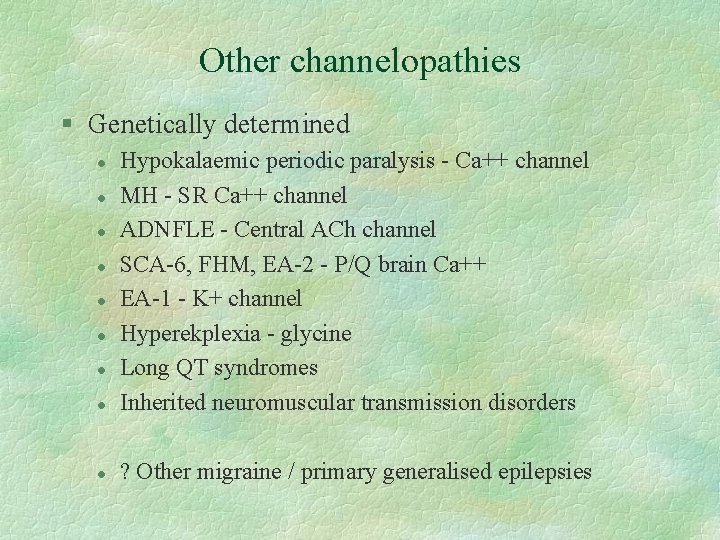
Other channelopathies § Genetically determined l Hypokalaemic periodic paralysis - Ca++ channel MH - SR Ca++ channel ADNFLE - Central ACh channel SCA-6, FHM, EA-2 - P/Q brain Ca++ EA-1 - K+ channel Hyperekplexia - glycine Long QT syndromes Inherited neuromuscular transmission disorders l ? Other migraine / primary generalised epilepsies l l l l
§ Acquired l l presynaptic Ca++ channel - LEMS Axonal Na+ channel - Isaac’s syndrome
FSH § § § Assymmetry Variability and chimeras described Face not invariable, foot drop not uncommon Scapular appearance suggestive Family members worth examining Associated (in young? ) with Coat’s syndrome - eyes >> ears - telangiectasia / microaneurysms in 56/75 § Most (not all) DNA diagnosis 4 q 35 quantal deletions 3. 3 k. B sequence § Probably no cardiac disease § Inflammatory biopsies
§ PB, female, 39 yo, Cousin DMD (through father of that child) § Lifelong l l LL, stiff crampy, never able to run, ‘had a note at school’ new exercise related soreness led to presentation Assym leg length and mild T achilles contractures Proximal LL weakness, no pattern, AJ o/o
§ EMG - no spontaneous activity or myotonia § Biopsy l myopathic, eosinophilic fibres l inflammatory cells in one area l collagen proliferation § a diagnostic test. .
§ Xp 2. 1 dystrophies l l l Duchenne. . Becker. . Milder • Hyper. CKaemia and rhabdomyolysis • Late onset LGMD pattern l Carriers • females often mildly symptomatic
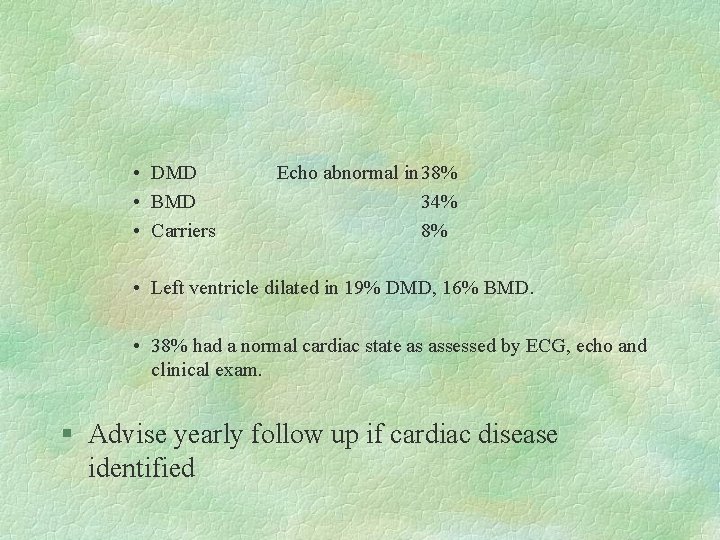
• DMD • BMD • Carriers Echo abnormal in 38% 34% 8% • Left ventricle dilated in 19% DMD, 16% BMD. • 38% had a normal cardiac state as assessed by ECG, echo and clinical exam. § Advise yearly follow up if cardiac disease identified
§ OH, 27, motor mechanic l Gait noted to be abnormal age 23 by partner gave up football in teens now can’t work as Uls won’t carry gearboxes etc CK 2236 l Patchy UL proximal weakness l l l • ext rotation and biceps> triceps and distally • HF, Quads, and DF in LLs l Brother identical l Have different X chromosomes
§ ? A Dystrophy • Pseudohypertrophy; seen in Xp 2. 1, sarcoglycanopathy, remember neurogenic causes • Distal; Myotonic Dystrophy, IBM, Desmin, Dysferlinopathies and EDMD (X-linked and AD) • Contractures; EDMD,
§ ? A dystrophy - catches • • • l Mosaicism Acid Maltase deficiency Polymyositis (and vice-versa) IBM Desminopathies Congenital myopathies (Bethlem often progress) Beware of • genetic counselling without molecular diagnosis- it gets complex • Cardiomyopathies and rhythm disorders • Avoidable contractures
§ High CK • be sure it is muscle • remember non-normal distribution but also that N seen in dystrophies / mitochondrials / AMD • glycolytic • CPT deficiency • also seen in – mitochondrials – Xp 2. 1 – trauma and compression / immobility