
MUSCLE CONTRACTION AND MOVEMENT MUSCLES Muscles are attached
- Slides: 6
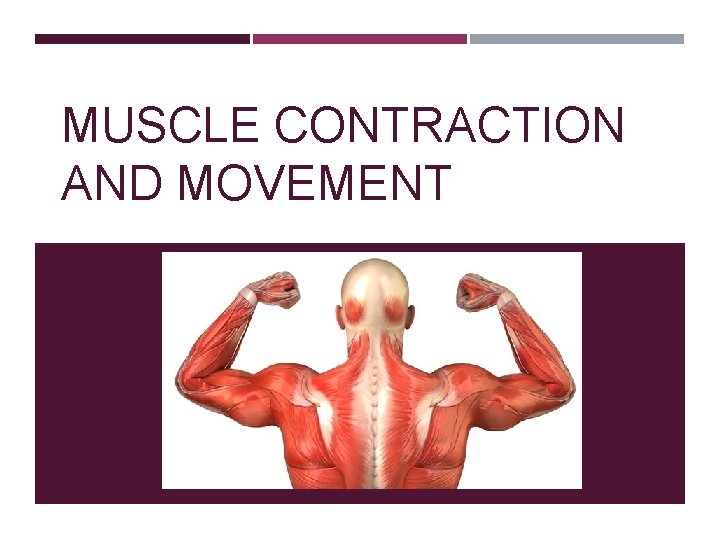
MUSCLE CONTRACTION AND MOVEMENT
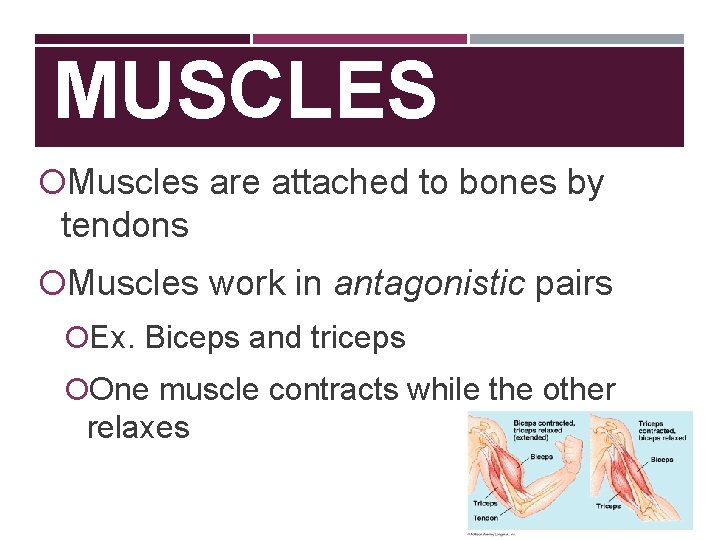
MUSCLES Muscles are attached to bones by tendons Muscles work in antagonistic pairs Ex. Biceps and triceps One muscle contracts while the other relaxes
CONTRACTILE APPARATUS Skeletal muscle Muscle cell = muscle fiber (a single cell with one nucleus) Muscle fibers are made of myofibrils (striated) Myofibrils are made of units called sarcomeres Sarcomeres are made of thick and thin filaments Thick and thin filaments slide over one another to shorten the muscle during contraction Ca and ATP required for sliding and attachment
MOTOR NEURONS AND MUSCLE CONTRACTION Motor neurons stimulate muscle contraction Motor neurons are branched and can stimulate more than one muscle fiber The strength of a muscular contraction is controlled by the number of motor units activated. More motor units = stronger contractions Muscles requiring precise control have one motor neuron per muscle fiber
MUSCLE INJURIES ‘Pulled muscle' - Usually the muscle is forcibly stretched beyond its limits and the muscle tissue becomes torn. Depending upon its severity it is classified as a first, second or third degree strain
MUSCLE INJURIES – SIGNS AND SYMPTOMS Grade 1 Signs may not be present until after the activity is over. There may be a sensation of cramps or tightness and a slight feeling of pain when the muscles are stretched or contracted. Grade 2 Immediate pain which is more severe than the pain of a grade one injury. It is confirmed by pain on stretch and contraction of the muscle. sore to touch. Grade 3 Catastrophic injury. There is an immediate burning or stabbing pain and the athlete is unable to walk without pain. The muscle is completely torn and there may be a large lump of muscle tissue above a depression where the tear is.