
Muscle Atrophy and Functional Deficits of Knee Extensors
- Slides: 7
Muscle Atrophy and Functional Deficits of Knee Extensors and Flexors in People With Chronic Stroke by Christiane L. Prado-Medeiros, Milla P. Silva, Giovanna C. Lessi, Marcela Z. Alves, Alberto Tannus, Ana R. Lindquist, and Tania F. Salvini ptjournal Volume 92(3): 429 -439 February 29, 2012 © 2012 American Physical Therapy Association
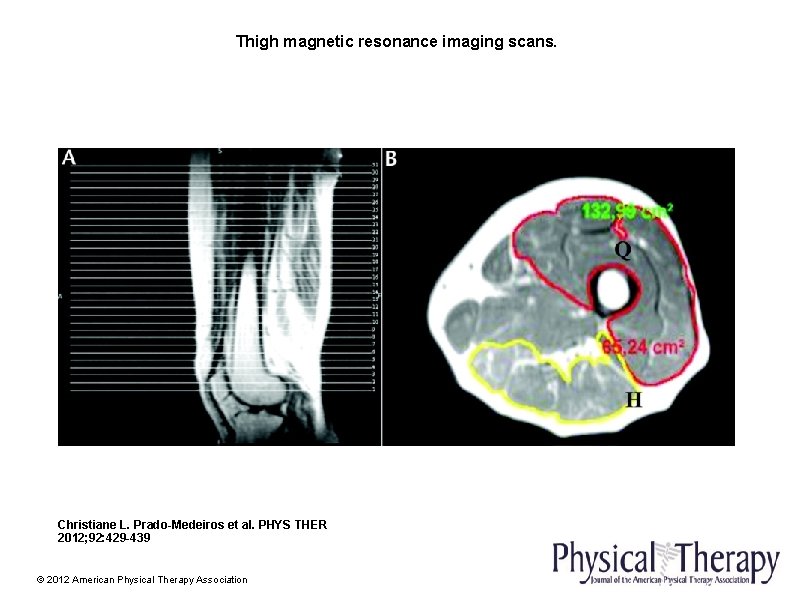
Thigh magnetic resonance imaging scans. Christiane L. Prado-Medeiros et al. PHYS THER 2012; 92: 429 -439 © 2012 American Physical Therapy Association
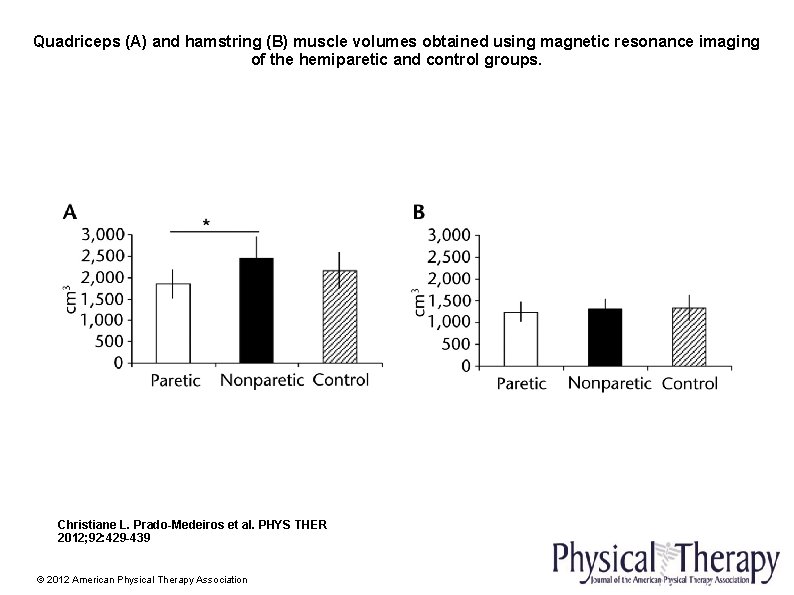
Quadriceps (A) and hamstring (B) muscle volumes obtained using magnetic resonance imaging of the hemiparetic and control groups. Christiane L. Prado-Medeiros et al. PHYS THER 2012; 92: 429 -439 © 2012 American Physical Therapy Association
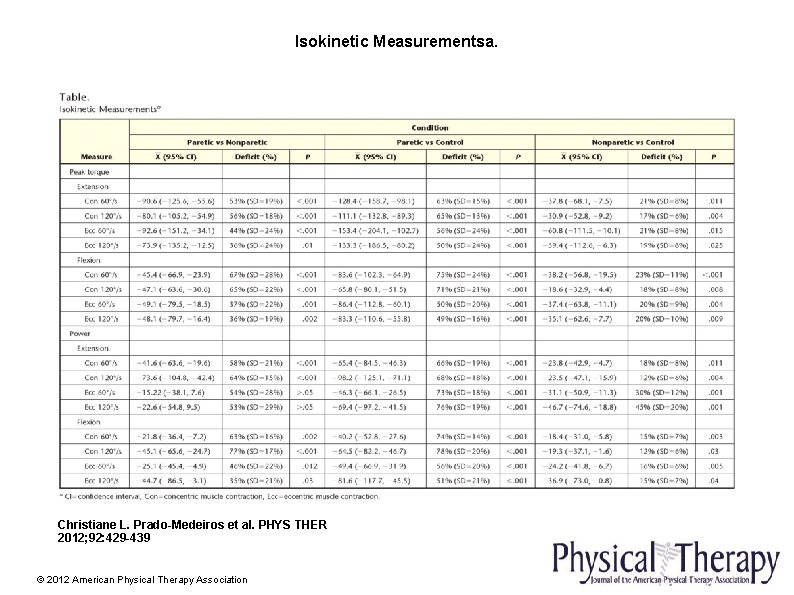
Isokinetic Measurementsa. Christiane L. Prado-Medeiros et al. PHYS THER 2012; 92: 429 -439 © 2012 American Physical Therapy Association
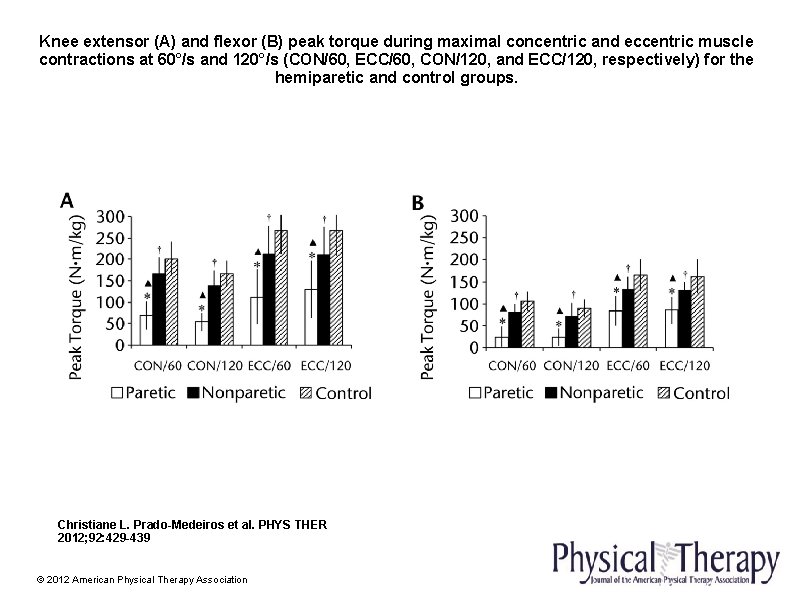
Knee extensor (A) and flexor (B) peak torque during maximal concentric and eccentric muscle contractions at 60°/s and 120°/s (CON/60, ECC/60, CON/120, and ECC/120, respectively) for the hemiparetic and control groups. Christiane L. Prado-Medeiros et al. PHYS THER 2012; 92: 429 -439 © 2012 American Physical Therapy Association
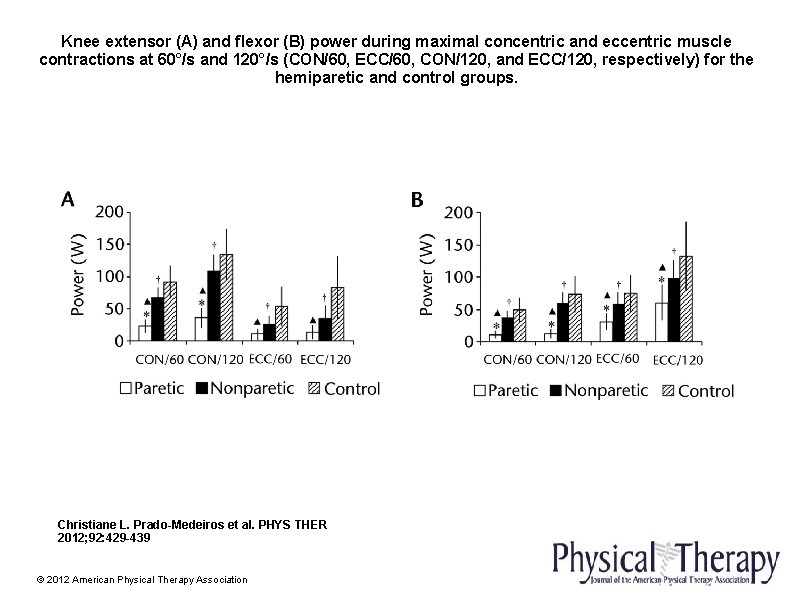
Knee extensor (A) and flexor (B) power during maximal concentric and eccentric muscle contractions at 60°/s and 120°/s (CON/60, ECC/60, CON/120, and ECC/120, respectively) for the hemiparetic and control groups. Christiane L. Prado-Medeiros et al. PHYS THER 2012; 92: 429 -439 © 2012 American Physical Therapy Association
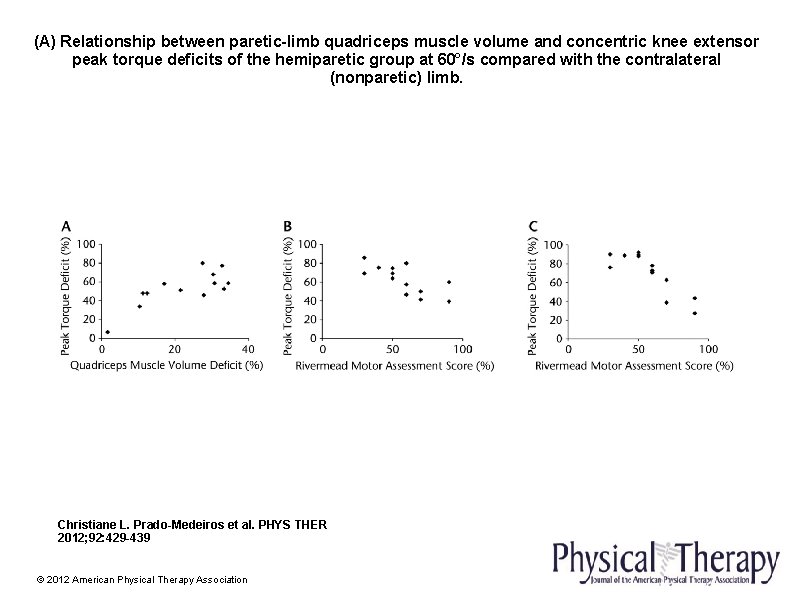
(A) Relationship between paretic-limb quadriceps muscle volume and concentric knee extensor peak torque deficits of the hemiparetic group at 60°/s compared with the contralateral (nonparetic) limb. Christiane L. Prado-Medeiros et al. PHYS THER 2012; 92: 429 -439 © 2012 American Physical Therapy Association