
Murphy Schmidt solicitors Family Provision Claims Helping clients

- Slides: 36
Murphy. Schmidt solicitors Family Provision Claims Helping clients excluded from Wills Tim Baumann Senior Associate – Murphy. Schmidt Solicitors 130 Mary Street, Brisbane E: tbaumann@murphyschmidt. com. au P: (07) 3303 9850
Murphy. Schmidt solicitors “I want to challenge the Will” Two (2) ways in which someone can do so in Queensland: 1. Challenge the creation process of the Will; 2. Bring a Family Provision Claim.
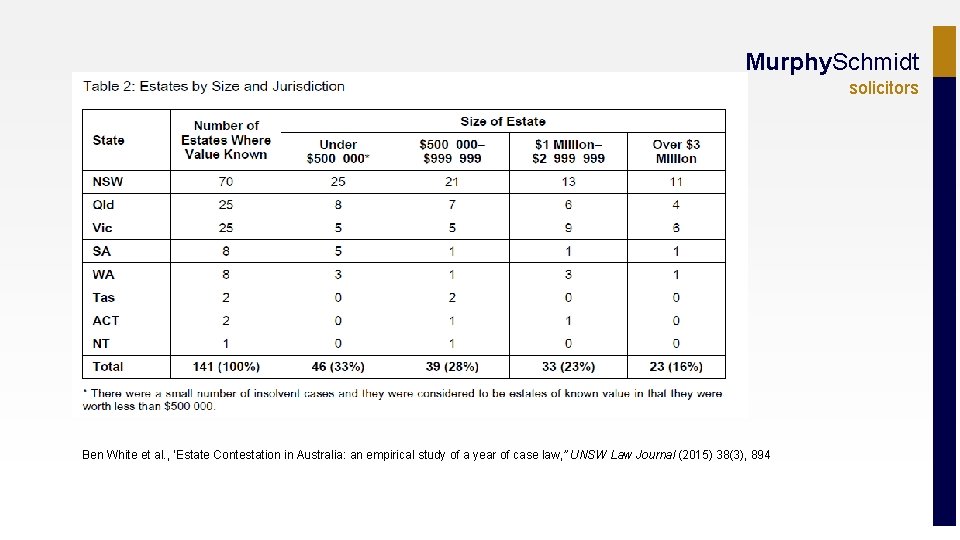
Murphy. Schmidt solicitors Ben White et al. , ‘Estate Contestation in Australia: an empirical study of a year of case law, ” UNSW Law Journal (2015) 38(3), 894
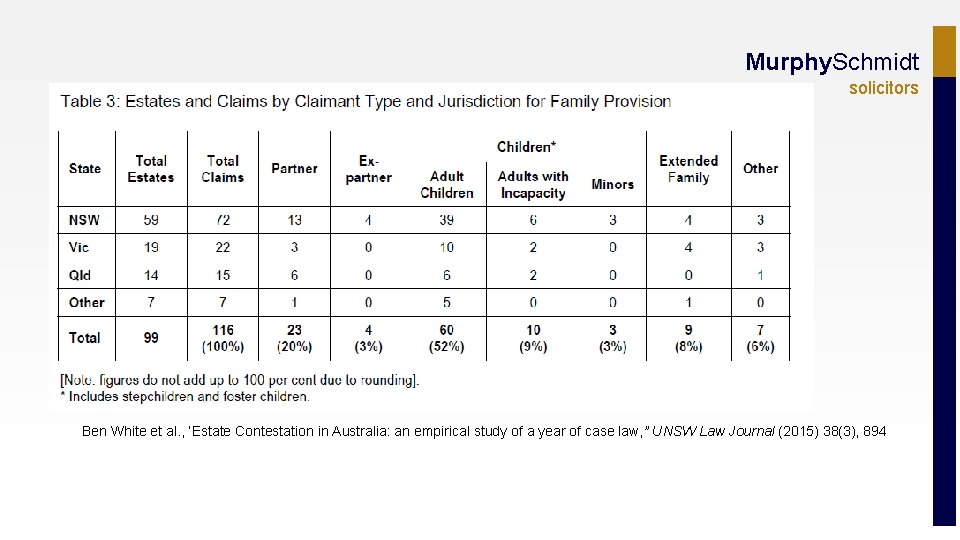
Murphy. Schmidt solicitors Ben White et al. , ‘Estate Contestation in Australia: an empirical study of a year of case law, ” UNSW Law Journal (2015) 38(3), 894
Murphy. Schmidt A short history lesson • Common law jurisdictions: – Magna Carta (1215) – The Statute of Wills (UK) (1540) – Dower Act 1833 (UK) • Civil law jurisdictions: – Forced share approach solicitors
Murphy. Schmidt solicitors The development of Family Provision Claims • • • Testator’s Family Maintenance Act 1900 (NZ) Family Provision Claims are also recognised in Australia, Canada and the United Kingdom Ireland India have partial recognition provisions
Murphy. Schmidt solicitors “the making of provision for the maintenance and support of members of a family who are found in need when the family tie is broken by death” Leonie Englefield, Australian Family Provision Law (Law Book Co of Australasia, 2011).
Murphy. Schmidt solicitors Who is likely to be affected? • An Applicant dissatisfied with the terms of a Will or the distribution of the Estate on intestacy • A Personal Representative (ie Executor or Administrator) • A beneficiary under a Will
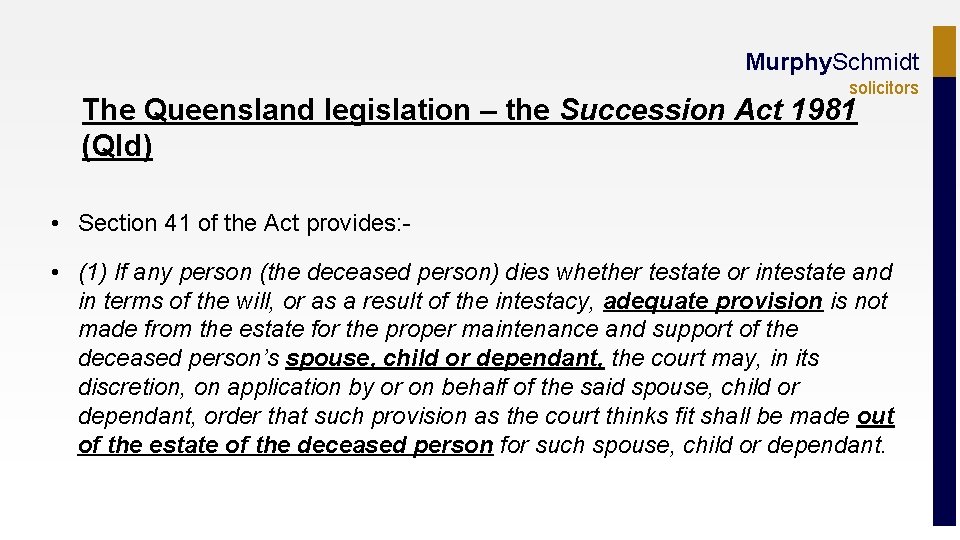
Murphy. Schmidt solicitors The Queensland legislation – the Succession Act 1981 (Qld) • Section 41 of the Act provides: - • (1) If any person (the deceased person) dies whether testate or intestate and in terms of the will, or as a result of the intestacy, adequate provision is not made from the estate for the proper maintenance and support of the deceased person’s spouse, child or dependant, the court may, in its discretion, on application by or on behalf of the said spouse, child or dependant, order that such provision as the court thinks fit shall be made out of the estate of the deceased person for such spouse, child or dependant.
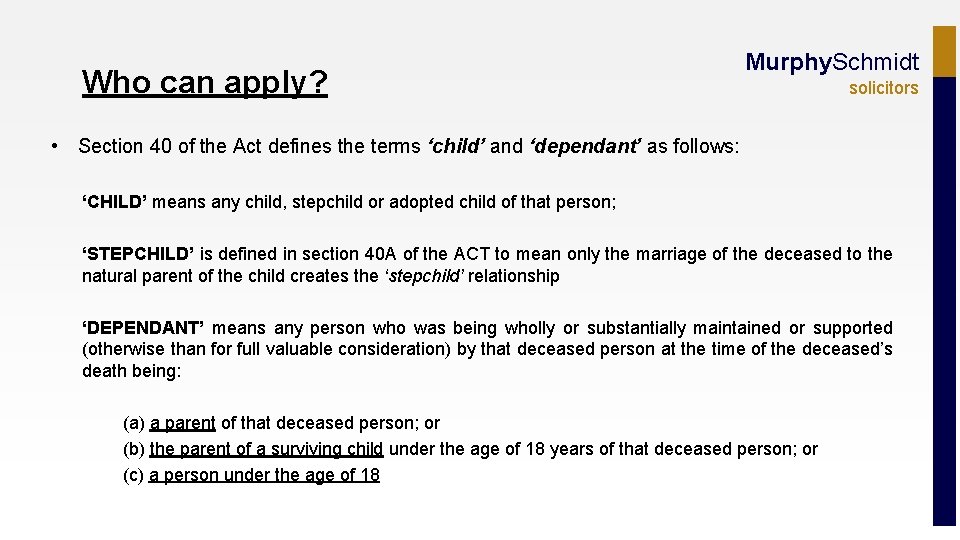
Who can apply? Murphy. Schmidt solicitors • Section 40 of the Act defines the terms ‘child’ and ‘dependant’ as follows: ‘CHILD’ means any child, stepchild or adopted child of that person; ‘STEPCHILD’ is defined in section 40 A of the ACT to mean only the marriage of the deceased to the natural parent of the child creates the ‘stepchild’ relationship ‘DEPENDANT’ means any person who was being wholly or substantially maintained or supported (otherwise than for full valuable consideration) by that deceased person at the time of the deceased’s death being: (a) a parent of that deceased person; or (b) the parent of a surviving child under the age of 18 years of that deceased person; or (c) a person under the age of 18
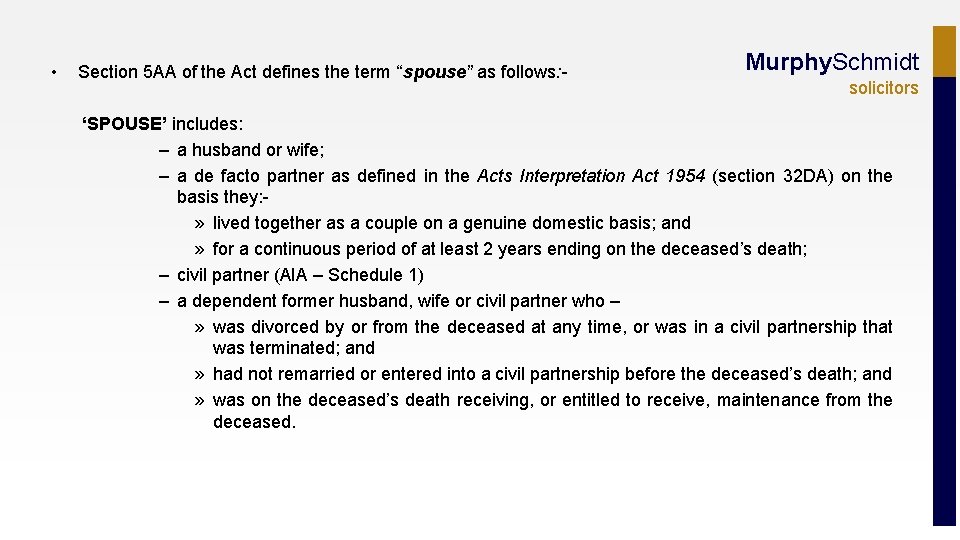
• Section 5 AA of the Act defines the term “spouse” as follows: - Murphy. Schmidt solicitors ‘SPOUSE’ includes: – a husband or wife; – a de facto partner as defined in the Acts Interpretation Act 1954 (section 32 DA) on the basis they: » lived together as a couple on a genuine domestic basis; and » for a continuous period of at least 2 years ending on the deceased’s death; – civil partner (AIA – Schedule 1) – a dependent former husband, wife or civil partner who – » was divorced by or from the deceased at any time, or was in a civil partnership that was terminated; and » had not remarried or entered into a civil partnership before the deceased’s death; and » was on the deceased’s death receiving, or entitled to receive, maintenance from the deceased.
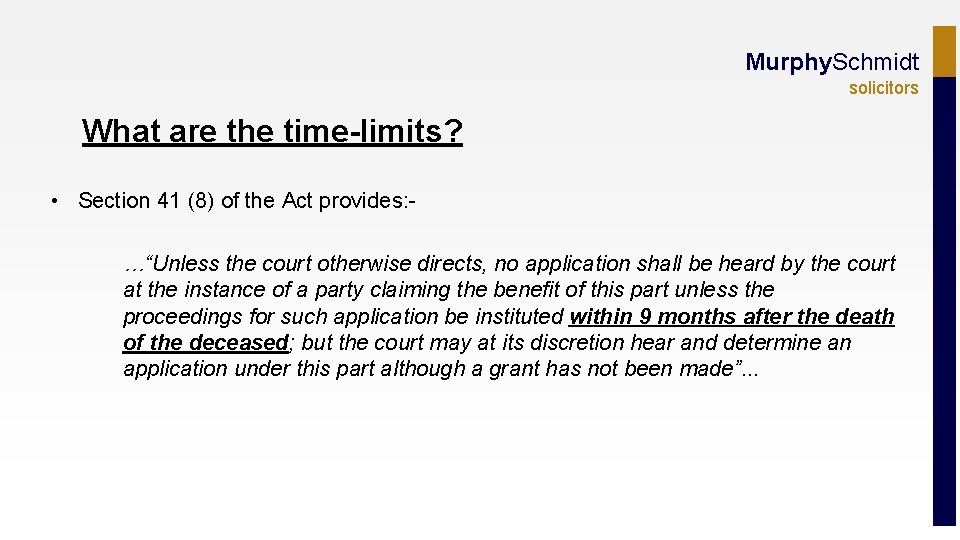
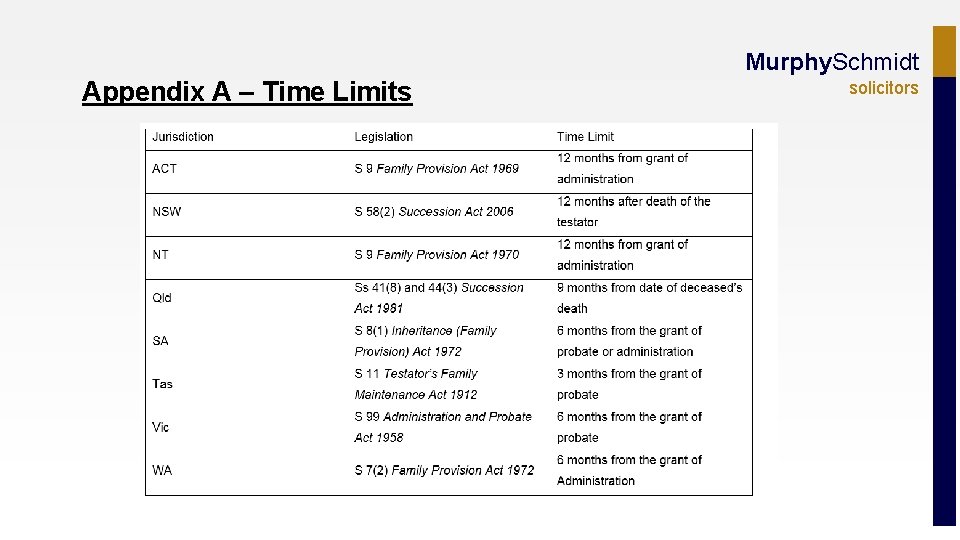
Murphy. Schmidt solicitors What are the time-limits? • Section 41 (8) of the Act provides: …“Unless the court otherwise directs, no application shall be heard by the court at the instance of a party claiming the benefit of this part unless the proceedings for such application be instituted within 9 months after the death of the deceased; but the court may at its discretion hear and determine an application under this part although a grant has not been made”. . .
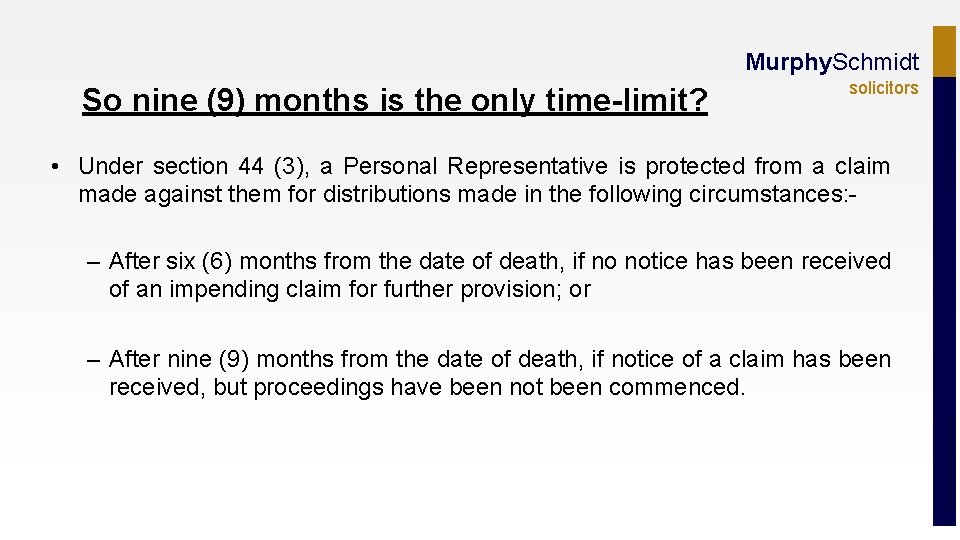
Murphy. Schmidt So nine (9) months is the only time-limit? solicitors • Under section 44 (3), a Personal Representative is protected from a claim made against them for distributions made in the following circumstances: – After six (6) months from the date of death, if no notice has been received of an impending claim for further provision; or – After nine (9) months from the date of death, if notice of a claim has been received, but proceedings have been not been commenced.
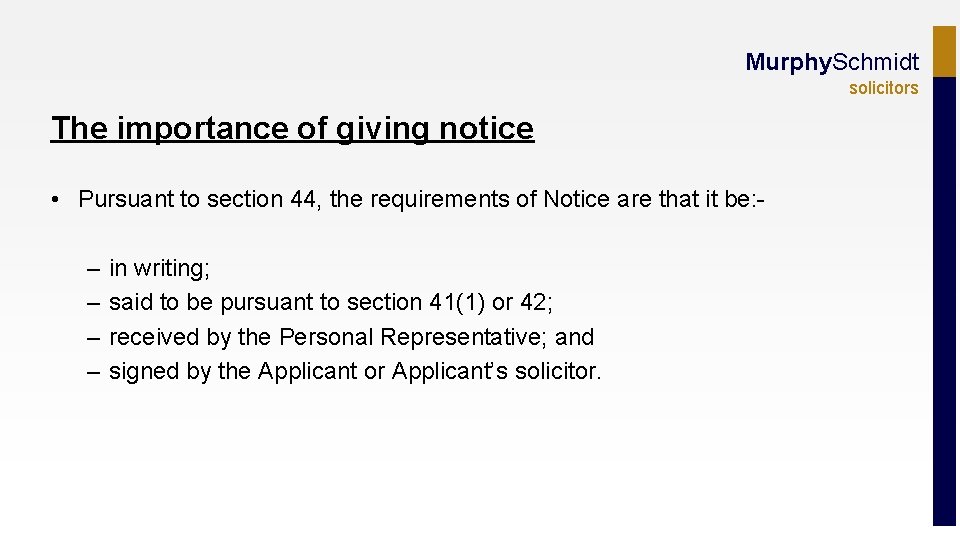
Murphy. Schmidt solicitors The importance of giving notice • Pursuant to section 44, the requirements of Notice are that it be: – in writing; – said to be pursuant to section 41(1) or 42; – received by the Personal Representative; and – signed by the Applicant or Applicant’s solicitor.
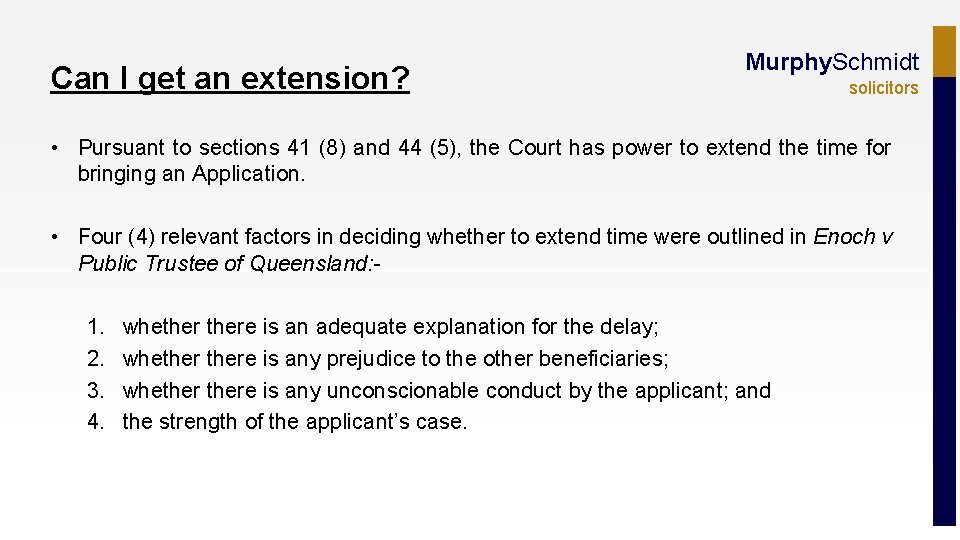
Can I get an extension? Murphy. Schmidt solicitors • Pursuant to sections 41 (8) and 44 (5), the Court has power to extend the time for bringing an Application. • Four (4) relevant factors in deciding whether to extend time were outlined in Enoch v Public Trustee of Queensland: 1. whethere is an adequate explanation for the delay; 2. whethere is any prejudice to the other beneficiaries; 3. whethere is any unconscionable conduct by the applicant; and 4. the strength of the applicant’s case.
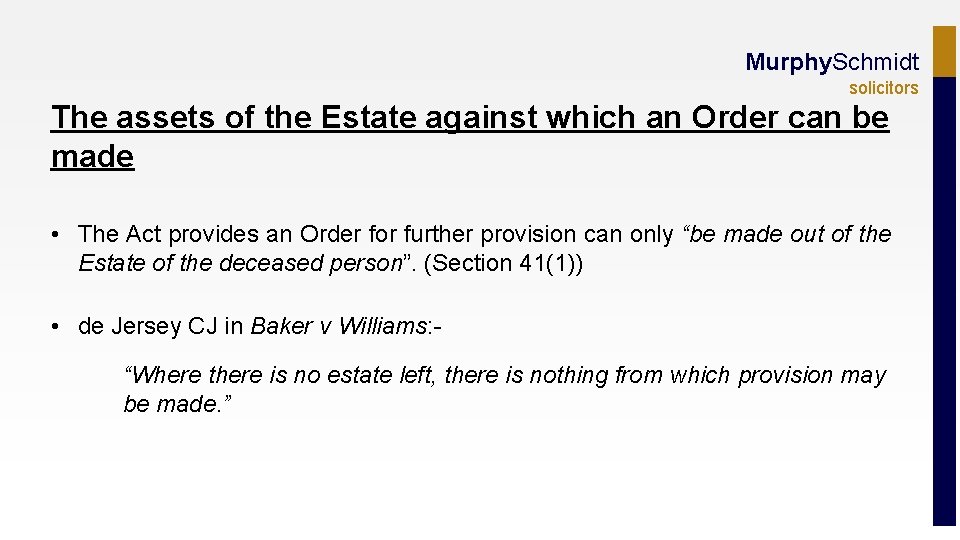
Murphy. Schmidt solicitors The assets of the Estate against which an Order can be made • The Act provides an Order for further provision can only “be made out of the Estate of the deceased person”. (Section 41(1)) • de Jersey CJ in Baker v Williams: “Where there is no estate left, there is nothing from which provision may be made. ”
Murphy. Schmidt solicitors What are NOT assets of the Estate • Assets held as joint tenants − The law of survivorship applies • Superannuation − Unless it is paid by the Trustee of the fund to the “Legal Personal Representative” (ie the Estate). • Assets that were the subject of a valid gift during the deceased’s lifetime • Life insurance (in particular circumstances)
Murphy. Schmidt How do the Courts determine these claims? solicitors • The Court, in exercising its discretion under section 41 of the Act, applies a two (2) stage process. 1. Has the applicant been left without adequate provision for their maintenance and support? 2. If so, what provision should be made for the Applicant? Singer v Berghouse (1994) 181 CLR 201; Vigolo v Boston (2005) 221 CLR 191
Murphy. Schmidt First-stage solicitors • This is the ‘jurisdictional’ question and is determined at the date of death. • The determination of this stage calls for an assessment of: - – – the applicant’s financial position; the size and nature of the deceased’s estate; the totality of the relationship between the applicant and the deceased; the relationship between the deceased and other persons who have a legitimate claim upon the deceased’s bounty.
Murphy. Schmidt solicitors Second-stage • If the jurisdictional question is overcome, the question then becomes what provision should be made for the Applicant? • This requires the Court, in exercising its discretion, to make such provision as it thinks fit, taking into account all the circumstances of the case
Murphy. Schmidt Other relevant matters solicitors – the ability of the applicant to meet their own financial responsibilities; – the financial and non-financial contributions to the deceased’s estate by the applicant; – the standard of living of the applicant during the deceased’s lifetime; – the nature and extent of the relationship between the deceased and the applicant; – the manner in which the deceased has conducted themselves in relation to the deceased during their lifetime. • What about fairness? Irrelevant
Murphy. Schmidt solicitors The Application process • Jurisdictional question – Supreme Court – over $750, 000. 00 – District Court - $750, 000. 00 monetary limit • Supreme and District Court Practice Direction – No. 8 of 2001
Form 5 – Originating Application Murphy. Schmidt solicitors • Seeking adequate provision for the proper maintenance and support of the Applicant • That the costs of the Application be assessed on the indemnity basis and paid out of the Estate • Any or all of the following: - – the application be heard and determined notwithstanding it is instituted outside the time limited for the bringing of applications; – the application be heard and determined notwithstanding it is instituted when no grant of representation has been made in the estate of the deceased; – (insert part of Estate) should be exonerated from the incidence of the order for further provision. • This Application will be heard by the Court upon a date to be fixed by agreement or failing agreement after notice of not less than fourteen (14) days from one party to the other party.
Murphy. Schmidt solicitors Service • The Application should be accompanied by: – supporting Affidavit(s); and – Draft Directions Order. * setting out the information required by the Practice Directions.
Murphy. Schmidt solicitors Other aspects • It protects the interests of all persons who might apply (s 41 (6)) • The application only may be filed - with the supporting affidavit filed later – This should be reserved for only urgent applications in order to protect the client’s interests • It should be served on the Personal Representative immediately given the protections afforded to them under s 44 (3) in respect of distributions
Applicant’s Affidavit: Murphy. Schmidt solicitors – must show a prima facie case that the applicant is a person who is entitled to apply; – provide details of the applicant’s assets and liabilities and sources of income; – show the identity of all persons who fall within the definitions of “spouse”, “child” or “dependant” in section 41(1); – contain material identifying persons having an interest in the estate, who should be served; – material relevant to an extension of time; – contain particulars of any bequest which the applicant seeks to have exonerated; – material relevant to jurisdiction; – information and material as to the assets and liabilities in the estate from which further provision might be made for the applicant; – contain the applicant’s best estimate of the applicant’s costs through to and inclusive of final hearing; – contain such other material as may be necessary to support the application.
Murphy. Schmidt solicitors Draft Directions Order – notice of the application to be given to any beneficiary or any other person entitled to apply for further provision; – the filing of affidavits (or further affidavits) by the parties; – a dispute resolution plan/ alternative dispute resolution process; – filing of a request for trial date
Murphy. Schmidt solicitors The role of other parties to the Application • The Personal Representative: – Duty to uphold the Will – Duty to compromise? – What if they are also an Applicant? • Section 59 of the Trusts Act 1973 provides the Applicant may be represented in different capacities where they also seek further provision out of the Estate. • Where the Executor Applicant is a co-Executor, the Application will be served on the other co-Executor who will act to uphold the Will.
Beneficiaries Murphy. Schmidt solicitors – Any Order for further provision to fall on the beneficiaries rateably (section 41 (3)) – Should they be individually represented? • Parties with a common interest should avoid separate representation • If a beneficiary chooses to be separately represented, they risk having the costs of representation disallowed unless special circumstances justifying separate representation – Should they bring their own claim? – Are they under a disability? • Section 41 (7) provides for an application to be made by the Personal Representative on behalf of a person under a legal incapacity, or alternatively, to apply to the Court for advice and/or directions as to whether that person ought to apply • Chapter 3, Part 4 UCPR – Litigation Guardian
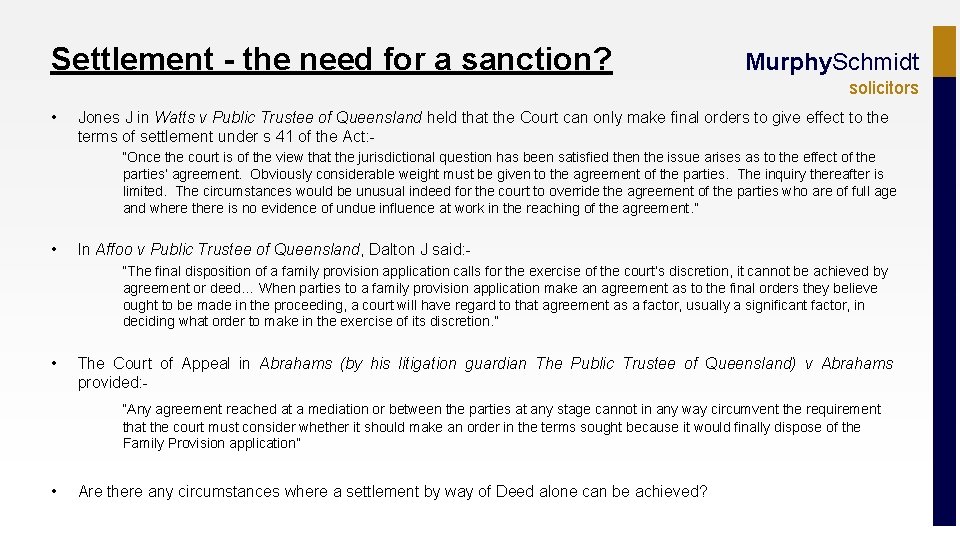
Settlement - the need for a sanction? Murphy. Schmidt solicitors • Jones J in Watts v Public Trustee of Queensland held that the Court can only make final orders to give effect to the terms of settlement under s 41 of the Act: “Once the court is of the view that the jurisdictional question has been satisfied then the issue arises as to the effect of the parties’ agreement. Obviously considerable weight must be given to the agreement of the parties. The inquiry thereafter is limited. The circumstances would be unusual indeed for the court to override the agreement of the parties who are of full age and where there is no evidence of undue influence at work in the reaching of the agreement. ” • In Affoo v Public Trustee of Queensland, Dalton J said: “The final disposition of a family provision application calls for the exercise of the court’s discretion, it cannot be achieved by agreement or deed… When parties to a family provision application make an agreement as to the final orders they believe ought to be made in the proceeding, a court will have regard to that agreement as a factor, usually a significant factor, in deciding what order to make in the exercise of its discretion. ” • The Court of Appeal in Abrahams (by his litigation guardian The Public Trustee of Queensland) v Abrahams provided: “Any agreement reached at a mediation or between the parties at any stage cannot in any way circumvent the requirement that the court must consider whether it should make an order in the terms sought because it would finally dispose of the Family Provision application” • Are there any circumstances where a settlement by way of Deed alone can be achieved?
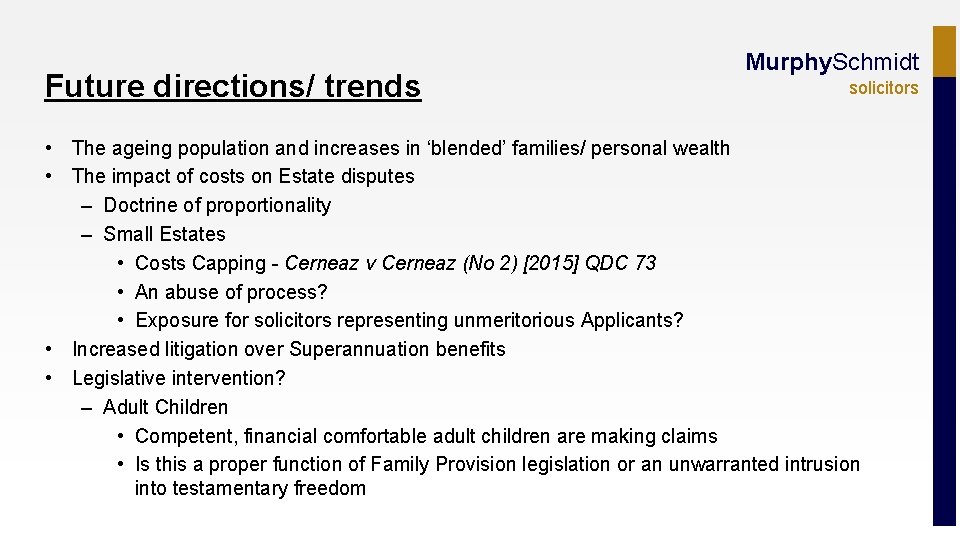
Future directions/ trends Murphy. Schmidt solicitors • The ageing population and increases in ‘blended’ families/ personal wealth • The impact of costs on Estate disputes – Doctrine of proportionality – Small Estates • Costs Capping - Cerneaz v Cerneaz (No 2) [2015] QDC 73 • An abuse of process? • Exposure for solicitors representing unmeritorious Applicants? • Increased litigation over Superannuation benefits • Legislative intervention? – Adult Children • Competent, financial comfortable adult children are making claims • Is this a proper function of Family Provision legislation or an unwarranted intrusion into testamentary freedom
Murphy. Schmidt References solicitors Articles / Books / Reports • • • Ben White et al. , ‘Estate Contestation in Australia: an empirical study of a year of case law, ” UNSW Law Journal (2015) 38(3), 894 Doug Murphy S. C, ‘Family Provision Claims by Adult Children’ Hearsay (undated) <http: //www. hearsay. org. au/index. php? option=com_content&task=view&id=1472&Itemid=35> John de Groot, Wills, Probate and Administration Practice (CLE Dept, Queensland Law Society Inc, 1985) Leonie Englefield, Australian Family Provision Law (Law Book Co of Australasia, 2011). Myles Mc. Gregor-Lowndes & Frances M. Hannah, ‘Every Player Wins a Prize? Family Provision Applications and bequests to Charity, ’ (Research Report, Australian Centre for Philanthropy and Nonprofit Studies, QUT, 2008)
Murphy. Schmidt solicitors Cases • Abrahams (by his litigation guardian The Public Trustee of Queensland) v Abrahams [2015] QCA 286 • Affoo v Public Trustee of Queensland [2012] 1 Qd R 408 • Baker v Williams [2007] QSC 226 • Cerneaz v Cerneaz (No 2) [2015] QDC 73 • Coates v National Trustees Executors and Agency Co Ltd (1956) 95 CLR 494 • Easterbrook v Youn (1977) 136 CLR 308 • Enoch v Public Trustee of Queensland [2005] QSC 194 • Public Trustee v Kidd [1931] NZLR 1 • Re Burton (deceased) [1958] Q. W. N. 27 • Re Donkin (deceased) [1966] Qd R 96 • Re Donohue (deceased) [1933] NZLR 477 • Re Gilmore (deceased) [1963] 5 F. L. R. 371 at 378 • Re Klease [1972] QWN 44 • Re Lowe (deceased) [1964] QWN 37
Murphy. Schmidt • • • Singer v Berghouse (1994) 181 CLR 201 Vigolo v Boston (2005) 221 CLR 191 Watts v Public Trustee of Queensland (2010) 3 ASTLR 613 Legislation • • • Acts Interpretation Act 1954 (Qld) Administration and Probate Act 1958 (Vic) Dower Act 1833 (UK) Family Provision Act 1969 (ACT) Family Provision Act 1970 (NT) Family Provision Act 1972 (WA) Inheritance (Family Provision) Act 1972 (SA) Succession Act 1981 (Qld) Succession Act 2006 (NSW) solicitors
Murphy. Schmidt • • Testator’s Family Maintenance Act 1900 (NZ) Testator’s Family Maintenance Act 1912 (Tas) The Statute of Wills 1540 (UK) Uniform Civil Procedure Rules 1999 (Qld) Other • • Supreme Court of Queensland, Practice Note No 8 of 2001 – Family Provision Applications, 10 October 2001. District Court of Queensland, Practice Note No 8 of 2001 – Family Provision Applications, 10 December 2001. solicitors
Murphy. Schmidt Appendix A – Time Limits solicitors