
Murphy Schmidt solicitors Death and Superannuation Tim Baumann
Murphy. Schmidt solicitors Death and Superannuation Tim Baumann Senior Associate – Murphy. Schmidt Solicitors 130 Mary Street, Brisbane E: tbaumann@murphyschmidt. com. au P: (07) 3303 9850
Murphy. Schmidt DID THEY HAVE SUPERANNUATION? • Being ‘left out’ of an Estate or wanting to ‘challenge’ a person’s Will • Applying for a deceased person’s superannuation benefits solicitors
Murphy. Schmidt LIMITS OF WEBINAR solicitors • Not an Estate planning webinar • Retail/ Industry superannuation funds as opposed to Self-Managed Superannuation Funds (SMSFs) • Will not be canvassing the taxation consequences of superannuation death benefit payments
Murphy. Schmidt SUPERANNUATION solicitors • The first compulsory retirement saving scheme extending to all employees introduced by the Federal Government in 1992 • Superannuation assets currently total $2. 2 trillion, with over 14. 8 million Australians having at least one (1) superannuation account • Group insurance cover in Retail and Industry superannuation funds is generally automatic
Murphy. Schmidt THE NATURE OF SUPERANNUATION solicitors • General rule – superannuation benefits do not automatically form part of the Estate of a deceased person • Superannuation is not (yet) your money • The death of a superannuation fund member does not automatically impact upon the ownership of the assets held on trust for the benefit of the member
Murphy. Schmidt THE NATURE OF SUPERANNUATION solicitors • Conditions of full or partial release: i. Has reached preservation age and retires; ii. Has died; iii. Permanent incapacity; iv. Severe financial hardship; v. Terminal medical condition. • There is an obligation to “cash” superannuation benefits as soon as practicable after the death of a member. • A benefit must therefore be paid from the fund (usually by way of either a lump sum, or one or more pensions).
Murphy. Schmidt WHO CAN RECEIVE SUPERANNUATION DEATH BENEFITS? • A superannuation death benefit can only be paid to a: i. “dependant” of the deceased person; or ii. their “legal personal representative” (i. e. their Estate) (r 6. 22 of the SIS Regulations) solicitors
Murphy. Schmidt WHO IS A DEPENDANT? ‘Dependant’ is defined in section 10 of the SIS Act to include: i. iii. iv. the deceased’s spouse; the deceased’s children; those financially dependent on the deceased; and those in an interdependency relationship with the deceased. solicitors
Murphy. Schmidt WHO IS A DEPENDANT? solicitors ‘Spouse’ is also defined in section 10 of the SIS Act to include: i. another person who is legally married to the person; ii. another person (whether of the same or different sex) in a prescribed kind of relationship that is registered under a State or Territory law; iii. another person who, although not legally married to the person, lives with the person on a genuine domestic basis in a relationship as a couple.
Murphy. Schmidt WHO IS A DEPENDANT? solicitors In determining “on a genuine domestic basis” factors include: • the duration of the relationship; • the nature and extent of the couple’s common residence; • whether a sexual relationship exists; • the degree of financial dependence or interdependence, and any arrangements for financial support between the couple; • the ownership, use and acquisition of the couple’s property; • the care and support of children; and • the reputation and public aspects of the relationship. Section 22 C of the Acts Interpretation Act 1901
Murphy. Schmidt WHO IS A DEPENDANT? solicitors ‘Child’ is defined in section 10 of the SIS Act to include: i. iii. iv. v. an adopted child; a stepchild; an ex-nuptial child of the person; a child of the person's spouse; and someone who is a child of the person within the meaning of the Family Law Act 1975.
Murphy. Schmidt WHO IS A DEPENDANT? solicitors ‘Financially dependent’ on a deceased person: i. iii. iv. v. Often claimed by those who are unable to satisfy one of the other categories; the Trust Deed may specify the necessary degree of financial dependence; financial dependency cannot be established by the mere giving of money; the level of reliance need not be total; a parent is not dependent on their child merely as a result of that parent lending money to the child; vi. if financial assistance has not been provided by the deceased, a legal right to such support from the deceased may be relied upon to show financial dependency existed.
Murphy. Schmidt WHO IS A DEPENDANT? solicitors An ‘interdependency relationship’ exists if: i. iii. iv. they have a close personal relationship; they live together; one provides the other with financial support; and one provides the other with domestic support and personal care.
Murphy. Schmidt WHO IS A DEPENDANT? solicitors A ‘close personal relationship’: i. All circumstances of the relationship are to be taken into account in determining the existence of an interdependency relationship including: • the duration of the relationship; • whether or not a sexual relationship exists; • the ownership, use and acquisition of property; • the degree of mutual commitment to a shared life; • the care and support of children; • reputation and public aspects of the relationship; • the degree of emotional support; • the extent to which the relationship is one of mere convenience; and • any evidence suggesting the parties intended the relationship to be permanent.
Murphy. Schmidt WHO IS A DEPENDANT? ‘Living together’: i. The existence of an interdependency relationship can still be established if two (2) people were temporarily living apart ii. The parties must, of course, be living together before they can be considered to be temporarily living apart ‘Financial Support’: i. Provided to or by the deceased ii. Mutual financial support solicitors
Murphy. Schmidt WHO IS A DEPENDANT? ‘Domestic Support and Personal Care’: i. pursuant to an employment arrangement or behalf of another person or organisation is excluded ii. Support and care must be of a type and quality normally provided in a close personal relationship, rather than by a mere friend or flatmate solicitors
Murphy. Schmidt WHO IS A DEPENDANT? solicitors ‘Disability Test’: i. Two (2) people who fail the test for interdependency can still be in an interdependency relationship if: a) They had a close personal relationship; and b) Either or both suffered from a disability that meant they could not meet one (1) or more of the other requirements for the basic test (i. e. cohabitation, financial support or domestic support and personal care). ii. Mere existence of a disability is not sufficient.
Murphy. Schmidt WHO DECIDES WHO GETS SUPERANNUATION DEATH BENEFITS ON DEATH? solicitors • General rule The Trustee of the fund often has a wide discretion under the Trust Deed to decide how superannuation death benefits are paid. • Importantly There avenues by which the Trustee’s discretion can be removed: i. Binding Death Benefit Nominations; and ii. Reversionary Pension Nominations.
Murphy. Schmidt WHY THE TERMS OF THE TRUST DEED ARE IMPORTANT? solicitors 9. 21 Death of a Member without a Request or Direction If a Member dies, the Trustee must pay the Death Benefit (to the extent the Death Benefit is not payable under any other provision of this Deed): a) if the estate is solvent, to the Legal Personal Representative of the Member; b) if there is no Legal Personal Representative of the Member or the estate is not solvent, to the Spouse of the Member (divided equally between them, if more than one); c) if there is no Spouse of the Member: i. to one or more of the Member’s other Dependants; or ii. if there are no other Dependants, to anyone else as permitted under Superannuation Law, in proportions the Trustee determines.
Murphy. Schmidt BINDING DEATH BENEFIT NOMINATIONS solicitors • If a binding nomination is allowed under the Trust Deed, and is valid, the Trustee has no discretion to determine the payment of the benefits and must pay them in accordance with the nomination • Valid binding death benefit nominations are largely unimpeachable, except in specific circumstances: i. Notional Estate provisions in NSW; and ii. Family Law Act 1975 superannuation splitting/ flagging orders.
Murphy. Schmidt REVERSIONARY PENSION NOMINATIONS solicitors • A pension that continues to another beneficiary on the death of a deceased member who was themselves receiving a pension • It is an automatic process that removes the discretion of the Trustee in choosing the beneficiary of the deceased’s superannuation funds
Murphy. Schmidt REQUIREMENTS OF A VALID BINDING DEATH BENEFIT NOMINATION solicitors • Two (2) basic requirements: i. The Trust Deed must allow such nominations; ii. The nomination can only favour those eligible to receive a death benefit payment under the SIS Act and SIS Regulations (i. e. Dependants or the Legal Personal Representatives)
Murphy. Schmidt REQUIREMENTS OF A VALID BINDING DEATH BENEFIT NOMINATION solicitors • Additional requirements set out in SIS Regulations (6. 17 A and 6. 17 B) i. The nomination must be in writing; ii. signed and dated by the member; iii. in the presence of two witnesses over the age of 18 years and who are not mentioned in the nomination; iv. The proportion that is payable to each nominee is certain or readily ascertainable; v. ceases to have effect three (3) years after it is signed • No dispensing power for the Court for non-complying binding nominations • If there is any doubt the Trustee can apply to the Court for advice
Murphy. Schmidt WHY MAKE A BINDING DEATH BENEFIT NOMINATION? • Certainty • Risk of litigation • Insolvent Estates solicitors
Murphy. Schmidt WHY WOULD YOU NOT MAKE A BINDING DEATH BENEFIT NOMINATION? • Flexibility • Specific Estate plans would otherwise be frustrated • Broad inability to make cascading nominations solicitors
Murphy. Schmidt THE DECEASED HAS NOT EXCLUDED IT HOW IS THE TRUSTEE’S DISCRETION APPLIED solicitors General guidance can be obtained from the factors the SCT has previously considered relevant in determining disputes: i. The nature and purpose of superannuation (to provide for the member’s retirement); ii. The degree of financial dependency on the deceased member of all potential recipients; iii. The nature and quality of the relationship between the applicant and the deceased member; iv. The current and likely future financial needs of the applicant and other potential recipients; v. The age and health of all potential recipients, including any factors affecting income earning ability; vi. The other entitlements arising from the death of the member (i. e. insurance benefits or benefits from the Estate; vii. The deceased’s wishes, which are usually expressed in a non-binding death benefit nomination form or their Will. Spouses as at the date of death are generally preferred to adult children by the SCT.
Murphy. Schmidt CHALLENGING THE TRUSTEE’S DECISION solicitors • The Superannuation Complaints Tribunal (SCT) • A person with an “interest” in a death benefit may make a complaint to the SCT but only after the internal dispute resolution procedure has been completed. • The Superannuation fund Trustee “claim staking” period involves: i. ii. iii. The Trustee undertakes a search for beneficiaries and providing information about how it proposes to distribute the benefits; If an objection is made but rejected by the Trustee, the Trustee gives written notice to the claimant setting out the decision and that the claimant has 28 days in which to make a complaint to the SCT; If a complaint is not raised, a Trustee will distribute the death benefit in accordance with its decision.
Murphy. Schmidt THE SUPERANNUATION COMPLAINTS TRIBUNAL (SCT) • Is an independent statutory administrative tribunal that provides consumers with a free service for resolving complaints relating to superannuation funds • Superannuation fund Trustees agree to abide by SCT determinations as a condition of their registrable superannuation entity (RSE) licence solicitors
Murphy. Schmidt SCT PROCESS solicitors • Complaints are lodged by the individual making the complaint i. There is a presumption against representation except where the complainant has a disability or where the SCT considers it ‘necessary in all the circumstances’ (s 23 of the SCR Act) • SCT can only accept disputes where the individual has made all reasonable efforts to have the dispute resolved by the superannuation provider through their internal dispute resolution process
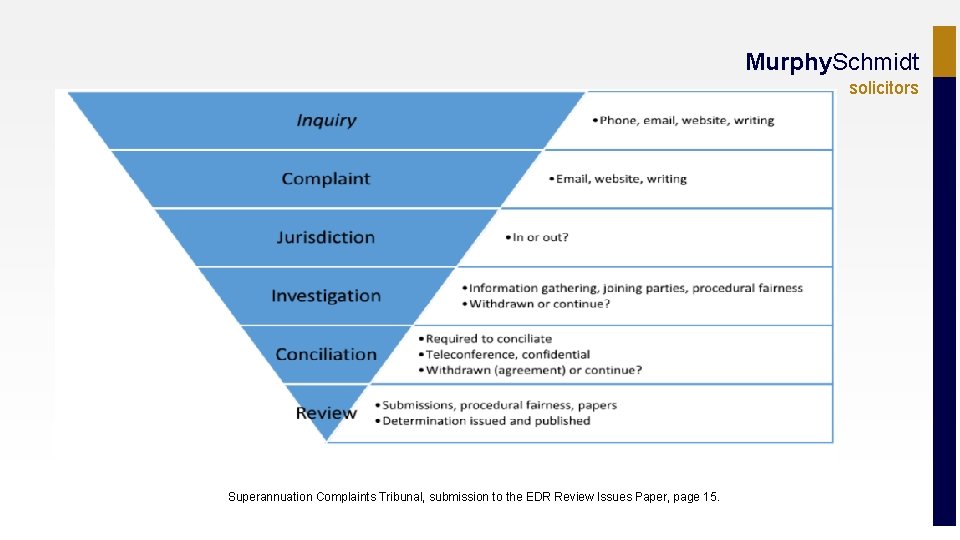
Murphy. Schmidt solicitors Superannuation Complaints Tribunal, submission to the EDR Review Issues Paper, page 15.
Murphy. Schmidt SCT REVIEWS solicitors • Reviews are conducted on the papers • Once the complaint is scheduled for review, a document exchange occurs between the parties and each party is provided with an opportunity to make written submissions. • The SCT ‘stands in the shoes’ of the Trustee and must consider whether the Trustee’s decision was ‘fair and reasonable’ in the circumstances • The SCT can consider the decision on its merits and make its own findings of fact • There are no costs awarded in the SCT.
Murphy. Schmidt APPEAL OF SCT DECISION solicitors • Can be made to the Federal Court on questions of law only • The Federal Court cannot make adverse cost orders against an individual that does not defend an appeal instituted by another party to the complaint
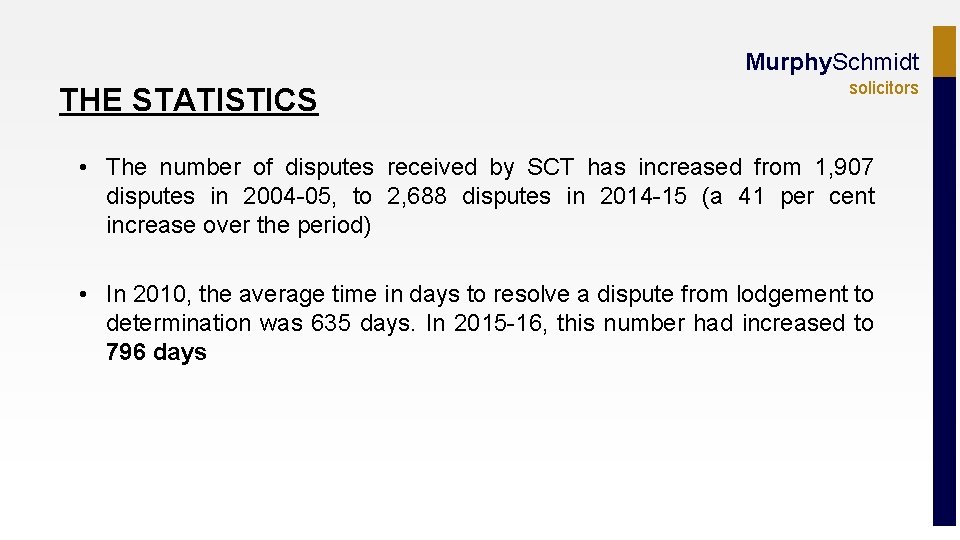
Murphy. Schmidt THE STATISTICS solicitors • The number of disputes received by SCT has increased from 1, 907 disputes in 2004 -05, to 2, 688 disputes in 2014 -15 (a 41 per cent increase over the period) • In 2010, the average time in days to resolve a dispute from lodgement to determination was 635 days. In 2015 -16, this number had increased to 796 days
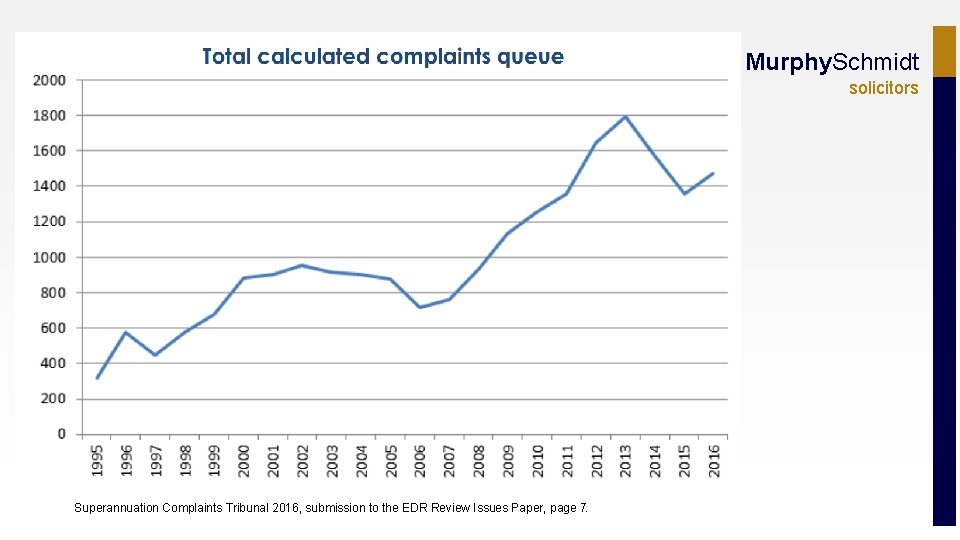
Murphy. Schmidt solicitors Superannuation Complaints Tribunal 2016, submission to the EDR Review Issues Paper, page 7.
Murphy. Schmidt FUTURE OF THE SCT? solicitors • The Australian Financial Complaints Authority (AFCA) scheduled to begin in the middle of 2018 • This authority will replace the SCT, amongst other ombudsman financial services
Murphy. Schmidt FUTURE DIRECTIONS/ TRENDS solicitors • Increasing litigation in respect of superannuation benefits • The importance of engaging competent legal/ financial advice in preparation of Estate plans
Murphy. Schmidt REFERENCES solicitors A Articles / Books / Reports • External Dispute Resolution Review Panel, Parliament of Australia, External Dispute Resolution Review Final Report (2017). • Superannuation Complaints Tribunal, submission to Treasury, EDR Review, 7 October 2016. • Australian Securities and Investments Commission, submission to Treasury, EDR Review, 7 October 2016. • Leonie Englefield, Australian Family Provision Law (Thomson Reuters, 2011). • John K De Groot, Wills, Probate and Administration Practice (Queensland) (CLE Dept, Queensland Law Society Inc, 1985 -). • A. A. Preece, Lee’s Manual of Queensland Succession Law (Thomson Reuters, 7 th Edition, 2012).
Murphy. Schmidt REFERENCES solicitors B Cases • • Griffiths v Westernhagen [2008] NSWSC 851. Bovaird v Frost (2009) 3 ASTLR 155. Faull v Superannuation Complaints Tribunal [1999] NSWSC 1137. Rutter v Australian Retirement Fund Pty Ltd [2000] VSC 375. Young v Niddrie & Benhar Coal Co Ltd [1913] AC 531. D 09 -10/052 [2010] SCTA 20. EM Squared Pty Ltd v Hassan (‘Australian Motors SA Pty Ltd Staff Superannuation Fund’) [2010] SASC 62. Retail Employees Superannuation Pty Ltd v Crocker (2001) 48 ATR 359.
Murphy. Schmidt REFERENCES C Legislation • Explanatory Memorandum, Superannuation Industry (Supervision) Bill 1993 (Cth). • Superannuation Industry (Supervision) Act 1993 (Cth). • Superannuation Industry (Supervision) Regulations 1994 (Cth). • Superannuation (Resolution of Complaints) Act 1993 (Cth). solicitors
Murphy. Schmidt REFERENCES solicitors D Other • • • Australian Bureau of Statistics, 5232. 0 - Australian National Accounts: Finance and Wealth, September 2016 (15 December 2016) <http: //www. abs. gov. au/AUSSTATS/abs@. nsf/allprimarymainfeatures/151 E 01 E 3 F 26 D 72 FACA 2580 F 2000 BF 966? opendocument>. Australian Taxation Office, Superannuation Statistics, http: //www. ato. gov. au/About-ATO? Research-andstatistics/In-detail/Super-statistics/Super-accounts-date/Super-accounts-data-overview/. Scott Hay-Bartlem, Where did it go? Superannuation, death benefits and blended families, (July 2016) Cooper Grace Ward http: //www. cgw. com. au/wp-content/uploads/2016/07/Where-did-it-go-Superannuation-Death. Benefits-and-Blended-Families-Scott-Hay-Bartlem. July 2016. pdf? utm_source=Mondaq&utm_medium=syndication&utm_campaign=inter-article-link>
- Slides: 40