
Muon Spin Rotation SR technique and its applications

- Slides: 50
Muon Spin Rotation (µSR) technique and its applications in superconductivity and magnetism Zurab Guguchia Physik-Institut der Universität Zürich, Winterthurerstrasse 190, CH-8057 Zürich, Switzerland Group of Prof. Hugo Keller
Outline Ø Basic principles of the μSR technique Ø Vortex matter in cuprate superconductors Ø Multi-band superconductivity in high-temperature superconductors Ø Magnetism and superconductivity Ø Low-energy μSR and applications Ø Conclusions
Thank you! University of Zurich in collaboration with: • Paul Scherrer Institute (PSI) Laboratory for Muon Spin Spectroscopy Laboratory for Developments and Methods • Tbilisi State University Prof. Alexander Shengelaya • ETH Zürich • IBM Research Laboratory Rüschlikon (Zurich) • Max Planck Institute for Solid State Research, Stuttgart • EPFL, Lausanne • Institute of Low Temperature and Structure research, Poland • Brookhaven National Laboratory, Upton NY
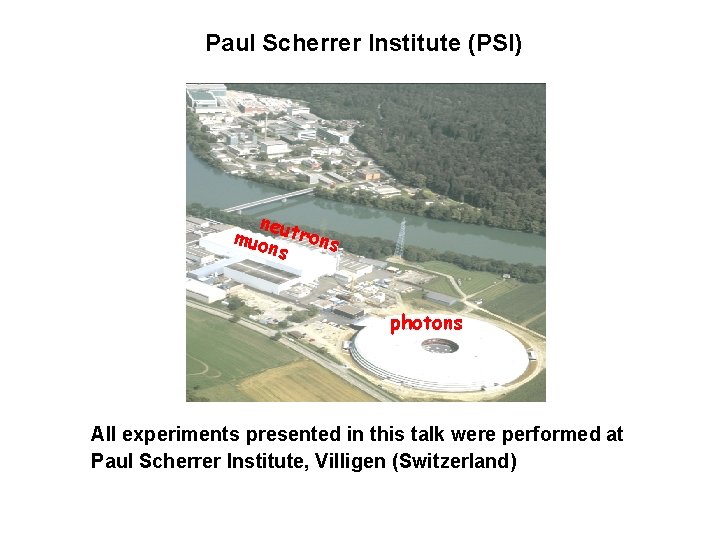
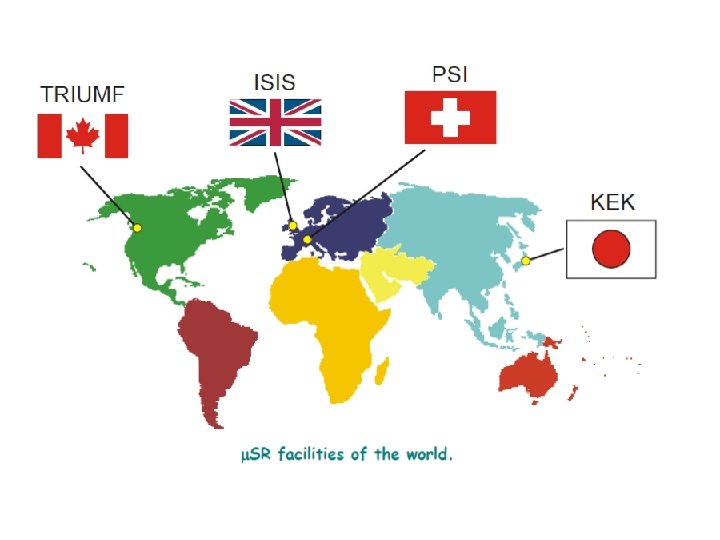
Paul Scherrer Institute (PSI) neut rons muo ns photons All experiments presented in this talk were performed at Paul Scherrer Institute, Villigen (Switzerland)
Basic principles of the μSR technique
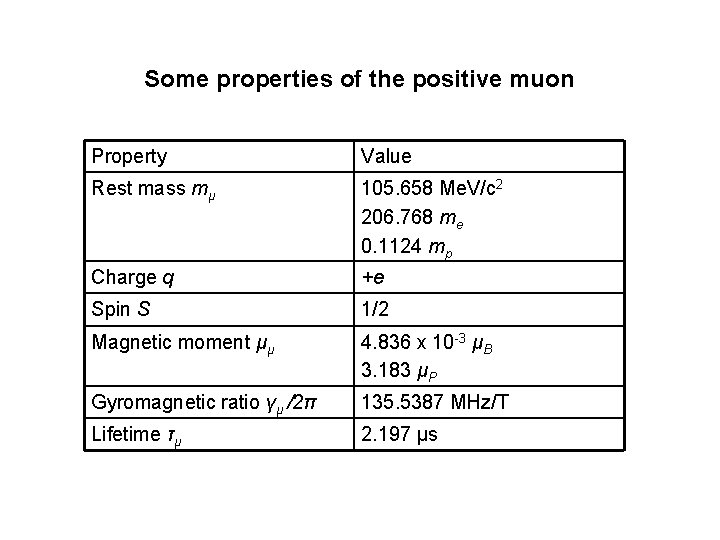
Some properties of the positive muon Property Value Rest mass mμ 105. 658 Me. V/c 2 206. 768 me 0. 1124 mp Charge q +e Spin S 1/2 Magnetic moment μμ 4. 836 x 10 -3 μB 3. 183 μP Gyromagnetic ratio γμ /2π 135. 5387 MHz/T Lifetime τμ 2. 197 μs
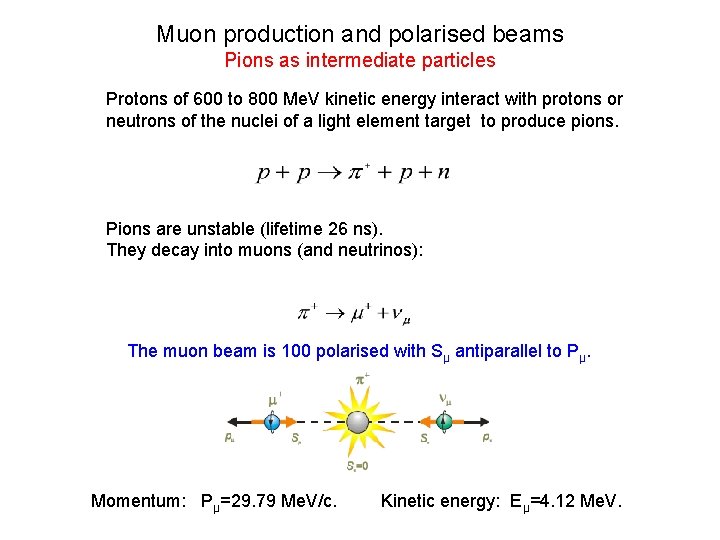
Muon production and polarised beams Pions as intermediate particles Protons of 600 to 800 Me. V kinetic energy interact with protons or neutrons of the nuclei of a light element target to produce pions. Pions are unstable (lifetime 26 ns). They decay into muons (and neutrinos): The muon beam is 100 polarised with Sµ antiparallel to Pµ. Momentum: Pµ=29. 79 Me. V/c. Kinetic energy: Eµ=4. 12 Me. V.
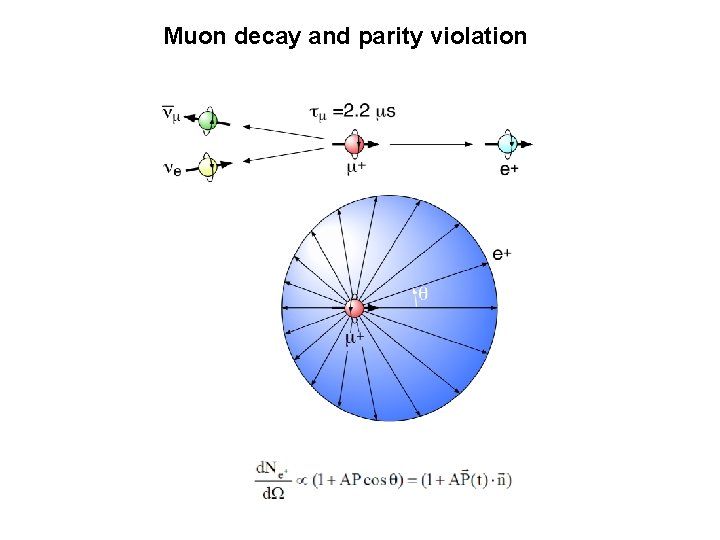
Muon decay and parity violation
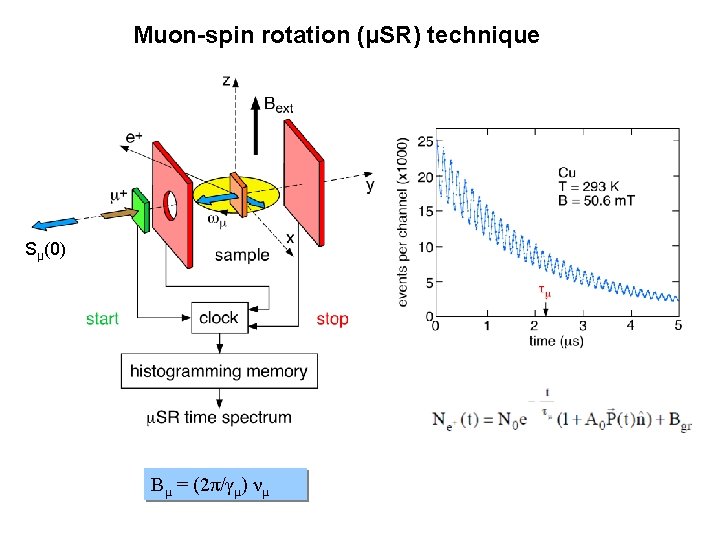
Muon-spin rotation (μSR) technique Sµ(0) Bμ = (2π/γμ) νμ
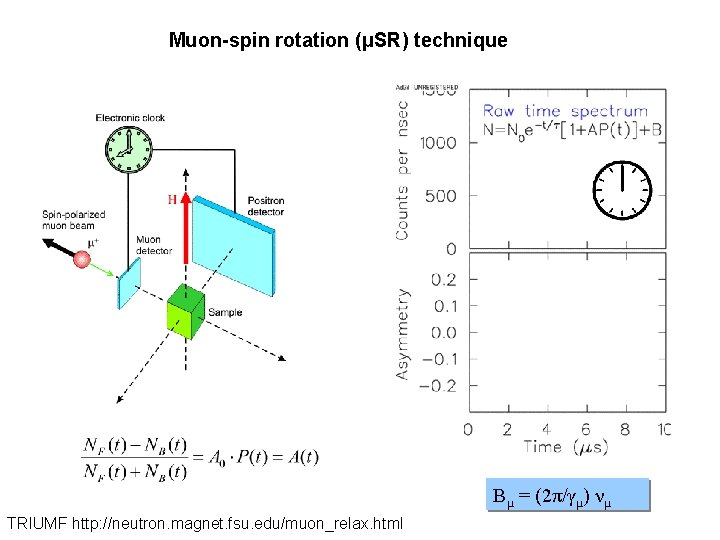
Muon-spin rotation (μSR) technique Bμ = (2π/γμ) νμ TRIUMF http: //neutron. magnet. fsu. edu/muon_relax. html
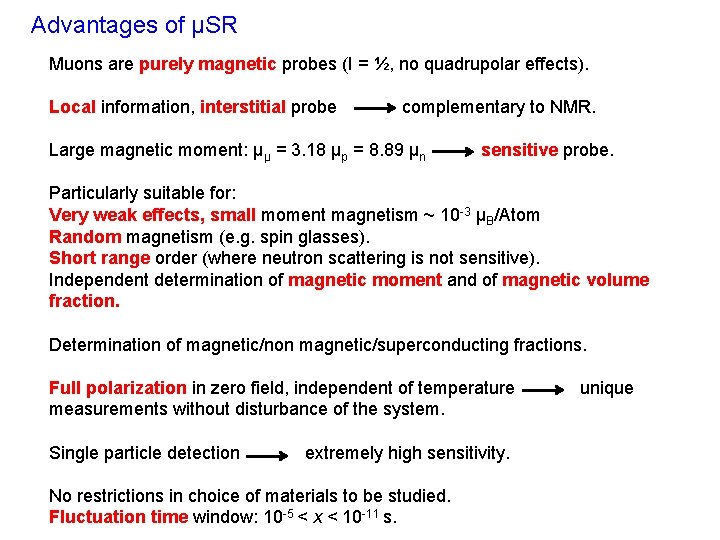
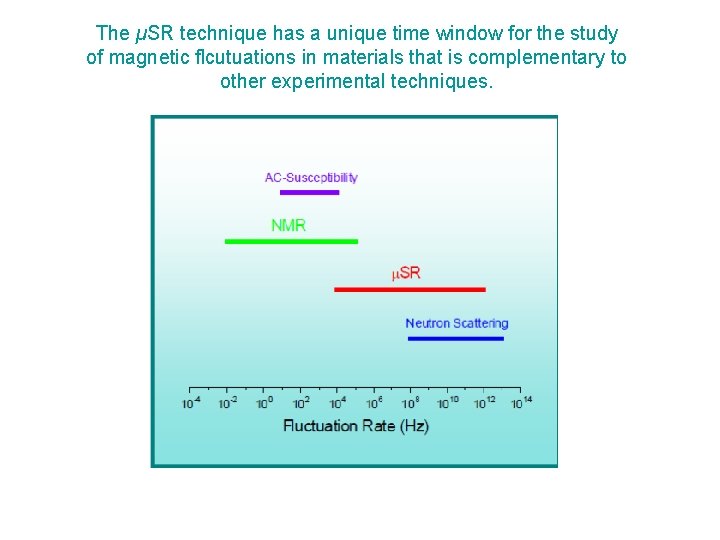
Advantages of µSR Muons are purely magnetic probes (I = ½, no quadrupolar effects). Local information, interstitial probe complementary to NMR. Large magnetic moment: μµ = 3. 18 µp = 8. 89 µn sensitive probe. Particularly suitable for: Very weak effects, small moment magnetism ~ 10 -3 µB/Atom Random magnetism (e. g. spin glasses). Short range order (where neutron scattering is not sensitive). Independent determination of magnetic moment and of magnetic volume fraction. Determination of magnetic/non magnetic/superconducting fractions. Full polarization in zero field, independent of temperature measurements without disturbance of the system. Single particle detection extremely high sensitivity. No restrictions in choice of materials to be studied. Fluctuation time window: 10 -5 < x < 10 -11 s. unique
The µSR technique has a unique time window for the study of magnetic flcutuations in materials that is complementary to other experimental techniques.
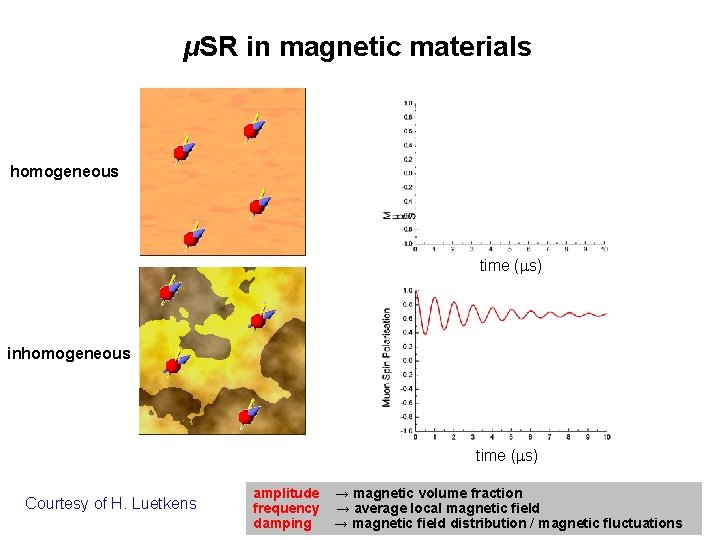
μSR in magnetic materials homogeneous time (ms) inhomogeneous time (ms) Courtesy of H. Luetkens amplitude → magnetic volume fraction frequency → average local magnetic field damping → magnetic field distribution / magnetic fluctuations
Vortex matter in cuprate superconductors
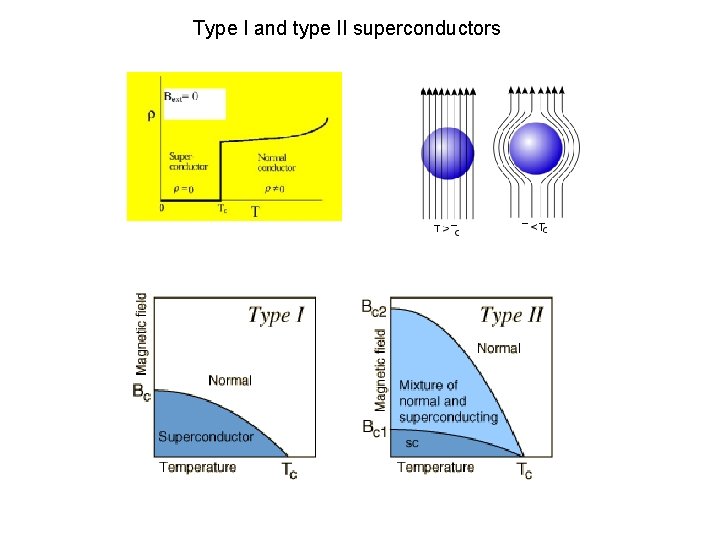
Type I and type II superconductors
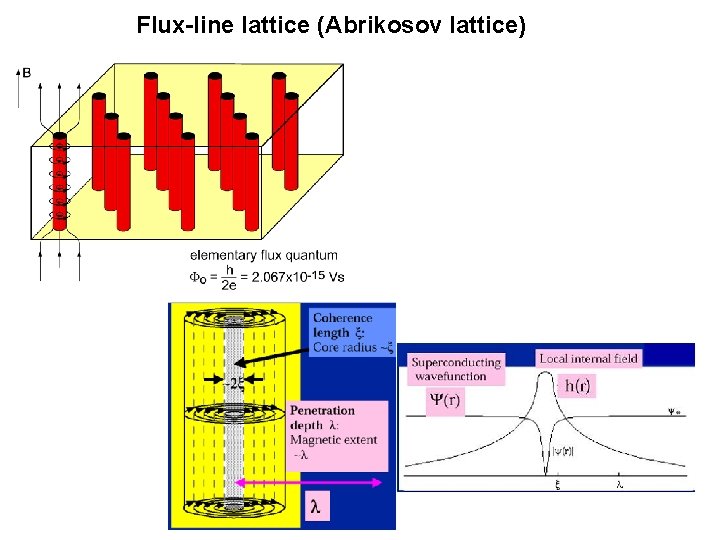
Flux-line lattice (Abrikosov lattice)
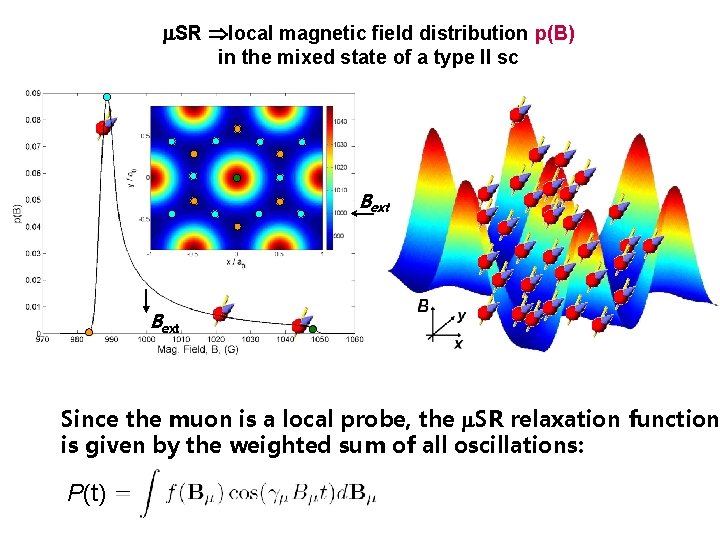
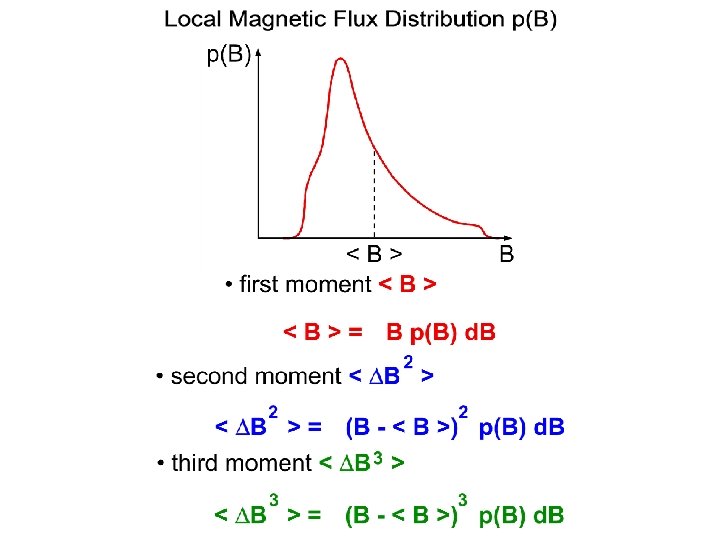
SR local magnetic field distribution p(B) in the mixed state of a type II sc Bext Since the muon is a local probe, the SR relaxation function is given by the weighted sum of all oscillations: P(t)
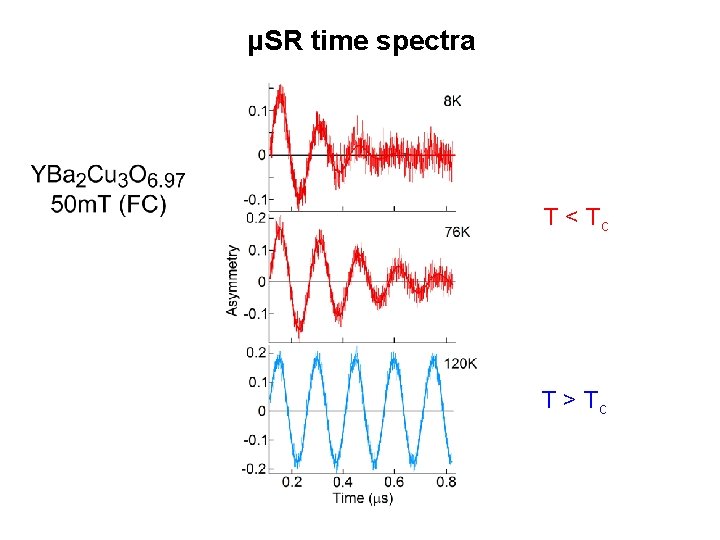
μSR time spectra T < Tc T > Tc
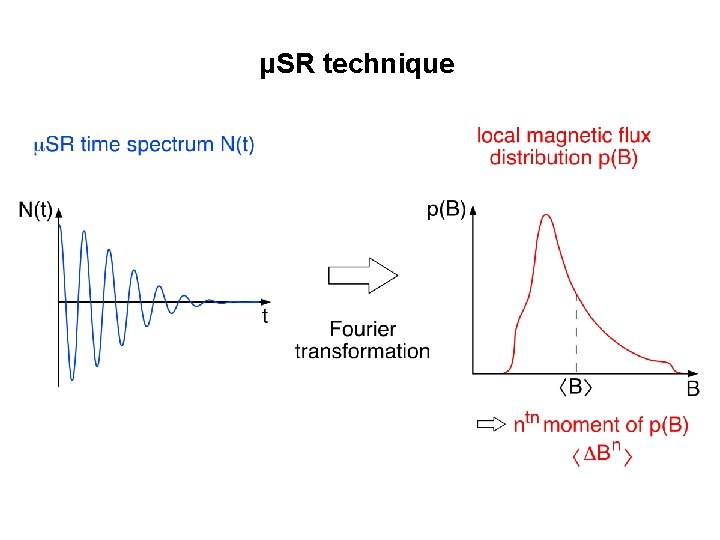
μSR technique
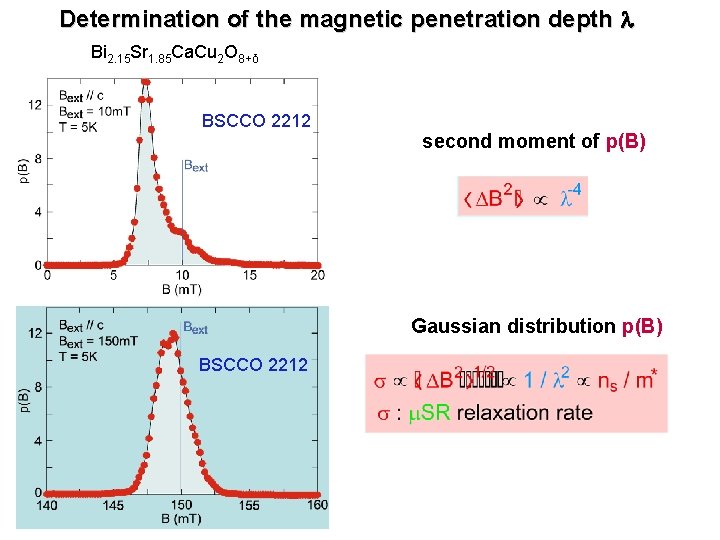
Determination of the magnetic penetration depth Bi 2. 15 Sr 1. 85 Ca. Cu 2 O 8+δ BSCCO 2212 second moment of p(B) Gaussian distribution p(B) BSCCO 2212
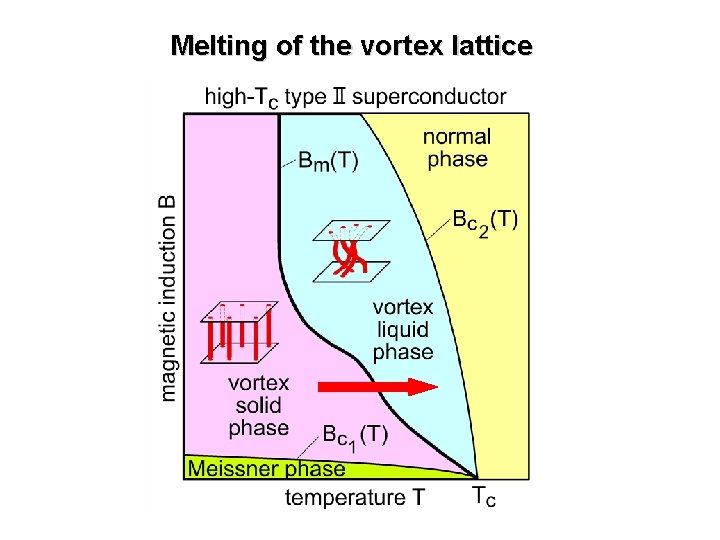
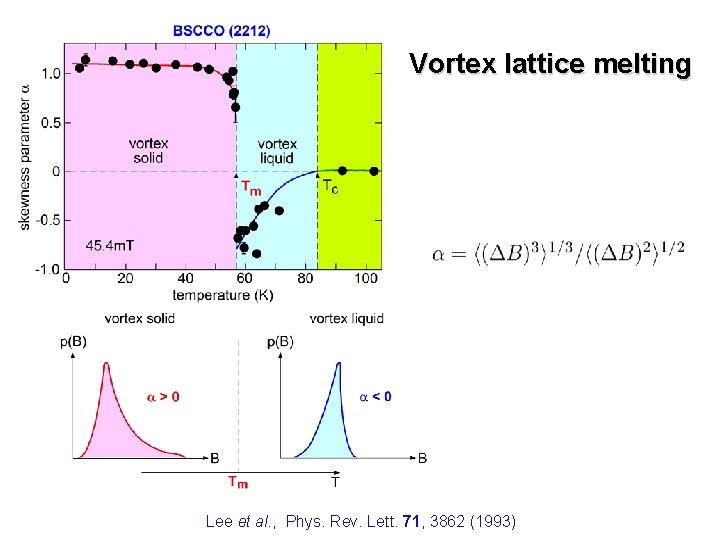
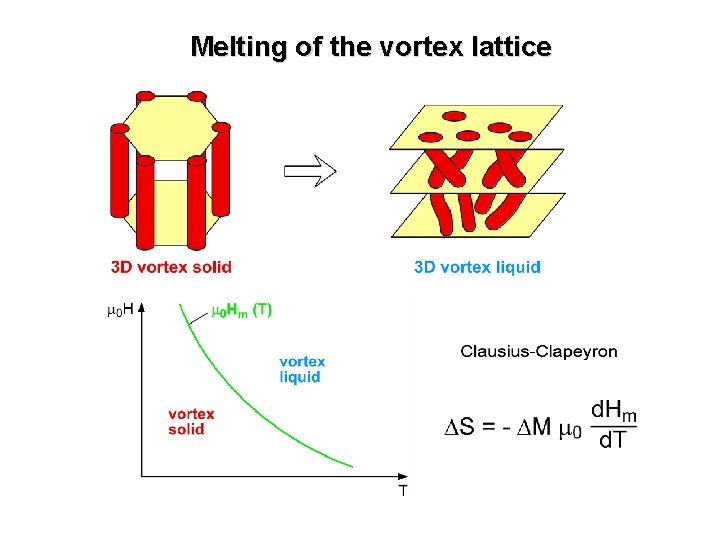
Melting of the vortex lattice
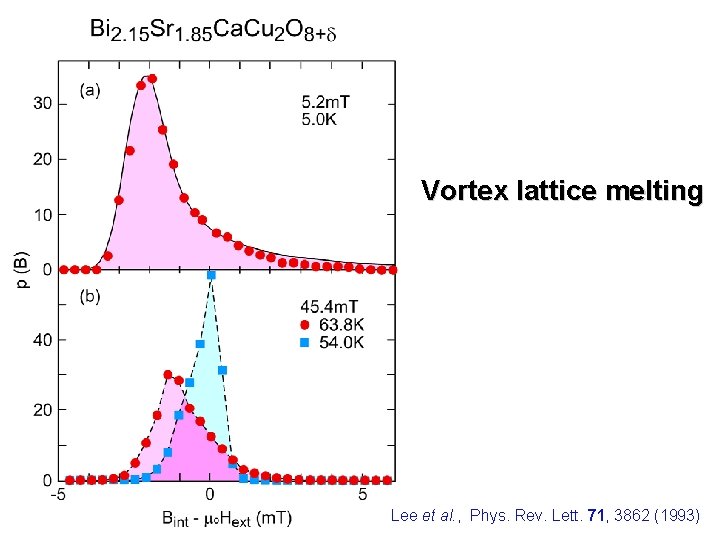
Vortex lattice melting Lee et al. , Phys. Rev. Lett. 71, 3862 (1993)
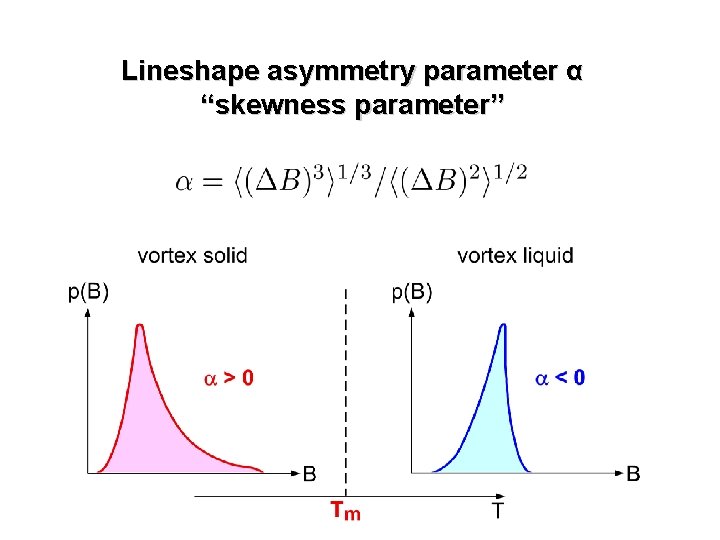
Lineshape asymmetry parameter α “skewness parameter”
Vortex lattice melting Lee et al. , Phys. Rev. Lett. 71, 3862 (1993)
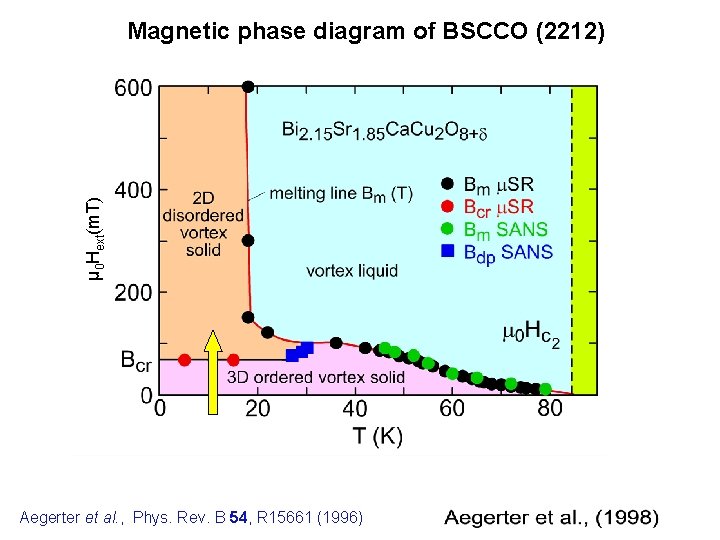
µ 0 Hext(m. T) Magnetic phase diagram of BSCCO (2212) Aegerter et al. , Phys. Rev. B 54, R 15661 (1996)
Multi-band superconductivity in high-temperature superconductors
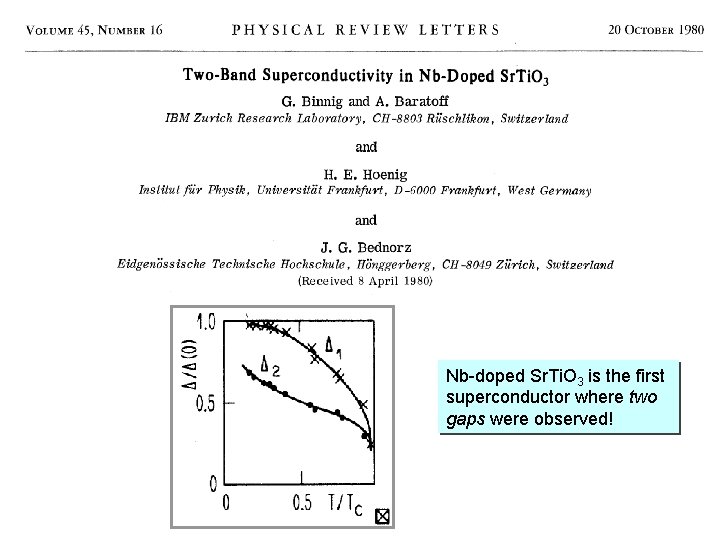
Nb-doped Sr. Ti. O 3 is the first superconductor where two gaps were observed!
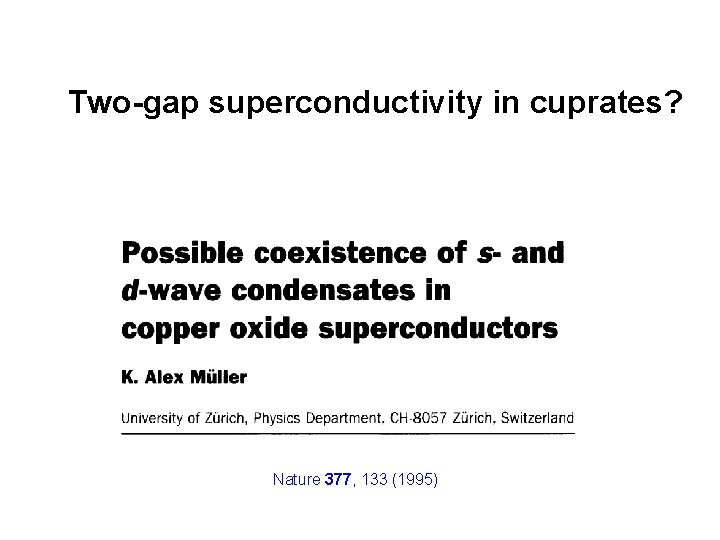
Two-gap superconductivity in cuprates? Nature 377, 133 (1995)
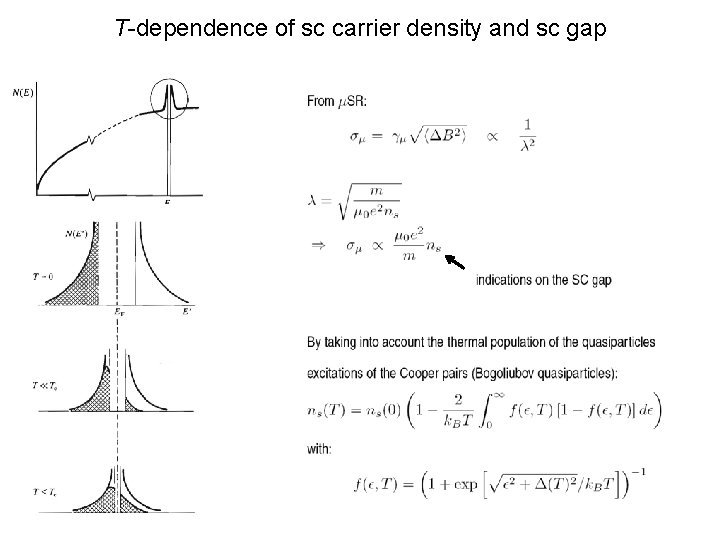
T-dependence of sc carrier density and sc gap
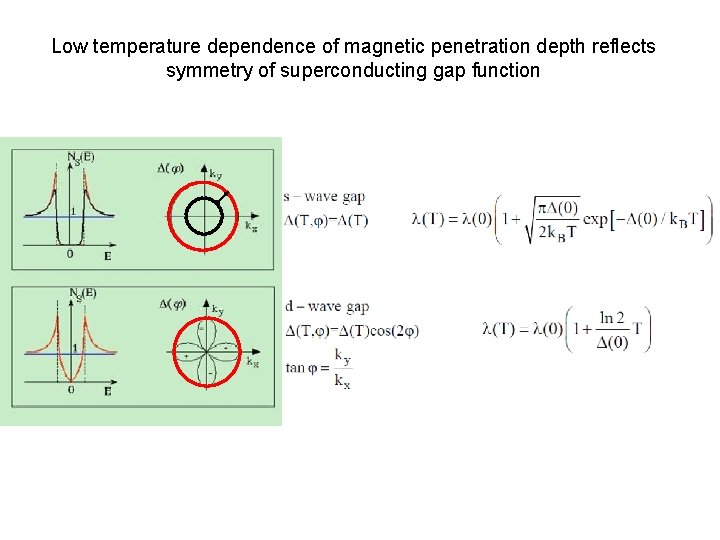
Low temperature dependence of magnetic penetration depth reflects symmetry of superconducting gap function
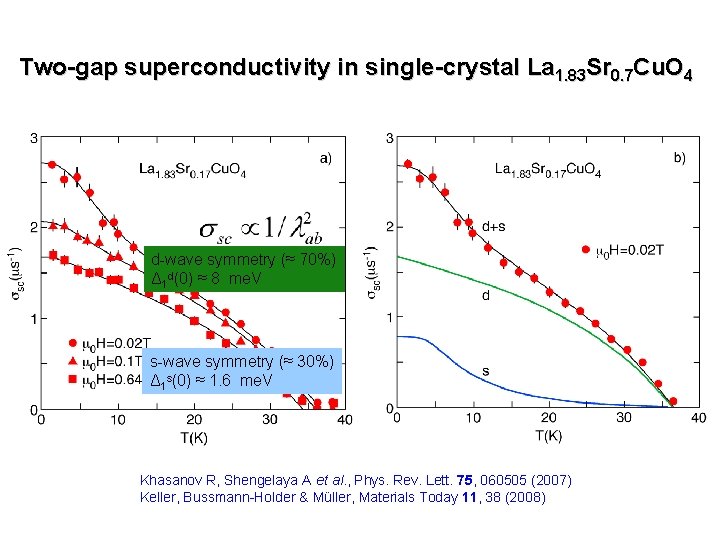
Two-gap superconductivity in single-crystal La 1. 83 Sr 0. 7 Cu. O 4 d-wave symmetry (≈ 70%) Δ 1 d(0) ≈ 8 me. V s-wave symmetry (≈ 30%) Δ 1 s(0) ≈ 1. 6 me. V Khasanov R, Shengelaya A et al. , Phys. Rev. Lett. 75, 060505 (2007) Keller, Bussmann-Holder & Müller, Materials Today 11, 38 (2008)
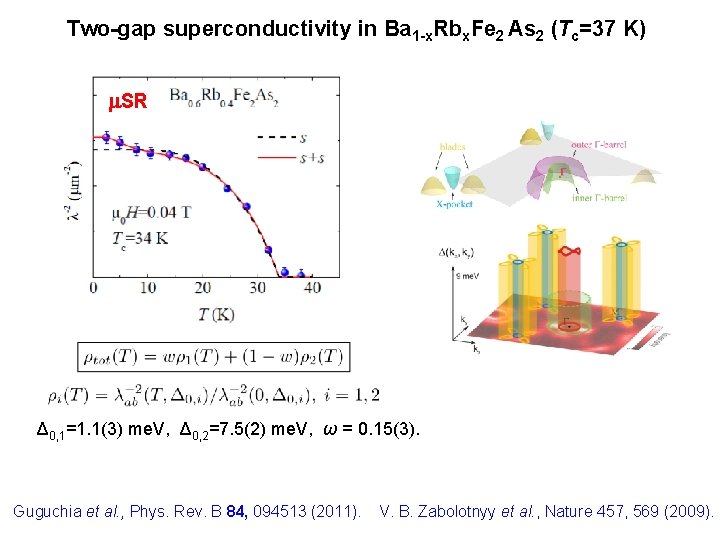
Two-gap superconductivity in Ba 1 -x. Rbx. Fe 2 As 2 (Tc=37 K) SR Δ 0, 1=1. 1(3) me. V, Δ 0, 2=7. 5(2) me. V, ω = 0. 15(3). Guguchia et al. , Phys. Rev. B 84, 094513 (2011). V. B. Zabolotnyy et al. , Nature 457, 569 (2009).
Magnetism and superconductivity
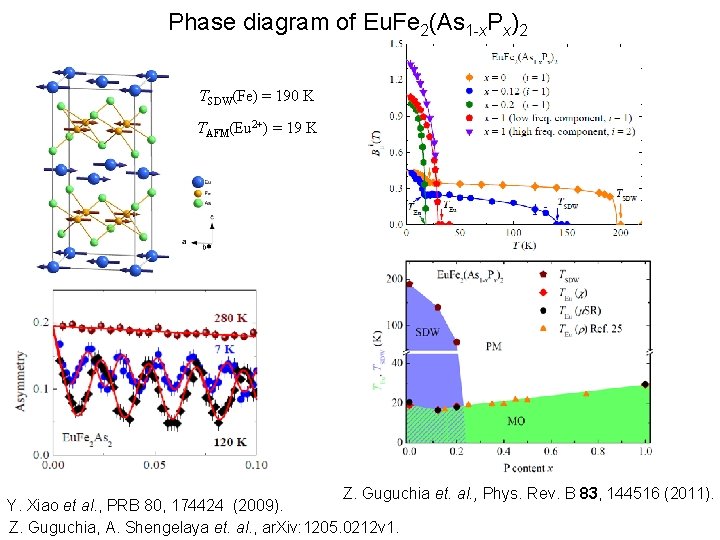
Phase diagram of Eu. Fe 2(As 1 -x. Px)2 TSDW(Fe) = 190 K TAFM(Eu 2+) = 19 K Z. Guguchia et. al. , Phys. Rev. B 83, 144516 (2011). Y. Xiao et al. , PRB 80, 174424 (2009). Z. Guguchia, A. Shengelaya et. al. , ar. Xiv: 1205. 0212 v 1.
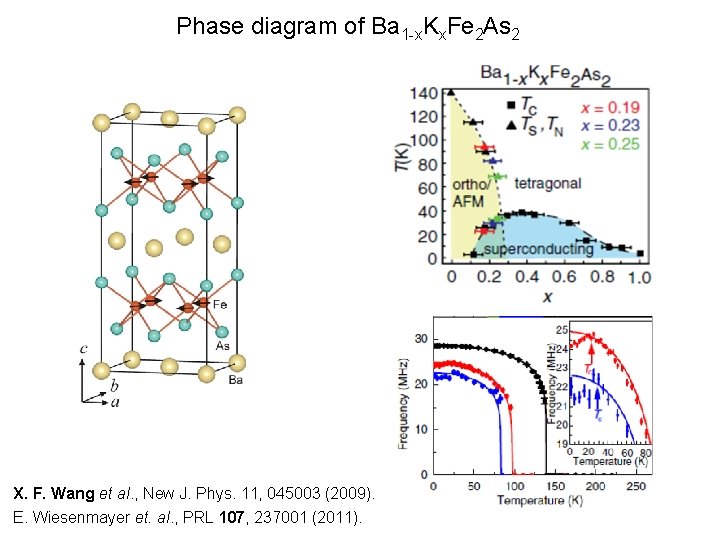
Phase diagram of Ba 1 -x. Kx. Fe 2 As 2 X. F. Wang et al. , New J. Phys. 11, 045003 (2009). E. Wiesenmayer et. al. , PRL 107, 237001 (2011).
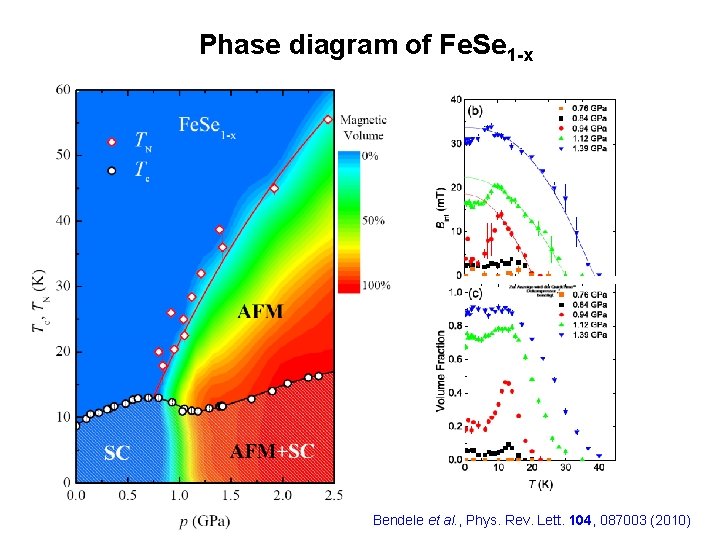
Phase diagram of Fe. Se 1 -x Bendele et al. , Phys. Rev. Lett. 104, 087003 (2010)
Low-energy μSR and applications
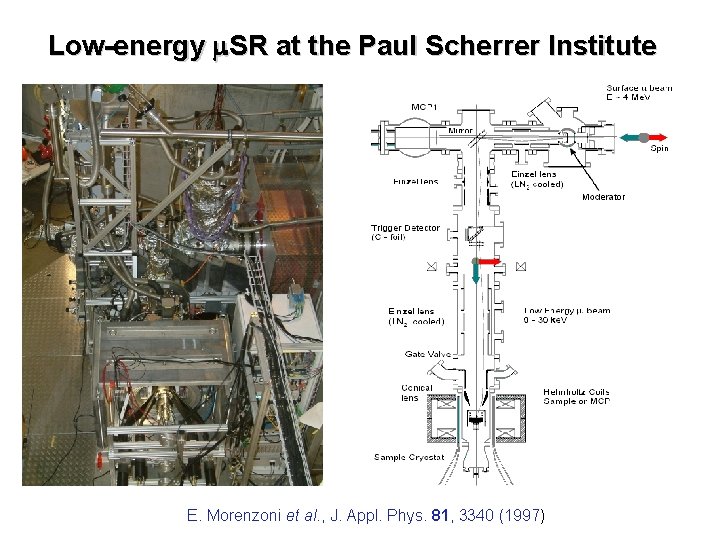
Low-energy SR at the Paul Scherrer Institute E. Morenzoni et al. , J. Appl. Phys. 81, 3340 (1997)
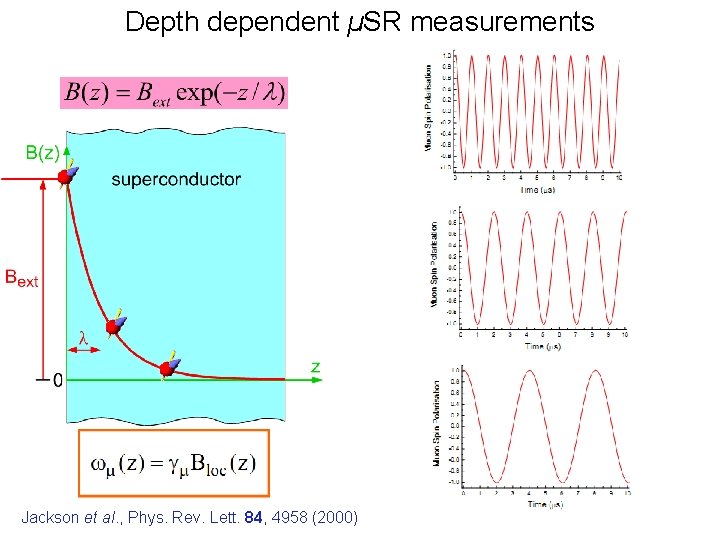
Depth dependent µSR measurements Jackson et al. , Phys. Rev. Lett. 84, 4958 (2000)
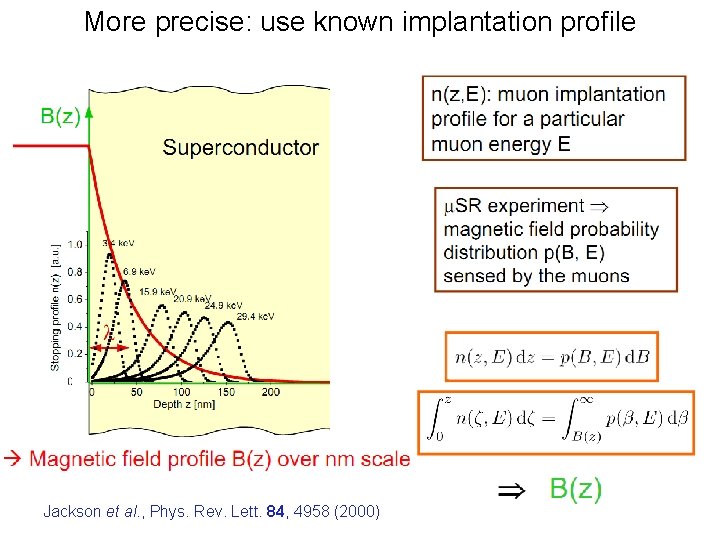
More precise: use known implantation profile Jackson et al. , Phys. Rev. Lett. 84, 4958 (2000)
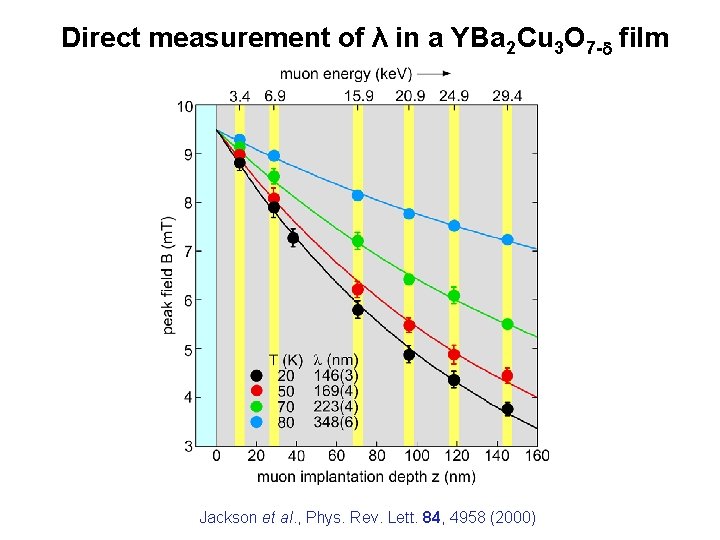
Direct measurement of λ in a YBa 2 Cu 3 O 7 - film Jackson et al. , Phys. Rev. Lett. 84, 4958 (2000)
Conclusions q The positive muon is a powerful and unique tool to explore the microscopic magnetic properties of novel superconductors and related magnetic systems q μSR has demonstrared to provide important information on high-temperature superconductors, which are hardly obtained by any other experimental technique, such as neutron scattering, magnetization studies etc. q However, in any case complementary experimental techniques have to be applied to disentangle the complexity of novel superconductors such as the cuprates and the recently discovered iron-based superconductors
Thank you very much for your attention!
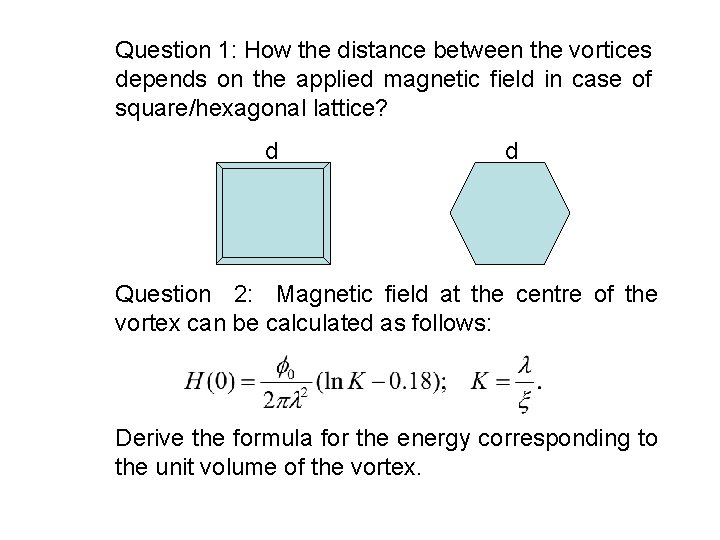
Question 1: How the distance between the vortices depends on the applied magnetic field in case of square/hexagonal lattice? d d Question 2: Magnetic field at the centre of the vortex can be calculated as follows: Derive the formula for the energy corresponding to the unit volume of the vortex.
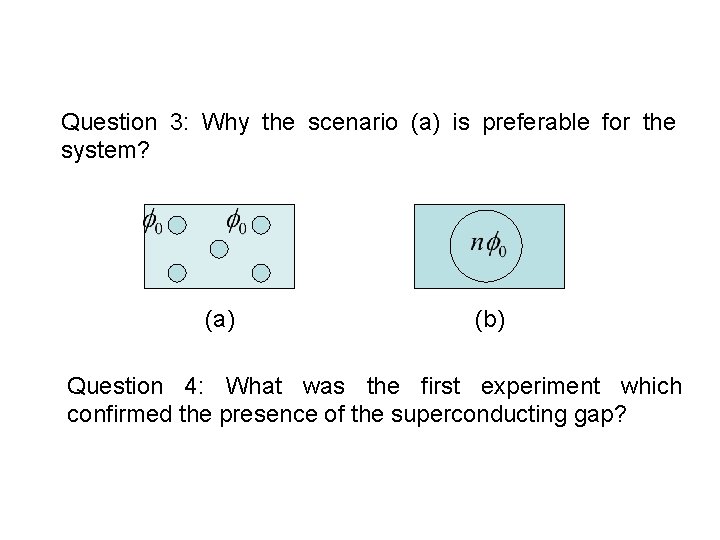
Question 3: Why the scenario (a) is preferable for the system? (a) (b) Question 4: What was the first experiment which confirmed the presence of the superconducting gap?
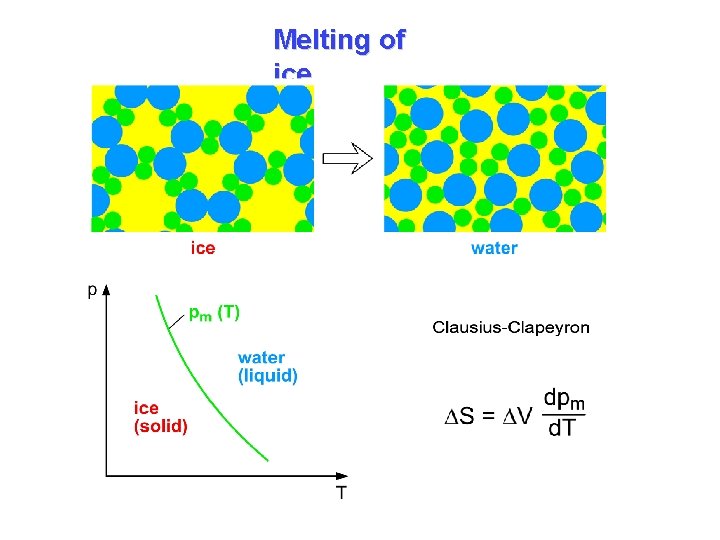
Melting of ice
Melting of the vortex lattice