
MUON RADIOGRAPHY MUON TOMOGRAPHY Despina Hatzifotiadou INFN Bologna
MUON RADIOGRAPHY – MUON TOMOGRAPHY Despina Hatzifotiadou INFN Bologna, Italy IPPOG Working Group Applications for Society 6. 5. 2020 19 th IPPOG Meeting
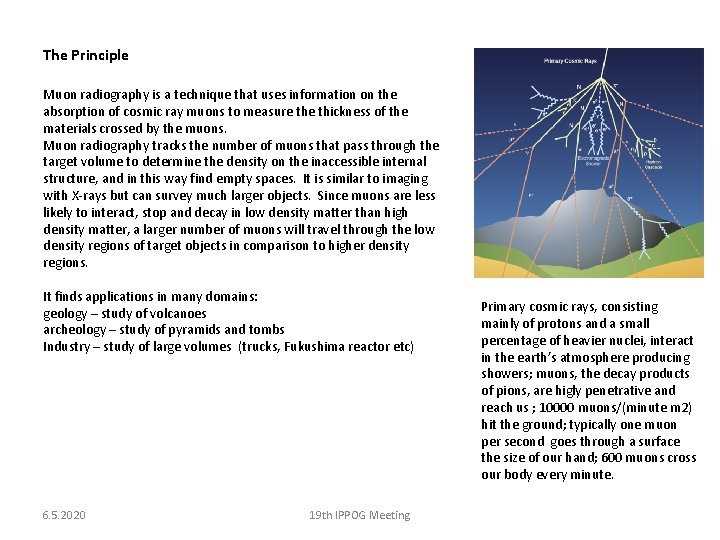
The Principle Muon radiography is a technique that uses information on the absorption of cosmic ray muons to measure thickness of the materials crossed by the muons. Muon radiography tracks the number of muons that pass through the target volume to determine the density on the inaccessible internal structure, and in this way find empty spaces. It is similar to imaging with X-rays but can survey much larger objects. Since muons are less likely to interact, stop and decay in low density matter than high density matter, a larger number of muons will travel through the low density regions of target objects in comparison to higher density regions. It finds applications in many domains: geology – study of volcanoes archeology – study of pyramids and tombs Industry – study of large volumes (trucks, Fukushima reactor etc) 6. 5. 2020 19 th IPPOG Meeting Primary cosmic rays, consisting mainly of protons and a small percentage of heavier nuclei, interact in the earth’s atmosphere producing showers; muons, the decay products of pions, are higly penetrative and reach us ; 10000 muons/(minute m 2) hit the ground; typically one muon per second goes through a surface the size of our hand; 600 muons cross our body every minute.
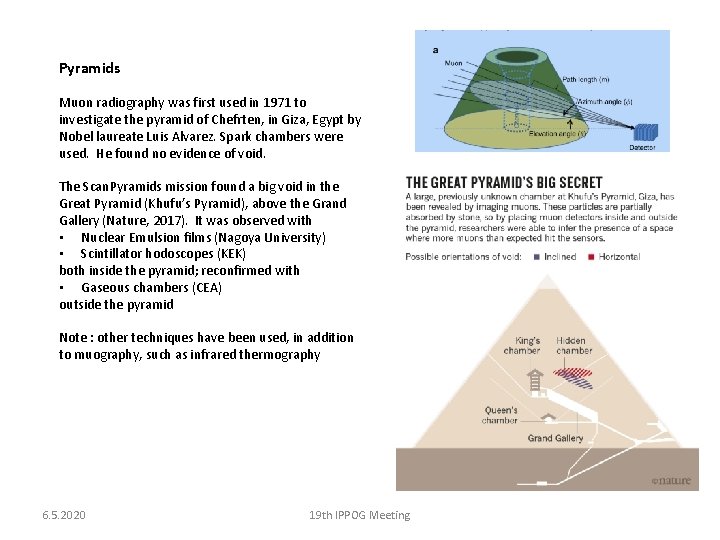
Pyramids Muon radiography was first used in 1971 to investigate the pyramid of Chefrten, in Giza, Egypt by Nobel laureate Luis Alvarez. Spark chambers were used. He found no evidence of void. The Scan. Pyramids mission found a big void in the Great Pyramid (Khufu’s Pyramid), above the Grand Gallery (Nature, 2017). It was observed with • Nuclear Emulsion films (Nagoya University) • Scintillator hodoscopes (KEK) both inside the pyramid; reconfirmed with • Gaseous chambers (CEA) outside the pyramid Note : other techniques have been used, in addition to muography, such as infrared thermography 6. 5. 2020 19 th IPPOG Meeting

Volcanoes Like X-ray scans of the human body, muon radiography allows to obtain an image of the internal structures of the upper levels of volcanoes. Although such an image cannot help to predict ‘when’ an eruption might occur, it can, if combined with other observations, help to foresee ‘how’ it could develop and serves as a powerful tool for the study of geological structures. In 2007 Nagamine and Tanaka were the first to apply this technique for the study of volcanoes. Volcanoes under study with muons: • Vesuvius Mu-Ray project • Etna Me. V project • Stromboli using nuclear emulsion films from OPERA • Soufrière (Montserrat, Guadeloupe) • Puy de Dôme (Massif Centrale) TOMUVOL Collaboration • 6. 5. 2020 Satsuma-Iwojima (Japan) 19 th IPPOG Meeting

Muon scattering tomography An extension of muon radiography based on muon absorption, muon scattering tomography, is based on the multiple Coulomb scattering of muons crossing the volume under investigation. Muons are deflected and slow down when they interact with a material with high atomic number. Using tracking detectors in front of and behind the volume under study the deflection is measured and thus high-z objects localized 6. 5. 2020 19 th IPPOG Meeting
Applications Muon scattering tomography is suitable for scanning large volumes, and looking for high-density objects inside them • • • 6. 5. 2020 Security/Safety Cargo scanners to inspect the contents of trucks and containers Control of spent nuclear fuel deposits (without opening, no radiation risk) Study of the core of the Fukushima reactor plant Industry : Control of trucks when entering steel foundries to detect hidden radioactive sources Inspection of the inner structure of a blast furnace Precision measurements : Measuring the alignment of structures / stability of buildings 19 th IPPOG Meeting
Useful links General https: //en. wikipedia. org/wiki/Muography https: //en. wikipedia. org/wiki/Muon_tomography Muography for the study of volcanoes Muons reveal the interiors of volcanoes https: //cds. cern. ch/journal/CERNBulletin/2010/51/News%20 Articles/1312698 The secret life of volcanoes: Using Muon Radiography https: //www. scienceinschool. org/2013/issue 27/muons Attraverso la roccia – la tecnologia della radiografia muonica https: //www. asimmetrie. it/attraverso-la-roccia https: //physicstoday. scitation. org/doi/abs/10. 1063/PT. 3. 1829? journal. Code=pto The MU-RAY project : Volcano Radiography with cosmic-ray muons https: //www. sciencedirect. com/science/article/pii/S 0168900210014890? via%3 Dihub STROMBOLI: REALIZZATA LA PRIMA RADIOGRAFIA MUONICA DEL VULCANO http: //home. infn. it/it/comunicazione/comunicati-stampa/3536 -stromboli-realizzata-la-prima-radiografiamuonica-del-vulcano First muography of the Stromboli Volcano https: //www. nature. com/articles/s 41598 -019 -43131 -8 6. 5. 2020 19 th IPPOG Meeting
The MEV project: design and testing of a new high-resolution telescope for Muography of Etna Volcano https: //inspirehep. net/literature/1675335 http: //wwwobs. univ-bpclermont. fr/tomuvol/presentation. php Muography for the study of Pyramids http: //www. scanpyramids. org https: //www. sciencesetavenir. fr/archeo-paleo/archeologie/egypte-de-l-infrarouge-et-des-muons-pour-sonder -le-coeur-des-pyramides_103836 Cosmic-ray particles reveal secret chamber in Egypt's Great Pyramid https: //www. nature. com/news/cosmic-ray-particles-reveal-secret-chamber-in-egypt-s-great-pyramid 1. 22939#/graphic Discovery of a big void in Khufu’s Pyramid by observation of cosmic-ray muons https: //www. nature. com/articles/nature 24647. epdf? Muon Scattering Tomography Progress in Muon Tomography (G. Bonomi, EPS conf. 2017) https: //indico. cern. ch/event/466934/contributions/2524834/attachments/1490162/2316412/progress_in_m uon_tomography_EPS-2017. pdf https: //cms. cern/content/muon-tomography Cosmic Muon Tomography Project 6. 5. 2020 http: //mutomweb. pd. infn. it: 5210 19 th IPPOG Meeting
- Slides: 8